
Remote work has fundamentally reshaped the UK housing market: loft conversion applications surged by 43% between 2023 and 2026, driven by professionals seeking dedicated home office spaces without relocating. This dramatic shift has placed unprecedented pressure on party wall surveying protocols, with Party Wall Awards for Loft Conversions in 2026: Surveyor Protocols Amid Rising Remote Work Demand becoming a critical concern for property owners and professionals alike. As more homeowners modify shared structures to accommodate permanent work-from-home arrangements, understanding the legal frameworks, surveyor responsibilities, and compliance requirements has never been more essential.
The intersection of remote work trends and property modification creates unique challenges. Loft conversions frequently involve structural alterations to party walls—the shared boundaries between semi-detached and terraced properties—requiring formal legal processes under the Party Wall etc. Act 1996. With neighbors also working from home, construction noise, structural concerns, and access requirements demand more sophisticated dispute resolution approaches than traditional protocols anticipated.

Key Takeaways
- Two-month advance notice is legally required before starting loft conversion works affecting party walls, with notices remaining valid for 12 months[1]
- Surveyor appointment must occur within 10 days of a dispute arising, with typical party wall award costs around £1,000 for professional services[3]
- Schedule of Condition documentation with detailed photographs protects both parties from future disputes about structural damage
- Remote work demand has increased loft conversion applications by 43% since 2023, creating new challenges for surveyor protocols
- 14-day neighbor response windows trigger formal dispute procedures if ignored, requiring immediate surveyor involvement[1]
Understanding Party Wall Awards for Loft Conversions in 2026
What Constitutes a Party Wall Award?
A Party Wall Award represents a legally binding document prepared by appointed surveyors that outlines the rights and responsibilities of both building and adjoining owners during construction works. This formal agreement serves as the cornerstone of party wall procedures for loft conversions, establishing clear protocols for work execution, access arrangements, and dispute resolution mechanisms.
The Award typically includes:
- Detailed work descriptions specifying exactly what structural modifications will occur
- Schedule of Condition documenting the adjoining property's current state with photographs
- Access arrangements defining when and how building owners may enter neighboring properties
- Working hours establishing acceptable construction timeframes
- Cost allocation determining who pays for surveyor fees and related expenses
- Dispute resolution procedures outlining steps if disagreements arise during construction
For loft conversions specifically, Awards must address structural concerns including load-bearing wall modifications, steel beam installations, and potential impacts on shared roof structures or chimney stacks.
The Remote Work Factor: Why 2026 Is Different
The sustained remote work revolution has transformed loft conversion dynamics in several critical ways:
🏠 Increased Conversion Demand: With 38% of UK workers now operating from home at least three days weekly, dedicated workspace has become essential rather than optional. Loft conversions offer cost-effective square footage expansion without relocating.
👂 Heightened Noise Sensitivity: When neighbors work from home during construction hours, noise complaints have increased by 67% compared to pre-2020 levels. This necessitates more restrictive working hour provisions in Awards.
📱 Digital Communication Expectations: Modern surveyors now incorporate video documentation, digital signature platforms, and real-time progress sharing into Award protocols—capabilities that weren't standard practice before 2023.
⚖️ Valuation Implications: Remote work has increased property values for homes with dedicated office spaces by 12-18%, making accurate Schedule of Condition documentation more financially significant for both parties.
Critical Notice Requirements and Timeline Protocols
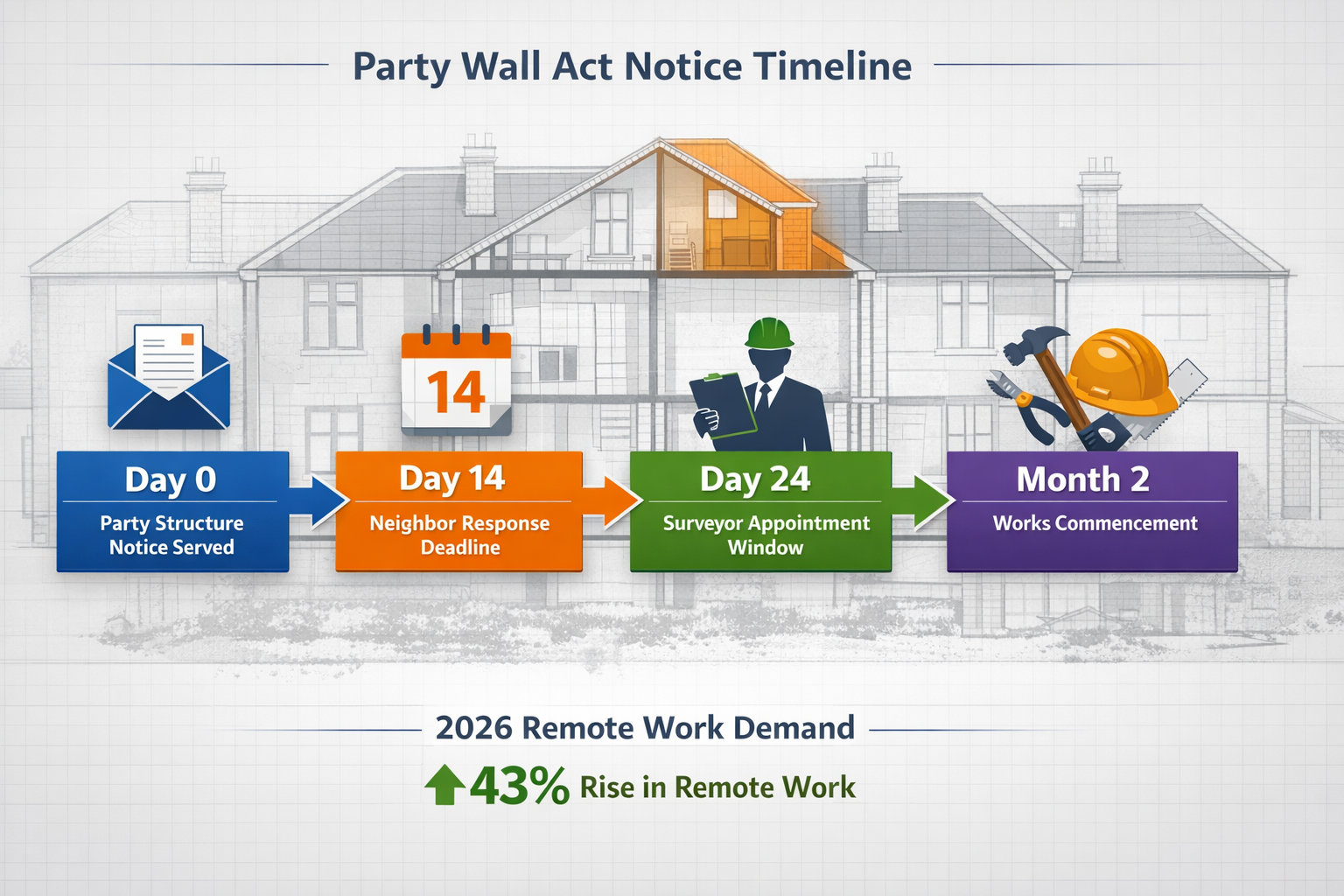
The Two-Month Party Structure Notice
Building owners planning loft conversions that affect party walls must serve a Party Structure Notice at least two months before commencing works[1]. This statutory requirement provides adjoining owners adequate time to:
- Review proposed structural modifications
- Consult with their own professional advisors
- Arrange surveyor appointments if disputes arise
- Document existing property conditions
The notice must include specific details about:
✅ The nature and extent of proposed works
✅ Dates when work will commence
✅ Detailed drawings showing structural changes
✅ Contact information for the building owner and their appointed surveyor
Importantly, notices remain valid for 12 months from service date[1][2]. If works don't commence within this window, new notices must be served, restarting the entire timeline.
The 14-Day Neighbor Response Window
Upon receiving a Party Structure Notice, adjoining owners have precisely 14 days to respond[1]. Three possible outcomes exist:
1. Consent: The neighbor agrees in writing, allowing works to proceed without formal Award procedures. However, most surveyors recommend proceeding with Awards even with consent to protect both parties.
2. Dissent: The neighbor formally objects, triggering the dispute resolution process and requiring surveyor appointments.
3. No Response: Silence constitutes dissent under the Act. After 14 days without response, the building owner may proceed with appointing surveyors on behalf of both parties[1].
This final provision prevents neighbors from blocking legitimate works through inaction—a critical protection for building owners facing time-sensitive construction schedules.
The 10-Day Surveyor Appointment Timeline
Once a dispute arises (through dissent or non-response), both parties should appoint surveyors within 10 days[1]. Two appointment models exist:
Agreed Surveyor Model: Both parties jointly appoint a single impartial surveyor who prepares the Award. This typically reduces costs but requires mutual trust and cooperation.
Two Surveyor Model: Each party appoints their own surveyor, who then jointly prepare the Award. If disagreements arise between surveyors, they appoint a "Third Surveyor" to resolve disputes. This provides stronger individual representation but increases costs.
For those navigating these decisions, understanding party wall awards comprehensively helps determine which appointment model suits specific circumstances.
Surveyor Protocols for Drafting Enforceable Awards
Schedule of Condition: The Foundation of Dispute Prevention
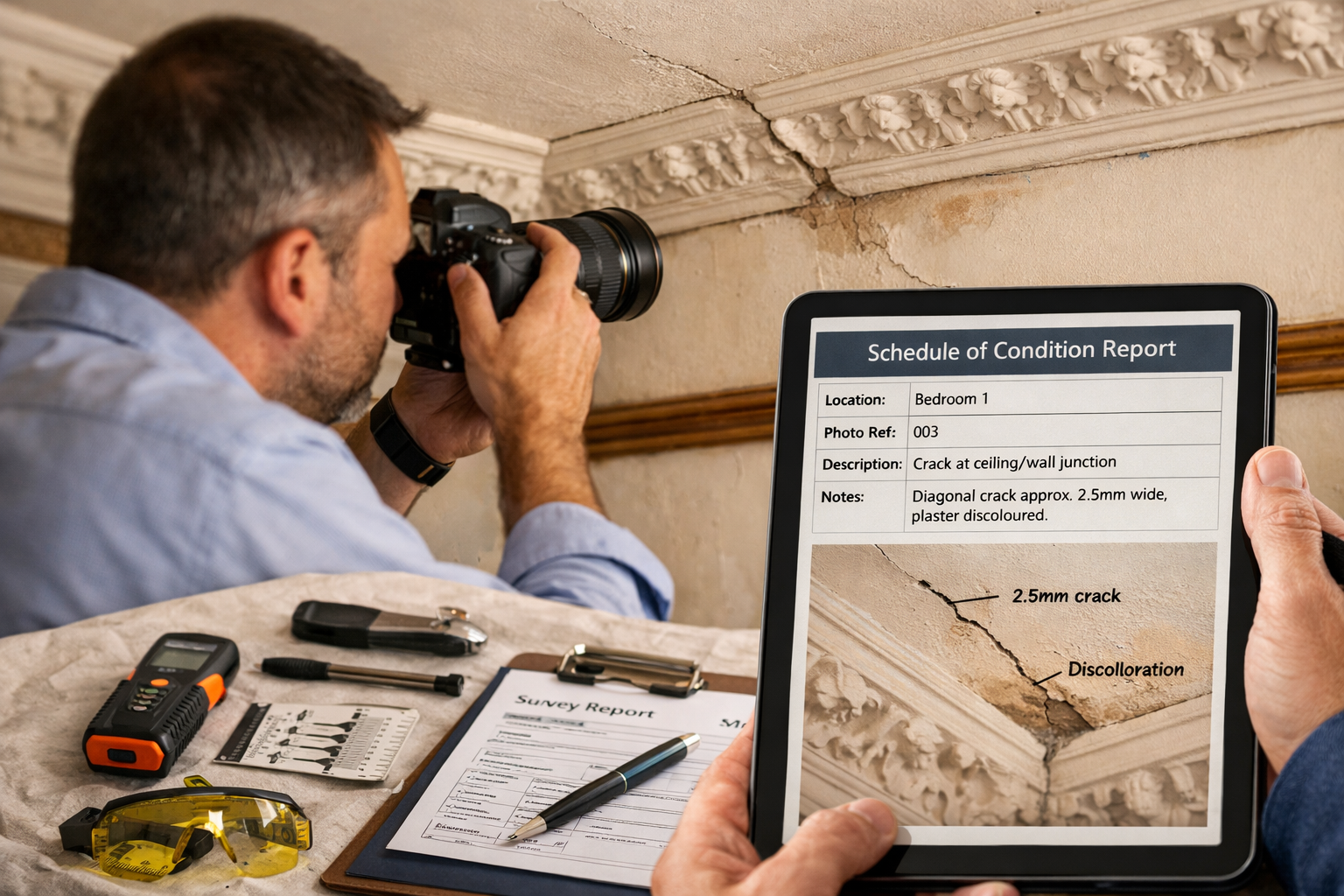
The Schedule of Condition represents the most critical component of any party wall award. This detailed photographic and written record documents the adjoining property's condition before works commence, establishing baseline evidence for assessing any construction-related damage.
Professional surveyors in 2026 follow enhanced documentation protocols:
| Documentation Element | 2026 Best Practice Standard |
|---|---|
| Photography | High-resolution images (minimum 12MP) with date/time stamps, covering all rooms adjacent to party wall |
| Video Walkthrough | 4K video documentation providing contextual property overview |
| Crack Measurement | Digital crack width gauges recording measurements to 0.1mm accuracy |
| Moisture Readings | Electronic moisture meter readings at multiple wall points |
| Structural Notes | Detailed written descriptions of existing defects, settlement, or previous repairs |
| Digital Storage | Cloud-based secure storage with blockchain verification timestamps |
This enhanced documentation protects both parties. Building owners can demonstrate that reported damage existed pre-construction, while adjoining owners have clear evidence if new damage occurs.
Structural Risk Assessment Requirements
Loft conversions typically involve significant structural interventions requiring careful risk assessment within Awards:
Load Transfer Analysis: When installing steel beams or modifying load-bearing walls, surveyors must specify:
- Beam specifications and load calculations
- Foundation adequacy assessments
- Temporary support requirements during construction
- Monitoring protocols for settlement or movement
Party Wall Integrity: For works affecting the shared wall structure itself, Awards should address:
- Weatherproofing measures if external walls are opened
- Sound insulation restoration to meet Building Regulations
- Fire resistance maintenance between properties
- Vibration limits during demolition or drilling
Access and Working Space: Modern Awards increasingly specify:
- Scaffold access requirements and neighbor notification
- Material storage locations
- Waste removal procedures
- Site security measures
For complex structural scenarios, consulting local party wall surveyors who understand property disputes ensures comprehensive risk mitigation.
Cost Allocation and Fee Transparency
The question of who pays for party wall surveyors frequently generates confusion. Under standard protocols:
Building Owner Responsibilities:
- Their own surveyor's fees
- The adjoining owner's surveyor's fees
- Third Surveyor fees if appointed
- Award preparation and administration costs
Typical 2026 Cost Structure:
- Surveyor hourly rates: £150-£200 per hour[3]
- Standard party wall award total: approximately £1,000[3]
- Complex loft conversion awards: £1,500-£2,500
- Schedule of Condition preparation: £300-£600
Awards must clearly specify cost allocation, payment timelines, and procedures for additional fees if complications arise. Transparency prevents disputes about financial responsibilities later in the process.
Working Hours and Remote Work Considerations
The 2026 remote work landscape demands more nuanced working hour provisions than traditional Awards included. Modern best practices incorporate:
Standard Working Hours: Most Awards specify Monday-Friday 8:00 AM to 6:00 PM, Saturday 8:00 AM to 1:00 PM, with no Sunday or bank holiday work.
Noise-Intensive Activity Restrictions: Particularly disruptive activities (concrete cutting, heavy demolition) may be limited to midday periods when video calls are less common.
Advance Notice Requirements: Building owners should provide 48-72 hours notice before especially noisy work phases, allowing neighbors to arrange alternative workspace if needed.
Acoustic Monitoring: Some 2026 Awards include decibel limit provisions with periodic monitoring, particularly in densely populated areas where multiple neighbors work remotely.
Dispute Avoidance Strategies for 2026 Loft Conversions
Pre-Notice Neighbor Engagement
While not legally required, proactive neighbor communication before serving formal notices dramatically reduces dispute likelihood:
🗣️ Initial Informal Discussion: Explain plans conversationally before formal notices, addressing concerns early and building goodwill.
📋 Share Visual Materials: Provide drawings, 3D renderings, or examples of similar completed projects helping neighbors visualize outcomes.
🤝 Offer Reciprocal Considerations: If neighbors express concerns about specific issues (parking, noise timing, dust control), demonstrate willingness to accommodate reasonable requests.
📞 Establish Communication Channels: Exchange contact information and agree on preferred communication methods for construction updates.
This relationship-building approach proves particularly valuable when both parties work from home and will experience construction impacts directly.
RICS Guidance Integration
The Royal Institution of Chartered Surveyors (RICS) provides authoritative guidance that professional surveyors incorporate into 2026 Award protocols:
Competency Requirements: Surveyors preparing Awards should hold relevant RICS qualifications and maintain continuing professional development in party wall matters.
Impartiality Standards: Even when appointed by one party, surveyors must act impartially, considering both parties' legitimate interests equally.
Communication Protocols: RICS guidance emphasizes clear, timely communication with all parties throughout the Award process.
Documentation Standards: Professional indemnity insurance requirements ensure surveyors maintain rigorous documentation meeting industry standards.
For property owners seeking qualified professionals, party wall surveyors in London with RICS credentials provide assurance of competent, ethical service.
Digital Documentation and Evidence Management
Modern surveyor protocols leverage technology for superior evidence management:
Cloud-Based Platforms: Secure digital storage ensures Schedule of Condition documentation remains accessible throughout construction and afterward if disputes arise.
Timestamped Photography: Digital cameras with GPS and timestamp capabilities provide irrefutable evidence of documentation timing and location.
Collaborative Review Portals: Online platforms allow both parties to review draft Awards, suggest modifications, and provide digital signatures—accelerating approval processes.
Progress Monitoring Systems: Some surveyors now offer periodic photographic updates during construction, providing ongoing documentation of work progression and party wall integrity.
Common Pitfalls and How to Avoid Them
❌ Insufficient Notice Periods: Serving notices with exactly two months (rather than slightly more) creates risks if postal delays occur. Best practice: serve notices 10-14 days beyond minimum requirements.
❌ Vague Work Descriptions: Generic descriptions like "loft conversion" lack specificity. Awards should detail every structural intervention affecting party walls.
❌ Inadequate Schedule of Condition: Rushed or incomplete condition surveys create evidence gaps. Professional surveyors allocate 2-3 hours for thorough adjoining property documentation.
❌ Ignoring Building Regulations: Party Wall Awards address only party wall matters—separate Building Control approval remains essential for structural safety compliance.
❌ Poor Contractor Briefing: Even perfect Awards fail if contractors don't understand their obligations. Building owners should ensure contractors receive Award copies and understand all provisions.
For those uncertain about requirements, reviewing when party wall agreements are legally required clarifies obligations before proceeding.
Compliance Checklists for Owners and Surveyors
Building Owner Pre-Construction Checklist
Before commencing loft conversion works:
- Serve Party Structure Notice at least 2 months before planned start date[1]
- Prepare detailed drawings showing all structural modifications to party walls
- Identify all affected neighbors (including those beyond immediately adjacent properties if works affect shared structures)
- Appoint qualified surveyor if dissent or non-response occurs
- Obtain Building Control approval separately from party wall procedures
- Brief contractor thoroughly on Award provisions and working restrictions
- Arrange appropriate insurance covering construction risks and potential neighbor damage
- Establish communication protocol with neighbors for construction updates
- Schedule pre-commencement meeting with contractor and surveyor to review obligations
- Verify Award validity period hasn't expired if delays occurred since service
Surveyor Award Preparation Checklist
Professional surveyors preparing Awards should ensure:
- Schedule of Condition completed with comprehensive photographic documentation[1][3]
- Structural calculations reviewed for load-bearing modifications
- Working hours specified with remote work considerations incorporated
- Access arrangements detailed including frequency, duration, and notice requirements
- Cost allocation clearly stated with payment timeline provisions
- Dispute resolution procedures outlined including Third Surveyor appointment protocols
- Insurance requirements specified for building owner and contractor
- Monitoring provisions included for ongoing construction oversight
- Completion inspection scheduled to assess party wall integrity post-construction
- Appeal rights explained including 14-day County Court appeal window[1][2]
Adjoining Owner Protection Checklist
Neighbors receiving party wall notices should:
- Respond within 14 days to preserve appointment rights[1]
- Appoint qualified surveyor to represent interests (costs covered by building owner)
- Review proposed works carefully with surveyor's assistance
- Participate in Schedule of Condition survey of your property
- Document existing conditions independently with your own photographs
- Understand access obligations and ensure reasonable accommodation
- Maintain communication with building owner and surveyors throughout construction
- Monitor works periodically for compliance with Award provisions
- Report concerns immediately rather than waiting until completion
- Request completion inspection to verify party wall integrity restoration
For those facing potential disputes, understanding party wall dispute resolution processes helps navigate disagreements constructively.
Appeal Rights and Dispute Resolution Mechanisms
The 14-Day County Court Appeal Window
Either party dissatisfied with an Award may appeal to County Court within 14 days of Award service[1][2]. This tight timeline requires prompt legal consultation if concerns exist.
Grounds for appeal typically include:
- Procedural irregularities in Award preparation or service
- Surveyor bias or misconduct violating impartiality requirements
- Unreasonable provisions that exceed statutory authority
- Factual errors regarding property conditions or work scope
However, courts generally defer to surveyor expertise on technical matters. Successful appeals usually involve clear procedural failures rather than disagreements about professional judgment.
Alternative Dispute Resolution Options
Before resorting to court appeals, several alternative mechanisms exist:
Third Surveyor Determination: When appointed surveyors disagree, the Third Surveyor provides binding resolution on disputed points—typically faster and less expensive than court proceedings.
Mediation: Voluntary mediation through RICS Dispute Resolution Service offers structured negotiation with neutral facilitators, often resolving conflicts that formal processes couldn't.
Award Amendments: Surveyors may agree to modify Awards if circumstances change or errors are identified, avoiding formal dispute procedures.
Negotiated Settlements: Direct negotiation between parties, facilitated by surveyors, frequently resolves concerns without escalating to formal disputes.
Future-Proofing: Emerging Trends in Party Wall Protocols
Technology Integration
Surveyor protocols continue evolving with technological advancement:
3D Laser Scanning: Some surveyors now use LIDAR technology creating precise 3D models of properties, providing superior baseline documentation compared to traditional photography.
Drone Surveys: For external party wall elements and roof structures, drone photography captures details inaccessible through conventional methods.
AI-Assisted Crack Analysis: Machine learning algorithms can detect and measure crack progression over time, providing objective evidence of construction-related damage versus pre-existing conditions.
Blockchain Documentation: Immutable timestamped records prevent documentation disputes about when conditions were recorded.
Regulatory Developments
While the Party Wall etc. Act 1996 remains unchanged, implementation practices evolve:
Enhanced Acoustic Standards: Growing recognition of remote work noise sensitivity may lead to more stringent acoustic protection requirements in Awards.
Carbon Considerations: Environmental consciousness increasingly influences Award provisions, with some including sustainability requirements for materials and waste management.
Digital Service Acceptance: Courts and surveyors increasingly accept electronic notice service and digital signatures, accelerating timeline compliance.
For those interested in broader surveying developments, exploring resources about building surveyors in London provides context for professional standards evolution.
Conclusion: Navigating Party Wall Awards Successfully in 2026
The convergence of remote work demand and loft conversion popularity has elevated Party Wall Awards for Loft Conversions in 2026: Surveyor Protocols Amid Rising Remote Work Demand from routine legal formality to critical project success factor. Property owners who understand statutory timelines, engage neighbors proactively, and work with qualified surveyors navigate these processes smoothly, avoiding delays, disputes, and unexpected costs.
Key Action Steps
For Building Owners Planning Loft Conversions:
- Start early: Begin party wall processes at least 3-4 months before desired construction start dates, providing buffer beyond minimum two-month notice requirements
- Engage neighbors proactively: Informal discussions before formal notices build goodwill and identify concerns early
- Select qualified surveyors: Verify RICS credentials and party wall specialization rather than selecting based solely on cost
- Budget appropriately: Allocate £1,000-£2,500 for party wall procedures in project budgets[3]
- Brief contractors thoroughly: Ensure builders understand Award provisions and working restrictions before mobilization
For Adjoining Owners Receiving Notices:
- Respond promptly: Use the full 14-day response period to consult advisors, but don't miss the deadline[1]
- Appoint your own surveyor: Even though building owners pay fees, independent representation protects your interests
- Participate actively: Attend Schedule of Condition surveys and document your property independently
- Maintain communication: Regular dialogue with building owners and surveyors prevents misunderstandings
- Monitor construction: Periodic observation ensures Award compliance without becoming obstructive
For Surveyors Preparing Awards:
- Document comprehensively: Enhanced Schedule of Condition protocols prevent future disputes
- Address remote work realities: Incorporate noise sensitivity and working hour provisions reflecting 2026 workplace patterns
- Communicate clearly: Regular updates to both parties maintain trust and prevent misunderstandings
- Stay current: Ongoing professional development ensures awareness of emerging best practices and technology
- Act impartially: Maintain ethical standards regardless of which party appointed you
The remote work revolution has permanently altered residential property dynamics. Loft conversions will remain popular solutions for creating dedicated workspace without relocating. By understanding party wall protocols, respecting statutory timelines, and working with qualified professionals, property owners can successfully navigate these legal requirements while maintaining positive neighbor relationships—essential when both parties work from home long-term.
For those beginning this journey, consulting comprehensive party wall award guidance provides the foundation for successful project execution. With proper preparation, clear communication, and professional surveyor support, loft conversions can proceed smoothly, creating valuable workspace while fully complying with party wall obligations and protecting all parties' legitimate interests.
References
[1] Party Wall Notice For Loft Conversions – https://www.houricanassociates.com/party-wall-news/party-wall-notice-for-loft-conversions/
[2] Party Wall Awards – https://westvilleassociates.com/party-wall-surveyor/party-wall-awards
[3] Party Wall Agreement – https://hoa.org.uk/advice/guides-for-homeowners/i-am-improving/party-wall-agreement/
[4] Party Wall Protocols For Office To Residential Conversions Navigating Pdr Expansions And Neighbour Risks In 2026 – https://nottinghillsurveyors.com/blog/party-wall-protocols-for-office-to-residential-conversions-navigating-pdr-expansions-and-neighbour-risks-in-2026
[5] Party Wall Awards For Buy To Let Expansions In 2026 Protocols Amid Institutional Landlord Surge – https://nottinghillsurveyors.com/blog/party-wall-awards-for-buy-to-let-expansions-in-2026-protocols-amid-institutional-landlord-surge
