
The urban landscape of the UK is transforming rapidly in 2026, with commercial office buildings increasingly converted into residential apartments under expanded Permitted Development Rights (PDR). As developers and property owners rush to capitalize on these streamlined conversion opportunities, Party Wall Protocols for Office-to-Residential Conversions: Navigating PDR Expansions and Neighbour Risks in 2026 has become a critical concern for surveyors, building owners, and adjacent property occupiers. The intersection of expedited planning processes and complex party wall legislation creates unique challenges that demand expert navigation to avoid costly disputes and project delays.
The March 2024 amendments to Class MA PDR removed significant barriers to office conversions, eliminating the three-month vacancy requirement and conversion space caps [4]. This legislative shift has unleashed a wave of conversion projects across urban centers, but it has also intensified the need for rigorous party wall protocols. When commercial buildings share walls with residential properties—or when portions of a building remain in commercial use while others convert—the potential for structural disputes, noise complaints, and legal conflicts multiplies exponentially.
Key Takeaways
- Expanded PDR rights in 2026 enable faster office-to-residential conversions through an eight-week Prior Approval process, but party wall obligations under the Party Wall etc. Act 1996 remain fully applicable [4][5]
- Dual-use buildings create complex party wall scenarios where commercial and residential occupiers share structural elements, requiring careful notice procedures and surveyor coordination
- Structural alterations during conversions—including internal reconfiguration, service installations, and facade modifications—trigger party wall requirements that must be addressed before work commences
- Neighbour disputes can derail conversion projects if party wall protocols are not followed correctly, with potential for injunctions, damage claims, and significant project delays
- Professional surveyor engagement is essential for managing the intersection of PDR compliance and party wall obligations, protecting all parties' interests throughout the conversion process
Understanding PDR Expansions for Office Conversions in 2026
The Evolution of Class MA Permitted Development Rights
The UK government introduced Class MA Permitted Development Rights in March 2021 to address housing shortages by facilitating the conversion of underutilized commercial office space into residential dwellings [4]. However, the most significant transformation occurred on March 5, 2024, when amendments removed two major obstacles that had previously limited conversion projects.
Before 2024, developers faced a three-month vacancy requirement, meaning office buildings had to remain empty for at least 90 days before conversion could proceed. Additionally, conversion space caps restricted the amount of floor area that could be transformed into residential use. These limitations were eliminated in the 2024 amendments, creating unprecedented opportunities for large-scale urban repurposing [4].
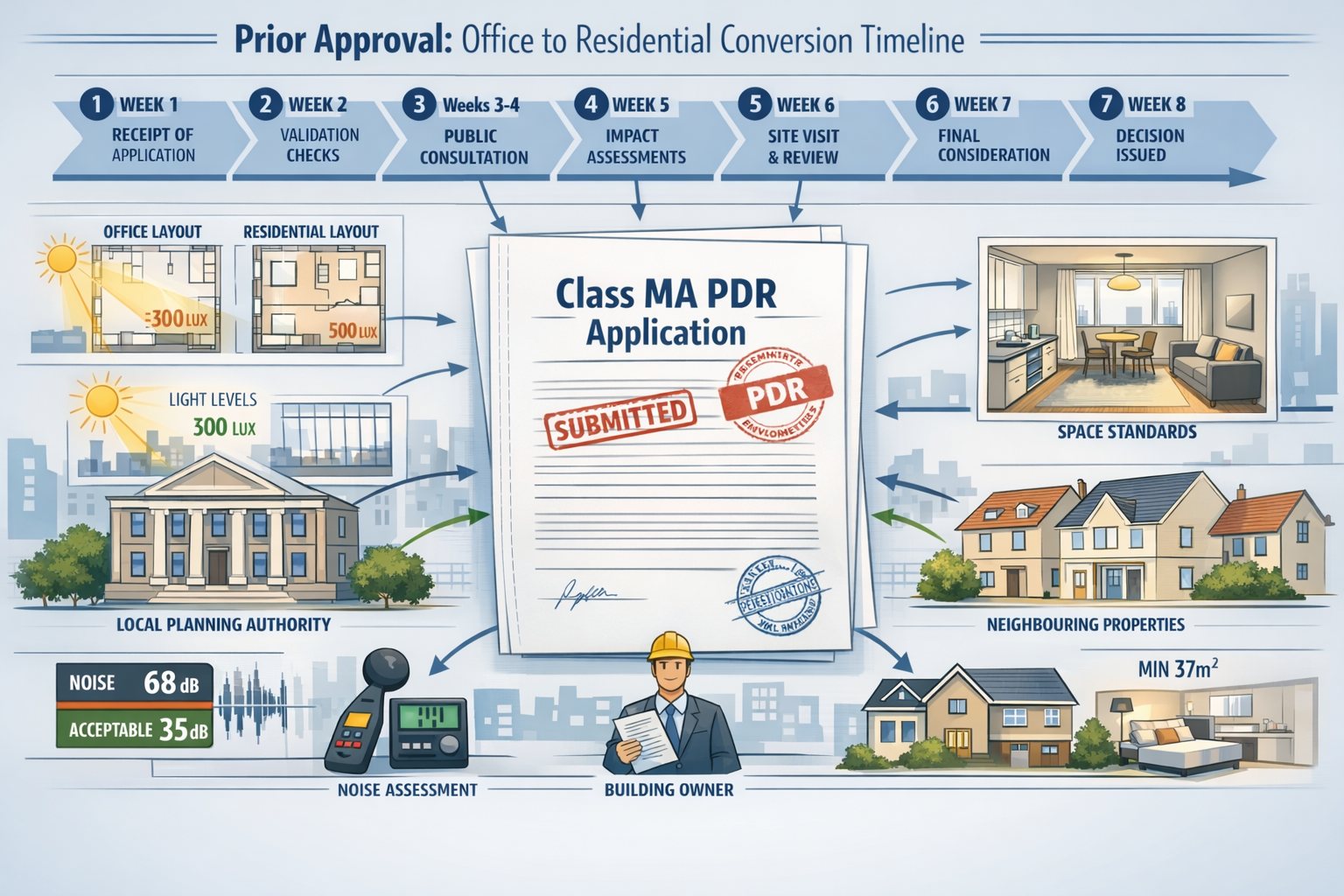
In 2026, Class MA PDR enables building owners to convert entire office buildings—regardless of vacancy duration or total floor area—through a streamlined Prior Approval process that takes just eight weeks. This expedited pathway focuses on specific technical considerations rather than the broader planning merits typically examined in full planning applications.
The Prior Approval Process: What Gets Assessed
The Prior Approval process for office-to-residential conversions in 2026 concentrates on four primary areas [4]:
- Natural Light Provision: Measured in lux distribution across proposed residential units, ensuring adequate daylight for habitable spaces
- Living Space Standards: Compliance with minimum floor areas and room dimensions for residential occupancy
- Noise Impact: Assessment of noise from remaining commercial occupiers or adjacent properties that could affect residential amenity
- Contamination and Flooding Risks: Evaluation of site-specific environmental hazards
Notably absent from this list is any explicit consideration of party wall implications. The Prior Approval process does not replace or supersede the requirements of the Party Wall etc. Act 1996, which operates as a separate legal framework [5].
This creates a critical distinction that many developers overlook: obtaining Prior Approval does not grant permission to proceed with party wall works. The two regulatory systems run in parallel, and failure to address party wall protocols can halt an otherwise approved conversion project.
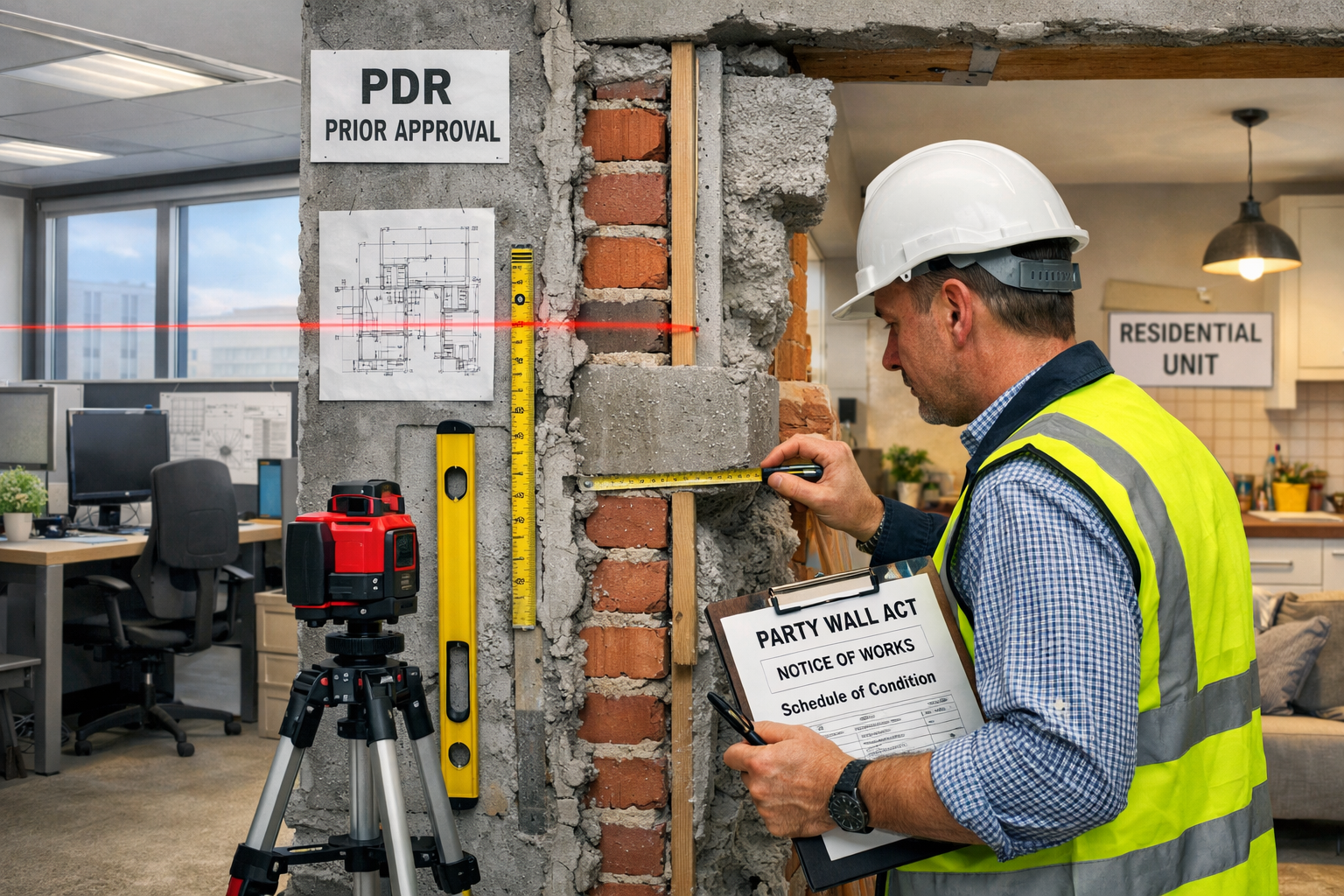
Party Wall Protocols for Office-to-Residential Conversions: Legal Framework and Requirements
The Party Wall etc. Act 1996: Core Principles
The Party Wall etc. Act 1996 applies throughout England and Wales and governs building work that affects shared walls, boundary structures, and excavations near neighbouring properties [5]. The Act serves three essential purposes:
- Provides a framework for building owners to give notice of intended works to affected neighbours
- Establishes procedures for resolving disputes through appointed surveyors when neighbours dissent
- Protects rights of both building owners and adjoining owners throughout construction projects
For office-to-residential conversions, the Act becomes particularly relevant when structural modifications affect party walls—walls shared between two separate buildings or properties. In urban environments where office buildings are often connected to adjacent structures, virtually all conversion projects trigger party wall requirements [5].
When Party Wall Notices Are Required for Conversions
Party Wall Protocols for Office-to-Residential Conversions: Navigating PDR Expansions and Neighbour Risks in 2026 require understanding which specific activities trigger notice obligations. According to the Party Wall etc. Act 1996, building owners must serve notice for [5]:
| Type of Work | Notice Requirement | Conversion Relevance |
|---|---|---|
| Building on boundary line | Party Structure Notice (2 months) | New internal walls at property boundaries |
| Work to existing party wall | Party Structure Notice (2 months) | Cutting into walls, installing beams, removing chimney breasts |
| Cutting into party wall | Party Structure Notice (2 months) | Service penetrations, new doorways, structural openings |
| Excavation within 3 metres | Notice of Adjacent Excavation (1 month) | Foundation work, basement conversions |
| Excavation within 6 metres | Notice of Adjacent Excavation (1 month) | Deep excavations below neighbour's foundations |
Office-to-residential conversions commonly involve multiple notice-triggering activities. Converting open-plan office floors into separate residential units requires internal partition walls that may connect to shared boundaries. Installing residential services—plumbing, heating, electrical systems—often necessitates cutting into party walls to route pipes and cables. Facade modifications to add balconies or improve natural light may affect structural elements of shared walls.
The two-month notice period for Party Structure Notices means that party wall procedures must commence well before construction begins. For projects operating under the eight-week Prior Approval timeline, this creates a critical timing consideration: party wall notices should be served concurrently with or even before the Prior Approval application to avoid delays [5].
Unique Challenges in Mixed-Use Conversion Scenarios
The 2026 landscape presents a particularly complex scenario: partially converted buildings where some floors remain in commercial office use while others become residential apartments. This mixed-use arrangement creates party wall situations that differ significantly from traditional residential-to-residential scenarios.
Consider a typical conversion project where floors 1-3 of a five-story office building are converted to apartments while floors 4-5 remain as commercial offices. The floor slabs between commercial and residential zones become party structures. Any work affecting these slabs—soundproofing installations, service penetrations, structural modifications—requires party wall procedures between the residential conversion developer and the commercial tenant or owner above [5].
Furthermore, if the building shares walls with adjacent properties (common in dense urban areas), the conversion may affect multiple adjoining owners simultaneously. Each adjoining owner has independent rights under the Act and may appoint their own surveyor, creating a complex web of professional relationships and party wall awards that must be coordinated.
Navigating Neighbour Risks and Dispute Prevention
Common Sources of Conflict in Conversion Projects
Party Wall Protocols for Office-to-Residential Conversions: Navigating PDR Expansions and Neighbour Risks in 2026 must address the heightened potential for disputes that arise from changing building use. Several factors contribute to increased conflict risk:
🏗️ Structural Concerns: Neighbours worry that conversion work will compromise the structural integrity of shared walls. Removing internal office partitions to create residential layouts may affect load distribution. Installing new bathroom and kitchen facilities adds weight and moisture exposure to structures originally designed for office use.
🔊 Noise and Vibration: Construction activities generate significant disruption. Neighbours in adjacent residential properties may object to extended construction periods, particularly if work occurs during evenings or weekends. Even after completion, new residential occupiers may create noise that affects remaining commercial tenants differently than previous office workers.
💧 Water Damage Risk: Plumbing installations for residential bathrooms and kitchens increase the risk of water penetration through party walls. Neighbours frequently express concerns about potential leaks and long-term moisture damage to their properties.
📏 Boundary Encroachment: Conversion projects sometimes reveal discrepancies between assumed and actual property boundaries. Installing new external features like balconies or modifying facades may inadvertently encroach on neighbouring airspace or structures.
🕐 Access Requirements: Conversion work may require temporary access to neighbouring properties for scaffolding, structural surveys, or repairs to the adjoining owner's side of the party wall. Negotiating access can become contentious, particularly with commercial tenants concerned about business disruption.
The Role of Party Wall Surveyors in Risk Mitigation
Engaging qualified party wall surveyors early in the conversion planning process is the most effective strategy for preventing disputes. Professional surveyors serve three distinct roles under the Party Wall etc. Act 1996:
- Building Owner's Surveyor: Appointed by the party undertaking the conversion work to prepare notices, document existing conditions, and represent the building owner's interests
- Adjoining Owner's Surveyor: Appointed by affected neighbours to protect their rights and ensure work complies with the Act
- Agreed Surveyor: A single surveyor appointed by consent of both parties to act impartially (less common in complex commercial conversions)
The surveyor's responsibilities include preparing detailed party wall awards that specify:
- Precise scope of permitted works affecting party structures
- Working hours and access arrangements
- Condition surveys documenting pre-construction state of adjoining properties
- Procedures for resolving damage claims
- Cost allocation for surveyor fees and related expenses
For office-to-residential conversions, surveyors must possess expertise in both commercial and residential construction standards. They should understand the technical requirements of PDR conversions—particularly natural light standards and acoustic performance—while also being well-versed in traditional party wall protocols.
Proactive Strategies for Neighbour Engagement
Beyond legal compliance, successful conversion projects in 2026 employ proactive neighbour engagement strategies that go beyond minimum statutory requirements:
Early Communication: Contact adjoining owners before formal notices are served to explain the project, address concerns informally, and establish positive working relationships. This approach often prevents formal dissent and reduces the likelihood of party wall disputes.
Comprehensive Documentation: Conduct thorough pre-construction condition surveys of all potentially affected properties, including detailed photography and structural assessments. This documentation protects both building owners and neighbours by establishing baseline conditions.
Transparent Timelines: Provide neighbours with realistic construction schedules, including anticipated noisy work periods and completion dates. Regular updates throughout the project maintain trust and reduce anxiety.
Professional Representation: Encourage neighbours to appoint their own surveyors rather than relying on agreed surveyor arrangements. While this increases costs, it often leads to more thorough awards and reduces post-construction disputes.
Insurance Verification: Ensure adequate contractor insurance coverage and provide evidence to concerned neighbours. This reassurance addresses financial concerns about potential damage.
Cost Considerations and Financial Planning
Party Wall Surveyor Fees for Conversion Projects
Understanding party wall surveyor costs is essential for accurate project budgeting. Office-to-residential conversions typically incur higher surveyor fees than standard residential extensions due to project complexity and multiple adjoining owners.
Building Owner's Surveyor Fees for conversion projects in 2026 typically range from £1,500 to £5,000+ depending on:
- Number of adjoining owners requiring notices
- Complexity of proposed structural works
- Building size and number of party wall interfaces
- Geographic location (London and major cities command premium rates)
Adjoining Owner's Surveyor Fees are usually borne by the building owner under the "costs follow the work" principle established by the Act. These fees typically mirror the building owner's surveyor costs, meaning a project with three adjoining owners could incur £9,000 to £30,000 in total surveyor fees [5].
For large-scale conversions involving entire office buildings with multiple shared boundaries, surveyor fees can represent a significant project cost. However, this investment prevents far more expensive disputes, injunctions, and construction delays.
Who Pays for Party Wall Procedures?
The Party Wall etc. Act 1996 establishes that the building owner (the party undertaking the conversion work) bears responsibility for reasonable costs incurred by adjoining owners in responding to party wall notices [5]. This includes:
- Adjoining owner's surveyor fees
- Cost of preparing party wall awards
- Reasonable legal advice fees for adjoining owners
- Condition survey costs for neighbouring properties
This cost allocation reflects the principle that those who benefit from building work should bear the associated administrative and professional costs. For conversion developers, this means budgeting not only for their own surveyor but also for potentially multiple adjoining owners' surveyors.
Some adjoining owners attempt to claim excessive costs or appoint unnecessarily expensive surveyors. Building owners can challenge unreasonable fees through the dispute resolution mechanisms in the Act, but this process itself incurs additional costs and delays. Selecting experienced surveyors with reputations for fair dealing helps minimize these risks.
For detailed guidance on cost responsibilities, review our comprehensive guide on who pays for a party wall surveyor.
Practical Implementation: Step-by-Step Process
Phase 1: Pre-Conversion Planning and Assessment
Before submitting a Prior Approval application, developers should complete a party wall feasibility assessment:
- Identify all party walls and shared boundaries through title deed review and site inspection
- Locate adjoining owners using Land Registry records and local authority databases
- Assess conversion design for party wall implications (structural openings, service penetrations, load changes)
- Engage building owner's surveyor to review plans and advise on notice requirements
- Prepare preliminary timeline integrating Prior Approval and party wall procedures
This preliminary work ensures that party wall requirements don't surprise developers mid-project and allows for realistic scheduling.
Phase 2: Notice Service and Surveyor Appointment
Once conversion plans are finalized, commence formal party wall procedures:
- Serve Party Structure Notices at least two months before intended work start date (one month for excavation notices) [5]
- Provide detailed drawings showing proposed works affecting party structures
- Allow 14-day response period for adjoining owners to consent or dissent
- Facilitate surveyor appointments if adjoining owners dissent or request surveyors
- Coordinate surveyor communications between building owner's and adjoining owners' surveyors
Parallel to these steps, submit the Prior Approval application to the local planning authority. The eight-week Prior Approval timeline and two-month party wall notice period should align to avoid construction delays.
Phase 3: Award Preparation and Condition Surveys
Appointed surveyors collaborate to prepare comprehensive party wall awards:
- Conduct joint site inspections to assess existing party wall conditions
- Prepare detailed condition schedules documenting pre-construction state of all affected properties
- Draft party wall award specifying permitted works, working hours, access arrangements, and dispute procedures
- Review and finalize award with input from both building owner and adjoining owners
- Serve completed award on all parties, triggering 14-day appeal period
Condition surveys are particularly critical for conversion projects. The extensive structural work involved creates significant potential for damage claims. Detailed photographic and written records protect all parties by establishing clear baseline conditions.
Phase 4: Construction Phase Compliance
During conversion work, ongoing party wall compliance is essential:
- Adhere to award specifications regarding working hours, access, and construction methods
- Maintain communication between contractors and surveyors regarding any variations or issues
- Document progress with photographs and reports, particularly for works affecting party structures
- Address concerns promptly if adjoining owners raise issues about vibration, noise, or visible damage
- Conduct interim inspections by surveyors to verify compliance and assess any emerging damage
Contractors must understand their party wall obligations. Including party wall award requirements in contractor briefings and site inductions prevents inadvertent violations.
Phase 5: Post-Completion Procedures
After conversion work concludes, final party wall procedures include:
- Final inspection by surveyors to assess party wall condition and identify any damage
- Comparison with condition surveys to determine whether construction caused deterioration
- Negotiation and resolution of any damage claims by adjoining owners
- Completion certificates issued by surveyors confirming work compliance with awards
- Final fee settlements for surveyor services and any agreed remedial works
Disputes about damage or award compliance can be referred to the Third Surveyor appointed in the party wall award. This independent professional adjudicates disagreements between the building owner's and adjoining owner's surveyors, providing binding decisions on technical matters.
Emerging Trends and Future Considerations
Increasing Conversion Complexity in 2026
As the most straightforward office-to-residential conversions are completed, developers in 2026 are tackling increasingly complex projects:
- Listed buildings and conservation areas where PDR rights may be restricted but conversion demand remains high
- Mixed-use developments combining residential, commercial, and retail uses within single structures
- Tall buildings where party wall considerations extend vertically across multiple floors
- Brownfield sites with contamination issues requiring extensive remediation alongside conversion
These complex projects demand sophisticated party wall protocols that address non-traditional scenarios. Surveyors must adapt traditional residential party wall practices to commercial-scale conversion projects with multiple stakeholders and intricate structural considerations.
Technology and Party Wall Procedures
Digital tools are transforming party wall practice in 2026:
- 3D scanning and BIM models enable precise documentation of party wall conditions and proposed works
- Digital notice service through secure platforms streamlines communication and record-keeping
- Drone surveys assess facade conditions and identify party wall interfaces in tall buildings
- Vibration monitoring systems provide objective data about construction impact on adjoining properties
These technologies enhance accuracy, reduce disputes, and provide robust evidence if disagreements arise. Forward-thinking surveyors incorporate digital tools into standard party wall procedures, particularly for large conversion projects.
Regulatory Evolution and Policy Considerations
The success of PDR expansions in addressing housing shortages will likely drive further regulatory evolution. Potential developments include:
- Integration of party wall considerations into Prior Approval processes to streamline procedures
- Standardized protocols for mixed-use buildings with both commercial and residential occupiers
- Enhanced enforcement mechanisms for party wall violations in conversion projects
- Professional accreditation requirements for surveyors working on PDR conversions
Developers and surveyors should monitor legislative developments and participate in industry consultations to shape effective policies that balance housing delivery with neighbour protection.
Conclusion
Party Wall Protocols for Office-to-Residential Conversions: Navigating PDR Expansions and Neighbour Risks in 2026 represents a critical competency for developers, surveyors, and property owners participating in the urban transformation enabled by expanded Permitted Development Rights. The streamlined eight-week Prior Approval process offers unprecedented opportunities to repurpose underutilized office space into much-needed housing, but these opportunities come with significant party wall obligations that cannot be overlooked.
The Party Wall etc. Act 1996 remains fully applicable to conversion projects, requiring careful notice procedures, professional surveyor engagement, and thorough documentation of existing conditions [5]. The unique challenges of mixed-use buildings, multiple adjoining owners, and complex structural modifications demand expertise that goes beyond standard residential party wall practice.
Success in this evolving landscape requires:
✅ Early planning that integrates Prior Approval and party wall timelines
✅ Professional surveyor engagement from project inception through completion
✅ Proactive neighbour communication that builds trust and prevents disputes
✅ Comprehensive documentation protecting all parties' interests
✅ Adequate budgeting for surveyor fees and potential remedial works
For building owners contemplating office-to-residential conversions in 2026, the message is clear: party wall compliance is not an optional administrative burden but an essential component of project success. Investing in proper protocols from the outset prevents costly disputes, construction delays, and legal complications that can derail otherwise viable conversion projects.
Next Steps for Conversion Project Stakeholders
For Developers and Building Owners:
- Conduct party wall feasibility assessments before finalizing conversion designs
- Engage experienced party wall surveyors with commercial conversion expertise
- Budget realistically for party wall costs including multiple adjoining owner surveyors
- Serve notices early to align with Prior Approval timelines
For Adjoining Owners:
- Understand your rights under the Party Wall etc. Act 1996 when receiving notices
- Consider appointing your own surveyor rather than agreeing to a single surveyor
- Document existing property conditions independently before work commences
- Engage constructively with building owners while protecting your interests
For Professional Surveyors:
- Develop expertise in both PDR conversion requirements and party wall procedures
- Adopt digital documentation tools for complex conversion projects
- Build networks with commercial and residential construction specialists
- Stay informed about regulatory developments affecting conversion practice
The intersection of expanded Permitted Development Rights and established party wall legislation creates both opportunities and challenges. By understanding and implementing proper Party Wall Protocols for Office-to-Residential Conversions: Navigating PDR Expansions and Neighbour Risks in 2026, all stakeholders can contribute to successful urban transformation while protecting individual property rights and maintaining positive neighbour relationships.
For expert guidance on your office-to-residential conversion project, consult with qualified chartered surveyors who specialize in party wall matters and understand the unique requirements of PDR conversions in 2026.
References
[1] Loft Conversion Rules – https://collier-stevens.co.uk/advice-hub/residential/loft-conversion-rules/
[2] Party Wall And Building Regulations For Your Loft Conversion – https://www.bespokelofts.co.uk/latest-loft-conversion-news/386/party-wall-and-building-regulations-for-your-loft-conversion.html
[3] Loft Conversion Party Wall Agreement – https://www.oakfieldsurveyors.co.uk/party-wall/loft-conversion-party-wall-agreement/
[4] Its A New Era For Office To Residential Conversions In The Uk If We Get The Light Right – https://www.tftconsultants.com/posts/its-a-new-era-for-office-to-residential-conversions-in-the-uk-if-we-get-the-light-right
[5] Party Walls Building Works – https://www.gov.uk/party-walls-building-works
[6] Legal Update Converting Commercial Spaces Legislative Changes Aiming To Fast Track Housing Provision – https://www.alarmrisk.com/resource/legal-update-converting-commercial-spaces-legislative-changes-aiming-to-fast-track-housing-provision.html
