
Nearly 40% of party wall disputes that escalate to formal adjudication involve defects that were present before excavation work began — defects that neither party documented, and neither party could prove. That single statistic explains why the thermal imaging revolution in party wall surveys and the 2026 protocols for detecting hidden defects before excavations have become the most significant shift in surveying practice this decade.
Thermal infrared technology, once reserved for industrial diagnostics and energy audits, has moved firmly into the mainstream of party wall practice. Updated RICS building survey quality standards now specifically incorporate thermal imaging for moisture detection in defined scenarios [1], and the post-Awaab's Law expansion of 2026 has triggered new building survey protocols for identifying prescribed hazards including damp and mould [5]. Together, these developments have reshaped what a competent pre-excavation inspection looks like.
This article explains exactly how the technology works, what the 2026 protocols require, and how property owners and surveyors can use thermal imaging to protect themselves — and their neighbours — before a single shovel breaks ground.
Key Takeaways 🔑
- Thermal imaging is now a recognised non-destructive investigation method within RICS-aligned party wall survey protocols for 2026.
- A structured four-stage protocol — history-taking, visual inspection, thermal scanning, and targeted moisture testing — delivers the most reliable pre-excavation defect records.
- Environmental preparation is non-negotiable: temperature differentials between inside and outside must be established before scanning for results to be valid.
- Thermal imaging combined with moisture meters distinguishes between harmless cold spots and genuine damp-proof course breaches or hidden leaks.
- Proper pre-excavation thermal records provide legally defensible evidence in party wall disputes and protect both building owners and adjoining owners.
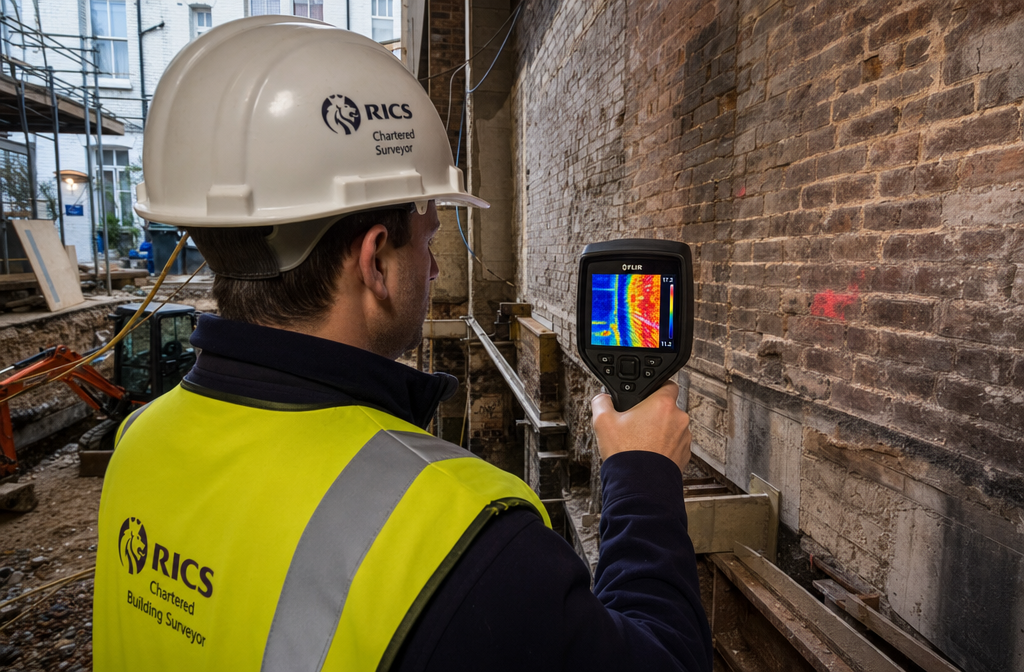
Why Traditional Party Wall Inspections Were Leaving Defects Undetected
For decades, the standard schedule of condition relied almost entirely on visual inspection and written notes. A surveyor would walk through the adjoining property, photograph visible cracks, note damp patches on plaster, and record the condition of floors and ceilings. The problem? The most damaging defects — moisture trapped inside a masonry cavity, a failing damp-proof course behind a plastered wall, cold bridges creating condensation within a structural junction — are completely invisible to the naked eye.
"Thermal imaging does not replace the surveyor's judgement — it extends it into parts of the building that no eye can reach."
This invisibility has caused real harm. When a neighbouring owner begins a basement excavation or underpinning project, vibration and ground movement can accelerate pre-existing defects. Without a clear thermal baseline, it becomes almost impossible to determine whether a crack that appears three months into construction was caused by the works — or was already there, hidden inside the wall fabric.
Understanding what a party wall surveyor does makes clear that their role extends well beyond serving notices. Protecting the adjoining owner's property through rigorous pre-works documentation is a core professional duty — and in 2026, that documentation increasingly means thermal data.
The Legal Context: Party Wall Act and Pre-Excavation Obligations
Under the Party Wall etc. Act 1996, building owners proposing excavation within 3 or 6 metres of an adjoining structure must serve notice and, where required, agree a party wall award. The schedule of condition attached to that award is the critical document. If it fails to capture pre-existing thermal anomalies — hidden moisture, cold bridges, or compromised insulation — those defects may later be wrongly attributed to the excavation works, creating costly disputes.
A thorough schedule of condition report that incorporates thermal imaging now represents best practice, and increasingly, it represents the minimum standard that a competent surveyor should meet.
How the 2026 Thermal Imaging Protocol Works: A Four-Stage Process
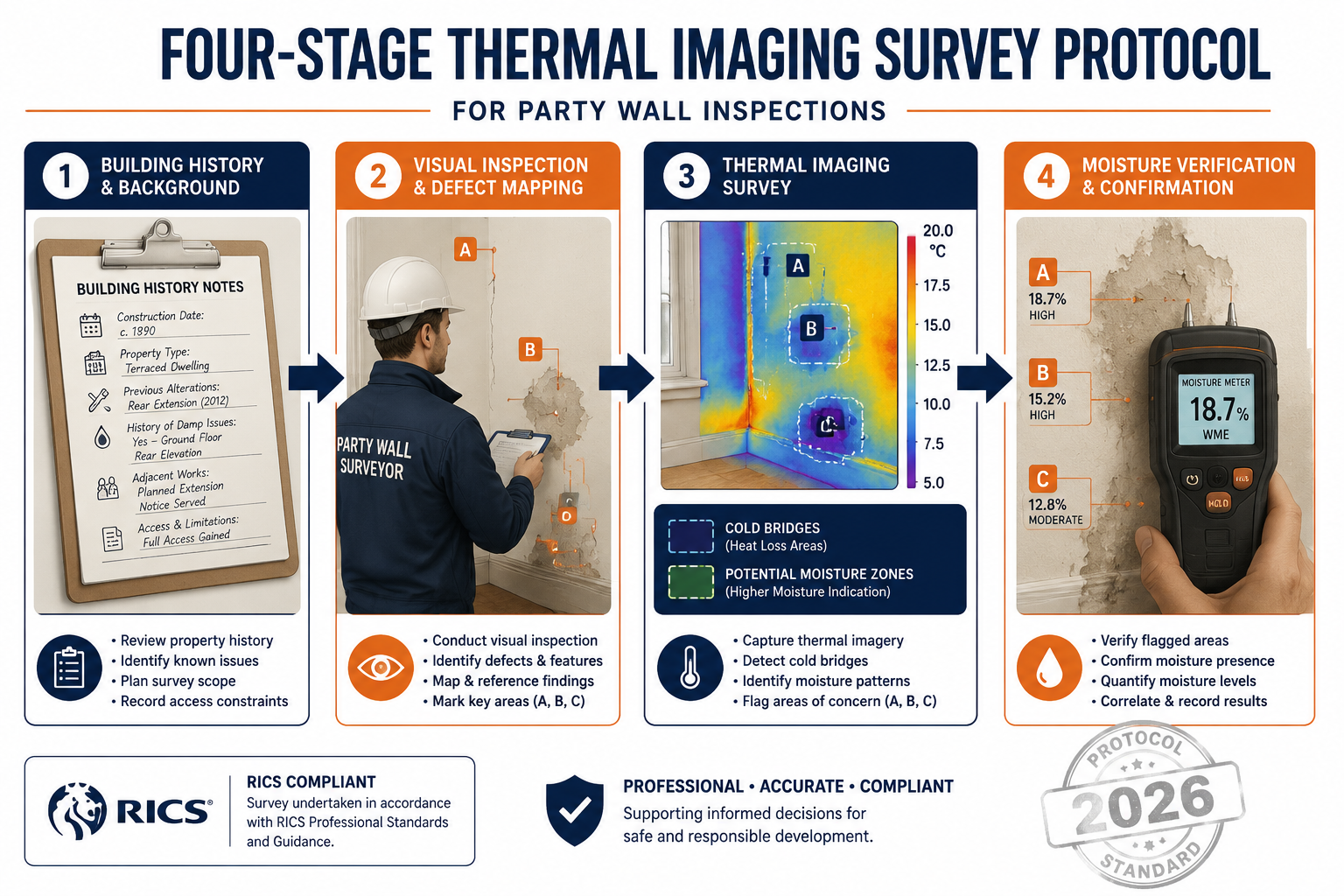
The thermal imaging revolution in party wall surveys and 2026 protocols for detecting hidden defects before excavations is built on a structured methodology. Modern thermal imaging surveys follow a four-stage process that ensures findings are reliable, comparable, and legally defensible [2].
Stage 1: Building History and Symptom Review
Before any camera enters the building, the surveyor gathers intelligence. This means reviewing:
- Previous building works — extensions, basement conversions, loft alterations
- Reported symptoms — damp patches, condensation, cold spots, unexplained cracking
- Construction type — solid masonry, cavity wall, timber frame, or mixed
- Age and condition of the damp-proof course and any existing waterproofing
This history-taking stage shapes the entire thermal scan. It tells the surveyor where to look, what patterns to expect, and which anomalies are likely to be significant [2].
Stage 2: Detailed Visual Inspection
The thermal camera does not replace the visual inspection — it follows it. The surveyor systematically logs all visible defects, construction details, and areas of concern. This creates a written and photographic baseline that the thermal data will later complement [2].
Key areas inspected at this stage include:
- External wall surfaces and pointing
- Internal plaster condition and staining
- Floor-to-wall junctions
- Ceiling junctions and roof interfaces
- Any existing cracks or movement
Stage 3: Thermal Imaging Under Controlled Conditions ♨️
This is where the technology delivers its greatest value. Infrared cameras map surface temperatures across walls, ceilings, floors, and accessible roofs, revealing how heat flows through the building fabric. Areas of moisture, cold bridging, or air infiltration show up as distinct thermal anomalies — patterns that are completely invisible to standard photography [2].
Critical environmental preparation requirements:
| Preparation Step | Why It Matters |
|---|---|
| Establish 10°C+ temperature differential (inside vs outside) | Creates clear thermal contrast for anomaly detection |
| Move furniture away from external walls | Prevents false readings from stored heat |
| Open curtains and blinds | Removes thermal barriers between wall and camera |
| Remove drying laundry from radiators | Eliminates moisture sources that distort readings |
| Allow heating system to run for minimum 2 hours | Stabilises internal temperature for consistent results |
The surveyor maintains consistent distance, angle, and framing when scanning similar building elements — external walls, ceiling junctions, floor perimeters — so that results are comparable across the property and easy to explain to all parties [2].
Stage 4: Targeted Moisture Testing on Flagged Zones
Thermal imaging identifies where to investigate — moisture meters confirm what is happening there. This combination is essential because not every thermal anomaly indicates a defect. A cold corner may simply reflect a structural geometry rather than a damp-proof course breach [2].
By targeting moisture meter readings at zones flagged by the thermal scan, the surveyor can definitively distinguish between:
- ✅ Harmless cold bridges (normal in older masonry)
- ⚠️ Active moisture ingress (requires remediation)
- 🚨 DPC failure or hidden leak (critical pre-excavation finding)
RICS-Compliant Checklist for Thermal Imaging in Party Wall Surveys
The following checklist reflects the 2026 standards for incorporating thermal imaging into pre-excavation party wall inspections, aligned with updated RICS building survey quality requirements [1] and post-Awaab's Law hazard identification protocols [5].
Pre-Survey Preparation ✅
- Confirm temperature differential of at least 10°C between interior and exterior
- Request property preparation from occupants at least 24 hours in advance
- Review building history, previous works, and any reported defects
- Calibrate thermal camera to manufacturer specifications
- Confirm camera sensitivity meets minimum 0.05°C NETD standard
During the Thermal Survey ✅
- Complete full visual inspection and photographic record first
- Scan all external-facing walls, ground floor perimeters, and basement walls
- Document all thermal anomalies with GPS-tagged images and temperature readings
- Maintain consistent scan distance (typically 1–3 metres for wall elements)
- Cross-reference thermal findings with visual defect log in real time
Post-Survey Reporting ✅
- Apply moisture meter readings to all thermally flagged zones
- Classify each anomaly: cold bridge, active moisture, or DPC-related
- Produce annotated thermal images alongside standard photographs
- Include thermal data in the schedule of condition as a formal appendix
- Confirm findings are referenced in the party wall award where relevant
Case Study: Thermal Imaging Preventing a Costly Dispute in a London Terrace
Consider a scenario that has become increasingly common in London's dense Victorian terraced housing stock. A building owner serves notice to excavate for a basement extension. The adjoining owner appoints a surveyor who, following 2026 protocols, conducts a full thermal imaging survey before works begin.
The thermal scan reveals a significant moisture anomaly running horizontally along the party wall at ground floor level — consistent with a DPC failure that predates the proposed works by several years. Without this thermal record, the defect would almost certainly have been attributed to the excavation once works began and the moisture became visible as surface staining.
With the thermal data documented in the schedule of condition, both parties have a clear, objective baseline. The building owner proceeds with their excavation knowing the pre-existing defect is recorded. The adjoining owner is protected from having to prove causation after the fact. The party wall award references the thermal findings, and the dispute that might have cost both parties thousands in legal fees simply does not arise.
This is the practical value of the thermal imaging revolution in party wall surveys — the 2026 protocols for detecting hidden defects before excavations exist precisely to prevent these disputes before they start.
"The best party wall dispute is the one that never happens — and thermal imaging is the most powerful tool surveyors now have to prevent them."
Aerial and Advanced Thermal Imaging: What's Coming Next
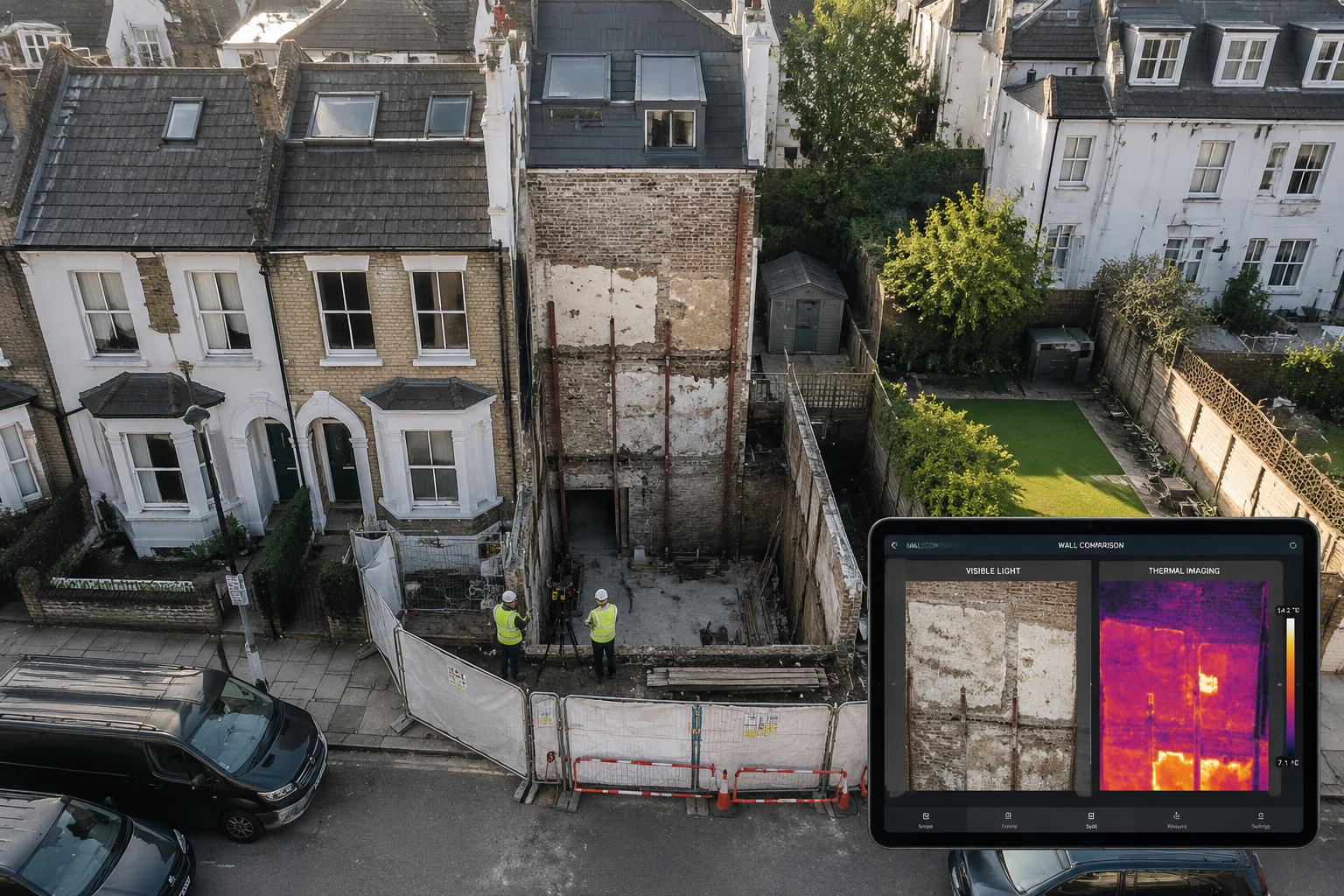
The expansion of thermal technology is not limited to ground-level surveys. 2026 has seen growing discussion of aerial thermal imaging as a complementary technique, particularly for large-scale developments where roof and upper-storey party wall junctions are difficult to access [3].
Drone-mounted thermal cameras can now survey the full external envelope of a terrace or semi-detached property in a single flight, identifying heat loss patterns, moisture ingress at roof level, and cold bridges at chimney stacks — all areas that are relevant to party wall conditions but difficult to reach safely from ground level.
For properties with shared chimneys — a common feature in Victorian and Edwardian terraces — party wall shared chimney assessments can now be significantly enhanced by aerial thermal data, capturing thermal anomalies at stack level that would otherwise require expensive scaffolding.
Specialist firms operating in this space are combining ground-level FLIR surveys with aerial thermal passes to create comprehensive 360° thermal records of party wall structures. This layered approach represents the leading edge of what the 2026 protocols are moving towards.
What Property Owners Need to Know Before Commissioning a Survey
Whether acting as a building owner proposing excavation or an adjoining owner receiving notice, understanding the thermal imaging landscape in 2026 is essential for protecting property interests.
For Building Owners 🏗️
- Commission a thermal survey of your own property first — identify defects in your structure before they are attributed to your works
- Ensure your surveyor is trained in thermographic interpretation — thermal imaging is a skill, not just a tool
- Budget appropriately — thermal surveys add cost but significantly reduce dispute risk; review party wall costs to understand the full financial picture
- Understand your legal obligations under the Party Wall etc. Act 1996 before works begin
For Adjoining Owners 🏠
- Request that thermal imaging forms part of the schedule of condition — this is now a reasonable and increasingly standard request
- Understand who pays for a party wall surveyor — in most cases, the building owner bears the cost
- Do not consent to a schedule of condition that relies solely on visual inspection for excavation works near your foundations
- Keep copies of all thermal reports — these are legally significant documents if a dispute arises later
Key Questions to Ask Your Surveyor
- Are you trained and certified in building thermography?
- What camera sensitivity and resolution will you use?
- Will thermal findings be formally incorporated into the schedule of condition?
- How will you distinguish cold bridges from active moisture?
- Will you use moisture meters to confirm thermal anomalies?
Conclusion: Thermal Imaging Is Now a Professional Standard, Not an Optional Extra
The thermal imaging revolution in party wall surveys and 2026 protocols for detecting hidden defects before excavations represents a genuine step-change in how the profession protects property owners. What was once considered advanced practice is now, in the context of updated RICS standards [1] and expanded hazard identification requirements [5], an expected component of any competent pre-excavation survey.
The four-stage protocol — history review, visual inspection, thermal scanning, and targeted moisture testing — delivers something that traditional visual surveys simply cannot: objective, measurable, and legally defensible evidence of a building's thermal and moisture condition before works begin [2].
Actionable Next Steps
- If you have received a party wall notice, contact a qualified surveyor immediately and specifically request that thermal imaging be included in the schedule of condition.
- If you are planning excavation works, commission a pre-notice thermal survey of your own property to identify and document any pre-existing defects.
- Verify your surveyor's thermographic credentials — ask for evidence of training in building thermography, not just general surveying qualifications.
- Review the Party Wall etc. Act 1996 guidance to understand your obligations and rights before any works begin.
- Engage a specialist early — thermal surveys require environmental preparation and cannot be conducted on the day of a standard inspection visit.
The technology exists. The protocols are established. The only remaining question is whether property owners and their surveyors will use them.
References
[1] Building Survey Quality Standards 2026 Navigating Rics Updates And Enhanced Home Inspection Requirements – https://nottinghillsurveyors.com/blog/building-survey-quality-standards-2026-navigating-rics-updates-and-enhanced-home-inspection-requirements
[2] Thermal Imaging Damp Survey Using Infrared To Trace Leaks Cold Bridges And Hidden Damp – https://www.sussexdampexperts.com/thermal-imaging-damp-survey-using-infrared-to-trace-leaks-cold-bridges-and-hidden-damp/
[3] Aerial Thermal Imaging Vs Traditional Inspection Whats Better In 2026 – https://skyelink.org/blogs/aerial-thermal-imaging-vs-traditional-inspection-whats-better-in-2026/
[5] Building Surveys For Damp And Mould Post Awaabs Law Expansion Protocols For Identifying Prescribed Hazards In 2026 – https://nottinghillsurveyors.com/blog/building-surveys-for-damp-and-mould-post-awaabs-law-expansion-protocols-for-identifying-prescribed-hazards-in-2026
