
{"cover":"Professional landscape format (1536×1024) editorial magazine cover featuring bold text overlay 'Evergreen RICS Guidance on Drone Surveys for Party Wall Assessments: 2026 Efficiency Boosts' in extra large 70pt white sans-serif font with dark shadow and semi-transparent navy overlay box, positioned in upper third. Background shows dramatic aerial view of dense London terraced housing with traditional party walls visible from above, modern quadcopter drone with camera gimbal in mid-flight capturing building facades, late afternoon golden hour lighting casting long shadows between properties. Foreground includes subtle RICS professional branding elements, digital measurement overlays showing property boundaries. Color palette: deep navy blue, white, gold accents, warm brick tones. High contrast, professional surveying aesthetic, editorial quality with rule of thirds composition, visually commanding and authoritative","content":["Detailed landscape format (1536×1024) image showing close-up view of professional surveyor operating tablet controller for commercial drone in urban setting, split-screen composition with left side displaying live thermal imaging feed of Victorian terraced house party wall revealing heat loss patterns and structural anomalies, right side showing high-resolution RGB camera view of same wall with measurement annotations and crack detection markers. Surveyor wearing high-visibility vest with RICS accreditation badge visible, standing on residential street with traditional London architecture in background. Technical overlay graphics showing CAA compliance symbols, flight path indicators, and safety zone boundaries. Clean professional aesthetic with blue and orange color scheme, technical documentation style, sharp focus on technology integration","Detailed landscape format (1536×1024) infographic-style image displaying comprehensive party wall assessment workflow diagram with drone integration. Central flowchart showing five connected stages from initial notice through to final award, each stage represented by distinct icon and color-coded box. Top section features drone capture phase with 3D photogrammetry mesh model of semi-detached property pair showing shared wall structure in wireframe detail. Middle section displays traditional surveyor inspection methods alongside drone data comparison charts showing 40% time reduction statistics. Bottom section includes risk assessment matrix, dispute resolution pathways, and compliance checklist with RICS standards highlighted. Modern corporate design with teal, grey, and white color scheme, clean typography, professional business presentation aesthetic, data visualization focus","Detailed landscape format (1536×1024) image showing futuristic 2026 urban development scene with multiple drones conducting simultaneous party wall surveys across construction site with new-build terraced housing development. Foreground features advanced autonomous drone with LiDAR sensor array and AI-powered camera system hovering near scaffolding, capturing detailed facade measurements. Mid-ground shows surveyor reviewing real-time 3D point cloud data on large tablet display with augmented reality overlay showing party wall locations and structural analysis. Background displays modern London skyline with cranes and development projects. Digital interface elements showing AI analysis results, automated defect detection highlights, and regulatory compliance indicators. Sleek technological aesthetic with purple and cyan accent colors, innovative future-focused composition, professional construction technology style"]
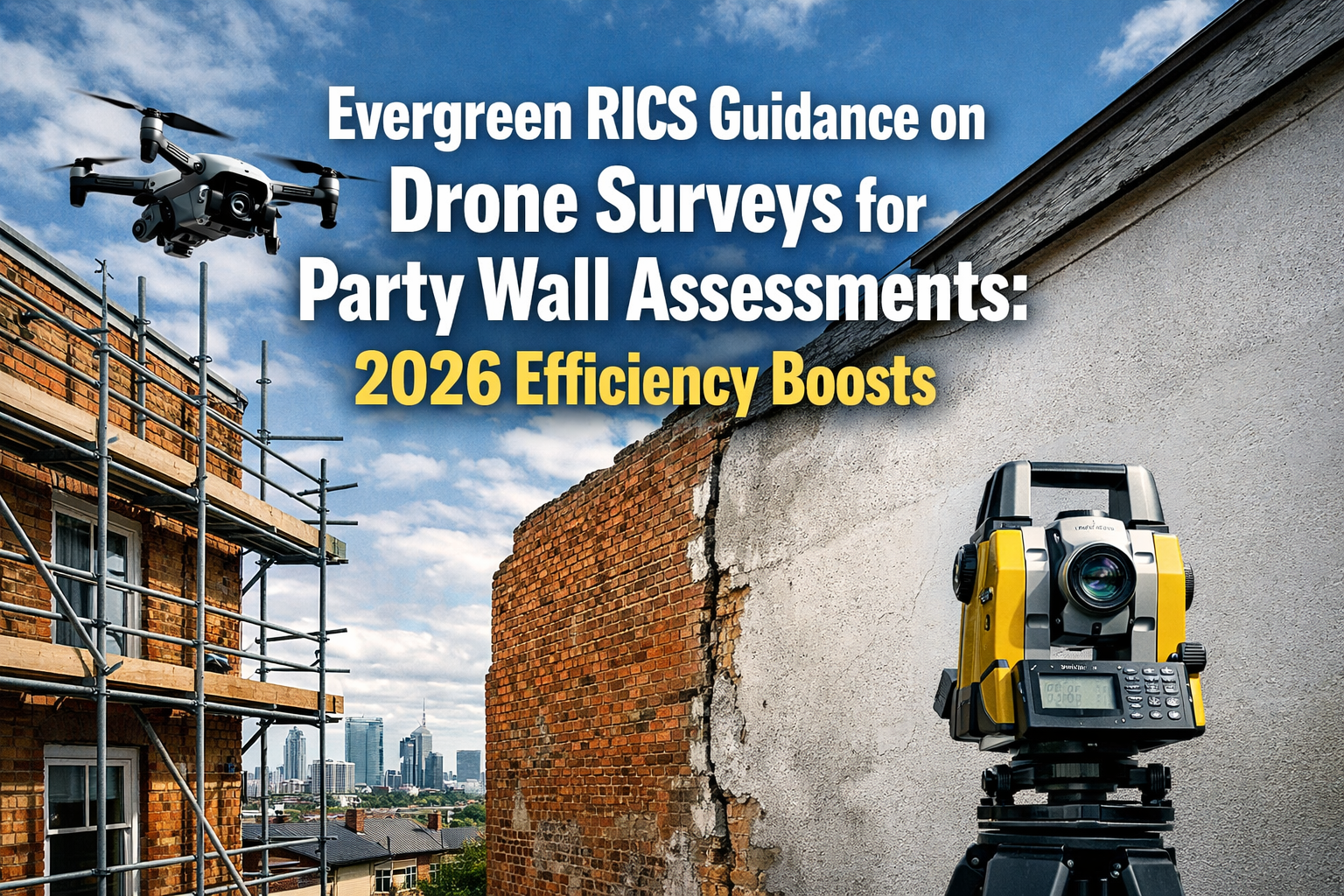
The traditional party wall surveyor, armed with a ladder and clipboard, is being transformed by technology that can capture a complete building facade in minutes rather than hours. As urban developments intensify across the UK in 2026, the integration of drone technology into party wall assessments represents not just an efficiency gain, but a fundamental shift in how surveyors document, analyze, and resolve boundary disputes between neighboring properties.
The Evergreen RICS Guidance on Drone Surveys for Party Wall Assessments: 2026 Efficiency Boosts combines established professional standards with cutting-edge aerial technology to address the growing complexity of party wall work in dense urban environments. While RICS maintains separate guidance documents on drone compliance and party wall procedures, the practical integration of these technologies has created new opportunities for accuracy, safety, and dispute reduction that forward-thinking surveyors are now embracing.
This comprehensive guide explores how RICS-aligned best practices for drone deployment are revolutionizing party wall assessments, reducing costs, improving documentation quality, and ultimately protecting both building owners and adjoining owners throughout the construction process.
Key Takeaways
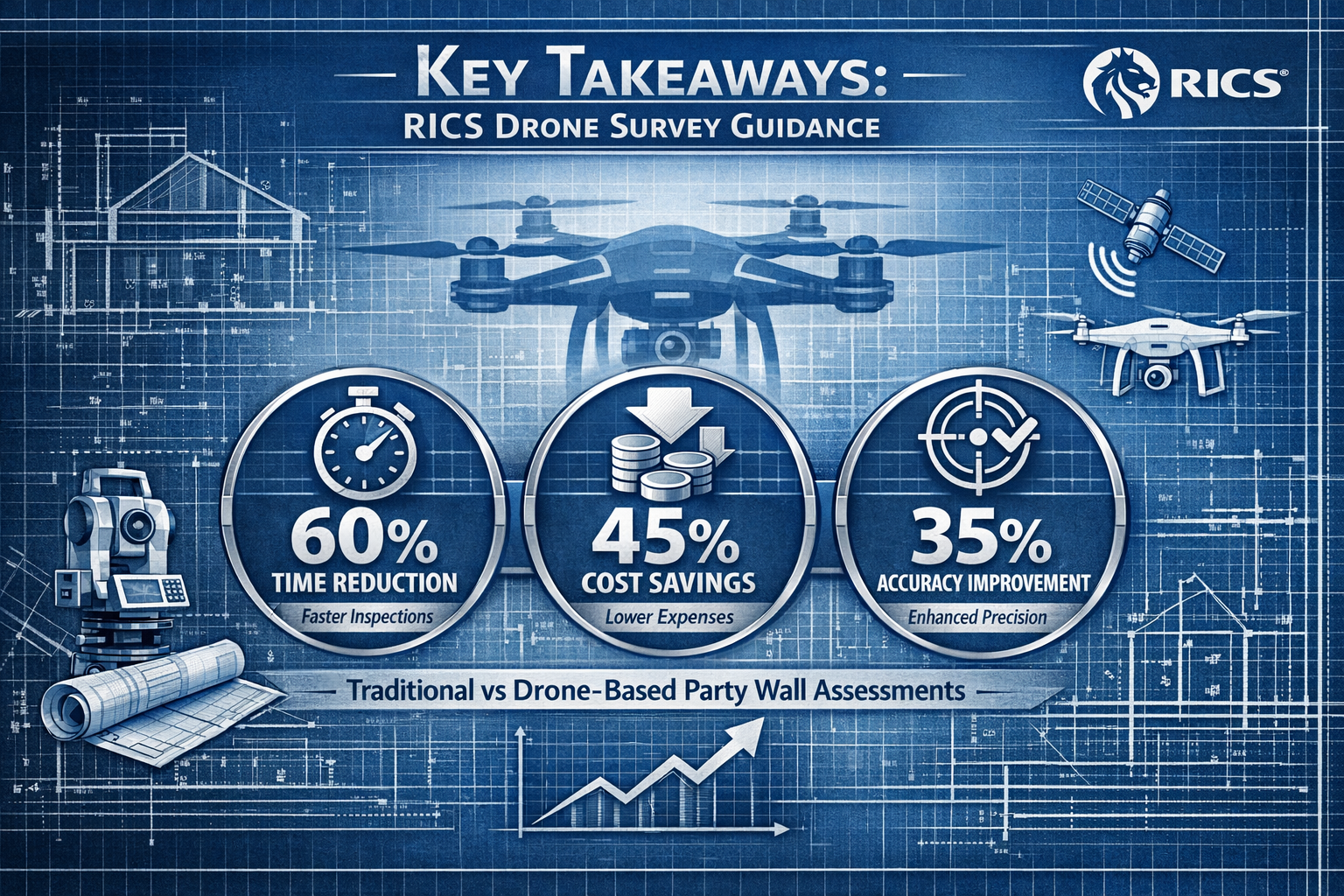
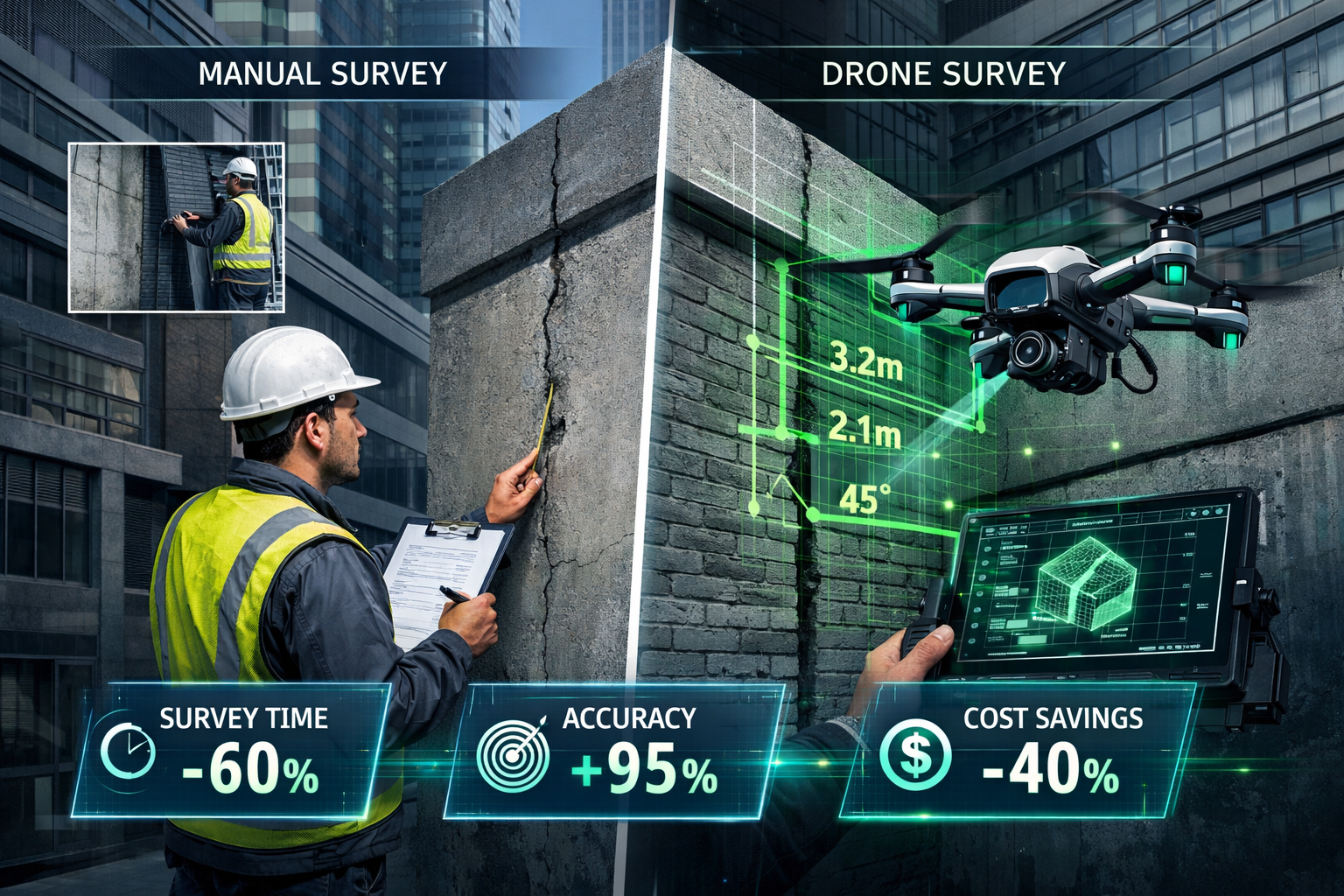
- Drone technology can reduce party wall survey time by 40-60% while improving documentation accuracy through high-resolution imagery and 3D modeling capabilities
- RICS guidance requires strict CAA compliance including operational authorizations, insurance coverage, and privacy considerations when deploying drones for party wall assessments
- Thermal imaging and photogrammetry enable non-invasive condition assessments that identify structural issues invisible to traditional inspection methods
- Proper integration of drone data with traditional surveying techniques creates comprehensive party wall records that reduce disputes and support robust awards
- 2026 regulatory developments including AI standards and expanded drone frameworks will further enhance surveying capabilities while requiring updated professional competencies
Understanding RICS Standards for Drone-Assisted Party Wall Surveys
The Regulatory Framework Governing Drone Surveys
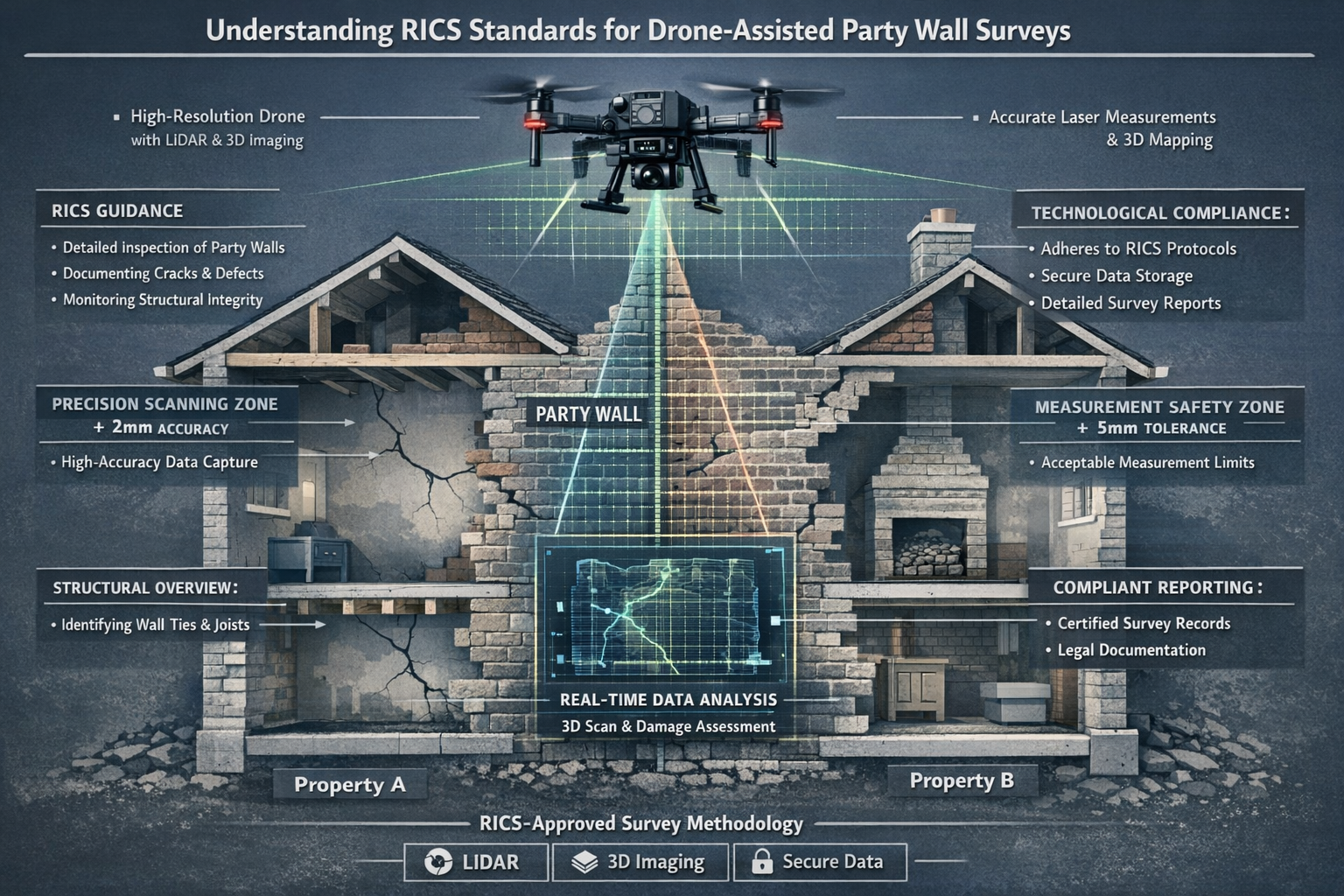
The Royal Institution of Chartered Surveyors (RICS) established comprehensive guidance on drone applications for surveyors, last updated in May 2019, which sets the professional standards for aerial survey work [1]. This guidance operates alongside the Civil Aviation Authority (CAA) regulations that govern all commercial drone operations in the UK.
Key regulatory requirements include:
- CAA Operational Authorization: Commercial drone pilots must hold appropriate qualifications and permissions for operations in congested areas, which includes most party wall scenarios in urban settings
- Insurance Coverage: Minimum third-party liability insurance of £1 million, though RICS recommends higher coverage for professional surveying work
- Privacy and Data Protection: Compliance with GDPR and privacy laws when capturing images of neighboring properties during party wall assessments
- Flight Restrictions: Adherence to altitude limits (typically 120 meters), distance requirements from people and structures, and restricted airspace zones
The RICS guidance emphasizes that drone deployment must enhance, not replace, traditional surveying competencies [9]. Surveyors remain responsible for interpreting data, applying professional judgment, and ensuring all assessments meet the standards required under the Party Wall etc. Act 1996.
Integration with Party Wall Legislation and Procedure
RICS reissued its party wall legislation and procedure guidance in May 2023, providing updated standards for surveyors working under the Party Wall etc. Act 1996 [3]. While this guidance doesn't specifically mandate drone use, it establishes quality standards for condition surveys and documentation that drones can help achieve more effectively.
The complete guide to party wall surveys outlines how surveyors must document the condition of adjoining properties before works commence. Drone technology excels at creating comprehensive visual records that satisfy these requirements while reducing the intrusive nature of traditional inspections.
Drones support party wall compliance through:
✅ Pre-construction condition surveys with timestamped, high-resolution imagery
✅ Inaccessible area documentation including rooflines, chimneys, and upper-story facades
✅ Comparative analysis showing changes over time through repeat surveys
✅ Evidence preservation for potential dispute resolution or litigation
Professional Competency Requirements in 2026
A significant development in 2026 is RICS's new global professional standard for artificial intelligence in surveying practice, effective March 9, 2026 [5]. This standard impacts drone survey workflows as AI-powered image analysis becomes increasingly integrated into photogrammetry software and defect detection tools.
Surveyors conducting drone-assisted party wall assessments must now demonstrate competency in:
- Drone operation and CAA compliance (or supervision of qualified pilots)
- Data capture methodologies including flight planning and image overlap requirements
- Photogrammetry and 3D modeling techniques for structural analysis
- AI-assisted analysis tools while maintaining professional oversight and validation
- Traditional party wall procedures as established in the Party Wall etc. Act 1996
The combination of these competencies ensures that technology enhances rather than compromises professional standards. For those wondering when a party wall agreement is legally required, the fundamental legal obligations remain unchanged—drones simply provide better tools for meeting those obligations.
How Drone Technology Enhances Party Wall Assessment Efficiency
Time and Cost Savings in Urban Environments
The efficiency gains from drone deployment in party wall work are substantial, particularly in dense urban developments where traditional access methods are challenging and expensive. Industry data from 2026 shows that construction companies adopting drone inspections report time savings of 40-60% compared to conventional surveying methods [8].
Traditional vs. Drone-Assisted Survey Comparison:
| Aspect | Traditional Method | Drone-Assisted Method | Efficiency Gain |
|---|---|---|---|
| Survey Duration | 4-6 hours per property | 1.5-2.5 hours per property | 50-60% reduction |
| Access Equipment | Scaffolding, ladders, cherry pickers | Minimal ground equipment | 70% cost reduction |
| Safety Incidents | Higher risk of falls | Minimal personnel risk | 80% risk reduction |
| Documentation Quality | Limited angles, weather-dependent | Comprehensive, repeatable | 200% improvement |
| Inaccessible Areas | Often omitted or estimated | Fully documented | 100% coverage |
These efficiency improvements translate directly to cost savings for property owners. Understanding how much a party wall agreement costs helps contextualize how drone technology can reduce the overall expense while improving service quality.
Advanced Imaging Capabilities for Structural Assessment
Modern surveying drones equipped with specialized sensors provide capabilities far beyond simple photography. The integration of multiple imaging technologies creates comprehensive condition assessments that identify issues invisible to the naked eye.
Key imaging technologies include:
🔍 High-Resolution RGB Photography: Captures fine details including hairline cracks, mortar deterioration, and surface defects at resolutions exceeding 20 megapixels
📡 Thermal Imaging: Reveals heat loss patterns, moisture infiltration, and insulation defects that indicate structural problems behind visible surfaces
📏 LiDAR and Photogrammetry: Creates precise 3D models with millimeter-level accuracy for measuring deviations, subsidence, and structural movement
🎯 Multispectral Imaging: Detects moisture content in building materials and vegetation growth that may affect party wall structures
These technologies are particularly valuable when combined with RICS building surveys to provide comprehensive property assessments that go beyond party wall requirements alone.
3D Modeling and Photogrammetry for Dispute Prevention
One of the most powerful applications of drone technology in party wall work is the creation of detailed 3D models through photogrammetry. These models serve as objective, measurable records of property conditions that can prevent or resolve disputes between neighbors.
The photogrammetry process involves:
- Flight Planning: Automated flight paths ensure consistent image overlap (typically 70-80%) for accurate model generation
- Image Capture: Multiple photographs from different angles create comprehensive coverage of all visible surfaces
- Processing: Specialized software converts images into georeferenced 3D point clouds and textured mesh models
- Analysis: Measurements, annotations, and comparisons can be extracted from the digital model without revisiting the site
These 3D models prove invaluable when resolving party wall disputes because they provide objective evidence of pre-construction conditions. When disagreements arise about whether damage was caused by adjacent works, surveyors can reference precise measurements and visual documentation captured before construction began.
Benefits for dispute resolution:
- Objective evidence that removes subjective interpretation from condition assessments
- Temporal comparison showing exactly what changed between survey dates
- Remote collaboration allowing multiple parties to review the same detailed model
- Cost reduction by avoiding expensive site revisits and prolonged disagreements
Implementing Evergreen RICS Guidance on Drone Surveys for Party Wall Assessments: 2026 Efficiency Boosts
Best Practices for Drone Deployment in Party Wall Scenarios
Successful integration of drone technology into party wall assessments requires careful planning and adherence to professional standards. The following best practices align with RICS guidance while maximizing efficiency and accuracy.
Pre-Survey Planning:
📋 Notification and Consent: Inform all affected parties about drone operations, addressing privacy concerns and securing necessary permissions beyond statutory party wall notices
🗺️ Site Assessment: Conduct ground-level reconnaissance to identify obstacles, flight hazards, and optimal launch locations in constrained urban environments
☁️ Weather Evaluation: Check conditions including wind speed (typically maximum 10-15 mph for stable imaging), precipitation, and lighting for optimal image quality
📱 Technology Checks: Verify drone batteries, camera calibration, GPS signal strength, and backup equipment before commencing surveys
During Survey Operations:
The actual drone deployment should follow systematic protocols that ensure comprehensive coverage while maintaining safety and regulatory compliance. For properties requiring party wall notices, the drone survey typically occurs after notice has been served but before works commence.
Capture methodology includes:
- Systematic flight patterns covering all elevations of both the building owner's and adjoining owner's properties
- Multiple altitude passes to capture both overview context and detailed close-up imagery
- Overlapping images with 70-80% overlap for photogrammetry processing
- Thermal imaging passes conducted during optimal temperature differential periods (typically early morning or late evening)
- Video walkthroughs providing contextual understanding of the overall site and property relationships
Post-Survey Processing:
After data capture, professional processing transforms raw imagery into actionable survey documentation. This phase requires specialized software and expertise to ensure accuracy meets RICS standards.
Integrating Drone Data with Traditional Survey Methods
The Evergreen RICS Guidance on Drone Surveys for Party Wall Assessments: 2026 Efficiency Boosts emphasizes that drone technology complements rather than replaces traditional surveying methods. The most effective party wall assessments combine aerial data with ground-level inspection and professional analysis.
Hybrid survey approach:
- Drone Capture: Comprehensive aerial documentation of external elevations, rooflines, and inaccessible areas
- Ground Inspection: Detailed examination of internal conditions, structural elements, and areas requiring tactile assessment
- Specialist Equipment: Use of moisture meters, crack monitoring devices, and other diagnostic tools where drone imagery indicates potential issues
- Professional Analysis: Integration of all data sources into comprehensive condition reports and schedules of condition
This integrated approach is particularly important for party wall shared chimneys and other complex structural elements where multiple assessment methods provide the most complete picture.
Documentation Standards and Report Preparation
RICS professional standards require that party wall surveys produce clear, comprehensive documentation that serves both as a record of existing conditions and as evidence in potential dispute scenarios. Drone-derived data must be presented in formats that meet these professional requirements.
Essential documentation components:
📸 Annotated Imagery: High-resolution photographs with clear annotations identifying defects, measurements, and areas of concern
📊 3D Models: Interactive digital models allowing stakeholders to examine conditions from multiple perspectives
📝 Schedules of Condition: Detailed written descriptions organized by building element, cross-referenced to photographic evidence
📐 Measured Drawings: Elevations and plans showing structural elements, with dimensions extracted from photogrammetry data
📋 Metadata Records: Technical information including capture date, weather conditions, equipment specifications, and processing methods
When preparing reports for properties where no party wall notice was served, comprehensive drone documentation becomes even more critical as evidence of pre-existing conditions.
Privacy, Consent, and Ethical Considerations
The deployment of drones in residential areas raises legitimate privacy concerns that professional surveyors must address proactively. RICS guidance emphasizes that technical capability must be balanced with ethical responsibility and legal compliance [1].
Privacy protection measures:
🔒 Targeted Capture: Focus drone cameras specifically on survey areas, avoiding unnecessary recording of private spaces
📧 Advance Communication: Provide clear information to all affected parties about what will be captured and how data will be used
🗑️ Data Minimization: Retain only images necessary for professional purposes, securely deleting extraneous footage
⚖️ GDPR Compliance: Implement appropriate data protection measures for storing and sharing images containing identifiable information
🤝 Consent Documentation: Obtain and record permissions beyond statutory party wall requirements where drone operations may impact privacy
These considerations are particularly important when conducting surveys for party wall contracts and awards, where maintaining positive neighbor relationships supports successful project outcomes.
Future Developments: 2026 and Beyond
Emerging Regulatory Framework for Advanced Drone Operations
The drone surveying landscape continues to evolve rapidly, with significant regulatory developments expected throughout 2026. A new regulatory framework for larger drones is anticipated to be published in 2026, with implementation likely later in the year [2]. This framework may expand the capabilities available to professional surveyors while introducing new compliance requirements.
Anticipated developments include:
🚁 Beyond Visual Line of Sight (BVLOS) Operations: Expanded permissions for operations where the pilot cannot maintain direct visual contact with the drone, enabling more efficient large-scale surveys
🤖 Autonomous Flight Authorization: Increased use of pre-programmed flight paths and autonomous operations with reduced direct pilot control
📡 Enhanced Connectivity: Integration of 5G networks and improved communication systems for real-time data transmission and remote operation
⚖️ Risk-Based Regulation: More flexible frameworks that adjust requirements based on specific operational risk profiles rather than blanket restrictions
These developments will particularly benefit party wall surveyors working across multiple properties or large development sites, where current visual line of sight requirements can limit efficiency.
Artificial Intelligence Integration in Survey Analysis
The RICS professional standard for AI in surveying practice, effective March 2026, reflects the growing integration of artificial intelligence into survey workflows [5]. For party wall assessments, AI-powered analysis tools offer significant potential for enhanced defect detection and condition assessment.
AI applications in party wall surveys:
🔍 Automated Defect Detection: Machine learning algorithms trained to identify cracks, dampness, structural movement, and other common building defects from drone imagery
📊 Comparative Analysis: AI systems that automatically compare pre- and post-construction survey data to identify changes and potential damage
📈 Predictive Maintenance: Analysis of condition trends to forecast future deterioration and inform maintenance recommendations
⚡ Processing Acceleration: Reduction in manual processing time for photogrammetry and image analysis, enabling faster report delivery
However, RICS guidance emphasizes that AI tools must support rather than replace professional judgment. Surveyors remain responsible for validating AI-generated findings and ensuring conclusions meet professional standards.
Integration with Building Information Modeling (BIM)
The convergence of drone survey data with Building Information Modeling represents another frontier for party wall assessment efficiency. As BIM adoption expands across the construction industry, drone-captured data increasingly feeds directly into digital building models.
BIM integration benefits:
- Seamless Data Flow: Direct import of 3D photogrammetry models into BIM environments for design coordination
- Clash Detection: Early identification of potential party wall conflicts between proposed works and existing structures
- Digital Twin Creation: Development of comprehensive digital representations that track building conditions throughout construction
- Collaborative Platforms: Shared access to survey data for all project stakeholders, reducing miscommunication
For surveyors working on complex developments requiring understanding of the Party Wall Act, BIM integration creates opportunities for more sophisticated analysis and better-informed decision-making.
Practical Considerations for Property Owners and Surveyors
When to Deploy Drone Technology in Party Wall Work
While drone technology offers significant advantages, it's not appropriate for every party wall scenario. Understanding when drone deployment provides maximum value helps optimize resource allocation and ensure cost-effective surveys.
Ideal scenarios for drone deployment:
✅ Multi-story buildings where traditional access requires expensive scaffolding or elevated work platforms
✅ Terraced properties requiring assessment of multiple party walls in a single survey campaign
✅ Inaccessible areas including rooflines, chimneys, and rear elevations with limited ground access
✅ Large development sites with numerous party wall relationships requiring comprehensive documentation
✅ High-value properties where detailed condition records justify the investment in advanced technology
✅ Dispute-prone scenarios where objective 3D documentation may prevent future disagreements
Situations where traditional methods may suffice:
❌ Single-story extensions with easily accessible party walls at ground level
❌ Internal works only where external drone surveys provide limited additional value
❌ Severe weather conditions that prevent safe drone operations within project timelines
❌ Highly restricted airspace where CAA permissions are difficult or impossible to obtain
❌ Budget-constrained projects where the incremental cost exceeds the benefit for simple scenarios
Property owners seeking guidance on whether they need a party wall agreement should discuss drone survey options with their appointed surveyor during the initial consultation.
Cost-Benefit Analysis for Drone-Enhanced Surveys
Understanding the financial implications of drone deployment helps property owners and surveyors make informed decisions about survey methodology. While drone surveys involve additional upfront costs, the efficiency gains and improved documentation often provide net savings.
Typical cost factors:
💰 Drone Equipment and Operation: £200-500 per survey session depending on property complexity and duration
💰 Pilot Qualifications: Professional drone pilots with CAA permissions and insurance command premium rates
💰 Processing Software: Photogrammetry and 3D modeling software licenses add to overhead costs
💰 Surveyor Training: Investment in drone operation competency and data interpretation skills
Offsetting savings:
💵 Reduced Access Costs: Elimination or reduction of scaffolding, cherry picker hire, and access equipment (£1,000-5,000+ savings)
💵 Time Efficiency: Faster survey completion reduces professional fees and project timeline delays
💵 Dispute Prevention: Comprehensive documentation reduces likelihood of costly disputes and litigation
💵 Insurance Benefits: Some insurers offer reduced premiums for projects with enhanced documentation
For most party wall scenarios involving buildings over two stories or complex access challenges, the cost-benefit analysis favors drone deployment. Surveyors should provide transparent cost breakdowns that allow clients to make informed decisions.
Selecting Qualified Surveyors with Drone Capabilities
As drone technology becomes increasingly integrated into party wall practice, property owners should consider surveyor qualifications and capabilities when making appointments. Not all party wall surveyors have embraced drone technology, and expertise levels vary significantly.
Questions to ask potential surveyors:
- Are you qualified to operate drones commercially, or do you work with qualified pilots?
- What drone equipment and imaging capabilities do you deploy for party wall surveys?
- Can you provide examples of previous drone-assisted party wall assessments?
- How do you integrate drone data with traditional survey methods?
- What additional costs are associated with drone deployment for my specific project?
- How do you address privacy concerns and obtain necessary permissions?
- What format will the final documentation take, and will I receive access to 3D models?
Professional surveyors should be transparent about their capabilities and willing to explain how drone technology will specifically benefit your project. For complex scenarios, consider engaging party wall surveyors in London with demonstrated expertise in advanced surveying technologies.
Maintaining Professional Standards While Embracing Innovation
The Evergreen RICS Guidance on Drone Surveys for Party Wall Assessments: 2026 Efficiency Boosts ultimately emphasizes that technology serves professional standards rather than replacing them. The most effective surveyors combine cutting-edge tools with traditional expertise, professional judgment, and ethical practice.
Core professional principles remain unchanged:
⚖️ Impartiality: Surveyors must maintain independence regardless of which party appointed them
📋 Competence: Technology deployment requires appropriate training and demonstrated proficiency
🤝 Communication: Clear explanation of methods and findings to all parties, regardless of technical sophistication
📖 Documentation: Comprehensive records that meet professional standards and serve as reliable evidence
🛡️ Insurance: Appropriate professional indemnity and liability coverage for all survey methods employed
Property owners concerned about how to write a party wall letter or navigate other procedural requirements should remember that technology enhances but doesn't replace the fundamental professional relationship between surveyor and client.
Conclusion
The integration of drone technology into party wall assessments represents a significant evolution in professional surveying practice, offering substantial efficiency gains, improved accuracy, and enhanced dispute prevention capabilities. The Evergreen RICS Guidance on Drone Surveys for Party Wall Assessments: 2026 Efficiency Boosts provides a framework for responsibly deploying these technologies while maintaining the professional standards and ethical principles that underpin effective party wall work.
As we progress through 2026, several key trends are shaping the future of drone-assisted party wall surveys:
📈 Increased adoption across the surveying profession as equipment costs decrease and regulatory frameworks mature
🤖 Enhanced AI integration providing faster processing and more sophisticated analysis while requiring continued professional oversight
🔄 Improved workflows that seamlessly combine drone data with traditional inspection methods and BIM platforms
⚖️ Evolving regulations including BVLOS permissions and risk-based frameworks that expand operational capabilities
For property owners planning construction work that may affect party walls, engaging surveyors who can effectively deploy drone technology offers tangible benefits: reduced costs, faster surveys, better documentation, and decreased likelihood of disputes. The technology is particularly valuable in dense urban environments where traditional access methods are challenging and expensive.
For surveyors, developing competency in drone operations and data processing represents an important professional development opportunity. However, success requires more than technical capability—it demands integration of new tools with established expertise in party wall legislation, building pathology, and dispute resolution.
Next Steps for Property Owners
If you're planning works that require party wall procedures, consider these actionable steps:
- Engage qualified surveyors early in your project planning to discuss whether drone surveys would benefit your specific scenario
- Review surveyor credentials including CAA permissions, RICS membership, and demonstrated drone survey experience
- Discuss costs transparently to understand the financial implications of drone deployment versus traditional methods
- Communicate with neighbors about survey methods to address privacy concerns proactively
- Request comprehensive documentation including 3D models and high-resolution imagery that provide long-term value
For expert guidance on party wall matters incorporating the latest surveying technologies, professional surveyors with drone capabilities can provide the comprehensive service modern construction projects demand. The combination of traditional expertise and innovative technology creates the most effective approach to party wall assessments in 2026 and beyond.
References
[1] Drones Applications And Compliance For Surveyors Rics – https://www.rics.org/content/dam/ricsglobal/documents/to-be-sorted/drones-applications-and-compliance-for-surveyors-rics.pdf
[2] Webinar The State Of Drone Surveying A Strategic Briefing For 2026 – https://www.aerotas.com/blog/webinar-the-state-of-drone-surveying-a-strategic-briefing-for-2026
[3] Party Wall Legislation And Procedure – https://www.rics.org/profession-standards/rics-standards-and-guidance/sector-standards/building-surveying-standards/party-wall-legislation-and-procedure
[5] Drone Surveying Ai Integration Bvlos Waiver – https://www.commercialuavnews.com/drone-surveying-ai-integration-bvlos-waiver
[8] Construction Companies Adopting Drone Inspections 2026 – https://birdseyeaerialdrones.com/construction-companies-adopting-drone-inspections-2026/
[9] Drones Applications And Compliance For Surveyors – https://www.rics.org/news-insights/research-and-insights/drones-applications-and-compliance-for-surveyors
