
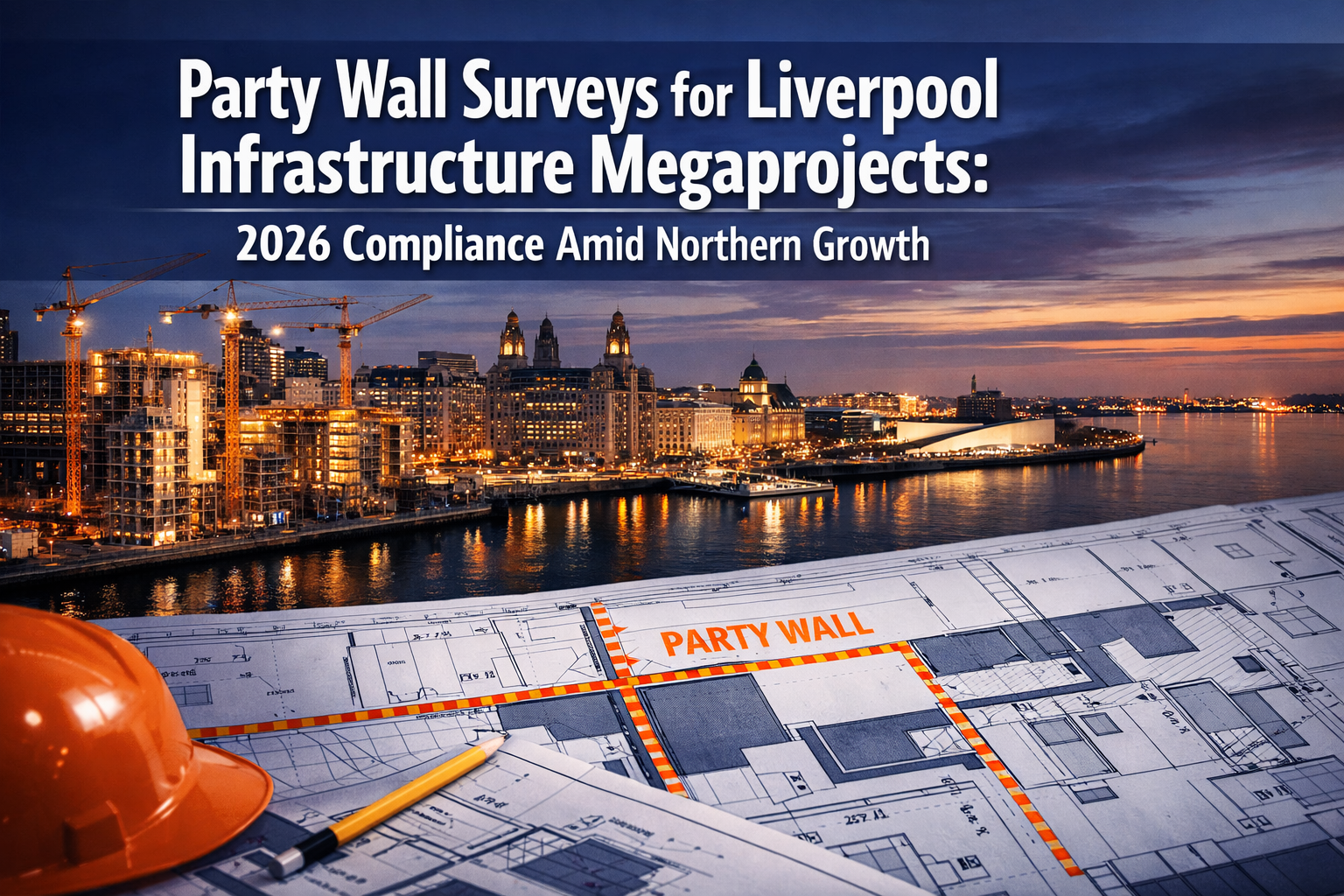
Liverpool's skyline is transforming at an unprecedented pace. With over £7 billion in regeneration projects underway across the city and surrounding areas, 2026 marks a pivotal year for one of Northern England's most ambitious urban renewal programmes.[3] From the £1 billion King Edward Triangle development to the transformation of historic docklands, these megaprojects are reshaping the city's landscape. Yet beneath the excitement of cranes and construction lies a critical legal framework that developers, contractors, and property owners must navigate: Party Wall Surveys for Liverpool Infrastructure Megaprojects: 2026 Compliance Amid Northern Growth.
As massive infrastructure schemes advance alongside existing residential and commercial properties, the Party Wall etc. Act 1996 becomes an essential tool for managing boundaries, preventing disputes, and ensuring that growth doesn't come at the expense of existing property owners. Understanding how party wall protocols apply to large-scale public infrastructure projects is no longer optional—it's a regulatory necessity.
Key Takeaways
- 🏗️ Liverpool's £7bn+ regeneration portfolio requires comprehensive party wall compliance for projects adjacent to existing structures
- 📋 Party wall surveys are mandatory when infrastructure megaprojects involve excavation, boundary work, or construction within 3-6 metres of neighbouring properties
- ⚖️ RICS protocols provide standardized frameworks for managing party wall agreements in complex, multi-stakeholder infrastructure developments
- 🤝 Early engagement with party wall surveyors (typically 2-4 months before construction) prevents costly delays and legal disputes
- 📊 Public infrastructure adjacencies create unique compliance challenges requiring specialized surveying expertise and community consultation
Understanding Party Wall Surveys for Liverpool Infrastructure Megaprojects: 2026 Compliance Amid Northern Growth
What Makes Liverpool's 2026 Infrastructure Boom Unique
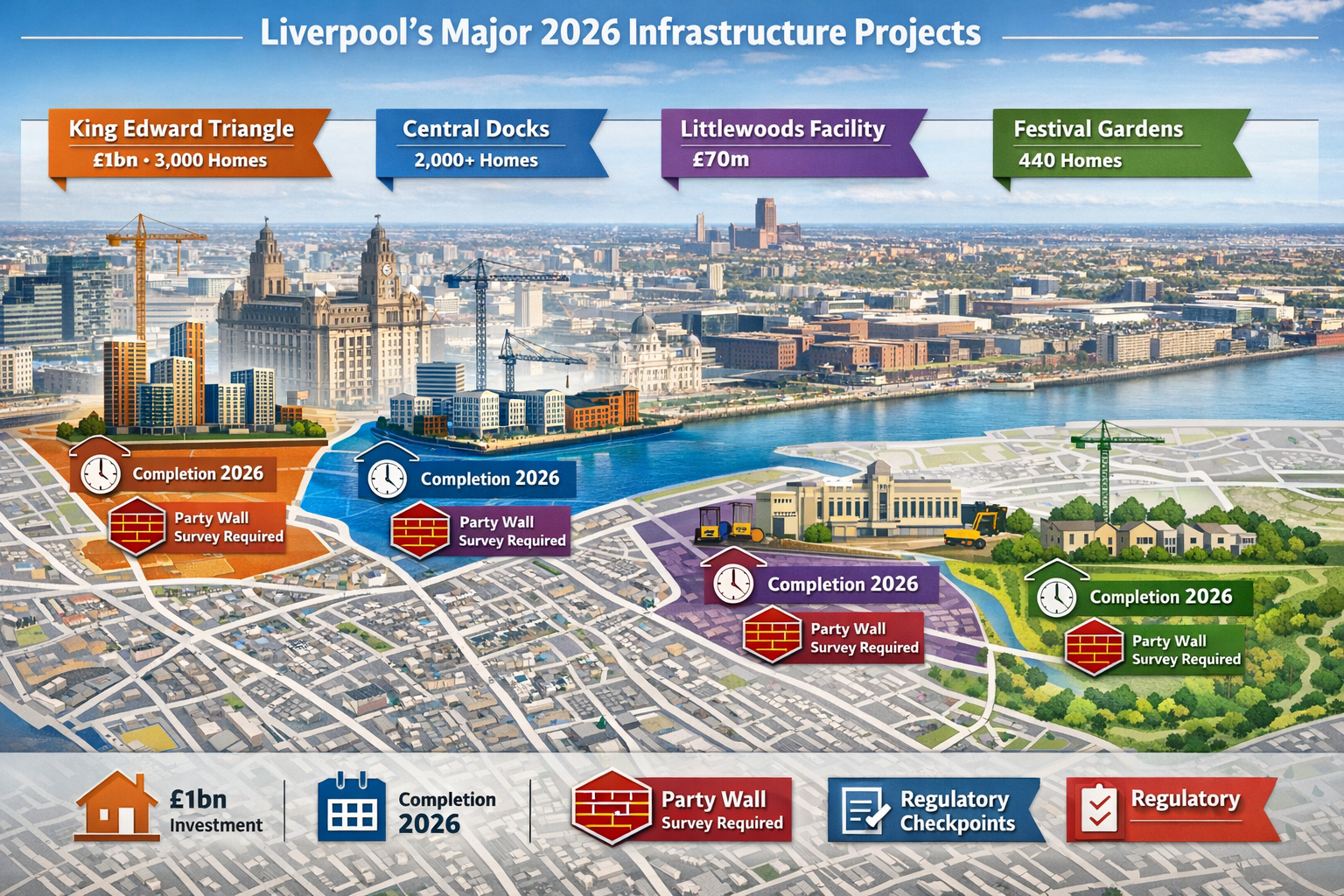
Liverpool's current regeneration wave differs fundamentally from previous development cycles. The scale, density, and proximity to existing properties create unprecedented party wall considerations. The King Edward Triangle scheme alone will deliver approximately 3,000 homes in high-rise buildings on Liverpool's northern waterfront, with delivery extending into the early 2030s.[3] This massive residential project, combined with new hotels and a potential events arena, sits adjacent to established neighbourhoods where Victorian terraces and post-war housing meet cutting-edge development.
Similarly, the Central Docks neighbourhood spans 26 acres and will produce over 2,000 new homes with supporting infrastructure, including a five-acre Central Park targeted for completion in 2028.[3] Construction began in late 2025, meaning 2026 represents a critical compliance year as excavation and foundation work progresses alongside occupied properties.
The £70 million Littlewoods film and television facility proposal by Capital&Centric presents another dimension: converting a Grade II-listed former retail building into a major production facility with two 20,000 sq ft studio stages.[3] Heritage considerations intersect with party wall requirements when historic structures undergo substantial modification near neighbouring properties.
The Party Wall Act Framework in Large-Scale Projects
The Party Wall etc. Act 1996 applies to all building works in England and Wales, regardless of project scale. For infrastructure megaprojects, three main notice types become relevant:
Party Structure Notices cover work directly to a shared wall, floor, or boundary structure. In Liverpool's dense urban core, many megaproject sites abut existing buildings where foundations, retaining walls, or boundary structures require modification.
Party Wall Notices apply when building a new wall at or astride a boundary line. Large-scale residential developments frequently involve perimeter walls, security barriers, or acoustic screening that trigger these requirements.
Excavation Notices become critical for Liverpool's infrastructure projects. When excavation occurs within 3 metres of a neighbouring building and goes deeper than its foundations—or within 6 metres and cuts a 45-degree line from the foundation base—formal notice is mandatory. Given Liverpool's waterfront geology and the depth requirements for high-rise foundations, excavation notices represent the most common party wall trigger for 2026 megaprojects.
For comprehensive background on party wall protocols, refer to our complete guide to party wall surveys.
RICS Standards and Regional Compliance Data
The Royal Institution of Chartered Surveyors (RICS) provides professional standards that govern party wall surveying practice. In 2026, RICS guidance emphasizes proportionate and collaborative approaches for infrastructure projects, recognizing that megaprojects involve multiple stakeholders with varying interests.
RICS-accredited party wall surveyors must:
- Conduct thorough pre-construction condition surveys of all affected neighbouring properties
- Prepare detailed party wall awards that specify work scope, timing, and protective measures
- Monitor construction activities to ensure compliance with agreed terms
- Resolve disputes through impartial professional judgment
Northern England's infrastructure expansion has transformed the construction landscape in 2026, with party wall surveys playing an essential role in managing agreements during this regional growth.[1] Liverpool's experience mirrors broader Northern patterns, where urban regeneration concentrates multiple large projects in established neighbourhoods.
Understanding what party wall surveyors do becomes crucial when navigating these complex scenarios.
Key Compliance Challenges in Liverpool's 2026 Megaprojects

Multi-Stakeholder Coordination Complexities
Infrastructure megaprojects involve far more parties than typical residential extensions. A single Liverpool development might include:
- Primary developers (Peel Group, Urban Splash, Capital&Centric)
- Multiple contractors and subcontractors for different construction phases
- Local authorities with planning and highways responsibilities
- Utility companies managing services infrastructure
- Dozens or hundreds of adjacent property owners requiring individual party wall notices
- Commercial tenants in neighbouring buildings
- Heritage bodies when listed buildings are affected
Coordinating party wall compliance across this stakeholder matrix requires sophisticated project management. The Festival Gardens redevelopment by Urban Splash and Igloo Regeneration illustrates this complexity: 440 new homes (including 110 affordable units and 80 extra-care units) on the former 1984 International Garden Festival site, with planning application expected late 2026 and construction beginning in 2027.[3]
Each adjacent property owner has legal rights under the Party Wall Act. Developers cannot simply issue blanket notices—each case requires individual assessment, documentation, and potentially separate party wall awards. For projects spanning multiple city blocks, this might mean managing 50-100+ separate party wall agreements simultaneously.
Excavation and Foundation Challenges Near Historic Properties
Liverpool's architectural heritage creates unique party wall challenges. Victorian warehouses, Georgian terraces, and early 20th-century commercial buildings often have shallow foundations by modern standards. When contemporary high-rise developments require deep piling or basement excavation nearby, the risk of settlement or structural movement increases significantly.
Deep excavation protocols for 2026 compliance include:
- Detailed geological surveys assessing soil composition, water table levels, and existing foundation depths
- Vibration monitoring during piling operations to ensure neighbouring structures remain within safe thresholds
- Underpinning provisions in party wall awards, specifying remedial measures if movement occurs
- Photographic and structural condition surveys before work commences, establishing baseline conditions
The Party Wall Act requires building owners to serve notice at least two months before construction begins for most work types, or one month for excavation-only notices. For megaprojects with phased construction timelines, this means advance planning and rolling notice schedules.
Questions about whether neighbours can refuse party wall agreements arise frequently in large-scale contexts where community concerns about disruption run high.
Public Infrastructure Adjacencies and Highways Work
Liverpool's £5 billion vision to regenerate 86 acres between Liverpool Central Station and Lime Street includes improved connectivity and a potential underground link, with feasibility and design work expected during 2026.[3] This ambitious proposal highlights a unique party wall dimension: public infrastructure adjacencies.
When megaprojects involve work near or beneath public highways, rail corridors, or utility easements, additional regulatory layers apply:
- Highways authorities may have statutory rights that override or complement party wall provisions
- Network Rail requirements for work near railway infrastructure
- Utility company protocols for excavation near gas mains, water pipes, or electrical cables
- Environmental Agency considerations for work affecting drainage or flood defences
Party wall surveyors working on Liverpool's 2026 infrastructure projects must coordinate with these bodies, ensuring that party wall awards align with broader statutory requirements. This often means extended timelines for approval and more complex protective provisions.
Residential Displacement and Tenant Rights
Large-scale excavation or construction can occasionally necessitate temporary relocation of neighbouring residents, particularly when underpinning or structural shoring is required. The Party Wall Act doesn't explicitly address compensation for inconvenience or temporary displacement, but party wall awards can include provisions for:
- Alternative accommodation costs during high-risk construction phases
- Compensation for loss of amenity (noise, dust, restricted access)
- Security measures to protect vacant properties during construction
- Schedules of condition documenting pre-work property states
For Liverpool's residential megaprojects delivering thousands of new homes, managing these community impacts professionally is essential for maintaining social license and avoiding costly disputes.
Best Practices for Party Wall Surveys in Liverpool's 2026 Infrastructure Context
Early Engagement and Pre-Construction Planning
The single most effective strategy for successful party wall compliance in megaprojects is early engagement—ideally 4-6 months before construction commences. This timeline allows for:
Month 1-2: Identify all potentially affected properties through desktop review and site surveys. For Liverpool's high-density urban areas, this might include properties up to 6 metres from excavation zones.
Month 2-3: Appoint qualified party wall surveyors and begin preliminary discussions with neighbouring property owners. Early informal consultation often identifies concerns that can be addressed in project design.
Month 3-4: Serve formal party wall notices and conduct detailed condition surveys of neighbouring properties. Professional photographic documentation and structural assessments establish baseline conditions.
Month 4-5: Negotiate and finalize party wall awards, incorporating protective measures, monitoring protocols, and dispute resolution procedures.
Month 5-6: Establish monitoring systems and communication channels before construction begins.
This proactive approach contrasts sharply with reactive compliance, where no party wall notice is served until disputes arise—a scenario that can halt construction and trigger costly legal proceedings.
Selecting Qualified Party Wall Surveyors for Megaprojects
Not all party wall surveyors have experience with infrastructure-scale projects. When selecting professionals for Liverpool's 2026 developments, developers should prioritize:
- RICS accreditation and professional indemnity insurance
- Demonstrated experience with large-scale urban regeneration projects
- Local knowledge of Liverpool's building stock, geology, and regulatory environment
- Multi-party coordination capabilities for managing dozens of simultaneous agreements
- Technical expertise in structural engineering, particularly for deep excavation and high-rise construction
The party wall surveyor's role extends beyond legal compliance to include risk management, community relations, and construction monitoring.
Leveraging Technology for Compliance Management
Modern party wall compliance increasingly relies on digital tools:
Digital condition surveys using 360-degree photography, laser scanning, and drone imagery create comprehensive baseline records that are admissible in dispute resolution.
Vibration monitoring systems with real-time alerts notify surveyors and contractors immediately if ground movement or structural vibration exceeds safe thresholds.
Project management platforms track notice deadlines, award milestones, and stakeholder communications across complex multi-party agreements.
GIS mapping visualizes party wall notice zones, excavation boundaries, and affected properties, helping project teams understand spatial relationships and compliance requirements.
For Liverpool's megaprojects, these technologies scale party wall management from dozens to hundreds of properties without proportional increases in administrative burden.
Community Consultation and Transparent Communication
Beyond legal requirements, successful infrastructure projects in 2026 emphasize social license—community acceptance and support. Party wall compliance offers an opportunity for positive engagement:
- Public information sessions explaining party wall processes and addressing concerns before formal notices are served
- Dedicated community liaison officers who handle party wall queries and complaints
- Regular progress updates to neighbouring property owners about construction milestones and upcoming high-impact activities
- Accessible dispute resolution processes that address concerns quickly and fairly
The Festival Gardens redevelopment, with its 110 affordable units and 80 extra-care units, demonstrates how infrastructure projects can balance growth with community benefit.[3] Transparent party wall processes reinforce this balance, showing respect for existing residents' rights while enabling necessary development.
Understanding Cost Responsibilities
A common question in large-scale projects concerns who pays for party wall surveyors. Under the Party Wall Act:
- The building owner (developer) pays for their own surveyor
- The building owner also pays reasonable costs for the adjoining owner's surveyor
- If parties agree to use a single agreed surveyor, the building owner pays those fees
For megaprojects affecting dozens of properties, surveyor costs can reach £50,000-£150,000+ depending on project complexity. However, this investment is modest compared to potential costs of construction delays, legal disputes, or remedial work resulting from inadequate party wall compliance.
Regulatory Outlook and Future Developments
2026 Compliance Trends in Northern Infrastructure
Northern England's infrastructure expansion in 2026 has established new norms for party wall practice.[1] Liverpool's experience contributes to emerging regional standards:
Standardized notice templates for large-scale residential developments reduce administrative burden while ensuring legal compliance.
Pre-approved protective measures for common scenarios (e.g., piling near Victorian terraces) streamline party wall award negotiations.
Regional surveyor networks facilitate knowledge sharing and consistent professional standards across Northern megaprojects.
Integrated planning conditions increasingly require developers to demonstrate party wall compliance strategies before planning approval, rather than treating it as a post-approval formality.
Legislative and Professional Practice Evolution
While the Party Wall Act 1996 remains unchanged, professional practice continues to evolve. RICS guidance updates in 2025-2026 emphasize:
- Proportionality in surveyor appointments and award complexity relative to project risk
- Alternative dispute resolution mechanisms before escalating to formal surveyor determinations
- Climate resilience considerations in party wall awards, particularly for flood risk and sustainable drainage
- Digital documentation standards for condition surveys and monitoring data
These developments reflect infrastructure realities: megaprojects require flexible, scalable party wall frameworks that protect property rights without creating unnecessary bureaucracy.
Liverpool's Long-Term Regeneration Pipeline
Looking beyond 2026, Liverpool's regeneration pipeline extends into the 2030s. The King Edward Triangle's phased delivery, the Central Docks neighbourhood completion, and the Littlewoods facility construction will require sustained party wall compliance over multiple years.[3]
This long-term perspective demands:
Institutional memory within development organizations about party wall commitments across project phases
Ongoing monitoring of structural conditions in neighbouring properties throughout extended construction periods
Adaptive management as construction methods, site conditions, or neighbouring property ownership changes
Legacy planning ensuring that party wall obligations transfer properly if projects change hands mid-development
For guidance on related surveying needs, explore our resources on construction surveys and commercial building surveys.
Practical Guidance for Stakeholders
For Developers and Contractors
Action Steps:
- Budget appropriately for party wall compliance—typically 0.5-1.5% of construction costs for urban megaprojects
- Appoint surveyors early in project planning, not as an afterthought when construction is imminent
- Integrate party wall timelines into critical path project scheduling
- Establish clear internal protocols for managing multiple simultaneous party wall agreements
- Document everything through professional condition surveys and photographic records
Understanding party structure notices and excavation notice requirements is essential for compliance.
For Neighbouring Property Owners
Your Rights Include:
- Formal notice at least 1-2 months before work affecting your property begins
- Independent surveyor representation at the building owner's expense
- Detailed party wall awards specifying work scope, protective measures, and monitoring
- Compensation for any damage caused by construction activities
- Access rights for surveyors to inspect your property before, during, and after construction
If you receive a party wall notice from a Liverpool megaproject developer, don't ignore it. Respond within 14 days, either consenting to the work or dissenting (which triggers the surveyor appointment process). Seeking professional advice early prevents misunderstandings and protects your interests.
For Local Authorities and Planners
Supporting Compliance:
- Integrate party wall requirements into pre-application advice for major projects
- Include compliance verification in planning conditions for developments near existing properties
- Facilitate community consultation processes that complement statutory party wall procedures
- Maintain accessible guidance for residents receiving party wall notices from infrastructure projects
Liverpool's regeneration success depends on balancing growth with existing community protection—party wall compliance is a key mechanism for achieving this balance.
Conclusion
Party Wall Surveys for Liverpool Infrastructure Megaprojects: 2026 Compliance Amid Northern Growth represents far more than bureaucratic box-ticking. As Liverpool advances its £7 billion regeneration portfolio—from the King Edward Triangle's 3,000 homes to the Central Docks neighbourhood and Littlewoods film facility—party wall protocols provide essential legal and practical frameworks for managing the interface between ambitious new development and existing property rights.[3]
The scale and complexity of 2026's infrastructure boom demand sophisticated approaches: early surveyor engagement, multi-stakeholder coordination, advanced monitoring technologies, and transparent community communication. Developers who treat party wall compliance as a strategic priority rather than a regulatory burden will find smoother project delivery, fewer disputes, and stronger community relationships.
For neighbouring property owners, understanding party wall rights and processes ensures that Northern England's growth doesn't come at the expense of existing homes and businesses. The Party Wall Act provides robust protections—but only when properly invoked and professionally managed.
As Liverpool's transformation continues through the remainder of the decade, party wall surveys will remain a critical enabler of sustainable, equitable urban regeneration. The lessons learned in 2026 will shape infrastructure practice across Northern England and beyond, demonstrating that ambitious growth and respectful property management can advance together.
Next Steps
For developers: Schedule party wall compliance planning sessions for Q2-Q3 2026 projects now. Engage qualified RICS surveyors and begin neighbour identification processes.
For property owners: If you've received a party wall notice, respond within 14 days and consider appointing an independent surveyor to represent your interests.
For all stakeholders: Stay informed about Liverpool's evolving infrastructure landscape and ensure party wall compliance remains integrated into project planning and community engagement strategies.
Liverpool's regeneration represents an extraordinary opportunity to reshape the city for future generations. Professional party wall practice ensures this transformation respects the rights and properties of those who call Liverpool home today.
References
[1] Party Wall Surveys For Northern Englands Infrastructure Boom Managing Agreements Amid Regional Growth – https://nottinghillsurveyors.com/blog/party-wall-surveys-for-northern-englands-infrastructure-boom-managing-agreements-amid-regional-growth
[2] State Nation 2026 – https://knowledgehub.ice.org.uk/insight/state-nation-2026/
[3] Liverpools Regeneration To Take Major Step Forward In 2026 – https://www.buyassociationgroup.com/en-us/news/liverpools-regeneration-to-take-major-step-forward-in-2026/
