
{"cover":"Professional landscape format (1536×1024) hero image with bold text overlay 'Expert Witness Valuations in Buyer Demand Disputes: RICS Evidence for the February 2026 Market Correction' in extra large 70pt white sans-serif font with dark shadow effect, centered in upper third. Background shows courtroom setting with professional expert witness at stand, legal documents, property valuation charts on digital screens, RICS Red Book visible on desk. Color scheme: deep navy blue, white, gold accents. High contrast, editorial magazine cover quality, professional legal-property aesthetic with subtle UK property market graphs in background blur.","content":["Detailed landscape format (1536×1024) image showing dramatic downward trending graph of UK buyer enquiries with prominent red arrow declining from January 2026 (-15% net balance) to February 2026 (-26% net balance). Split screen composition: left side shows concerned property buyers reviewing documents with surveyor, right side displays large digital dashboard with RICS market data, percentage drops highlighted in red, calendar showing February 2026. Professional color scheme: red for decline, navy blue for stability, white background. Clean infographic style with data visualization, professional property market aesthetic.","Detailed landscape format (1536×1024) image depicting RICS chartered surveyor as expert witness in formal dispute resolution setting. Central focus on professional in business attire presenting Red Book valuation report to panel, large screen behind showing comparable property data, market correction evidence charts, February 2026 timeline. Foreground shows open RICS valuation standards manual, calculator, property photographs. Composition uses rule of thirds, professional lighting, corporate boardroom environment. Color palette: professional navy, burgundy, cream tones. Documentary photography style with legal-professional atmosphere.","Detailed landscape format (1536×1024) image showing comprehensive valuation methodology workspace. Overhead flat-lay composition featuring multiple property valuation reports spread across desk, RICS Red Book prominently displayed, laptop screen showing February 2026 market data spreadsheets, comparable sales analysis documents with highlighted sections, interest rate forecasts (3.5% base rate), regional price variation maps of UK with Central London highlighted showing 4-6.5% gains. Professional surveyor's tools: measuring tape, property inspection checklist, expert witness statement draft. Warm professional lighting, organized chaos aesthetic, business documentary style with rich detail."]

The UK property market has experienced a sharp correction in early 2026, with buyer enquiries plummeting by 26% net balance in February following a 15% drop in January. This dramatic shift in market sentiment has triggered a wave of valuation disputes between buyers, sellers, and lenders—disputes that increasingly require expert witness testimony grounded in robust RICS evidence. Understanding how to navigate Expert Witness Valuations in Buyer Demand Disputes: RICS Evidence for the February 2026 Market Correction has become essential for property professionals, legal teams, and stakeholders facing contractual disagreements in this volatile environment.
When market conditions change rapidly, property valuations can differ significantly between parties. Buyers may argue that agreed purchase prices no longer reflect current market reality, while sellers maintain that valuations remain sound. In these situations, expert witness testimony becomes crucial to resolving disputes through arbitration, mediation, or court proceedings.
Key Takeaways
- 📉 Buyer enquiries dropped 26% net balance in February 2026, creating widespread valuation disputes as market sentiment shifted dramatically
- ⚖️ Expert witness valuations must follow RICS standards and provide objective, evidence-based opinions rather than advocacy for either party
- 📊 February 2026 market data shows regional variation, with Central London gaining 4-6.5% while other areas experienced corrections
- 🏦 Interest rate expectations (base rate cuts to 3.5%) significantly impact valuation methodologies and dispute outcomes
- 📋 Proper documentation and comparable evidence from the specific valuation date are essential for credible expert witness testimony
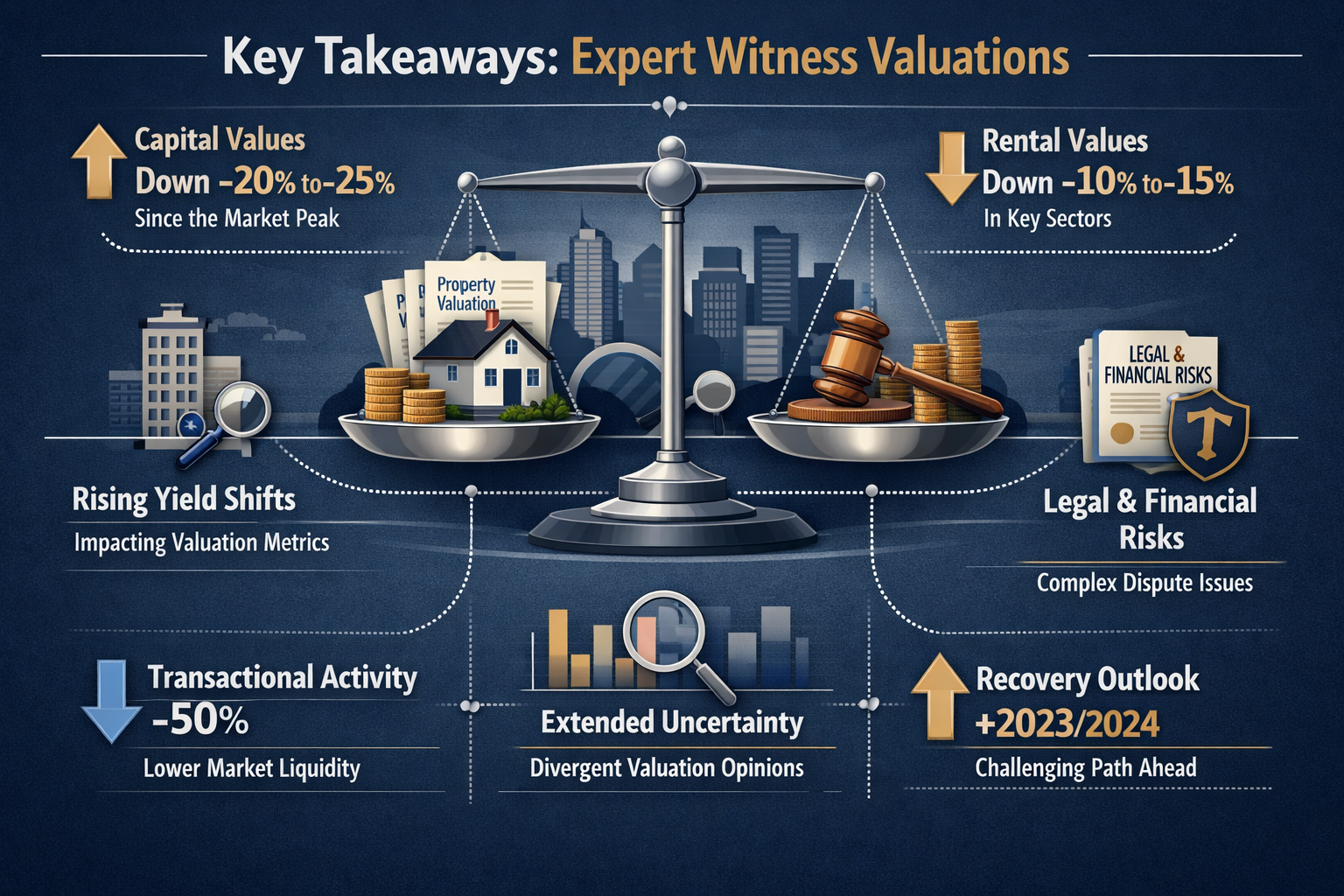
Understanding the February 2026 Market Correction and Its Impact on Valuations
The February 2026 market correction represents one of the most significant shifts in buyer sentiment in recent years. The 26% net balance decline in buyer enquiries signals a fundamental change in market dynamics that directly affects property valuations and creates fertile ground for disputes[4].
What Caused the Sharp Decline in Buyer Demand?
Several interconnected factors contributed to this dramatic market shift:
Economic Uncertainty: The UK economy ended 2025 with minimal growth of just 0.1% in the final quarter, achieving only 1.3% growth for the full year. This subdued economic outlook continued into 2026, dampening buyer confidence[4].
Interest Rate Volatility: While the Bank of England's base rate was expected to be cut to 3.5% in March or April 2026, uncertainty around the timing and extent of cuts created hesitation among potential buyers[4].
Affordability Pressures: Despite potential rate cuts, accumulated affordability challenges from previous years continued to constrain buyer purchasing power.
Sentiment Shift: The rapid decline from -15% in January to -26% in February suggests a psychological tipping point where buyer caution became self-reinforcing.
Regional Variations in the Market Correction
The February 2026 correction did not affect all regions equally. Central London demonstrated resilience with approximately 4% gains in aggregate, with some prime areas posting 6.5% gains[4]. This regional divergence creates additional complexity for expert witness valuations, as comparable evidence must be carefully selected from appropriate geographic areas.
| Region | Performance | Implications for Valuations |
|---|---|---|
| Central London | +4% to +6.5% | Strong comparable evidence available |
| Outer London | Mixed results | Requires careful submarket analysis |
| Regional Markets | Generally weaker | More significant correction impact |
| Rental Market | +3% composite growth | Alternative valuation benchmarks[4] |
How Market Corrections Trigger Valuation Disputes
When buyer demand drops sharply, several dispute scenarios commonly emerge:
- Contract Renegotiations: Buyers seek to reduce agreed purchase prices based on changed market conditions
- Mortgage Valuation Disputes: Lender valuations come in below agreed prices, threatening transaction completion
- Development Appraisals: Projected values for development schemes require downward revision
- Portfolio Valuations: Investment property portfolios face revaluation challenges
- Divorce Settlements: Property division disputes intensify when valuations are contested
Understanding the specific context of the February 2026 market correction is essential for preparing credible expert witness testimony that courts and tribunals will accept.
The Role of Expert Witness Valuations in Buyer Demand Disputes: RICS Evidence for the February 2026 Market Correction
Expert witnesses play a critical role in resolving property valuation disputes by providing independent, objective opinions based on professional expertise and RICS standards. Their testimony helps courts, tribunals, and arbitrators understand complex valuation issues in the context of rapidly changing market conditions.
What Makes a Valuation "Expert Witness" Quality?
According to RICS standards, real estate valuation is "a professional opinion based on the valuer's experience and expertise" rather than a definitive fact[1]. This distinction becomes particularly important in uncertain market conditions like those experienced in February 2026.
Key characteristics of expert witness valuations include:
- ✅ Independence: The expert owes their primary duty to the court or tribunal, not to the party instructing them
- ✅ RICS Compliance: All valuations must follow the RICS Red Book global standards
- ✅ Transparency: Clear explanation of methodology, assumptions, and limitations
- ✅ Evidence-Based: Comprehensive comparable evidence from the relevant valuation date
- ✅ Objectivity: Balanced consideration of all factors affecting value
"The expert witness must provide an objective, unbiased opinion to assist the court in understanding technical matters, not to advocate for the party who instructed them."
RICS Standards for Expert Witness Work
The Royal Institution of Chartered Surveyors provides specific guidance for members acting as expert witnesses. These standards ensure that expert testimony meets professional and legal requirements:
Professional Competence: Experts must possess appropriate knowledge, skills, and experience for the specific valuation dispute. For February 2026 market correction disputes, this includes understanding recent market dynamics and data interpretation.
Conflicts of Interest: Experts must declare any potential conflicts and ensure independence from the parties involved.
Report Standards: Expert witness reports must include:
- Clear instructions received
- Valuation date and purpose
- Inspection details and property description
- Market context and analysis
- Methodology and approach
- Comparable evidence
- Valuation conclusion
- Assumptions and limitations
- Declaration of truth
Preparing Expert Witness Testimony for Market Correction Disputes
When preparing expert witness valuations related to the February 2026 market correction, several specific considerations apply:
1. Establishing the Valuation Date
The valuation date is crucial. A property valued in December 2025 versus February 2026 could have significantly different values given the 26% drop in buyer enquiries. Expert witnesses must clearly establish whether the dispute concerns:
- Original valuation date (pre-correction)
- Current market value (post-correction)
- Retrospective valuation at a specific point during the correction
2. Gathering Market Evidence
Robust comparable evidence is essential. For February 2026 disputes, experts should gather:
- Transaction data from the specific period showing actual sale prices
- RICS survey data documenting the decline in buyer enquiries[4]
- Regional performance data showing geographic variations
- Interest rate expectations and their impact on affordability
- Days on market statistics showing changing absorption rates
3. Addressing Market Uncertainty
The February 2026 correction created significant uncertainty. RICS guidance acknowledges that valuation in extreme or uncertain conditions presents particular challenges[1]. Expert witnesses should:
- Clearly state the level of uncertainty in their opinion
- Provide sensitivity analysis showing value ranges
- Explain how market volatility affects confidence levels
- Reference relevant RICS guidance on valuation uncertainty
4. Methodology Selection
Different valuation approaches may be appropriate depending on the dispute context:
| Approach | When Applicable | February 2026 Considerations |
|---|---|---|
| Comparable Method | Residential properties | Must use transactions from correction period |
| Investment Method | Buy-to-let properties | Consider 3% rental growth data[4] |
| Residual Method | Development sites | Adjust for reduced buyer demand impact |
| Profits Method | Commercial properties | Factor in economic outlook[4] |
For most residential buyer demand disputes, the comparable method remains primary, but experts must carefully select comparables that reflect the February 2026 market conditions.
Common Challenges in Buyer Demand Dispute Valuations
Expert witnesses face several specific challenges when dealing with market correction disputes:
Data Lag: Published market data often lags real-time conditions by several weeks or months, making February 2026 evidence initially scarce.
Sentiment vs. Reality: The 26% drop in enquiries reflects sentiment, but actual transaction prices may not immediately reflect this decline.
Regional Divergence: Central London's 4-6.5% gains contrast sharply with other areas, requiring careful geographic analysis[4].
Conflicting Evidence: Different data sources may tell different stories about the correction's severity.
Experienced expert witnesses address these challenges through comprehensive research, transparent explanation of limitations, and balanced interpretation of available evidence. Those seeking professional guidance can benefit from understanding what property surveyors look for during their assessments.

Applying RICS Evidence and Data to Support Expert Witness Valuations in Buyer Demand Disputes: RICS Evidence for the February 2026 Market Correction
The credibility of expert witness testimony depends heavily on the quality and relevance of supporting evidence. For disputes arising from the February 2026 market correction, RICS data and properly documented market evidence form the foundation of persuasive expert opinions.
Key RICS Data Sources for February 2026 Disputes
Several RICS publications and data sources provide essential evidence for market correction disputes:
RICS UK Residential Market Survey: This monthly survey captures real-time sentiment and activity levels. The February 2026 survey documented the 26% net balance decline in buyer enquiries, providing authoritative evidence of the market shift[4].
RICS UK Economy & Property Update: This comprehensive report provides broader economic context, including the subdued 0.1% Q4 2025 growth and 1.3% annual growth figures that influenced the market correction[4].
RICS Valuation Standards (Red Book): The global standards that govern all professional valuations, ensuring consistency and quality in expert witness work.
Regional Market Data: RICS regional reports showing the divergent performance between Central London (4-6.5% gains) and other markets[4].
Building a Compelling Evidence Base
Expert witnesses must construct a comprehensive evidence package that supports their valuation opinion:
1. Market Context Documentation
Establish the broader market environment:
- Economic growth data (1.3% annual, 0.1% Q4)[4]
- Interest rate environment and expectations (3.5% base rate forecast)[4]
- Buyer enquiry trends (-15% January, -26% February)[4]
- Rental market performance (3% composite growth)[4]
2. Comparable Transaction Evidence
Select and analyze appropriate comparables:
- Temporal relevance: Transactions from the correction period
- Geographic relevance: Same submarket or comparable area
- Property characteristics: Similar size, type, condition
- Transaction type: Arm's length sales, not distressed
- Adjustments: Clear explanation of any adjustments made
3. Supporting Market Indicators
Supplement transaction data with additional indicators:
- Average days on market
- Price reduction frequency
- Mortgage approval rates
- Survey activity levels
- Vendor confidence measures
Addressing Conflicting Valuations
In many disputes, opposing parties present significantly different valuations. Expert witnesses must address these discrepancies professionally:
Analyze Methodology Differences: Often, valuation gaps result from different methodological approaches or assumptions. Expert witnesses should clearly explain their chosen methodology and why it's appropriate.
Examine Comparable Selection: Differences in comparable evidence selection frequently explain valuation gaps. Experts should critique comparable choices based on relevance and reliability.
Consider Timing Issues: Valuations prepared at different dates during the correction period may legitimately differ due to rapidly changing conditions.
Assess Adjustment Appropriateness: How adjustments are made to comparable evidence significantly affects final valuations.
Case Study: Typical February 2026 Buyer Demand Dispute
Consider a typical dispute scenario:
Background: A buyer agreed to purchase a property in December 2025 for £750,000. By February 2026, the mortgage lender's valuation came in at £695,000, citing the market correction. The buyer sought to renegotiate, while the seller insisted the original price remained valid.
Expert Witness Approach:
- Establish valuation dates: December 2025 (agreement) vs. February 2026 (dispute)
- Gather comparable evidence: Transactions from both periods in the same area
- Analyze market shift: Document the 26% enquiry decline and its local impact
- Consider regional factors: Assess whether the property was in a resilient or vulnerable submarket
- Apply appropriate methodology: Use comparable method with clear adjustments
- Provide reasoned opinion: Explain whether the price reduction was justified and to what extent
Outcome: The expert witness determined that a 5-7% reduction was supported by market evidence, recommending a revised value of approximately £705,000-£712,500, providing a middle ground for settlement.
Documentation and Report Preparation
Expert witness reports for February 2026 market correction disputes should include:
Executive Summary: Clear statement of the valuation opinion and key supporting factors
Instructions and Scope: What the expert was asked to determine
Property Description: Based on inspection or provided documentation
Market Analysis Section:
- Economic context (1.3% growth, 0.1% Q4)[4]
- Buyer demand trends (-26% February enquiries)[4]
- Regional performance (Central London +4-6.5%)[4]
- Interest rate environment (3.5% forecast)[4]
Comparable Evidence: Detailed schedule of comparable transactions with adjustments
Valuation Methodology: Clear explanation of approach and reasoning
Valuation Conclusion: Supported opinion with confidence level statement
Assumptions and Limitations: Transparent disclosure of any constraints
Declaration: Statement of truth and expert witness duties
Those involved in property transactions may also find value in understanding Help to Buy valuations, which follow similar RICS standards.
The Importance of Professional Qualifications
Expert witnesses in property valuation disputes should possess:
- RICS Membership: Preferably MRICS or FRICS designation
- Relevant Experience: Demonstrated expertise in residential valuations
- Local Market Knowledge: Understanding of the specific geographic market
- Expert Witness Training: Formal training in expert witness procedures
- Professional Indemnity Insurance: Adequate coverage for expert witness work
The combination of professional qualifications, robust RICS evidence, and transparent methodology creates expert witness testimony that courts and tribunals find credible and useful for resolving disputes.
Practical Considerations for Property Professionals and Parties to Disputes
Understanding how to effectively use expert witness valuations in buyer demand disputes requires practical knowledge beyond theoretical principles. Property professionals, legal advisors, and parties to disputes should consider several key factors when engaging with the expert witness process.
When to Instruct an Expert Witness
Not every valuation disagreement requires expert witness involvement. Consider instructing an expert witness when:
- Significant Financial Stakes: The valuation difference exceeds the cost of expert engagement
- Formal Proceedings: Litigation, arbitration, or tribunal proceedings are underway or likely
- Negotiation Deadlock: Parties cannot reach agreement through standard negotiation
- Complex Valuation Issues: The property or market conditions present unusual challenges
- Credibility Gaps: One party's valuation lacks professional support or RICS compliance
For the February 2026 market correction, disputes involving properties valued above £500,000 with valuation gaps exceeding 5-7% typically warrant expert witness instruction.
Selecting the Right Expert Witness
The choice of expert witness significantly impacts dispute outcomes. Key selection criteria include:
Relevant Expertise: For February 2026 buyer demand disputes, select experts with:
- Recent residential valuation experience
- Knowledge of the specific geographic market
- Understanding of market correction dynamics
- Familiarity with current RICS standards
Independence: Ensure the expert has no conflicts of interest with either party.
Track Record: Review their experience in similar disputes and their acceptance by courts or tribunals.
Communication Skills: Expert witnesses must explain complex valuation issues clearly to non-specialists.
Availability: Ensure they can meet the dispute timeline requirements.
Engaging chartered surveyors with expert witness experience ensures professional standards and credibility.
Cost Considerations
Expert witness services involve several cost components:
| Service Component | Typical Cost Range | Notes |
|---|---|---|
| Initial consultation | £200-£500 | Understanding the dispute |
| Desktop valuation | £800-£1,500 | Without property inspection |
| Full inspection & report | £2,000-£5,000+ | Comprehensive expert report |
| Court attendance | £1,500-£3,000/day | Plus preparation time |
| Conference attendance | £200-£400/hour | Meetings with legal teams |
For February 2026 market correction disputes, expect total expert witness costs between £3,000-£8,000 depending on complexity and whether court attendance is required.
Preparing for Expert Witness Engagement
Parties instructing expert witnesses should prepare thoroughly:
Gather Documentation:
- Original purchase agreement and correspondence
- Previous valuations and survey reports
- Property details and marketing materials
- Relevant market data and comparable evidence
- Timeline of events leading to the dispute
Define Clear Instructions: Specify exactly what questions the expert should address, such as:
- What was the property's market value on [specific date]?
- Was the decline in buyer enquiries sufficient to justify a price reduction?
- What is the appropriate valuation methodology for this property?
Provide Context: Explain the nature of the dispute, the parties involved, and the intended use of the expert opinion.
Establish Timeline: Clarify deadlines for report delivery and any court or hearing dates.
Working with Legal Teams
Expert witnesses typically work alongside solicitors and barristers. Effective collaboration requires:
Early Engagement: Instruct experts early to allow adequate time for thorough analysis.
Clear Communication: Ensure legal teams and experts understand each other's requirements and constraints.
Joint Expert Meetings: In some disputes, experts from both sides meet to identify areas of agreement and disagreement, potentially narrowing the issues for determination.
Pre-Trial Preparation: Legal teams should thoroughly prepare experts for cross-examination if court attendance is required.
Alternative Dispute Resolution
Many February 2026 market correction disputes can be resolved without full litigation through:
Mediation: A neutral mediator helps parties reach agreement, often with expert valuations informing the negotiation.
Arbitration: A binding decision by an arbitrator based on expert evidence, typically faster and less expensive than court proceedings.
Expert Determination: Both parties agree to be bound by a single expert's valuation opinion.
These alternative approaches often provide faster, more cost-effective resolution than traditional litigation while still benefiting from professional expert witness input.
Learning from the February 2026 Market Correction
The sharp decline in buyer enquiries in February 2026 provides valuable lessons for future market volatility:
Early Warning Systems: Monitor RICS survey data and other leading indicators to anticipate market shifts before they impact transactions.
Flexible Contracting: Consider including market condition clauses in purchase agreements during periods of uncertainty.
Regular Revaluations: For development projects and portfolios, conduct regular revaluations during volatile periods.
Professional Advice: Engage qualified surveyors early in transactions to identify potential valuation issues.
Documentation: Maintain thorough records of market conditions and valuation rationale at each stage of property transactions.
Understanding these practical considerations helps all parties navigate buyer demand disputes more effectively, whether as property professionals, legal advisors, or parties to disputes themselves. Those purchasing property may also benefit from understanding whether a homebuyer survey is worth it to avoid future disputes.
Conclusion
The February 2026 market correction, marked by a dramatic 26% net balance decline in buyer enquiries, has created unprecedented challenges for property valuations and spawned numerous disputes between buyers, sellers, and lenders. Expert Witness Valuations in Buyer Demand Disputes: RICS Evidence for the February 2026 Market Correction has emerged as an essential service for resolving these conflicts through objective, professionally supported opinions.
Key insights from this analysis include:
🎯 Market Context Matters: The subdued UK economic outlook (1.3% annual growth), interest rate volatility (expected 3.5% base rate), and regional variations (Central London +4-6.5% versus broader corrections) all significantly impact valuation opinions[4].
⚖️ RICS Standards Are Essential: Expert witnesses must follow Red Book standards, maintain independence, and provide transparent, evidence-based opinions rather than advocacy[1].
📊 Robust Evidence Is Critical: Comprehensive comparable evidence from the relevant valuation date, supported by RICS survey data and market indicators, forms the foundation of credible expert testimony.
💼 Professional Expertise Delivers Results: Qualified RICS members with relevant experience, local market knowledge, and expert witness training provide the most effective support for dispute resolution.
Actionable Next Steps
For parties facing valuation disputes arising from the February 2026 market correction:
- Act Quickly: Market conditions continue to evolve, so early expert instruction preserves evidence and options
- Choose Wisely: Select expert witnesses with specific experience in residential valuations and market correction disputes
- Gather Evidence: Compile comprehensive documentation of the transaction history, market conditions, and comparable evidence
- Consider Alternatives: Explore mediation, arbitration, or expert determination before committing to full litigation
- Engage Professionals: Work with experienced chartered surveyors and legal advisors who understand both valuation principles and dispute resolution procedures
The February 2026 market correction demonstrates how rapidly property market conditions can change and how critical professional valuation expertise becomes during periods of volatility. By understanding the principles of expert witness valuations, the importance of RICS evidence, and the practical considerations for dispute resolution, property professionals and parties to disputes can navigate these challenges more effectively and reach fair, evidence-based outcomes.
Whether you're a buyer seeking to renegotiate a purchase price, a seller defending an agreed valuation, a lender managing risk, or a legal advisor representing clients, the combination of RICS-compliant methodology, comprehensive market evidence, and independent expert opinion provides the most reliable path to resolving valuation disputes in this challenging market environment.
References
[1] Real Estate Valuation Extreme Conditions – https://ww3.rics.org/uk/en/journals/property-journal/real-estate-valuation-extreme-conditions.html
[2] Expert Witness Roles In Lettings Tenant Demand Surge Valuations For 2026 Rental Price Rises Per Rics – https://nottinghillsurveyors.com/blog/expert-witness-roles-in-lettings-tenant-demand-surge-valuations-for-2026-rental-price-rises-per-rics
[3] Expert Witness Challenges In 2026 Interest Rate Volatility Disputes Rics Data Driven Preparation – https://nottinghillsurveyors.com/blog/expert-witness-challenges-in-2026-interest-rate-volatility-disputes-rics-data-driven-preparation
[4] Uk Economy Property Update February 2026 – https://www.rics.org/content/dam/ricsglobal/documents/market-surveys/uk-economy-property-update-february-2026.pdf
