
As Q1 2026 unfolds, building surveyors face unprecedented pressure to deliver comprehensive assessments of properties affected by Reinforced Autoclaved Aerated Concrete (RAAC) and dangerous cladding systems. With accelerated government remediation drives targeting schools and hospitals, alongside sweeping homebuying reforms, the demand for robust Building Survey Checklists for RAAC and Cladding Remediation Projects in Q1 2026: Post-Reform Compliance Essentials has never been more critical. 🏗️
The landscape has shifted dramatically. Seven additional NHS hospitals have completed RAAC eradication, with 12 more on track to finish by March 2026.[1] Over 42,000 pupils now learn in RAAC-free classrooms following intensive remediation efforts.[1] Yet approximately 3.5 million RAAC panels were sold across the UK between the 1960s and 1990s, affecting both public and private sectors.[1] For chartered surveyors conducting Level 2 and Level 3 surveys, updated checklists incorporating post-reform compliance requirements are essential tools for protecting clients and mitigating professional liability.
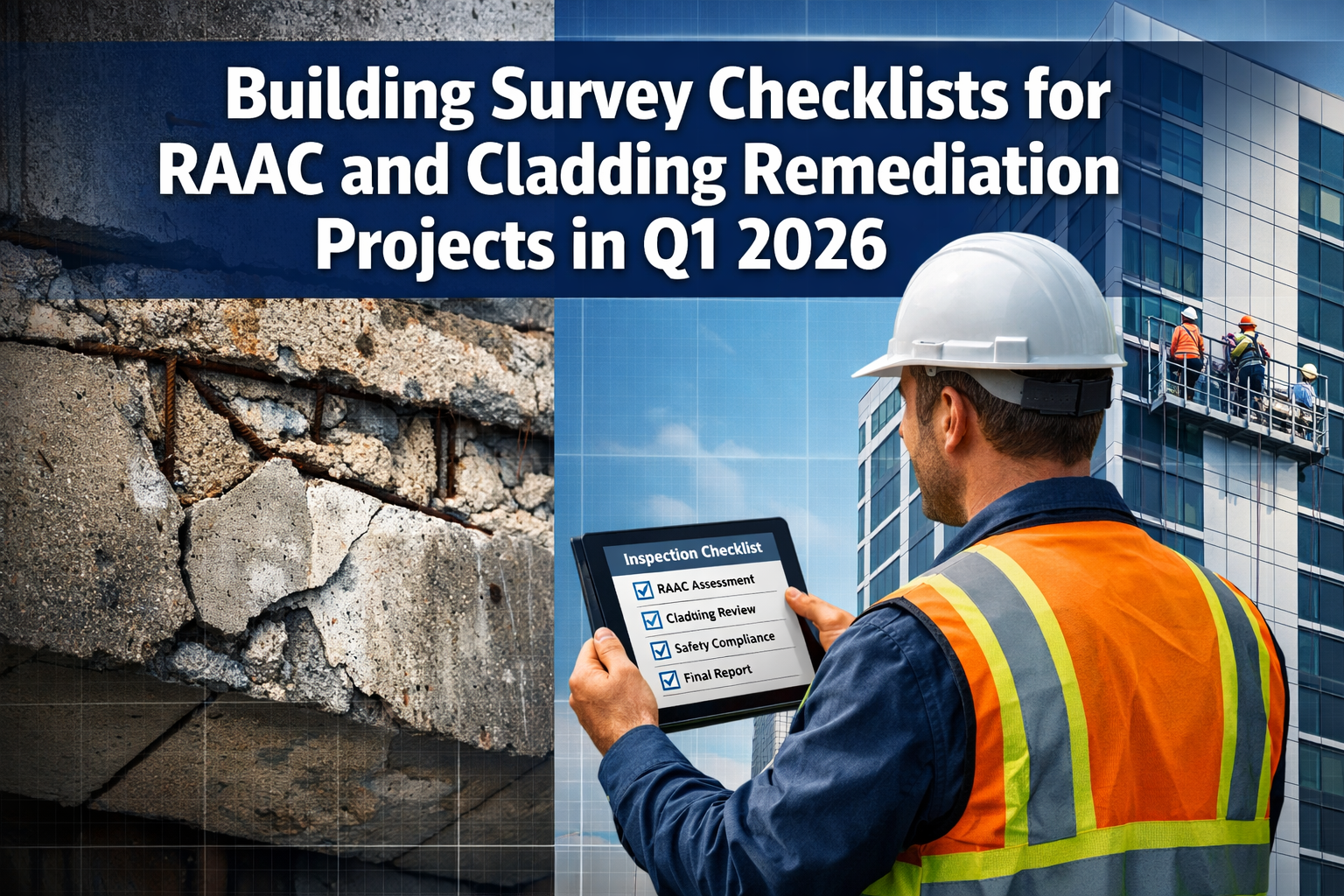
Key Takeaways
- Government timelines are accelerating: RAAC must be eliminated from NHS estates by 2035 and from schools before the 2029 general election, creating urgent survey demand.[1]
- Pre-1980 RAAC is beyond service life: Buildings constructed with RAAC panels installed before 1980 are now past their 30-year expected lifespan and can collapse with little warning.[2]
- Comprehensive checklists require phased methodology: Effective Building Survey Checklists for RAAC and Cladding Remediation Projects in Q1 2026 must incorporate desktop studies, visual inspections, and intrusive testing protocols.
- Professional qualifications matter: Only Chartered Building Surveyors and Chartered Structural Engineers possess the expertise required for accurate RAAC identification and remediation advice.[3]
- Liability limitation periods have expired: Most RAAC installations are beyond the 6-15 year limitation period, making proper documentation and risk assessment essential for surveyors.[1]
Understanding the RAAC Crisis and 2026 Regulatory Context
What Makes RAAC So Dangerous?
Reinforced Autoclaved Aerated Concrete represents one of the most significant structural challenges facing the UK property sector in 2026. Unlike traditional concrete, RAAC is a lightweight, bubbly material that was widely used in roof planks, floor panels, and wall sections throughout the 1960s to 1990s. The material's porous structure and limited reinforcement make it particularly vulnerable to moisture ingress, structural fatigue, and sudden catastrophic failure.[3]
The critical concern for surveyors developing Building Survey Checklists for RAAC and Cladding Remediation Projects in Q1 2026 is that pre-1980 RAAC installations have exceeded their anticipated 30-year service life. These panels can collapse with minimal warning signs, creating immediate safety hazards for building occupants.[2]
Current Scale of the Problem
The numbers paint a sobering picture:
| Sector | RAAC Status | Timeline |
|---|---|---|
| NHS Hospitals | 7 completed removals, 12 more by March 2026 | Target: Full estate clearance by 2035[1] |
| Schools | 62 permanently remediated, 237 total affected | Target: Elimination before 2029 election[1] |
| Survey Response | ~10% of schools (1,500) haven't responded to surveys | Ongoing identification efforts[2] |
| Total UK Exposure | 3.5 million panels sold nationwide | Affects public and private sectors[1] |
Over 150 schools have closed buildings or relocated due to RAAC concerns, with 104 additional schools requiring remediation and 52 already implementing mitigation plans.[2] For surveyors working across chartered surveyor locations throughout England, these statistics underscore the importance of systematic identification protocols.
Post-Reform Compliance Landscape
The Building Safety Act 2022 and subsequent reforms have fundamentally altered surveyor responsibilities. Building Survey Checklists for RAAC and Cladding Remediation Projects in Q1 2026 must now address:
- Enhanced duty of care requirements for surveyors identifying structural defects
- Mandatory reporting protocols for RAAC and dangerous cladding discoveries
- Updated professional indemnity insurance considerations
- Client disclosure obligations regarding remediation costs and timelines
- Integration with EWS1 form requirements for residential properties
The liability landscape has shifted significantly. While most RAAC installations are beyond the 6-15 year latent defect liability period, preventing retrospective claims,[1] surveyors who fail to identify RAAC or cladding issues during contemporary assessments face substantial professional risk.
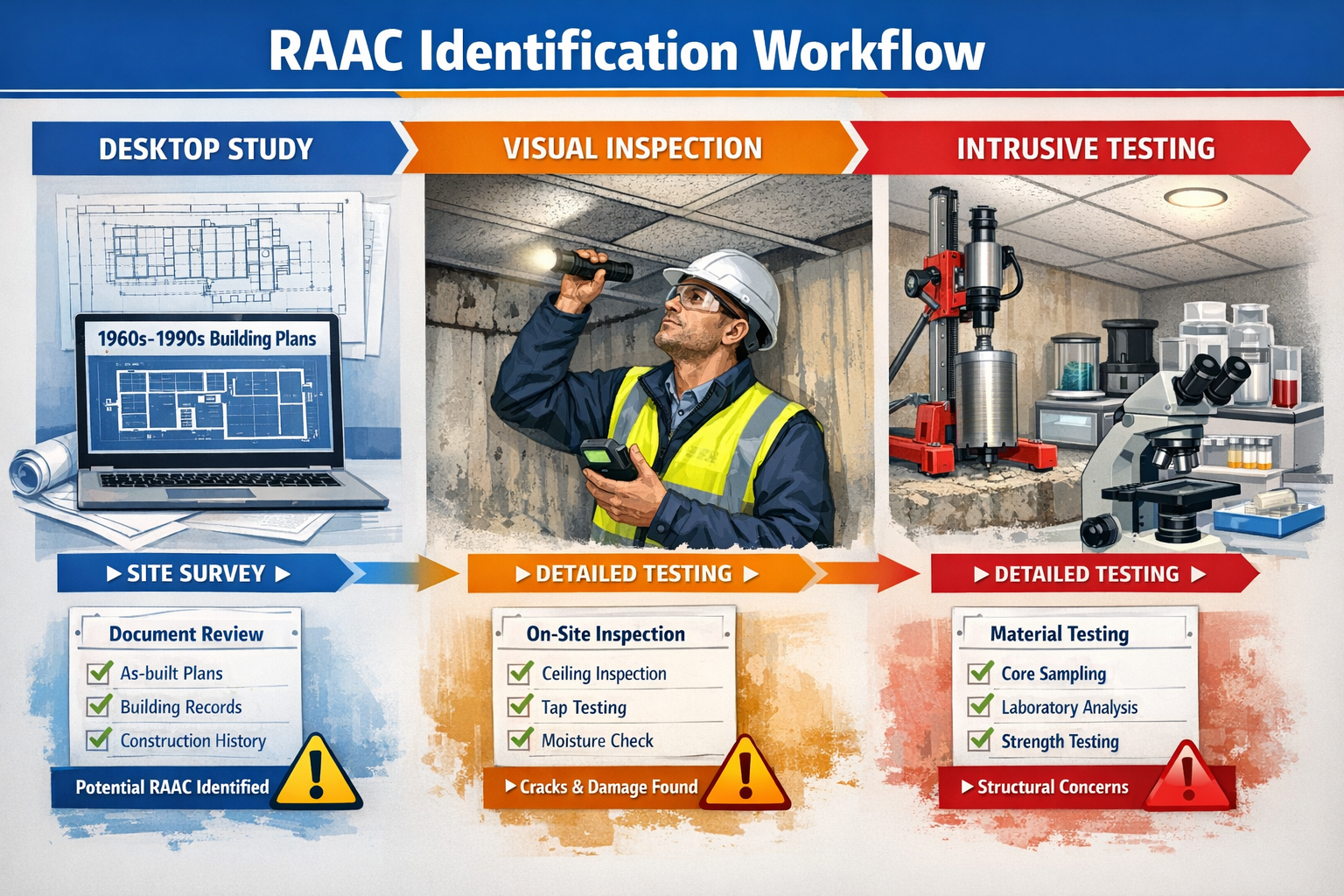
Essential Components of Building Survey Checklists for RAAC and Cladding Remediation Projects in Q1 2026
Phase 1: Desktop Study and Property Inventory
Before setting foot on site, thorough desktop research forms the foundation of effective RAAC identification. Building Survey Checklists for RAAC and Cladding Remediation Projects in Q1 2026: Post-Reform Compliance Essentials should begin with:
Construction Date Verification
- ✅ Review planning records to confirm construction dates between 1960-1995 (peak RAAC usage period)
- ✅ Identify original contractors and subcontractors who commonly used RAAC systems
- ✅ Examine building type: schools, hospitals, commercial premises, and some residential blocks are higher risk
- ✅ Check for previous survey reports or structural assessments mentioning concrete specifications
Document Analysis
- ✅ Obtain original architectural drawings and specifications
- ✅ Review as-built documentation for roof and floor construction details
- ✅ Examine maintenance records for roof leaks or structural repairs
- ✅ Identify any previous remediation work or structural interventions
- ✅ Check building control records for alterations affecting load-bearing elements
Risk Profiling
- ✅ Categorize building by occupancy type (educational, healthcare, residential, commercial)
- ✅ Assess occupant vulnerability (children, elderly, patients)
- ✅ Evaluate consequence of failure (single-story vs. multi-story, occupied spaces below)
- ✅ Document existing temporary propping or support measures
This desktop phase enables surveyors to develop targeted inspection strategies before conducting specific defect surveys on site.
Phase 2: Visual Survey Methodology
The on-site visual inspection represents the critical middle phase of Building Survey Checklists for RAAC and Cladding Remediation Projects in Q1 2026. Chartered surveyors must systematically evaluate:
Roof and Ceiling Assessments
- ✅ Panel identification: Look for characteristic RAAC features including:
- Panels typically 600mm wide, 2.4-3.6m long
- Visible bubbly/aerated concrete texture
- T-shaped or inverted T-shaped profiles
- Manufacturer stamps (Durox, Siporex, Celcon)
- ✅ Structural condition indicators:
- Sagging, deflection, or visible movement
- Cracks, particularly at panel ends or support points
- Water staining indicating moisture ingress
- Spalling or surface deterioration
- Exposed reinforcement showing corrosion
Cladding System Evaluation
- ✅ Material identification: Document cladding type and composition
- ACM (Aluminium Composite Material) panels
- HPL (High Pressure Laminate) systems
- Render on insulation systems
- Timber or metal cladding
- ✅ Fire safety assessment:
- Verify cladding fire classification ratings
- Check cavity barrier installations
- Assess compartmentation integrity
- Document building height and residential occupancy
- Review compliance with current Building Regulations Approved Document B
Access and Safety Considerations
- ✅ Use appropriate access equipment (mobile towers, cherry pickers, drone surveys for external facades)
- ✅ Implement safe working procedures near suspected RAAC (avoid loading panels)
- ✅ Document access limitations affecting inspection completeness
- ✅ Photograph all suspected RAAC and cladding concerns with scale references
Professional Insight: "RAAC panels can appear deceptively sound from below. Only qualified Chartered Building Surveyors and Chartered Structural Engineers possess the training to distinguish RAAC from conventional concrete and assess structural adequacy."[3]
Phase 3: Intrusive Investigation Protocols
When visual inspection suggests RAAC presence or cladding concerns, Building Survey Checklists for RAAC and Cladding Remediation Projects in Q1 2026 must incorporate intrusive testing:
RAAC Confirmation Testing
- ✅ Core sampling: Extract samples for laboratory density analysis
- RAAC density: typically 600-900 kg/m³
- Standard concrete density: 2,200-2,400 kg/m³
- ✅ Borescope inspection: Examine concealed panel profiles and reinforcement
- ✅ Moisture content testing: Assess water ingress affecting structural capacity
- ✅ Load testing: Where safe and appropriate, assess residual structural capacity
- ✅ Reinforcement survey: Use cover meters to locate and assess steel reinforcement condition
Cladding Investigation
- ✅ Opening up works: Expose cladding fixings, cavity barriers, and insulation
- ✅ Fire testing: Confirm material classifications match specifications
- ✅ Pull testing: Assess fixing adequacy and structural integrity
- ✅ Thermal imaging: Identify insulation defects and moisture ingress
- ✅ Compartmentation surveys: Verify fire stopping and cavity barriers
For properties requiring comprehensive structural analysis, surveyors should coordinate with structural engineering specialists to ensure accurate assessment and appropriate remediation recommendations.
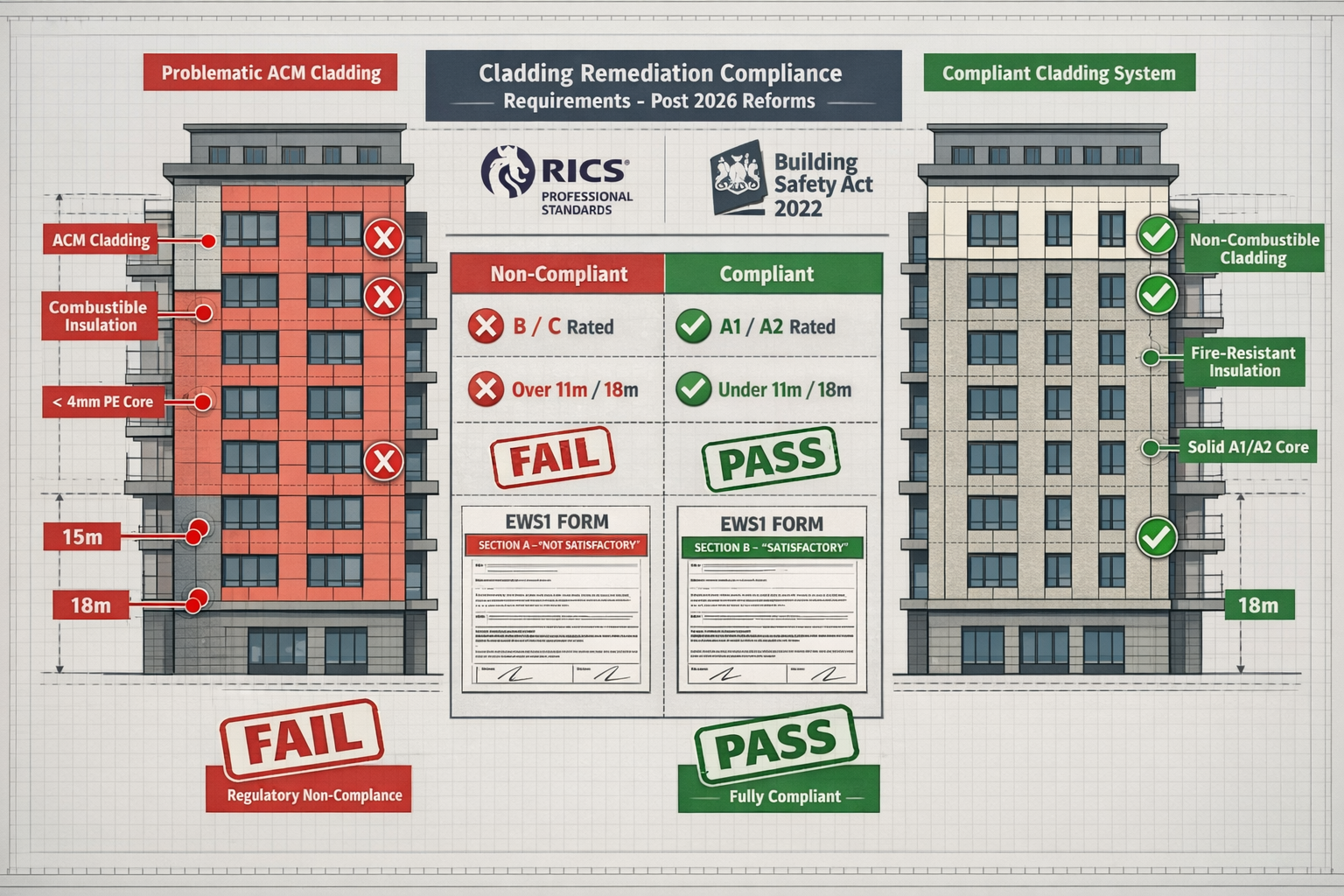
Cladding Remediation Compliance: Building Survey Checklists for RAAC and Cladding Remediation Projects in Q1 2026
Post-Grenfell Regulatory Framework
The tragic Grenfell Tower fire fundamentally transformed cladding regulations. By Q1 2026, surveyors must ensure Building Survey Checklists for RAAC and Cladding Remediation Projects incorporate:
Building Height Classifications
- High-rise residential (18m+): Strictest requirements, ACM cladding banned
- Medium-rise residential (11-18m): Enhanced fire safety standards apply
- Low-rise residential (<11m): Risk-based assessment approach
- Non-residential: Varies by occupancy type and building use
EWS1 Form Integration
The External Wall System (EWS1) form remains critical for residential property transactions in 2026. Surveyors conducting homebuyer surveys must:
- ✅ Determine if EWS1 form is required based on building height and construction
- ✅ Assess whether existing EWS1 forms remain valid or require updating
- ✅ Identify cladding systems requiring specialist fire engineer assessment
- ✅ Document implications for property valuation and mortgage availability
- ✅ Advise clients on remediation funding options (Building Safety Fund, developer contributions)
Compliance Checklist for Cladding Assessment
Building Survey Checklists for RAAC and Cladding Remediation Projects in Q1 2026: Post-Reform Compliance Essentials must systematically evaluate:
Material Compliance
- ✅ ACM panels: Verify limited combustibility classification (Class A2-s1, d0 or better)
- ✅ Insulation materials: Confirm fire performance ratings
- ✅ Cavity barriers: Check installation at appropriate intervals (typically every floor and compartment line)
- ✅ Fire stopping: Assess integrity around penetrations and junctions
- ✅ Fixings and support systems: Verify adequate fire resistance ratings
Documentation Requirements
- ✅ Obtain manufacturer specifications and test certificates
- ✅ Review building control approval for cladding installation
- ✅ Examine maintenance records and previous inspections
- ✅ Document any remediation works completed or planned
- ✅ Verify warranty and insurance coverage for remediation works
Risk Assessment Matrix
| Cladding Type | Building Height | Fire Risk | Action Required |
|---|---|---|---|
| ACM (combustible core) | >18m | Critical | Immediate removal required |
| ACM (combustible core) | 11-18m | High | Remediation within 12 months |
| HPL (combustible) | >18m | High | Specialist assessment required |
| Render on insulation | Any | Medium | Case-by-case evaluation |
| Non-combustible systems | Any | Low | Verify compliance documentation |
For properties in locations such as Chelsea or Fulham, where high-rise residential buildings are common, cladding assessment forms a critical component of comprehensive property surveys.
Technology and Innovation in 2026 Survey Practices
Digital Survey Tools
Modern Building Survey Checklists for RAAC and Cladding Remediation Projects in Q1 2026 leverage advanced technology:
Inspection Technologies
- 📱 Mobile survey apps: Real-time checklist completion with geo-tagged photos
- 🚁 Drone surveys: Safe external facade inspection without scaffolding
- 🌡️ Thermal imaging: Identify moisture ingress and insulation defects
- 📡 Ground-penetrating radar: Non-destructive RAAC panel identification
- 🔬 Portable density meters: On-site RAAC confirmation testing
Data Management Systems
- ✅ Cloud-based survey platforms for multi-site remediation projects
- ✅ Integration with building information modeling (BIM) systems
- ✅ Automated compliance checking against current regulations
- ✅ Risk scoring algorithms for prioritizing remediation works
- ✅ Client portal access for real-time project updates
Quality Assurance Protocols
Professional surveyors implementing Building Survey Checklists for RAAC and Cladding Remediation Projects in Q1 2026 must maintain rigorous quality standards:
- ✅ Peer review: Independent verification of RAAC identifications
- ✅ Photographic evidence: Comprehensive documentation of all findings
- ✅ Chain of custody: Proper handling of samples for laboratory testing
- ✅ Competency verification: Ensure surveyors hold appropriate RICS qualifications
- ✅ Professional indemnity insurance: Adequate coverage for RAAC and cladding assessments
Liability Mitigation and Professional Standards
Understanding Surveyor Liability in 2026
The legal landscape surrounding RAAC and cladding creates significant liability exposure for building surveyors. While most original RAAC installations are beyond the 6-15 year limitation period for claims,[1] contemporary survey work carries substantial risk.
Key Liability Considerations
- ⚠️ Duty of care: Surveyors owe clients a duty to identify reasonably discoverable defects
- ⚠️ Scope limitations: Clearly define inspection limitations in terms of engagement
- ⚠️ Competence requirements: Only qualified professionals should undertake RAAC assessments
- ⚠️ Reporting obligations: Immediate notification of safety-critical findings
- ⚠️ Follow-up recommendations: Specify appropriate specialist investigations required
RICS Professional Standards
Building Survey Checklists for RAAC and Cladding Remediation Projects in Q1 2026 must align with RICS guidance:
- ✅ Comply with RICS Surveying Safely principles
- ✅ Follow RICS Home Survey Standard (1st edition) requirements
- ✅ Adhere to RICS guidance note on RAAC identification
- ✅ Maintain continuing professional development (CPD) on emerging construction defects
- ✅ Document limitations of inspection in survey reports
For surveyors uncertain about professional obligations, consulting what surveyors do resources can clarify roles and responsibilities.
Report Writing Best Practices
Effective communication of RAAC and cladding findings requires:
Clear Risk Communication
- 🔴 Critical findings: Immediate safety hazards requiring urgent action
- 🟠 High priority: Significant defects requiring remediation within 6-12 months
- 🟡 Medium priority: Defects requiring monitoring and future remediation
- 🟢 Low priority: Minor issues for routine maintenance
Remediation Guidance
- ✅ Outline remediation options (removal, strengthening, monitoring)
- ✅ Provide indicative cost ranges for remediation works
- ✅ Recommend appropriate specialists for detailed design
- ✅ Specify ongoing monitoring requirements where applicable
- ✅ Address funding options and grant availability
Sector-Specific Considerations
Educational Buildings
Schools represent a priority sector for Building Survey Checklists for RAAC and Cladding Remediation Projects in Q1 2026, with government targets to eliminate dangerous RAAC before the 2029 general election.[1]
School Survey Priorities
- ✅ Focus on buildings constructed 1960-1990 (peak RAAC usage)
- ✅ Prioritize occupied teaching spaces and assembly halls
- ✅ Assess temporary accommodation requirements during remediation
- ✅ Coordinate with Department for Education funding programs
- ✅ Plan surveys during school holidays to minimize disruption
With 62 schools already remediated and 237 total affected,[1] surveyors must develop efficient assessment protocols for rapid deployment across multiple sites.
Healthcare Facilities
NHS hospitals face a 2035 deadline for complete RAAC eradication.[1] Healthcare building surveys require:
- ✅ Operational continuity planning: Maintain critical services during assessment
- ✅ Infection control: Minimize dust and disruption in clinical areas
- ✅ Emergency access: Ensure survey work doesn't compromise emergency routes
- ✅ Patient safety: Prioritize areas above occupied wards and treatment spaces
- ✅ Phased approach: Coordinate with NHS estates teams for systematic assessment
Residential Properties
For residential surveyors conducting home surveys, Building Survey Checklists for RAAC and Cladding Remediation Projects in Q1 2026 must address:
Buyer Due Diligence
- ✅ Identify RAAC risk in properties built 1960-1995
- ✅ Assess cladding systems on apartment buildings
- ✅ Verify EWS1 form status for mortgage purposes
- ✅ Estimate remediation costs for purchase negotiations
- ✅ Advise on building safety fund eligibility
Leaseholder Implications
- ✅ Review lease terms regarding major works contributions
- ✅ Assess building safety charge implications
- ✅ Evaluate management company remediation plans
- ✅ Consider resale and mortgage availability impacts
- ✅ Document service charge reserve fund adequacy
For properties across locations like Hounslow, Harrow, or Watford, systematic RAAC and cladding assessment has become an essential component of comprehensive property surveys.
Cost Implications and Funding Mechanisms
Remediation Cost Ranges
Understanding cost implications helps surveyors provide realistic guidance within Building Survey Checklists for RAAC and Cladding Remediation Projects in Q1 2026:
| Remediation Type | Cost Range (per m²) | Typical Project Duration |
|---|---|---|
| RAAC panel removal and replacement | £800-£1,500 | 3-12 months |
| Temporary propping | £200-£400 | Immediate (1-2 weeks) |
| ACM cladding replacement | £150-£300 | 6-18 months |
| Render system remediation | £100-£200 | 4-12 months |
| Cavity barrier installation | £50-£100 | 2-6 months |
These figures vary significantly based on building height, access challenges, and project complexity. For detailed cost guidance, surveyors can reference structural survey cost information.
Available Funding Sources
Public Sector Buildings
- NHS capital funding: Up to £440 million allocated for hospital RAAC removal[1]
- Department for Education grants: Covering affected schools and colleges
- Local authority support: Varies by region and building type
Residential Buildings
- Building Safety Fund: For ACM cladding removal on high-rise residential
- Cladding Safety Scheme: Extended funding for 11-18m buildings
- Developer contributions: Legal agreements with original developers
- Leaseholder protections: Caps on contributions under Building Safety Act
Implementing Your Checklist: Practical Workflow
Pre-Survey Preparation
Effective deployment of Building Survey Checklists for RAAC and Cladding Remediation Projects in Q1 2026 requires:
- Client briefing: Explain scope, limitations, and potential outcomes
- Access arrangements: Coordinate with building managers, schools, or healthcare facilities
- Equipment preparation: Ensure all testing equipment is calibrated and operational
- Team competency: Verify all surveyors hold appropriate qualifications
- Insurance verification: Confirm professional indemnity coverage is adequate
On-Site Survey Execution
Follow a systematic approach:
- Site induction: Complete health and safety requirements
- Initial walkthrough: Identify areas requiring detailed inspection
- Systematic survey: Work through checklist methodically by building zone
- Real-time documentation: Photograph and record findings immediately
- Sample collection: Follow proper protocols for any intrusive testing
- Client communication: Notify of critical findings requiring immediate action
Post-Survey Reporting
Deliver comprehensive reports including:
- ✅ Executive summary with key findings and recommendations
- ✅ Detailed checklist completion with photographic evidence
- ✅ Risk assessment matrix prioritizing remediation works
- ✅ Indicative cost estimates for recommended works
- ✅ Specialist recommendations for detailed design and implementation
- ✅ Monitoring protocols where immediate remediation isn't required
Future Outlook: Beyond Q1 2026
Emerging Challenges
Building surveyors must prepare for evolving requirements:
- 📊 Expanding scope: Additional construction defects may emerge requiring similar systematic assessment
- 🏛️ Regulatory changes: Building Safety Regulator will continue refining requirements
- 💻 Technology integration: AI and machine learning may enhance defect identification
- 🌍 Climate considerations: Moisture ingress from extreme weather accelerating RAAC deterioration
- 📈 Market impacts: Property values increasingly tied to building safety compliance
Professional Development
Surveyors should pursue:
- ✅ RICS CPD courses on RAAC identification and cladding assessment
- ✅ Manufacturer training on modern remediation systems
- ✅ Fire engineering awareness for cladding risk assessment
- ✅ Technology training on inspection tools and survey software
- ✅ Legal updates on liability and professional obligations
Conclusion
Building Survey Checklists for RAAC and Cladding Remediation Projects in Q1 2026: Post-Reform Compliance Essentials represent critical tools for chartered surveyors navigating the complex landscape of structural defects and building safety compliance. With government remediation drives accelerating, 3.5 million RAAC panels requiring assessment,[1] and cladding safety remaining a priority, systematic inspection protocols have never been more important.
The three-phase approach—desktop study, visual survey, and intrusive investigation—provides a robust framework for identifying RAAC and cladding concerns while managing professional liability. By incorporating current regulatory requirements, leveraging modern inspection technology, and maintaining rigorous documentation standards, surveyors can deliver the comprehensive assessments clients need to make informed decisions.
Actionable Next Steps
For surveyors implementing these checklists:
- Review and update existing survey templates to incorporate RAAC and cladding-specific requirements
- Invest in training to ensure team competency in defect identification
- Upgrade technology with thermal imaging, drones, and mobile survey apps
- Verify insurance coverage for RAAC and cladding assessment work
- Establish networks with specialist structural engineers and fire engineers for complex cases
- Document procedures to demonstrate compliance with professional standards
For property owners, developers, and building managers:
- Commission surveys for buildings constructed 1960-1995 if not already assessed
- Review existing EWS1 forms to ensure they remain current
- Budget appropriately for potential remediation works
- Engage early with funding programs where eligible
- Prioritize safety by implementing temporary measures while permanent solutions are designed
The challenge of RAAC and cladding remediation will define building safety practice for years to come. By adopting comprehensive, technology-enabled survey checklists aligned with 2026 regulatory requirements, chartered surveyors can protect public safety, support informed decision-making, and maintain the highest professional standards in this critical area of practice.
For expert assistance with RICS-compliant building surveys incorporating comprehensive RAAC and cladding assessment, contact qualified chartered surveyors who maintain current knowledge of post-reform compliance requirements and best practices.
References
[1] Reinforced Autoclaved Aerated Concrete Raac – https://www.brownejacobson.com/insights/2026-horizon-scanning-in-construction/reinforced-autoclaved-aerated-concrete-raac
[2] Precast Aerated Concrete Panels The Uks Concerns And Australias Response – https://builtoffsite.com.au/news/precast-aerated-concrete-panels-the-uks-concerns-and-australias-response/
[3] How Do You Solve A Problem Like Raac – https://www.atkinsrealis.com/en/engineering-better-future/beyond-engineering/how-do-you-solve-a-problem-like-raac
