
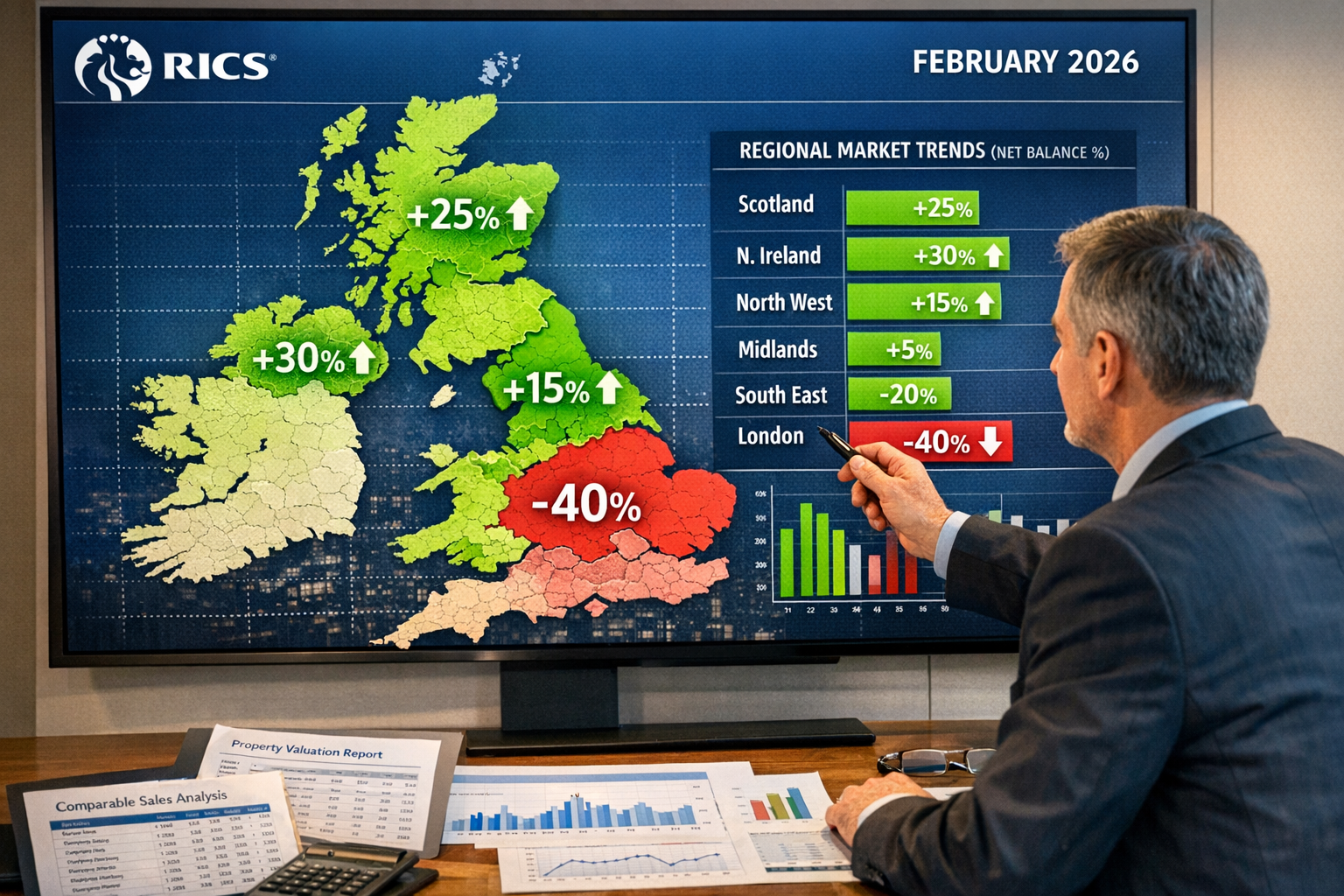
The UK property market in 2026 tells two very different stories depending on where you look. While national headlines suggest stability, Valuing Regional Price Disparities in 2026: Surveyor Insights from RICS Data on North-South Divides reveals a market fracturing along geographic lines. Recent RICS data from February 2026 shows London properties declining at -40% net balance while Northern Ireland and Scotland continue posting solid gains[1][3]. For property professionals, understanding these regional variations has become essential for accurate valuation work.
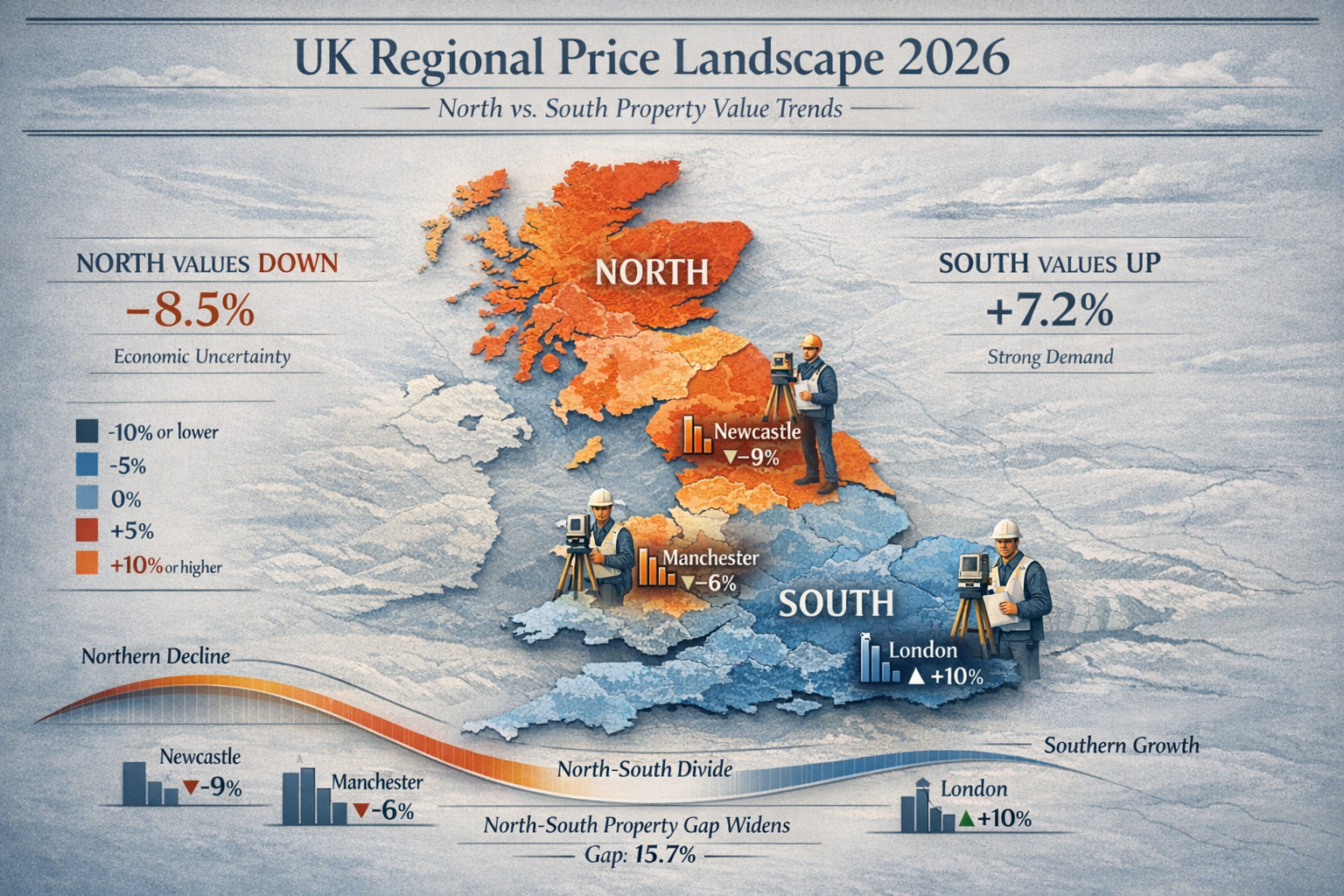
The widening gap between North and South now sees Southern England properties commanding premiums of 150-200% over comparable Northern properties[5]. This creates unique challenges for surveyors, lenders, and buyers who must navigate vastly different market conditions within the same country. The latest RICS survey data provides crucial insights into how these disparities are evolving and what adjustment techniques professionals are using to bridge these valuation gaps.
Key Takeaways
- 🏘️ London leads price declines at -40% net balance while Northern regions show resilience with positive growth trends in February 2026
- 📊 Southern property premiums have reached 150-200% compared to equivalent Northern properties, requiring specialized valuation methodologies
- 📈 Northern investment opportunities are strengthening due to lower entry prices, solid rental demand, and better affordability metrics
- 🔍 Surveyor confidence varies dramatically by region, with London's 12-month outlook dropping from +56% to +7% in just one month
- 💡 Comparable-based valuation models are essential for bridging regional gaps and meeting lender requirements in 2026's fragmented market
Understanding the 2026 Regional Price Landscape
National Stability Masks Regional Volatility
The February 2026 RICS Residential Market Survey reported a national net balance of -12% for house price changes, down from -10% in January[1]. This represents the first decline in four months and fell short of market expectations for improvement to -9%[2]. However, this headline figure conceals dramatic regional variations that surveyors must account for in their valuation work.
The data reveals a market splitting into distinct zones:
Southern England Weakness:
- London: -40% (most severe decline nationally)
- South East: -24%
- East Anglia: -26%
Northern Resilience:
- Northern Ireland: Strongest regional performance
- Scotland: Continued price rises
- North West England: Positive growth trends[1][4]
The Affordability Factor Driving Divergence
Acute affordability constraints are the primary driver behind Southern England's underperformance[1][3]. Properties in London and the South East have reached price levels that exclude increasing numbers of potential buyers, particularly first-time purchasers and younger families. This affordability ceiling is creating downward pressure on valuations that surveyors must carefully document.
In contrast, Northern regions benefit from:
✅ Lower absolute price points
✅ Better price-to-income ratios
✅ Stronger local employment markets
✅ Growing infrastructure investment
✅ Increased remote working flexibility
Specific Market Performance Data
The RICS data combined with Land Registry figures reveals specific towns recording notable performance. Burnley recorded the highest house price growth in 2025, with several North West towns including Rochdale, Blackburn, Liverpool, and Wigan registering price gains exceeding 4%[4].
For chartered surveyors working across different regions, understanding these micro-market variations is essential for accurate comparable selection and adjustment calculations.
Valuing Regional Price Disparities in 2026: Surveyor Methodologies and RICS Adjustments
Comparable-Based Models for Regional Gaps
When Valuing Regional Price Disparities in 2026: Surveyor Insights from RICS Data on North-South Divides become critical for accurate property assessment, chartered surveyors rely on sophisticated comparable-based valuation models. These models must account for the 150-200% premium differential between similar properties in different regions[5].
The core methodology involves:
1. Geographic Adjustment Factors
Surveyors apply location-specific multipliers based on:
- Regional market strength indicators
- Local employment and wage data
- Transport infrastructure access
- School quality and amenities
- Historic price trend analysis
2. Property Characteristic Normalization
Before comparing properties across regions, surveyors must normalize for:
- Property age and condition
- Square footage and room count
- Garden size and parking
- Energy efficiency ratings
- Recent renovation work
3. Market Timing Adjustments
Given the rapid shifts in regional performance, surveyors must apply time-based adjustments to comparable sales data. A sale from six months ago in a declining London market may require a 5-10% downward adjustment, while a Northern property might need an upward correction.
RICS-Compliant Valuation Approaches
Professional surveyors following RICS Red Book standards must document their regional adjustment methodology clearly. Understanding what surveyors do and their professional responsibilities helps buyers appreciate the complexity involved in cross-regional valuations.
Key RICS Requirements for Regional Valuations:
| Requirement | Application |
|---|---|
| Comparable Evidence | Minimum 3-5 comparable properties within same region |
| Adjustment Documentation | Written justification for each regional adjustment factor |
| Market Context | Reference to current RICS survey data and regional trends |
| Assumption Clarity | Explicit statement of assumptions about regional market conditions |
| Valuation Uncertainty | Disclosure of confidence levels given market volatility |
Bridging the Gap for Lenders and Buyers
Mortgage lenders require valuations that accurately reflect both current market value and future risk. When valuing regional price disparities in 2026, surveyors must provide lenders with:
🔹 Risk-Adjusted Valuations – Accounting for regional market volatility
🔹 Comparable Sales Analysis – Demonstrating local market evidence
🔹 Regional Market Commentary – Contextualizing the valuation within broader trends
🔹 Sensitivity Analysis – Showing how value might change under different regional scenarios
For buyers, especially those relocating between regions, comprehensive home surveys must explain the regional context affecting property values. A buyer moving from Manchester to London needs to understand not just the absolute price difference, but the underlying market dynamics driving that gap.
Advanced Adjustment Techniques
Experienced surveyors employ several advanced techniques when dealing with significant regional disparities:
Hedonic Pricing Models – Statistical approaches that isolate the value contribution of location from other property characteristics
Repeat Sales Analysis – Tracking how identical properties perform in different regions over time
Regional Index Application – Using established regional house price indices to adjust comparable values
Rental Yield Comparison – Evaluating investment value through regional rental market analysis
These methodologies are particularly important for surveyors working in diverse London locations where micro-market variations can be as significant as broader North-South differences.
Forecasting Tools and Investment Implications for 2026

Near-Term vs. Long-Term Outlook Divergence
The February 2026 RICS data reveals a striking divergence between near-term caution and longer-term optimism. Near-term price expectations fell sharply to -18% from -6% in January, driven by renewed concerns over inflation, interest rates, and geopolitical uncertainty[1].
However, the 12-month outlook remains positive at +33% net balance, with surveyors expecting prices to edge higher across the country over the coming year[1]. This divergence creates both challenges and opportunities for property professionals.
London's Confidence Collapse
Perhaps most dramatic was London's sentiment shift. The capital's 12-month price expectations balance dropped from +56% in January to just +7% in February[1][6]. This represents a fundamental reassessment of London's recovery trajectory and has significant implications for valuation work in the capital.
Surveyors working in North London, West London, and other prime areas must now incorporate this heightened uncertainty into their forecasting models and risk assessments.
Regional Investment Opportunities
For property investors, the emerging North-South divide creates distinct opportunities. Northern and devolved nation areas offer:
Lower Entry Prices 💰
Properties in Northern regions provide access to the housing market at significantly lower absolute prices, reducing both deposit requirements and mortgage commitments.
Stronger Rental Demand 📈
Tenant demand edged higher in the three months to January 2026, while supply remains constrained with landlord instructions firmly negative[7]. This creates upward pressure on rents, particularly benefiting Northern regions with lower entry prices.
Better Yield Profiles 💵
The combination of lower purchase prices and solid rental demand means Northern properties often deliver superior rental yields compared to Southern equivalents.
Greater Market Resilience 🛡️
Areas with better affordability metrics demonstrate greater resilience to economic shocks and interest rate fluctuations.
Surveyor Forecasting Methodologies
Professional surveyors use several forecasting tools when advising clients on regional market prospects:
1. RICS Survey Data Integration
Monthly RICS survey results provide real-time sentiment indicators from practicing surveyors across all regions. These forward-looking indicators often predict market movements before they appear in transaction data.
2. Economic Indicator Correlation
Regional employment rates, wage growth, and business confidence indices help predict local housing market performance.
3. Supply-Demand Modeling
Tracking new listings, sales volumes, and time-on-market metrics provides insights into market balance and likely price trajectories.
4. Historical Pattern Analysis
Understanding how different regions performed during previous market cycles helps inform current forecasting.
Practical Applications for Buyers and Sellers
Understanding Valuing Regional Price Disparities in 2026: Surveyor Insights from RICS Data on North-South Divides has practical implications:
For Buyers:
- Consider whether current regional trends support your purchase timing
- Request detailed regional market analysis as part of your home survey
- Evaluate investment potential through rental yield analysis
- Factor in regional outlook when determining maximum offer price
For Sellers:
- Understand how your region's performance affects marketing strategy
- Price competitively based on current regional trends, not national headlines
- Highlight property features that mitigate regional concerns
- Consider timing based on surveyor sentiment indicators
For Investors:
- Diversify geographically to balance regional risks
- Focus on Northern regions for yield-focused strategies
- Maintain longer-term perspective despite near-term volatility
- Work with experienced surveyors who understand regional nuances
The Role of Professional Valuation
In a market characterized by significant regional disparities, professional valuation becomes more important than ever. Building surveyors in London and other regions provide essential services that go beyond simple price estimation.
A comprehensive valuation should include:
✓ Detailed comparable analysis with regional adjustments
✓ Commentary on current regional market conditions
✓ Forward-looking assessment based on RICS data
✓ Risk factors specific to the region
✓ Recommendations for buyers, sellers, or investors
Regional Rental Market Dynamics
The rental market adds another dimension to regional price disparities. While purchase prices in Southern England face affordability constraints, rental demand remains strong across all regions. This creates interesting dynamics for property valuation.
Rental Market Key Indicators (January 2026):
📊 Tenant demand: Edged higher nationally
📊 Landlord instructions: Firmly negative (supply constrained)
📊 Rent expectations: Continued upward pressure expected
📊 Regional variation: Northern regions showing strongest rental growth potential[7]
For investors evaluating properties across different regions, rental yield becomes a crucial metric. A property in the North West might purchase for £200,000 and rent for £1,000 monthly (6% gross yield), while a London property costing £500,000 might rent for £2,000 monthly (4.8% gross yield).
Surveyors must incorporate these rental dynamics into investment valuations, particularly when advising clients on portfolio strategies. Understanding what surveyors check during property assessments includes evaluation of rental potential and investment returns.
Technology and Data in Regional Valuation
Modern surveying increasingly relies on technology to manage regional price disparities. Advanced tools enable more accurate valuations across diverse markets:
Automated Valuation Models (AVMs)
Machine learning algorithms can process thousands of regional transactions to identify pricing patterns and adjustment factors. However, human expertise remains essential for interpreting results and applying professional judgment.
Geographic Information Systems (GIS)
Mapping technology helps visualize regional price variations and identify comparable properties within appropriate geographic boundaries.
Real-Time Market Data Platforms
Instant access to RICS survey data, Land Registry transactions, and local market intelligence enables surveyors to provide current, accurate valuations.
Predictive Analytics
Statistical models incorporating economic indicators, demographic trends, and historical patterns help forecast regional market movements.
Despite technological advances, the professional surveyor's role remains central. Technology provides data, but experienced professionals provide context, judgment, and RICS-compliant methodology that lenders and buyers require.
Conclusion
Valuing Regional Price Disparities in 2026: Surveyor Insights from RICS Data on North-South Divides reveals a UK property market undergoing significant geographic fragmentation. The February 2026 RICS survey data demonstrates that national headline figures mask dramatic regional variations, with London declining at -40% while Northern regions post solid gains[1][3].
For property professionals, buyers, and investors, understanding these regional disparities is no longer optional—it's essential for making informed decisions. The 150-200% premium differential between Southern and Northern properties requires sophisticated valuation methodologies that go beyond simple comparable analysis[5].
Key insights for navigating 2026's regional market include:
🎯 Regional Performance Varies Dramatically – Never rely on national data alone when making property decisions
🎯 Affordability Drives Divergence – Southern markets face structural constraints while Northern regions benefit from better value propositions
🎯 Professional Valuation Is Essential – Complex regional adjustments require RICS-qualified surveyors with local expertise
🎯 Investment Opportunities Favor the North – Lower entry prices and stronger rental yields create compelling investment cases
🎯 Sentiment Remains Volatile – Near-term caution contrasts with longer-term optimism, requiring careful timing decisions
Actionable Next Steps
Whether you're buying, selling, or investing in 2026's fragmented market, consider these practical actions:
-
Engage a Qualified Surveyor Early – Work with experienced chartered surveyors who understand regional market dynamics and can provide RICS-compliant valuations
-
Request Regional Market Analysis – Ensure your survey includes detailed commentary on regional trends, not just property condition
-
Evaluate Multiple Regions – If relocating or investing, compare opportunities across different regions using consistent valuation methodologies
-
Monitor RICS Data Monthly – Stay informed about evolving regional trends through regular RICS survey releases
-
Consider Long-Term Regional Fundamentals – Look beyond short-term volatility to underlying factors like employment, infrastructure, and demographics
-
Factor Regional Risk Into Decisions – Adjust your risk tolerance and financial planning based on regional market characteristics
The UK property market of 2026 demands a more nuanced, regionally-aware approach than ever before. By understanding the insights from RICS data and working with qualified professionals who can navigate these complexities, buyers, sellers, and investors can make confident decisions despite the challenging regional disparities.
For comprehensive surveying services that account for regional market variations, professional guidance remains your most valuable asset in navigating 2026's divided property landscape.
References
[1] Uk Residential Survey February 2026 – https://www.rics.org/news-insights/uk-residential-survey-february-2026
[2] tradingeconomics – https://tradingeconomics.com/united-kingdom/rics-house-price-balance/news/532749
[3] Latest Rics Survey Reveals Global Headwinds Are Weighing On Housing Market Confidence – https://www.buyassociationgroup.com/en-gb/news/latest-rics-survey-reveals-global-headwinds-are-weighing-on-housing-market-confidence/
[4] Uk Economy Property Update February 2026 – https://www.rics.org/content/dam/ricsglobal/documents/market-surveys/uk-economy-property-update-february-2026.pdf
[5] Valuation Techniques For Widening North South Divides Rics Adjustments For 2026 Regional Price Gaps – https://nottinghillsurveyors.com/blog/valuation-techniques-for-widening-north-south-divides-rics-adjustments-for-2026-regional-price-gaps
[6] Uk Residential Market Survey February 2026 – https://www.rics.org/content/dam/ricsglobal/documents/market-surveys/uk-residential-market-survey/UK-Residential-Market-Survey_February-2026.pdf
[7] Uk Resi Survey Jan 2026 Report Shows Early Signs Market Recovery Despite Caution – https://www.rics.org/news-insights/uk-resi-survey-jan-2026-report-shows-early-signs-market-recovery-despite-caution
