
The UK property market stands on the brink of its most significant transformation in decades. With government reforms proposing mandatory upfront condition surveys for all residential property transactions from early 2026, the building surveying profession faces unprecedented demand. This seismic shift in homebuying regulations means that every property sale will require a comprehensive assessment before reaching the market—creating an urgent need for qualified professionals equipped with the latest competencies and regulatory knowledge.
Building Surveyor Training for 2026 Homebuying Reforms: RICS Pathways to Meet Surging Demand has become a critical focus for the Royal Institution of Chartered Surveyors (RICS) and the wider property industry. As the implementation date approaches, aspiring and current surveyors must understand the training pathways, continuing professional development (CPD) requirements, and specialized competencies needed to meet this surge in workload while maintaining the highest professional standards.
Key Takeaways
- 🏠 Mandatory upfront surveys from 2026 will dramatically increase demand for qualified building surveyors across the UK residential market
- 📚 RICS offers multiple training routes including the Certificate in Building Surveying Practice (£1,173 + VAT, 8 months) and on-demand online options (£1,133 + VAT)
- ⚡ Fast-track pathways exist for experienced professionals, while the APC route requires 12-24 months of structured training for new entrants
- 💼 CPD requirements range from 48-96 hours depending on experience level, ensuring surveyors stay current with evolving regulations
- 🎯 Early preparation is essential as capacity constraints and increased competition for training places are expected throughout 2026
Understanding the 2026 Homebuying Reforms and Their Impact
The proposed homebuying reforms represent the most comprehensive overhaul of the UK property transaction process since the introduction of Home Information Packs (HIPs) in 2007. Unlike the short-lived HIPs scheme, however, these 2026 reforms are designed with greater industry consultation and a more practical implementation framework.
What the Reforms Entail
The core requirement mandates that sellers commission a condition survey before marketing their property. This upfront assessment must be conducted by a qualified building surveyor and made available to all prospective buyers. The reform aims to:
- Reduce transaction fall-through rates currently hovering around 30%
- Eliminate the duplication of surveys by multiple interested buyers
- Provide transparency about property condition from the outset
- Speed up the overall homebuying process by front-loading due diligence
The Demand Surge: Numbers and Projections
Industry analysts project that the reforms will create demand for approximately 1.2 million additional surveys annually based on typical UK residential transaction volumes. This represents a 40-60% increase in workload for the building surveying sector—a surge that the current workforce is not adequately sized to handle.
The Royal Institution of Chartered Surveyors has acknowledged this capacity challenge and is actively expanding its training programs to ensure sufficient qualified professionals enter the market. For those considering whether a homebuyers survey is worth the investment, the 2026 reforms will make this question largely moot, as surveys become a standard, seller-funded component of every transaction.
RICS Training Pathways: Building Surveyor Training for 2026 Homebuying Reforms
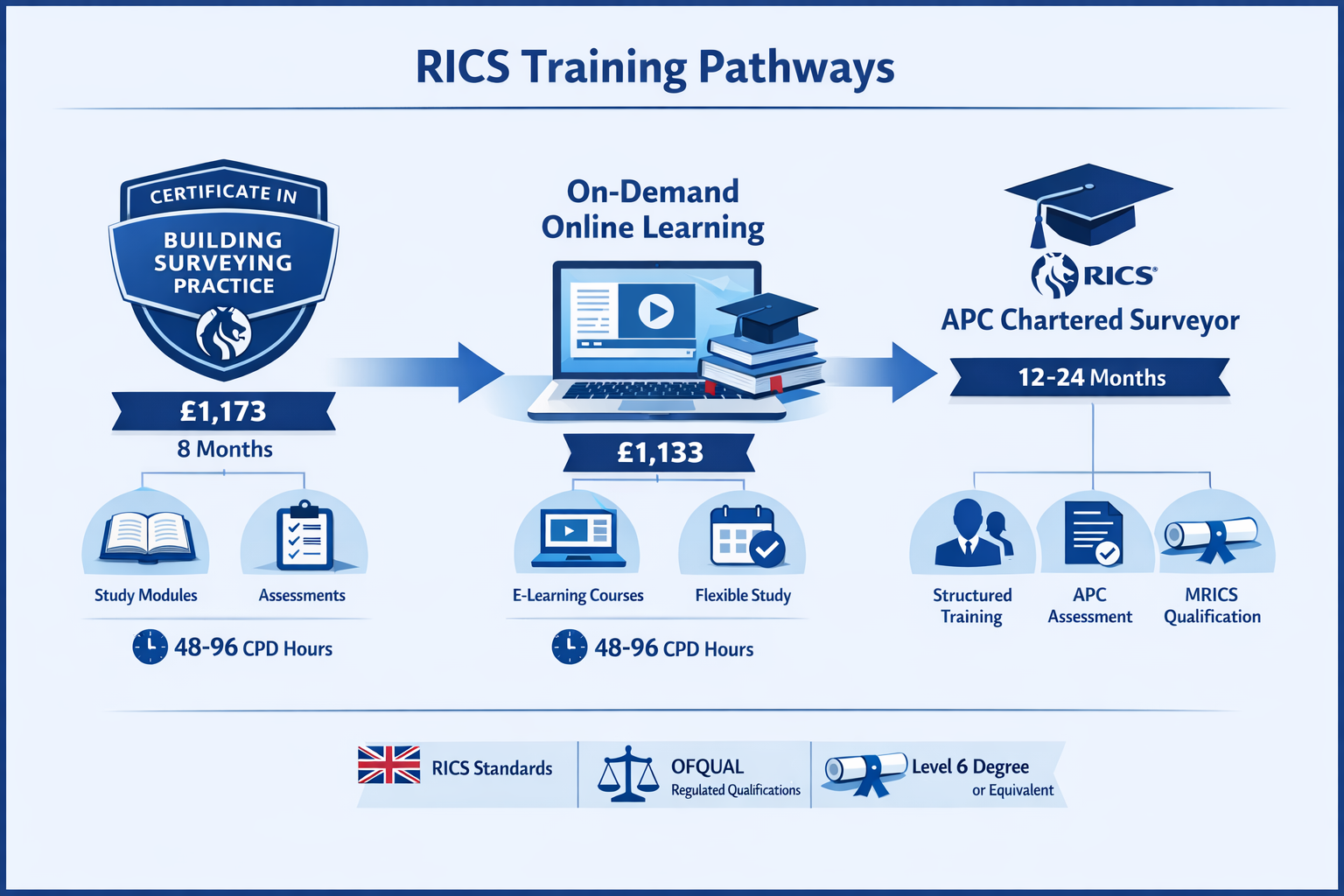
The Royal Institution of Chartered Surveyors offers several structured pathways for individuals seeking to enter or advance within the building surveying profession. Understanding these routes is essential for anyone looking to capitalize on the surging demand created by the 2026 reforms.
Certificate in Building Surveying Practice (2025)
The Certificate in Building Surveying Practice represents RICS's flagship intermediate qualification for building surveyors. This comprehensive program is specifically designed for professionals who want to deepen their technical knowledge and demonstrate competence in building pathology, construction technology, and condition assessment.[1]
Key Program Details:
| Feature | Details |
|---|---|
| Duration | 8 months (monthly modules) |
| Cost | £1,173 + VAT |
| Format | Structured learning with scheduled modules |
| Target Audience | Practicing surveyors seeking formal qualification |
| Assessment | Module assignments plus final examination |
The 2025 iteration of this certificate has been updated to specifically address the competencies required under the new homebuying framework. Modules now include enhanced content on digital reporting standards, consumer protection obligations, and liability management—all critical considerations for surveyors operating under the reformed system.[1]
On-Demand Online Certificate Program
For professionals with demanding schedules or those preferring self-paced learning, RICS offers an on-demand online version of the Certificate in Building Surveying Practice. This flexible alternative provides the same rigorous content with the added benefit of personal time management.[2]
Program Highlights:
- Cost: £1,133 + VAT (£40 savings compared to scheduled version)
- Structure: Six comprehensive modules plus examination
- Access: Learn at your own pace within enrollment period
- Content: Identical curriculum to the scheduled program
- Support: Online resources and tutor assistance
This pathway is particularly valuable for those already working in related fields who need to quickly upskill to meet the 2026 demand surge. The flexibility allows professionals to continue earning while gaining the necessary qualifications—a practical consideration given the financial investment required.
APC Pathway to Chartered Surveyor Status
For those seeking the highest level of professional recognition, the Assessment of Professional Competence (APC) pathway leads to Chartered Surveyor status—the gold standard in the UK surveying profession.[3]
APC Requirements:
✅ Educational Foundation: RICS-accredited degree in building surveying or related discipline
✅ Structured Training: 12-24 months of supervised practical experience (duration depends on degree level)
✅ CPD Commitment: 48-96 hours of continuing professional development
✅ Competency Achievement: Demonstrated proficiency across mandatory and technical competencies
✅ Final Assessment: Professional interview examining knowledge and experience
The APC route is particularly relevant for recent graduates and career changers who want to position themselves as leaders in the post-reform market. Chartered status not only commands higher fees but also provides greater professional credibility—essential when surveyors' reports will carry increased legal and commercial weight under the new system.
Understanding the different types of surveyors and their specializations can help aspiring professionals determine which pathway aligns best with their career goals.
Essential Competencies for the Reformed Homebuying Market
Building Surveyor Training for 2026 Homebuying Reforms: RICS Pathways to Meet Surging Demand extends beyond simply obtaining qualifications. The reformed market requires surveyors to develop specific competencies that address the unique challenges of mandatory upfront surveys.
Technical Assessment Skills
The foundation of effective building surveying remains thorough technical knowledge. Surveyors must be proficient in:
- Building pathology: Identifying defects, understanding deterioration mechanisms, and assessing severity
- Construction technology: Knowledge of traditional and modern building methods across different property ages
- Structural assessment: Recognizing signs of structural movement, subsidence, and load-bearing concerns
- Building services: Understanding electrical, plumbing, heating, and ventilation systems
For those interested in the most comprehensive assessment approach, our guide to understanding Level 3 building surveys provides detailed insights into the thorough inspection methodology required.
Digital Reporting and Technology
The 2026 reforms emphasize standardized digital reporting to ensure consistency and accessibility. Modern building surveyors must be comfortable with:
- Digital survey software and mobile inspection apps
- Thermal imaging and moisture detection equipment
- Drone technology for roof and elevation surveys
- Cloud-based report generation and distribution systems
- Electronic signature and document management platforms
Consumer Communication Skills
Unlike traditional surveying work conducted for commercial clients, the reformed system requires surveyors to communicate effectively with residential consumers who may lack technical knowledge. Essential skills include:
- Translating technical findings into plain language
- Managing client expectations about property condition
- Explaining the significance and urgency of different defects
- Providing clear recommendations for remediation
- Handling emotionally charged situations when serious defects are discovered
"The 2026 reforms fundamentally change the surveyor's role from technical specialist to consumer advisor. Our training programs now emphasize communication and client management as core competencies alongside technical expertise." — RICS Training Development Team
Regulatory and Legal Awareness
Mandatory upfront surveys create new liability exposures for building surveyors. Professionals must understand:
- Professional indemnity insurance requirements and coverage limits
- Consumer protection legislation and duty of care obligations
- Limitation periods and potential claims scenarios
- Documentation standards for defensible reports
- Conflicts of interest and independence requirements
CPD Requirements: Staying Current in a Changing Landscape

Continuing Professional Development (CPD) is not optional for RICS members—it's a mandatory requirement that ensures surveyors maintain competence throughout their careers. With the 2026 reforms introducing new standards and expectations, CPD becomes even more critical.
Mandatory CPD Hours
RICS requires different CPD commitments based on professional status and experience:[3]
📊 CPD Requirements by Level:
- Chartered Members (MRICS/FRICS): Minimum 20 hours annually
- APC Candidates: 48-96 hours over training period (depending on route)
- AssocRICS Members: Minimum 20 hours annually
- Specialized Accreditations: Additional hours for specific designations
Reform-Specific CPD Topics for 2026
To prepare for the reformed homebuying market, surveyors should prioritize CPD in these areas:
- Updated Inspection Standards: Understanding the specific requirements for upfront seller surveys
- Digital Reporting Protocols: Training on standardized formats and delivery systems
- Consumer Protection Law: Recent legislative changes affecting surveyor liability
- Conflict Management: Handling disputes when surveys reveal unexpected issues
- Quality Assurance: Implementing robust checking procedures to minimize errors
Where to Find Quality CPD
RICS-approved CPD can be obtained through:
- RICS Events and Webinars: Regular online and in-person training sessions
- Accredited Course Providers: Specialized training organizations offering certified programs
- Industry Conferences: Annual gatherings featuring technical presentations and workshops
- Technical Publications: Structured reading and assessment of professional journals
- Peer Learning: Participation in regional RICS groups and technical forums
For professionals seeking to understand the practical aspects of survey delivery, our guide on how long a homebuyers survey takes provides valuable context for time management and client expectations.
Practical Steps: Preparing for the 2026 Demand Surge
For aspiring and current building surveyors, early preparation is essential to capitalize on the opportunities created by the homebuying reforms. Here's a strategic roadmap:
For New Entrants to the Profession
🎯 Immediate Actions (Next 3 Months):
- Research educational requirements: Identify RICS-accredited degree programs or conversion courses
- Explore entry pathways: Determine whether the Certificate program or APC route better suits your background
- Network with professionals: Join RICS student membership and attend introductory events
- Gain relevant experience: Seek work placements or assistant roles with established surveying practices
📅 Medium-Term Goals (3-12 Months):
- Enroll in training: Secure a place on the Certificate in Building Surveying Practice or begin APC pathway
- Develop technical skills: Focus on building pathology, construction technology, and inspection methodology
- Build digital competence: Familiarize yourself with survey software and reporting tools
- Study the reforms: Understand the regulatory framework and its implications for practice
For Existing Surveyors
🔄 Upskilling Priorities:
- Review current competencies: Identify gaps in knowledge related to residential condition surveys
- Complete targeted CPD: Focus on reform-specific topics and consumer-facing skills
- Update professional indemnity: Ensure insurance coverage is adequate for increased workload
- Invest in technology: Upgrade equipment and software to meet digital reporting standards
- Expand capacity: Consider hiring additional staff or partnering with other practices
Understanding the difference between Level 2 and Level 3 surveys becomes crucial as surveyors must be prepared to offer appropriate assessment levels based on property characteristics and client needs.
For Surveying Firms and Practices
💼 Strategic Planning:
- Workforce expansion: Begin recruitment and training programs now to build capacity for 2026
- Process optimization: Develop efficient workflows for high-volume survey delivery
- Quality control systems: Implement robust checking procedures to maintain standards under pressure
- Marketing preparation: Position your practice as reform-ready to attract seller clients
- Technology investment: Deploy digital platforms for survey booking, delivery, and archiving
Overcoming Common Challenges in Training and Qualification
The path to becoming a qualified building surveyor capable of meeting the 2026 demand is not without obstacles. Understanding these challenges helps aspiring professionals prepare effectively.
Financial Investment
Training costs can be substantial, particularly when combining course fees with lost income during study periods. The Certificate in Building Surveying Practice alone costs £1,173 + VAT, while the full APC pathway may involve several years of reduced earnings as a trainee.[1][2]
💡 Funding Solutions:
- Employer sponsorship programs (many firms will fund training for committed employees)
- Professional development loans specifically designed for vocational qualifications
- RICS bursaries and scholarships for eligible candidates
- Phased learning through the on-demand option while maintaining employment
Time Management
Balancing work, study, and personal commitments presents a significant challenge, especially for the 8-month Certificate program or the 12-24 month APC pathway.[1][3]
⏰ Time Management Strategies:
- Choose the on-demand online option if schedule flexibility is essential
- Block dedicated study time in your calendar and treat it as non-negotiable
- Leverage commute time for reading and review
- Form study groups with fellow trainees for mutual support and accountability
Technical Knowledge Gaps
Career changers and those from related but different disciplines may find certain technical aspects challenging, particularly building pathology and structural assessment.
📚 Bridging Knowledge Gaps:
- Supplement formal training with practical site visits and shadowing experienced surveyors
- Utilize RICS technical guidance notes and case studies
- Attend specialist workshops on specific topics (e.g., damp diagnosis, structural movement)
- Seek mentorship from chartered surveyors willing to share expertise
For those specifically interested in RICS building surveys, understanding the comprehensive nature of these assessments provides valuable context for the level of expertise required.
The Business Case: Return on Investment for Training
While Building Surveyor Training for 2026 Homebuying Reforms: RICS Pathways to Meet Surging Demand requires significant investment, the financial returns can be substantial given the projected market conditions.
Earning Potential
Qualified building surveyors can expect strong compensation, particularly in the high-demand environment created by the 2026 reforms:
💰 Typical Fee Ranges (2026 Projections):
| Survey Type | Typical Fee Range | Volume Potential |
|---|---|---|
| Standard Residential Survey | £400-£800 | High (daily surveys possible) |
| Larger/Complex Properties | £800-£1,500 | Medium (2-3 weekly) |
| Specialized Assessments | £1,500-£3,000+ | Lower (monthly) |
Chartered surveyors with MRICS designation typically command 15-25% premium fees compared to non-chartered professionals, making the APC pathway particularly attractive from a long-term earnings perspective.[3]
Career Advancement Opportunities
The 2026 reforms create numerous career pathways beyond traditional surveying:
- Practice ownership: Establishing your own surveying firm to capture market demand
- Specialist consulting: Focusing on particular property types or defect categories
- Training and education: Teaching the next generation of surveyors
- Policy and regulation: Contributing to industry standards and government consultation
- Expert witness work: Providing professional opinions in legal disputes
Market Positioning
Early qualification provides competitive advantages as the reform implementation date approaches. Surveyors who are fully trained and experienced by early 2026 will be positioned to:
✅ Secure preferred supplier agreements with estate agents and property platforms
✅ Command premium fees due to limited qualified competition
✅ Build strong reputations before the market becomes saturated
✅ Establish efficient processes that maximize productivity and profitability
Regional Considerations and Market Variations
The impact of the 2026 reforms will vary across different UK regions, influencing where training and career opportunities are most abundant.
High-Demand Metropolitan Areas
Major urban centers will experience the most acute surveyor shortages:
- London and Southeast: Highest transaction volumes and most complex property stock
- Manchester and Northwest: Rapid residential development and strong buyer activity
- Birmingham and Midlands: Growing population and housing market expansion
- Edinburgh and Glasgow: Separate Scottish regulatory framework but similar demand pressures
For professionals considering regional specialization, our guides to chartered surveyors in specific locations provide insights into local market characteristics.
Rural and Suburban Markets
While metropolitan areas offer volume opportunities, rural and suburban markets present different advantages:
- Less competition from established surveying practices
- Stronger community relationships and repeat business potential
- More diverse property types requiring varied expertise
- Potential to serve multiple nearby towns from a single base
Property Type Specializations
Different regions feature distinct property characteristics that may influence specialization decisions:
🏘️ Specialization Opportunities:
- Period properties: Victorian and Georgian homes requiring traditional building knowledge
- Modern developments: New-build estates with contemporary construction methods
- Conversions and renovations: Increasing prevalence of adapted properties
- Non-standard construction: Properties built with alternative materials or methods
Understanding non-standard construction becomes increasingly important as surveyors encounter diverse building types.
Technology and Innovation in Building Survey Training
The surveying profession is experiencing rapid technological transformation, and training programs must prepare professionals for this digital future.
Digital Tools Reshaping Practice
Modern building surveyors utilize an expanding array of technologies:
- Thermal imaging cameras: Detecting heat loss, moisture ingress, and insulation defects
- Moisture meters: Quantifying dampness levels for accurate diagnosis
- Drone surveys: Accessing difficult-to-reach elevations and roof areas safely
- 3D scanning: Creating detailed property models for complex assessments
- AI-assisted analysis: Emerging tools that help identify common defects from photographs
For specialized applications, drone surveys represent an increasingly important capability for comprehensive property assessment.
Digital Reporting Platforms
The 2026 reforms emphasize standardized digital delivery of survey reports. Training now includes:
- Cloud-based report generation systems
- Mobile data capture during site inspections
- Automated quality checking and compliance verification
- Secure client portals for report delivery and access
- Integration with property transaction platforms
Virtual and Augmented Reality Training
RICS and training providers are exploring immersive technologies for surveyor education:
- Virtual site visits: Practicing inspection techniques in simulated environments
- Defect libraries: Interactive 3D models demonstrating various building pathologies
- Remote mentoring: Experienced surveyors guiding trainees through augmented reality
- Assessment simulations: Realistic scenarios for testing competence before qualification
Industry Partnerships and Employer Support
Successful Building Surveyor Training for 2026 Homebuying Reforms: RICS Pathways to Meet Surging Demand often involves collaboration between training providers, employers, and professional bodies.
Employer-Sponsored Training Programs
Many surveying practices and property firms are establishing structured training schemes:
🤝 Typical Employer Support Includes:
- Full or partial funding for RICS qualifications
- Paid study leave for course attendance and examination preparation
- Assignment of experienced mentors for practical guidance
- Guaranteed employment upon successful qualification
- Structured progression with salary increases tied to competency achievement
RICS Accredited Employer Scheme
The RICS Accredited Employer program recognizes organizations that demonstrate commitment to professional development and training standards. Working for an accredited employer provides:
- Access to structured APC training programs
- Regular competency reviews and feedback
- Networking opportunities with other trainees
- Enhanced credibility for your training experience
- Smoother pathway to chartered status
University and Industry Partnerships
RICS-accredited degree programs increasingly incorporate practical industry experience:
- Sandwich placements with surveying practices
- Live project work on real properties
- Guest lectures from practicing chartered surveyors
- Site visits to diverse building types
- Joint research projects addressing industry challenges
Ethical Considerations and Professional Standards
As demand surges and commercial pressures increase, maintaining ethical standards becomes paramount. RICS training emphasizes professional conduct alongside technical competence.
Independence and Objectivity
The mandatory upfront survey model creates potential conflicts of interest that surveyors must navigate carefully:
⚠️ Key Ethical Principles:
- Surveys must be conducted independently without seller influence
- Findings must be reported accurately regardless of commercial implications
- Pressure to minimize defects to facilitate sales must be resisted
- Appropriate disclaimers and limitations must be clearly stated
Quality Over Quantity
The temptation to maximize survey volume at the expense of thoroughness poses risks:
- Professional standards: RICS requires adequate time and attention for each survey
- Liability exposure: Rushed surveys that miss significant defects create negligence claims
- Reputation damage: Poor quality work undermines professional credibility
- Regulatory action: Complaints to RICS can result in disciplinary proceedings
"The 2026 reforms will test the profession's commitment to quality standards. Surveyors who prioritize thoroughness and accuracy over volume will build sustainable, respected practices." — RICS Professional Standards Team
Consumer Protection Obligations
Surveyors operating under the reformed system owe duties to multiple parties:
- Sellers: Commissioning the survey and paying fees
- Buyers: Relying on survey findings for purchase decisions
- Lenders: Using surveys for mortgage lending decisions
- Society: Contributing to safer, more transparent property transactions
Training programs now emphasize these multi-stakeholder obligations and the professional judgment required to balance competing interests appropriately.
Conclusion: Seizing the Opportunity in 2026 and Beyond
The upcoming homebuying reforms represent a watershed moment for the UK building surveying profession. The mandatory upfront survey requirement will fundamentally reshape the residential property market, creating unprecedented demand for qualified professionals equipped with the right competencies, technology, and ethical framework.
Building Surveyor Training for 2026 Homebuying Reforms: RICS Pathways to Meet Surging Demand is not merely about obtaining qualifications—it's about positioning yourself at the forefront of a transforming industry. Whether you're a new entrant exploring career options or an experienced professional seeking to upskill, the pathways are clear:
Actionable Next Steps
For Aspiring Surveyors:
- Research and decide: Choose between the Certificate in Building Surveying Practice (£1,173 + VAT, 8 months) or the comprehensive APC pathway (12-24 months)[1][3]
- Enroll early: Training places will become increasingly competitive as 2026 approaches
- Gain practical experience: Seek opportunities to shadow qualified surveyors and understand real-world practice
- Build your network: Join RICS as a student member and attend industry events
- Stay informed: Monitor reform implementation updates and adjust your preparation accordingly
For Current Surveyors:
- Assess your readiness: Honestly evaluate whether your skills and knowledge meet the demands of the reformed market
- Complete targeted CPD: Focus on consumer communication, digital reporting, and updated technical standards
- Upgrade your toolkit: Invest in technology that enhances inspection efficiency and report quality
- Expand capacity: Plan workforce and operational changes to handle increased demand
- Position your practice: Market your reform-ready capabilities to sellers, agents, and property platforms
For Surveying Firms:
- Develop training programs: Create structured pathways for new recruits to gain qualifications
- Partner with RICS: Pursue accredited employer status to attract top talent
- Invest in systems: Implement digital platforms that support high-volume, high-quality survey delivery
- Build quality assurance: Establish robust checking procedures to maintain standards under pressure
- Engage with reforms: Participate in industry consultation to shape implementation details
The 2026 homebuying reforms will challenge the surveying profession, but they also present extraordinary opportunities for those who prepare effectively. By pursuing RICS-accredited training pathways, maintaining commitment to professional standards, and embracing technological innovation, building surveyors can build rewarding, sustainable careers while contributing to a more transparent and efficient property market.
The time to act is now. With implementation approaching rapidly, early movers who invest in training and preparation will reap the greatest rewards in this transformed landscape. The surge in demand is coming—ensure you're ready to meet it with the competence, professionalism, and ethical framework that defines excellence in building surveying.
References
[1] Certificate In Building Surveying Practice 2025 – https://www.rics.org/training-events/training-courses/certificate-in-building-surveying-practice-2025
[2] Certificate In Building Surveying Practice – https://www.rics.org/training-events/online-training/on-demand/certificate-in-building-surveying-practice
[3] Chartered Surveyor – https://www.rics.org/surveyor-careers/how-to-become-a-surveyor/chartered-surveyor
