
London's commercial property landscape is experiencing a remarkable transformation. Empty office towers across the capital are finding new life as residential developments, driven by evolving work patterns and urgent housing demand. Building Survey Checklists for Office-to-Resi Conversions Under 2026 Planning Reforms have become essential tools for developers, surveyors, and property professionals navigating this adaptive reuse revolution. With recent regulatory changes removing size restrictions and introducing stricter fire safety requirements, comprehensive Level 3 survey protocols now form the backbone of successful conversion projects.
The 2026 planning reforms have fundamentally reshaped how office-to-residential conversions proceed under permitted development rights. These changes demand rigorous technical assessments that go far beyond traditional property surveys, requiring specialists to evaluate structural capacity, fire safety compartmentation, and habitability standards simultaneously.
Key Takeaways
- Size restrictions eliminated: The 1,500 sqm floorspace cap has been removed, enabling larger office buildings to convert without artificial subdivision strategies
- Fire safety now critical path: March 2024 reforms introduced mandatory fire safety assessments with HSE consultation for taller schemes during prior approval
- Enhanced habitability scrutiny: Natural light adequacy, national space standards compliance, and environmental assessments face intensified review in 2026
- Comprehensive survey protocols required: Level 3 building surveys must now address structural integrity, fire compartmentation, acoustic performance, and regulatory compliance simultaneously
- Prior approval timeline remains tight: Councils have 56 days to determine applications, making thorough upfront surveys essential to avoid delays
Understanding the 2026 Planning Reform Landscape for Office Conversions
The regulatory framework governing Building Survey Checklists for Office-to-Resi Conversions Under 2026 Planning Reforms has evolved significantly. Understanding these changes is crucial before commissioning any survey work.
Permitted Development Rights Under Class MA
Office-to-residential conversions fall under Class MA permitted development rights, which allow change of use from Class E (commercial, business, and service) to residential without full planning permission. However, developers must still obtain prior approval from the local planning authority for specific matters.[1]
The most significant 2026 reform removed the previous 1,500 sqm floorspace limitation. Previously, developers converting larger buildings needed to artificially divide projects into smaller phases. This restriction has been eliminated, streamlining larger conversion schemes.[1]
Core Eligibility Requirements
Before commissioning a comprehensive Level 3 building survey, verify these fundamental eligibility criteria:
Building Use History 📋
- Property must have been in Class E use for at least two continuous years
- Documentary evidence of use class required
- Mixed-use buildings may face additional scrutiny
Location Exclusions 🚫
- National Parks
- Areas of Outstanding Natural Beauty (AONBs)
- World Heritage Sites
- Listed buildings
- Scheduled monuments
Local Authority Restrictions
- Check for Article 4 directions that remove permitted development rights in specific areas
- Verify the site isn't designated for industrial or employment protection
- Confirm no loss of nurseries or health centres would result[1]
The Fire Safety Game-Changer
The March 2024 reforms introduced explicit fire safety prior approval triggers that fundamentally changed survey requirements. For schemes meeting specific height or occupancy thresholds, developers must now:
- Submit comprehensive fire statements during initial application
- Undergo consultation with the Health and Safety Executive (HSE)
- Demonstrate compliance with current fire safety regulations
- Address compartmentation, means of escape, and fire suppression systems[1]
This requirement has elevated fire safety assessment from a secondary consideration to a critical path item in building survey checklists.
Prior Approval Determination Timeline
Local councils have 56 days to determine prior approval applications once validly submitted. However, parliamentary scrutiny acknowledges some decisions have exceeded nine months in practice.[1]
This tight statutory timeline makes thorough upfront surveys absolutely essential. Incomplete or inadequate survey documentation leads to:
- ⏰ Validation delays
- 📝 Requests for additional information
- 🔄 Resubmission requirements
- 💰 Extended holding costs
Essential Components of Building Survey Checklists for Office-to-Resi Conversions Under 2026 Planning Reforms
A comprehensive survey checklist for office-to-residential conversions must address multiple technical domains simultaneously. Unlike standard Level 3 building surveys, conversion surveys require specific focus on regulatory compliance and adaptive reuse feasibility.
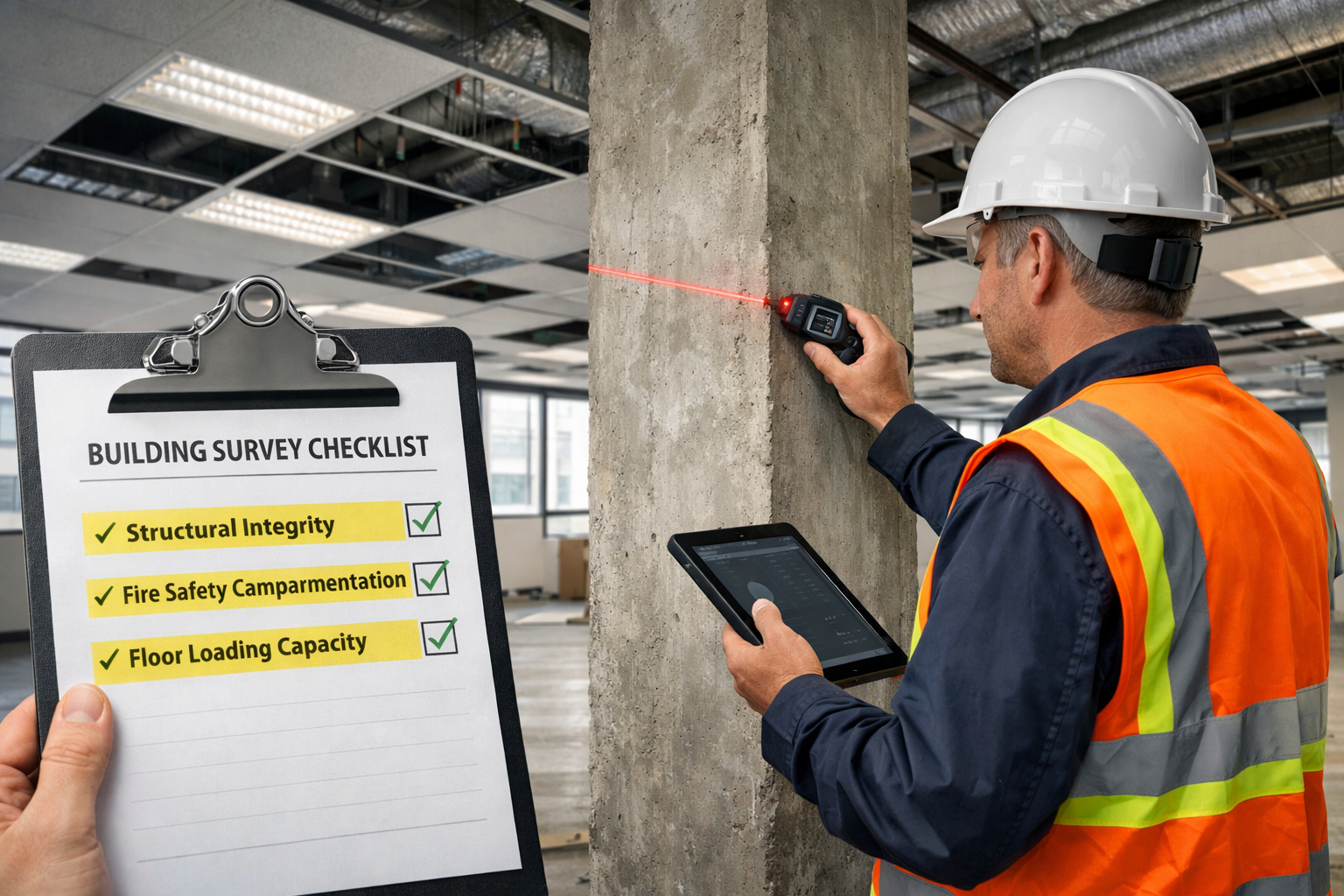
Structural Integrity and Load Capacity Assessment
Office buildings are typically designed for different loading conditions than residential properties. Survey checklists must thoroughly evaluate:
Floor Loading Capacity 🏗️
- Verify existing floor loading specifications (typically 2.5-5.0 kN/m² for offices)
- Assess adequacy for residential use (typically 1.5-2.0 kN/m² for dwellings)
- Identify areas requiring structural reinforcement
- Evaluate impact of partition wall additions
Structural Frame Condition
- Document condition of load-bearing elements (concrete, steel, masonry)
- Identify signs of deterioration, corrosion, or concrete spalling
- Assess adequacy of foundations for change of use
- Review structural calculations and original design documents where available
Vertical Penetrations and Core Modifications
- Evaluate feasibility of creating new stairwells or lift shafts
- Assess structural impact of additional vertical services
- Identify constraints on core repositioning
- Document existing service penetrations through floors
Working with experienced commercial property surveyors ensures structural assessments meet both building control requirements and prior approval expectations.
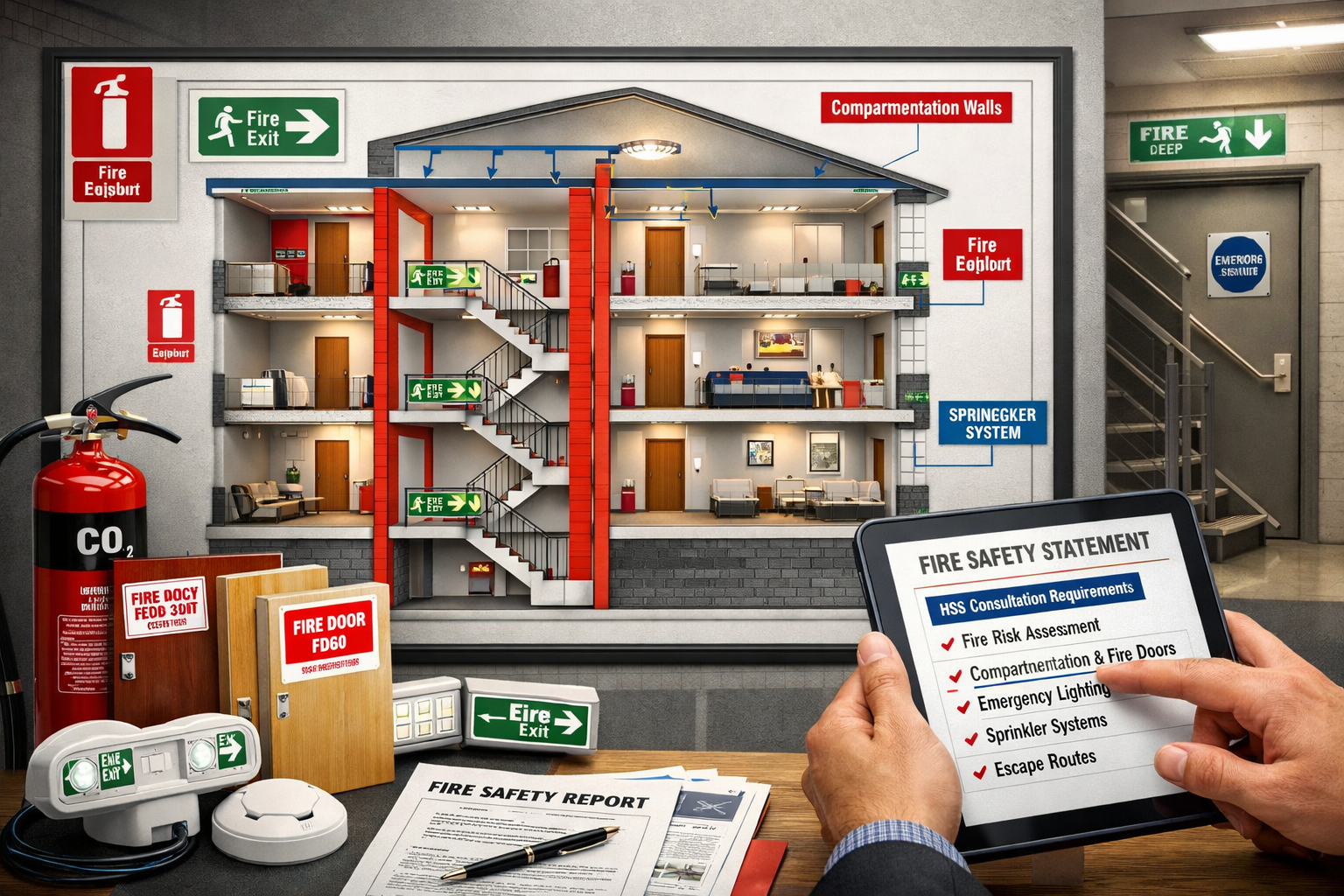
Fire Safety and Compartmentation Analysis
Fire safety has become the most scrutinized aspect of office-to-residential conversions in 2026. Survey checklists must comprehensively address:
Fire Compartmentation Requirements 🔥
- Assess existing fire compartmentation and fire stopping
- Identify required compartmentation for residential use
- Evaluate fire resistance of existing walls, floors, and doors
- Document need for upgraded fire barriers between units
Means of Escape Evaluation
- Analyze adequacy of existing escape routes
- Measure travel distances to protected stairwells
- Assess capacity and fire resistance of existing stairs
- Identify requirements for additional escape routes
Fire Detection and Suppression Systems
- Document existing fire alarm and detection systems
- Assess requirement for residential-grade smoke detection
- Evaluate need for sprinkler systems (particularly in taller buildings)
- Review emergency lighting provisions
Fire Statement Preparation
- Compile information for HSE consultation where required
- Document fire strategy for the proposed residential use
- Address Building Regulations Approved Document B requirements
- Provide fire safety management proposals
Habitability and Space Standards Compliance
All conversion schemes must meet national space standards as a non-negotiable prior approval criterion.[1] Survey checklists must verify:
Minimum Space Requirements 📏
| Unit Type | Minimum Gross Internal Area |
|---|---|
| 1-bed, 1-person | 37 m² |
| 1-bed, 2-person | 50 m² |
| 2-bed, 3-person | 61 m² |
| 2-bed, 4-person | 70 m² |
| 3-bed, 4-person | 74 m² |
| 3-bed, 5-person | 86 m² |
Natural Light Adequacy Assessment ☀️
Adequate natural light to every habitable room faces intensified scrutiny in 2026, particularly for buildings in conservation areas.[1] Survey checklists must include:
- Measure window-to-floor area ratios for each proposed room
- Calculate daylight factor percentages
- Assess impact of deep floor plates on light penetration
- Document external obstructions affecting daylight
- Evaluate need for light wells or additional windows
Ceiling Height Verification
- Measure floor-to-ceiling heights throughout
- Account for services and suspended ceiling requirements
- Verify minimum 2.3m ceiling height for at least 75% of gross internal area
- Identify areas requiring raised floors or lowered ceilings
Acoustic Performance Standards 🔊
Office buildings often lack adequate acoustic separation for residential use. Surveys must assess:
- Existing party wall construction and sound insulation
- Floor construction and impact sound transmission
- External noise levels and glazing performance
- Requirements for enhanced acoustic treatments
Environmental and Infrastructure Assessments
The 2026 reforms require comprehensive environmental assessments as part of prior approval.[1] Building survey checklists must coordinate:
Ground Contamination Analysis 🧪
- Review historical use of site and surrounding area
- Conduct Phase 1 desk study
- Recommend Phase 2 intrusive investigation where appropriate
- Assess remediation requirements and costs
Flood Risk Evaluation
- Determine Environment Agency flood zone classification
- Assess surface water flood risk
- Evaluate adequacy of drainage systems
- Identify flood mitigation measures required
Noise Assessment
- Measure external noise levels from roads, railways, or commercial uses
- Assess adequacy of facade insulation
- Evaluate internal noise from plant and services
- Recommend acoustic upgrades to meet residential standards
Transport and Highways Impact
- Assess parking provision requirements
- Evaluate cycle storage adequacy
- Review refuse collection arrangements
- Analyze impact on local transport infrastructure
Understanding these requirements helps coordinate specialist assessments alongside the core building survey work.
Implementing Comprehensive Survey Protocols for Conversion Projects
Successfully executing Building Survey Checklists for Office-to-Resi Conversions Under 2026 Planning Reforms requires methodical planning, specialist coordination, and thorough documentation.
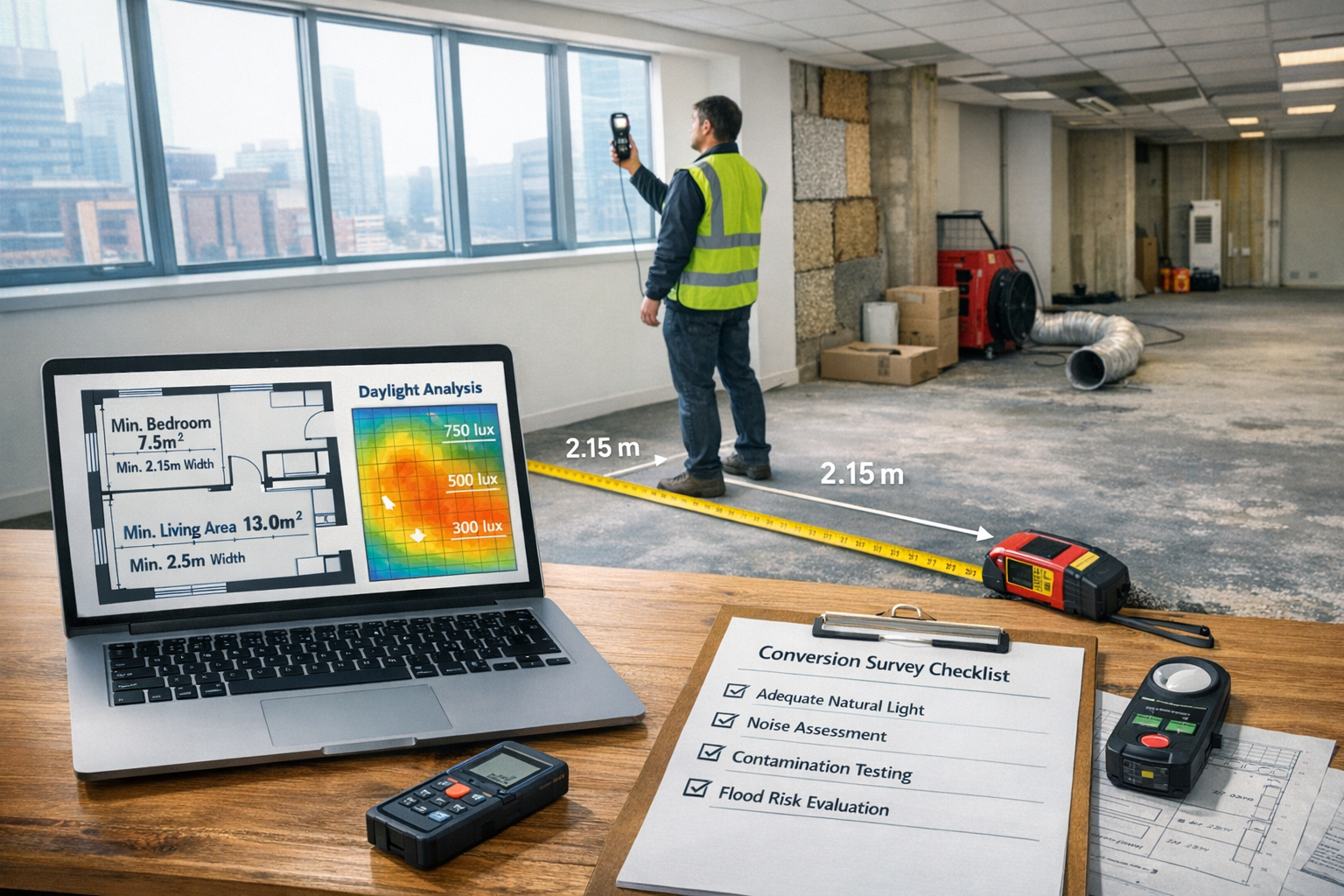
Survey Scope Definition and Specialist Coordination
Office-to-residential conversion surveys demand multi-disciplinary expertise. The survey scope should clearly define:
Core Survey Team Composition 👥
- Lead building surveyor: Overall survey coordination and structural assessment
- Fire safety consultant: Fire strategy and compartmentation design
- M&E engineer: Services capacity and distribution assessment
- Acoustic consultant: Sound insulation testing and specification
- Environmental consultant: Contamination, flood risk, and noise studies
Effective coordination between these specialists prevents gaps in coverage and ensures all prior approval requirements are addressed. The lead surveyor should establish clear communication protocols and shared documentation standards.
Phased Survey Methodology
A systematic phased approach ensures comprehensive coverage while managing costs:
Phase 1: Desktop Review and Feasibility 📋
- Review planning history and Article 4 direction status
- Obtain and analyze existing building drawings
- Review structural calculations and specifications
- Assess fire safety records and previous inspections
- Conduct preliminary space planning analysis
Phase 2: Intrusive Investigation 🔍
- Conduct detailed internal and external inspections
- Open up investigations of concealed elements
- Test floor loading and structural capacity
- Assess existing services infrastructure
- Document existing conditions photographically
Phase 3: Testing and Analysis 🔬
- Conduct acoustic testing of party walls and floors
- Perform daylight factor calculations
- Commission contamination testing if required
- Analyze structural samples if deterioration suspected
- Test existing mechanical and electrical systems
Phase 4: Reporting and Recommendations 📄
- Compile comprehensive survey report
- Provide cost estimates for required works
- Develop phased implementation strategy
- Prepare documentation for prior approval submission
- Coordinate specialist reports and appendices
Documentation Standards for Prior Approval Applications
The quality and completeness of survey documentation directly impacts prior approval success rates. Best practice in 2026 includes:
Minimum Technical Drawing Requirements 📐
- Existing floor plans at 1:100 scale
- Proposed floor plans showing unit layouts
- Existing and proposed elevations
- Sections through building showing floor heights
- Fire strategy drawings showing compartmentation and escape routes
Supporting Technical Reports
- Comprehensive building survey report (Level 3 standard)
- Fire safety statement and strategy
- Acoustic assessment report
- Daylight and sunlight analysis
- Transport and highways assessment
- Contamination assessment
- Flood risk assessment
- Noise impact assessment
Design and Access Statement
Although not always expressly required by regulation, best practice includes comprehensive Design and Access Statements addressing:[1]
- Site context and surrounding character
- Layout compliance with space standards
- Daylight and privacy design approach
- Access arrangements and inclusive design
- Refuse and cycle storage provisions
- Sustainability measures
This documentation reduces validation delays and demonstrates thorough consideration of prior approval criteria.
Common Survey Deficiencies and How to Avoid Them
Experience with conversion projects reveals recurring survey deficiencies that delay or derail prior approval:
❌ Inadequate Fire Safety Documentation
- Problem: Generic fire strategies not tailored to specific building
- Solution: Commission detailed fire engineering assessment with building-specific escape analysis
❌ Insufficient Natural Light Analysis
- Problem: Assumptions about daylight adequacy without calculations
- Solution: Conduct formal daylight factor analysis for all habitable rooms
❌ Incomplete Structural Assessment
- Problem: Visual inspection only without load capacity verification
- Solution: Engage structural engineer to review calculations and conduct load testing
❌ Missing Environmental Assessments
- Problem: Failure to commission required contamination or noise studies
- Solution: Review prior approval requirements early and commission all necessary assessments upfront
❌ Poor Coordination Between Specialists
- Problem: Conflicting information between different consultant reports
- Solution: Establish clear lead surveyor coordination role with regular team meetings
Cost Considerations and Budget Planning
Comprehensive conversion surveys represent significant investment, but inadequate surveys cost far more through delays and redesign. Typical cost ranges for London projects include:
Survey and Assessment Costs 💰
| Assessment Type | Typical Cost Range |
|---|---|
| Level 3 Building Survey | £3,000 – £8,000 |
| Fire Safety Strategy | £2,500 – £6,000 |
| Structural Engineering Review | £2,000 – £5,000 |
| Acoustic Assessment | £1,500 – £3,500 |
| Daylight/Sunlight Analysis | £1,000 – £2,500 |
| Contamination Study | £2,000 – £5,000 |
| Transport Assessment | £1,500 – £4,000 |
These costs vary significantly based on building size, complexity, and location. However, they represent essential due diligence that protects against far larger risks.
Technology Integration in Modern Conversion Surveys
Advanced technology enhances survey accuracy and efficiency:
Digital Survey Tools 📱
- Laser scanning for accurate dimensional surveys
- Thermal imaging for insulation and moisture detection
- Drone photography for roof and elevation surveys
- BIM (Building Information Modeling) integration
- Digital collaboration platforms for multi-disciplinary coordination
These technologies improve documentation quality while reducing survey time and costs.
Navigating Local Authority Requirements and Prior Approval Submission
Understanding local authority expectations and submission requirements maximizes approval prospects for office-to-residential conversions.
Pre-Application Consultation Strategy
While not mandatory, pre-application consultation with planning officers provides valuable insights into local priorities and concerns. Effective pre-application engagement should:
Present Comprehensive Survey Findings 📊
- Share preliminary survey results highlighting compliance with key criteria
- Demonstrate understanding of local planning context
- Address potential concerns proactively
- Seek feedback on approach to challenging aspects
Clarify Local Interpretation
- Understand how the authority interprets "adequate natural light"
- Clarify expectations for Design and Access Statements
- Confirm environmental assessment scope
- Verify validation requirements
This consultation investment typically saves time and reduces risk of refusal.
Validation Requirements and Common Rejection Reasons
Prior approval applications face initial validation checks before formal determination begins. Common validation failures include:
Missing Documentation ❌
- Incomplete drawing sets
- Missing specialist reports
- Inadequate fire safety information
- Insufficient site location plans
Technical Deficiencies
- Drawings not to required scale
- Inconsistencies between plans and reports
- Missing ownership certificates
- Incorrect application fee
Ensuring survey documentation meets all validation requirements prevents the 56-day determination clock from starting until deficiencies are corrected.
Responding to Consultation Feedback
During the determination period, authorities may consult:
- Environmental Health: Noise and contamination concerns
- Highways Authority: Transport and parking impacts
- Fire Service: Fire safety arrangements (though HSE now leads on taller buildings)
- Housing Officers: Space standards and housing mix
Survey documentation should anticipate and address likely consultation responses. Where concerns are raised, prompt technical responses supported by survey evidence are essential.
Article 4 Directions and Alternative Routes
Where Article 4 directions remove permitted development rights, full planning permission becomes necessary. However, comprehensive survey work remains valuable:
- Demonstrates technical feasibility
- Addresses material planning considerations
- Supports design quality arguments
- Provides evidence for planning committee decisions
The same survey protocols apply, but additional planning considerations (design quality, heritage impact, urban design) become relevant.
Regional Variations: London and Home Counties Considerations
Office-to-residential conversion dynamics vary significantly across London and the Home Counties, affecting survey priorities and approval prospects.
Central London Conversion Challenges
Central London office conversions face unique constraints:
Deep Floor Plates 🏢
- Many City and West End offices have floor plates exceeding 15m depth
- Natural light penetration becomes critical constraint
- May require light wells or external alterations
- Survey must rigorously assess daylight adequacy
Conservation Area Restrictions
- Heightened scrutiny of external alterations
- Restrictions on window modifications
- Requirements to preserve architectural character
- May limit conversion feasibility despite permitted development rights
Heritage Considerations
- Many office buildings in conservation areas or near listed buildings
- Survey must assess impact on heritage assets
- May trigger additional consultation requirements
Working with chartered surveyors in London familiar with these local considerations proves invaluable.
Suburban and Home Counties Opportunities
Suburban office parks and town center offices present different opportunities:
Parking and Transport 🚗
- Greater parking provision typically required
- Lower public transport accessibility
- Survey must assess parking capacity and potential
- May require transport assessments demonstrating sustainability
Lower Density Contexts
- More flexibility for external alterations
- Potential for additional stories
- Less restrictive design expectations
- Survey can explore broader conversion options
Regional specialists such as chartered surveyors in Hertfordshire or chartered surveyors in Sussex understand local authority priorities and approval patterns.
Article 4 Direction Hotspots
Certain areas have implemented Article 4 directions removing office-to-residential permitted development rights:
- Parts of Central London (protecting employment uses)
- Some town centers in Surrey and Berkshire
- Areas with particular housing quality concerns
Survey work in these locations must support full planning applications, requiring broader consideration of planning policy compliance beyond technical prior approval criteria.
Conclusion
Building Survey Checklists for Office-to-Resi Conversions Under 2026 Planning Reforms represent far more than routine property inspections. They form the technical foundation for successful adaptive reuse projects navigating complex regulatory requirements, structural challenges, and habitability standards.
The 2026 planning reforms have created significant opportunities by removing size restrictions while simultaneously raising the bar for fire safety, natural light adequacy, and environmental performance. Developers and property professionals who invest in comprehensive Level 3 survey protocols addressing structural integrity, fire compartmentation, acoustic performance, and regulatory compliance position themselves for approval success.
Actionable Next Steps
For Developers Considering Office Conversions 🎯
- Commission preliminary feasibility assessment before site acquisition
- Verify absence of Article 4 directions and location exclusions
- Engage multi-disciplinary survey team early in project planning
- Budget adequately for comprehensive survey and assessment work
- Consider pre-application consultation to clarify local authority expectations
For Property Professionals 📋
- Update survey protocols to reflect 2026 fire safety requirements
- Establish relationships with specialist fire safety and acoustic consultants
- Develop standardized documentation templates meeting prior approval requirements
- Invest in digital survey technology to improve efficiency and accuracy
- Maintain awareness of local Article 4 directions and planning policy changes
For Building Owners 🏢
- Assess conversion potential of vacant or underutilized office space
- Commission initial building survey to identify constraints and opportunities
- Gather historical documentation on building construction and services
- Consider phased conversion approaches for larger buildings
- Engage experienced conversion specialists familiar with local market conditions
The London office-to-residential conversion market continues to evolve rapidly. Success requires rigorous technical assessment, comprehensive survey protocols, and thorough understanding of the 2026 regulatory framework. By implementing the survey checklists and methodologies outlined in this guide, property professionals can navigate this complex landscape with confidence and deliver high-quality residential developments that meet urgent housing needs while preserving the capital's architectural heritage.
For expert guidance on conversion surveys and prior approval applications, consult with experienced RICS building surveyors who understand both the technical requirements and local authority expectations shaping this dynamic sector in 2026.
References
[1] How To Convert Offices Into Homes Without Planning Permission – https://urbanistarchitecture.co.uk/how-to-convert-offices-into-homes-without-planning-permission/
[2] Planning Reforms – https://www.homebuilding.co.uk/news/planning-reforms
