
As homeowners across England and Wales embrace sustainable living in 2026, the intersection of Party Wall Notices for Sustainable Home Extensions in 2026: Eco-Compliance Clauses has become increasingly critical. With the housing market recovering and environmental regulations tightening, understanding how to align traditional party wall procedures with modern eco-standards is no longer optional—it's essential. 🌱
The Party Wall Act 1996 remains the cornerstone legislation governing construction work on shared boundaries, but 2026 brings fresh challenges and opportunities [1]. As the Future Homes Standard pushes the construction industry toward low-carbon solutions, party wall agreements must evolve to accommodate green retrofits, biodiversity considerations, and sustainable building practices. This comprehensive guide explores how Party Wall Notices for Sustainable Home Extensions in 2026: Eco-Compliance Clauses are transforming the way neighbors collaborate on environmentally responsible home improvements.
Key Takeaways
- Party wall notices now require eco-compliance clauses that address sustainable materials, energy performance standards, and biodiversity net gain requirements in 2026
- The Future Homes Standard integration means party wall agreements must document low-carbon construction methods and thermal performance specifications
- Notice periods remain unchanged at 2 months for party wall works and 1 month for excavations, but documentation requirements have expanded to include environmental impact assessments [1]
- Sustainable extensions trigger party wall procedures when they involve loft conversions, foundation work, or structural alterations, with additional green certification requirements
- Professional party wall surveyors now assess both structural integrity and environmental compliance to ensure extensions meet 2026 sustainability benchmarks
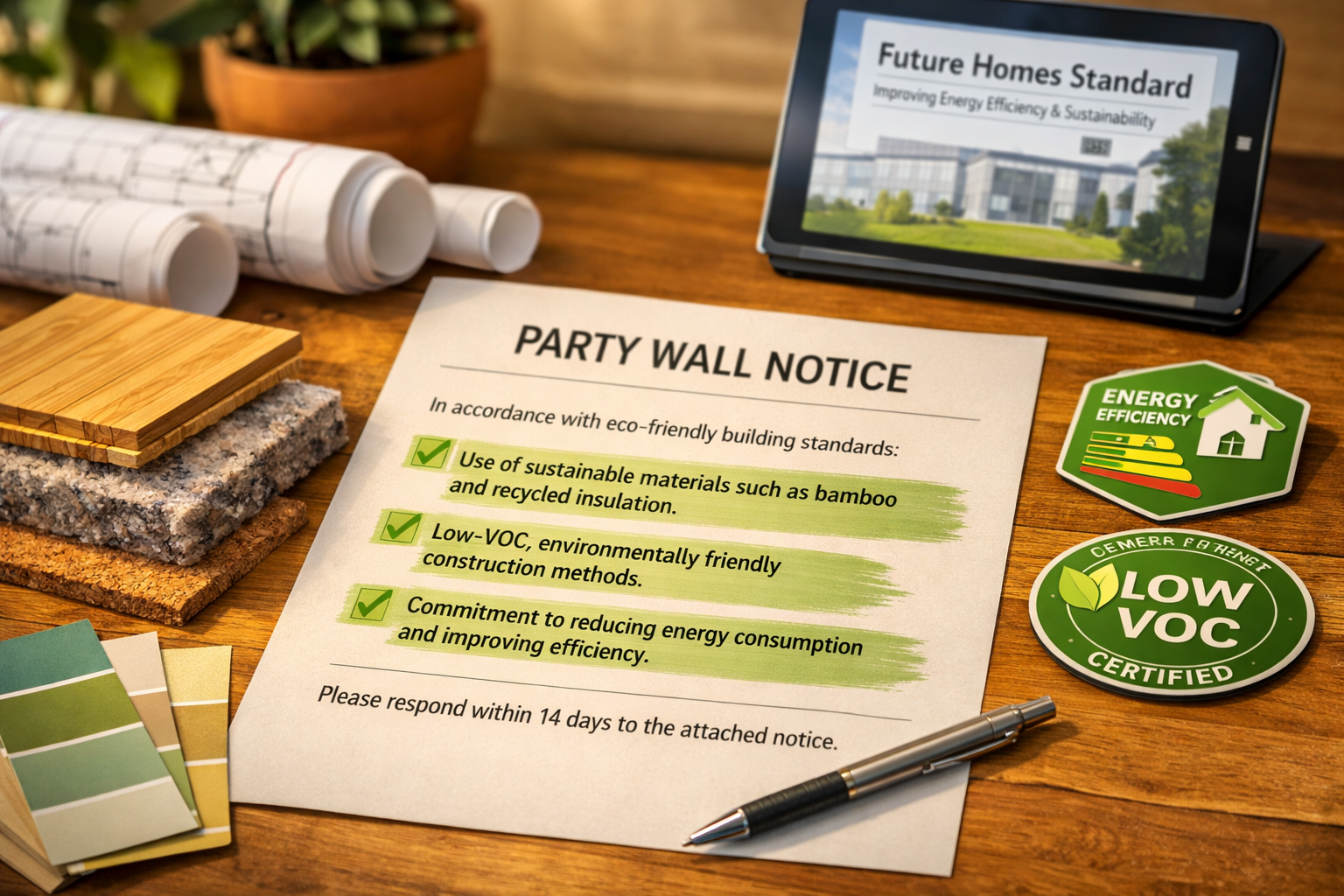
Understanding Party Wall Notices for Sustainable Home Extensions in 2026
The Party Wall Act 1996 Framework
The Party Wall Act 1996 applies exclusively to England and Wales, providing the legal framework for construction work affecting shared walls, boundaries, and adjacent excavations [1]. In 2026, this legislation continues to protect both building owners and adjoining owners during construction projects, but with enhanced environmental considerations.
Party wall notices are legally required for several types of sustainable home extensions:
- Loft conversions with structural alterations to party walls
- Foundation excavations for ground-floor extensions within 3-6 meters of neighboring properties
- Installation of damp-proof courses in shared walls
- Beam insertions for open-plan layouts
- Underpinning works to improve structural stability
However, minor works such as plastering, electrical installations, and internal drilling do not require party wall agreements [1]. Understanding this distinction helps homeowners plan sustainable extensions efficiently while maintaining good neighbor relations.
Notice Periods and Documentation Requirements
The statutory notice periods established under the Party Wall Act remain consistent in 2026:
| Work Type | Notice Period | Documentation Required |
|---|---|---|
| Party wall building works | 2 months | Party Structure Notice, eco-compliance schedule |
| Boundary wall construction | 2 months | Line of Junction Notice, sustainability specifications |
| Excavation near boundaries | 1 month | Adjacent Excavation Notice, environmental impact statement |
These timeframes allow adjoining owners adequate opportunity to review proposals, assess environmental impacts, and respond appropriately [1]. For more details on the complete process, consult our comprehensive guide to party wall surveys.
The 2026 Sustainability Imperative
Building regulations in 2026 emphasize energy performance and sustainable construction more than ever before [2]. The Future Homes Standard, which mandates significant carbon emission reductions for new homes, influences extension projects through:
- Enhanced thermal performance requirements (U-values below 0.18 W/m²K for walls)
- Renewable energy integration (solar panels, heat pumps)
- Sustainable material specifications (recycled content, low embodied carbon)
- Biodiversity net gain obligations (wildlife habitats, green roofs)
- Water efficiency measures (rainwater harvesting, greywater systems)
When these sustainable features affect party walls or boundaries, eco-compliance clauses become essential components of party wall agreements. Understanding the Party Wall Act comprehensively helps homeowners navigate these dual requirements effectively.
Eco-Compliance Clauses in Party Wall Agreements
What Are Eco-Compliance Clauses?
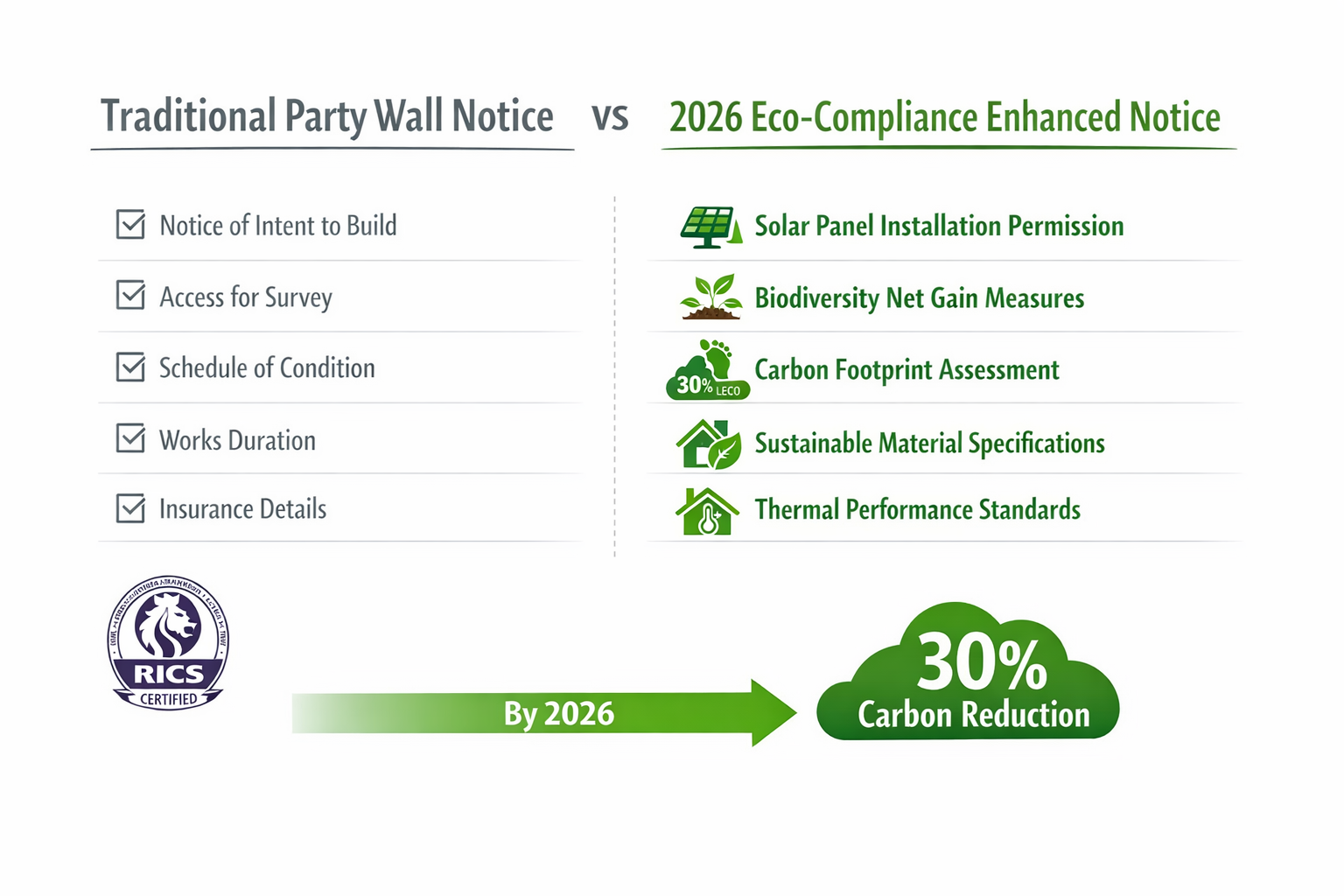
Eco-compliance clauses are contractual provisions within party wall agreements that specifically address environmental standards, sustainable construction methods, and green building certifications. These clauses ensure that home extensions meet both legal party wall requirements and contemporary environmental regulations.
In 2026, typical eco-compliance clauses include:
✅ Sustainable Material Specifications: Requirements for recycled content, FSC-certified timber, low-VOC paints, and materials with Environmental Product Declarations (EPDs)
✅ Thermal Performance Standards: Commitments to exceed minimum U-values and prevent thermal bridging at party wall junctions
✅ Carbon Footprint Documentation: Calculations showing embodied carbon reductions compared to conventional construction methods
✅ Biodiversity Protection Measures: Provisions for wildlife surveys, bat boxes, bird nesting sites, and green infrastructure
✅ Waste Management Protocols: Plans for construction waste recycling and circular economy practices
✅ Energy System Integration: Specifications for renewable energy installations that may affect shared structures
Aligning with the Future Homes Standard
The Future Homes Standard represents the UK government's commitment to carbon-neutral housing. While primarily targeting new builds, its principles increasingly influence extension projects in 2026 [2]. Party wall agreements now frequently incorporate:
Low-Carbon Retrofit Provisions: When extending properties, homeowners often simultaneously retrofit existing structures. Eco-compliance clauses should address:
- Installation of external wall insulation affecting party wall appearance
- Upgrading shared chimneys for heat pump flue requirements
- Roof modifications for solar panel arrays
- Foundation work for ground-source heat pump systems
Performance Verification Requirements: Modern party wall agreements may stipulate:
- Post-construction thermal imaging to confirm insulation effectiveness
- Air tightness testing at party wall junctions
- Acoustic performance verification for sustainable building systems
- Energy Performance Certificate (EPC) improvements
For homeowners wondering when a party wall agreement is necessary, the answer in 2026 increasingly includes consideration of environmental impact.
Biodiversity Net Gain Requirements
Since 2024, biodiversity net gain has been mandatory for most development projects in England, requiring a 10% improvement in habitat value. While small home extensions may qualify for exemptions, responsible homeowners in 2026 voluntarily incorporate biodiversity considerations into party wall agreements:
🦇 Wildlife Impact Assessments: Pre-construction surveys identifying protected species (bats, nesting birds) in walls, roofs, and boundaries
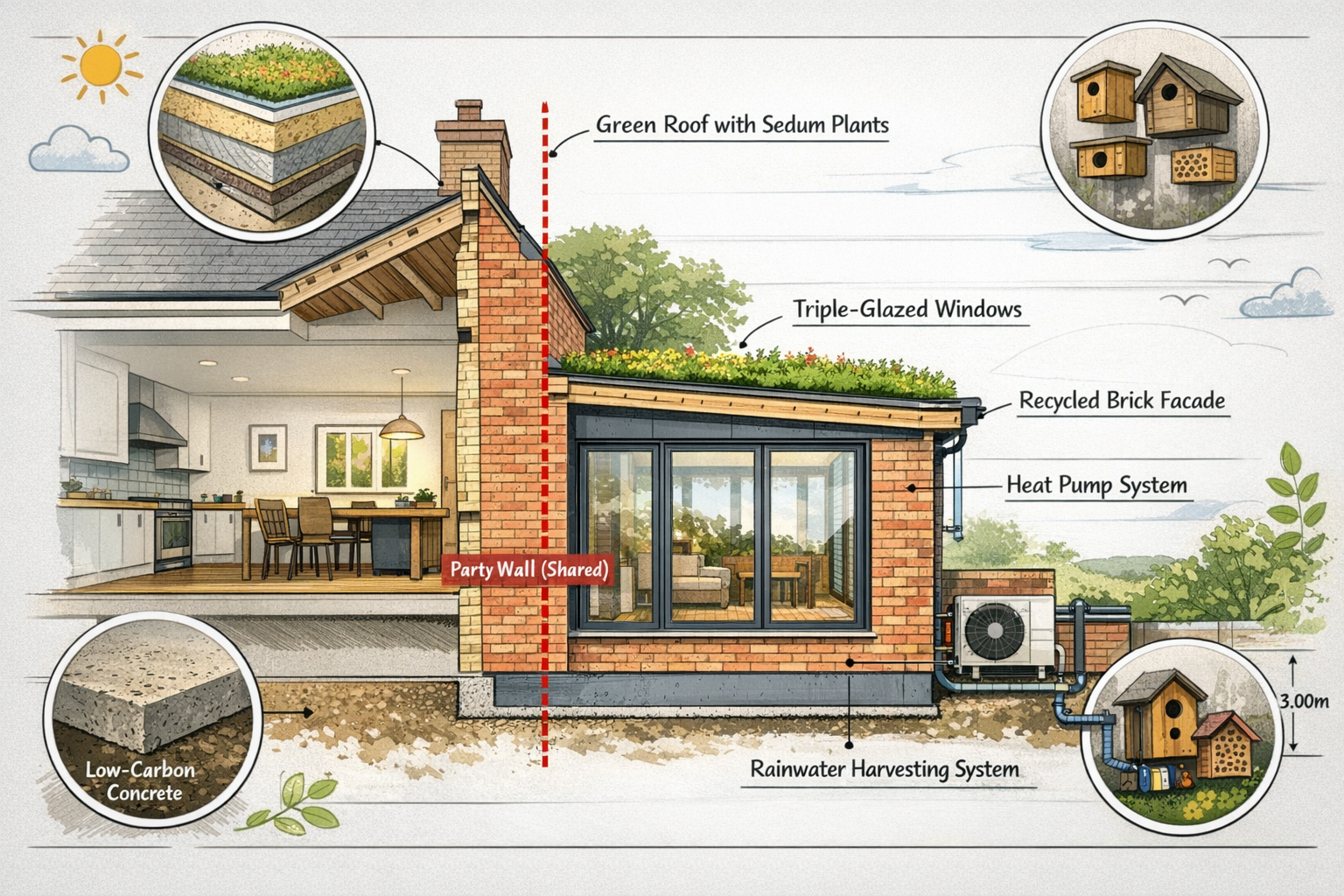
🌿 Habitat Creation Commitments: Installation of green roofs, living walls, insect hotels, and native planting schemes
🐦 Seasonal Work Restrictions: Timing construction to avoid bird nesting seasons (March-August) and bat hibernation periods
🌳 Tree and Hedge Protection: Safeguarding boundary vegetation that provides ecological value
These provisions protect both biodiversity and neighbor relations, demonstrating environmental responsibility throughout the construction process.
Sample Eco-Compliance Clause Language
A well-drafted eco-compliance clause for 2026 might read:
"The Building Owner commits to constructing the proposed extension using materials with an average embodied carbon not exceeding 450 kgCO2e/m², verified through Environmental Product Declarations. All timber shall be FSC-certified, and insulation materials shall contain minimum 30% recycled content. The Building Owner shall install a minimum of two integrated bat boxes and one bird nesting box within the new structure, and shall provide photographic evidence of installation to the Adjoining Owner upon completion. All work affecting the party wall shall achieve a thermal transmittance (U-value) not exceeding 0.15 W/m²K, verified by post-construction thermal imaging within 30 days of completion."
This language provides specific, measurable commitments that protect environmental standards while maintaining party wall integrity. For guidance on party wall awards and agreements, professional surveyors can help draft appropriate clauses.
Implementing Party Wall Notices for Sustainable Home Extensions in 2026: Eco-Compliance Clauses
Step-by-Step Process for Green Extensions
Implementing Party Wall Notices for Sustainable Home Extensions in 2026: Eco-Compliance Clauses requires careful coordination between legal requirements and environmental objectives:
1. Pre-Design Environmental Assessment (Weeks 1-2)
- Conduct biodiversity surveys of existing structures
- Assess current thermal performance of party walls
- Identify opportunities for sustainable improvements
- Research local planning authority environmental requirements
2. Design Development with Sustainability Focus (Weeks 3-6)
- Specify low-carbon materials and construction methods
- Design for thermal efficiency at party wall junctions
- Integrate renewable energy systems
- Plan biodiversity enhancement features
3. Party Wall Notice Preparation (Week 7)
- Draft comprehensive party wall notices including eco-compliance schedules
- Prepare supporting documentation (sustainability specifications, material EPDs)
- Include visual representations of green features
- Serve notices with appropriate lead times (1-2 months) [1]
4. Neighbor Consultation and Agreement (Weeks 8-16)
- Discuss environmental benefits with adjoining owners
- Address concerns about sustainable construction methods
- Negotiate eco-compliance clause details
- Obtain consent or appoint party wall surveyors if disputed
5. Party Wall Award Documentation (Weeks 17-18)
- Formalize agreements through party wall awards
- Incorporate finalized eco-compliance clauses
- Establish monitoring and verification procedures
- Define dispute resolution mechanisms
For those concerned about potential neighbor objections, our guide on whether neighbors can refuse party wall agreements provides valuable insights.
The Role of Party Wall Surveyors in 2026
The surge in party wall surveying demand during 2026 reflects increased construction activity, particularly loft conversions [3]. Modern party wall surveyors now require expertise in both traditional structural matters and contemporary sustainability standards:
Dual Competency Requirements:
- Traditional structural assessment skills
- Understanding of low-carbon construction techniques
- Knowledge of thermal performance standards
- Familiarity with biodiversity regulations
- Awareness of renewable energy system implications
Enhanced Survey Scope: Party wall surveys in 2026 typically include:
📋 Structural Condition Assessment: Traditional documentation of existing party wall condition
🌡️ Thermal Performance Evaluation: Baseline thermal imaging to establish pre-construction heat loss patterns
🔍 Environmental Impact Analysis: Assessment of proposed sustainable features affecting shared structures
📊 Carbon Footprint Calculation: Documentation of embodied carbon in proposed materials
🦋 Biodiversity Baseline Survey: Recording of existing ecological features requiring protection
Professional surveyors help navigate the complexity of party wall awards while ensuring environmental compliance.
Cost Considerations for Eco-Compliant Extensions
Sustainable home extensions with proper party wall procedures involve several cost components:
| Cost Category | Typical Range (2026) | Notes |
|---|---|---|
| Party wall surveyor fees | £700-£1,500 | Per surveyor; both parties may appoint separate surveyors |
| Biodiversity surveys | £300-£800 | Pre-construction ecological assessments |
| Sustainable materials premium | 10-20% above standard | Low-carbon alternatives to conventional materials |
| Enhanced insulation | £40-£80/m² | High-performance insulation at party walls |
| Green roof installation | £100-£200/m² | Biodiversity enhancement features |
| Thermal imaging verification | £200-£400 | Post-construction performance testing |
While sustainable features increase upfront costs, they deliver long-term benefits through reduced energy bills, increased property value, and environmental stewardship. Understanding the cost of party wall procedures helps homeowners budget effectively.
Common Challenges and Solutions
Challenge 1: Neighbor Skepticism About Green Features
Some adjoining owners may question the necessity or effectiveness of sustainable construction methods. Solution: Provide clear documentation of environmental benefits, including energy modeling showing reduced carbon emissions and potential property value increases for both properties.
Challenge 2: Balancing Thermal Performance with Party Wall Integrity
High-performance insulation can affect party wall dimensions and fire resistance. Solution: Engage structural engineers early to specify appropriate materials that meet both thermal and structural requirements, ensuring compliance with Building Regulations Part B (fire safety).
Challenge 3: Timing Conflicts Between Biodiversity Surveys and Construction Schedules
Ecological surveys must occur during specific seasons, potentially delaying projects. Solution: Conduct preliminary biodiversity assessments during design phases, well before serving party wall notices, allowing adequate time for seasonal surveys.
Challenge 4: Documenting Embodied Carbon for Party Wall Agreements
Calculating embodied carbon requires specialized knowledge and data. Solution: Work with sustainability consultants who can provide verified carbon calculations using recognized methodologies (RICS Whole Life Carbon Assessment).
For specific scenarios like loft conversions requiring party wall agreements, professional guidance ensures smooth implementation of eco-compliance clauses.
Best Practices for Party Wall Notices for Sustainable Home Extensions in 2026
Proactive Neighbor Engagement
Early communication transforms potential conflicts into collaborative opportunities:
🤝 Pre-Notice Discussions: Before formal party wall notices, informally discuss sustainable extension plans with neighbors, emphasizing environmental benefits for the entire community
📄 Comprehensive Information Packages: Provide neighbors with detailed sustainability specifications, including material certifications, energy modeling results, and biodiversity enhancement plans
🌍 Shared Environmental Vision: Frame sustainable extensions as contributions to neighborhood carbon reduction goals and local biodiversity improvement
💡 Educational Approach: Explain how eco-compliance clauses protect both properties' long-term value and environmental performance
Documentation Excellence
Thorough documentation prevents disputes and ensures successful implementation:
Essential Documents for 2026 Party Wall Notices:
- Architectural drawings showing sustainable features
- Material specifications with Environmental Product Declarations
- Thermal performance calculations and U-value schedules
- Biodiversity survey reports and enhancement proposals
- Construction methodology statements emphasizing low-impact techniques
- Waste management plans demonstrating circular economy principles
- Post-construction verification protocols
Consider whether you can proceed with a party wall agreement without a surveyor, though professional assistance often proves valuable for complex sustainable extensions.
Future-Proofing Agreements
Well-crafted eco-compliance clauses anticipate future environmental regulations:
Forward-Looking Provisions:
- Adaptability Clauses: Allow for upgrading to more stringent environmental standards as regulations evolve
- Technology Integration Rights: Permit future installation of emerging sustainable technologies (e.g., advanced battery storage, hydrogen-ready heating)
- Monitoring and Verification: Establish ongoing performance monitoring to demonstrate sustained environmental benefits
- Maintenance Commitments: Define responsibilities for maintaining green features (living walls, green roofs, renewable energy systems)
Professional Support Network
Successful sustainable extensions require coordinated expertise:
Key Professional Roles:
- 🏗️ Architects with Sustainability Credentials: Passivhaus designers, LEED-accredited professionals
- 📐 Party Wall Surveyors: RICS-qualified professionals experienced in eco-compliance matters
- 🔬 Sustainability Consultants: Specialists in embodied carbon calculation and life cycle assessment
- 🌿 Ecological Surveyors: Licensed bat surveyors, ornithologists, botanists
- ⚖️ Construction Lawyers: Advisors on environmental compliance and party wall law
For questions about specific procedures, the party wall FAQ provides helpful guidance, while understanding who pays for party wall surveyors clarifies financial responsibilities.
Conclusion: Building Sustainably and Collaboratively in 2026
Party Wall Notices for Sustainable Home Extensions in 2026: Eco-Compliance Clauses represent the convergence of traditional property law and contemporary environmental responsibility. As the housing market recovers and homeowners increasingly prioritize sustainability, integrating eco-compliance provisions into party wall agreements has become essential practice rather than optional enhancement.
The key to success lies in proactive planning, comprehensive documentation, and collaborative neighbor engagement. By aligning party wall procedures with the Future Homes Standard, incorporating biodiversity considerations, and specifying low-carbon construction methods, homeowners can create extensions that benefit both their families and the environment while maintaining positive neighbor relations.
Actionable Next Steps
Ready to proceed with a sustainable home extension? Follow these steps:
-
Assess Your Project Scope: Determine whether your planned extension triggers party wall requirements by consulting our guide on party wall structure notices
-
Conduct Early Environmental Assessments: Commission biodiversity surveys and thermal performance evaluations during the design phase, well before serving party wall notices
-
Engage Professional Surveyors: Appoint RICS-qualified party wall surveyors experienced in sustainable construction to draft comprehensive agreements with eco-compliance clauses
-
Communicate with Neighbors: Initiate early discussions with adjoining owners, emphasizing the environmental and property value benefits of sustainable construction
-
Document Thoroughly: Prepare complete sustainability specifications, material certifications, and environmental impact assessments to accompany party wall notices
-
Serve Notices with Adequate Lead Time: Remember the statutory periods—2 months for party wall works, 1 month for excavations—and allow additional time for eco-compliance discussions [1]
-
Monitor and Verify: Implement post-construction verification procedures to demonstrate achievement of environmental commitments
The integration of sustainability principles into party wall procedures reflects broader societal shifts toward environmental responsibility. By embracing Party Wall Notices for Sustainable Home Extensions in 2026: Eco-Compliance Clauses, homeowners contribute to carbon reduction goals, biodiversity enhancement, and the creation of healthier, more resilient communities. The future of home extensions is both legally compliant and environmentally conscious—a dual commitment that benefits individual homeowners, neighbors, and the planet alike. 🌍✨
References
[1] Party Wall Agreement – https://hoa.org.uk/advice/guides-for-homeowners/i-am-improving/party-wall-agreement/
[2] House Extension Rules 2026 What You Need To Know – https://devisarchitecture.com/home-extensions/house-extension-rules-2026-what-you-need-to-know/
[3] Party Wall Surveying Surge In 2026 Loft Conversions Navigating High Demand Compliance During Housing Uptick – https://nottinghillsurveyors.com/blog/party-wall-surveying-surge-in-2026-loft-conversions-navigating-high-demand-compliance-during-housing-uptick
