
{"cover":"Professional landscape format (1536×1024) hero image featuring bold text overlay 'Navigating North-South Valuation Divides in 2026: RICS Techniques for Property Appraisals' in extra large 72pt white sans-serif font with dark gradient shadow, positioned in upper third. Background shows split-screen composition: left side displays modern Northern UK terraced houses with upward trending price graph overlay, right side shows Southern UK period properties with stagnant market indicators. Color scheme: deep navy blue, white text, gold accents for RICS branding. Includes subtle UK map outline with regional price heat zones. High contrast, editorial magazine cover quality, professional surveying aesthetic with rulers and measurement tools as decorative elements","content":["Detailed landscape format (1536×1024) editorial image showing UK map with dramatic color-coded regional valuation zones, Northern regions in vibrant green and amber showing growth, Southern regions in cooler blue tones indicating stagnation. Overlaid transparent data visualization showing percentage changes by region, with Manchester, Leeds, and Liverpool highlighted with upward arrows, London and Southeast with horizontal trend lines. Professional surveying tools like measuring tape and digital tablet displaying RICS Red Book standards frame the corners. Clean infographic style with clear typography showing 2026 Q1 data points, modern business aesthetic","Detailed landscape format (1536×1024) professional photograph of RICS chartered surveyor conducting property inspection, holding digital tablet displaying comparable sales analysis software with multiple property images and valuation matrices visible on screen. Background shows interior of Northern UK Victorian terrace property with period features. Foreground includes open Red Book standards manual, measuring laser device, and property documentation spread on table. Warm natural lighting, documentary photography style, showing real-world application of valuation methodologies, professional business attire, serious concentrated expression","Detailed landscape format (1536×1024) conceptual business illustration showing three distinct valuation approaches as interconnected pillars: Market Approach pillar with comparable property images, Income Approach pillar with rental yield calculations and cash flow diagrams, Cost Approach pillar with construction materials and depreciation charts. Center shows RICS professional standards badge connecting all three. Background features faded architectural blueprints and UK property skyline silhouette. Modern flat design style with clean lines, professional color palette of navy, gold, and white, educational infographic aesthetic with clear labels and arrows showing methodology relationships"]"}

The UK property market has entered uncharted territory in 2026. While Northern cities experience unprecedented growth, Southern markets face stagnation—creating the widest regional valuation gap in decades. For property professionals, this divergence presents both challenges and opportunities. Navigating Widening North-South Valuation Divides in 2026: RICS Techniques for Accurate Property Appraisals requires understanding not just the numbers, but the methodology behind them.
Recent RICS survey data from January 2026 reveals a stark reality: Manchester property values surged 8.2% year-on-year while London's prime areas remained flat or declined by up to 3%. This regional disparity demands precision from chartered surveyors who must justify valuations in markets behaving completely differently from historical norms. The question isn't simply what properties are worth—it's how to determine value when traditional comparables no longer apply.
Key Takeaways
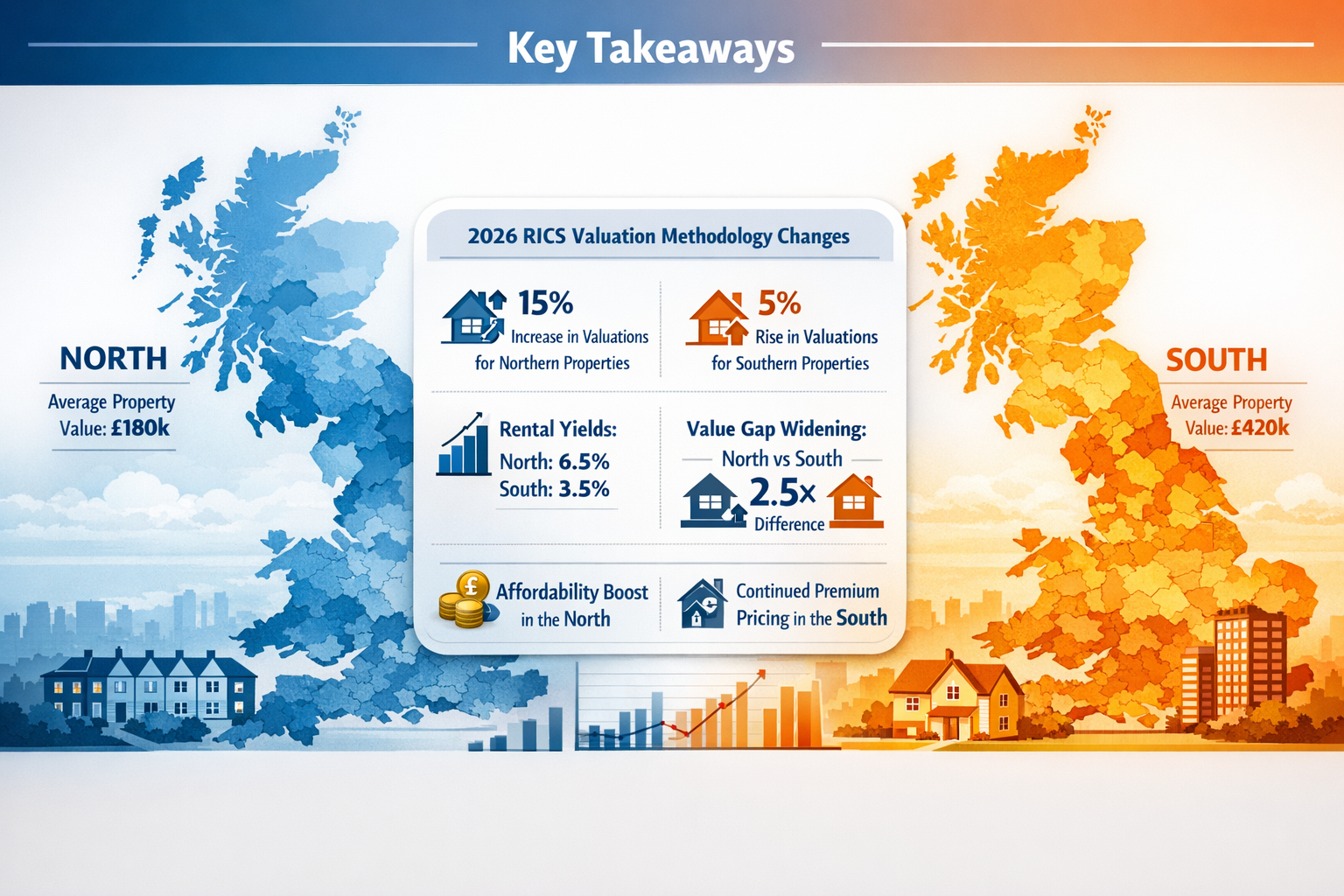
- Regional divergence is unprecedented: Northern UK markets show 6-8% growth while Southern regions experience stagnation or decline, creating the widest North-South valuation gap since 2008
- RICS Red Book standards provide essential framework: The updated global standards effective January 2025 offer mandatory guidance for consistent valuation methodology across disparate markets
- Comparable sales adjustments require enhanced scrutiny: Traditional comparison methods need significant modification when market conditions vary dramatically by region
- ESG factors now impact valuations: The April 2026 RICS ESG standard mandates consideration of sustainability factors in commercial property valuations
- Multiple valuation approaches strengthen accuracy: Combining market, income, and cost approaches provides triangulation necessary for defensible appraisals in volatile markets
Understanding the 2026 North-South Property Valuation Landscape
The regional property divide dominating 2026 didn't emerge overnight. Economic restructuring, remote work patterns, and infrastructure investment have fundamentally altered where people choose to live and work. Northern cities—particularly Manchester, Leeds, and Liverpool—have transformed from industrial centres to technology and creative hubs, attracting younger professionals priced out of Southern markets.
The Data Behind the Divide
January 2026 RICS survey data paints a compelling picture:
| Region | Year-on-Year Growth | Average Property Value | Market Sentiment |
|---|---|---|---|
| Greater Manchester | +8.2% | £285,000 | Strong demand ⬆️ |
| Leeds | +7.8% | £268,000 | Very positive ⬆️ |
| Liverpool | +6.9% | £215,000 | Growing interest ⬆️ |
| London (Prime) | -2.8% | £895,000 | Cautious ➡️ |
| Southeast | -0.5% | £425,000 | Stagnant ➡️ |
| Southwest | +1.2% | £385,000 | Mixed signals ↔️ |
These figures represent more than statistical curiosities—they reflect fundamental shifts in economic geography. For surveyors conducting RICS home surveys, understanding why these disparities exist is as important as documenting what they are.
Market Perception Factors Driving Regional Variations
Economic fundamentals explain only part of the story. Market perception—how buyers, sellers, and investors view different regions—creates self-reinforcing cycles. Northern markets benefit from:
- 🏢 Corporate relocations: Major employers establishing regional headquarters
- 🚄 Infrastructure investment: HS2 and Northern Powerhouse Rail projects
- 🎓 University expansion: Growing student populations transitioning to permanent residents
- 💰 Affordability advantage: Significantly lower entry costs attracting first-time buyers
Southern markets face headwinds from:
- 📉 Affordability crisis: Prices disconnected from local wage growth
- 🏛️ Political uncertainty: Ongoing debates about London's economic dominance
- 🌍 International buyer retreat: Reduced overseas investment in prime London property
- 💼 Remote work normalization: Reduced necessity for physical proximity to offices
When conducting valuation assessments, chartered surveyors must acknowledge these perception factors while maintaining objectivity grounded in evidence.
RICS Standards Framework for Navigating Widening North-South Valuation Divides in 2026
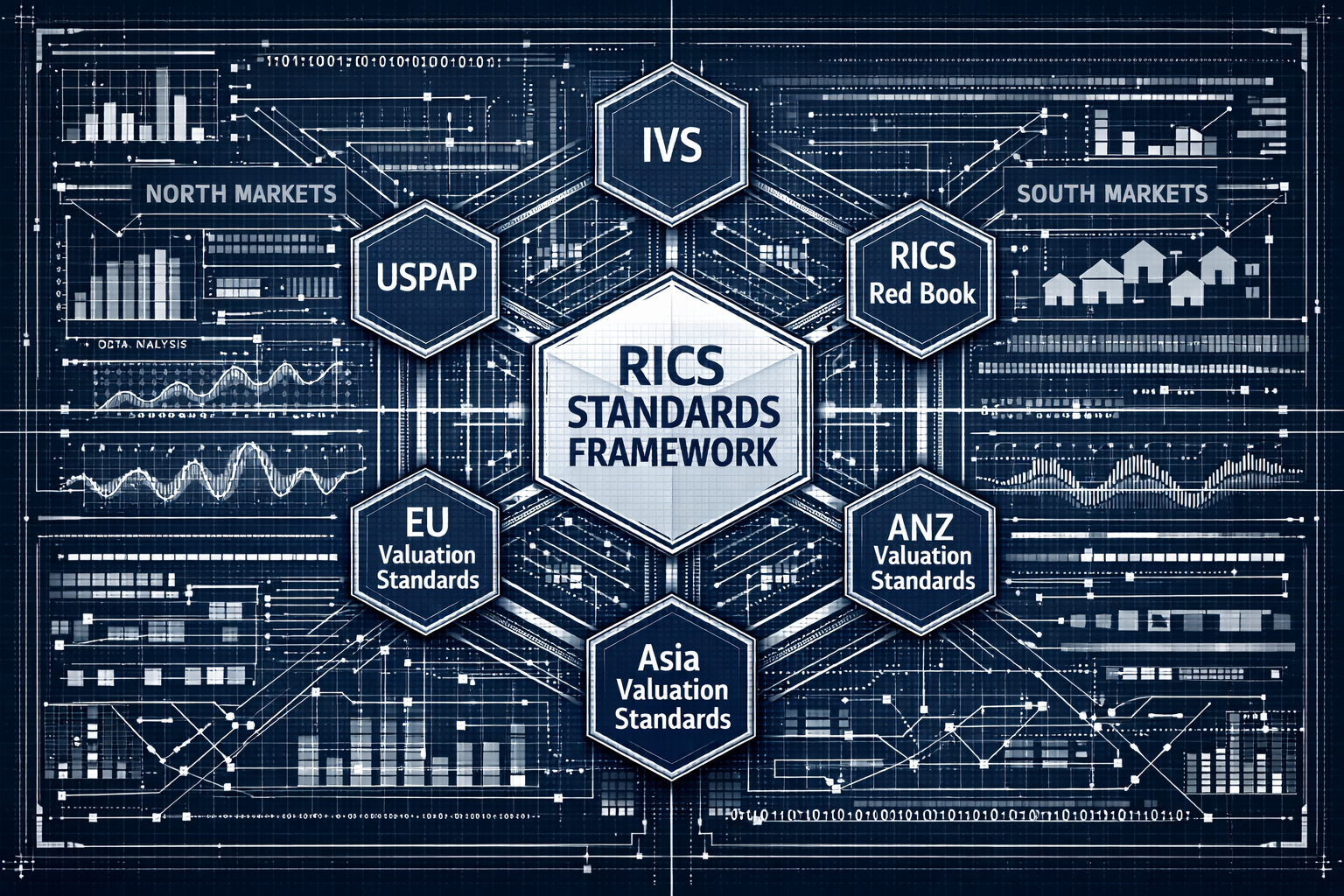
The Royal Institution of Chartered Surveyors provides the professional foundation for consistent, defensible property valuations regardless of market conditions. The RICS Valuation – Global Standards (Red Book), which became effective January 31, 2025, establishes mandatory requirements for all members undertaking valuation assignments[2].
Core Principles of the Red Book Standards
The Red Book operates on five fundamental principles that become especially critical when Navigating Widening North-South Valuation Divides in 2026: RICS Techniques for Accurate Property Appraisals:
- Competence: Valuers must possess appropriate knowledge and skills for the specific property type and market
- Objectivity: Personal interests must not compromise professional judgment
- Transparency: All assumptions, limitations, and uncertainties must be clearly disclosed
- Accountability: Valuers remain responsible for their professional opinions
- Consistency: Methodology must align with recognized valuation approaches
These principles take on heightened importance when comparable properties in different regions produce vastly different values. A three-bedroom Victorian terrace in Manchester and an identical property in a Southern market might differ by £200,000—yet both valuations must be equally defensible under RICS standards.
Three Core Valuation Approaches
RICS recognizes three fundamental approaches to property valuation, each with specific applications[3]:
Market Approach 🏘️
This method relies on comparing the subject property with similar properties recently sold in the same market. It's the most commonly used approach for residential properties but requires careful adjustment when regional markets diverge significantly.
Income Approach 💷
This capitalizes the income-generating potential of a property, particularly relevant for investment properties. In 2026's divided market, rental yields vary dramatically—Northern properties often deliver 5-7% gross yields while Southern equivalents produce 2-4%.
Cost Approach 🏗️
This estimates the cost to replace or reproduce a property, minus depreciation. While less common for standard residential valuations, it provides useful triangulation when comparable sales are limited or unreliable.
For professionals seeking comprehensive guidance, our building surveys in London resource explores how these approaches integrate with structural assessments.
The New ESG Valuation Standard
A significant development for 2026 is the fourth edition of RICS' global professional standard on environmental, social and governance (ESG) and sustainability in commercial property valuation, effective April 30, 2026[1]. This standard provides practical guidance on reflecting ESG factors in valuation advice, including:
- Energy Performance Certificate (EPC) ratings and their market impact
- Cost assumptions for ESG-related capital expenditure
- Operational expenditure implications of sustainability features
- Market perception of "green" versus conventional properties
While primarily targeting commercial property, these considerations increasingly affect residential valuations as buyers prioritize energy efficiency amid rising utility costs. Properties with superior ESG credentials command premiums in both Northern and Southern markets—though the magnitude differs by region.

Practical Techniques for Accurate Property Appraisals Across Regional Divides
Understanding standards is essential, but application separates competent surveyors from exceptional ones. Navigating Widening North-South Valuation Divides in 2026: RICS Techniques for Accurate Property Appraisals demands practical strategies for handling unprecedented market conditions.
Comparable Sales Analysis with Enhanced Adjustments
Traditional comparable sales methodology assumes relatively stable market conditions. When regional markets diverge dramatically, standard adjustments for size, condition, and location prove insufficient.
Time Adjustments ⏰
In rapidly appreciating Northern markets, comparables older than three months may understate current values. Consider:
- Monthly price movement trends in the specific locality
- Seasonal variations (spring markets typically stronger)
- Interest rate changes affecting buyer affordability
- Local economic announcements (new employers, infrastructure projects)
Location Adjustments 📍
Even within a single city, micro-markets behave differently. A property in Manchester's Northern Quarter commands different premiums than one in Salford, despite proximity. Effective location adjustments require:
- Granular analysis of sub-market performance
- Proximity to transport links (especially new infrastructure)
- School catchment areas and quality ratings
- Crime statistics and neighborhood perception
Condition Adjustments 🔧
In strong markets, buyers accept properties in poorer condition, expecting to renovate. In stagnant markets, only turnkey properties sell at premium prices. Adjust for:
- Modernization standards expected in the local market
- Energy efficiency features (increasingly important in 2026)
- Structural issues requiring immediate attention
- Cosmetic updates versus fundamental improvements
For properties requiring detailed condition assessment, our comprehensive condition survey reports provide the foundation for accurate condition-based adjustments.
Case Study: Comparable Sales in Divergent Markets
Scenario: Valuing a three-bedroom Victorian terrace in Leeds (Northern market) and a comparable property in Reading (Southern market).
Leeds Property:
- Sale price: £285,000 (March 2026)
- Condition: Good, recently renovated
- EPC Rating: C
- Market: Strong demand, multiple offers common
Reading Property:
- Sale price: £425,000 (March 2026)
- Condition: Good, recently renovated
- EPC Rating: C
- Market: Stagnant, properties taking 90+ days to sell
Valuation Challenge: A client purchasing the Reading property after relocating from Leeds questions why they're paying 49% more for an essentially identical property in a weaker market.
Surveyor's Response: The valuation must explain:
- Absolute pricing: Reading's historical price base reflects decades of higher demand and London proximity
- Relative performance: While Reading's market is stagnant, values remain supported by fundamental scarcity
- Income differentials: Average salaries in Reading's catchment area significantly exceed Leeds equivalents
- Comparable evidence: Multiple recent sales in Reading support the £425,000 valuation despite slower transaction times
This scenario illustrates why Navigating Widening North-South Valuation Divides in 2026: RICS Techniques for Accurate Property Appraisals requires contextual explanation, not just numerical analysis.
Income Approach Modifications for Regional Variations
For investment properties and shared ownership valuations, the income approach provides crucial insights. However, rental yields and capitalization rates vary dramatically by region in 2026.
Rental Yield Analysis 💰
Northern markets typically offer superior gross yields:
- Manchester city centre: 5.5-6.5% gross yield
- Leeds: 5.8-7.2% gross yield
- Liverpool: 6.5-8.0% gross yield
Southern markets show compressed yields:
- London prime: 2.5-3.5% gross yield
- Southeast commuter belt: 3.5-4.5% gross yield
- Southwest: 4.0-5.0% gross yield
Capitalization Rate Selection 📊
Selecting appropriate capitalization (cap) rates requires understanding:
- Risk perception: Northern markets perceived as higher risk command higher cap rates (lower valuations)
- Growth expectations: Markets expecting continued appreciation justify lower cap rates (higher valuations)
- Liquidity: Properties in markets with fewer transactions require higher cap rates
- Tenant quality: Student lets versus professional tenants affect risk assessment
For matrimonial valuations or capital gains tax purposes, income approach provides essential triangulation with market comparables.
Cost Approach Applications in Unique Situations
While less common for standard residential properties, the cost approach proves valuable when:
- Limited comparables exist: New developments in emerging areas
- Unique property types: Converted commercial buildings, unusual architectural styles
- Insurance valuations: Reinstatement cost assessments
- Verification: Cross-checking market approach results in volatile conditions
The cost approach considers:
- Land value: Varies dramatically by region (London land values 5-10x Northern equivalents)
- Construction costs: Relatively consistent nationally (materials and labor)
- Depreciation: Physical deterioration, functional obsolescence, economic obsolescence
- Developer's profit: Market-dependent (higher in strong markets)
In 2026's divided market, cost approach often reveals Southern properties trading below replacement cost—a potential value indicator—while Northern properties may exceed replacement cost due to land scarcity in desirable locations.
Regional Market Intelligence and Data Sources
Accurate valuations depend on comprehensive market intelligence. Surveyors must access and interpret data from multiple sources to understand regional dynamics.
Essential Data Sources for 2026 Valuations
Official Statistics 📈
- HM Land Registry: Definitive transaction data, though lagging by 2-3 months
- ONS House Price Index: Regional trends and long-term patterns
- RICS Residential Market Survey: Monthly sentiment indicators and forward-looking metrics
Commercial Data Providers 💼
- Rightmove and Zoopla: Asking prices and time-on-market data
- CoStar and Property Data: Commercial property intelligence
- Local estate agents: Micro-market insights and off-market transactions
Economic Indicators 📊
- Regional employment statistics
- Wage growth by locality
- Infrastructure investment announcements
- Corporate relocation news
Local Authority Data 🏛️
- Planning applications and approvals
- Council tax bands and changes
- Local development frameworks
- School performance tables
For surveyors working across multiple regions, maintaining relationships with chartered surveyors in North London and chartered surveyors in South West London provides invaluable local market intelligence.
Interpreting Market Sentiment Indicators
RICS monthly surveys provide forward-looking indicators that complement backward-looking transaction data:
- New buyer enquiries: Leading indicator of demand (3-6 month forward view)
- Agreed sales: Current market activity
- New instructions: Supply-side dynamics
- Price expectations: Professional sentiment on future movements
In January 2026, Northern regions showed net balance of +45% of surveyors expecting price increases over the next three months, while Southern regions showed net balance of -15% expecting decreases—the widest sentiment gap recorded.
Special Valuation Scenarios in Divided Markets
Certain valuation contexts require additional considerations when regional markets diverge.
Help to Buy and Shared Ownership Schemes
Government-assisted purchase schemes create unique valuation challenges. Help to Buy valuations must determine market value for equity loan purposes, while shared ownership valuations establish fair purchase prices for additional equity stakes.
In Northern markets experiencing rapid appreciation, buyers purchasing additional equity shares may face significantly higher prices than their initial purchase just 12-18 months earlier. Valuers must:
- Use contemporaneous comparables (not historical prices)
- Explain market movement clearly to avoid buyer confusion
- Consider lease terms and restrictions affecting marketability
- Document methodology thoroughly for potential disputes
Right to Buy Valuations
Right to Buy valuations in Northern markets present interesting dynamics. Properties in areas experiencing regeneration may have substantially appreciated, reducing the discount's relative impact. Conversely, Southern properties may see discounts representing larger proportions of market value in stagnant markets.
Freehold Valuations and Enfranchisement
Freehold valuations for leasehold enfranchisement depend heavily on future growth assumptions. In 2026's divided market:
- Northern properties: Higher growth assumptions justify increased freehold values
- Southern properties: Stagnant growth expectations may reduce freehold premiums
- Investment value: Capitalization rates vary by region affecting ground rent valuations
Risk Management and Professional Liability
In volatile markets, surveyors face increased professional liability exposure. Clients dissatisfied with valuations—particularly if markets move adversely—may challenge professional opinions.
Defensive Valuation Practices
Documentation 📝
Comprehensive records protect against future challenges:
- Detailed comparable analysis with adjustment justifications
- Market condition explanations
- Assumptions and limitations clearly stated
- Correspondence demonstrating client understanding
Assumption Clarity ⚠️
Explicitly state all assumptions:
- Market conditions as of valuation date
- Property condition based on inspection limitations
- Information sources and reliability
- Special assumptions (if any) and their impact
Scope Limitations 🔍
Clearly define what the valuation includes and excludes:
- Inspection extent (visual only versus intrusive)
- Title review limitations
- Environmental considerations
- Planning and building regulation compliance
Professional Indemnity Insurance 🛡️
Ensure adequate coverage for:
- Valuation amount (typically 10-20x valuation figure)
- Regional practice areas
- Specialist valuation types
- Retroactive coverage for past work
Technology and Innovation in Valuation Practice
Modern valuation practice increasingly leverages technology to enhance accuracy and efficiency.
Automated Valuation Models (AVMs)
AVMs use statistical modeling and comparable sales data to generate valuations. In 2026, sophisticated AVMs incorporate:
- Machine learning algorithms analyzing thousands of variables
- Real-time market data integration
- Regional market condition adjustments
- Confidence scores indicating reliability
Limitations: AVMs struggle with:
- Unique properties lacking comparables
- Rapidly changing markets (data lag issues)
- Condition variations requiring physical inspection
- Micro-market dynamics within broader regions
AVMs serve as useful sense checks but cannot replace professional judgment, especially when Navigating Widening North-South Valuation Divides in 2026: RICS Techniques for Accurate Property Appraisals.
Geographic Information Systems (GIS)
GIS technology enables sophisticated spatial analysis:
- Heat mapping of price movements by micro-location
- Proximity analysis to amenities and transport
- Demographic overlays showing buyer profiles
- Planning constraint visualization
Drones and Remote Inspection Technology
Drone surveys facilitate:
- Roof condition assessment without scaffolding
- Large site documentation
- Boundary verification
- Comparable property photography from consistent angles
Remote inspection technology gained prominence during pandemic restrictions and continues providing efficiency benefits in 2026, though physical inspection remains essential for accurate valuations.
Future Outlook: Valuation Practice Beyond 2026
The North-South divide dominating 2026 may represent a long-term structural shift rather than temporary aberration. Surveyors must prepare for:
Continued Regional Divergence
Economic restructuring, remote work normalization, and infrastructure investment suggest Northern growth may continue while Southern markets remain constrained by affordability limits. Valuation practices must adapt to:
- Increasingly localized market analysis
- Reduced reliance on national trend data
- Enhanced regional specialization
- Greater emphasis on forward-looking indicators
Enhanced Sustainability Requirements
The April 2026 ESG standard represents the beginning, not the endpoint, of sustainability integration into valuations[1]. Future developments likely include:
- Mandatory EPC improvements affecting valuations
- Carbon pricing mechanisms impacting property values
- Green mortgage products creating two-tier markets
- Retrofit cost considerations in older properties
Regulatory Changes
Potential regulatory developments affecting valuation practice:
- Enhanced consumer protection in valuation reporting
- Standardized data sharing between valuers
- Artificial intelligence governance in AVM usage
- Cross-border valuation standard harmonization
Conclusion
Navigating Widening North-South Valuation Divides in 2026: RICS Techniques for Accurate Property Appraisals demands more than technical competence—it requires market intelligence, professional judgment, and clear communication. The unprecedented regional divergence characterizing 2026 creates challenges but also opportunities for surveyors who master the complexities.
The RICS Red Book standards provide the essential framework, establishing mandatory requirements for consistent, defensible valuations regardless of market conditions[2]. The three core valuation approaches—market, income, and cost—offer complementary perspectives that, when properly applied, deliver robust appraisals even in volatile markets[3]. The new ESG standard adds another dimension, recognizing sustainability's growing impact on property values[1].
Key Success Factors for accurate valuations in 2026's divided market:
✅ Rigorous comparable analysis with enhanced adjustments for time, location, and condition
✅ Multiple valuation approaches providing triangulation and verification
✅ Comprehensive market intelligence from diverse data sources
✅ Clear documentation protecting professional liability
✅ Transparent communication ensuring client understanding
✅ Continuous professional development maintaining technical competence
Actionable Next Steps
For property professionals seeking to enhance their valuation practice:
- Review RICS Red Book standards ensuring full compliance with current requirements
- Develop regional market intelligence networks through professional connections
- Invest in technology including GIS, data analytics, and inspection tools
- Enhance documentation practices with comprehensive comparable analysis records
- Consider specialist training in ESG valuation and sustainability assessment
- Build interdisciplinary knowledge connecting property values to economic fundamentals
For clients requiring professional valuation services across diverse markets, partnering with RICS-qualified surveyors who understand regional dynamics ensures accurate, defensible appraisals. Whether conducting homebuyer surveys, building surveys, or specialist valuations, professional expertise makes the difference between adequate and exceptional service.
The widening North-South divide of 2026 represents both challenge and opportunity. Surveyors who master these complexities—combining technical standards with market insight and professional judgment—will deliver the accurate, reliable valuations that clients, lenders, and the broader property market depend upon.
References
[1] Rics Publishes Updated Global Standard Esg Sustainability Commercial Property Valuation – https://www.rics.org/news-insights/rics-publishes-updated-global-standard-esg-sustainability-commercial-property-valuation
[2] Red Book Global – https://www.rics.org/profession-standards/rics-standards-and-guidance/sector-standards/valuation-standards/red-book/red-book-global
[3] Apc 5 Valuation Methods – https://ww3.rics.org/uk/en/journals/property-journal/apc-5-valuation-methods.html
