
The property surveying landscape stands at a pivotal crossroads in 2026. As chartered surveyors navigate an increasingly complex market with heightened consumer expectations and rapid technological advancement, the Royal Institution of Chartered Surveyors (RICS) is meticulously crafting the second edition of its Home Survey Standard—a document that will fundamentally reshape how building surveys are conducted across the United Kingdom. The Impact of RICS Home Survey Standard 2nd Edition on 2026 Building Surveys: Key Updates and Implementation represents more than just regulatory refinement; it signals a paradigm shift toward consumer-centric reporting, technology integration, and climate-conscious property assessment.

Currently in its most intensive review phase, with over 1,000 detailed consultation comments being analyzed line-by-line, the second edition promises to address critical gaps identified by both industry professionals and homebuyers.[3] This comprehensive guide examines the transformative changes ahead, providing surveyors with actionable compliance checklists and offering property buyers insight into what these reforms mean for their investment decisions.
Key Takeaways
✅ Simplified terminology: Survey levels renamed from technical "Level 1/2/3" to consumer-friendly "Basic, Intermediate, Advanced" to improve understanding[4]
✅ Technology integration: Official guidance on AI, drones, and camera poles now embedded within standard survey protocols[1]
✅ Extended implementation timeline: Minimum 24-month adoption period required after final approval, ensuring adequate preparation for all RICS members[2]
✅ Climate-focused assessments: Enhanced requirements for energy efficiency reporting and retrofit building evaluations reflecting 2026 priorities[4]
✅ Rigorous consultation process: Over 1,000 stakeholder comments from 325+ RICS members and 1,400+ homeowners shaping final requirements[3]
Understanding the Current Status of the RICS Home Survey Standard 2nd Edition
Where the Standard Stands in Early 2026
As of February 2026, the RICS Home Survey Standard 2nd Edition remains firmly in development, with the 1st edition (published in 2019) continuing as the mandatory framework for all RICS-regulated building surveys.[1] The current phase represents what RICS officials describe as "the most time-intensive stage" of the revision process—a meticulous, line-by-line analysis of consultation feedback that will directly inform the final document structure.[3]
The journey to this point has been substantial. The revision programme encompassed:
- Over 70 hours of collaborative work across 20+ expert group meetings
- Presentations delivered to 1,600+ industry professionals
- Formal stakeholder engagement with The Property Ombudsman, Home Buying & Selling Council, and Homeowners Alliance
- An eight-week public consultation period (19 August – 14 October 2025) generating unprecedented engagement[3]
The Approval Pipeline Ahead
Before surveyors see the 2nd edition in practice, the draft must navigate several critical approval stages:
| Stage | Reviewing Body | Focus Area |
|---|---|---|
| 1️⃣ Current Phase | Author & Expert Group | Line-by-line consultation analysis |
| 2️⃣ Editorial Review | RICS Editorial Team | Clarity, consistency, language precision |
| 3️⃣ Panel Review | Residential Professional Group Panel | Technical accuracy, practical application |
| 4️⃣ Committee Review | Knowledge and Practice Committee | Strategic alignment, professional impact |
| 5️⃣ Final Approval | Standards and Regulation Board | Regulatory compliance, mandatory adoption |
This multi-layered governance structure ensures that the Impact of RICS Home Survey Standard 2nd Edition on 2026 Building Surveys: Key Updates and Implementation will be thoroughly vetted before reaching practitioners. However, it also means no confirmed release date exists as of early 2026.[3]
For surveyors planning their practice evolution, understanding the RICS home survey framework currently in force remains essential while preparing for forthcoming changes.
Key Proposed Changes in the RICS Home Survey Standard 2nd Edition
Consumer-Focused Terminology Transformation
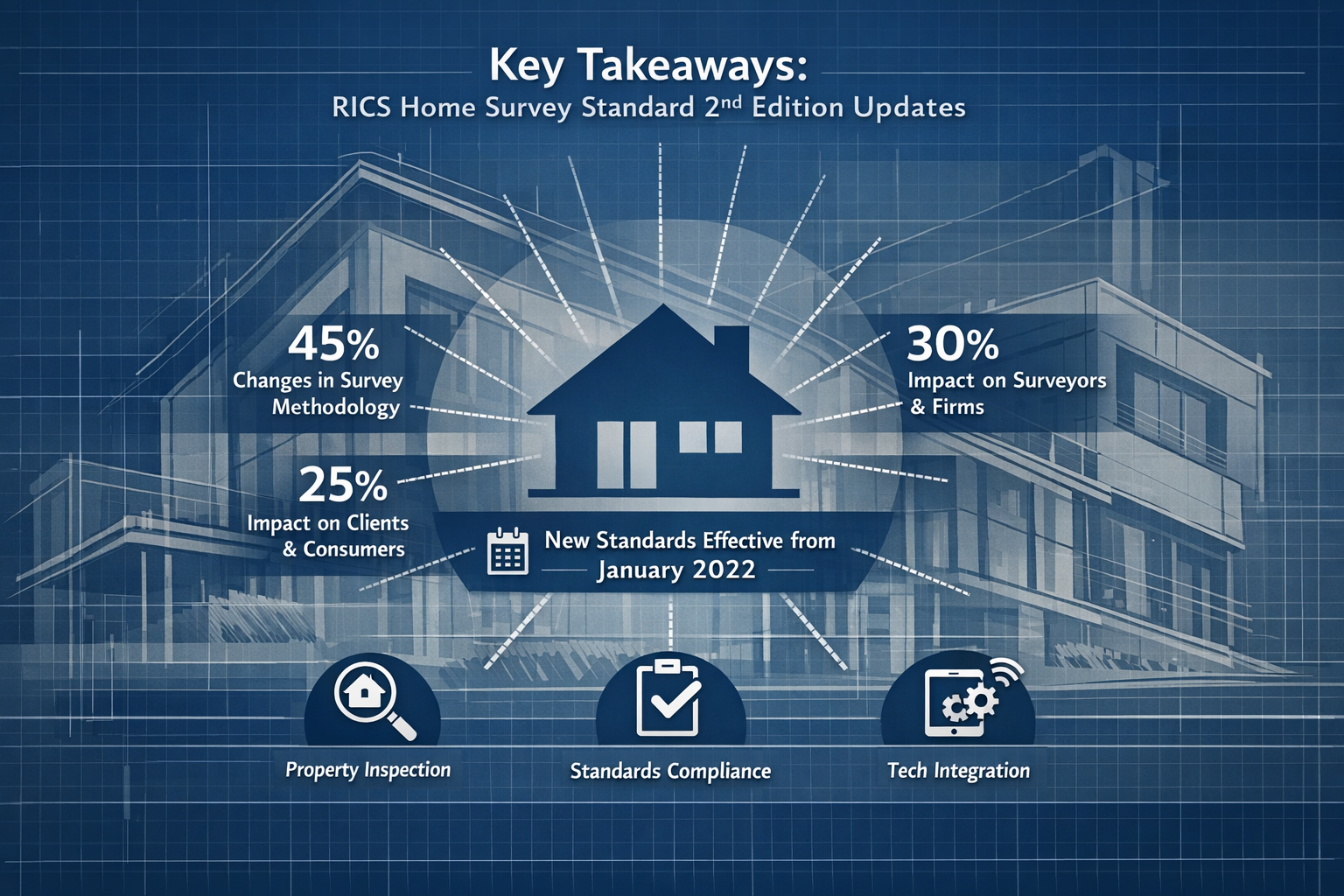
Perhaps the most immediately visible change addresses a longstanding source of confusion: survey level nomenclature. The technical descriptors "Level 1," "Level 2," and "Level 3" will be replaced with intuitive terms that clearly communicate service scope:[4]
- Basic Survey (formerly Level 1): Entry-level inspection suitable for newer, conventional properties
- Intermediate Survey (formerly Level 2): Mid-range assessment for typical residential properties—the most commonly commissioned survey type
- Advanced Survey (formerly Level 3): Comprehensive investigation for older, altered, or unconventional dwellings
This linguistic shift directly responds to homebuyer research revealing widespread confusion about service differences. When property buyers understand what a Level 3 building survey entails, they make more informed decisions about appropriate inspection depth for their circumstances.
"The consistent feedback from homeowners was clear: technical level numbers created barriers to understanding. The new terminology removes that obstacle while maintaining professional rigor." — RICS Consultation Summary, 2025[4]
Enhanced Inspection Clarity: Checking vs. Testing
A significant refinement addresses the distinction between "checking" and "testing" building services—a nuance previously causing misunderstanding between surveyors and clients.[4]
New guidance specifies:
- Checking = Visual verification and operational confirmation (e.g., igniting a gas hob to verify connection)
- Testing = Specialized examination requiring equipment or expertise beyond standard survey scope (e.g., gas safety certification)
This clarification will be explicitly stated within survey reports, helping clients understand what has been examined and what requires specialist follow-up. For those questioning whether they need a home survey when buying, this transparency provides clearer value proposition.
Technology Integration: AI, Drones, and Digital Tools
The 2026 standard formally acknowledges the technological revolution transforming surveying practice since 2019. Official guidance now covers:
🚁 Drone deployment for roof and chimney inspection in situations where traditional access poses safety risks or practical challenges
🤖 AI-assisted defect identification to enhance consistency and reduce oversight in high-volume inspection periods
📸 Camera pole technology for examining areas with restricted access without requiring invasive investigation
These tools don't replace professional judgment but augment surveyor capabilities, particularly valuable during the anticipated reform-era increase in survey demand. The standard will establish parameters for appropriate use, documentation requirements, and disclosure obligations when technology-assisted inspection occurs.[1]
Climate Change and Energy Efficiency Focus
Reflecting 2026's heightened awareness of environmental considerations, the 2nd edition substantially expands guidance on:
- Retrofit assessment protocols for properties undergoing energy efficiency improvements
- Climate resilience factors including flood risk, overheating potential, and thermal performance
- Energy performance integration connecting survey findings with EPC recommendations
- Sustainable materials identification relevant to future maintenance and modification decisions
Homeowner research identified climate considerations as a top priority, with buyers increasingly viewing energy efficiency as a financial factor affecting running costs and future saleability.[4] This aligns with broader market trends visible in commercial building surveys where sustainability credentials significantly impact valuation.
Expanded Guidance for Higher-Risk Properties
The revised standard provides enhanced protocols for "additional risk" dwellings, including:
- Properties with unconventional construction methods
- Buildings with significant alterations or extensions
- Dwellings in areas with known environmental hazards
- Structures with heritage or conservation constraints
This expansion recognizes that standardized inspection approaches may inadequately address properties requiring specialist consideration. The guidance helps surveyors determine when building surveys should recommend additional specialist investigations beyond standard scope.
Optional Valuation Across All Service Levels
A notable flexibility enhancement allows optional valuation services at all survey tiers, not just advanced surveys. This responds to market demand for consolidated services, though maintains clear separation between inspection findings and market value opinion to preserve professional objectivity.[1]
For buyers seeking both condition assessment and market value confirmation, this streamlines the process while maintaining the integrity of each professional service. Understanding the difference between Level 2 and Level 3 surveys becomes even more important when optional services are layered onto base inspection requirements.
Impact of RICS Home Survey Standard 2nd Edition on 2026 Building Surveys: Implementation Considerations

The 24-Month Implementation Imperative
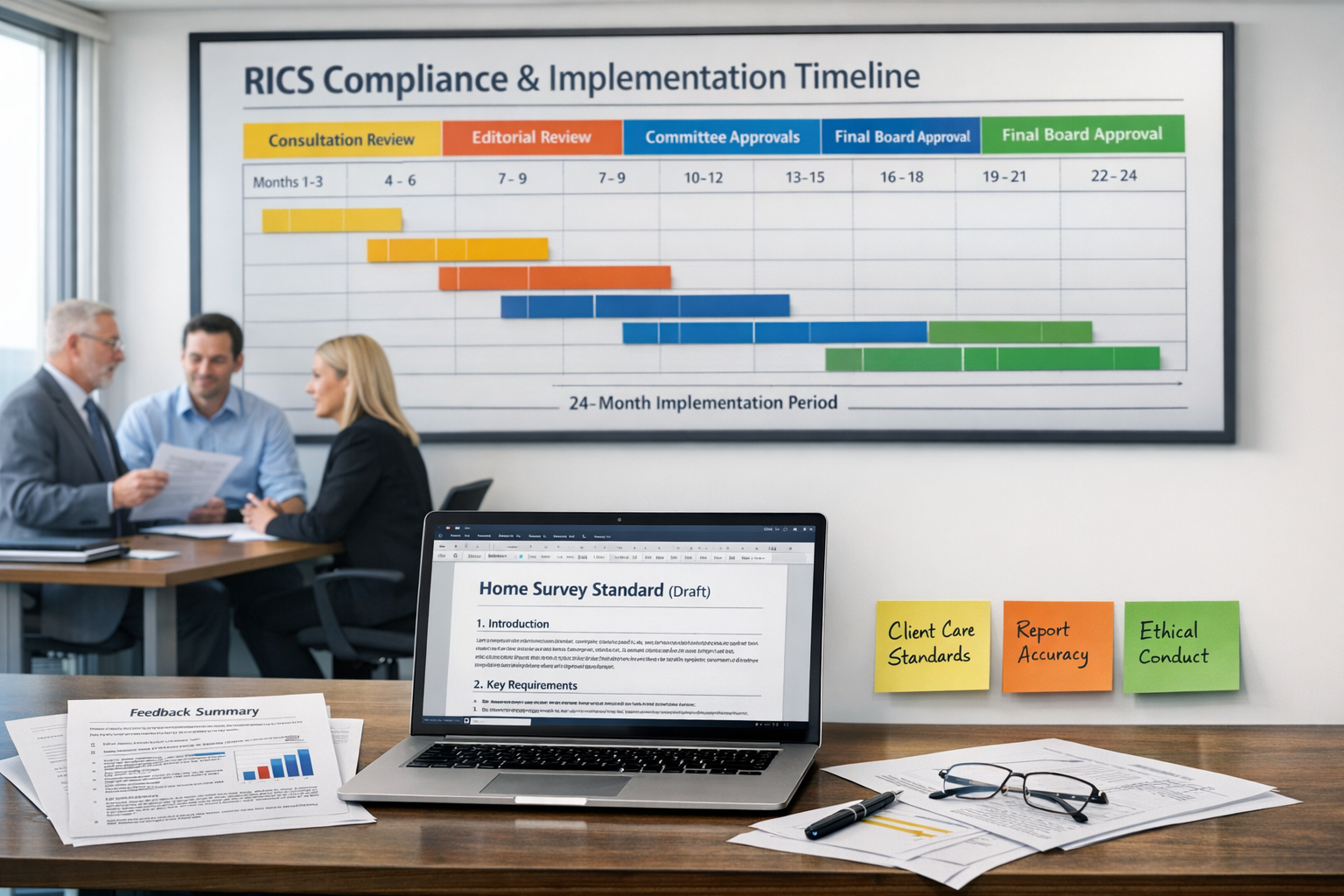
RICS has explicitly stated that any reforms involving fundamental changes to survey delivery require a minimum 24-month implementation period.[2] This extended timeline serves multiple critical functions:
For surveying firms:
- Technology investment and integration (drones, AI software, digital reporting platforms)
- Staff training on revised protocols and terminology
- Template and report format redesign
- Quality assurance system updates
- Professional indemnity insurance review and adjustment
For consumers:
- Market education about new terminology and service options
- Mortgage lender alignment with revised survey formats
- Conveyancer familiarization with updated reporting structures
- Estate agent understanding of enhanced survey scope
This implementation buffer means that even after final approval, the 1st edition will remain in force during the transition period. Surveyors should anticipate operating under current standards well into 2027 or beyond, depending on final approval timing.[2]
Technology Adoption Challenges and Opportunities
The formal inclusion of AI and drone technology presents both opportunities and challenges for surveying practices:
Opportunities:
- ✅ Enhanced safety by reducing dangerous access requirements
- ✅ Improved documentation quality with high-resolution imagery
- ✅ Increased efficiency in high-volume inspection periods
- ✅ Competitive differentiation for early adopters
- ✅ Better client communication through visual evidence
Challenges:
- ⚠️ Capital investment requirements for equipment and software
- ⚠️ Training needs for effective technology utilization
- ⚠️ Regulatory compliance (CAA drone licensing, data protection)
- ⚠️ Professional indemnity considerations for technology-assisted findings
- ⚠️ Client expectation management regarding technology limitations
Smaller practices, particularly SMEs that provided substantial consultation feedback, expressed concerns about resource requirements for technology adoption.[3] RICS will need to balance innovation encouragement with practical accessibility for all member firms.
Surveyor Compliance Checklist for the Transition Period
As the 2nd edition approaches finalization, proactive surveyors should begin preparation:
Immediate Actions (2026)
- Review consultation draft to understand proposed changes
- Assess current technology capabilities against anticipated requirements
- Evaluate report templates for necessary modifications
- Identify staff training needs for new protocols
- Monitor RICS communications for approval timeline updates
Pre-Implementation Phase (Upon Final Approval)
- Attend RICS implementation training sessions
- Update professional indemnity insurance coverage
- Revise client engagement documentation and terms
- Redesign report templates incorporating new terminology
- Develop internal quality assurance checklists
- Create client education materials explaining changes
Implementation Phase (Mandatory Adoption Date)
- Complete all staff training and competency assessment
- Deploy updated reporting systems
- Implement new terminology across all client communications
- Update website and marketing materials
- Establish technology integration protocols
- Monitor early implementation for quality assurance
For practices offering specialized services like homebuyer surveys, template redesign will be particularly important to ensure compliance while maintaining service efficiency.
Common Feedback Themes Shaping Final Requirements
The consultation process revealed consistent themes that will influence the final standard:
Clarity and Conciseness 📝
SME firms particularly emphasized the need for clearer distinction between mandatory "must" requirements and recommended "should" practices. The final edition will feature improved structure separating absolute requirements from best practice guidance.[3]
Practical Application Guidance 🔧
Surveyors requested enhanced appendices with benchmarking examples demonstrating appropriate inspection and reporting levels for each survey tier. These practical illustrations will reduce interpretation variability across the profession.[1]
Service Scope Boundaries 🎯
Feedback highlighted ongoing confusion about where standard survey scope ends and specialist investigation begins. The 2nd edition will provide clearer guidance on when to recommend follow-up investigations such as structural surveys or drainage surveys.
Consumer Communication 💬
Both surveyors and homeowners emphasized the importance of plain-language reporting that avoids unnecessary jargon while maintaining technical accuracy. The standard will include enhanced guidance on effective client communication strategies.[4]
Preparing for Higher-Volume Reform-Era Inspections
The Anticipated Survey Demand Surge
The RICS Home Survey Standard revision coincides with broader home buying and selling reform initiatives that may fundamentally alter property transaction timelines. Government and industry discussions around mandatory upfront property information could dramatically increase survey demand if implemented.[2]
Potential market impacts include:
- 📈 Volume increase: Sellers commissioning surveys before marketing rather than buyers after offer acceptance
- ⏱️ Timing shift: Surveys conducted earlier in transaction process
- 🔄 Repeat instructions: Properties potentially requiring updated surveys if initial sale falls through
- 💰 Fee pressure: Increased competition potentially affecting pricing structures
- 📊 Capacity constraints: Practices needing to scale operations to meet demand
For surveyors, this potential transformation requires strategic planning around capacity, efficiency, and quality maintenance during high-volume periods.
Efficiency Without Compromising Quality
The challenge of higher inspection volumes while maintaining professional standards requires systematic approaches:
Process Optimization Strategies:
- Standardized workflows with clear stage gates and quality checkpoints
- Technology leverage for routine documentation and defect cataloging
- Team specialization allowing surveyors to focus on inspection while support staff handle administrative elements
- Template refinement balancing efficiency with customization needs
- Scheduling optimization grouping geographically proximate inspections
The key principle: efficiency gains should emerge from process improvement and technology assistance, never from reduced inspection rigor or abbreviated reporting.
Quality Assurance in High-Volume Environments
Maintaining consistent quality during demand surges requires robust internal systems:
Essential QA Components:
✓ Peer review protocols for complex or unusual properties
✓ Regular calibration sessions ensuring consistent interpretation across team members
✓ Client feedback mechanisms identifying service gaps or communication issues
✓ Continuing professional development keeping skills current with evolving standards
✓ Technology validation confirming AI or drone-assisted findings against traditional methods
Practices offering comprehensive services from Level 2 surveys through advanced building surveys must ensure quality consistency across all service tiers, particularly as volume increases.
Client Education and Expectation Management
The terminology changes and enhanced service options create both opportunities and obligations for client communication:
Effective client education includes:
- Clear explanation of survey tier differences using new terminology
- Transparent discussion of inspection limitations and exclusions
- Guidance on when specialist follow-up investigations are advisable
- Realistic timeline expectations reflecting current market conditions
- Plain-language reporting that connects findings to practical implications
Property buyers increasingly seek comprehensive guidance on survey selection, making resources like the ultimate house survey checklist valuable for informed decision-making.
Broader Context: RICS Standards in the Evolving Property Market
Integration with Related RICS Standards
The Home Survey Standard operates within a broader ecosystem of RICS professional standards that collectively govern property assessment:
- Valuation standards (Red Book) for market value determination
- Building surveying standards for specialized investigations
- Residential property standards for letting and management
- Sustainability standards for environmental assessment
The 2nd edition's enhanced climate focus aligns with RICS's broader sustainability agenda, reflecting the institution's recognition that property professionals play a crucial role in the built environment's climate transition.[1]
For practices offering diverse services including commercial property surveys and RICS registered valuations, understanding these interconnections ensures comprehensive client service.
Consumer Protection and Professional Accountability
The extensive consultation process—engaging over 1,400 homeowners—demonstrates RICS's commitment to consumer-focused standards development.[3] This approach recognizes that survey standards ultimately serve property buyers making significant financial decisions based on professional advice.
Consumer protection elements include:
- Clear service level descriptions enabling informed selection
- Transparent scope limitations preventing unrealistic expectations
- Plain-language reporting improving accessibility
- Consistent quality standards across all RICS members
- Robust complaints and redress mechanisms
The standard's evolution reflects broader trends toward enhanced consumer protection in property transactions, with professional standards playing a central role in maintaining public confidence.
International Context and Best Practice
While the Home Survey Standard specifically governs UK practice, RICS's international presence means the 2nd edition will influence property assessment approaches globally. The integration of technology, climate considerations, and consumer-focused communication represents best practice evolution relevant beyond UK borders.
International members and organizations often adapt RICS standards to local contexts, meaning the innovations in the 2nd edition may ripple through global property markets over subsequent years.
Practical Implications for Different Stakeholder Groups
For Chartered Surveyors
Strategic considerations:
- Investment decisions: Evaluate technology adoption timing and budget allocation
- Service positioning: Determine how enhanced survey options affect market positioning
- Capacity planning: Assess staffing and workflow requirements for potential volume increases
- Professional development: Identify training needs for new protocols and technologies
- Quality systems: Review and update internal QA processes for compliance
The transition period offers competitive opportunities for practices that proactively prepare rather than reactively respond to mandatory changes.
For Property Buyers
Key benefits:
- Clearer choices: Simplified terminology improving survey selection confidence
- Enhanced information: Expanded climate and energy efficiency reporting
- Better value: Optional valuation services reducing separate instruction needs
- Improved understanding: Plain-language reporting making findings more accessible
- Greater consistency: Standardized protocols ensuring quality across different surveyors
Buyers should engage with surveyors early in the property search process, understanding whether they need a survey on a new build and selecting appropriate inspection depth for their circumstances.
For Mortgage Lenders and Conveyancers
Adaptation requirements:
- Report format familiarization: Understanding revised survey structures and terminology
- Risk assessment updates: Incorporating enhanced climate and energy information
- Timeline adjustments: Accommodating potential shifts in survey commissioning timing
- Client guidance: Explaining survey changes to borrowers and property buyers
- System integration: Updating digital platforms to accommodate new report formats
Professional collaboration between surveyors, lenders, and conveyancers will be essential for smooth implementation.
For Estate Agents and Property Professionals
Market education responsibilities:
- Explaining survey terminology changes to sellers and buyers
- Advising on appropriate survey selection for different property types
- Managing timeline expectations during implementation transition
- Understanding how enhanced survey information affects marketing and negotiation
- Coordinating with surveyors on potential upfront survey initiatives
Estate agents play a crucial communication role, bridging professional standards and consumer understanding.
Conclusion: Navigating the Transition to Enhanced Survey Standards
The Impact of RICS Home Survey Standard 2nd Edition on 2026 Building Surveys: Key Updates and Implementation represents a carefully considered evolution of professional practice, balancing technological innovation, consumer accessibility, and climate awareness within a robust regulatory framework. As the standard progresses through its final approval stages during 2026, the surveying profession stands at the threshold of meaningful change that will shape property assessment for years to come.
Key Takeaways for Action
For surveyors, the path forward requires:
- Proactive monitoring of RICS communications regarding approval timeline and implementation requirements
- Strategic planning for technology investment, staff training, and system updates
- Quality focus ensuring efficiency gains never compromise professional rigor
- Client communication preparing buyers for enhanced service options and clearer reporting
- Collaborative engagement with lenders, conveyancers, and estate agents to ensure smooth market transition
For property buyers, the emerging standard promises:
- More intuitive survey selection through simplified terminology
- Enhanced information about climate resilience and energy efficiency
- Clearer reporting that connects technical findings to practical implications
- Greater consistency in survey quality across different providers
For the broader property market, the 2nd edition signals:
- RICS's commitment to consumer-focused professional standards
- Recognition of technology's role in enhancing traditional surveying practice
- Integration of climate considerations into mainstream property assessment
- Ongoing evolution of standards to meet changing market needs
Next Steps
As 2026 progresses, stakeholders should:
Surveyors:
- Attend RICS implementation briefings when announced
- Begin technology capability assessment and investment planning
- Review current report templates against anticipated requirements
- Engage with professional networks to share implementation insights
Property buyers:
- Consult with chartered surveyors about current survey options
- Stay informed about terminology changes affecting survey selection
- Ask surveyors about their preparation for the 2nd edition
- Understand that current standards remain in force during transition
Industry professionals:
- Monitor RICS announcements regarding final approval and implementation timeline
- Participate in industry discussions about practical implementation challenges
- Update internal systems and processes in preparation for changes
- Maintain focus on consumer education throughout the transition
The journey from consultation to full implementation will likely extend through 2027 and beyond, but the direction is clear: more accessible, technology-enhanced, climate-conscious building surveys that better serve both professional standards and consumer needs. By understanding these changes now and preparing systematically, surveyors can turn regulatory evolution into competitive advantage while maintaining the professional excellence that defines RICS membership.
For comprehensive guidance on current survey standards and expert property assessment services, explore our RICS home survey services and discover how professional building surveys protect your property investment.
References
[1] Home Survey Standards – https://www.rics.org/profession-standards/rics-standards-and-guidance/sector-standards/building-surveying-standards/home-surveys/home-survey-standards
[2] What The Rics Home Buying And Selling Reform Hub Means For Surveyors – https://www.surventrix.com/blog/what-the-rics-home-buying-and-selling-reform-hub-means-for-surveyors
[3] Home Survey Standard 2nd Edition A Progress Update – https://www.rics.org/news-insights/home-survey-standard-2nd-edition-a-progress-update
[4] Understanding The Rics Home Survey Standard Proposal – https://www.rics.org/news-insights/understanding-the-rics-home-survey-standard-proposal
