
When property valuation disputes reach tribunal hearings in 2026, the stakes have never been higher. Regional price variations between North and South England continue to diverge, creating complex challenges for expert witnesses who must navigate increasingly sophisticated legal arguments. Understanding how to prepare compelling, RICS-compliant evidence that accounts for these geographical disparities can mean the difference between winning and losing a case worth hundreds of thousands of pounds.
Expert Witness Preparation for 2026 Regional Price Dispute Cases: North vs South RICS Evidence Strategies requires a nuanced understanding of both professional standards and regional market dynamics. As property values in southern England continue their upward trajectory while northern markets demonstrate different growth patterns, expert witnesses must arm themselves with robust data, clear methodologies, and persuasive presentation techniques.
Key Takeaways
- Regional price divergence between North and South England requires distinct evidence strategies backed by localized market data and RICS-compliant valuation methodologies
- RICS Expert Witness Standards mandate specific professional conduct requirements, including duty to the tribunal that supersedes client obligations [2]
- Evidence preparation must incorporate 2026 regional performance metrics, comparable transaction analysis, and defensible valuation approaches tailored to geographical contexts
- Cross-examination readiness demands thorough understanding of regional market drivers, economic indicators, and potential counter-arguments specific to North vs South disparities
- Professional credibility stems from RICS certification, continuous professional development, and adherence to updated 2026 standards for expert testimony
Understanding RICS Expert Witness Standards for 2026 Regional Disputes
The foundation of effective Expert Witness Preparation for 2026 Regional Price Dispute Cases: North vs South RICS Evidence Strategies begins with comprehensive knowledge of professional obligations. The RICS Expert Witness Standards, updated in February 2023, establish clear requirements that apply regardless of regional focus [2].
Core Professional Obligations
Expert witnesses must recognize their overriding duty to the tribunal rather than to the party instructing them. This fundamental principle shapes every aspect of evidence preparation and presentation. For regional price disputes, this means presenting balanced analysis of both northern and southern market conditions, even when findings may not fully support the instructing party's position.
The standards require experts to:
- 📋 Provide objective, unbiased opinions based on professional expertise
- 🎯 Stay within their area of competence and geographical knowledge
- 📊 Clearly distinguish between facts, assumptions, and professional opinions
- ✅ Acknowledge limitations in available data or methodology
- 🔍 Consider alternative viewpoints and counter-arguments
Regional Competence Requirements
When preparing evidence for North vs South price disputes, experts must demonstrate specific regional competence. This extends beyond general valuation knowledge to include:
Northern England Expertise:
- Understanding post-industrial regeneration impacts on property values
- Knowledge of regional economic drivers (Manchester, Leeds, Newcastle corridors)
- Familiarity with northern housing stock characteristics
- Awareness of local authority planning policies affecting valuations
Southern England Expertise:
- Comprehension of London commuter belt dynamics
- Understanding of international investment influences
- Knowledge of constrained supply factors in Home Counties
- Recognition of premium pricing for specific southern amenities
For chartered surveyors operating across regions, demonstrating dual competence strengthens credibility when addressing comparative regional evidence.
RICS Training and Certification
The RICS Expert Witness Certificate provides structured preparation for tribunal work. This 12-week course, available from £2,100 + VAT, covers essential skills including evidence preparation, report writing, and cross-examination techniques [3]. For 2026 regional disputes, this training proves invaluable in understanding how to present complex geographical price variations to legal decision-makers.
Building Evidence Strategies for North vs South Price Disputes
Expert Witness Preparation for 2026 Regional Price Dispute Cases: North vs South RICS Evidence Strategies demands meticulous evidence construction that withstands rigorous cross-examination. The diverging performance of regional property markets requires distinct analytical approaches.
Gathering Regional Market Data
Quantitative Evidence Requirements:
Robust evidence begins with comprehensive data collection across both regions. For 2026 disputes, experts should compile:
| Data Category | Northern Evidence | Southern Evidence |
|---|---|---|
| Transaction Comparables | 12-24 months of sales data from relevant postcodes | Equivalent timeframe with London/Home Counties focus |
| Price Indices | Regional house price index trends (ONS, Land Registry) | Same indices showing southern performance differential |
| Economic Indicators | Employment rates, wage growth, business investment | Comparative southern economic metrics |
| Supply Constraints | Planning approvals, housing completions, land availability | Southern supply limitations and green belt impacts |
| Market Velocity | Days on market, sale-to-asking price ratios | Comparative southern market liquidity metrics |
Qualitative Evidence Considerations:
Beyond numbers, effective evidence incorporates qualitative factors that explain regional price differentials:
- 🏘️ Lifestyle and amenity premiums – Southern properties often command premiums for specific school catchments, transport links, or cultural amenities
- 🏗️ Development pipeline impacts – Northern regeneration projects vs southern infrastructure improvements
- 💼 Employment accessibility – Proximity to major employment centers varies significantly between regions
- 🌳 Environmental factors – Green space, air quality, and sustainability considerations
Valuation Methodology Selection
Choosing appropriate valuation approaches for regional disputes requires strategic thinking. The three main methodologies apply differently across North and South contexts:
Comparative Method:
Most common for residential disputes, but requires careful selection of comparables within the relevant region. For RICS valuations, experts must justify why specific transactions provide valid comparison points despite regional variations.
Investment Method:
Particularly relevant for commercial or rental property disputes. Yield expectations differ significantly between regions, with southern properties typically accepting lower yields due to perceived security and capital growth prospects.
Residual Method:
For development site disputes, regional variations in construction costs, planning requirements, and end values create substantial differences in residual land values between North and South.
Addressing Regional Performance Divergence
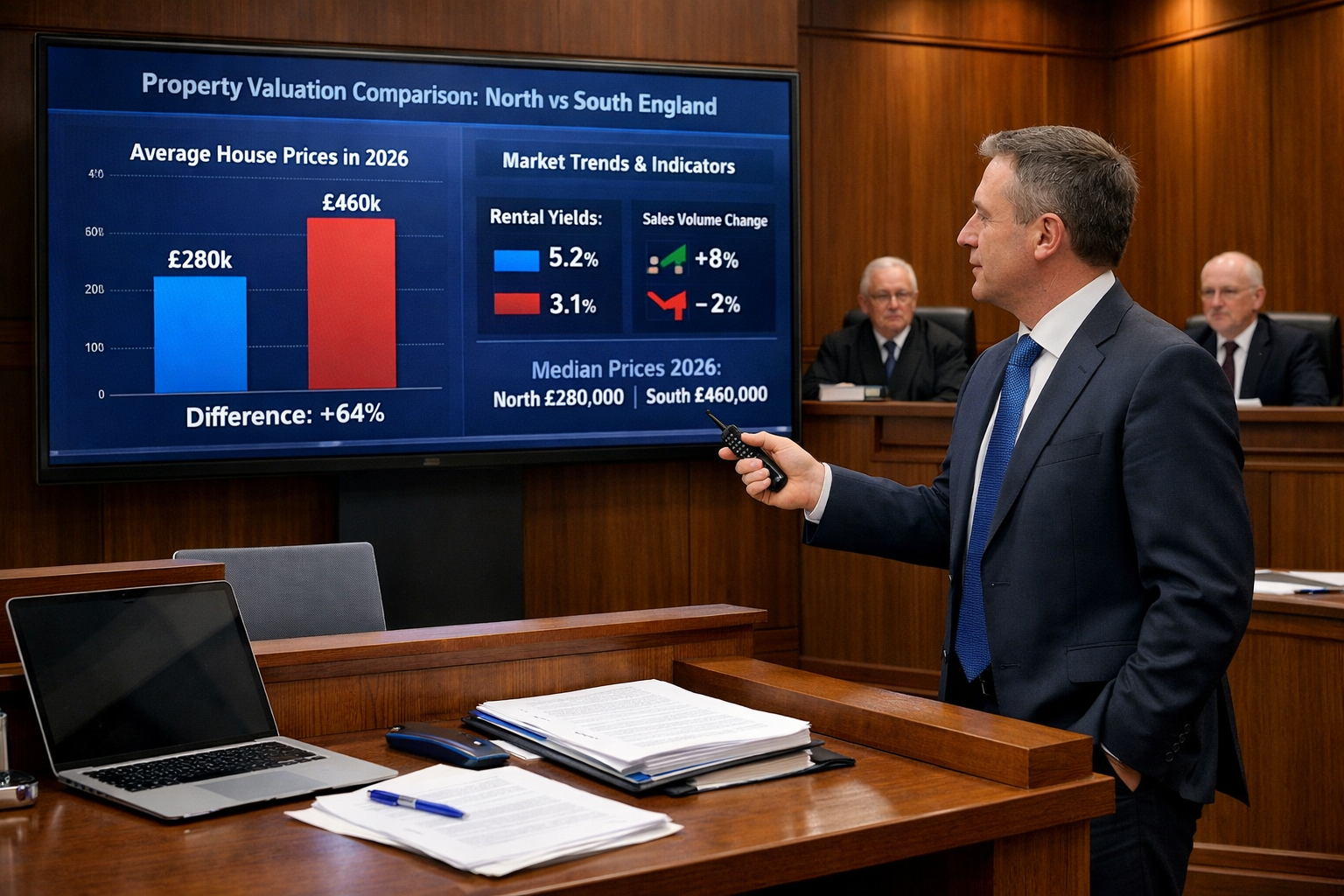
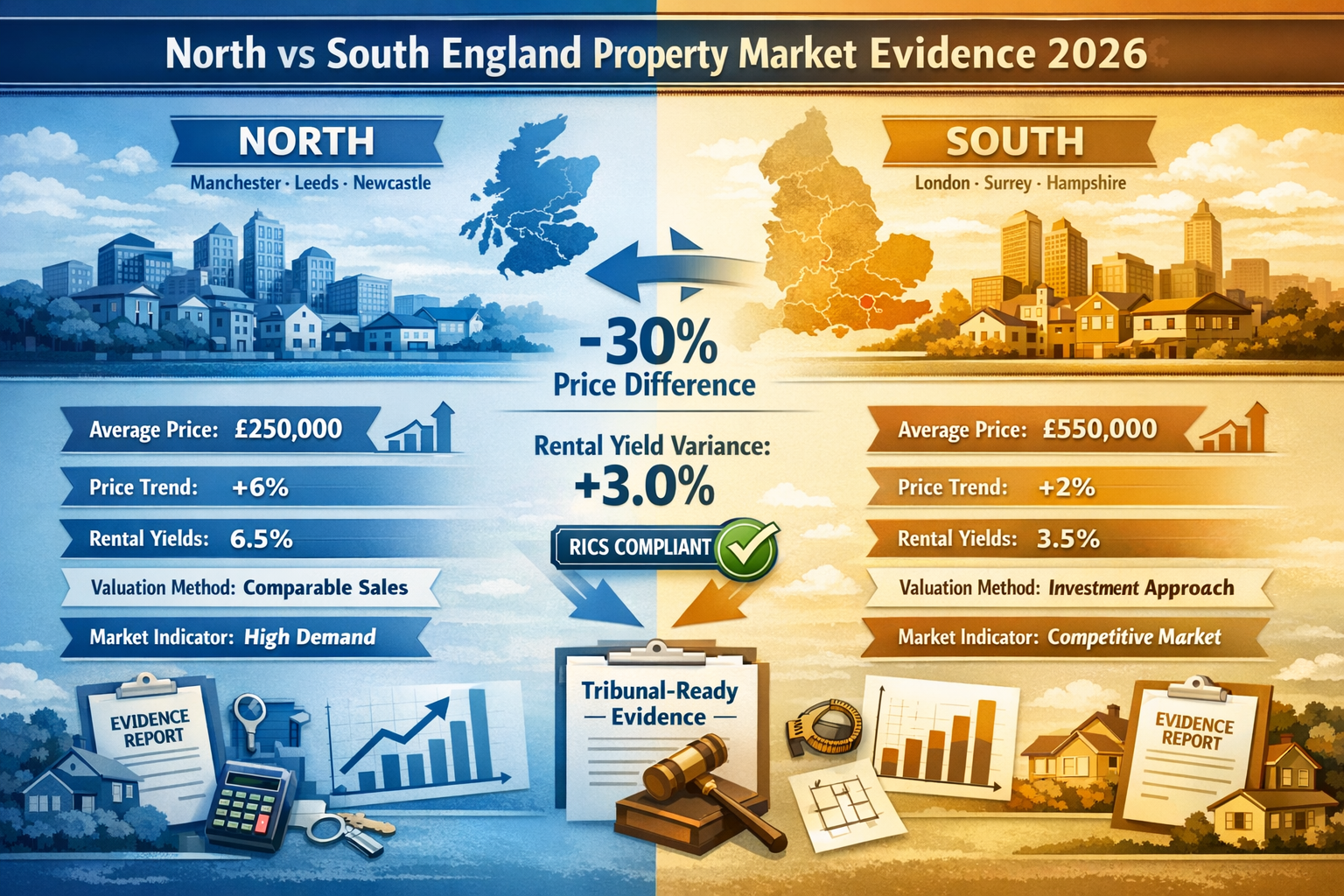
The 2026 property market continues to demonstrate significant North-South performance gaps. Expert witnesses must prepare evidence that explains rather than merely reports these differences:
Northern Market Characteristics (2026):
- Steady but moderate price growth (typically 3-5% annually)
- Strong rental yields (often 5-7% gross)
- Affordability advantages attracting first-time buyers
- Regional economic diversification reducing historical volatility
- Government leveling-up initiatives creating localized hotspots
Southern Market Characteristics (2026):
- Variable but generally higher price growth (4-8% in prime areas)
- Lower rental yields (often 3-4% gross in prime locations)
- Continued international and domestic investment demand
- Supply constraints maintaining price premiums
- Infrastructure investment (Crossrail, HS2) creating value uplift
When preparing evidence for disputes involving properties in South West London versus North London, these regional factors become critical to establishing fair market value.
Presenting Evidence Effectively in Tribunal Settings

The quality of evidence preparation means little without effective presentation. Expert Witness Preparation for 2026 Regional Price Dispute Cases: North vs South RICS Evidence Strategies culminates in compelling tribunal testimony that educates decision-makers about complex regional variations.
Structuring Expert Reports
RICS standards require expert reports to follow specific structural conventions [2]. For regional price disputes, the report structure should include:
1. Executive Summary
Concise overview stating the property, valuation figure, and key regional factors influencing the opinion. This section should immediately clarify whether regional considerations materially affect valuation conclusions.
2. Instructions and Scope
Clear statement of what the expert was asked to determine, including any specific regional comparison requirements. Transparency about limitations in instructions or available data builds credibility.
3. Property Description
Detailed description including location context within the relevant region. For comparative disputes, parallel descriptions highlighting regional similarities and differences prove valuable.
4. Market Analysis
This section carries particular weight in regional disputes. Present:
- Regional market trends with supporting data
- Comparable transaction analysis within the relevant region
- Economic and demographic factors specific to North or South context
- Supply and demand dynamics affecting the subject property's region
5. Valuation Methodology
Explain chosen approach and justify its appropriateness for the specific regional context. Address why alternative methods may be less suitable given regional characteristics.
6. Valuation Conclusion
Clear statement of opinion with supporting reasoning tied directly to regional evidence presented. Acknowledge uncertainty ranges where appropriate.
7. Declaration and Statement of Truth
Confirmation of RICS compliance and overriding duty to the tribunal.
Visual Evidence Presentation
Tribunals respond well to clear visual representations of complex regional data:
- 📊 Comparative charts showing price trends across regions
- 🗺️ Heat maps illustrating geographical value variations
- 📈 Transaction timelines demonstrating market velocity differences
- 🏘️ Location maps with comparable properties marked
- 📉 Yield comparison graphs for investment properties
When presenting evidence about properties requiring detailed inspection, reference to structural surveys or Level 3 surveys demonstrates thoroughness in evidence gathering.
Anticipating Cross-Examination Challenges
Effective preparation includes anticipating challenges to regional evidence:
Common Cross-Examination Lines:
"Aren't you cherry-picking comparables to support your regional argument?"
Preparation Strategy: Document comprehensive comparable search methodology. Explain inclusion/exclusion criteria objectively. Acknowledge all relevant transactions, including those that don't perfectly support your position.
"How can you be certain these regional differences will persist?"
Preparation Strategy: Present historical trend data showing consistency of regional patterns. Acknowledge market uncertainty while explaining structural factors likely to maintain differentials.
"Isn't your regional expertise limited to [North/South]?"
Preparation Strategy: Clearly establish credentials in both regions. Reference specific experience, transactions analyzed, and continuing professional development in regional markets.
"Haven't you ignored [specific regional factor]?"
Preparation Strategy: Comprehensive evidence preparation should address all material regional factors. If a factor was considered but deemed immaterial, explain reasoning clearly.
Maintaining Professional Credibility
Credibility stems from multiple sources:
- ✅ RICS membership and compliance with professional standards
- 📚 Demonstrated regional expertise through specific examples
- 🎓 Relevant qualifications including Expert Witness Certificate [3]
- 💼 Experience in similar disputes without overstating capabilities
- 🤝 Professional demeanor maintaining objectivity under pressure
For experts handling diverse property types, experience with specialized valuations like Help to Buy valuations or shared ownership valuations demonstrates breadth of competence.
Regional Evidence Strategies: Practical Applications
Northern England Dispute Scenarios
Scenario 1: Post-Industrial Regeneration Area
A dispute involves a property in a regenerating northern city center. The claimant argues comparable southern city center prices should apply given similar regeneration characteristics.
Evidence Strategy:
- Present data showing distinct regeneration trajectories between regions
- Demonstrate different investor profiles (local vs international)
- Show wage differential impacts on sustainable price levels
- Provide comparable transactions from similar northern regeneration areas
- Explain infrastructure investment timelines and their regional variations
Scenario 2: Northern Rental Investment Property
Dispute centers on valuation of a buy-to-let property with the claimant arguing southern yield expectations should apply.
Evidence Strategy:
- Present regional yield analysis showing consistent North-South differential
- Demonstrate tenant demographic and income differences
- Show rental demand drivers specific to northern markets
- Provide investment market evidence from northern property investors
- Explain risk-return profiles varying by region
Southern England Dispute Scenarios
Scenario 1: London Commuter Belt Premium
Dispute involves property value where one party claims excessive premium for commuter location.
Evidence Strategy:
- Quantify commuter premium through comparable analysis
- Present transport time and cost data
- Show employment center accessibility value
- Demonstrate historical premium consistency
- Provide evidence of buyer demographic willing to pay premium
Scenario 2: International Investment Influence
Valuation dispute where international buyer activity affects price levels.
Evidence Strategy:
- Present transaction data showing international buyer participation
- Demonstrate price differential in internationally-favored locations
- Show currency and investment flow impacts
- Provide expert evidence on international investment drivers
- Explain sustainability of international demand
For properties in specific southern locations like Battersea or Putney, localized market knowledge strengthens evidence credibility.
Leveraging RICS DRS Expert Services
The RICS Dispute Resolution Service provides valuable support for expert witnesses preparing regional evidence [1]. These services include:
Expert Witness Referral
RICS maintains a register of qualified expert witnesses with proven regional competence. For complex North vs South disputes, parties can access experts with demonstrated experience in comparative regional analysis.
Benefits:
- Pre-vetted professional credentials
- Regional specialization matching
- Quality assurance through RICS oversight
- Standardized fee structures
Administrative Support
RICS DRS offers administrative services that streamline expert appointment processes, particularly valuable in multi-party disputes involving regional considerations [1].
Continuing Professional Development
RICS provides ongoing training specific to expert witness work, including updates on regional market developments, emerging case law, and evolving professional standards. For 2026 disputes, staying current with regional market intelligence proves essential.
Practical Preparation Checklist for 2026 Regional Disputes
Pre-Instruction Phase:
- ✅ Confirm regional competence matches dispute geography
- ✅ Verify RICS membership and expert witness credentials current
- ✅ Review conflict of interest considerations
- ✅ Assess availability for full dispute timeline
Evidence Gathering Phase:
- ✅ Compile comprehensive regional transaction data (12-24 months)
- ✅ Gather economic indicators for both North and South contexts
- ✅ Conduct property inspection with regional context noted
- ✅ Research planning and development factors specific to region
- ✅ Identify and analyze comparable properties within relevant region
- ✅ Document methodology for comparable selection
Report Preparation Phase:
- ✅ Structure report according to RICS standards [2]
- ✅ Include clear regional market analysis section
- ✅ Prepare visual aids illustrating regional variations
- ✅ Address foreseeable counter-arguments
- ✅ Review for objectivity and balance
- ✅ Include proper declarations and statements of truth
Pre-Hearing Phase:
- ✅ Review all evidence thoroughly
- ✅ Prepare for anticipated cross-examination questions
- ✅ Organize supporting documentation for easy reference
- ✅ Coordinate with instructing solicitors on procedural matters
- ✅ Ensure all exhibits properly referenced and available
Hearing Phase:
- ✅ Maintain professional demeanor throughout testimony
- ✅ Answer questions directly and concisely
- ✅ Acknowledge limitations in knowledge or data when appropriate
- ✅ Reference regional evidence clearly and confidently
- ✅ Remain objective regardless of challenging questions
Advanced Considerations for Complex Regional Disputes
Multi-Property Portfolio Disputes
When disputes involve property portfolios spanning both regions, evidence strategies must address:
- Portfolio effect – How regional diversification impacts overall value
- Management efficiency – Regional variations in property management costs
- Risk profiles – Different risk-return characteristics by region
- Disposal strategies – Regional liquidity differences affecting realization values
Development Site Valuations
Regional disputes involving development sites require additional considerations:
- Planning policy variations between northern and southern local authorities
- Construction cost differentials – Labor and material costs varying by region
- Affordable housing requirements – Different Section 106 obligations
- Infrastructure contribution – CIL and other developer contribution variations
- Market absorption rates – How quickly developed units sell in each region
Leasehold and Enfranchisement Disputes
For leasehold disputes with regional components:
- Relativity curves may differ between regions
- Marriage value calculations affected by regional price levels
- Hope value considerations varying by regional market dynamics
Understanding party wall disputes and their resolution can inform approaches to other property-related conflicts.
Commercial Property Considerations
Regional commercial property disputes present unique challenges:
- Rental tone variations between regional markets
- Yield expectations differing by region and property type
- Tenant covenant strength varying with regional economic conditions
- Alternative use potential constrained differently by regional planning policies
For experts working with commercial property, regional market knowledge proves particularly critical.
Ethical Considerations in Regional Evidence Presentation
Avoiding Regional Bias
Expert witnesses must guard against unconscious bias favoring their "home" region. Strategies include:
- 🔍 Peer review – Having evidence reviewed by experts from the other region
- 📊 Data-driven conclusions – Ensuring opinions flow from evidence rather than preconceptions
- 🤔 Devil's advocate testing – Actively considering arguments against your position
- 📚 Continuous learning – Regular exposure to both regional markets
Transparency in Limitations
Professional integrity requires acknowledging:
- Geographic areas where expertise is limited
- Data gaps affecting regional analysis
- Uncertainty in projecting regional trends
- Alternative interpretations of regional evidence
Managing Client Expectations
Expert witnesses must educate clients about:
- The duty to the tribunal superseding client interests
- Realistic assessment of regional evidence strength
- Potential weaknesses in regional arguments
- Importance of objective rather than advocacy-oriented evidence
Future Trends in Regional Price Dispute Evidence
Technology Integration
2026 sees increasing use of technology in evidence preparation:
- AI-powered comparable analysis – Machine learning identifying relevant regional transactions
- Geographic information systems (GIS) – Sophisticated mapping of regional value patterns
- Virtual tribunal hearings – Remote expert testimony becoming standard
- Real-time data visualization – Dynamic presentation of regional trends during hearings
Regulatory Developments
Ongoing developments affecting regional dispute evidence:
- Updated RICS guidance on regional competence requirements
- Case law evolution establishing precedents for regional evidence standards
- Data transparency requirements – Increased disclosure of comparable transactions
- Professional indemnity considerations – Insurance implications of regional expertise claims
Market Evolution
Regional market dynamics continue evolving:
- Leveling-up impacts – Government investment narrowing some North-South gaps
- Remote work effects – Changing location value drivers post-pandemic
- Sustainability premiums – Regional variations in green building values
- Infrastructure projects – HS2 and other investments reshaping regional accessibility
Conclusion
Expert Witness Preparation for 2026 Regional Price Dispute Cases: North vs South RICS Evidence Strategies demands rigorous preparation, comprehensive regional knowledge, and unwavering professional integrity. The diverging performance of northern and southern property markets creates complex valuation challenges that expert witnesses must navigate with both technical competence and clear communication skills.
Success in regional price disputes stems from:
Solid Foundation – Thorough understanding of RICS Expert Witness Standards and professional obligations [2], supplemented by appropriate training such as the RICS Expert Witness Certificate [3].
Comprehensive Evidence – Meticulous gathering and analysis of regional market data, comparable transactions, and economic indicators that explain rather than merely report North-South variations.
Effective Presentation – Clear, well-structured reports and testimony that educate tribunals about complex regional factors while maintaining objectivity and acknowledging limitations.
Professional Credibility – Demonstrated regional competence, RICS compliance, and ethical conduct that withstands rigorous cross-examination.
Actionable Next Steps
For surveyors preparing to serve as expert witnesses in regional disputes:
- Verify credentials – Ensure RICS membership is current and consider pursuing the Expert Witness Certificate [3]
- Build regional expertise – Systematically develop knowledge of both northern and southern markets through transactions, research, and networking
- Establish methodologies – Develop robust, defensible approaches to regional comparable analysis and valuation
- Create templates – Prepare report structures and evidence checklists aligned with RICS standards [2]
- Seek mentorship – Learn from experienced expert witnesses who have successfully handled regional disputes
- Maintain CPD – Stay current with regional market developments, case law, and professional standards
For parties involved in regional price disputes, engaging expert witnesses with demonstrated competence in both North and South markets, supported by comprehensive evidence preparation and RICS compliance, provides the strongest foundation for successful dispute resolution.
The regional property market landscape continues evolving, but the fundamental principles of expert witness work remain constant: objectivity, competence, and unwavering commitment to assisting the tribunal in reaching just decisions based on sound evidence. By mastering Expert Witness Preparation for 2026 Regional Price Dispute Cases: North vs South RICS Evidence Strategies, surveyors can provide invaluable service to the dispute resolution process while upholding the highest professional standards.
References
[1] Expert Services – https://www.rics.org/dispute-resolution-service/drs-services/expert-services
[2] Surveyors Acting As Expert Witnesses – https://www.rics.org/profession-standards/rics-standards-and-guidance/sector-standards/dispute-resolution-standards/surveyors-acting-as-expert-witnesses
[3] Expert Witness Certificate – https://www.rics.org/training-events/training-courses/expert-witness-certificate
