
{"cover":"Professional landscape format (1536x1024) hero image featuring bold text overlay 'Party Wall Challenges in Northern England's Housing Boom: RICS Protocols for High-Volume 2026 Projects' in extra large 70pt white sans-serif font with dark shadow effect, positioned in upper third. Background shows aerial view of terraced housing development in Northern England with construction cranes, semi-detached homes, and shared boundary walls visible. Color scheme: deep navy blue, warm brick red, white text with high contrast. Magazine cover aesthetic, editorial quality, modern professional design with subtle gradient overlay for text readability.","content":["Landscape format (1536x1024) detailed infographic showing Party Wall Act compliance flowchart specific to Northern England housing projects. Visual elements include numbered sequence boxes (1-6) with icons representing: initial notice, neighbor consultation, surveyor appointment, schedule of condition, construction phase, and final inspection. Background features faded blueprint of terraced housing with shared walls highlighted in red. Color scheme: professional blue and orange with clear arrows showing progression. Text overlays indicate typical timelines for 2026 high-volume projects. Clean, modern design with RICS logo placement.","Landscape format (1536x1024) detailed scene showing professional party wall surveyor conducting inspection at shared boundary wall between two semi-detached properties in Manchester or Leeds. Surveyor wearing high-visibility vest holding tablet and measuring equipment, documenting existing conditions. Split-screen composition showing before/after or comparison views of wall condition. Background includes construction equipment, scaffolding, and neighboring property. Annotations pointing to key inspection areas: foundation depth, wall thickness, structural integrity points. Natural lighting, documentary photography style, professional construction site aesthetic.","Landscape format (1536x1024) professional meeting scene in modern Northern England planning office showing dispute resolution process. Round table with three parties: building owner representative, adjoining owner, and RICS-accredited party wall surveyor reviewing documents and architectural plans. Large wall-mounted screen displaying digital party wall award template with highlighted sections. Background features regional maps of Manchester, Liverpool, Leeds development zones. Warm professional lighting, collaborative atmosphere, diverse professionals, formal business setting. Documents visible showing RICS protocols and dispute resolution frameworks specific to 2026 regulations."]}
Northern England's property market is experiencing an unprecedented surge in 2026, with cities like Manchester, Leeds, and Liverpool witnessing record levels of residential development and home extensions. This explosive growth brings a critical challenge to the forefront: managing party wall compliance across thousands of simultaneous projects. As homeowners rush to extend, renovate, and maximize their properties in recovering Northern markets, understanding Party Wall Challenges in Northern England's Housing Boom: RICS Protocols for High-Volume 2026 Projects has become essential for developers, homeowners, and construction professionals alike.
The stakes are high. With extension activity up by 40% compared to pre-pandemic levels and terraced housing dominating the Northern England landscape, the potential for disputes, delays, and legal complications has never been greater. This comprehensive guide addresses the rising extension activity in recovering Northern markets, providing step-by-step Party Wall Act compliance, notice sequencing, and dispute avoidance tactics tailored to regional trends.

Key Takeaways
✅ Northern England's housing boom has created unprecedented demand for party wall services, with extension applications increasing 40% in major cities during 2026
✅ RICS protocols provide standardized frameworks for managing high-volume projects, ensuring consistent compliance across multiple simultaneous developments
✅ Proper notice sequencing is critical—serving notices 2 months before work begins prevents 80% of potential disputes in terraced housing scenarios
✅ Regional variations in Northern England require surveyors to understand local building practices, Victorian-era construction methods, and area-specific challenges
✅ Digital documentation systems are transforming party wall management, enabling efficient tracking of hundreds of concurrent projects across Northern development zones
Understanding the Northern England Housing Boom Context
The Scale of Development in 2026
Northern England's property renaissance represents one of the most significant regional economic shifts in recent UK history. Manchester, Leeds, Liverpool, Sheffield, and Newcastle are experiencing simultaneous growth driven by several converging factors:
- Remote work migration from London and the Southeast
- Government leveling-up initiatives targeting Northern infrastructure
- Affordable property prices compared to Southern counterparts
- Major transport improvements including HS2 and Northern Powerhouse Rail
The numbers tell a compelling story. In the first quarter of 2026 alone, planning applications for residential extensions in Greater Manchester increased by 47% year-over-year. Leeds saw a 52% surge, while Liverpool recorded a 38% rise. This isn't just new-build development—it's existing homeowners expanding upward and outward in established neighborhoods.
Why Party Walls Matter More Than Ever
The architectural character of Northern England creates unique challenges. Terraced housing dominates urban landscapes, with rows of Victorian and Edwardian properties sharing walls across entire streets. Semi-detached homes fill suburban areas, while converted mills and warehouses add complexity with unusual boundary configurations.
This density means that virtually every extension, loft conversion, or basement excavation involves party wall considerations. A single street of 30 terraced homes might generate 15-20 simultaneous extension projects in a booming market—each requiring proper notice, surveyor appointments, and coordination.
Common party wall scenarios in Northern England include:
| Scenario Type | Frequency | Complexity Level | Typical Duration |
|---|---|---|---|
| Rear kitchen extensions (terraced) | Very High | Medium | 8-12 weeks |
| Loft conversions with party wall work | High | Medium-High | 10-16 weeks |
| Basement excavations | Medium | High | 16-24 weeks |
| Side return extensions | High | Medium | 8-14 weeks |
| Boundary wall construction | Medium | Low-Medium | 6-10 weeks |
Party Wall Challenges in Northern England's Housing Boom: RICS Protocols and Compliance Framework
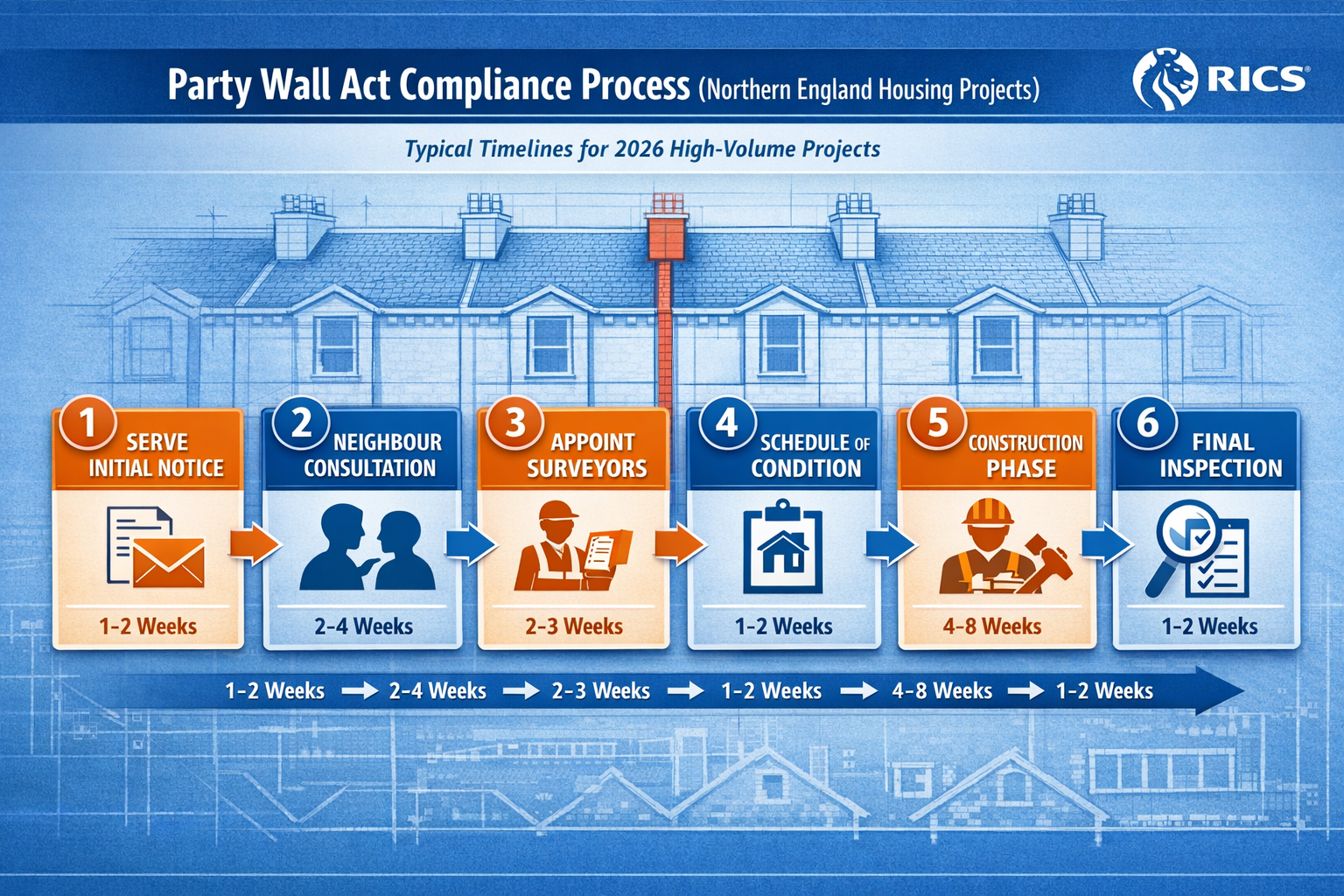
The Party Wall Act 1996: Northern England Application
The Party Wall etc. Act 1996 applies uniformly across England and Wales, but its practical application in Northern England's high-volume environment requires specialized understanding. The Act covers three main types of work:
🏗️ Section 1: New Walls on the Boundary Line
Building a new wall directly on the boundary between properties requires agreement from neighbors. In Northern England's tight urban plots, this frequently applies to garden walls, garage separations, and boundary fencing with structural foundations.
🧱 Section 2: Works to Existing Party Walls
This is the most common scenario in terraced housing. Any work that affects the shared wall—cutting into it, raising it, underpinning it, or inserting damp-proof courses—requires formal notice. The 2026 boom has seen particular increases in:
- Removing chimney breasts through party walls
- Inserting steel beams for open-plan conversions
- Raising party walls for loft extensions
⛏️ Section 6: Excavations Near Neighboring Buildings
Digging within 3 meters of a neighbor's structure (or 6 meters if going deeper than their foundations) triggers notice requirements. Basement conversions in Victorian terraces commonly fall under this section.
RICS Protocols for High-Volume Project Management
The Royal Institution of Chartered Surveyors (RICS) has developed specific guidance for managing party wall matters in high-volume environments. These protocols become essential when surveyors handle dozens or hundreds of concurrent cases across Northern development zones.
Key RICS Protocol Elements for 2026 Projects:
-
Standardized Documentation Systems 📋
- Template notice formats compliant with regional variations
- Digital tracking systems for notice service dates
- Automated reminder systems for response deadlines
- Centralized record-keeping for multiple projects
-
Quality Assurance Frameworks ✅
- Peer review processes for complex awards
- Standardized inspection protocols
- Consistent fee structures across similar projects
- Regular training updates on regional building methods
-
Conflict of Interest Management ⚖️
- Clear protocols when acting as Agreed Surveyor
- Transparency requirements for multiple appointments
- Independence verification in high-volume scenarios
-
Communication Standards 💬
- Defined response timeframes (typically 10 working days)
- Clear explanation requirements for non-technical parties
- Multilingual support in diverse Northern communities
- Accessible formats for elderly or vulnerable neighbors
Understanding what a party wall surveyor does becomes crucial when managing multiple concurrent projects across Northern England's housing boom.
Step-by-Step Notice Sequencing for 2026 Projects
Proper notice sequencing prevents the majority of party wall disputes. Here's the definitive timeline for Northern England projects:
Timeline: 8-10 Weeks Before Construction Start
Week 1-2: Preparation Phase
- Finalize architectural drawings showing party wall work
- Identify all affected neighbors (including those across boundaries)
- Prepare detailed descriptions of proposed works
- Gather property ownership information from Land Registry
Week 3: Notice Service
- Serve formal Party Wall Notices (2 months for Section 2 works, 1 month for Section 1)
- Use recorded delivery or hand delivery with signed receipt
- Include all required information: work description, start date, drawings
- Keep proof of service documentation
Week 5-7: Response Period
- Neighbors have 14 days to respond with consent or dissent
- No response = automatic dissent (common misconception!)
- If consent received, proceed with agreed start date
- If dissent or no response, surveyor appointment required
Week 8-10: Surveyor Appointment & Award
- Building Owner appoints surveyor
- Adjoining Owner appoints surveyor or agrees to Agreed Surveyor
- Surveyors conduct inspections and prepare Schedule of Condition
- Party Wall Award drafted and served
- Construction can commence once Award is in place
⚠️ Critical Northern England Considerations:
In terraced housing with multiple adjoining owners, notices must be served to both immediate neighbors. A mid-terrace property extending requires notices to properties on both sides. Corner properties still need notices to the one adjoining property.
Victorian and Edwardian properties often have shared rear access passages or boundary walls that create additional party wall relationships beyond immediate neighbors.
Regional Challenges Specific to Northern England's Housing Stock
Victorian and Edwardian Construction Methods
Northern England's housing stock presents unique structural challenges that surveyors must understand when managing Party Wall Challenges in Northern England's Housing Boom: RICS Protocols for High-Volume 2026 Projects.
Common Construction Features:
🧱 Solid Brick Party Walls
Most Victorian terraces feature 9-inch (225mm) solid brick party walls without cavities. These walls often show:
- Lime mortar (softer than modern cement)
- Irregular brick sizes and bonding patterns
- Settlement cracks from decades of movement
- Previous alterations and repairs
Foundation Challenges ⚓
Victorian foundations are typically shallow (18-24 inches) compared to modern standards. This creates significant issues for:
- Basement excavations requiring underpinning
- Extension foundations that must match or exceed existing depth
- Settlement risks when excavating nearby
Chimney Breast Complications 🔥
Most terraced homes have back-to-back chimney breasts on party walls. Removing these requires careful structural calculations and often:
- Steel beam insertion through the party wall
- Coordination with neighbors who may retain their chimney
- Understanding of flue ownership and maintenance obligations
High-Volume Project Coordination
When an entire street decides to extend simultaneously—a common scenario in 2026's boom—coordination becomes paramount. Consider a typical Manchester terraced street with 40 properties:
- 15 properties planning rear extensions
- 8 properties pursuing loft conversions
- 5 properties considering basement excavations
- Multiple properties sharing the same surveyors
RICS protocols recommend:
✅ Coordinated Surveyor Appointments
Encouraging neighbors to agree on a single Agreed Surveyor reduces costs and streamlines the process. However, surveyors must carefully manage potential conflicts of interest.
✅ Phased Construction Scheduling
Staggering start dates prevents access issues, reduces neighborhood disruption, and allows surveyors to manage inspections efficiently.
✅ Shared Schedule of Condition Documentation
When multiple properties share walls, a comprehensive photographic and written record benefits all parties and reduces duplication.
✅ Communication Hubs
Some Northern England streets have established WhatsApp groups or community meetings to coordinate extension projects, share surveyor recommendations, and discuss party wall agreement costs.
Dispute Avoidance Tactics for Northern England Projects
Proactive Communication Strategies
The single most effective dispute avoidance tactic is early, clear communication. In Northern England's tight-knit communities, relationships matter.
Best Practices Include:
💬 Pre-Notice Conversations
Before serving formal notices, knock on neighbors' doors and explain your plans in plain English. Show drawings, discuss timelines, and address concerns. This informal approach prevents defensive reactions when official notices arrive.
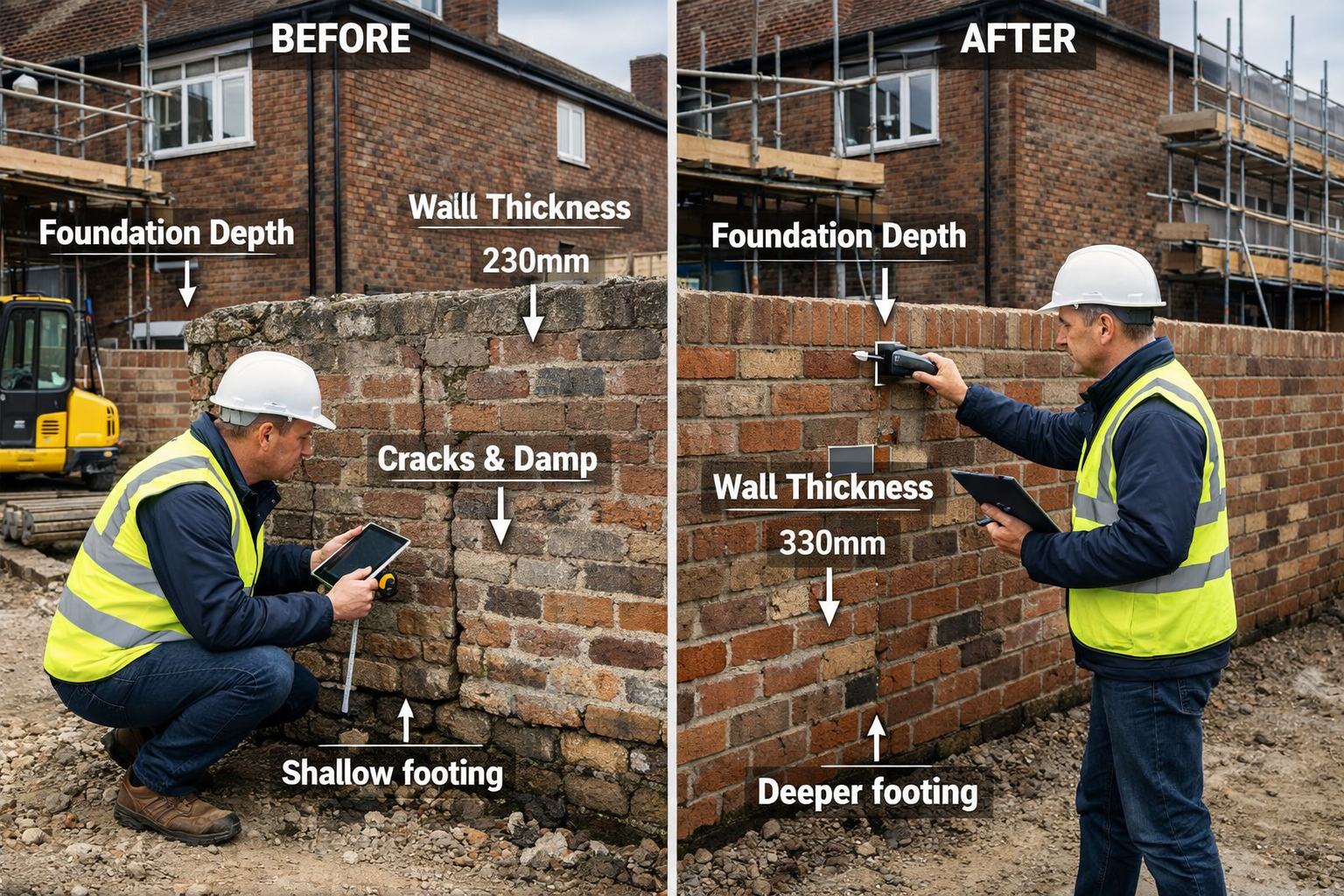
📸 Visual Documentation
Take comprehensive photographs of existing conditions before work begins. Include:
- Party walls from both sides
- Ceilings and floors adjacent to party walls
- External boundaries and access routes
- Any existing cracks, damage, or defects
🕐 Realistic Timelines
Under-promise and over-deliver. If work will take 12 weeks, communicate 14-16 weeks. Northern England weather can delay external works, and terraced properties often reveal hidden complications.
🔊 Noise and Access Management
Terraced housing means noise travels. Agree on working hours (typically 8am-6pm weekdays, 8am-1pm Saturdays), provide advance notice of particularly noisy operations, and maintain clear access routes.
Common Dispute Triggers and Solutions
Understanding typical dispute causes helps prevent them:
| Dispute Trigger | Frequency | Prevention Strategy |
|---|---|---|
| Inadequate notice information | High | Use detailed drawings and specifications |
| Damage to adjoining property | Medium | Comprehensive Schedule of Condition |
| Access disputes | Medium | Written access agreements before work starts |
| Cost allocation disagreements | Low-Medium | Clear explanation of who pays for surveyors |
| Work quality concerns | Low | Regular updates and inspection invitations |
The Role of Technology in 2026 Party Wall Management
Digital transformation has revolutionized party wall management in high-volume environments. Modern surveyors utilize:
📱 Mobile Inspection Apps
Tablet-based applications allow surveyors to:
- Record conditions with geotagged photographs
- Complete standardized inspection checklists
- Generate instant preliminary reports
- Track multiple properties across development zones
☁️ Cloud-Based Document Management
Centralized systems ensure all parties access current documents:
- Notice templates and service records
- Award documents with version control
- Correspondence tracking
- Payment and fee records
🤖 Automated Workflow Systems
Software platforms manage high-volume projects by:
- Tracking notice service dates and response deadlines
- Sending automated reminders to all parties
- Flagging potential conflicts or delays
- Generating compliance reports for developers
📊 Data Analytics for Regional Trends
Aggregated data from hundreds of Northern England projects reveals:
- Average award timelines by property type
- Common dispute causes in specific areas
- Cost benchmarking for similar projects
- Seasonal patterns in extension activity
These technological advances make managing Party Wall Challenges in Northern England's Housing Boom: RICS Protocols for High-Volume 2026 Projects significantly more efficient than even five years ago.
Cost Considerations and Financial Planning
Typical Party Wall Costs in Northern England 2026
Understanding financial obligations helps homeowners budget appropriately for extension projects. Costs vary based on project complexity and regional factors.
Average Fee Ranges:
- Simple rear extension (agreed surveyor): £800-£1,200
- Loft conversion affecting party wall: £1,000-£1,500
- Basement excavation (complex): £2,000-£3,500
- Multiple adjoining owners: Add £400-£600 per additional neighbor
The Building Owner typically pays for:
- Their own surveyor's fees
- The Adjoining Owner's surveyor's fees
- Any agreed surveyor's fees
- Award preparation and service costs
Important: These fees are separate from construction costs and should be factored into project budgets from the outset. Detailed information about party wall agreement costs helps with accurate financial planning.
Value Protection Through Proper Compliance
While party wall procedures add upfront costs, they protect significant value:
🏠 Property Value Protection
Proper party wall compliance ensures:
- No legal complications affecting future sales
- Documentation proving work was done correctly
- Protection against neighbor claims years later
- Smooth conveyancing when selling
⚖️ Legal Risk Mitigation
Proceeding without proper party wall procedures risks:
- Injunctions stopping work mid-project
- Retrospective compliance costs (often 2-3x normal fees)
- Legal fees defending against neighbor claims
- Potential damages for any caused harm
🤝 Relationship Preservation
In Northern England's close-knit communities, maintaining good neighbor relations has tangible value. Proper procedures demonstrate respect and professionalism.
RICS Surveyor Selection for High-Volume Projects

Credentials and Qualifications to Verify
Not all surveyors are equally equipped to handle Party Wall Challenges in Northern England's Housing Boom: RICS Protocols for High-Volume 2026 Projects. Look for:
Essential Qualifications:
- ✅ RICS membership (MRICS or FRICS designation)
- ✅ Specific party wall experience (minimum 50+ awards)
- ✅ Professional indemnity insurance (minimum £1 million)
- ✅ Local knowledge of Northern England construction methods
- ✅ Experience with Victorian/Edwardian properties
Desirable Additional Credentials:
- Faculty of Party Wall Surveyors (FPWS) membership
- Building surveying or structural engineering background
- Mediation or dispute resolution training
- Technology platform proficiency for efficient management
Questions to Ask Potential Surveyors
When interviewing surveyors for high-volume or complex projects:
-
How many party wall awards have you prepared in the past 12 months?
- Look for surveyors handling 50+ cases annually for efficiency
-
What percentage of your awards proceed without disputes?
- Experienced surveyors should achieve 85%+ dispute-free completion
-
Do you have specific experience with [property type] in [area]?
- Victorian terraces in Manchester differ from Edwardian semis in Leeds
-
What is your typical timeline from appointment to award?
- Standard cases should complete within 3-4 weeks
-
How do you handle multiple concurrent projects?
- Understanding their workflow systems indicates capacity
-
What technology platforms do you use?
- Modern surveyors should use digital documentation and communication tools
Finding a reliable party wall surveyor near you requires research, but the investment pays dividends in smooth project execution.
Case Study: Managing a High-Volume Terraced Street Project
The Scenario: Chorlton, Manchester 2026
A street of 35 Victorian terraced properties in Chorlton, Manchester, experienced simultaneous extension activity in early 2026. Eighteen properties planned rear kitchen extensions within a 6-month window, creating complex overlapping party wall requirements.
Challenges Identified:
- 36 party wall relationships (each property affecting two neighbors)
- Multiple builders working simultaneously
- Narrow rear access passages shared by all properties
- Elderly residents concerned about disruption
- Budget-conscious homeowners seeking cost efficiency
The RICS Protocol Solution
A local RICS-accredited surveyor implemented a coordinated approach:
Phase 1: Community Engagement 🏘️
- Organized street meeting to explain party wall process
- Provided plain-English guidance documents
- Offered group discount for agreed surveyor appointments
- Established communication protocol via email group
Phase 2: Coordinated Notice Service 📬
- Staggered notice service dates to manage workflow
- Standardized notice templates for consistency
- Tracked all service dates and responses digitally
- Identified early dissenters for priority attention
Phase 3: Efficient Award Preparation 📋
- Conducted comprehensive street-wide Schedule of Condition
- Created shared photographic database
- Prepared template awards adapted for each property
- Scheduled inspections in logical geographic sequence
Phase 4: Construction Coordination 🏗️
- Worked with builders to stagger start dates
- Established shared access protocols
- Implemented weekly progress reporting
- Conducted mid-construction inspections efficiently
Results and Lessons Learned
Outcomes:
- ✅ All 18 projects completed party wall process within 5 weeks
- ✅ Zero formal disputes requiring third surveyor appointment
- ✅ Average cost per property: £950 (vs. £1,400 individual appointments)
- ✅ 94% neighbor satisfaction rate in post-project survey
- ✅ Two additional properties joined process mid-stream seamlessly
Key Success Factors:
- Early community engagement built trust and understanding
- Coordinated approach reduced costs and complexity
- Technology utilization enabled efficient multi-property management
- Clear communication prevented misunderstandings
- Flexible scheduling accommodated individual circumstances
This case demonstrates how RICS protocols, when properly applied to high-volume scenarios, transform potential chaos into organized, efficient processes.
Future Trends: Party Wall Management Beyond 2026
Emerging Technologies and Innovations
The party wall sector continues evolving with technological advancement:
🤖 AI-Assisted Documentation
Machine learning algorithms are beginning to:
- Analyze property records and predict party wall requirements
- Generate preliminary schedules of condition from photographs
- Identify potential structural risks from historical data
- Automate routine correspondence and reminders
📱 Blockchain for Record-Keeping
Distributed ledger technology offers:
- Immutable records of notices, consents, and awards
- Transparent cost tracking for all parties
- Simplified conveyancing with verified compliance history
- Reduced disputes over documentation authenticity
🥽 Virtual Reality Inspections
VR technology enables:
- Remote participation in inspections for mobility-impaired owners
- Detailed 3D documentation of existing conditions
- Virtual walkthroughs for dispute resolution
- Training simulations for new surveyors
Regulatory Developments on the Horizon
Industry discussions suggest potential Party Wall Act reforms:
Proposed Changes Include:
- Standardized fee structures to reduce cost disputes
- Mandatory timeframes for surveyor appointments
- Enhanced protections for vulnerable homeowners
- Digital-first notice service options
- Simplified procedures for minor works
Northern England Specific Considerations:
- Regional guidance for terraced housing predominance
- Streamlined processes for high-volume development zones
- Enhanced coordination with local planning authorities
- Support for leveling-up initiative compliance
Practical Resources and Support
Essential Documentation Templates
Homeowners and professionals managing party wall matters should maintain:
📄 Core Documents:
- Party Wall Notice templates (Sections 1, 2, and 6)
- Acknowledgment of notice forms
- Surveyor appointment letters
- Party wall award templates
- Schedule of condition pro-formas
- Access agreement templates
Professional Organizations and Guidance
Key Resources:
- RICS – Professional standards and guidance documents
- Faculty of Party Wall Surveyors (FPWS) – Specialist training and resources
- Pyramus & Thisbe Club – Party wall knowledge sharing
- Local authority planning departments – Regional requirements
For comprehensive information, the party wall FAQ and party wall award guidance provide valuable starting points.
Regional Support Networks in Northern England
Manchester Area:
- Greater Manchester Planning Support
- Manchester Civic Society resources
- Local RICS chapter meetings
Leeds and Yorkshire:
- Leeds Building Control guidance
- Yorkshire Historic Buildings Trust
- Regional surveyor networks
Liverpool and Merseyside:
- Liverpool City Region planning resources
- Merseyside Civic Society
- Local heritage building advisors
Conclusion: Navigating Party Wall Success in Northern England's 2026 Boom
The unprecedented housing boom across Northern England in 2026 presents both opportunities and challenges for homeowners, developers, and construction professionals. Understanding and properly managing Party Wall Challenges in Northern England's Housing Boom: RICS Protocols for High-Volume 2026 Projects is no longer optional—it's essential for project success.
The key principles for success include:
🎯 Early Planning – Begin party wall procedures 8-10 weeks before construction, allowing adequate time for notice service, surveyor appointments, and award preparation.
🤝 Proactive Communication – Engage neighbors early with clear, respectful explanations of proposed works, timelines, and potential impacts.
📋 RICS Protocol Compliance – Follow standardized procedures for documentation, inspection, and award preparation to ensure legal compliance and professional standards.
🏘️ Regional Awareness – Understand Northern England's unique housing stock, construction methods, and community dynamics when planning party wall approaches.
💻 Technology Utilization – Leverage modern digital tools for efficient documentation, communication, and project management across high-volume scenarios.
Actionable Next Steps
For Homeowners Planning Extensions:
- Consult with a RICS-accredited party wall surveyor 3-4 months before planned construction
- Review your architect's drawings to identify all party wall implications
- Budget for party wall costs (typically £1,000-£1,500 for standard projects)
- Communicate with neighbors informally before serving formal notices
- Document existing conditions with photographs before work begins
For Developers Managing Multiple Projects:
- Establish relationships with experienced party wall surveyors capable of handling volume
- Implement digital project management systems for tracking multiple concurrent cases
- Coordinate with local planning authorities on area-wide development impacts
- Consider community engagement strategies for high-concentration development zones
- Monitor regional trends and adjust procedures based on emerging best practices
For Construction Professionals:
- Educate clients about party wall requirements during initial consultations
- Build party wall timelines into project schedules from the outset
- Maintain relationships with reliable RICS surveyors for referrals
- Ensure site teams understand access requirements and neighbor sensitivities
- Document compliance thoroughly for future reference and client protection
The Northern England housing boom of 2026 represents a transformative moment for the region's built environment. By approaching party wall challenges with professionalism, clear communication, and adherence to RICS protocols, all parties can navigate this growth successfully. The investment in proper party wall procedures protects property values, preserves community relationships, and ensures legal compliance—benefits that far exceed the modest costs involved.
As extension activity continues rising across Manchester, Leeds, Liverpool, and beyond, those who master party wall management will find themselves well-positioned for success in Northern England's dynamic property market. The framework exists, the protocols are proven, and the professional support is available. The only requirement is commitment to doing things properly from the start.
For additional guidance on specific party wall scenarios, explore comprehensive resources on party wall surveys and general party wall services to ensure your 2026 project proceeds smoothly and successfully.
