
When property markets stabilize after periods of volatility, valuation disputes inevitably surge. In 2026, expert witness surveyors face the complex challenge of presenting robust, defensible evidence in courtrooms where market recovery data must be carefully interpreted and applied. Understanding how to build court-ready cases for Expert Witness Surveyors in Recovering Markets: Building Court-Ready Cases for 2026 Valuation Disputes requires mastering both technical valuation principles and the rigorous standards of legal testimony.
The current market environment presents unique challenges. Property values are stabilizing after recent fluctuations, creating grey areas where historical data may not accurately reflect current conditions. For surveyors serving as expert witnesses, this means every valuation opinion must be supported by comprehensive evidence, transparent methodology, and unwavering adherence to professional standards.
Key Takeaways
- RICS standards mandate impartiality: Expert witness surveyors must prioritize their duty to the court over client interests, maintaining complete independence in all valuation opinions[1]
- Market recovery data requires careful interpretation: Stabilizing prices in 2026 demand sophisticated analysis of comparable sales, adjustment factors, and trend validation
- Documentation quality determines case outcomes: Court-ready cases depend on comprehensive evidence trails, transparent methodologies, and defensible assumptions
- Common pitfalls undermine credibility: Inadequate market research, biased comparable selection, and insufficient documentation frequently weaken expert testimony
- Specialized expertise matters: Different property types and dispute contexts require tailored approaches to evidence preparation and presentation
Understanding the Role of Expert Witness Surveyors in Recovering Markets
The Unique Challenges of 2026 Valuation Disputes
Recovering markets create specific challenges for property valuation that don't exist in stable or declining environments. When prices stabilize after volatility, determining the "correct" value becomes contentious. Buyers and sellers, landlords and tenants, investors and tax authorities—all may have legitimate but conflicting interpretations of what a property is worth.
Expert witness surveyors must navigate these disagreements by providing objective, evidence-based opinions that courts can rely upon. This role extends far beyond standard valuation work. While a typical RICS valuation serves transactional purposes, expert witness testimony must withstand cross-examination, challenge from opposing experts, and judicial scrutiny.
The recovering market context of 2026 adds layers of complexity:
- Transitional comparable sales: Properties sold during market decline may not reflect current recovery values
- Limited recovery data: Insufficient transaction volume in the early recovery phase creates evidence gaps
- Divergent market segments: Different property types and locations may recover at varying rates
- Buyer sentiment shifts: Psychological factors influence pricing beyond fundamental value drivers
Core Responsibilities Under RICS Standards
The Royal Institution of Chartered Surveyors establishes clear expectations for surveyors acting as expert witnesses. The most recent guidance emphasizes several fundamental principles that apply directly to Expert Witness Surveyors in Recovering Markets: Building Court-Ready Cases for 2026 Valuation Disputes[1]:
✅ Overriding duty to the court: Expert witnesses serve the court first, not the party instructing them
✅ Complete impartiality: Opinions must be objective and unbiased, regardless of which party benefits
✅ Transparency in methodology: All assumptions, data sources, and analytical approaches must be clearly disclosed
✅ Competence and expertise: Experts should only accept instructions within their areas of genuine competence
✅ Conflicts of interest management: Any potential conflicts must be identified and appropriately addressed
These standards aren't merely aspirational—they form the foundation of professional credibility. Courts increasingly scrutinize expert qualifications and adherence to professional standards. An expert witness who fails to demonstrate compliance with RICS guidance risks having their testimony discounted or excluded entirely.
Types of Valuation Disputes in 2026
Expert witness surveyors encounter diverse dispute contexts, each requiring specialized knowledge and evidence preparation:
| Dispute Type | Common Issues | Key Evidence Requirements |
|---|---|---|
| Matrimonial | Asset division, settlement fairness | Open market valuations, forced sale scenarios, timing considerations |
| Tax Appeals | Capital gains, inheritance tax, stamp duty | Historical valuations, statutory definitions, comparable evidence |
| Lease Disputes | Rent reviews, lease extensions, dilapidations | Market rent analysis, settlement patterns, repair cost assessments |
| Compulsory Purchase | Compensation levels, disturbance claims | Before-and-after valuations, loss quantification, comparable schemes |
| Professional Negligence | Surveyor errors, valuation accuracy | Standard of care, causation, loss calculation |
| Boundary Disputes | Property extent, encroachment value impact | Title analysis, physical surveys, market impact assessment |
For specialized contexts like matrimonial valuations or capital gains tax disputes, expert witnesses must understand not only valuation methodology but also the relevant legal framework and precedents.
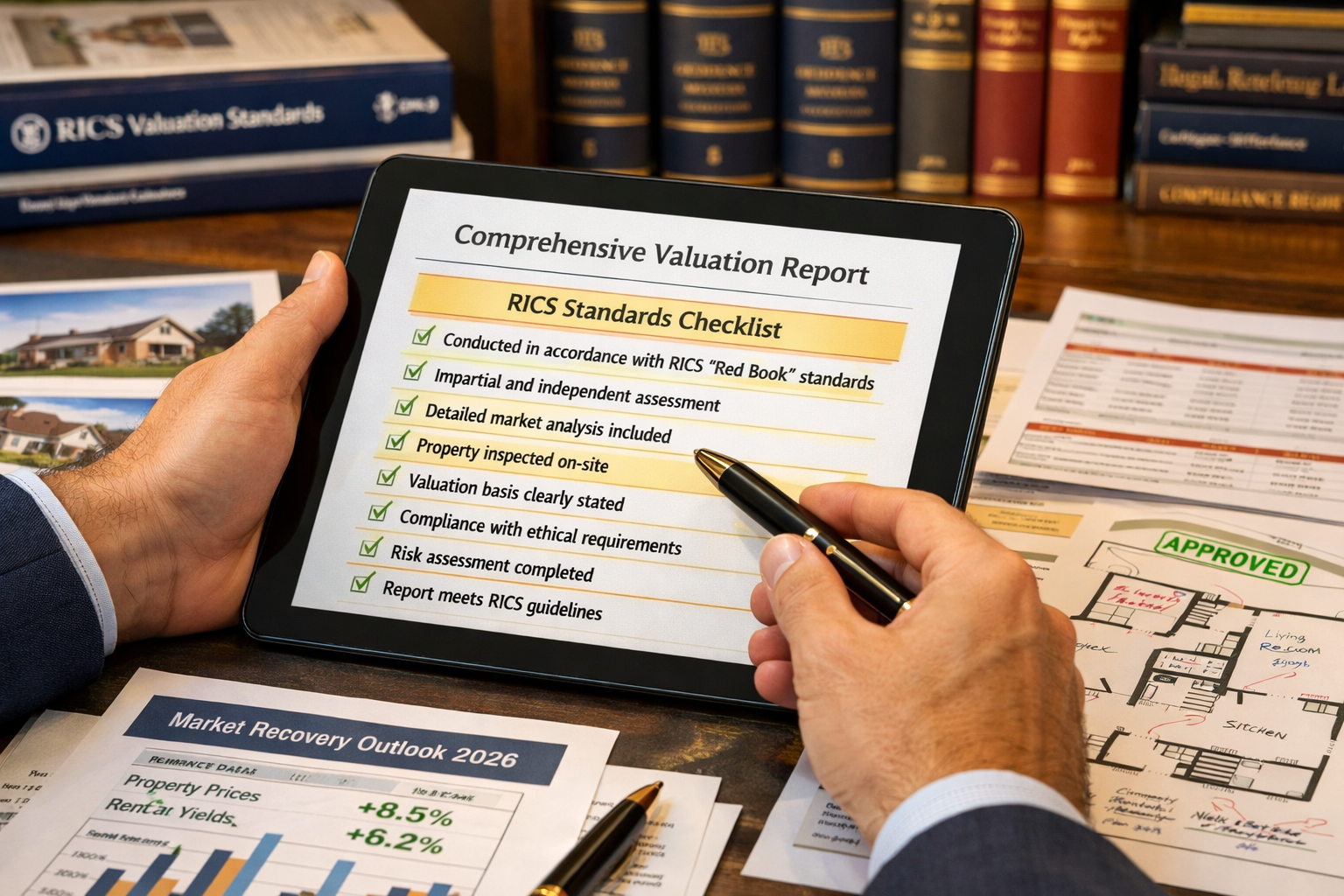
Building Court-Ready Cases: Evidence Standards for Expert Witness Surveyors in Recovering Markets
Comprehensive Market Research and Data Collection
The foundation of any defensible valuation opinion is thorough market research. In recovering markets, this research must go beyond standard comparable analysis to capture the dynamics of stabilization and recovery.
Essential data sources include:
🔍 Transaction databases: Land Registry data, CoStar, EGi, and proprietary databases provide comparable sales evidence
🔍 Market reports: RICS market surveys, agent reports, and economic forecasts establish context
🔍 Local intelligence: Conversations with active agents and developers reveal sentiment and emerging trends
🔍 Historical analysis: Multi-year price trends identify recovery patterns and inflection points
🔍 Segment-specific data: Different property types require tailored comparable sets
For 2026 disputes, expert witnesses must demonstrate they've considered how market recovery affects valuation. This means analyzing:
- Recovery trajectory: Is the market in early, mid, or late recovery?
- Transaction volume: Are there sufficient sales to establish reliable value levels?
- Price stability: Have values plateaued or are they still rising?
- Market breadth: Is recovery consistent across property types and locations?
The quality of comparable evidence directly impacts case outcomes. Courts expect expert witnesses to explain why specific comparables were selected, what adjustments were applied, and how recovery dynamics influenced the analysis.
Valuation Methodology and Transparency
Transparent methodology separates credible expert testimony from advocacy. When building court-ready cases for Expert Witness Surveyors in Recovering Markets: Building Court-Ready Cases for 2026 Valuation Disputes, every analytical step must be documented and defensible.
Key methodological requirements:
1. Explicit assumptions: State all assumptions clearly, including market conditions, property condition, and transaction circumstances
2. Comparable selection criteria: Document why specific comparables were included or excluded
3. Adjustment transparency: Explain all adjustments for size, location, condition, and timing
4. Multiple approaches: Where appropriate, apply different valuation methods (comparable sales, income capitalization, cost approach) and reconcile results
5. Sensitivity analysis: Show how key variables affect the valuation conclusion
6. Limitation disclosure: Acknowledge any data limitations, inspection restrictions, or analytical constraints
"The expert's primary duty is to help the court on matters within their expertise. This duty overrides any obligation to the person from whom they have received instructions or by whom they are paid." – RICS Expert Witness Guidance[1]
For recovering markets specifically, methodology must address temporal issues. A comparable sale from six months ago may reflect different market conditions than the valuation date. Expert witnesses should explain:
- How they adjusted for market movement between comparable sale dates and valuation date
- What evidence supports the adjustment percentage applied
- Whether recovery has been linear or volatile
- How they verified that recovery trends continued through the valuation date
Documentation and Evidence Trail
Courts demand comprehensive documentation. An expert opinion without supporting evidence is merely assertion. For valuation disputes, the evidence trail should include:
📋 Inspection records: Detailed notes, photographs, measurements, and observations from property inspections
📋 Comparable evidence: Full details of comparable transactions including addresses, dates, prices, sizes, and sources
📋 Market data: Reports, articles, statistics, and analyses supporting market context and trends
📋 Calculation worksheets: Step-by-step calculations showing how the valuation conclusion was reached
📋 Correspondence: Relevant communications with agents, parties, or other experts
📋 Professional qualifications: Evidence of expertise, RICS membership, and relevant experience
This documentation serves multiple purposes. It supports the expert's opinion, demonstrates thoroughness, provides transparency for opposing experts to review, and enables effective cross-examination preparation.
Many disputes involving building surveys or commercial property assessments require extensive technical documentation beyond standard valuation evidence. Expert witnesses must tailor their evidence collection to the specific dispute context.
Common Pitfalls and How Expert Witness Surveyors Can Avoid Them in 2026 Cases
Inadequate Market Analysis
The pitfall: Relying on insufficient comparable evidence or failing to properly analyze market recovery dynamics.
In recovering markets, inadequate analysis often manifests as:
- Using too few comparables to establish reliable value conclusions
- Selecting comparables from the wrong market phase (decline vs. recovery)
- Failing to verify whether comparable sales were distressed or arm's-length
- Ignoring market segment differences (luxury vs. mainstream, urban vs. suburban)
- Overlooking local market variations within broader regional trends
How to avoid it: Develop a systematic approach to market analysis that includes:
✅ Comprehensive comparable search: Cast a wide net initially, then refine based on relevance
✅ Temporal stratification: Analyze comparables by time period to identify recovery patterns
✅ Quality verification: Confirm transaction circumstances and verify reported prices
✅ Adjustment validation: Support all adjustments with market evidence, not just professional judgment
✅ Peer review: Have methodology reviewed by colleagues before finalizing opinions
For 2026 disputes, expert witnesses should demonstrate they've considered how stabilizing prices affect valuation. This might include analyzing month-by-month price trends, examining transaction volume changes, or consulting multiple data sources to confirm recovery patterns.
Bias and Lack of Independence
The pitfall: Allowing client interests or instruction circumstances to influence valuation opinions.
Expert witness work differs fundamentally from advocacy. While solicitors advocate for their clients, expert witnesses serve the court. This distinction creates tension that some surveyors struggle to navigate.
Common bias indicators include:
- Adjusting methodology to achieve a desired result
- Selectively presenting evidence that supports the instructing party
- Dismissing contrary evidence without adequate explanation
- Adopting extreme positions at the edges of reasonable opinion
- Failing to acknowledge weaknesses in one's own analysis
How to avoid it: Maintain rigorous independence through:
✅ Early bias awareness: Recognize that unconscious bias exists and implement checks against it
✅ Methodology first: Determine valuation approach before knowing what result the client prefers
✅ Balanced evidence: Present both supporting and contrary evidence, explaining how you weighed each
✅ Reasonable range: Acknowledge where valuation falls within a range of reasonable opinions
✅ Peer challenge: Invite colleagues to critique your analysis and identify potential bias
The RICS guidance explicitly addresses this issue, requiring experts to include a statement in their reports confirming they understand their duty to the court and have complied with it[1].
Insufficient Documentation
The pitfall: Failing to create a comprehensive evidence trail that supports every aspect of the valuation opinion.
Documentation failures undermine credibility in several ways:
- Unable to substantiate claims when challenged in cross-examination
- Appearing unprepared or careless
- Raising questions about whether proper analysis was actually conducted
- Providing openings for opposing experts to attack methodology
How to avoid it: Implement systematic documentation practices:
✅ Contemporary notes: Document research, analysis, and reasoning as work progresses, not retrospectively
✅ Source attribution: Clearly identify the source of every fact, figure, and assumption
✅ Calculation detail: Show all mathematical steps, not just final results
✅ Version control: Maintain records of how opinions evolved if additional information became available
✅ Assumption log: Keep a running list of all assumptions made and their justification
For disputes involving specialized areas like lease extension valuations or freehold valuations, documentation requirements may extend to statutory interpretation, settlement patterns, and precedent analysis.

Misunderstanding Legal Context
The pitfall: Focusing solely on valuation technicalities while ignoring the legal framework within which the dispute exists.
Different legal contexts require different valuation approaches:
- Matrimonial disputes may require both open market and forced sale scenarios
- Tax appeals must comply with statutory valuation definitions
- Lease disputes involve interpreting lease terms and rent review clauses
- Compulsory purchase requires specific compensation principles
- Professional negligence demands understanding the standard of care at the relevant time
How to avoid it: Develop contextual expertise:
✅ Study relevant law: Understand the legal framework governing the specific dispute type
✅ Review precedents: Familiarize yourself with how courts have approached similar cases
✅ Collaborate with lawyers: Work closely with instructing solicitors to understand legal requirements
✅ Appropriate definitions: Apply the correct valuation definition for the legal context
✅ Statutory compliance: Ensure methodology aligns with any statutory requirements
Expert witnesses who understand both valuation and legal context provide more valuable assistance to courts. This is particularly important when dealing with specialized areas like party wall disputes where legal and technical issues intersect.
Poor Communication and Report Writing
The pitfall: Producing reports that are technically sound but poorly communicated, making them difficult for non-experts to understand.
Judges, lawyers, and juries are not valuation specialists. Expert reports must communicate complex technical concepts in accessible language without sacrificing accuracy or precision.
Common communication failures include:
- Excessive jargon without explanation
- Unclear structure that obscures key conclusions
- Inadequate executive summaries
- Failure to address the specific questions posed by the court
- Overly technical presentation that loses the audience
How to avoid it: Prioritize clear communication:
✅ Executive summary: Provide a concise summary of key opinions at the beginning
✅ Logical structure: Organize reports to guide readers through the analysis step-by-step
✅ Plain language: Explain technical concepts in accessible terms, defining specialized vocabulary
✅ Visual aids: Use tables, charts, and photographs to illustrate key points
✅ Direct answers: Clearly answer the specific questions the court has posed
✅ Conclusion clarity: State final opinions unambiguously, avoiding hedging or ambiguity
Remember that expert reports serve multiple audiences: instructing solicitors, opposing experts, opposing solicitors, and ultimately the court. Each audience has different needs and levels of technical knowledge.
Leveraging Market Recovery Data in Expert Testimony
Analyzing Recovery Patterns and Trends
Market recovery rarely follows a smooth, predictable path. Understanding recovery patterns helps expert witnesses provide nuanced, credible opinions about 2026 valuations.
Key recovery indicators to analyze:
📊 Transaction volume trends: Recovery typically begins with increased transaction activity before prices rise
📊 Price stabilization patterns: Identify when prices stopped declining and began plateauing
📊 Segment divergence: Different property types and locations recover at different rates
📊 Buyer composition shifts: Investor return, first-time buyer activity, and institutional involvement signal recovery stages
📊 Time on market: Decreasing marketing periods indicate strengthening demand
📊 Offer-to-asking price ratios: Rising ratios suggest buyers are more willing to meet asking prices
For Expert Witness Surveyors in Recovering Markets: Building Court-Ready Cases for 2026 Valuation Disputes, demonstrating awareness of these indicators enhances credibility. Courts appreciate experts who can explain not just what a property is worth, but why the market supports that value in the recovery context.
Adjusting Comparables for Market Movement
One of the most challenging aspects of valuation in recovering markets is adjusting comparable sales for time. When market conditions are changing, a sale from six months ago may not reflect current values.
Approaches to time adjustments:
1. Index-based adjustments: Apply published price indices (Land Registry HPI, Nationwide, Halifax) to adjust historical comparables to the valuation date
2. Paired sales analysis: Compare properties that sold at different times to quantify market movement
3. Repeat sales analysis: Track properties that sold multiple times to measure price changes
4. Market evidence: Use asking price trends, agent feedback, and market reports to support adjustment percentages
5. Conservative approach: When recovery evidence is unclear, acknowledge uncertainty and provide a range
The key is transparency. Expert witnesses should clearly explain:
- What adjustment percentage was applied
- What evidence supports that adjustment
- Whether the adjustment reflects actual market movement or professional judgment
- How sensitive the valuation conclusion is to the time adjustment
For disputes involving residential property surveys or detailed Level 3 building surveys, time adjustments may need to account for both market movement and property condition changes.
Addressing Uncertainty and Providing Ranges
Recovering markets inherently involve greater uncertainty than stable markets. Honest expert witnesses acknowledge this uncertainty rather than presenting false precision.
When to provide valuation ranges:
- Limited comparable evidence exists
- Market recovery trajectory is unclear
- Significant assumptions are required
- Different methodologies produce varying results
- The property has unique characteristics with limited market evidence
How to present ranges effectively:
✅ Justify the range: Explain what factors create the uncertainty
✅ Indicate most likely value: Within the range, identify where the most probable value lies
✅ Avoid excessive breadth: Ranges should be meaningful, not so wide as to be unhelpful
✅ Support boundaries: Explain what evidence supports the upper and lower bounds
✅ Address implications: Discuss how the range affects the legal issues in dispute
Courts generally appreciate experts who acknowledge limitations and uncertainty rather than those who present unjustified precision. A well-reasoned range often carries more weight than a single-point estimate that cannot withstand scrutiny.
Preparing for Cross-Examination and Expert Conferences
Anticipating Challenges to Your Opinion
Effective expert witnesses prepare for cross-examination by anticipating how opposing counsel will challenge their opinions. Common challenge areas include:
🎯 Comparable selection: Why were certain properties included or excluded?
🎯 Adjustment justification: What evidence supports the adjustments applied?
🎯 Methodology choice: Why was this approach used rather than alternatives?
🎯 Assumption validity: Are the assumptions reasonable and supported?
🎯 Qualification and experience: Does the expert have relevant expertise?
🎯 Independence: Has bias influenced the opinion?
Preparation strategies:
✅ Self-critique: Identify weaknesses in your own analysis before opposing experts do
✅ Alternative scenarios: Consider how different assumptions would affect conclusions
✅ Evidence mastery: Know your evidence thoroughly, including sources and details
✅ Precedent awareness: Understand how courts have treated similar issues
✅ Mock cross-examination: Practice answering challenging questions with colleagues or instructing solicitors
The goal isn't to develop defensive responses but to ensure your opinions can withstand rigorous scrutiny. If weaknesses exist, acknowledge them candidly rather than attempting to conceal them.
Participating in Expert Conferences
Many courts now require expert conferences where opposing experts meet to identify areas of agreement and disagreement. These conferences serve several purposes:
- Narrow the issues requiring court determination
- Clarify technical points for the court
- Potentially reach agreement on certain matters
- Demonstrate professional collaboration
Best practices for expert conferences:
✅ Prepare thoroughly: Review all evidence and reports before the conference
✅ Identify common ground: Look for areas where agreement is possible
✅ Explain differences clearly: When disagreement exists, articulate the reasons precisely
✅ Remain professional: Treat opposing experts with courtesy and respect
✅ Focus on substance: Address technical issues, not personalities or advocacy
✅ Document outcomes: Ensure the joint statement accurately reflects discussions
Expert conferences test professional integrity. The temptation to advocate for the instructing party must be resisted in favor of genuine technical discussion with fellow professionals.
Maintaining Professional Standards Under Pressure
Legal proceedings create pressure that can challenge professional standards. Clients may push for favorable opinions, lawyers may suggest particular approaches, and the adversarial nature of litigation can erode objectivity.
Strategies for maintaining standards:
✅ Know your limits: Decline instructions outside your competence
✅ Document independence: Keep records showing opinions were formed independently
✅ Resist pressure: Politely but firmly decline requests to alter opinions for tactical reasons
✅ Seek guidance: Consult RICS professional standards team if ethical issues arise
✅ Prioritize reputation: Remember that long-term professional reputation outweighs any single case
The RICS guidance provides a framework for navigating these pressures, emphasizing that the expert's duty to the court must override all other considerations[1].
Conclusion
Expert Witness Surveyors in Recovering Markets: Building Court-Ready Cases for 2026 Valuation Disputes requires a sophisticated blend of technical expertise, professional integrity, and legal awareness. As property markets stabilize following recent volatility, valuation disputes will continue to challenge surveyors serving as expert witnesses.
The foundation of credible expert testimony rests on comprehensive market research, transparent methodology, and rigorous documentation. Understanding recovery dynamics—how markets transition from decline to stability—enables experts to provide nuanced opinions that courts can rely upon.
Avoiding common pitfalls demands constant vigilance. Inadequate market analysis, unconscious bias, insufficient documentation, misunderstanding legal context, and poor communication all undermine expert credibility. By implementing systematic approaches to evidence collection, maintaining independence, and prioritizing clear communication, expert witnesses can build cases that withstand judicial scrutiny.
The RICS standards for expert witnesses provide essential guidance, emphasizing the overriding duty to the court and the requirement for complete impartiality[1]. These aren't merely professional aspirations—they form the ethical foundation of expert witness work.
Actionable Next Steps
For surveyors preparing to serve as expert witnesses in 2026 valuation disputes:
- Review RICS expert witness guidance thoroughly and ensure your practice aligns with all requirements
- Develop systematic documentation practices that create comprehensive evidence trails for every opinion
- Build market recovery expertise by analyzing current transaction data, trends, and recovery patterns
- Invest in legal knowledge relevant to your typical dispute contexts (matrimonial, tax, lease, etc.)
- Seek mentorship from experienced expert witnesses who can provide guidance and peer review
- Participate in continuing professional development focused on expert witness skills and market analysis
- Consider specialized training in cross-examination techniques and expert conference participation
The role of expert witness carries significant responsibility. Courts, parties, and the public rely on expert opinions to resolve disputes fairly. By maintaining the highest professional standards and building truly court-ready cases, expert witness surveyors contribute to justice while enhancing the reputation of the surveying profession.
For those seeking expert witness services or comprehensive valuation support, working with RICS-qualified professionals who understand both technical valuation and legal requirements ensures the strongest possible foundation for dispute resolution.
References
[1] Surveyors Acting As Expert Witnesses – https://www.rics.org/profession-standards/rics-standards-and-guidance/sector-standards/dispute-resolution-standards/surveyors-acting-as-expert-witnesses
[2] How Expert Witness Surveyors Help Resolve Construction Disputes – https://novusresolve.com/knowledge-base/how-expert-witness-surveyors-help-resolve-construction-disputes
[3] Expert Witness Challenges In 2026 Buy To Let Valuation Disputes Institutional Investor Trends – https://nottinghillsurveyors.com/blog/expert-witness-challenges-in-2026-buy-to-let-valuation-disputes-institutional-investor-trends
[4] Post Budget 2026 Valuation Challenges Surveyor Strategies For High Value Properties Over 2 Million – https://nottinghillsurveyors.com/blog/post-budget-2026-valuation-challenges-surveyor-strategies-for-high-value-properties-over-2-million
