
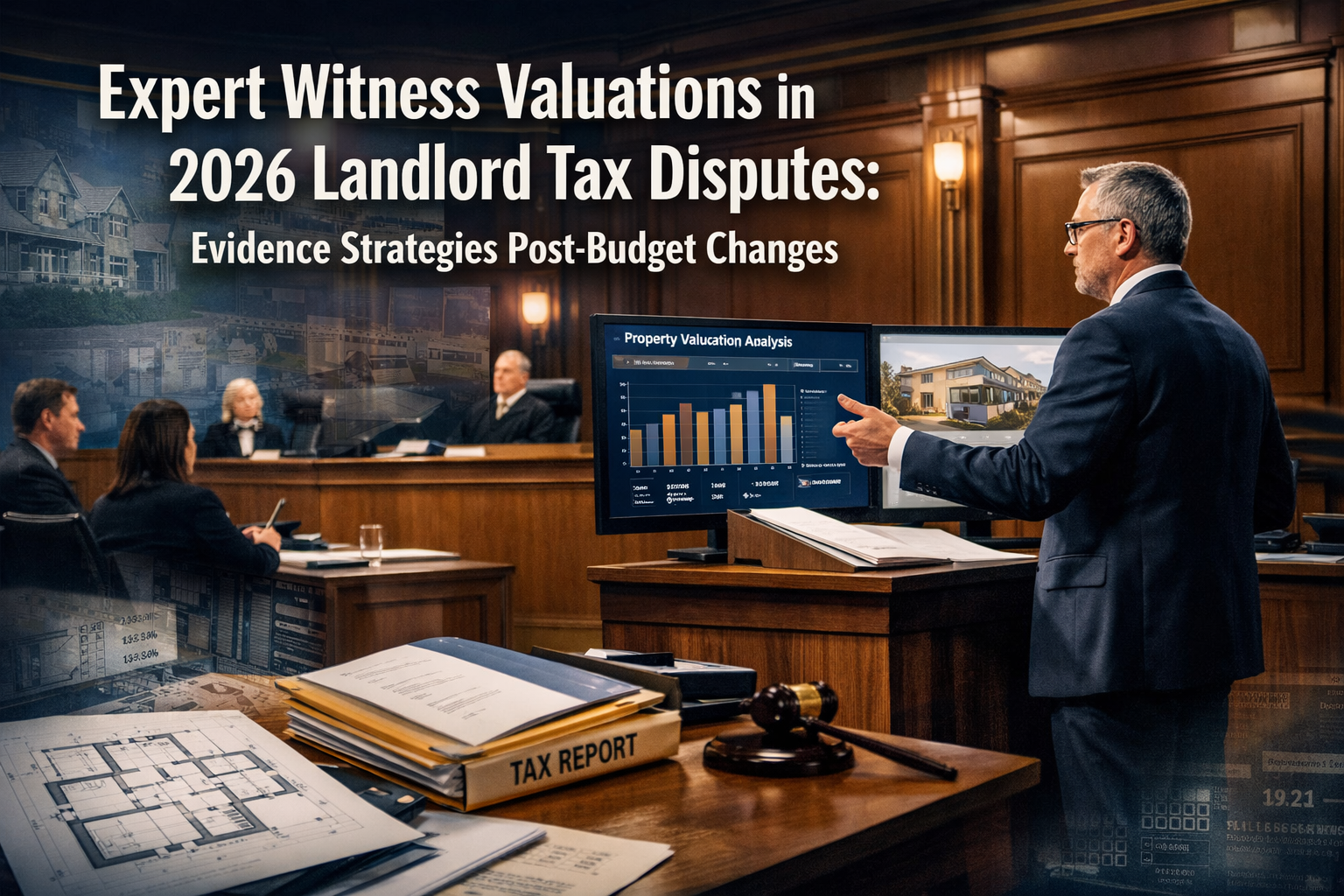
The landscape of landlord taxation has shifted dramatically in 2026, creating unprecedented challenges for property investors navigating complex tax disputes. With Making Tax Digital requirements now mandatory for landlords earning over £50,000 and significant tax rate increases looming in 2027, the role of expert witness valuations in resolving disputes has never been more critical. Understanding how to leverage Expert Witness Valuations in 2026 Landlord Tax Disputes: Evidence Strategies Post-Budget Changes can mean the difference between successful appeals and costly tribunal defeats. 📊
The convergence of new digital reporting obligations, increased property income tax rates, and heightened scrutiny on high-value and buy-to-let properties has created a perfect storm for valuation disputes. Landlords, lenders, and investors increasingly rely on RICS-qualified experts to provide credible evidence that withstands tribunal scrutiny while optimizing their tax positions—particularly in Northern markets where yield opportunities remain strong despite regulatory headwinds.
Key Takeaways
- Making Tax Digital requirements from April 2026 demand meticulous record-keeping that directly impacts valuation evidence quality and admissibility in tax disputes
- Property income tax rates increase substantially from April 2027 (22%, 42%, 47%), making accurate valuations critical for minimizing liabilities and supporting appeals
- RICS Red Book standards provide the authoritative framework for expert witness valuations that tribunals recognize and respect in landlord tax disputes
- Northern England markets offer superior yield optimization opportunities (6-8% vs 3-4% in London) that require specialized valuation expertise to defend against HMRC challenges
- Evidence presentation strategies must integrate digital records, comparable analysis, and professional credibility to succeed in post-budget dispute environments
Understanding the 2026 Tax Landscape for Landlords
Making Tax Digital: The Foundation of Modern Disputes
The Making Tax Digital (MTD) initiative represents the most significant administrative change for landlords in decades. From April 2026, any landlord with annual property income exceeding £50,000 must maintain digital records and submit quarterly updates to HMRC through compatible software. This requirement fundamentally transforms how valuation evidence is gathered, stored, and presented in tax disputes.
For expert witnesses, MTD compliance creates both challenges and opportunities:
Challenges:
- Digital records must be reconcilable with valuation evidence
- Quarterly submissions create multiple data points that require consistency
- Software limitations may not capture nuanced valuation factors
- Retrospective valuations must align with contemporaneous digital records
Opportunities:
- Enhanced data quality improves valuation accuracy and defensibility
- Digital trails provide robust audit evidence supporting expert opinions
- Quarterly snapshots enable trend analysis strengthening comparative valuations
- Integration with professional valuation software streamlines evidence preparation
Expert witnesses providing commercial valuation services must now ensure their methodologies align seamlessly with clients' MTD-compliant systems, creating a unified evidence package that withstands tribunal scrutiny.
The 2027 Tax Rate Increases: Planning Ahead
While the new property income tax rates don't take effect until April 2027, their shadow looms large over 2026 disputes. The increases are substantial:
| Tax Band | Current Rate | 2027 Rate | Increase |
|---|---|---|---|
| Basic Rate | 20% | 22% | +2% |
| Higher Rate | 40% | 42% | +2% |
| Additional Rate | 45% | 47% | +2% |
These increases create strategic imperatives for landlords engaged in tax disputes during 2026. Valuations that reduce taxable income or shift timing of disposals can generate significant savings. Expert witnesses must consider:
- Timing strategies for property disposals and valuations
- Income vs capital characterization disputes
- Allowable expense valuations and depreciation schedules
- Portfolio restructuring implications for tax liability
Additionally, dividend tax rates for company landlords increased by 2 percentage points from April 2026, affecting those who hold properties through corporate structures. This creates complex valuation scenarios requiring expert analysis of optimal ownership structures.
High-Value and Buy-to-Let Property Scrutiny
HMRC has intensified scrutiny on high-value properties and extensive buy-to-let portfolios. This increased attention stems from:
- 🏢 Revenue protection as traditional income sources face pressure
- 📈 Property market volatility creating valuation disputes
- 💼 Professional landlord classification triggering enhanced compliance
- 🔍 Anti-avoidance measures targeting aggressive tax planning
Expert witnesses must navigate this heightened scrutiny by providing valuations that are not only technically sound but also demonstrably conservative and well-documented. Our expert witness services emphasize transparency and adherence to professional standards that tribunals recognize as authoritative.
Expert Witness Valuations in 2026 Landlord Tax Disputes: RICS Standards and Methodologies

The RICS Red Book: Your Evidence Foundation
The RICS Valuation – Global Standards (the "Red Book") provides the internationally recognized framework for professional property valuations. In landlord tax disputes, Red Book compliance is not optional—it's essential for credibility and admissibility.
Key Red Book principles for tax dispute valuations include:
1. Basis of Value
Expert witnesses must clearly identify whether they're providing:
- Market Value: The estimated amount for which an asset should exchange on the valuation date
- Investment Value: Value to a particular investor based on individual requirements
- Fair Value: Price that would be received to sell an asset in an orderly transaction
For most landlord tax disputes, Market Value forms the appropriate basis, particularly for capital gains tax valuation purposes.
2. Valuation Approaches
The Red Book recognizes three primary approaches:
- Comparable Method: Analysis of similar properties that have sold recently (most common for residential landlords)
- Income Capitalization: Valuation based on rental income streams (essential for buy-to-let portfolios)
- Cost Approach: Replacement cost less depreciation (used for specialized properties)
Expert witnesses typically employ multiple approaches to triangulate value and strengthen evidence credibility.
3. Professional Competence and Independence
RICS standards require expert witnesses to:
- Possess appropriate qualifications and experience
- Maintain professional indemnity insurance
- Declare any conflicts of interest
- Provide objective, unbiased opinions
"The expert witness's duty is to the tribunal, not to the client. This fundamental principle underpins the credibility of all valuation evidence in tax disputes." — RICS Practice Statement
Valuation Methodologies for Different Dispute Types
Capital Gains Tax Disputes
When landlords dispose of properties, accurate valuation at acquisition (or March 1982 for long-held assets) and disposal dates is crucial. Expert witnesses must:
- Establish market value at relevant dates using contemporaneous comparable evidence
- Account for indexation allowance where applicable (frozen since 2017)
- Consider principal private residence relief partial exemptions
- Document enhancement expenditure with supporting valuations
The challenge intensifies when historical valuations are required. Expert witnesses must reconstruct market conditions using:
- Historical sales data from Land Registry
- Archived property listings and marketing materials
- Economic indicators and house price indices
- Expert knowledge of local market evolution
Inheritance Tax and Estate Valuations
Landlord estates often include substantial property portfolios requiring careful valuation. Key considerations include:
- Vacant possession value vs tenanted investment value
- Portfolio discounts for bulk holdings
- Related property rules affecting valuation methodology
- Agricultural property relief for qualifying holdings
Our matrimonial valuation expertise translates well to inheritance scenarios where family property divisions require authoritative expert evidence.
Income Tax and Rental Valuation Disputes
Disputes over rental income valuations typically involve:
- Market rent determinations for connected party lettings
- Furnished holiday lettings qualification requiring evidence of commercial letting patterns
- Rent-a-room relief threshold valuations
- Property expense allocations requiring apportionment valuations
Expert witnesses must demonstrate that reported rental income reflects genuine market conditions, particularly when HMRC challenges below-market family lettings.
Evidence Strategies Post-Budget Changes: Building Winning Cases

Integrating Digital Records with Valuation Evidence
The MTD requirement creates a new paradigm for evidence presentation. Successful strategies integrate:
Digital Audit Trail
- Quarterly MTD submissions providing contemporaneous income records
- Software-generated reports showing consistent rental income patterns
- Digital receipts and invoices supporting expense claims
- Timestamped communications with tenants and agents
Valuation Documentation
- RICS-compliant valuation reports with clear methodology
- Comparable evidence with photographs and market data
- Income capitalization calculations reconciling to MTD records
- Professional credentials and experience statements
Synthesis Strategy
Expert witnesses should create a narrative that shows:
- Digital records accurately reflect property performance
- Valuation methodologies align with recorded income/expenses
- Conclusions are consistent across multiple evidence sources
- Professional standards have been rigorously applied
Comparable Evidence: Quality Over Quantity
Tribunals value relevant, recent, and reliable comparable evidence. Expert witnesses should:
✅ Select comparables that are:
- Geographically proximate (same postcode district preferred)
- Similar in size, condition, and specification
- Transacted within 6 months of valuation date
- Arm's length transactions (not family sales)
❌ Avoid comparables that are:
- Too distant geographically or temporally
- Significantly different in quality or features
- Forced sales or distressed transactions
- Based on asking prices rather than achieved sales
For landlords with properties requiring dilapidations surveys, condition adjustments to comparables must be clearly documented and justified.
Professional Credibility: The X-Factor in Disputes
Technical competence is necessary but insufficient. Tribunals assess expert witnesses on:
Qualifications and Experience
- RICS membership (MRICS or FRICS)
- Specialist designations (Registered Valuer status)
- Years of practice in relevant property sectors
- Previous tribunal experience and track record
Report Quality
- Clear, logical structure following RICS guidance
- Comprehensive methodology explanation
- Transparent assumptions and limitations
- Professional presentation with supporting appendices
Testimony Performance
- Confident, articulate communication
- Ability to explain technical concepts simply
- Responsiveness to cross-examination
- Maintenance of professional composure
Expert witnesses from established firms with RICS registered valuers on staff carry inherent credibility advantages in tribunal settings.
Case Study Approach: Learning from Precedents
While each dispute is unique, successful expert witnesses study previous tribunal decisions to understand:
- Valuation methodologies that tribunals have accepted or rejected
- Evidence standards required for different dispute types
- Common pitfalls that undermine expert credibility
- Effective presentation techniques that resonate with judges
Key lessons from recent landlord tax dispute cases include:
- Contemporaneous evidence trumps retrospective analysis — valuations prepared at the time carry more weight than later reconstructions
- Multiple methodologies strengthen conclusions — triangulation using comparable, income, and cost approaches enhances credibility
- Conservative assumptions are safer — tribunals favor prudent valuations over aggressive positions
- Documentation quality matters — comprehensive records and clear reasoning overcome challenges more effectively
Northern England: Yield Optimization Strategies for Expert Witnesses
The Northern Advantage: Higher Yields, Different Challenges
While London and the Southeast dominate property headlines, Northern England offers compelling opportunities for landlords seeking superior yields. Expert witnesses working in these markets must understand regional dynamics:
Typical Yield Comparisons (2026):
| Region | Average Yield | Capital Growth | Total Return |
|---|---|---|---|
| London | 3.2% | 4.1% | 7.3% |
| Southeast | 3.8% | 3.7% | 7.5% |
| Northwest | 6.4% | 2.8% | 9.2% |
| Northeast | 7.1% | 2.2% | 9.3% |
| Yorkshire | 6.8% | 2.5% | 9.3% |
These higher yields create specific valuation considerations:
Income Capitalization Primacy
Northern buy-to-let valuations rely heavily on income capitalization rather than comparable sales, requiring:
- Detailed rental income analysis and verification
- Appropriate yield selection based on property quality and location
- Void period and management cost assumptions
- Tenant quality and covenant strength assessment
Regeneration and Area Improvement
Many Northern markets benefit from regeneration initiatives affecting valuations:
- Transport infrastructure improvements (HS2, Northern Powerhouse Rail)
- University expansion and student accommodation demand
- City center residential conversions
- Government leveling-up funding impacts
Expert witnesses must assess whether current yields reflect emerging trends or temporary market conditions.
Defending High-Yield Valuations Against HMRC Challenges
HMRC sometimes challenges Northern property valuations, suspecting inflated values or understated income. Expert witnesses should:
Document Market Context
- Provide regional market reports from RICS or professional bodies
- Include rental demand statistics and void rate data
- Reference comparable investment sales with similar yields
- Explain local economic factors supporting rental demand
Justify Yield Selection
- Compare yields to similar properties in the same locality
- Adjust for property-specific factors (condition, location, tenant quality)
- Reference published investment market data
- Explain yield compression or expansion trends
Demonstrate Professional Methodology
- Apply consistent valuation approaches across portfolio
- Use recognized investment valuation software
- Obtain independent rental valuations from letting agents
- Cross-reference to published indices (IPD, LSL, etc.)
For landlords managing commercial properties in Northern markets, specialized commercial property surveyors bring essential local knowledge to valuation disputes.
Portfolio Optimization: Tax-Efficient Restructuring
Expert witnesses increasingly support landlords in portfolio restructuring to optimize post-budget tax positions. This involves:
Strategic Disposal Planning
- Identifying properties with lower yields or higher tax exposure
- Timing disposals to minimize capital gains tax
- Valuing properties for optimal tax treatment
- Supporting 1031-style exchange strategies where applicable
Ownership Structure Optimization
- Valuing properties for transfer to limited companies
- Assessing incorporation relief eligibility
- Modeling tax implications of different structures
- Supporting evidence for HMRC clearance applications
Regional Rebalancing
- Comparing after-tax returns across different UK regions
- Identifying Northern opportunities with superior net yields
- Valuing portfolios for partial disposal and reinvestment
- Supporting lender requirements for portfolio refinancing
Practical Implementation: Working with Expert Witnesses in 2026
Selecting the Right Expert Witness
Not all valuers make effective expert witnesses. Landlords and their advisors should seek:
Essential Qualifications:
- ✅ RICS membership (MRICS or FRICS minimum)
- ✅ Registered Valuer status
- ✅ Professional indemnity insurance (minimum £1M)
- ✅ Relevant sector experience (residential/commercial landlord properties)
Desirable Attributes:
- 🎯 Previous tribunal or court experience
- 🎯 Specialist knowledge in tax-related valuations
- 🎯 Strong communication and presentation skills
- 🎯 Familiarity with MTD and digital record systems
Red Flags:
- ⚠️ Lack of RICS membership or professional qualifications
- ⚠️ No professional indemnity insurance
- ⚠️ Conflicts of interest (e.g., also acting as agent for the property)
- ⚠️ Unwillingness to provide independent, objective opinions
The Expert Witness Engagement Process
1. Initial Consultation (Week 1)
- Define dispute scope and valuation requirements
- Review available documentation and digital records
- Assess timeline and tribunal deadlines
- Agree fee structure and engagement terms
2. Information Gathering (Weeks 2-3)
- Collect MTD records and historical financial data
- Obtain property details, plans, and photographs
- Research comparable evidence and market data
- Conduct property inspections if required
3. Analysis and Valuation (Weeks 4-5)
- Apply appropriate RICS-compliant methodologies
- Prepare detailed calculations and supporting analysis
- Cross-reference conclusions with multiple approaches
- Identify assumptions and potential weaknesses
4. Report Preparation (Weeks 6-7)
- Draft comprehensive expert witness report
- Include all required RICS and tribunal elements
- Prepare supporting appendices and exhibits
- Review and finalize with client input (maintaining independence)
5. Pre-Tribunal Preparation (Week 8)
- Review opposing expert's report if available
- Prepare rebuttal analysis and additional evidence
- Conduct mock cross-examination preparation
- Coordinate with legal representatives
6. Tribunal Attendance and Testimony
- Present evidence clearly and professionally
- Respond to cross-examination confidently
- Maintain objectivity and professional demeanor
- Provide clarifications as requested by tribunal
Cost Considerations and Value
Expert witness fees vary based on:
- Complexity of valuation and dispute
- Number of properties involved
- Urgency and timeline constraints
- Seniority and experience of expert
- Tribunal attendance requirements
Typical Fee Ranges (2026):
- Single property valuation report: £2,500 – £5,000
- Multi-property portfolio valuation: £5,000 – £15,000
- Tribunal attendance (per day): £2,000 – £4,000
- Rebuttal report preparation: £1,500 – £3,500
While these fees may seem substantial, the potential tax savings from successful disputes often exceed costs by factors of 10 to 50 times. For high-value properties or extensive portfolios, expert witness investment represents prudent risk management.
Landlords should also consider that many disputes settle before tribunal once credible expert evidence is presented, avoiding additional legal costs and uncertainty.
Future-Proofing Your Tax Position: Proactive Strategies
Preventive Valuation Strategies
The best tax disputes are those avoided entirely. Proactive landlords should:
Commission Regular Valuations
- Obtain professional valuations at key trigger points (acquisition, major improvements, inheritance events)
- Maintain contemporaneous records supporting valuations
- Update valuations when market conditions change significantly
- Document assumptions and methodology for future reference
Maintain Comprehensive Records
- Ensure MTD compliance with integrated property management software
- Photograph properties regularly documenting condition
- Retain all improvement and repair invoices with clear descriptions
- Document tenant communications and rental negotiations
Engage Professional Advisors Early
- Consult tax advisors before major transactions
- Obtain preliminary valuation opinions for planning purposes
- Review portfolio structure annually for optimization opportunities
- Stay informed about legislative changes affecting property taxation
Building Relationships with Expert Witnesses
Rather than seeking expert witnesses only when disputes arise, sophisticated landlords develop ongoing relationships:
Benefits of Continuity:
- Expert develops deep understanding of portfolio and strategy
- Contemporaneous valuations are more credible than retrospective ones
- Consistent methodology across multiple properties strengthens evidence
- Faster response times when disputes arise
Engagement Models:
- Annual retainer for portfolio review and ad hoc valuations
- Scheduled valuations at key dates (year-end, disposal dates)
- Advisory support for acquisition due diligence
- Regular market updates and tax planning insights
For landlords with diverse property types, working with firms offering comprehensive services—from lease extension valuation to insurance reinstatement valuation—provides integrated expertise across all valuation needs.
Staying Ahead of Regulatory Changes
The 2026 budget changes are not the end of landlord tax evolution. Expert witnesses and landlords must monitor:
Upcoming Legislative Developments:
- Further MTD expansions to smaller landlords
- Potential wealth taxes on property holdings
- Environmental performance standards affecting valuations
- Regional variations in property taxation (Scotland, Wales divergence)
Market Trends Affecting Valuations:
- Interest rate movements impacting investment yields
- Rental market regulation and tenant protection measures
- Build-to-rent sector competition affecting traditional landlords
- Demographic shifts influencing regional demand patterns
Professional Standards Evolution:
- RICS guidance updates on valuation methodologies
- Tribunal precedents establishing new evidence standards
- Technology integration in valuation practice
- International valuation standards harmonization
Conclusion
Expert Witness Valuations in 2026 Landlord Tax Disputes: Evidence Strategies Post-Budget Changes represent a critical competency for property investors navigating an increasingly complex regulatory environment. The convergence of Making Tax Digital requirements, substantial tax rate increases, and heightened HMRC scrutiny has elevated the importance of professional, RICS-compliant valuations supported by credible expert testimony.
Success in landlord tax disputes requires more than technical valuation skills—it demands strategic evidence presentation, integration with digital records, and expert witnesses who combine professional credentials with tribunal experience. The Northern England markets offer particular opportunities for yield optimization, but these require specialized expertise to defend against tax authority challenges.
Actionable Next Steps
For Landlords Currently Facing Disputes:
- Engage a qualified expert witness immediately — early involvement improves evidence quality and settlement prospects
- Gather all digital records and documentation — MTD compliance creates the foundation for credible evidence
- Review comparable evidence — understand the market context for your property valuations
- Consider settlement opportunities — strong expert evidence often facilitates favorable pre-tribunal resolution
For Landlords Planning Ahead:
5. Commission baseline valuations now — establish contemporaneous evidence for future reference
6. Ensure MTD compliance excellence — digital records will form the backbone of any future dispute evidence
7. Review portfolio structure — optimize for post-2027 tax rate environment with expert guidance
8. Build advisor relationships — develop ongoing connections with qualified expert witnesses and tax professionals
For All Property Investors:
9. Stay informed — monitor regulatory changes and tribunal precedents affecting valuations
10. Invest in professional advice — the cost of expert witnesses is minimal compared to potential tax savings
11. Document everything — comprehensive records transform potential disputes into manageable challenges
12. Think strategically — integrate tax planning with investment decisions from the outset
The landscape of landlord taxation will continue evolving, but those who invest in professional expert witness valuations and evidence strategies will be best positioned to navigate disputes successfully, minimize tax liabilities, and optimize portfolio performance in the challenging years ahead.
For comprehensive support with all aspects of property valuation and expert witness services, consider consulting with qualified chartered surveyors who understand both the technical requirements and the strategic imperatives of 2026 landlord tax disputes.
