
As the UK accelerates toward net zero targets in 2026, homeowners are embracing renewable energy retrofits at unprecedented rates. Solar panels and heat pumps have become essential features of modern properties, driven by generous government incentives and regulatory changes. However, when these installations involve shared walls, party structures, or boundary excavations, property owners must navigate the Party Wall Act Essentials for 2026 UK Renewable Energy Retrofits: Solar Panels and Heat Pumps on Shared Walls to avoid costly disputes and legal complications.
The intersection of renewable energy ambitions and party wall legislation creates a complex landscape that requires careful planning, proper notification procedures, and professional guidance. With the government targeting 450,000 annual heat pump installations by 2030 and solar panels becoming a functional requirement under Building Regulations, understanding these legal obligations has never been more critical.
Key Takeaways
- 🏠 Solar panels and heat pumps on shared structures trigger Party Wall Act requirements, requiring formal neighbor notification and potential surveyor involvement
- 💰 Government grants totaling £7,500 for heat pumps and 0% VAT relief until March 2027 make renewable retrofits financially attractive, but legal compliance remains mandatory
- 📋 Proper Party Wall Act notices must be served 2 months before construction work begins, with specific procedures for different installation types
- ⚖️ Professional party wall surveyors help navigate agreements, schedules of condition, and awards, preventing disputes that could delay or derail renewable energy projects
- 🔍 Ground-source heat pumps requiring excavation within 3-6 meters of boundaries need additional Party Wall Act consideration beyond standard installations
Understanding the Party Wall Act Framework for Renewable Installations
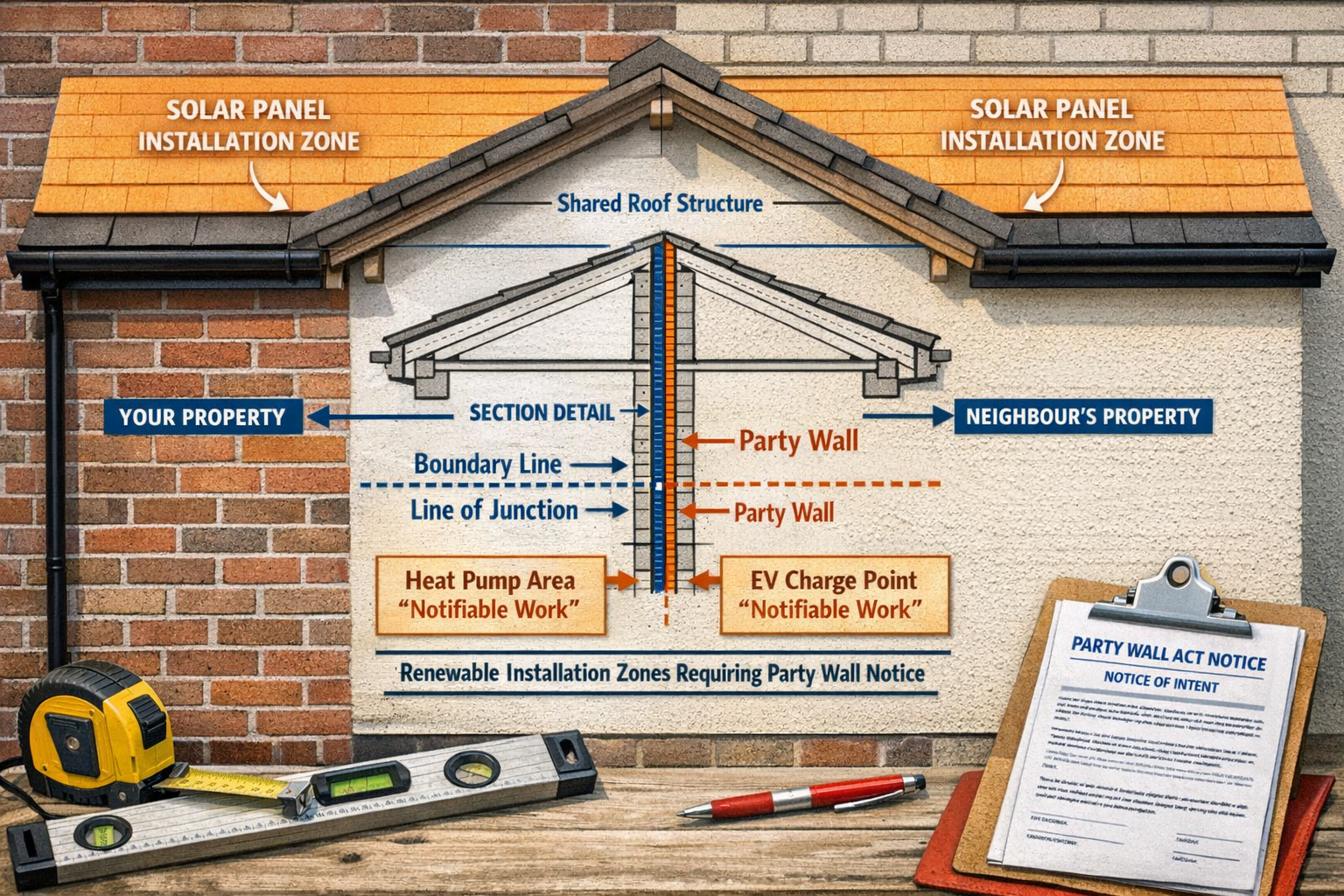
The Party Wall etc. Act 1996 governs construction work affecting shared walls, boundary structures, and excavations near neighboring properties throughout England and Wales. While originally designed for traditional building projects, this legislation increasingly applies to renewable energy retrofits as homeowners install solar panels on shared roofs and heat pumps requiring structural modifications.
What Constitutes a Party Wall in Renewable Energy Projects?
A party wall represents any wall or structure shared between two properties, including:
- Walls separating semi-detached or terraced houses
- Shared roof structures and chimneys
- Boundary walls built astride property lines
- Garden walls positioned on one owner's land but used by both neighbors
For renewable energy installations, the most common party wall scenarios involve solar panels mounted on shared roof structures between semi-detached properties and heat pump units requiring fixings or modifications to party walls[2][6].
When Solar Panel Installations Trigger Party Wall Requirements
Solar panel installations on shared roofs or structures specifically necessitate Party Wall Act compliance when the work involves:
✅ Penetrating or modifying a shared roof structure to install mounting brackets or rails
✅ Adding significant weight to a party wall or shared roof that could affect structural integrity
✅ Installing equipment that transmits vibration or noise through shared structures
✅ Accessing a neighbor's property during installation or maintenance
In the vast majority of residential cases, solar panel installations do not require planning permission if panels are not installed above the highest point of the property, protrude no more than 200mm from the roof surface, and minimize external appearance impacts[2]. However, planning permission and Party Wall Act compliance are separate requirements—even permitted development may still trigger party wall obligations.
As of June 2025, solar panels became a functional requirement of Building Regulations under the Future Homes Standard, with developers required to achieve 40% solar coverage of building floor area where feasible[1]. This regulatory shift has dramatically increased solar installations on shared structures, making party wall compliance more relevant than ever.
Heat Pump Installations and Party Wall Considerations
Heat pumps present unique party wall challenges depending on installation type:
Air-Source Heat Pumps may trigger Party Wall Act requirements when:
- External units are fixed to or positioned against party walls
- Installation requires drilling through shared structures for pipework
- Equipment positioning affects boundary walls or structures
- Noise transmission through party walls becomes a consideration
Ground-Source Heat Pumps frequently require Party Wall Act compliance due to:
- Extensive excavation near property boundaries for ground loop installation
- Trenching within 3-6 meters of neighboring foundations
- Structural work affecting shared underground structures
- Potential subsidence risks from excavation activities[6]
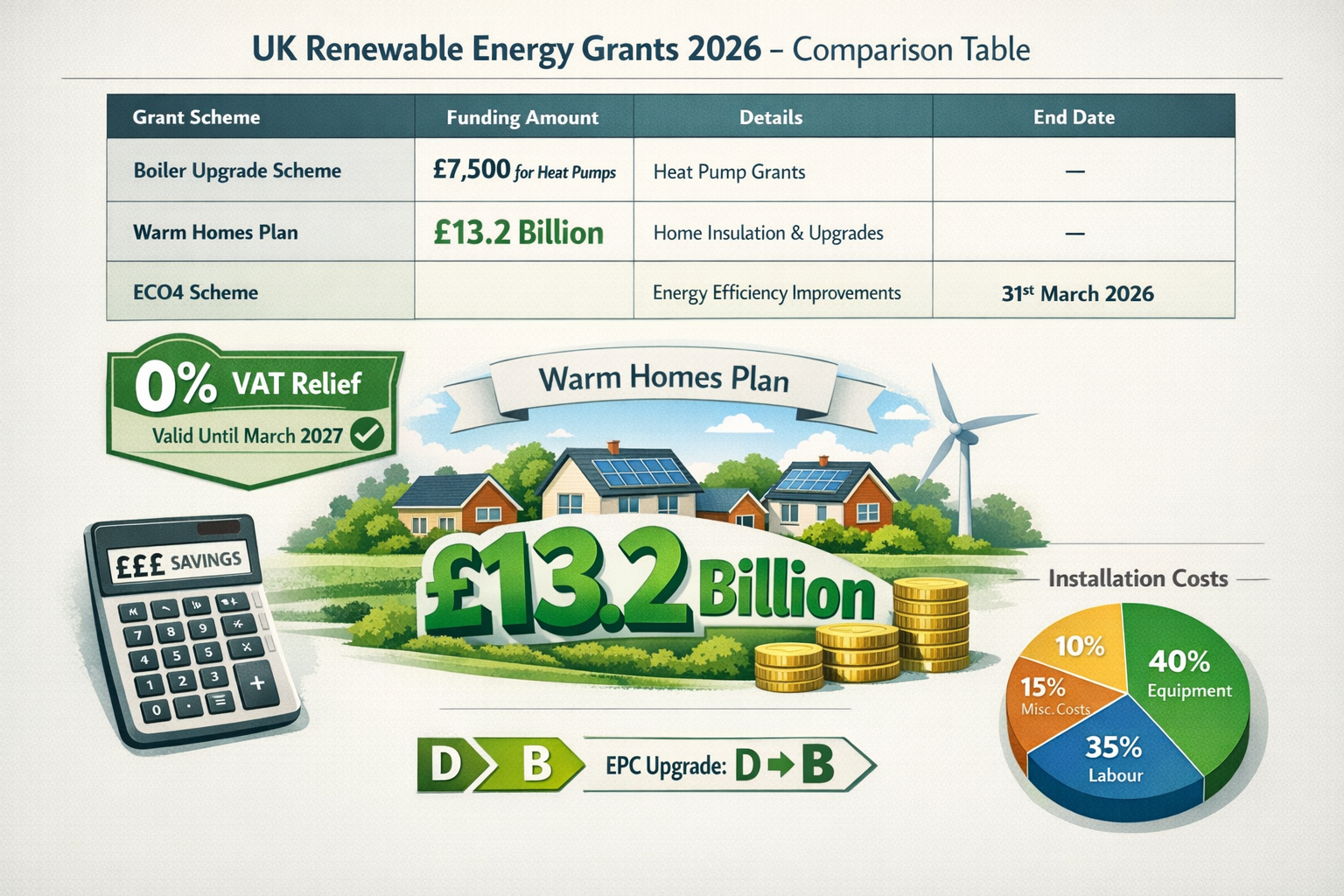
The Boiler Upgrade Scheme (BUS) provides £7,500 grants for air-to-water and ground-source heat pumps (extended to 2030), while air-to-air heat pumps now receive £2,500 grants as of 2026[3]. These generous incentives have accelerated heat pump adoption, but recipients must still comply with all Party Wall Act obligations regardless of grant funding.
For comprehensive guidance on when party wall agreements become legally mandatory, consult our detailed resource on when a party wall agreement is legally required in the UK.
Party Wall Act Essentials for 2026 UK Renewable Energy Retrofits: Notice Requirements and Procedures
Proper notification represents the cornerstone of Party Wall Act compliance. Property owners planning renewable energy installations on shared structures must follow specific procedures to protect both their interests and their neighbors' rights.
The Three Types of Party Wall Notices
The Party Wall Act establishes three distinct notice types, each applicable to different scenarios:
| Notice Type | Application to Renewable Installations | Notice Period |
|---|---|---|
| Party Structure Notice | Solar panels or heat pumps requiring work to existing party walls or shared roofs | 2 months before work begins |
| Line of Junction Notice | New boundary walls or structures for ground-mounted solar arrays | 1 month before work begins |
| Excavation Notice | Ground-source heat pump trenching within 3m (deeper than foundations) or 6m (any depth) of neighbor's structure | 1 month before work begins |
For most residential solar panel and heat pump installations, the Party Structure Notice applies when work affects existing shared structures[6].
Serving a Valid Party Wall Notice for Renewable Installations
A compliant Party Wall Notice must include:
📄 Detailed work description specifying solar panel mounting methods, heat pump unit specifications, and structural modifications
📄 Installation timeline with proposed start date (minimum 2 months from notice service)
📄 Technical drawings or diagrams showing mounting points, fixings, and structural impacts
📄 Building Owner contact information and property details
📄 Clear statement of rights informing neighbors of their response options
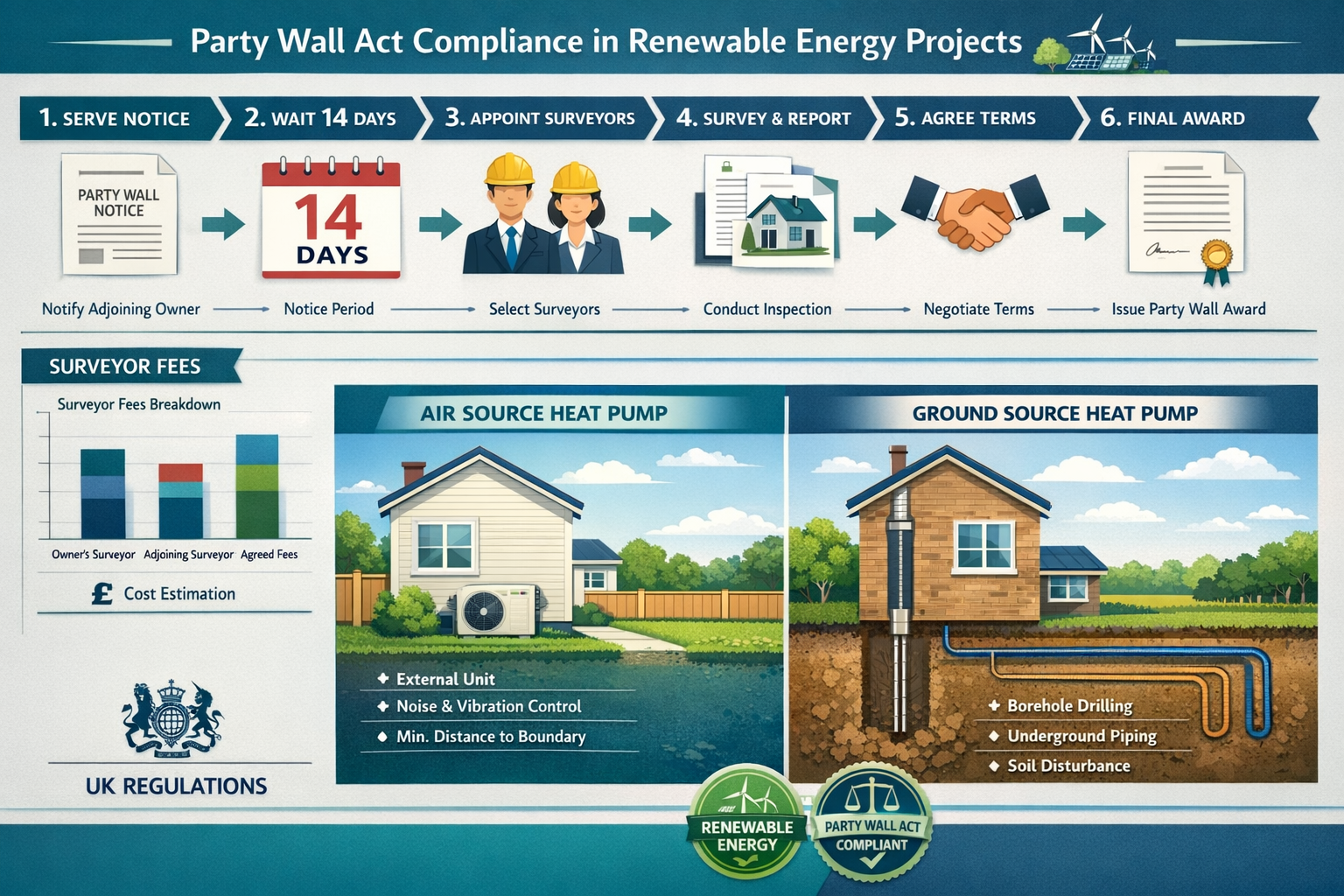
Neighbors have 14 days to respond to a Party Wall Notice with one of three options:
- Consent in writing – Work proceeds without surveyor involvement
- Dissent or no response – Triggers the party wall award process requiring surveyor appointment
- Request modifications – Initiates negotiation about installation methods or conditions
Understanding these response mechanisms helps property owners anticipate potential delays and budget for surveyor fees. Our guide on Party Wall Act notices and how to respond provides detailed information for both Building Owners and Adjoining Owners.
Common Mistakes in Renewable Energy Party Wall Notifications
❌ Serving notice too late – Many homeowners discover party wall requirements only after booking installers, creating costly delays
❌ Insufficient technical detail – Vague descriptions like "installing solar panels" without mounting specifications invite disputes
❌ Assuming neighbor consent – Verbal agreements hold no legal weight under the Party Wall Act
❌ Ignoring excavation requirements – Ground-source heat pump trenching often triggers overlooked excavation notice obligations
❌ Confusing planning permission with party wall compliance – These are separate legal requirements with different procedures
"Specialist planning navigation that DIY can't handle, particularly for listed buildings and conservation areas, becomes essential when combining renewable energy ambitions with party wall obligations."[3]
Professional party wall surveyors help avoid these pitfalls while ensuring installations proceed smoothly. Learn more about what party wall surveyors do and their responsibilities.
Template Party Wall Notice for Solar Panel Installation
While professional guidance remains advisable, a basic Party Wall Notice for solar panel installation should address:
PARTY STRUCTURE NOTICE
To: [Adjoining Owner Name and Address]
From: [Building Owner Name and Address]
Property: [Installation Address]
Date: [Service Date]
Notice is hereby given under Section 2 of the Party Wall etc. Act 1996 that the Building Owner intends to carry out the following works:
Description of Works:
Installation of [number] solar photovoltaic panels on the shared roof structure between [address] and [neighbor's address]. Work involves:
- Mounting [number] aluminum rails to existing roof structure using stainless steel fixings
- Penetrating roof covering at [number] fixing points with weatherproof sealing
- Installing electrical conduit through roof space (not penetrating party wall)
- Total additional weight: approximately [XX] kg distributed across [XX] mounting points
Proposed Start Date: [Date – minimum 2 months from notice service]
Estimated Duration: [Number] days
Technical drawings and specifications are attached. You have 14 days from receipt to provide written consent or dissent to this notice.
[Building Owner Signature and Contact Information]
This template provides a starting point, but complex installations benefit from professional surveyor input to ensure compliance.
Party Wall Act Essentials for 2026 UK Renewable Energy Retrofits: Schedules of Condition and Awards
When neighbors dissent to a Party Wall Notice—or fail to respond within 14 days—the formal party wall award process begins. This procedure protects both property owners through detailed documentation and agreed-upon conditions.
The Role of Schedules of Condition in Renewable Installations
A Schedule of Condition represents a comprehensive photographic and written record of the neighboring property's current state before renewable energy installation begins. This document serves as crucial evidence if disputes arise about installation-related damage.
For solar panel and heat pump installations, Schedules of Condition typically document:
🔍 Roof condition – Existing tiles, flashing, guttering, and structural elements
🔍 Interior ceiling and wall condition – Cracks, staining, or existing defects in rooms below installation areas
🔍 External wall condition – Rendering, brickwork, and finishes near heat pump units
🔍 Foundation and ground condition – Baseline documentation for ground-source heat pump excavations
🔍 Existing party wall state – Cracks, movement, or structural issues predating the work
Professional surveyors create detailed photographic records with date stamps, written descriptions of existing defects, and measurements documenting current conditions. This evidence becomes invaluable if neighbors later claim installation work caused damage that actually predated the project.
Understanding Party Wall Awards for Renewable Energy Projects
A Party Wall Award represents a legally binding document prepared by appointed surveyors that sets out:
- Detailed work specifications and methodologies
- Agreed-upon working hours and access arrangements
- Protective measures to prevent damage
- Dispute resolution procedures
- Cost allocation between parties
- Surveyor fee responsibilities
For renewable energy installations, Party Wall Awards often include specific conditions such as:
✓ Noise limitations for heat pump operation to prevent nuisance
✓ Vibration monitoring during ground-source heat pump excavation
✓ Structural load calculations confirming solar panel weight safety
✓ Access protocols for ongoing maintenance requirements
✓ Reinstatement obligations if equipment removal becomes necessary
The award process typically follows this timeline:
- Surveyor appointment (1-2 weeks after dissent)
- Site inspection and Schedule of Condition (1-2 weeks)
- Award preparation and negotiation (2-4 weeks)
- Award service to both parties (formal delivery)
- 14-day appeal period (either party may challenge)
- Work commencement (after appeal period expires)
This process adds approximately 6-10 weeks to project timelines, making early party wall consideration essential for homeowners planning renewable installations with fixed deadlines or seasonal installation windows.
Our comprehensive guide to understanding party wall awards provides detailed information about this process.
Surveyor Selection and the Agreed Surveyor Option
Property owners facing the party wall award process have two surveyor appointment options:
Option 1: Two Surveyors (Traditional Approach)
- Building Owner appoints their own surveyor
- Adjoining Owner appoints a separate surveyor
- The two surveyors jointly prepare the award
- If they disagree, they appoint a Third Surveyor to resolve disputes
- Cost: Higher due to multiple surveyor fees
Option 2: Agreed Surveyor (Streamlined Approach)
- Both parties jointly appoint a single impartial surveyor
- The Agreed Surveyor acts fairly for both owners
- Single surveyor prepares the award
- Cost: More economical with shared fees
For straightforward renewable energy installations like solar panels or air-source heat pumps, the Agreed Surveyor approach often provides cost-effective compliance. Complex ground-source heat pump projects with extensive excavation may warrant separate surveyor representation.
Finding qualified professionals becomes critical to successful outcomes. Our resource on how to find a reliable party wall surveyor near you helps property owners identify experienced specialists.
Cost Implications and Fee Responsibilities
Party wall surveyor fees for renewable energy installations typically range from:
- Agreed Surveyor: £500-£1,200 for straightforward solar panel installations
- Two Surveyors: £1,500-£3,000+ for complex heat pump projects with excavation
- Schedule of Condition: £300-£600 as a standalone service
Under the Party Wall Act, the Building Owner (person carrying out the work) pays all reasonable surveyor fees, including the Adjoining Owner's surveyor costs if separate surveyors are appointed. This cost allocation applies regardless of whether neighbors consent or dissent.
However, these fees pale in comparison to potential dispute costs. Unresolved party wall conflicts can result in:
- Injunctions halting installation work (legal fees £5,000-£15,000+)
- Damage claims if work proceeds without proper compliance
- Relationship breakdown with neighbors affecting property enjoyment
- Installation delays missing seasonal windows or grant deadlines
For detailed cost breakdowns, see our analysis of who pays for a party wall surveyor.
2026 Government Incentives and Their Party Wall Implications
The UK government has implemented substantial financial incentives to accelerate renewable energy adoption, creating unprecedented demand for solar panels and heat pumps. Understanding how these schemes interact with Party Wall Act requirements helps homeowners maximize benefits while maintaining legal compliance.
Boiler Upgrade Scheme and Party Wall Timing Considerations
The Boiler Upgrade Scheme (BUS) provides generous grants for heat pump installations:
💷 £7,500 for air-to-water heat pumps (extended to 2030)
💷 £7,500 for ground-source heat pumps (extended to 2030)
💷 £2,500 for air-to-air heat pumps (new for 2026)[3]
These grants significantly reduce installation costs, but applicants must coordinate BUS timelines with Party Wall Act procedures:
Critical Timeline Coordination:
- Obtain installer quote (BUS application requirement)
- Serve Party Wall Notice (2 months before installation)
- Submit BUS application (while party wall process proceeds)
- Complete party wall award (if neighbor dissents)
- Schedule installation (only after party wall compliance achieved)
Homeowners who book installations before completing party wall procedures risk losing installation slots or facing rushed compliance that invites disputes. The 2-month notice period for party structure work means planning should begin at least 3 months before desired installation dates to accommodate potential surveyor involvement.
VAT Relief and Cost-Benefit Analysis
Heat pump installations qualify for 0% VAT until March 2027, providing potential savings of £750-£2,000 depending on installation costs[3]. This temporary relief creates urgency for homeowners considering heat pumps, but rushing party wall compliance to meet the March 2027 deadline can prove counterproductive.
Strategic Approach:
- Begin party wall procedures immediately for installations planned before March 2027
- Budget for surveyor fees (£500-£3,000) when calculating VAT savings
- Consider whether VAT deadline justifies potential premium costs for expedited surveyor services
- Remember that party wall disputes can delay projects by 3-6 months, potentially missing the VAT relief window
ECO4 Scheme Conclusion and Warm Homes Plan Transition
The Energy Company Obligation (ECO4) scheme, which provided free or heavily subsidized heat pumps for low-income households, concludes on March 31, 2026[4]. The government's new Warm Homes Plan replaces ECO4 with £13.2-£15 billion funding to support installation of solar panels, heat pumps, batteries, and insulation for households across England, Scotland, and Wales[4][7].
This transition creates a brief window where eligible households may access both schemes, but Party Wall Act compliance remains mandatory regardless of funding source. Grant recipients cannot bypass party wall requirements, and installers working under government schemes must ensure legal compliance.
Future Homes Standard and Solar Panel Requirements
As of June 2025, solar panels became a functional requirement of Building Regulations under the Future Homes Standard, with developers required to achieve 40% solar coverage of building floor area where feasible[1]. This regulatory change affects:
New Build Properties:
- Developers must integrate party wall considerations into design phase
- Shared roof structures in semi-detached and terraced developments require coordinated party wall agreements
- Building Control approval now links to both solar installation and party wall compliance
Existing Properties:
- While not yet mandatory for existing homes, the regulatory direction signals future requirements
- Proactive party wall compliance positions properties for potential future solar mandates
- Energy Performance Certificate (EPC) improvements from solar installations increase property values
The government's target of 450,000 annual heat pump installations by 2030 represents a significant expansion of the heat pump market as part of decarbonization goals[5]. This ambitious target will inevitably increase party wall scenarios as more homeowners retrofit renewable technologies onto shared structures.
For properties requiring insulation alongside renewable installations, our guide to party wall insulation addresses combined compliance scenarios.
Dispute Avoidance Strategies for Renewable Energy Retrofits
Preventing party wall disputes proves far more cost-effective than resolving them. Professional surveyors employ proven strategies to maintain neighborly relations while achieving renewable energy goals.
Pre-Notice Neighbor Engagement
Informal communication before serving formal Party Wall Notices significantly improves outcomes:
Effective Engagement Approach:
- Early conversation – Discuss renewable energy plans before finalizing installer contracts
- Share benefits – Explain noise reduction from heat pumps vs. boilers, or potential shared solar opportunities
- Address concerns proactively – Listen to neighbor worries about noise, aesthetics, or structural impacts
- Provide information – Share installer credentials, equipment specifications, and installation timelines
- Offer transparency – Invite neighbors to review technical plans before formal notice service
This informal engagement doesn't replace formal Party Wall Notice requirements but creates cooperative relationships that facilitate smoother compliance.
Technical Solutions to Common Objections
Professional installers and surveyors can address typical neighbor concerns through technical modifications:
Noise Concerns (Heat Pumps):
- Specify ultra-quiet heat pump models (operating at <35 decibels)
- Position units away from neighbor bedroom windows
- Install acoustic barriers or enclosures
- Agree to operating hour restrictions in Party Wall Award
Visual Impact Concerns (Solar Panels):
- Use low-profile mounting systems minimizing roof protrusion
- Select panels matching roof aesthetics
- Position panels away from party wall sight lines where possible
- Provide visual renderings showing finished appearance
Structural Concerns (Both Technologies):
- Commission structural engineer calculations confirming load safety
- Use non-penetrative mounting alternatives where feasible
- Provide detailed fixing specifications in Party Wall Notice
- Offer structural monitoring during installation
Vibration Concerns (Ground-Source Heat Pumps):
- Specify vibration-isolated excavation equipment
- Agree to vibration monitoring protocols
- Schedule excavation during neighbor-approved hours
- Provide structural protection measures in Party Wall Award
The Role of Professional Party Wall Surveyors
Experienced party wall surveyors bring dispute prevention expertise that DIY approaches cannot match:
✅ Impartial assessment – Surveyors evaluate both owners' interests fairly
✅ Technical knowledge – Understanding renewable technology impacts on structures
✅ Legal compliance – Ensuring notices and awards meet statutory requirements
✅ Negotiation skills – Facilitating agreements between potentially conflicting parties
✅ Documentation standards – Creating defensible records protecting both owners
For complex installations or where neighbor relationships are already strained, early surveyor involvement prevents escalation. Our comprehensive guide to party wall surveyors' roles, costs, and legal requirements explains when professional assistance becomes essential.
When to Consider Proceeding Without a Surveyor
The Party Wall Act allows neighbors to agree without surveyor involvement, potentially saving fees. This approach works best when:
- Installation involves minimal structural impact (e.g., lightweight solar panels on robust shared roof)
- Neighbors have excellent existing relationships
- Both parties understand technical and legal implications
- Written agreement clearly documents all conditions
- Installation timeline allows for potential complications
However, even amicable neighbors benefit from professional guidance for:
- Ground-source heat pump excavations near boundaries
- Installations on older or structurally questionable party walls
- Properties in conservation areas or with listed building status
- Scenarios involving multiple adjoining owners
- High-value properties where damage risks justify professional protection
Our resource on party wall agreements without a surveyor explores this option's benefits and limitations.
Documentation Best Practices
Regardless of surveyor involvement, comprehensive documentation protects all parties:
📸 Photographic evidence – Extensive before-installation images of party walls, roofs, and neighboring property
📸 Written correspondence – Retain all emails, letters, and notices exchanged with neighbors
📸 Technical specifications – File installer credentials, equipment certifications, and structural calculations
📸 Installation records – Document actual work performed, any deviations from plans, and completion dates
📸 Post-installation inspection – Photograph finished installation and neighboring property condition
This documentation proves invaluable if disputes emerge months or years after installation, particularly regarding alleged damage or maintenance access issues.
Special Considerations for Listed Buildings and Conservation Areas
Properties in conservation areas or with listed building status face additional complexity when combining renewable energy retrofits with Party Wall Act compliance.
Enhanced Planning Requirements
While standard residential solar panel installations typically qualify as permitted development, conservation area and listed building locations often require:
- Full planning permission for external alterations including solar panels
- Listed building consent for any work affecting the building's character
- Conservation area approval for heat pump units visible from public spaces
- Heritage impact assessments demonstrating minimal visual impact
These requirements operate in addition to Party Wall Act obligations, creating multiple approval pathways that must be coordinated.
Specialist Surveyor Selection
Party wall surveyors working on heritage properties require additional expertise:
- Understanding of traditional construction methods and materials
- Experience with conservation officer requirements
- Knowledge of heritage-sensitive installation techniques
- Relationships with specialist renewable installers familiar with listed buildings
The intersection of renewable energy mandates and heritage protection creates unique challenges where "specialist planning navigation that DIY can't handle" becomes particularly relevant[3].
Alternative Technologies for Sensitive Properties
When standard solar panels or heat pumps prove incompatible with heritage requirements, alternatives include:
- Solar tiles integrating photovoltaics into traditional roofing materials
- Ground-mounted solar arrays positioned away from party walls (requiring different party wall considerations)
- Internal wall-mounted heat pumps minimizing external visual impact
- Shared renewable systems where multiple properties jointly invest in community installations
These alternatives may still trigger Party Wall Act requirements but can satisfy both energy efficiency goals and heritage protection obligations.
Conclusion
The Party Wall Act Essentials for 2026 UK Renewable Energy Retrofits: Solar Panels and Heat Pumps on Shared Walls represent a critical knowledge area as the UK accelerates toward net zero targets. With solar panels becoming a Building Regulations requirement and government grants totaling billions supporting heat pump adoption, understanding the intersection of renewable energy ambitions and party wall legislation has never been more important.
Key action steps for homeowners planning renewable energy retrofits:
- Assess party wall implications early – Identify shared structures affected by planned installations at least 3 months before desired installation dates
- Serve proper notices – Follow Party Wall Act procedures with detailed technical specifications and appropriate notice periods
- Engage neighbors proactively – Informal communication before formal notices improves cooperation and reduces dispute risks
- Budget for compliance costs – Include surveyor fees (£500-£3,000+) in project budgets alongside installation and grant application expenses
- Coordinate timelines – Align party wall procedures with government grant deadlines, VAT relief windows, and seasonal installation considerations
- Engage professional surveyors – Complex installations, difficult neighbor relationships, or heritage properties benefit from expert guidance
- Document comprehensively – Create detailed photographic and written records protecting all parties
The generous government incentives available in 2026—including £7,500 heat pump grants, 0% VAT relief until March 2027, and the £13.2 billion Warm Homes Plan—make renewable energy retrofits financially attractive. However, these benefits must be pursued within proper legal frameworks, with Party Wall Act compliance forming an essential component of successful projects.
Professional party wall surveyors provide invaluable expertise navigating notices, schedules of condition, and awards for boundary installations. Their guidance prevents disputes that could delay or derail renewable energy projects while protecting both Building Owners and Adjoining Owners through proper documentation and agreed-upon conditions.
As the UK government targets 450,000 annual heat pump installations by 2030 and solar panels become increasingly mandatory under Building Regulations, the volume of renewable energy installations affecting party walls will continue rising. Property owners who understand and proactively address Party Wall Act requirements position themselves for smooth, dispute-free installations that contribute to national decarbonization goals while maintaining positive neighbor relationships.
For expert guidance on your specific renewable energy retrofit project, consult qualified party wall surveyors who understand both the technical requirements of modern installations and the legal frameworks protecting all property owners. The investment in professional compliance pays dividends through avoided disputes, protected property values, and successful renewable energy implementations.
References
[1] Future Homes Standard – https://home-energy-model.co.uk/future-homes-standard/
[2] Solar Panel Building Regulations – https://www.renewableenergyhub.co.uk/main/solar-panels/solar-panel-building-regulations
[3] Uk Heat Pump Grants 2026 – https://www.yooparchitects.co.uk/eco-friendly-homes/uk-heat-pump-grants-2026/
[4] Extending The Eco4 End Date Consultation Document Accessible Webpage – https://www.gov.uk/government/consultations/extending-the-eco4-end-date/extending-the-eco4-end-date-consultation-document-accessible-webpage
[5] Prs Homes Energy Performance Government Response – https://assets.publishing.service.gov.uk/media/69722b193f2908a349040547/prs-homes-energy-performance-government-response.pdf
[6] Party Wall Surveys For Data Centre Expansions Navigating Agreements In The 2026 Investment Surge – https://nottinghillsurveyors.com/blog/party-wall-surveys-for-data-centre-expansions-navigating-agreements-in-the-2026-investment-surge
[7] Government Reforms Energy Performance Buildings Regime And Raises Minimum Energy – https://www.osborneclarke.com/insights/government-reforms-energy-performance-buildings-regime-and-raises-minimum-energy
