
As the UK accelerates toward net zero carbon emissions, homeowners across the country are embracing renewable energy technologies like never before. Solar panels glisten on rooftops from Cornwall to Scotland, while heat pumps hum quietly outside terraced houses in every major city. Yet amid this green revolution, many property owners overlook a critical legal requirement that could derail their eco-friendly ambitions: the Party Wall Act 1996.
Understanding Party Wall Act Essentials for 2026 UK Renewable Energy Retrofits: Solar Panels and Heat Pumps on Shared Walls has become increasingly important as government incentives drive unprecedented demand for sustainable home improvements. With the Boiler Upgrade Scheme extended through 2030 and new regulations reshaping the retrofit landscape, navigating party wall requirements alongside renewable installations requires careful planning, proper documentation, and professional guidance.
Key Takeaways
🔑 Solar panels and heat pumps on shared structures typically require Party Wall Act compliance, including formal notices served at least two months before work begins.
🔑 The 2026 regulatory landscape simplifies heat pump installations by removing mandatory insulation prerequisites, but party wall obligations remain unchanged and critical.
🔑 Professional surveyors play an essential role in documenting pre-installation conditions, preventing disputes, and ensuring legal compliance for boundary-adjacent renewable energy works.
🔑 Proper notice procedures and schedules of condition protect both building owners and neighbours, creating clear records that prevent costly disagreements during and after installation.
🔑 Government grants worth up to £7,500 for heat pumps make 2026 an ideal time to retrofit, but budget planning must account for potential party wall surveyor costs alongside installation expenses.
Understanding the Party Wall Act Framework for Renewable Energy Projects
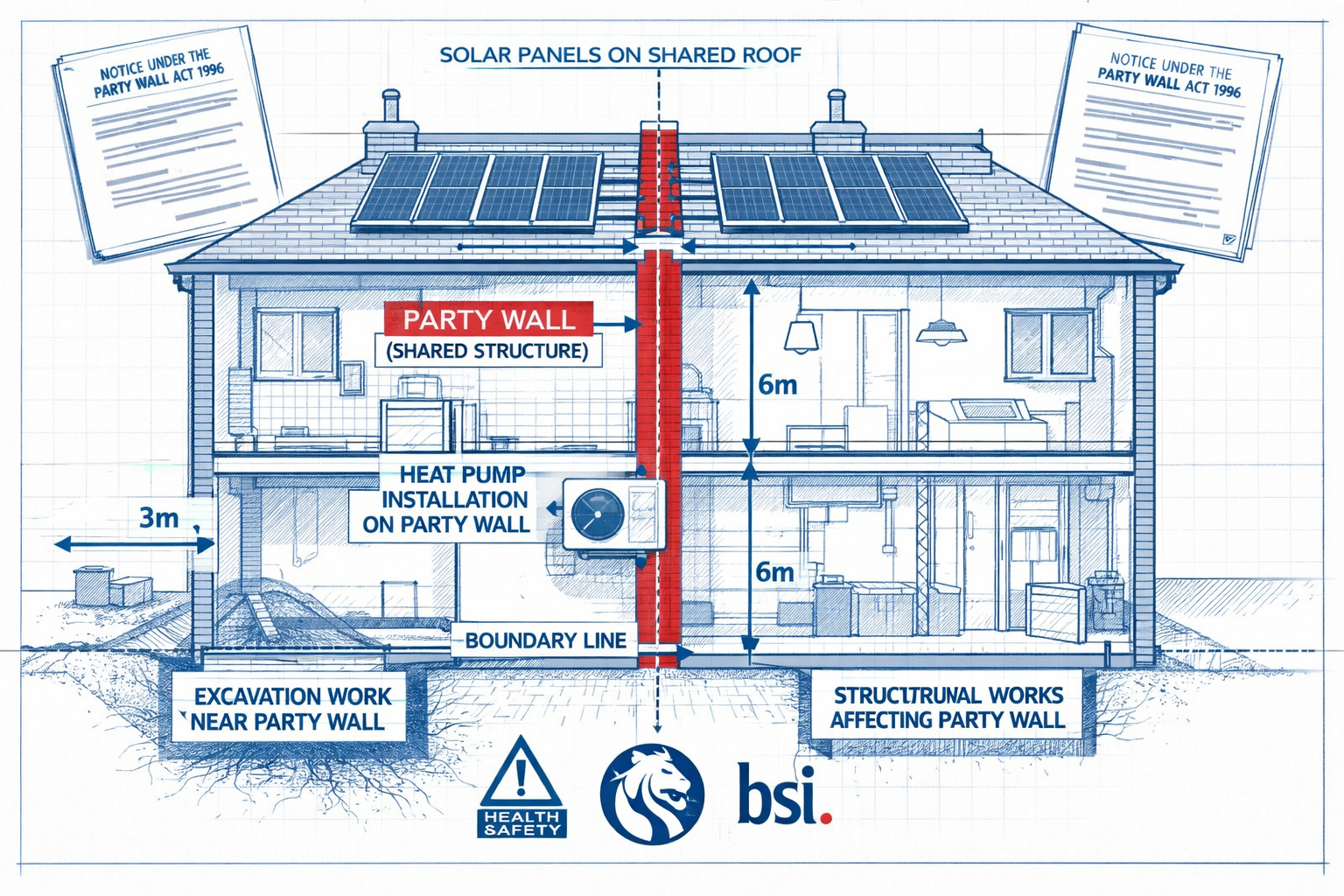
The Party Wall Act 1996 establishes clear procedures for building work affecting shared walls, boundaries, and structures between properties. While originally designed for traditional construction activities like extensions and loft conversions, this legislation applies equally to modern renewable energy installations when they impact party structures.
What Constitutes a Party Wall in Renewable Energy Context
A party wall represents any wall or structure shared between two properties, including:
- Walls separating semi-detached or terraced houses
- Shared garden walls between properties
- Floor and ceiling structures in converted flats
- Boundary walls built astride the property line
For renewable energy retrofits, party wall considerations extend beyond the obvious shared walls. Solar panel installations on shared roofs or walls specifically require Party Wall Act navigation[6], as mounting brackets, wiring conduits, and structural modifications directly affect the party structure.
Similarly, heat pump installations frequently trigger party wall requirements. External air-source units mounted on party walls, ground-source systems requiring excavation within three metres of neighbouring foundations, and pipework penetrating shared structures all fall within the Act's scope.
The Three Types of Party Wall Notices Relevant to Green Retrofits
The Party Wall Act defines three distinct notice types, each applicable to different renewable energy scenarios:
1. Party Structure Notice
Required when work directly affects the party wall itself, such as:
- Installing solar panel mounting brackets through shared roof structures
- Attaching heat pump units to party walls
- Running electrical conduits or refrigerant pipes through shared walls
- Strengthening party walls to support additional equipment weight
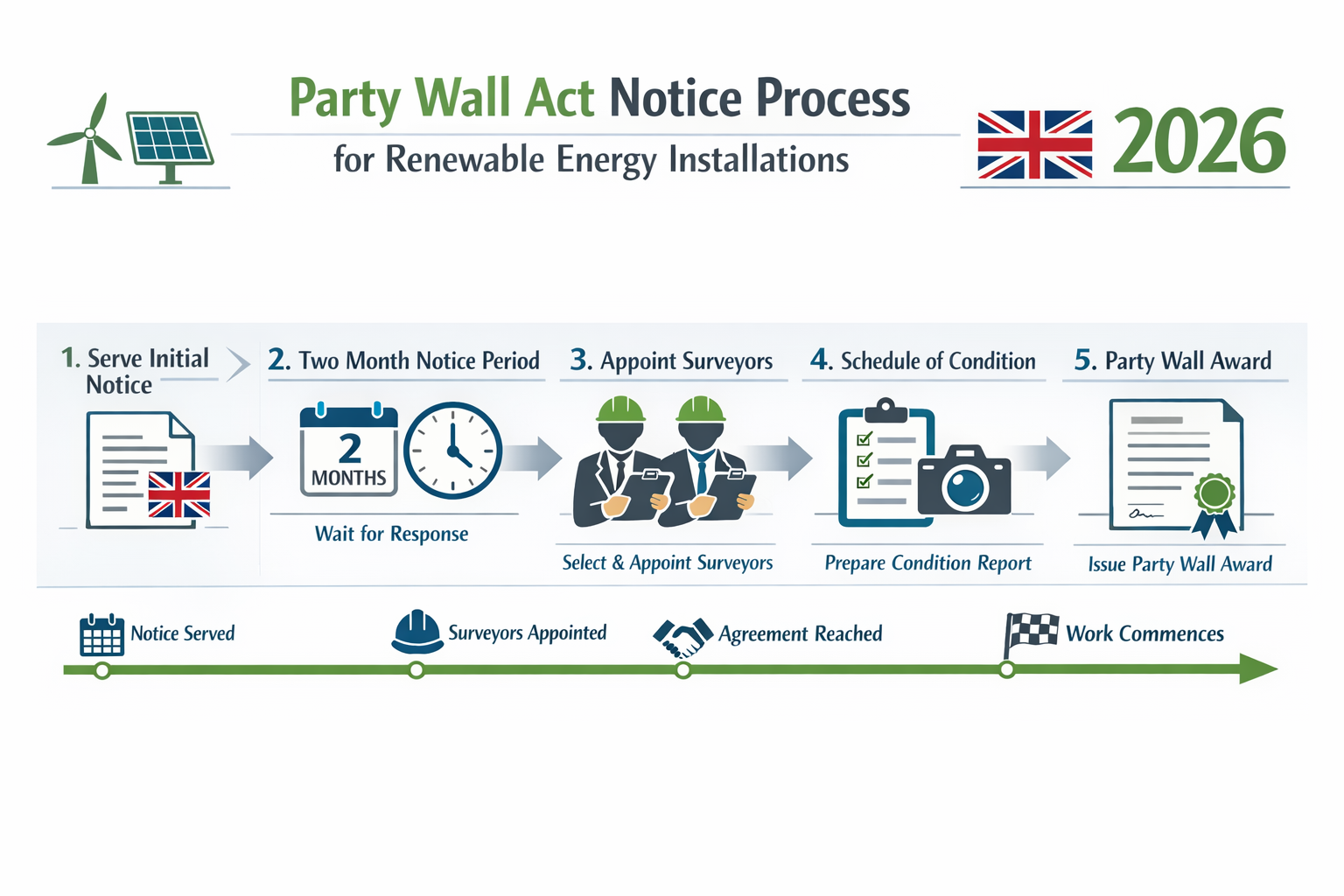
This notice must be served at least two months before work commences, giving neighbours adequate time to review proposals and appoint surveyors if needed.
2. Line of Junction Notice
Applicable when building new walls or structures at the boundary line, which might include:
- Constructing dedicated support structures for ground-mounted solar arrays along property boundaries
- Building enclosures for heat pump equipment at boundary lines
- Installing new boundary walls incorporating renewable energy infrastructure
This notice requires one month's advance notification to adjoining owners.
3. Three-Metre Notice
Triggered when excavation for ground-source heat pumps occurs within three metres of neighbouring structures and extends below their foundation level. This notice protects neighbours from potential subsidence or structural damage caused by nearby excavation work.
For comprehensive guidance on these notice types, consult our detailed resource on understanding party structure notices.
Party Wall Act Essentials for Solar Panel Installations on Shared Structures
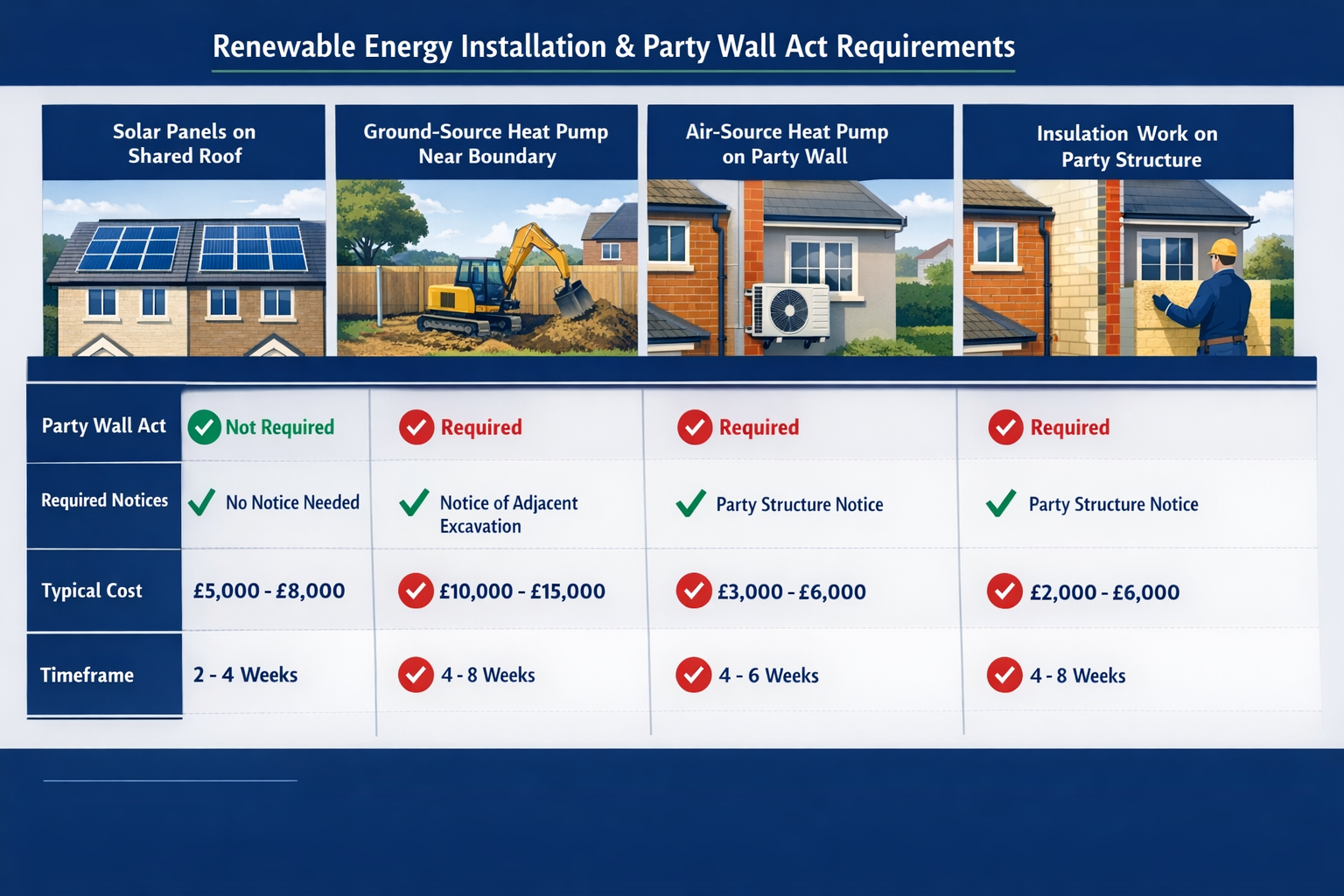
Solar photovoltaic systems represent one of the most popular renewable energy retrofits in 2026, with thousands of UK homeowners installing panels monthly. However, if your solar panel installation involves work on a shared or party wall, you may need to comply with the Party Wall Act, which might require notifying your neighbor and obtaining their consent[2].
When Solar Panels Trigger Party Wall Requirements
Not all solar installations require party wall procedures. Panels mounted exclusively on your own roof section, with no penetrations or structural modifications affecting shared elements, typically fall outside the Act's scope. However, several common scenarios demand compliance:
Shared Roof Structures 🏠
Terraced houses and semi-detached properties often share roof structures, including:
- Common rafters or trusses spanning both properties
- Shared ridge beams or purlins
- Party wall chimney stacks used for mounting
- Communal parapet walls on flat roofs
Installing mounting rails, drilling fixings, or adding structural reinforcement to these shared elements constitutes notifiable work under the Party Wall Act.
Wiring and Conduit Penetrations
Running cables from rooftop panels to internal inverters frequently requires drilling through party walls or shared roof spaces. Each penetration, regardless of size, technically affects the party structure and should be documented in party wall procedures.
Weight Loading Considerations
Solar panels add significant weight to roof structures—typically 10-15 kg per square metre. If structural engineers determine that party walls or shared roof supports require strengthening to accommodate this additional load, formal party wall procedures become mandatory.
The Solar Panel Party Wall Process: Step-by-Step
Step 1: Obtain Professional Assessments (Weeks 1-2)
Before serving any notices, commission both:
- A solar panel roof engineer calculation to confirm structural adequacy
- A party wall surveyor consultation to determine whether party wall procedures apply
Step 2: Prepare and Serve Party Structure Notice (Week 3)
If party wall work is confirmed, prepare a detailed notice including:
- Precise description of proposed solar installation
- Technical drawings showing mounting locations
- Structural calculations and load assessments
- Proposed start date (minimum two months ahead)
- Building owner's contact details
For guidance on proper notice preparation, review our guide on how to write a party wall letter.
Step 3: Neighbour Response Period (Weeks 4-6)
Neighbours have 14 days to respond with either:
- Consent: Work may proceed without further formality (though a schedule of condition remains advisable)
- Dissent or no response: Triggers the party wall award process requiring surveyor appointment
Step 4: Surveyor Appointment and Schedule of Condition (Weeks 7-10)
If neighbours dissent or fail to respond, both parties appoint surveyors (or agree to share a single "agreed surveyor"). Surveyors then:
- Conduct pre-work inspections of both properties
- Photograph existing conditions thoroughly
- Document any pre-existing cracks, defects, or concerns
- Prepare detailed schedules of condition
Step 5: Party Wall Award Issuance (Weeks 11-12)
Surveyors draft and serve a party wall award, which legally authorizes the work and establishes:
- Specific work permitted
- Working hours and access arrangements
- Protective measures required
- Dispute resolution procedures
- Cost allocation for surveyor fees
Step 6: Installation and Post-Work Inspection (Weeks 13+)
Following installation completion, surveyors conduct final inspections to verify no damage occurred to neighbouring properties and confirm compliance with award terms.
Cost Implications for Solar Panel Party Wall Compliance
Understanding the financial aspects of party wall compliance helps homeowners budget accurately. While party wall surveyor costs vary based on project complexity and location, typical fees for solar panel installations include:
| Service | Typical Cost Range |
|---|---|
| Initial consultation | £150-£300 |
| Party structure notice preparation | £200-£400 |
| Schedule of condition (per property) | £400-£800 |
| Party wall award preparation | £600-£1,200 |
| Post-installation inspection | £200-£400 |
| Total estimated cost | £1,550-£3,100 |
The building owner (person undertaking the work) typically bears all reasonable surveyor costs, including fees for the neighbour's appointed surveyor. This represents an important budgeting consideration when planning solar retrofits.
Heat Pump Installations and Party Wall Act Compliance in 2026
Heat pumps have surged in popularity following government policy changes that make them more accessible than ever. The removal of strict insulation requirements from 2026 onwards means homeowners can now access heat pump grants without clearing all recommended insulation upgrades first[3], significantly streamlining the retrofit process.
With the Boiler Upgrade Scheme providing £7,500 grants for air-to-water and ground-source heat pumps extended through 2030[3], thousands of UK homeowners are planning installations. However, party wall considerations remain a critical planning element that cannot be overlooked.
Air-Source Heat Pumps on Party Walls
Air-source heat pumps (ASHPs) extract heat from outdoor air using external units typically mounted on walls or placed on ground stands. When these installations affect party structures, specific party wall procedures apply.
Wall-Mounted Units
Fixing ASHP units directly to party walls requires Party Structure Notice procedures, as:
- Bracket fixings penetrate and load the shared structure
- Vibration from compressor operation affects both properties
- Refrigerant and electrical pipework may penetrate party walls
- Weight loading (units typically weigh 40-100 kg) impacts structural integrity
Noise and Vibration Considerations
While not strictly party wall matters, noise and vibration from heat pumps can trigger disputes. Modern units operate at 40-60 decibels, roughly equivalent to normal conversation levels. However, low-frequency vibration transmitted through party walls sometimes causes neighbour complaints.
Proactive measures include:
- Anti-vibration mounting brackets specified in party wall awards
- Acoustic insulation around penetrations through party walls
- Strategic positioning away from neighbour bedrooms where possible
- Timer controls limiting nighttime operation
Ground-Source Heat Pumps and Excavation Requirements
Ground-source heat pumps (GSHPs) extract heat from the earth through buried collector loops, requiring significant excavation. Ground-source heat pumps requiring extensive excavation near boundaries may trigger Party Wall Act considerations[6], particularly when trenches or boreholes approach neighbouring foundations.
Three-Metre Rule Application
The Party Wall Act's three-metre notice becomes relevant when:
- Horizontal ground loops require trenches within three metres of neighbouring buildings
- Excavation depth extends below neighbour foundation levels
- Vertical boreholes penetrate ground within three metres of boundaries
Even when excavation remains outside the three-metre zone, considerate practice involves informal neighbour notification and professional surveys to document pre-existing ground conditions.
Vertical Borehole Considerations
Vertical GSHP systems drill boreholes 50-200 metres deep, typically positioned closer to buildings than horizontal loops. Party wall surveyors should coordinate with drilling contractors to ensure:
- Borehole locations maintain adequate clearance from boundaries
- Ground stability assessments confirm no subsidence risk to neighbours
- Drilling vibration won't damage neighbouring structures
- Groundwater flow changes won't affect neighbour foundations
Shared Heating Systems in Converted Properties
Flats and maisonettes present unique party wall challenges for heat pump retrofits. Converting communal gas heating to individual heat pumps involves:
- Removing shared boiler systems and flues
- Installing individual external units on party walls or shared building exteriors
- Running new pipework through party structures
- Potentially strengthening party walls or floors to support equipment
These complex scenarios require specialist party wall surveyors with experience in multi-occupancy buildings and renewable energy systems.
Navigating Party Wall Disputes and Avoiding Common Pitfalls
Even with careful planning, party wall matters sometimes lead to disagreements. Understanding common dispute triggers and resolution mechanisms helps homeowners navigate challenges effectively.
Common Dispute Scenarios in Renewable Energy Retrofits
Aesthetic Objections
Neighbours may object to visible solar panels or heat pump units on aesthetic grounds. However, the Party Wall Act addresses structural and procedural matters only—not aesthetics. Planning permission and permitted development rights govern visual impacts separately.
If neighbours raise aesthetic concerns during party wall procedures, consider:
- Exploring alternative equipment positioning that satisfies both parties
- Providing detailed visualizations showing minimal visual impact
- Highlighting property value benefits from renewable energy installations
- Emphasizing that aesthetic preferences cannot legally prevent compliant work
Noise and Disturbance Fears
Neighbours often worry about ongoing noise from heat pumps or disruption during solar installation. Party wall awards can address these concerns by:
- Specifying maximum noise levels for installed equipment
- Establishing working hours for installation activities
- Requiring advance notice of particularly disruptive work phases
- Mandating acoustic testing post-installation to verify compliance
Property Value Concerns
Some neighbours fear renewable installations might devalue their properties. Evidence suggests the opposite—properties with renewable energy typically command price premiums. Party wall surveyors can include expert valuation evidence in awards to address these concerns.
The Role of Professional Surveyors in Dispute Prevention
Engaging qualified party wall surveyors early prevents most disputes from escalating. Professional surveyors provide:
✅ Impartial technical expertise separating legitimate concerns from unfounded objections
✅ Detailed documentation creating clear records that prevent "he said, she said" disagreements
✅ Mediation skills helping neighbours reach mutually acceptable solutions
✅ Legal compliance assurance ensuring all procedures follow statutory requirements
✅ Cost certainty through transparent fee structures and clear award terms
For London-based projects, consider consulting experienced party wall surveyors in London who understand local property types and renewable energy installation patterns.
What Happens When Neighbours Refuse Party Wall Agreements?
A common misconception holds that neighbours can block renewable energy projects by refusing party wall consent. In reality, neighbours cannot legally refuse a party wall agreement for work you have the right to undertake.
When neighbours dissent or fail to respond to party wall notices:
- Deemed dissent occurs after 14 days of silence, triggering automatic surveyor appointment procedures
- Building owners appoint their surveyor, who then contacts neighbours to facilitate their surveyor appointment
- If neighbours refuse to appoint a surveyor, the building owner's surveyor can appoint one on their behalf
- The two surveyors (or agreed surveyor) prepare a party wall award authorizing the work with appropriate safeguards
- Work proceeds under award terms regardless of neighbour objections, provided all statutory procedures are followed
This mechanism ensures legitimate building work isn't blocked by unreasonable refusals while protecting neighbour interests through professional surveyor oversight.
For complex disputes, review our comprehensive guide on party wall dispute resolution.
Special Considerations for Conservation Areas and Listed Buildings
The 2026 renewable energy landscape includes special challenges for historic and protected properties. Properties in conservation areas or listed buildings require specialist planning navigation for renewable energy installations[3], with party wall considerations adding another layer of complexity.
Listed Building Consent and Party Wall Procedures
Listed buildings require Listed Building Consent for alterations affecting character or appearance, including many renewable energy installations. When listed buildings share party walls, homeowners must navigate:
Dual Approval Processes
- Planning/Listed Building Consent from local planning authorities for the renewable installation itself
- Party Wall Act compliance for works affecting shared structures
- Building Regulations approval for electrical and structural work
These processes run in parallel but independently. Party wall procedures cannot commence until planning consent is secured, as notices must describe approved works accurately.
Heritage-Sensitive Installation Methods
Party wall awards for listed buildings should specify:
- Reversible fixing methods that don't permanently damage historic fabric
- Traditional materials matching existing construction where appropriate
- Specialist contractors experienced in heritage building work
- Enhanced schedules of condition documenting historic features in detail
Conservation Area Considerations
Conservation areas impose planning restrictions on external alterations visible from public viewpoints. Solar panels on front-facing roofs or prominent heat pump units may require planning permission despite normally falling under permitted development rights.
Party wall procedures in conservation areas should:
- Confirm planning status before serving notices
- Include heritage impact assessments in supporting documentation
- Specify installation methods protecting architectural character
- Coordinate with conservation officers where necessary
Templates and Documentation for Renewable Energy Party Wall Procedures
Proper documentation forms the foundation of successful party wall compliance. While professional surveyors handle formal documents, understanding key templates helps homeowners prepare effectively.
Essential Documents for Solar Panel and Heat Pump Projects
1. Party Structure Notice Template
A compliant party structure notice for renewable installations should include:
PARTY WALL etc. ACT 1996
PARTY STRUCTURE NOTICE

To: [Neighbour name and address]
From: [Building owner name and address]

Property address: [Installation address]

I/We hereby give you notice of my/our intention to carry out the following works:

Installation of [X number] solar photovoltaic panels on the shared roof structure, including:
- Mounting rail fixings penetrating shared rafters at [specific locations]
- Electrical conduit through party wall at [location]
- Structural reinforcement to [specific party wall elements]

OR

Installation of [air-source/ground-source] heat pump system, including:
- External unit mounted on party wall at [location]
- Refrigerant pipework penetrating party wall at [location]
- Ground excavation within [X] metres of property boundary

Technical drawings and structural calculations are attached.

Proposed start date: [Date - minimum 2 months ahead]

You have 14 days from service of this notice to consent or dissent...
2. Schedule of Condition Template
Pre-installation schedules should document:
| Room/Area | Existing Condition | Photographic Evidence | Notes |
|---|---|---|---|
| Neighbour loft space | Minor crack in plaster, NE corner | Photos 1-3 | Pre-existing, not related to proposed work |
| Party wall (internal) | Good condition, recent decoration | Photos 4-7 | No defects noted |
| External party wall | Slight mortar erosion, top course | Photos 8-10 | Recommend repointing post-installation |
3. Method Statement for Renewable Installations
Party wall awards typically incorporate detailed method statements covering:
- Equipment specifications (panel types, heat pump models)
- Installation sequence and timeline
- Protective measures for neighbouring property
- Access requirements and working hours
- Noise and vibration control measures
- Emergency contact procedures
Digital Tools and Resources for 2026
Modern party wall procedures increasingly leverage digital documentation:
📱 Photographic apps with GPS tagging and timestamp verification for schedule of condition evidence
📊 Collaborative platforms allowing surveyors, contractors, and homeowners to share documents securely
🎥 Video walkthroughs supplementing still photography for comprehensive condition recording
📋 Digital signature tools expediting notice service and consent documentation
These technologies enhance accuracy and accessibility while maintaining legal compliance with traditional party wall procedures.
Coordinating Party Wall Compliance with Government Grant Schemes
The 2026 renewable energy incentive landscape creates opportunities to align party wall procedures with grant applications, optimizing both timelines and costs.
Boiler Upgrade Scheme Timeline Coordination
The Boiler Upgrade Scheme provides £7,500 grants for eligible heat pump installations, with applications processed within weeks. However, party wall procedures require minimum two-month notice periods, creating potential timing conflicts.
Recommended Timeline Integration:
Months 1-2: Research heat pump options, obtain quotes, commission party wall surveyor consultation
Month 3: Submit Boiler Upgrade Scheme application AND serve party wall notices simultaneously
Months 4-5: BUS application processes while party wall notice period elapses; surveyors conduct inspections and prepare awards
Month 6: Receive BUS voucher code and party wall award; schedule installation
Month 7: Complete installation with both grant funding and party wall compliance secured
This coordinated approach prevents delays while maximizing available funding.
ECO4 and Local Authority Schemes
The ECO4 scheme, extended through 2026[4], provides funding for low-income households to install energy efficiency measures including heat pumps. Local authorities also offer various renewable energy grants with differing eligibility criteria and application processes.
When combining these schemes with party wall procedures:
✓ Disclose party wall requirements to grant administrators during application, as some schemes may provide additional funding for associated costs
✓ Coordinate surveyor appointments with grant-funded installer site visits to minimize disruption
✓ Request party wall cost estimates early to include in total project budgets for grant applications
✓ Maintain clear documentation showing party wall compliance, as some grant schemes audit installation procedures
Future-Proofing: Party Wall Considerations for Emerging Technologies
As renewable energy technology evolves, new party wall considerations emerge. Forward-thinking homeowners should anticipate:
Battery Storage Systems
Home battery systems storing solar-generated electricity increasingly accompany panel installations. When batteries mount in lofts, garages, or external enclosures adjacent to party walls, additional party wall considerations include:
- Weight loading on party floors or walls
- Fire safety measures specified in party wall awards
- Electrical penetrations through party structures
- Thermal management systems affecting party walls
Community Energy Projects
Shared renewable energy systems serving multiple properties require complex party wall arrangements addressing:
- Joint ownership of equipment mounted on party structures
- Shared maintenance access through multiple properties
- Cost allocation for party wall procedures across multiple building owners
- Long-term management agreements incorporated into party wall awards
Retrofit Coordination in Terraced Rows
When multiple adjoining properties plan simultaneous renewable retrofits, coordinated party wall procedures can reduce costs and complexity through:
- Single agreed surveyor serving multiple properties
- Combined schedules of condition documenting entire terraced row
- Shared installation timelines minimizing total disruption
- Proportional cost allocation among participating owners
Conclusion
The convergence of ambitious net zero targets, generous government incentives, and mature renewable energy technologies makes 2026 a pivotal year for UK home retrofits. Yet successful solar panel and heat pump installations on properties with shared walls demand more than technical expertise and financial planning—they require thorough understanding and compliance with Party Wall Act procedures.
Party Wall Act Essentials for 2026 UK Renewable Energy Retrofits: Solar Panels and Heat Pumps on Shared Walls encompass proper notice procedures, professional surveyor engagement, comprehensive condition documentation, and proactive dispute prevention. These elements protect both building owners pursuing sustainable improvements and neighbours whose properties adjoin the work.
Your Action Plan for Party Wall-Compliant Renewable Retrofits
Immediate Steps (This Month):
- Assess your property type and party wall situation by identifying shared structures that might be affected by renewable installations
- Consult a qualified party wall surveyor to determine whether your planned solar or heat pump project triggers Party Wall Act requirements
- Research available grants including the Boiler Upgrade Scheme and local authority programs, noting application deadlines
Short-Term Actions (Next 1-3 Months):
- Obtain technical assessments from renewable energy installers and structural engineers to inform party wall notices
- Prepare and serve party wall notices if required, allowing adequate time for the mandatory notice periods
- Submit grant applications coordinating timelines with party wall procedures
- Engage professional surveyors to prepare schedules of condition and party wall awards
Long-Term Planning (3-6 Months):
- Coordinate installation scheduling once party wall awards are issued and grant funding secured
- Maintain open communication with neighbours throughout the installation process
- Complete post-installation inspections with party wall surveyors to document final conditions and close out procedures
The path to a greener, more energy-efficient home need not be complicated by party wall requirements. With proper planning, professional guidance, and adherence to established procedures, homeowners can navigate both renewable energy retrofits and party wall compliance smoothly—protecting relationships with neighbours while advancing toward net zero.
For expert assistance with party wall matters related to your renewable energy project, consult experienced professionals who understand both the technical and legal dimensions of these increasingly common installations. The investment in proper party wall compliance pays dividends through dispute prevention, legal protection, and peace of mind as you transform your property for a sustainable future.
References
[1] Future Homes Standard – https://home-energy-model.co.uk/future-homes-standard/
[2] Solar Panel Building Regulations – https://www.renewableenergyhub.co.uk/main/solar-panels/solar-panel-building-regulations
[3] Uk Heat Pump Grants 2026 – https://www.yooparchitects.co.uk/eco-friendly-homes/uk-heat-pump-grants-2026/
[4] Extending The Eco4 End Date Consultation Document Accessible Webpage – https://www.gov.uk/government/consultations/extending-the-eco4-end-date/extending-the-eco4-end-date-consultation-document-accessible-webpage
[5] Prs Homes Energy Performance Government Response – https://assets.publishing.service.gov.uk/media/69722b193f2908a349040547/prs-homes-energy-performance-government-response.pdf
[6] Party Wall Surveys For Data Centre Expansions Navigating Agreements In The 2026 Investment Surge – https://nottinghillsurveyors.com/blog/party-wall-surveys-for-data-centre-expansions-navigating-agreements-in-the-2026-investment-surge
