
{"cover":"Professional landscape format (1536×1024) editorial hero image featuring bold text overlay 'Building Surveys for Office-to-Resi Conversions in 2026: Structural Risks & Value Opportunities' in extra large 72pt white sans-serif font with dark gradient shadow, positioned in upper third with perfect alignment. Background shows dramatic split-screen composition: left side displays modern office building exterior with large windows and commercial facade, right side shows same building transformed into contemporary residential apartments with balconies and warm interior lighting visible through windows. Foreground includes surveyor with clipboard and tablet examining structural plans, hard hat visible. Color palette: deep navy blue, warm amber lighting, white text, professional contrast. High-quality architectural photography style, magazine cover aesthetic, rule of thirds composition, crystal clear text readability, 2026 recovery theme emphasized through renovation imagery and professional surveying equipment.","content":["Detailed landscape format (1536×1024) image showing comprehensive building survey checklist for office-to-residential conversion. Split composition: left side displays cross-section architectural diagram of office building highlighting key structural elements including floor loadings, ceiling heights, window placements, core locations, and foundation systems with red warning indicators on potential risk areas. Right side shows professional surveyor conducting inspection with thermal imaging camera revealing hidden defects, moisture meters testing walls, and tablet displaying digital survey report. Overlay text boxes identify critical assessment points: 'Floor Depth Analysis', 'Natural Light Assessment', 'Services Capacity Review'. Color scheme: technical blueprint blue, warning red highlights, professional grey tones. Clean infographic style with annotated callouts, modern surveying technology visible, RICS compliance documentation in corner.","Detailed landscape format (1536×1024) image illustrating structural risk identification in office conversion projects. Central focus shows detailed cutaway view of commercial building revealing common structural challenges: inadequate floor-to-ceiling heights marked with measurement annotations, existing column grid patterns with spacing measurements, service core locations, fire safety compartmentation issues highlighted in orange, and load-bearing wall configurations. Foreground displays structural engineer reviewing calculations on laptop alongside building plans with red markup annotations. Background shows comparison photos of successful vs problematic conversions. Visual elements include: structural load diagrams with arrows, building regulation compliance checklist, cost implication callouts in British pounds, retrofit solution icons. Professional technical illustration style with CAD-drawing aesthetics, construction site safety elements, hard hats and high-visibility vests visible, 2026 building standards documentation.","Detailed landscape format (1536×1024) image showcasing value opportunity analysis for office-to-residential conversions in 2026 recovery market. Main composition features financial analysis dashboard on large screen displaying: comparative property values chart showing office vs residential valuations with upward trending green arrows, ROI calculator with percentage returns, location heat map of UK highlighting undervalued conversion opportunities in city centers. Foreground shows professional property valuer reviewing RICS valuation report with highlighted profit margins and market data. Side panels display before/after property photos with value increase percentages, permitted development rights flowchart, and timeline infographic showing typical conversion project phases from survey to completion. Color palette: financial green for profits, professional navy, gold accent highlights for opportunities. Clean corporate presentation style, data visualization elements, British property market context, modern office environment setting with London skyline visible through window."]"}
The UK property market is experiencing a remarkable shift in 2026. With housing demand surging and commercial office vacancies reaching historic highs, office-to-residential conversions have become one of the most compelling opportunities for property investors and developers. However, success in this market requires more than just identifying an empty office building. Building Surveys for Office-to-Resi Conversions in the 2026 Recovery: Identifying Structural Risks and Value Opportunities represents a critical first step that can mean the difference between a profitable transformation and a costly mistake.
As renewed buyer activity floods the residential market and permitted development rights continue to evolve, chartered surveyors find themselves at the forefront of assessing conversion viability. These professionals must navigate complex structural challenges, evaluate compliance with updated building regulations, and identify hidden defects that could derail projects worth millions. The stakes have never been higher, and the opportunities have never been greater. 🏢➡️🏠
Key Takeaways
- Comprehensive building surveys are essential for identifying structural limitations, defects, and compliance issues before committing to office-to-residential conversion projects in 2026
- Critical assessment areas include floor-to-ceiling heights, natural light availability, structural loading capacity, services infrastructure, and fire safety compartmentation
- Financial viability depends on early risk identification – surveys can reveal cost implications that impact ROI calculations and project feasibility
- Permitted development rights and building regulations have evolved significantly, requiring expert surveyor knowledge to navigate compliance requirements
- Undervalued markets present opportunities when surveyors can accurately assess retrofit potential and identify properties suitable for cost-effective conversion
Understanding the 2026 Office-to-Residential Conversion Landscape
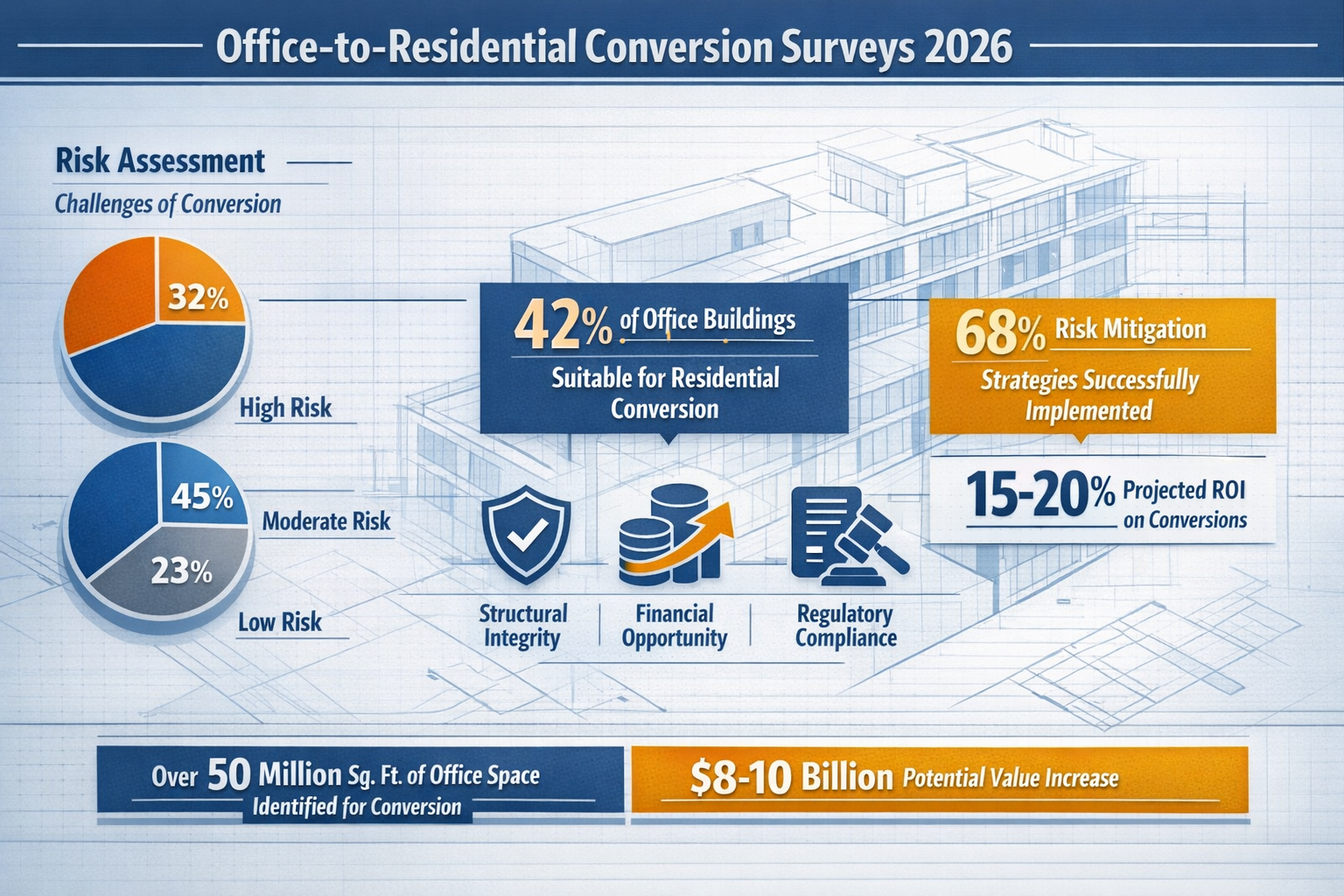
The commercial property sector has undergone dramatic changes since the pandemic accelerated remote working trends. By 2026, many city center office buildings stand partially or completely vacant, creating unprecedented opportunities for residential conversion. The UK government has responded by maintaining and refining permitted development rights that allow certain office-to-residential conversions without full planning permission [3].
The Market Drivers Behind Conversion Demand
Several powerful forces are driving the office-to-residential conversion boom in 2026:
Housing Supply Crisis 🏘️
The UK continues to face severe housing shortages, particularly in urban centers where office buildings are concentrated. Converting underutilized commercial space addresses this crisis while revitalizing city centers.
Economic Recovery Dynamics
As the 2026 recovery gains momentum, residential property values have rebounded strongly while commercial office values remain suppressed. This valuation gap creates attractive arbitrage opportunities for developers who can successfully navigate the conversion process.
Regulatory Environment
Permitted development rights allow conversions from Class E (commercial, business and service) to Class C3 (dwellinghouses) under specific conditions [1]. However, these rights come with limitations and requirements that make professional building surveys absolutely essential.
Why Building Surveys Are Non-Negotiable
A RICS commercial building survey provides the foundational intelligence needed to assess conversion viability. Unlike standard residential surveys, these specialized assessments evaluate properties through the lens of their intended transformation, identifying both risks and opportunities that determine project success.
The cost of skipping or inadequately conducting building surveys can be catastrophic. Structural issues discovered mid-conversion can add hundreds of thousands of pounds to budgets, delay projects by months, or even render conversions economically unviable.
Key Components of Building Surveys for Office-to-Resi Conversions in the 2026 Recovery
When conducting building surveys specifically for office-to-residential conversions, surveyors must evaluate factors that go far beyond traditional property assessments. The following components form the essential framework for comprehensive conversion surveys.
Structural Assessment and Load Capacity Analysis
Floor Loading Evaluation ⚖️
Office buildings are typically designed for different loading patterns than residential properties. Surveyors must assess whether existing floor structures can accommodate residential loads, including:
- Partition wall placements in new layouts
- Bathroom fixtures and water-filled spaces
- Kitchen equipment and appliances
- Residential furniture and occupancy patterns
A structural engineering assessment may be required to calculate precise loading capacities and identify necessary reinforcement work.
Column Grid and Layout Constraints
The spacing and location of structural columns in office buildings significantly impact residential layout options. Surveyors document:
- Column grid dimensions and spacing
- Load-bearing wall locations
- Core positioning (stairs, lifts, services)
- Structural transfer opportunities
These factors determine how efficiently the building can be subdivided into residential units and whether layouts will be commercially attractive to buyers or renters.
Building Envelope and Environmental Performance
Window Configuration and Natural Light ☀️
Residential properties require adequate natural light in habitable rooms. Building regulations specify minimum window areas relative to floor space. Surveyors must evaluate:
- Existing window sizes and positions
- Depth of floor plates from windows
- Potential for additional window openings
- Compliance with residential daylight standards
Deep floor plates common in office buildings can create "dark" internal spaces unsuitable for residential use without significant modification [2].
Thermal Performance and Energy Efficiency
Modern residential properties must meet stringent energy efficiency standards. Surveys assess:
- Existing insulation in walls, roofs, and floors
- Window thermal performance (U-values)
- Heating system suitability for residential use
- Opportunities for retrofit improvements
The cost of upgrading building fabric to meet residential energy standards can represent a significant portion of conversion budgets.
Building Services and Infrastructure Capacity
Mechanical and Electrical Systems 🔌
Office buildings have fundamentally different services requirements than residential properties. Comprehensive surveys evaluate:
- Electrical capacity: Can the existing electrical infrastructure support multiple residential units with individual metering?
- Heating and hot water: Are systems suitable for residential domestic use, or do they require complete replacement?
- Ventilation: Do bathroom and kitchen ventilation requirements necessitate new ductwork?
- Water supply and drainage: Is capacity adequate for residential demand patterns?
These assessments often require specialist mechanical and electrical engineers working alongside building surveyors.
Vertical Transportation
Lift provision suitable for office use may not meet residential requirements, particularly regarding:
- Fire evacuation capabilities
- Accessibility standards for residential buildings
- Capacity for furniture and goods movement
- Number of lifts relative to residential units
Fire Safety and Compartmentation
Post-Grenfell regulations have significantly tightened fire safety requirements for residential buildings. Surveys must rigorously assess:
- Fire resistance of structural elements: Do floors and walls provide adequate fire separation between units?
- Means of escape: Are stairwell configurations compliant with residential building regulations?
- Compartmentation: Can the building be adequately subdivided into fire-resistant compartments?
- External wall systems: Do cladding materials meet current safety standards?
Fire safety upgrades can represent substantial unexpected costs if not identified during initial surveys [5].
Sound Insulation and Acoustic Performance
Residential properties require acoustic separation between units that typically exceeds office building standards. A thorough Level 3 building survey for conversion projects evaluates:
- Existing floor and wall construction for sound transmission
- Requirements for additional acoustic insulation
- Impact of services (plumbing, ventilation) on noise transmission
- External noise levels and window acoustic performance
Acoustic upgrades can significantly impact ceiling heights and floor areas, affecting unit layouts and values.
Identifying Structural Risks in Office-to-Resi Conversions
Understanding potential structural risks before committing to a conversion project is essential for accurate financial modeling and project planning. Building surveys serve as the primary risk identification tool, revealing issues that could derail projects or dramatically increase costs.
Critical Dimensional Constraints
Floor-to-Ceiling Heights 📏
Perhaps the most common deal-breaker in office conversions is inadequate floor-to-ceiling height. Residential buildings require:
- Minimum 2.3 meters ceiling height in habitable rooms
- Additional depth for acoustic floor treatments
- Space for residential services (heating, ventilation)
- Headroom allowances in bathrooms
Many 1960s-1980s office buildings have floor-to-ceiling heights of 2.4-2.6 meters. After installing acoustic floor treatments (often 100-150mm), residential services, and ceiling finishes, the remaining ceiling height may fall below regulatory minimums [1].
Surveyors must carefully measure actual heights, account for all necessary treatments, and determine whether the building can accommodate residential conversion without regulatory non-compliance.
Floor Plate Depth and Natural Light Penetration
Building regulations require that habitable rooms receive adequate natural light. As a general rule, rooms should not extend more than 7-8 meters from windows without additional light sources [2].
Office buildings with deep floor plates (common in 1970s-1990s construction) create challenges:
- Internal "dark" spaces unsuitable for bedrooms or living rooms
- Potential use only as circulation, bathrooms, or storage
- Reduced efficiency and value per square meter
- Possible need for light wells or internal courtyards
Structural Defects and Building Condition
A comprehensive building survey identifies existing defects that could complicate or increase conversion costs:
Foundation and Structural Movement 🏗️
- Settlement cracks indicating ongoing movement
- Subsidence or heave affecting structural integrity
- Inadequate foundations for additional residential loads
- Historic structural alterations affecting stability
Building Envelope Deterioration
- Concrete spalling and reinforcement corrosion
- Curtain wall system failures or water ingress
- Roof membrane deterioration requiring replacement
- Window seal failures and thermal bridging
Water Damage and Moisture Issues
- Rising damp from failed damp-proof courses
- Penetrating damp through external walls
- Condensation issues indicating ventilation problems
- Historic water damage from leaks or flooding
Each defect identified requires cost estimation for remediation, feeding into financial viability assessments.
Hazardous Materials and Environmental Concerns
Older office buildings frequently contain materials now considered hazardous, requiring specialist surveys and remediation:
Asbestos ⚠️
Buildings constructed before 2000 may contain asbestos in:
- Ceiling tiles and textured coatings
- Pipe and boiler insulation
- Floor tiles and adhesives
- Sprayed coatings on structural steel
Asbestos removal during conversion can cost £10,000-£100,000+ depending on extent and type.
Lead Paint and Other Contaminants
Pre-1980s buildings may have lead paint requiring careful removal. Other potential contaminants include PCBs in electrical equipment and various industrial residues.
Regulatory Compliance Gaps
Building surveys must identify gaps between existing construction and current residential building regulations:
- Accessibility requirements: Do entrances, corridors, and lifts meet accessibility standards?
- Fire safety provisions: Are escape routes, fire doors, and detection systems adequate?
- Energy performance: Can the building achieve required EPC ratings for residential use?
- Sound insulation: Do party walls and floors meet residential acoustic standards?
Each compliance gap represents additional conversion costs that must be quantified and factored into project viability.
Uncovering Value Opportunities Through Expert Surveying
While identifying risks is crucial, expert building surveys also reveal opportunities that enhance project value and differentiate successful conversions from mediocre ones.
Maximizing Unit Mix and Layout Efficiency
Skilled surveyors work with architects to optimize residential layouts based on structural realities:
Strategic Unit Configuration 🏘️
- Identifying optimal unit sizes based on market demand
- Maximizing the number of dual-aspect units (windows on two sides)
- Creating efficient circulation patterns minimizing wasted space
- Positioning premium units to capture views and light
Value-Add Features
Surveys may identify opportunities for features that command premium values:
- Potential for private outdoor space (balconies, terraces)
- Scope for mezzanine levels in high-ceiling spaces
- Opportunities for penthouse units with roof access
- Potential for ground-floor commercial/retail retention
Heritage and Character Retention
Many office buildings suitable for conversion possess architectural merit that can be leveraged for value:
- Period features: Original windows, decorative elements, or impressive entrance halls
- Industrial character: Exposed brick, concrete, or steel elements desirable in residential lofts
- Historic significance: Buildings in conservation areas or with listed status
- Unique architectural elements: Atriums, roof terraces, or distinctive facades
Expert surveyors identify which elements should be retained, restored, or highlighted to maximize residential appeal and value.
Retrofit and Sustainability Opportunities
The 2026 market increasingly values sustainable, energy-efficient homes. Building surveys can identify retrofit opportunities:
Energy Performance Enhancements ♻️
- Optimal locations for solar panels or green roofs
- Feasibility of ground-source or air-source heat pumps
- Opportunities for enhanced insulation beyond minimum standards
- Potential for rainwater harvesting or greywater systems
Properties achieving high energy performance ratings command premium prices and attract environmentally conscious buyers.
Permitted Development vs. Planning Permission Strategy
Understanding the regulatory pathway is crucial for maximizing value while minimizing risk and delay. Surveyors help determine whether projects can proceed under permitted development rights or require full planning permission [3].
Permitted Development Advantages
- Faster approval process (typically 56 days)
- Lower application costs
- Reduced risk of planning refusal
- Simpler consultation requirements
When Full Planning Permission Adds Value
Sometimes seeking full planning permission, despite being slower and more complex, enables:
- Larger residential floor areas than permitted development allows
- External alterations improving appearance and value
- Mixed-use schemes retaining ground-floor commercial space
- More flexible unit configurations
Expert surveyors advise on the optimal regulatory strategy based on building characteristics and market conditions.
Location-Specific Market Opportunities
Building surveys inform location-specific value strategies:
Urban Center Regeneration 🌆
Converting offices in regenerating areas captures value from improving neighborhoods. Surveys assess:
- Building suitability for target demographics (young professionals, downsizers, families)
- Potential for premium positioning as regeneration catalysts
- Opportunities to leverage improving transport links or amenities
Undervalued Secondary Locations
Some of the best conversion opportunities exist in secondary cities or suburban locations where office values have fallen dramatically but residential demand remains strong. Surveys identify buildings where the office-to-residential value gap is widest.
Practical Survey Methodologies and Best Practices
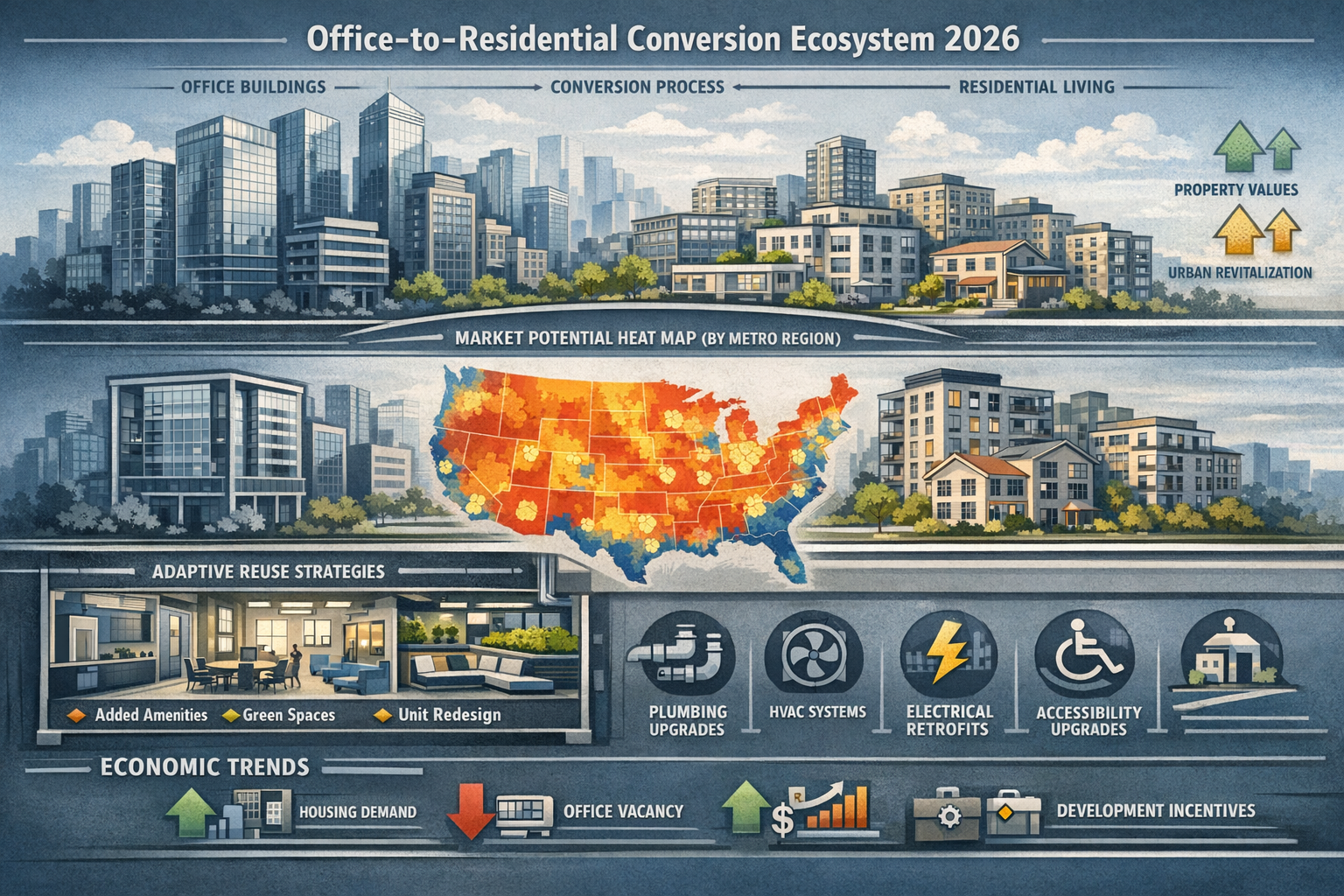
Conducting effective building surveys for office-to-residential conversions requires specialized methodologies that go beyond standard property surveys.
Multi-Disciplinary Survey Teams
Complex conversion projects benefit from integrated survey teams including:
- Chartered building surveyors: Overall building condition and compliance assessment
- Structural engineers: Detailed structural capacity and modification analysis
- M&E consultants: Services infrastructure evaluation and design
- Acoustic consultants: Sound insulation assessment and specification
- Fire safety engineers: Fire strategy development and compliance verification
This collaborative approach, often coordinated through a comprehensive Level 3 survey, ensures all critical aspects are thoroughly evaluated.
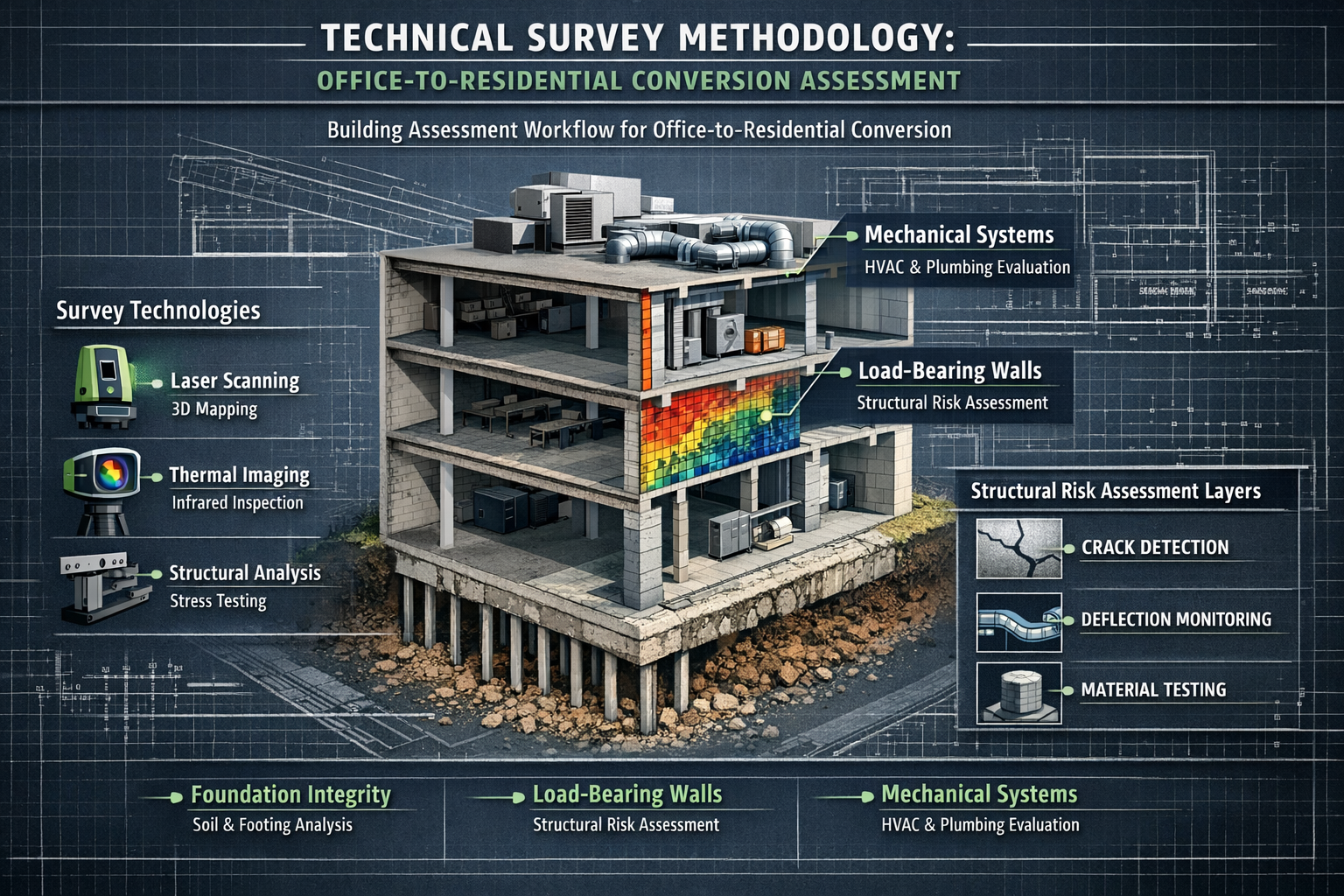
Technology-Enhanced Survey Techniques
Modern surveying leverages advanced technology for more accurate assessments:
3D Laser Scanning 📐
Creates precise digital models of existing buildings, enabling:
- Accurate dimensional analysis
- Clash detection between existing structure and proposed layouts
- Virtual design development before physical work begins
- Comprehensive record of existing conditions
Thermal Imaging
Identifies hidden defects including:
- Insulation gaps and thermal bridging
- Water ingress and moisture problems
- Air leakage points affecting energy performance
Non-Destructive Testing
Techniques like ground-penetrating radar and ultrasonic testing reveal:
- Concealed structural elements
- Reinforcement locations and condition
- Void locations and hidden services
Phased Survey Approach
For large or complex conversions, a phased survey strategy manages costs and risks effectively:
Phase 1: Desktop Feasibility Study
- Review existing building documentation
- Assess planning and regulatory constraints
- Preliminary dimensional and layout analysis
- High-level cost and value modeling
Phase 2: Detailed Building Survey
- Comprehensive site inspection and condition assessment
- Detailed dimensional surveys
- Structural and services evaluation
- Defect identification and costing
Phase 3: Intrusive Investigation
- Opening up works to verify hidden conditions
- Material testing and analysis
- Specialist surveys (asbestos, ecology, contamination)
- Final risk and cost refinement
This approach allows projects to be abandoned early if Phase 1 reveals fundamental viability issues, avoiding unnecessary expenditure on detailed surveys.
Survey Deliverables and Reporting
Effective survey reports for conversion projects should include:
✅ Executive Summary: Clear statement of conversion viability and key risks/opportunities
✅ Detailed Findings: Comprehensive documentation of building condition, defects, and compliance issues
✅ Photographic Record: Extensive photography documenting all significant features and defects
✅ Cost Implications: Estimated costs for remediation, compliance works, and recommended improvements
✅ Recommendations: Prioritized action items and further investigation requirements
✅ Appendices: Specialist reports, test results, and regulatory documentation
Reports should be structured to inform both technical teams (architects, engineers) and decision-makers (investors, developers) with appropriate levels of detail for each audience.
Financial Modeling and ROI Analysis
Building survey findings feed directly into financial viability assessments that determine whether conversion projects should proceed.
Cost Impact of Survey Findings
Survey-identified issues translate into specific cost categories:
Essential Remediation Costs 💷
- Structural repairs and strengthening
- Building envelope repairs (roof, walls, windows)
- Hazardous material removal
- Drainage and foundation repairs
Regulatory Compliance Costs
- Fire safety upgrades (compartmentation, detection, suppression)
- Acoustic insulation installation
- Accessibility improvements
- Energy efficiency enhancements
Services Infrastructure Costs
- Electrical system upgrades and new distribution
- Heating and hot water system replacement
- Ventilation system installation
- Plumbing and drainage modifications
Contingency Allowances
Based on building age, condition, and survey comprehensiveness, appropriate contingencies (typically 10-20% of construction costs) account for unforeseen issues.
Value Optimization Strategies
Survey findings also inform value-enhancement strategies:
- Unit mix optimization: Configuring the optimal blend of studio, one-bed, two-bed, and three-bed units based on structural constraints and market demand
- Specification levels: Determining appropriate finish quality balancing costs against achievable sale prices or rents
- Phasing strategies: Identifying opportunities for phased conversion reducing financing costs and market risk
- Alternative use considerations: Assessing whether mixed-use schemes (residential plus commercial or amenity space) maximize value
Comparative Analysis and Market Positioning
Surveys enable comparison of multiple potential conversion properties, assessing:
| Assessment Factor | Property A | Property B | Property C |
|---|---|---|---|
| Conversion Cost/m² | £1,200 | £1,500 | £900 |
| Achievable GDV/m² | £4,500 | £4,200 | £3,800 |
| Net Margin | 35% | 28% | 42% |
| Risk Level | Medium | High | Low |
| Timeline | 18 months | 24 months | 15 months |
This analysis identifies which opportunities offer the best risk-adjusted returns.
Regulatory Compliance and Planning Considerations in 2026
The regulatory landscape for office-to-residential conversions continues to evolve. Building surveys must assess compliance with current requirements while anticipating likely future changes.
Permitted Development Rights Framework
Class E to Class C3 conversions can proceed under permitted development rights subject to specific conditions [3]:
Prior Approval Requirements
Developers must obtain prior approval for:
- Transport and highways impacts
- Contamination risks
- Flooding risks
- Noise impacts
- Provision of adequate natural light
- Impact on existing residential amenity
Building surveys provide the evidence base for prior approval applications, demonstrating that conversions meet these requirements.
Permitted Development Limitations
Not all conversions qualify for permitted development. Surveys must identify whether properties fall within exclusions:
- Buildings in conservation areas or with listed status
- Properties where office use began after March 2021
- Buildings in areas where permitted development rights are withdrawn
- Conversions creating units below minimum space standards
Building Regulations Compliance
Conversion projects must comply with current Building Regulations, with surveys assessing:
Part B – Fire Safety 🔥
- Means of escape provisions
- Fire resistance of structural elements
- Fire detection and alarm systems
- Firefighting access and facilities
Part E – Sound Insulation
- Airborne sound insulation between units
- Impact sound insulation through floors
- Sound insulation of external walls
Part F – Ventilation
- Whole-building ventilation strategy
- Extract ventilation in bathrooms and kitchens
- Purge ventilation in habitable rooms
Part L – Energy Efficiency
- U-values of building fabric elements
- Heating system efficiency
- Renewable energy contributions
- Overall energy performance (EPC rating)
Survey findings determine the scope of works required to achieve compliance, directly impacting project costs and viability.
Space Standards and Quality Requirements
Many local authorities require conversions to meet Nationally Described Space Standards, specifying minimum unit sizes:
- Studio: 37m²
- 1-bed/2-person: 50m²
- 2-bed/4-person: 70m²
- 3-bed/5-person: 86m²
Building surveys assess whether structural constraints allow efficient layouts meeting these standards [4].
Case Study Applications: Survey-Driven Success
Real-world examples illustrate how comprehensive building surveys enable successful office-to-residential conversions in the 2026 recovery.
Case Study 1: 1970s Office Block Transformation
Building Profile: 8-story 1970s concrete frame office building, city center location, 4,500m² gross area
Survey Findings:
- ✅ Adequate floor-to-ceiling heights (2.8m) allowing for acoustic treatments
- ✅ Regular column grid enabling efficient residential layouts
- ⚠️ Curtain wall system requiring complete replacement (£500k)
- ⚠️ Asbestos ceiling tiles throughout (£120k removal)
- ⚠️ Inadequate electrical capacity requiring new infrastructure (£180k)
Outcome: Survey-informed design created 52 apartments (mix of 1-bed and 2-bed units). Early identification of curtain wall and asbestos issues allowed accurate budgeting. Project achieved 32% profit margin, completing in 16 months.
Case Study 2: Victorian Warehouse Conversion Opportunity
Building Profile: 4-story Victorian warehouse, former office use, 2,200m² gross area, conservation area location
Survey Findings:
- ✅ Generous ceiling heights (3.2m+) creating character and flexibility
- ✅ Original timber floors and exposed brick adding value
- ✅ Large windows providing excellent natural light
- ⚠️ Structural movement requiring foundation underpinning (£95k)
- ⚠️ Full planning permission required (conservation area)
Outcome: Survey identified heritage features to retain and structural issues to address. Full planning permission secured for 18 high-specification loft apartments. Premium pricing achieved due to character retention. 38% profit margin despite higher specification costs.
Case Study 3: Suburban Office Park Conversion
Building Profile: 3-story 1980s office building, suburban location, 3,800m² gross area
Survey Findings:
- ⚠️ Marginal ceiling heights (2.5m) limiting acoustic treatment options
- ⚠️ Deep floor plates creating layout challenges
- ⚠️ Single-aspect units only possible
- ✅ Good parking provision (attractive to suburban market)
- ✅ Minimal structural issues
Outcome: Survey revealed layout constraints requiring creative design solutions. Project proceeded with larger unit sizes (predominantly 2-bed and 3-bed) targeting family market. Lower density than initially hoped, but still achieved 24% margin due to low acquisition cost in undervalued location.
Selecting the Right Survey Provider
The quality of building surveys directly impacts conversion project success. Selecting qualified, experienced survey providers is essential.
Essential Qualifications and Expertise
Look for survey providers with:
Professional Accreditation 📜
- RICS (Royal Institution of Chartered Surveyors) membership
- Relevant professional indemnity insurance
- Proven track record in commercial and conversion projects
Conversion-Specific Experience
- Demonstrated experience with office-to-residential conversions
- Understanding of permitted development and planning processes
- Knowledge of residential building regulations and standards
Multi-Disciplinary Capabilities
- Access to structural engineers, M&E consultants, and specialists
- Ability to coordinate comprehensive multi-disciplinary surveys
- Integration of findings into coherent, actionable reports
Questions to Ask Potential Survey Providers
Before engaging a surveyor for conversion assessment, ask:
- How many office-to-residential conversion surveys have you completed?
- What is your approach to assessing conversion viability?
- Which specialists do you work with for comprehensive assessments?
- Can you provide examples of survey reports for similar projects?
- How do you quantify cost implications of identified issues?
- What is your typical timeline and fee structure?
Understanding Survey Costs and Value
Building survey costs for conversion projects typically range from £3,000-£15,000+ depending on:
- Building size and complexity
- Extent of specialist investigations required
- Accessibility and location
- Urgency and timeline requirements
While this represents a significant upfront investment, comprehensive surveys typically save 10-50 times their cost by:
- Identifying deal-breaking issues before purchase
- Enabling accurate project budgeting
- Preventing costly mid-project surprises
- Optimizing design for maximum value
- Supporting financing and investor confidence
Conclusion
Building Surveys for Office-to-Resi Conversions in the 2026 Recovery: Identifying Structural Risks and Value Opportunities represents far more than a technical assessment—it's the foundation upon which successful conversion projects are built. As the UK property market continues its 2026 recovery trajectory, the gap between undervalued office properties and strong residential demand creates compelling opportunities for those who can navigate the conversion process effectively.
The complexity of transforming commercial office space into desirable residential homes cannot be underestimated. From structural capacity and dimensional constraints to regulatory compliance and hidden defects, countless factors determine whether conversions succeed or fail. Comprehensive building surveys conducted by qualified professionals provide the critical intelligence needed to make informed decisions, avoid costly mistakes, and optimize value creation.
Key Success Factors
✅ Early engagement: Commission detailed surveys before committing to property acquisition
✅ Comprehensive scope: Ensure surveys address all critical aspects—structural, services, regulatory, and environmental
✅ Expert providers: Work with RICS-qualified surveyors experienced in conversion projects
✅ Integrated approach: Coordinate building surveys with architectural, planning, and financial analysis
✅ Risk-based decision making: Use survey findings to inform go/no-go decisions and project parameters
Next Steps for Conversion Projects
For developers, investors, and property professionals considering office-to-residential conversions in 2026:
- Identify potential properties in locations with strong residential demand and weak office markets
- Engage qualified surveyors early to conduct preliminary feasibility assessments
- Commission comprehensive surveys before making acquisition commitments
- Develop integrated project teams bringing together surveyors, architects, engineers, and planning consultants
- Model financial scenarios based on survey findings to ensure robust project viability
- Maintain contingency for unforeseen issues despite thorough surveying
The office-to-residential conversion opportunity in 2026 rewards those who combine market insight with technical rigor. Building surveys provide the technical foundation, identifying both the risks to avoid and the opportunities to capture. By investing in comprehensive surveying upfront, conversion projects can navigate complexity, manage risk, and unlock the substantial value available in transforming yesterday's offices into tomorrow's homes.
For expert guidance on building surveys for your conversion project, consider consulting with experienced professionals who understand both the technical requirements and market dynamics shaping the 2026 recovery. Whether you're evaluating a single property or developing a portfolio strategy, professional building survey services provide the insights needed to make confident, informed decisions in this dynamic market.
References
[1] How To Convert Office Space To Residential – https://propertydata.co.uk/resources/how-to-convert-office-space-to-residential
[2] How To Successfully Convert Offices Into Homes – https://www.garnessjones.co.uk/news/how-to-successfully-convert-offices-into-homes
[3] How To Convert Offices Into Homes Without Planning Permission – https://urbanistarchitecture.co.uk/how-to-convert-offices-into-homes-without-planning-permission/
[4] Convert Comercial Property – https://www.legalclarity.co.uk/blog/convert-comercial-property
[5] Converting Commercial To Residential What You Need To Know – https://www.cooperparry.com/news/converting-commercial-to-residential-what-you-need-to-know/
[6] Converting Vacant Office Space Into Housing – https://www.americanprogress.org/article/converting-vacant-office-space-into-housing/
