
The London commercial property market stands at a pivotal crossroads in 2026. As retrofit expansions emerge as the dominant strategy for office development, savvy investors are discovering unprecedented opportunities in undervalued assets across the capital. However, navigating Party Wall Agreements for Office Retrofit Expansions 2026: Navigating Underpriced London Market Recovery requires more than financial acumen—it demands a thorough understanding of legal frameworks, surveyor processes, and market dynamics that will define this recovery phase.
With the pipeline for new, high-quality office space expected to tighten significantly from 2026 onwards, retrofit projects have become the primary engine driving supply in London's commercial sector.[1] Yet many investors overlook a critical component that can make or break these ventures: proper party wall compliance. Understanding how to navigate party wall agreements while capitalizing on underpriced London assets represents a competitive advantage in today's market.
Key Takeaways
- 🏢 Retrofit dominance: Retrofit expansions have displaced traditional new construction as the main supply strategy in London's office market, creating unique party wall compliance requirements
- 📊 Market opportunity: Supply tightening from 2026 onwards positions undervalued assets for significant appreciation, particularly those with retrofit potential
- ⚖️ Legal compliance: The Party Wall etc. Act 1996 governs all office retrofit expansions affecting shared boundaries, making professional surveyor engagement essential
- 💰 Cost management: Understanding party wall surveyor fees and responsibilities prevents budget overruns and project delays in retrofit developments
- 🎯 Strategic advantage: Proactive party wall management accelerates project timelines and protects investor returns in London's recovering commercial market
Understanding the London Office Market Recovery Context
The commercial property landscape in London has undergone a fundamental transformation. Retrofit has become "the main engine of supply through creativity: building less, building better, building greener," displacing traditional new construction as the primary development approach.[3] This shift creates both opportunities and challenges for investors targeting underpriced assets.
The Flight to Quality Effect
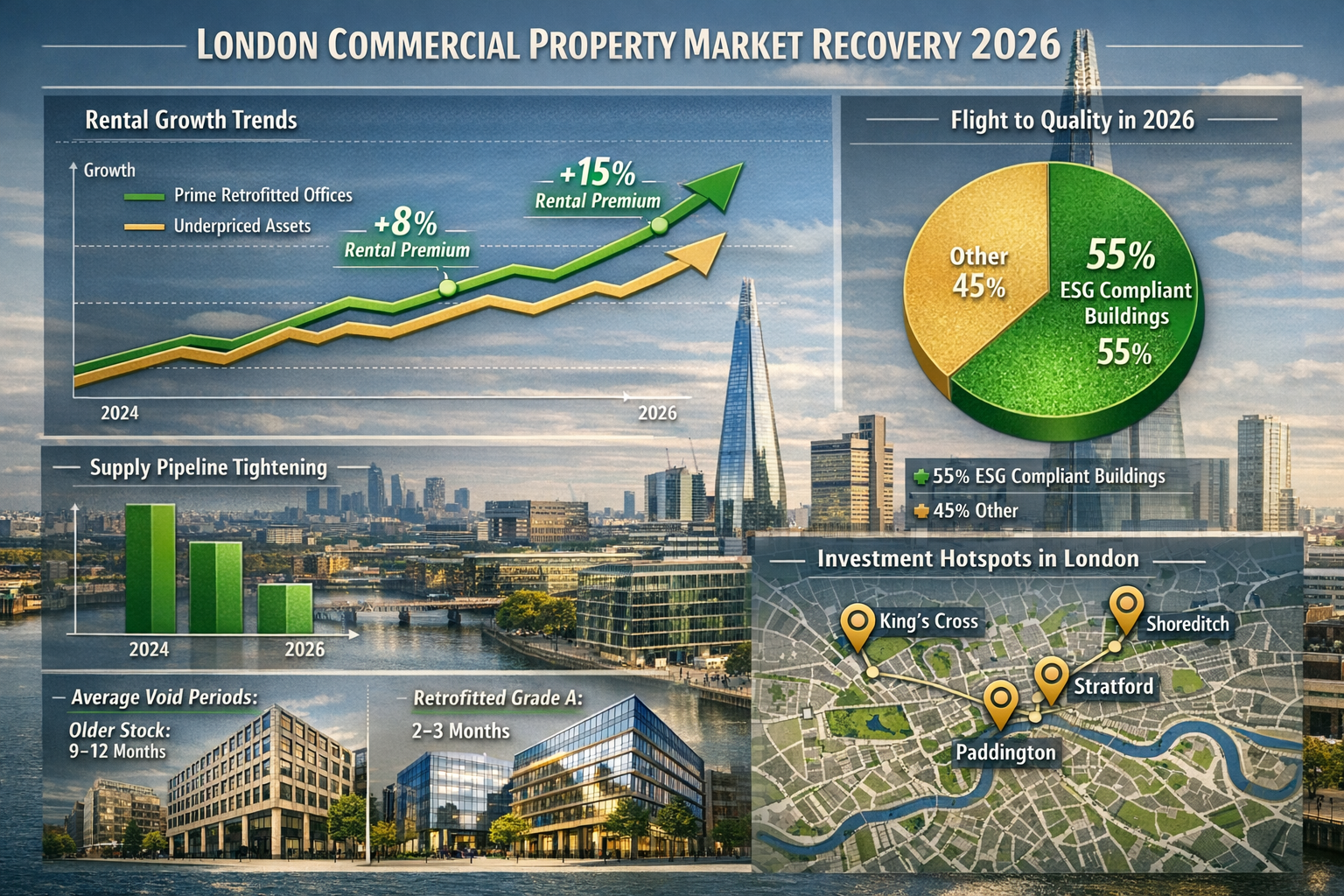
The market is experiencing a pronounced flight to quality that reshapes valuation dynamics. Older stock without retrofit potential faces longer voids and discounted rents, while ESG-compliant, energy-efficient, and Grade A refurbished buildings are the only ones truly holding their value.[1] This bifurcation creates opportunities for investors who can identify underpriced assets with strong retrofit potential.
The strongest rental growth rates since the late 1980s are expected for quality offices in good locations across Central London.[2] However, this growth remains concentrated in properties that meet modern tenant demands for sustainability, flexibility, and technological infrastructure—all achievable through strategic retrofit expansions.
Emerging Districts and Investment Hotspots
King's Cross, Shoreditch, Stratford, and Paddington have evolved into fully-fledged commercial hubs, offering superior transport connectivity and mixed-use ecosystems that appeal to modern tenants.[1] These districts often contain undervalued office buildings ripe for retrofit expansion, presenting compelling investment opportunities for those who understand party wall compliance requirements.
The definition of "prime" has been redefined to encompass not just location or specification, but "deliverability, efficiency and resilience."[3] This expanded definition means that secondary assets in emerging districts can achieve prime status through well-executed retrofit expansions—provided developers navigate party wall agreements properly.
Party Wall Agreements for Office Retrofit Expansions 2026: Legal Framework and Requirements
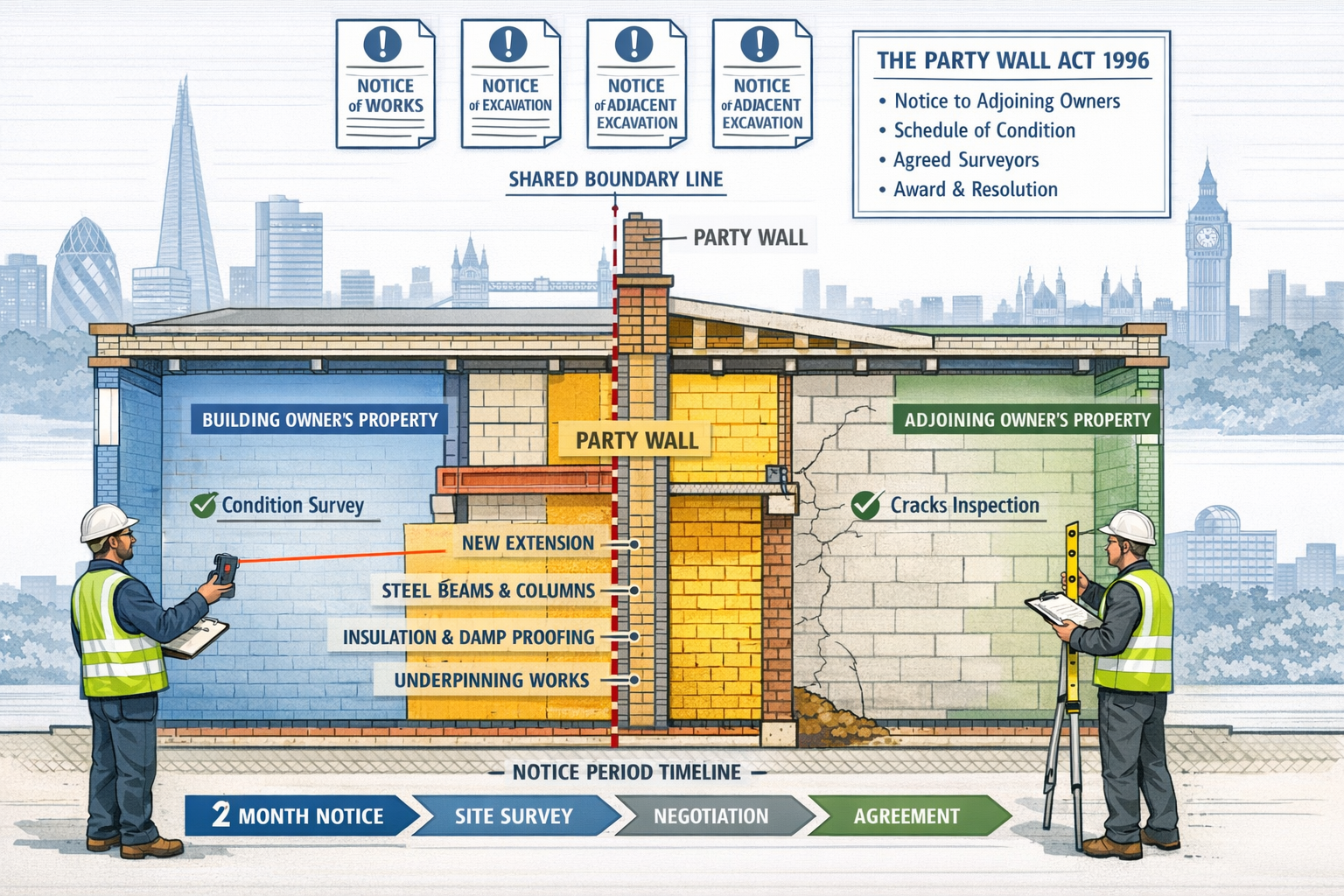
When undertaking office retrofit expansions in London, understanding the Party Wall etc. Act 1996 forms the foundation of legal compliance. This legislation governs all building work affecting shared walls, boundaries, and structures between adjoining properties—a common scenario in London's densely developed commercial districts.
What Triggers Party Wall Requirements in Office Retrofits?
Office retrofit expansions typically trigger party wall requirements in several scenarios:
Building on or astride the boundary line: When extending an office building that shares a boundary with adjacent property, party wall notices become mandatory. This applies whether the neighboring property is commercial or residential.
Work to existing party walls: Structural modifications to shared walls, including:
- Cutting into party walls for new openings
- Raising party walls for additional floors
- Underpinning party walls for basement expansions
- Installing steel beams or support structures
- Removing chimney breasts or structural elements
Excavation near adjoining buildings: Digging within three or six meters of neighboring structures (depending on depth) requires party wall procedures, particularly relevant for basement retrofit expansions increasingly popular in London's constrained market.
The Three Types of Party Wall Notices
Understanding the party wall process requires familiarity with the three notice types:
| Notice Type | Purpose | Minimum Notice Period |
|---|---|---|
| Party Structure Notice | Work directly to party walls or structures | 2 months |
| Line of Junction Notice | Building new walls on boundary lines | 1 month |
| 3/6 Meter Notice | Excavation near adjoining properties | 1 month |
For most office retrofit expansions, the Party Structure Notice represents the most common requirement, as these projects typically involve modifications to existing shared walls rather than entirely new construction.
Neighbor Consent vs. Dispute Resolution
Once notices are served, adjoining owners have 14 days to respond. They can either:
- Consent in writing: The work proceeds without formal party wall awards, though written consent should document agreed conditions
- Dissent or remain silent: A party wall dispute arises, requiring appointment of party wall surveyors
Many investors wonder whether neighbors can legally refuse a party wall agreement. While adjoining owners cannot prevent lawful work, they can influence conditions, timing, and protective measures through the surveyor-led process.
The Party Wall Surveyor Process for Commercial Retrofit Projects
Professional surveyor engagement represents a critical success factor in Party Wall Agreements for Office Retrofit Expansions 2026: Navigating Underpriced London Market Recovery. Understanding what party wall surveyors do in London helps investors budget appropriately and manage timelines effectively.
Surveyor Appointment Options
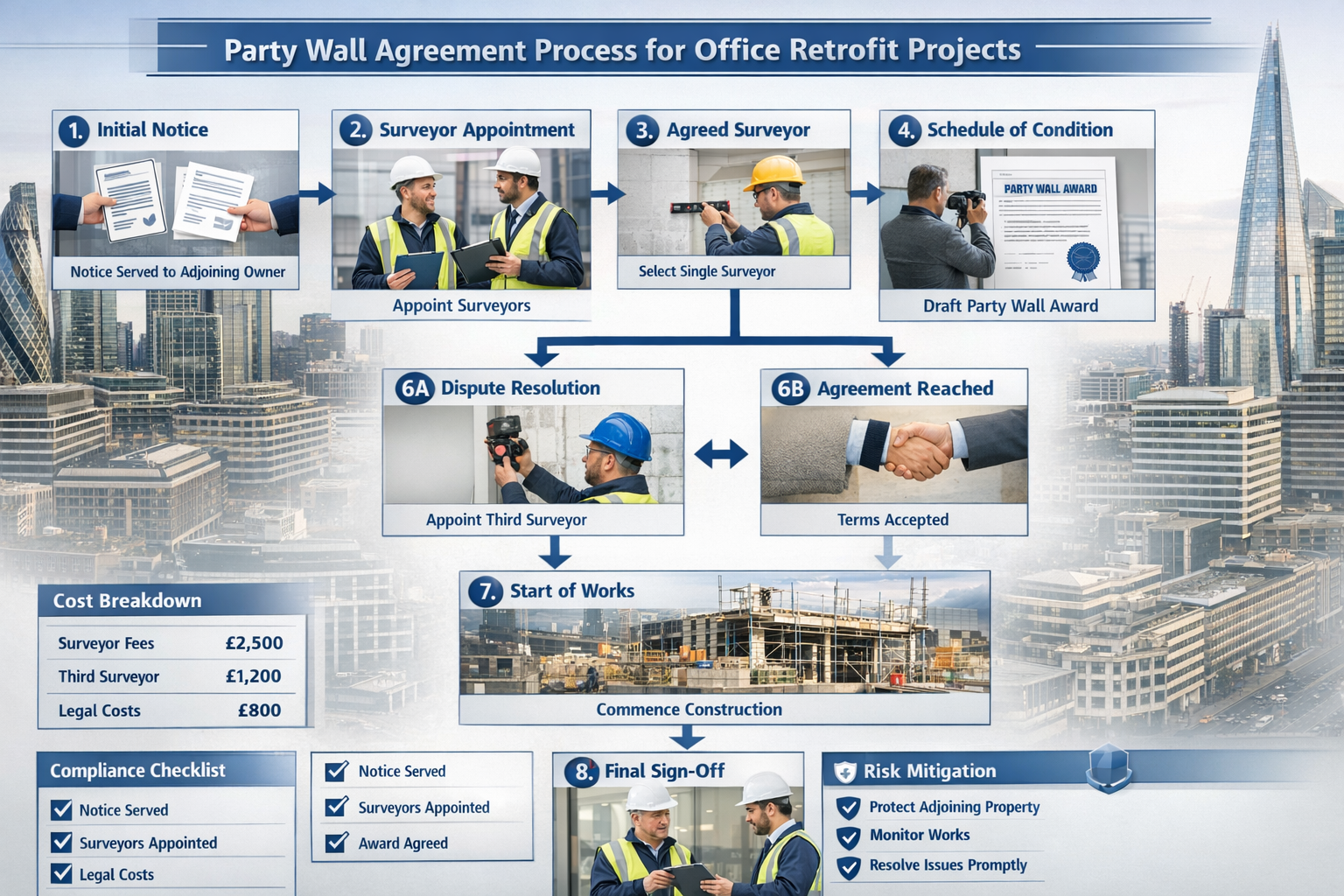
When a party wall dispute arises (either through dissent or silence), three surveyor appointment routes exist:
Option 1: Agreed Surveyor 🤝
Both parties jointly appoint a single surveyor to act impartially. This approach typically reduces costs and accelerates timelines—ideal for straightforward retrofit expansions where relationships between building owners remain cordial.
Option 2: Two Surveyors Plus Third Surveyor ⚖️
Each party appoints their own surveyor, who together select a third surveyor to resolve any disagreements. This structure provides maximum protection for both parties but increases costs and potential delays.
Option 3: Building Owner's Surveyor Acts for Both 📋
The adjoining owner may allow the building owner's surveyor to act for both parties, though this requires explicit written consent and careful consideration of potential conflicts of interest.
For commercial retrofit projects in London's recovering market, the agreed surveyor route often provides the optimal balance of cost-efficiency and legal protection, particularly when finding qualified party wall surveyors near you with commercial retrofit experience.
The Party Wall Award: Key Components
The party wall award represents the legally binding document that governs retrofit expansion work. Essential components include:
- Scope of permitted works: Detailed description of all construction activities affecting party structures
- Schedule of condition: Photographic and written record of adjoining property's current state
- Working hours: Restrictions on construction timing to minimize disruption
- Access provisions: Rights for surveyors and contractors to inspect adjoining property
- Security for expenses: Financial guarantees protecting adjoining owners
- Dispute resolution procedures: Mechanisms for addressing issues during construction
For office retrofit expansions, awards should specifically address:
✅ Structural loading changes from additional floors or equipment
✅ Vibration monitoring during excavation or structural work
✅ Temporary works like scaffolding or hoarding
✅ Service diversions affecting shared utilities
✅ Fire safety provisions during construction phases
Timeline Considerations for Retrofit Projects
Understanding party wall timelines proves essential for project planning:
- Notice service: 2 months before work commences (Party Structure Notice)
- Response period: 14 days for adjoining owner consent/dissent
- Surveyor appointment: 10 days if adjoining owner fails to appoint
- Award preparation: 2-6 weeks depending on complexity
- Appeal period: 14 days after award service
Total minimum timeline: Approximately 3-4 months from initial notice to work commencement, though complex commercial retrofits may require longer periods for thorough schedule of condition surveys and award negotiation.
Cost Management: Party Wall Surveyor Fees in Commercial Projects
Budget management represents a critical concern for investors pursuing Party Wall Agreements for Office Retrofit Expansions 2026: Navigating Underpriced London Market Recovery. Understanding how much party wall agreements cost helps prevent financial surprises that erode returns.
Fee Structures for Commercial Retrofit Expansions
Party wall surveyor fees for office retrofits typically exceed residential project costs due to increased complexity, higher property values, and greater potential liabilities. Expect the following ranges for London commercial projects in 2026:
Building Owner's Surveyor Fees:
- Simple retrofit (single party wall): £1,500 – £3,000
- Moderate complexity (multiple walls): £3,000 – £6,000
- Complex expansion (structural changes, multiple neighbors): £6,000 – £15,000+
Adjoining Owner's Surveyor Fees:
- Similar ranges, though sometimes slightly lower
- Building owner pays these fees under the Act
Third Surveyor Fees (if appointed):
- Retainer: £1,000 – £2,500
- Hourly rates: £150 – £300 for dispute resolution
Who Pays for Party Wall Surveyors?
A common misconception concerns who pays for party wall surveyors. Under the Party Wall etc. Act 1996, the building owner (the party undertaking the retrofit expansion) bears responsibility for all reasonable surveyor fees, including:
- Their own surveyor's fees
- The adjoining owner's surveyor's fees
- The third surveyor's fees (if appointed)
- Award preparation and service costs
This cost structure should be factored into retrofit project budgets from the outset. For a typical office retrofit affecting three adjoining properties, total party wall surveyor costs might range from £15,000 to £40,000—a material consideration when evaluating underpriced assets.
Cost Control Strategies
Savvy investors employ several strategies to manage party wall costs:
Early engagement 🎯: Consulting surveyors during acquisition due diligence identifies potential party wall complexities before purchase completion.
Agreed surveyor approach 💰: Where relationships permit, the single agreed surveyor route significantly reduces total costs.
Clear scope definition 📝: Precisely defining retrofit work scope prevents scope creep during the surveyor process.
Professional selection ⭐: Choosing RICS party wall surveyors with commercial retrofit experience ensures efficient processes and defensible awards.
Strategic Considerations for Investors in Underpriced London Assets
The convergence of party wall compliance requirements and London's market recovery creates unique strategic considerations for investors targeting Party Wall Agreements for Office Retrofit Expansions 2026: Navigating Underpriced London Market Recovery opportunities.
Identifying Underpriced Assets with Retrofit Potential
Not all underpriced office buildings offer equal retrofit potential. Key evaluation criteria include:
Structural capacity: Can existing party walls support additional floors or lateral extensions? Pre-acquisition structural surveys should assess:
- Foundation adequacy for increased loading
- Party wall thickness and material condition
- Existing structural grid and column spacing
- Roof structure capacity for upward extensions
Planning context: Does the local planning authority support office intensification in the area? Research:
- Recent planning approvals for similar retrofits
- Emerging Area Action Plans or Opportunity Area frameworks
- Article 4 Directions limiting permitted development rights
- Conservation area restrictions
Neighbor profile: Who are the adjoining owners, and what's their likely response to retrofit proposals?
- Commercial neighbors often prove more pragmatic than residential
- Multiple small adjoining owners increase complexity versus single large neighbor
- Established relationships facilitate smoother party wall processes
ESG upgrade potential: Can the retrofit achieve modern sustainability standards?
- BREEAM Excellent or Outstanding ratings
- EPC rating improvement to A or B
- Net zero carbon pathway alignment
- WELL Building Standard certification potential
Due Diligence: Party Wall Considerations
Before acquiring underpriced assets for retrofit, comprehensive due diligence should address:
- Historical party wall issues: Review any previous party wall awards, disputes, or ongoing issues with neighbors
- Existing structural defects: Identify any party wall damage requiring remediation before retrofit work
- Access rights: Confirm legal access for surveyors and contractors to adjoining properties
- Previous work without consent: Investigate whether previous owners proceeded without party wall agreements, creating potential liabilities
Engaging party wall surveyors during due diligence—even before formal notices—provides valuable intelligence on likely costs, timelines, and potential complications.
Integrating Party Wall Timelines into Development Programs
Successful retrofit developers integrate party wall timelines into overall project programming:
Month 1-2: Acquisition completion and design development
Month 3-4: Party wall notices served
Month 5-6: Surveyor appointments and award preparation
Month 7: Planning application submission (can parallel party wall process)
Month 8-10: Award finalization and appeals period
Month 11+: Construction commencement
This integration prevents the common mistake of treating party wall compliance as an afterthought, which can delay construction starts by 3-6 months and compromise project returns.
Common Party Wall Challenges in Office Retrofit Projects
Even well-planned retrofit expansions encounter party wall challenges. Understanding common issues helps investors prepare contingency strategies.
Challenge 1: Unreasonable Adjoining Owner Demands
While adjoining owners cannot prevent lawful work, they may make unreasonable demands through their surveyors:
- Excessive protective measures beyond genuine necessity
- Unrealistic restrictions on working hours
- Demands for betterment (improvements to their property at building owner's expense)
- Inflated security for expenses requirements
Resolution approach: The third surveyor mechanism provides a neutral arbitration route. Well-drafted awards anticipate these issues by establishing clear, reasonable parameters from the outset.
Challenge 2: Access Refusal
Office retrofits often require access to adjoining properties for:
- Schedule of condition surveys
- Structural monitoring during construction
- Emergency inspections if damage occurs
Resolution approach: Party wall awards should explicitly grant access rights with reasonable notice periods. Persistent refusal may require legal enforcement through county court proceedings, though this remains rare in commercial contexts.
Challenge 3: Undisclosed Structural Interdependencies
Complex office buildings may have hidden structural connections between properties:
- Shared foundations or basement structures
- Interconnected drainage systems
- Common service risers or plant rooms
- Historic structural modifications
Resolution approach: Comprehensive party wall surveys including intrusive investigations identify these issues before work commences. Awards should include contingency provisions for addressing unexpected discoveries.
Challenge 4: Multiple Adjoining Owners
Office buildings in dense commercial districts may adjoin multiple properties, each requiring separate party wall processes:
- Different surveyors with varying approaches
- Inconsistent award conditions
- Coordinating access across multiple properties
- Managing cumulative costs
Resolution approach: Appointing a single building owner's surveyor to coordinate all adjoining owner surveyors creates consistency. Standardized award templates adapted for each property streamline the process.
Dispute Resolution and Risk Mitigation Strategies
Despite best efforts, party wall disputes occasionally arise during office retrofit expansions. Effective risk mitigation protects project timelines and investor returns.
Preventive Measures
Pre-notice consultation 📞: Informal discussions with adjoining owners before formal notices build goodwill and identify concerns early. For commercial neighbors, emphasize mutual benefits like area improvement and increased property values.
Comprehensive design information 📐: Providing detailed plans, structural calculations, and construction methodologies with notices demonstrates professionalism and reduces adjoining owner anxiety.
Professional surveyor selection 🎓: Engaging experienced commercial party wall surveyors signals commitment to proper process and often encourages adjoining owners to reciprocate with reasonable appointments.
Clear communication protocols 💬: Establishing regular update mechanisms keeps all parties informed throughout the retrofit process, preventing misunderstandings that escalate into disputes.
When Disputes Arise
If party wall disputes occur despite preventive measures:
Step 1: Surveyor negotiation – Allow appointed surveyors to negotiate solutions before third surveyor involvement. Most commercial disputes resolve at this stage through professional dialogue.
Step 2: Third surveyor determination – If surveyors cannot agree, the third surveyor makes binding determinations on disputed matters. Their decisions carry the same legal weight as agreed provisions.
Step 3: Appeal to county court – Either party may appeal third surveyor decisions within 14 days, though courts typically uphold surveyor determinations unless procedural errors occurred.
Step 4: Injunction defense – In extreme cases, adjoining owners may seek injunctions to halt work. Strong party wall awards and demonstrable compliance provide robust defense against such applications.
Insurance Considerations
Party wall insurance products have emerged to protect investors:
Party wall indemnity insurance: Covers costs arising from proceeding without proper party wall procedures (typically purchased to resolve title issues rather than for planned retrofits).
Professional indemnity insurance: Ensures appointed surveyors carry adequate cover for negligent advice or award preparation.
Construction all-risks insurance: Should include party wall damage cover and third-party liability for adjoining properties.
Case Study: Successful Office Retrofit with Party Wall Compliance
Consider a hypothetical but representative example illustrating Party Wall Agreements for Office Retrofit Expansions 2026: Navigating Underpriced London Market Recovery principles in practice:
The Opportunity
An investor identifies a 1980s office building in Shoreditch trading at £450 per square foot—significantly below the £650-750 per square foot achieved by recently retrofitted Grade A space in the area. The building adjoins three properties: a converted warehouse office, a residential building, and a retail unit.
The retrofit strategy involves:
- Two-floor upward extension (adding 8,000 sq ft)
- Façade replacement with high-performance glazing
- Basement excavation for cycle storage and plant
- Internal reconfiguration creating flexible floorplates
Party Wall Strategy
Month 1-2: Pre-acquisition party wall consultant engagement identified:
- Structural capacity for upward extension (party walls adequate)
- Basement excavation triggering 6-meter notices for all three neighbors
- Façade work requiring Party Structure Notices
- Previous cordial relationships between building owners
Month 3: Simultaneous service of Party Structure Notices and 6-meter notices to all three adjoining owners, accompanied by:
- Detailed architectural drawings
- Structural engineer's reports
- Construction methodology statements
- Offer of pre-commencement meetings
Month 4: Responses received:
- Commercial neighbor: Consented in writing with request for working hours restrictions
- Residential neighbor: Dissented, appointing their own surveyor
- Retail neighbor: No response (deemed dissent)
Month 5-6: Surveyor appointments:
- Agreed surveyor approach with commercial neighbor (fees: £2,500)
- Two surveyors plus third surveyor for residential neighbor (fees: £8,500)
- Building owner's surveyor acting for both parties for retail neighbor (fees: £3,000)
Month 7-8: Award preparation including:
- Comprehensive schedule of condition (all three properties)
- Vibration monitoring protocols during basement excavation
- Working hours: 8am-6pm weekdays, 9am-1pm Saturdays
- Monthly progress updates to all parties
- £50,000 security for expenses lodged
Month 9: All awards served and accepted without appeals
Month 10: Construction commencement
Outcomes
Total party wall costs: £14,000 (0.4% of total £3.5M retrofit budget)
Timeline impact: 3 months (within planned program)
Disputes: None (proactive management prevented escalation)
Final value: £725 per square foot (£14.5M total)
Return on investment: 115% increase over acquisition cost
This case demonstrates how proper party wall management supports successful retrofit investments in London's recovering market.
The 2026 Market Context: Supply, Demand, and Opportunity
Understanding broader market dynamics helps investors contextualize Party Wall Agreements for Office Retrofit Expansions 2026: Navigating Underpriced London Market Recovery within the commercial property landscape.
Supply Pipeline Constraints
The pipeline for new, high-quality office space is expected to tighten significantly from 2026 onwards, setting the stage for increased competition and further rental premiumisation for the best assets.[1] This supply constraint creates favorable conditions for retrofit expansions that can deliver Grade A space faster than ground-up development.
Several factors drive this tightening:
Construction cost inflation 💷: Rising material and labor costs make new construction increasingly uneconomic except for premium locations and uses.
Planning policy shifts 🏛️: Many London boroughs now favor retrofit and refurbishment over demolition and rebuild, extending planning timelines for new construction.
Sustainability requirements 🌱: Embodied carbon considerations increasingly favor retrofit over new build, with planning authorities requiring whole-life carbon assessments.
Skills shortages 👷: The construction industry faces workforce constraints heading into 2026, with retrofit skills particularly scarce despite growing demand.[5]
Rental Growth Projections
The strongest rental growth rates since the late 1980s are expected for quality offices in good locations across Central London.[2] This growth trajectory particularly benefits retrofit projects that can achieve modern specifications:
- West End prime: 15-20% rental growth projected 2026-2028
- City core: 12-18% rental growth projected 2026-2028
- Emerging districts: 20-25% rental growth projected 2026-2028 (from lower bases)
These projections assume successful delivery of ESG-compliant, flexible, amenity-rich space—precisely what well-executed retrofits provide.
The "Underpriced" Opportunity
The characterization of certain London assets as "underpriced" in 2026 reflects several market dynamics:
Valuation lag: Property valuations often lag market sentiment shifts, creating windows where assets with strong retrofit potential trade below replacement cost for equivalent Grade A space.
Perception gaps: Older buildings may be discounted based on current specification despite strong retrofit potential that would justify higher values.
Financing constraints: Some sellers face refinancing pressures or portfolio rebalancing requirements, creating motivated seller situations.
Information asymmetries: Buyers with deep market knowledge and retrofit expertise can identify opportunities others overlook.
However, "underpriced" remains relative—thorough financial modeling including all retrofit costs (party wall compliance, construction, professional fees, finance, and void periods) ensures genuine value creation rather than value traps.
Future-Proofing Office Retrofits: ESG and Regulatory Trends
Successful Party Wall Agreements for Office Retrofit Expansions 2026: Navigating Underpriced London Market Recovery strategies must anticipate evolving regulatory and market requirements.
Energy Performance Standards
The Minimum Energy Efficiency Standards (MEES) continue tightening:
- Current requirement: EPC rating E minimum for commercial lettings
- 2027 requirement: EPC rating C minimum (proposed)
- 2030 target: EPC rating B for majority of commercial stock
Retrofit expansions provide ideal opportunities to achieve these standards through:
- High-performance building envelope upgrades
- Efficient HVAC systems and controls
- Renewable energy integration (solar PV, heat pumps)
- Smart building technology deployment
Party wall agreements should accommodate these sustainability measures, particularly where they affect shared structures or require access to adjoining properties for installation.
Embodied Carbon Considerations
Whole-life carbon assessments increasingly influence planning decisions. Retrofit expansions offer significant embodied carbon advantages over new construction:
- Retaining existing structure (typically 50-70% of embodied carbon)
- Avoiding demolition waste and associated emissions
- Utilizing existing foundations and party walls
- Shorter construction programs reducing site emissions
Investors should document these benefits in planning applications and marketing materials, as tenants increasingly prioritize low-carbon buildings.
Wellness and Flexibility Standards
Post-pandemic office requirements emphasize:
Indoor air quality 🌬️: Enhanced ventilation, air filtration, and monitoring systems
Natural light ☀️: Maximized daylight penetration and views
Flexible layouts 🔄: Adaptable floorplates supporting hybrid working
Amenity provision ✨: End-of-trip facilities, collaboration spaces, outdoor terraces
Retrofit expansions can deliver these features while respecting party wall constraints through creative design solutions and proper surveyor coordination.
Practical Steps: Implementing Your Party Wall Strategy
For investors ready to pursue Party Wall Agreements for Office Retrofit Expansions 2026: Navigating Underpriced London Market Recovery opportunities, a systematic implementation approach ensures success.
Step 1: Acquisition Due Diligence
Before completing property purchase:
✅ Commission preliminary party wall assessment
✅ Review historical party wall records and disputes
✅ Identify all adjoining owners and property uses
✅ Assess structural capacity for planned retrofit
✅ Budget for party wall costs (typically 0.5-1.5% of construction costs)
Step 2: Design Development
During retrofit design:
✅ Engage party wall surveyor in design team
✅ Minimize party wall impact where possible
✅ Develop construction methodologies minimizing disruption
✅ Prepare comprehensive information packages for notices
✅ Consider adjoining owner concerns in design decisions
Step 3: Notice Service
When serving party wall notices:
✅ Provide detailed, professional documentation
✅ Offer pre-notice consultation meetings
✅ Allow adequate response time (don't rush)
✅ Serve notices to correct parties (verify ownership)
✅ Maintain detailed records of all service
Step 4: Surveyor Appointment
When appointing surveyors:
✅ Select experienced commercial party wall specialists
✅ Verify RICS membership and professional indemnity insurance
✅ Clarify fee structures and payment terms upfront
✅ Establish clear communication protocols
✅ Coordinate with project team (architect, engineer, contractor)
For guidance on finding reliable party wall surveyors, prioritize those with demonstrable commercial retrofit experience in London.
Step 5: Award Negotiation
During award preparation:
✅ Provide complete access for schedule of condition surveys
✅ Respond promptly to surveyor information requests
✅ Negotiate reasonable conditions (not minimum compliance)
✅ Consider adjoining owner legitimate concerns
✅ Document all agreements in writing
Step 6: Construction Phase
During retrofit execution:
✅ Comply strictly with award conditions
✅ Maintain regular communication with adjoining owners
✅ Address any damage or concerns immediately
✅ Allow surveyor inspections as required
✅ Document compliance photographically
Step 7: Completion
After construction completion:
✅ Commission final surveyor inspections
✅ Address any identified damage promptly
✅ Obtain formal sign-off from all surveyors
✅ Return security for expenses (if applicable)
✅ Maintain records for future reference
Conclusion: Capitalizing on London's Retrofit-Driven Recovery
The convergence of market dynamics in 2026 creates exceptional opportunities for investors who understand Party Wall Agreements for Office Retrofit Expansions 2026: Navigating Underpriced London Market Recovery. As retrofit becomes "the main engine of supply" in London's commercial market[3], proper party wall compliance transforms from administrative burden to competitive advantage.
The tightening supply pipeline from 2026 onwards positions well-executed retrofit expansions for significant value creation, particularly in emerging districts like King's Cross, Shoreditch, Stratford, and Paddington.[1] However, realizing this potential requires navigating party wall requirements with the same strategic rigor applied to acquisition, design, and construction decisions.
Key success factors include:
🎯 Early engagement: Integrating party wall considerations into acquisition due diligence and design development
💰 Realistic budgeting: Allocating 0.5-1.5% of construction costs for party wall compliance
⏱️ Timeline planning: Allowing 3-4 months minimum for party wall processes before construction
🤝 Relationship management: Building constructive relationships with adjoining owners and their surveyors
⚖️ Professional expertise: Engaging experienced commercial party wall surveyors with London retrofit knowledge
The strongest rental growth rates since the late 1980s await quality office space in good locations[2]—precisely what strategic retrofits deliver. By mastering party wall compliance alongside market analysis, design excellence, and construction management, investors can capitalize on London's underpriced assets while contributing to the city's sustainable, retrofit-driven recovery.
Next Steps
For property investors and developers ready to pursue office retrofit opportunities in London's 2026 market:
- Assess your portfolio for underpriced assets with retrofit potential
- Engage party wall specialists during preliminary feasibility studies
- Model comprehensive costs including all party wall compliance requirements
- Develop relationships with experienced commercial party wall surveyors
- Monitor market trends in target districts for emerging opportunities
- Consider professional guidance from qualified party wall surveyors specializing in commercial retrofits
The London office market recovery of 2026 rewards those who combine financial acumen with legal compliance expertise. Party wall agreements need not obstruct retrofit ambitions—when managed strategically, they protect investments, accelerate timelines, and unlock the value embedded in London's underpriced commercial assets.
For investors seeking to navigate this complex landscape, professional party wall guidance represents not an optional expense but an essential investment in project success. The question is not whether to engage with party wall requirements, but how to leverage them as part of a comprehensive value-creation strategy in London's retrofit-driven commercial property renaissance.
References
[1] How Retrofit And Quality Are Shaping – https://www.constructionmagazine.uk/2025/10/how-retrofit-and-quality-are-shaping.html
[2] 2026 Is Set To Bring The Office Rebound As Estate Gazette Shares Industry Leaders Insights And Predications For The Year Ahead – https://www.co-re.co.uk/news/2026-is-set-to-bring-the-office-rebound-as-estate-gazette-shares-industry-leaders-insights-and-predications-for-the-year-ahead
[3] London Series – https://www.knightfrank.co.uk/research/reports/london-series
[5] Are Retrofit Skills And Workforce Growth On Track Heading Into 2026 – https://elementallondon.show/features/are-retrofit-skills-and-workforce-growth-on-track-heading-into-2026/
