
The surveying profession stands at a critical crossroads in 2026. As property markets expand, infrastructure projects multiply, and construction activity surges across the United Kingdom, the demand for qualified chartered surveyors has never been higher. Yet the industry faces a significant challenge: a widening skills gap that threatens to constrain market growth and limit the sector's ability to meet client needs. Surveyor Talent Pipeline and Training: Preparing the Next Generation for 2026 Market Growth has become not just an industry priority, but an economic imperative.
The numbers tell a compelling story. With over 290,000 open construction positions nationwide and an average workforce age of 42 years[3], the surveying sector mirrors broader construction industry trends that demand urgent action. The Royal Institution of Chartered Surveyors (RICS) has responded by developing clearer qualification pathways and enhanced Continuing Professional Development (CPD) platforms, recognizing that the future of the profession depends on attracting, training, and retaining the next generation of surveying professionals.
For surveying practices across the country—from established firms to growing regional operations—developing robust talent pipelines has shifted from a nice-to-have initiative to a competitive necessity. The question is no longer whether to invest in training programs, but how to design and implement strategies that effectively prepare new surveyors for the complex demands of modern practice.
Key Takeaways
- 📊 Critical Skills Shortage: The surveying sector faces capacity constraints with 290,000+ construction positions unfilled and an aging workforce averaging 42 years old, creating urgent demand for new talent
- 🎓 Apprenticeship Advantage: Firms investing in apprenticeship programs see returns within 18-24 months, with improved retention and productivity compared to traditional hiring approaches
- 💻 Technology Integration Essential: Modern surveying education must incorporate digital tools like BIM, drone technology, and project management platforms to meet 2026 market expectations
- 🔄 RICS Pathway Clarity: Enhanced qualification routes and CPD platforms provide structured frameworks for developing chartered surveyor competencies
- 🚀 Competitive Differentiation: Practices with strong training programs gain significant advantages in talent acquisition, client service delivery, and long-term business sustainability
Understanding the 2026 Surveying Workforce Crisis
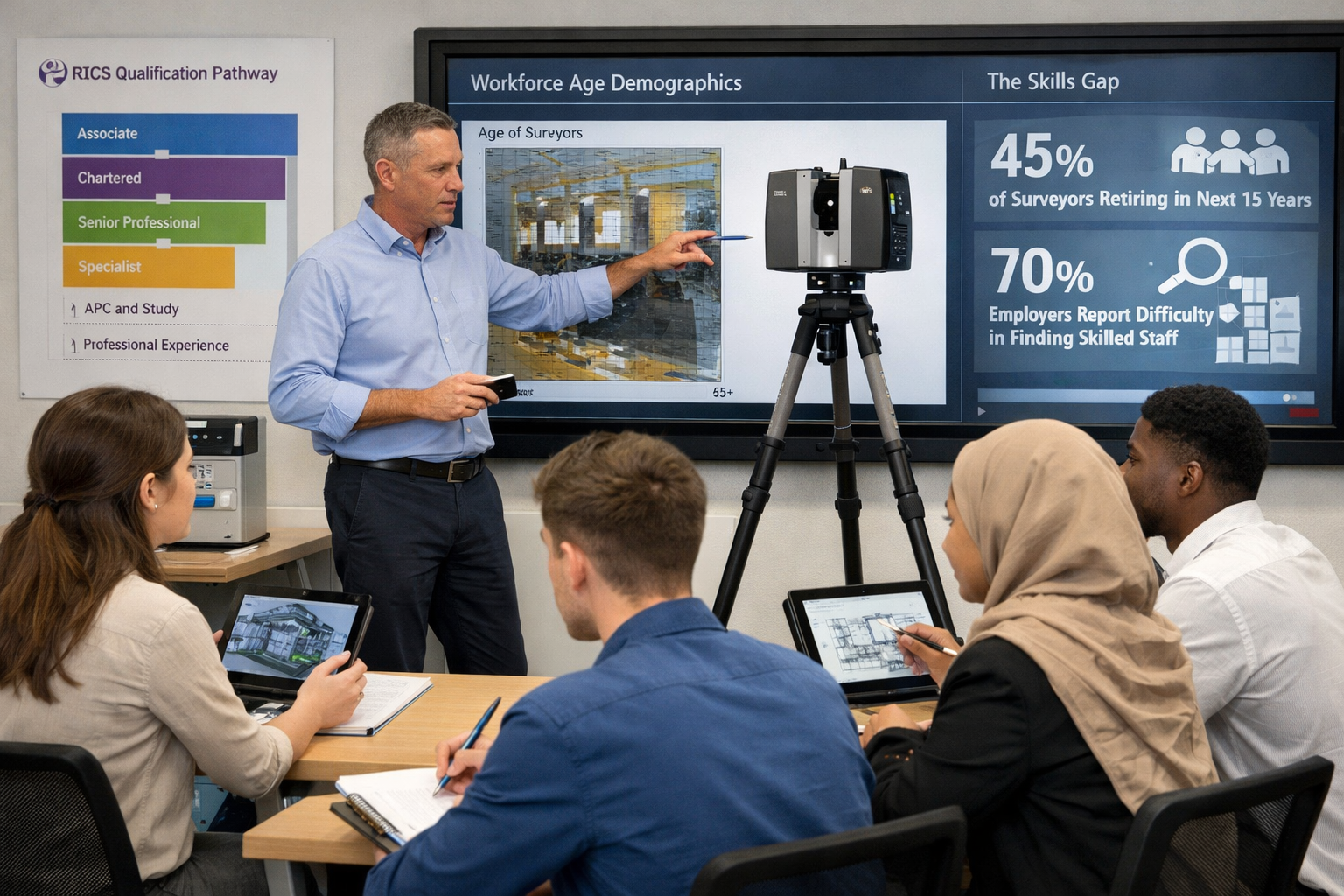
The Scope of the Skills Gap
The surveying profession doesn't exist in isolation—it's deeply interconnected with the broader construction and property sectors. Current workforce data reveals troubling trends that directly impact surveying practices. The construction industry, which relies heavily on surveying expertise, currently faces a shortage of skilled workers that has reached crisis proportions[2].
Key workforce statistics for 2026:
| Metric | Current Status | Impact on Surveying |
|---|---|---|
| Open Positions | 290,000+ nationwide[3] | Increased competition for qualified candidates |
| Average Worker Age | 42 years[3] | Impending retirement wave within 10-15 years |
| Apprenticeship Capacity | Limited by infrastructure[2] | Bottleneck in new talent development |
| Technology Adoption | Accelerating rapidly[3] | Skills gap in digital competencies |
The surveying sector experiences these pressures acutely. What surveyors do has evolved dramatically, requiring mastery of traditional measurement techniques alongside advanced digital technologies, regulatory knowledge, and client communication skills.
Demographic Challenges and Retirement Trends
The aging workforce presents a particularly acute challenge. With the average surveyor age climbing steadily, the profession faces a knowledge transfer crisis. Experienced professionals who understand complex building pathology, historical construction methods, and nuanced client relationship management are approaching retirement without sufficient numbers of trained successors.
This demographic shift creates several interconnected problems:
- Loss of institutional knowledge as senior surveyors retire
- Increased workload on remaining experienced professionals
- Quality concerns when inexperienced staff handle complex assignments
- Client service disruptions due to capacity constraints
- Business continuity risks for firms heavily dependent on senior personnel
Regional Variations in Talent Availability
The skills shortage doesn't affect all regions equally. Metropolitan areas like London often attract more candidates due to higher salaries and career opportunities, while regional markets struggle to compete. Practices serving areas like Buckinghamshire, Ealing, and Romford must develop creative strategies to attract and retain talent in competitive markets.
Rural and semi-rural regions face additional challenges, including:
- Smaller pools of local candidates
- Limited access to training facilities
- Competition from urban employers
- Fewer networking and professional development opportunities
- Transportation and accessibility barriers for apprentices
The Business Case for Investing in Surveyor Talent Pipeline and Training: Preparing the Next Generation for 2026 Market Growth
Return on Investment in Apprenticeship Programs
Despite the challenges, forward-thinking surveying practices are discovering that strategic investment in training delivers measurable returns. Research shows that construction employers prioritizing apprenticeship program development gain competitive advantages, with typical payoff timelines of 18-24 months[3].
The financial logic is compelling:
💰 Cost Comparison
- Hiring experienced surveyors: £45,000-£65,000 starting salary plus recruitment fees
- Training apprentices: Lower initial salary (£18,000-£25,000) with structured progression
- Long-term retention: Apprentices show 40-60% higher retention rates than external hires
The investment extends beyond salary considerations. Firms that develop robust training programs report:
- Reduced recruitment costs through internal talent development
- Enhanced firm culture with mentorship opportunities for senior staff
- Improved client service as apprentices learn firm-specific methodologies
- Competitive differentiation in marketing and business development
- Knowledge preservation through structured transfer from senior to junior staff
Talent Acquisition Trends for 2026
Recent research on talent acquisition trends reveals significant shifts in how organizations approach recruitment and development. According to Korn Ferry's 2026 research, companies are increasingly prioritizing internal talent development and skills-based hiring over traditional credential-focused approaches[5].
For surveying practices, this translates to several strategic opportunities:
Expanding the candidate pool by focusing on aptitude and potential rather than existing qualifications. Many successful surveyors come from non-traditional backgrounds, bringing diverse perspectives and problem-solving approaches.
Emphasizing career development pathways in recruitment messaging. Modern candidates, particularly those in younger demographics, prioritize learning opportunities and clear progression routes over static roles.
Leveraging technology platforms for recruitment and onboarding. HR technology budgets for 2026 show recruiting platforms receiving priority investment[7], reflecting the importance of sophisticated talent acquisition systems.
Building Competitive Advantage Through Training Excellence
In an industry facing widespread skills shortages, firms with superior training programs gain multiple competitive advantages. These benefits extend across all aspects of practice operations:
🎯 Client Service Excellence
Well-trained surveyors deliver more thorough inspections, clearer reports, and better client communication. Whether conducting Level 2 surveys or Level 3 building surveys, properly trained professionals provide superior value.
📈 Business Development
Training programs create marketing opportunities. Firms can highlight their investment in professional development, demonstrating commitment to quality and industry advancement.
🔧 Operational Efficiency
Structured training ensures consistent methodologies across the team, reducing errors and improving quality control. This proves particularly valuable in specialized areas like party wall surveying or commercial property surveys.
RICS Qualification Pathways and Enhanced CPD Frameworks
Understanding the RICS Chartered Surveyor Route
The Royal Institution of Chartered Surveyors has refined its qualification pathways to provide clearer guidance for aspiring professionals. The 2025 RICS Surveying Skills Report identifies specific competency requirements and assessment criteria designed to ensure consistent professional standards[4].
The typical RICS qualification journey includes:
- Academic Foundation – Accredited degree in surveying or related discipline (3-4 years)
- Assessment of Professional Competence (APC) – Structured workplace experience (24 months minimum)
- Final Assessment – Professional interview demonstrating competency achievement
- Continuing Professional Development – Ongoing learning requirements post-qualification
This structured approach provides several benefits for both candidates and employing firms:
✅ Clear expectations for competency development at each stage
✅ Standardized assessment ensuring consistent qualification standards
✅ Flexibility to accommodate different specializations and career paths
✅ Quality assurance protecting public interest and professional reputation
Alternative Entry Routes and Apprenticeship Standards
Recognizing that traditional university routes don't suit all candidates, RICS has developed alternative pathways including:
Degree Apprenticeships combining academic study with paid employment, allowing candidates to earn while they learn without accumulating student debt.
Technical Surveyor Routes providing qualification pathways for those focusing on specific technical specializations rather than full chartered status.
Senior Professional Routes enabling experienced practitioners from related fields to transition into surveying through accelerated programs.
These alternatives address capacity constraints in traditional education while expanding access to surveying careers for diverse candidates.
Enhanced CPD Platforms and Lifelong Learning
The surveying profession evolves continuously, with new technologies, regulations, and methodologies emerging regularly. RICS has responded by enhancing its CPD requirements and delivery platforms, emphasizing lifelong learning as essential to professional competence.
2026 CPD requirements focus on:
- Structured learning through formal courses and qualifications
- Reflective practice documenting how learning applies to professional work
- Ethics and professional conduct maintaining high standards throughout careers
- Technology competency staying current with digital tools and methodologies
Training trends for 2026 emphasize personalized learning pathways, microlearning modules, and technology-enabled delivery methods[6]. Progressive surveying firms are incorporating these approaches into their internal training programs, creating cultures of continuous improvement.
Designing Effective Training Programs for Surveying Practices
Overcoming Infrastructure and Resource Constraints
One of the primary challenges in developing apprenticeship and training programs is infrastructure capacity. Construction apprenticeship programs face limitations including classroom space, equipment availability, funding constraints, and qualified instructor shortages[2].
Surveying practices can address these constraints through:
🤝 Collaborative Training Consortiums
Multiple firms partnering to share training resources, reducing individual costs while expanding capacity. Regional surveying associations can facilitate these collaborations.
💻 Technology-Enabled Learning
Online modules, virtual reality simulations, and digital resources reduce dependency on physical classroom space while providing flexible learning options.
🏢 University Partnerships
Formal relationships with educational institutions provide access to facilities, expertise, and qualified instructors while creating recruitment pipelines.
👥 Mentorship Structures
Pairing apprentices with experienced surveyors for on-the-job learning maximizes existing resources while preserving institutional knowledge.
Curriculum Design for Modern Surveying Practice
Effective training programs must balance traditional surveying fundamentals with modern technological competencies. Understanding what surveyors check requires comprehensive knowledge spanning multiple domains.
Essential curriculum components include:
Technical Foundations
- Building construction and materials
- Structural principles and pathology
- Measurement and calculation methodologies
- Legal and regulatory frameworks
Technology Skills
Modern construction workers expect digital tools, and firms using platforms like Procore and PlanGrid report higher productivity and retention[3]. Training must incorporate:
- Building Information Modeling (BIM)
- Digital measurement tools and laser scanning
- Drone technology for site surveys
- Project management software
- Report writing and presentation tools
Professional Competencies
- Client communication and relationship management
- Report writing and technical documentation
- Ethics and professional conduct
- Business development and practice management
Specialized Knowledge
Depending on practice focus, training may emphasize specific areas such as:
- New build surveys
- Party wall matters and dispute resolution
- Commercial property assessment
- Valuation methodologies
Structured Progression and Assessment
Effective training programs provide clear progression pathways with regular assessment and feedback. This structure benefits both trainees and employers by:
For Trainees:
- Clear understanding of expectations and progress
- Regular feedback supporting skill development
- Motivation through visible achievement
- Confidence building through incremental challenges
For Employers:
- Quality control ensuring competency standards
- Early identification of development needs
- Documentation supporting RICS APC requirements
- Performance management integration
Sample progression framework:
| Stage | Duration | Focus Areas | Assessment Methods |
|---|---|---|---|
| Foundation | Months 1-6 | Basic surveying principles, safety, client interaction | Observation, basic reports, supervisor feedback |
| Development | Months 7-18 | Technical skills, specialized knowledge, independent work | Complex assignments, peer review, client feedback |
| Advanced | Months 19-24 | Leadership, business development, mentoring others | APC preparation, professional interview, project management |
Technology Integration in Surveyor Training
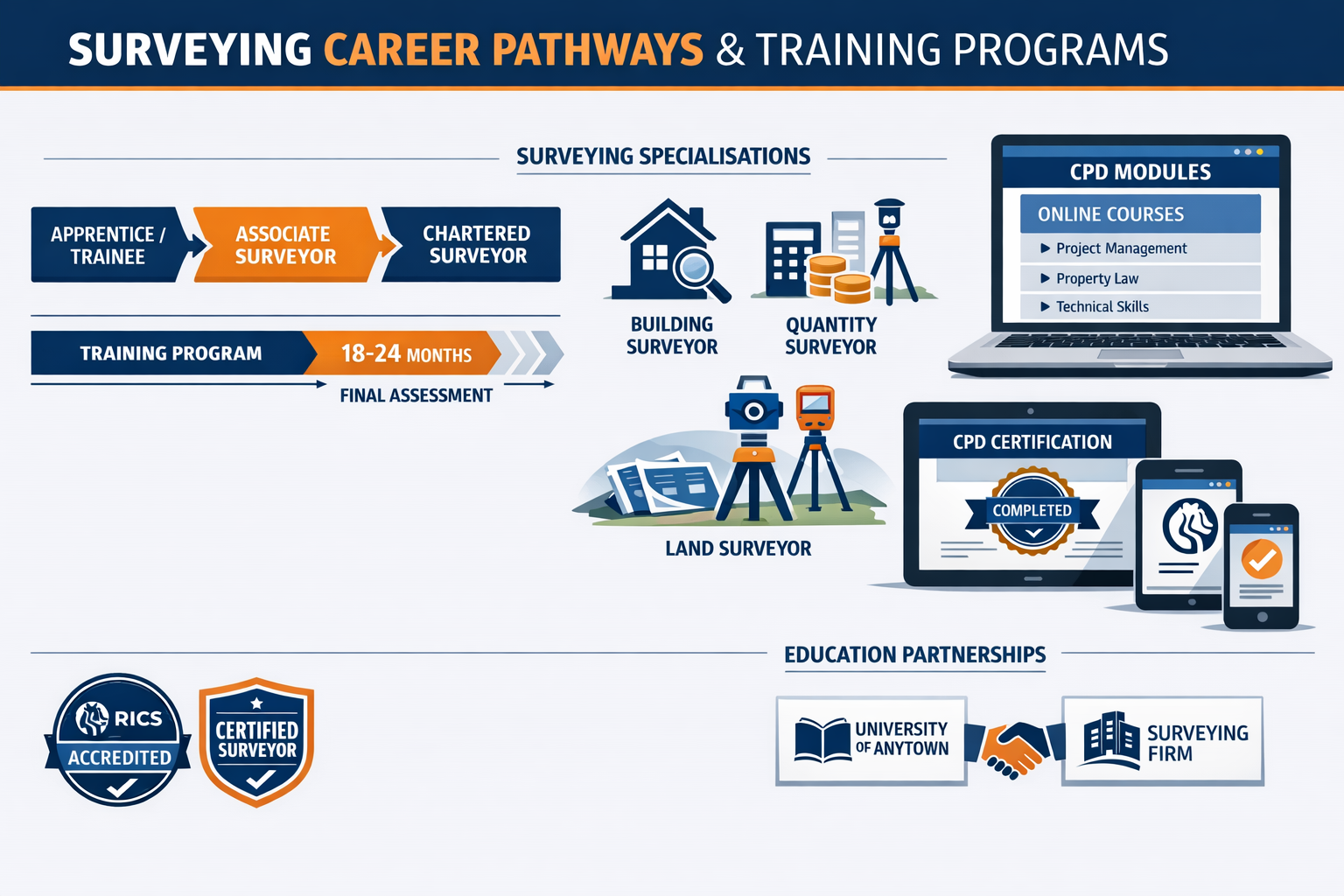
Digital Tools Transforming Surveying Practice
The surveying profession has undergone dramatic technological transformation over the past decade. Training programs must prepare new surveyors for a digital-first practice environment where traditional skills combine with advanced technology competencies.
Key technologies reshaping surveying include:
📱 Mobile and Cloud Platforms
Project management tools enable real-time collaboration, document sharing, and workflow management. Trainees must develop proficiency with industry-standard platforms to meet client expectations and practice efficiency requirements.
🚁 Drone and Aerial Survey Technology
Unmanned aerial vehicles (UAVs) provide cost-effective site documentation, particularly for large properties, roofing inspections, and land surveys. Training programs should include drone operation, data processing, and regulatory compliance.
📐 3D Laser Scanning and Point Cloud Technology
Modern measurement tools capture incredibly detailed spatial data, revolutionizing how surveyors document existing conditions. Understanding these technologies and their applications is increasingly essential.
🏗️ Building Information Modeling (BIM)
BIM has become standard in construction and increasingly important in surveying. Trainees need familiarity with BIM concepts, software platforms, and collaborative workflows.
Balancing Traditional and Modern Methodologies
While technology offers tremendous advantages, effective surveying still requires fundamental skills that technology cannot replace. Training programs must balance innovation with tradition:
Irreplaceable traditional skills:
- Visual assessment and pattern recognition
- Tactile investigation techniques
- Professional judgment and experience-based decision making
- Client relationship building and communication
- Understanding historical construction methods
Technology as enhancement, not replacement:
The most effective surveyors use technology to enhance, not replace, professional judgment. Training should emphasize critical thinking about when and how to apply different tools and methodologies.
Preparing for Emerging Technologies
Forward-thinking training programs also prepare trainees for technologies still emerging or evolving:
- Artificial intelligence for data analysis and pattern recognition
- Augmented reality for on-site visualization and client presentations
- Internet of Things (IoT) sensors for building performance monitoring
- Blockchain for property records and transaction management
While these technologies may not be mainstream in 2026, exposure during training prepares surveyors for continuous adaptation throughout their careers.
Recruitment Strategies for Building Your Surveyor Talent Pipeline
Attracting Young Talent to Surveying Careers
The surveying profession faces a perception challenge among young people considering career options. Many school leavers and university students have limited awareness of surveying as a profession or understanding of its diverse opportunities.
Effective recruitment strategies include:
🎓 Educational Outreach
Partnering with schools and colleges to provide career talks, work experience placements, and mentoring programs raises awareness and builds interest in surveying careers.
💼 Apprenticeship Marketing
Promoting apprenticeship opportunities as alternatives to traditional university routes appeals to candidates seeking debt-free education and practical experience.
🌟 Digital Recruitment
Modern candidates research careers extensively online. Practices need strong digital presence showcasing culture, career opportunities, and employee testimonials.
📊 Highlighting Career Benefits
Emphasizing surveying's advantages:
- Diverse specialization options
- Strong earning potential
- Job security and demand
- Varied work environments
- Professional status and respect
- Technology integration and innovation
Diversity and Inclusion in Talent Development
The surveying profession has historically lacked diversity, particularly in gender and ethnic representation. Building inclusive talent pipelines addresses this imbalance while strengthening the profession through diverse perspectives and approaches.
Inclusive recruitment practices:
- Reviewing job descriptions and requirements to remove unnecessary barriers
- Partnering with organizations supporting underrepresented groups
- Providing flexible working arrangements supporting diverse needs
- Creating mentorship programs connecting diverse candidates with role models
- Addressing unconscious bias in assessment and progression decisions
Research consistently shows that diverse teams deliver better outcomes, enhanced creativity, and improved problem-solving. For surveying practices, diversity strengthens client service and business performance.
Retention Through Career Development
Attracting talent represents only the first step. Retention requires ongoing investment in career development, professional growth, and job satisfaction.
Retention strategies for surveying practices:
✨ Clear progression pathways showing how trainees advance to senior roles
✨ Competitive compensation reflecting market rates and individual contribution
✨ Professional development support including RICS fees, CPD funding, and study time
✨ Work-life balance through flexible arrangements and reasonable workload management
✨ Recognition and reward acknowledging achievements and contributions
✨ Engaging work providing variety, challenge, and meaningful client impact
Firms investing in apprenticeship programs typically see 40-60% higher retention rates compared to external hiring, creating long-term stability and reducing recruitment costs.
Regional Considerations and Local Market Dynamics
Adapting Training to Regional Market Needs
Surveying practice varies significantly across different regions, influenced by local property markets, construction types, regulatory environments, and client expectations. Training programs should reflect these regional variations.
Regional factors influencing training:
London and Metropolitan Areas
High-value properties, complex construction, diverse building types, and sophisticated clients require advanced technical knowledge and strong communication skills. Practices serving areas like Chelsea, Battersea, and Hampstead emphasize premium service delivery.
Suburban and Commuter Belt
Areas like Chiswick, Weybridge, and Epsom feature mixed property types requiring versatility across residential survey levels and commercial work.
Regional Towns and Rural Areas
Markets in Sussex, Hampshire, and Watford may emphasize agricultural buildings, conservation properties, and local construction traditions.
Building Regional Training Networks
Individual practices, particularly smaller firms, may struggle to provide comprehensive training independently. Regional collaboration creates opportunities for shared resources and enhanced training quality.
Collaborative approaches include:
- Regional training consortiums sharing costs and resources
- Practice exchange programs providing trainees with diverse experience
- Joint CPD events bringing together professionals for learning and networking
- Shared specialist resources accessing expertise beyond individual firm capacity
- University partnerships connecting academic institutions with local practices
These networks strengthen the profession regionally while supporting individual firm development.
Measuring Success: KPIs for Training Program Effectiveness
Quantitative Metrics
Effective training programs require measurement and continuous improvement. Key performance indicators help practices assess program effectiveness and identify enhancement opportunities.
Essential training metrics:
| Metric | Target | Measurement Method |
|---|---|---|
| Apprentice Retention Rate | >75% completion | Track starts vs. completions |
| Time to Competency | 18-24 months | Assessment milestones |
| RICS APC Pass Rate | >90% first attempt | Exam results tracking |
| Post-Qualification Retention | >80% at 3 years | Employee tenure data |
| Training ROI | Positive by month 24 | Cost-benefit analysis |
| Client Satisfaction | >4.5/5.0 average | Feedback surveys |
Qualitative Assessment
Numbers tell only part of the story. Qualitative assessment provides deeper insights into training program effectiveness:
Feedback mechanisms:
- Regular trainee interviews and surveys
- Supervisor and mentor evaluations
- Client feedback on trainee performance
- Peer assessment and collaboration observations
- Self-reflection and personal development reviews
Cultural indicators:
- Knowledge sharing and collaboration frequency
- Innovation and improvement suggestions from trainees
- Mentoring engagement from senior staff
- Professional pride and firm advocacy
- External recognition and industry awards
Continuous Improvement Processes
Training programs should evolve based on assessment data, industry changes, and emerging best practices. Establishing regular review cycles ensures ongoing relevance and effectiveness.
Improvement framework:
- Quarterly reviews of trainee progress and program delivery
- Annual curriculum updates reflecting industry changes and feedback
- Benchmarking against industry standards and competitor programs
- Stakeholder consultation with trainees, supervisors, clients, and RICS
- Innovation testing piloting new approaches and technologies
Case Studies: Successful Training Program Models

Multi-Firm Apprenticeship Consortium
A group of five surveying practices across West London and North West London established a collaborative apprenticeship program in 2024, now serving as a model for regional training initiatives.
Program structure:
- Shared recruitment and selection process
- Rotational placements across member firms
- Joint classroom training sessions
- Pooled funding for specialist instructors
- Collaborative CPD events
Results after 18 months:
- 12 apprentices recruited (vs. 2-3 individually)
- 95% retention rate
- Reduced per-firm training costs by 40%
- Enhanced learning through diverse experience
- Strengthened regional professional community
Technology-Focused Training Innovation
A progressive surveying practice specializing in commercial building surveys redesigned its training program around digital-first methodologies, incorporating advanced technologies from day one.
Key innovations:
- Virtual reality building pathology training
- Drone operation certification for all trainees
- BIM software proficiency requirements
- Digital report writing and presentation tools
- Project management platform integration
Outcomes:
- 30% faster time to independent working
- Enhanced client satisfaction scores
- Competitive advantage in business development
- Improved trainee recruitment and retention
- Industry recognition and awards
University Partnership Model
A regional firm established a formal partnership with a local university offering accredited surveying degrees, creating an integrated academic-practical training pathway.
Partnership elements:
- Guest lectures from practice professionals
- Work placement programs for students
- Collaborative research projects
- Preferential recruitment access
- Shared facilities and resources
Benefits:
- Consistent talent pipeline
- Enhanced firm reputation
- Access to academic expertise
- Reduced recruitment costs
- Knowledge exchange and innovation
Overcoming Common Training Program Challenges
Resource Constraints and Budget Limitations
Many surveying practices, particularly smaller firms, face genuine resource constraints when considering training program investment. However, creative approaches can overcome these limitations:
Cost-effective strategies:
💡 Phased implementation starting small and expanding as programs prove value
💡 Grant and funding programs accessing government apprenticeship incentives
💡 Technology leverage using online resources and digital tools
💡 Collaborative approaches sharing costs through consortiums
💡 Structured mentoring maximizing existing staff expertise
The 18-24 month payoff timeline for apprenticeship programs[3] means initial investment delivers returns relatively quickly, particularly when compared to ongoing recruitment costs for experienced staff.
Balancing Training with Operational Demands
Practices often struggle to balance training responsibilities with client service delivery and operational pressures. This tension can undermine program effectiveness if not managed carefully.
Balance strategies:
- Dedicated training time protected in schedules and workload planning
- Realistic progression timelines avoiding rushed development
- Appropriate supervision ratios ensuring adequate mentor capacity
- Client communication setting expectations for trainee involvement
- Workflow design incorporating training-appropriate assignments
Maintaining Consistency and Quality
As training programs grow and evolve, maintaining consistent quality across different supervisors, projects, and timeframes becomes challenging.
Quality assurance approaches:
✓ Documented standards providing clear expectations and assessment criteria
✓ Regular calibration ensuring consistent supervisor approaches
✓ Structured reviews catching issues early
✓ External validation through RICS assessment and industry benchmarking
✓ Continuous feedback from all stakeholders
The Future of Surveyor Talent Pipeline and Training: Preparing the Next Generation for 2026 Market Growth
Emerging Trends Shaping Training Evolution
The surveying profession continues evolving, driven by technological advancement, regulatory changes, and shifting client expectations. Training programs must anticipate and prepare for these changes.
Key trends influencing future training:
🔮 Increased specialization as surveying knowledge deepens and diversifies
🔮 Sustainability focus with environmental assessment and energy efficiency expertise
🔮 Data analytics applying advanced analysis to building performance and valuation
🔮 Integrated service delivery combining surveying with project management and consultancy
🔮 Global perspectives as property markets become increasingly international
Policy and Regulatory Developments
Government policy significantly impacts training program viability and structure. Current trends suggest continued emphasis on apprenticeships, skills development, and professional qualification pathways.
Policy areas to monitor:
- Apprenticeship levy and funding mechanisms
- Construction skills initiatives and grants
- Professional qualification recognition
- Immigration policy affecting workforce availability
- Educational funding and student finance
Building Resilient Talent Pipelines
The ultimate goal of training investment is creating sustainable talent pipelines that support long-term business success. This requires strategic thinking beyond immediate needs.
Long-term pipeline development:
📈 Multi-year planning anticipating future capacity needs
📈 Brand building establishing reputation as employer of choice
📈 Alumni networks maintaining relationships with former trainees
📈 Industry leadership contributing to professional development broadly
📈 Continuous innovation staying ahead of training best practices
Conclusion: Taking Action on Surveyor Talent Development
The surveying profession stands at a pivotal moment in 2026. Market growth creates tremendous opportunities, but realizing these opportunities requires addressing the critical skills shortage through strategic investment in talent pipeline development and training excellence.
The evidence is clear: practices that prioritize training gain competitive advantages in recruitment, retention, client service, and long-term sustainability. The 18-24 month payoff timeline for apprenticeship programs demonstrates that training investment delivers tangible returns, not just long-term benefits.
Immediate action steps for surveying practices:
- Assess current capacity and identify specific skills gaps and future needs
- Explore partnership opportunities with universities, other firms, or industry associations
- Review RICS pathways and align internal programs with professional standards
- Invest in technology supporting both training delivery and modern practice
- Develop recruitment strategies targeting diverse candidate pools
- Establish measurement systems tracking program effectiveness and ROI
- Commit leadership support ensuring training receives necessary resources and priority
The next generation of surveyors will shape the profession for decades to come. Whether they develop the competencies, technologies, and professional standards required for excellence depends on the training investments made today.
For practices ready to build robust talent pipelines, the opportunity is significant. Those who act decisively on Surveyor Talent Pipeline and Training: Preparing the Next Generation for 2026 Market Growth will not only solve their immediate capacity challenges but position themselves as industry leaders for years to come.
The question is not whether to invest in training, but how quickly and effectively practices can implement programs that attract, develop, and retain the surveying professionals who will drive future success. The time for action is now.
References
[1] Early Exposure Education And Training Blueprint For Constructions Workforce Woes – https://www.trimble.com/blog/trimble/en-US/article/early-exposure-education-and-training-blueprint-for-constructions-workforce-woes
[2] Construction Industry Labor Shortage Data Drivers And Strategic Responses – https://abccarolinas.org/construction-industry-labor-shortage-data-drivers-and-strategic-responses/
[3] 2026 Construction Workforce Trends For Employers – https://www.worldwide-rs.com/blog/2026/01/2026-construction-workforce-trends-for-employers/
[4] Surveying Skills Report 2025 – https://www.rics.org/content/dam/ricsglobal/documents/reports/Surveying-skills-report-2025.pdf
[5] Korn Ferry Research Unveils Top Talent Acquisition Trends Shaping 2026 – https://www.kornferry.com/about-us/press/korn-ferry-research-unveils-top-talent-acquisition-trends-shaping-2026
[6] Top Trends In Training For 2026 – https://strategichrinc.com/top-trends-in-training-for-2026/
[7] Recruiting Platforms Get Hr Tech Budget Priority For 2026 Plus People Move News – https://hrexecutive.com/recruiting-platforms-get-hr-tech-budget-priority-for-2026-plus-people-move-news/
