
}
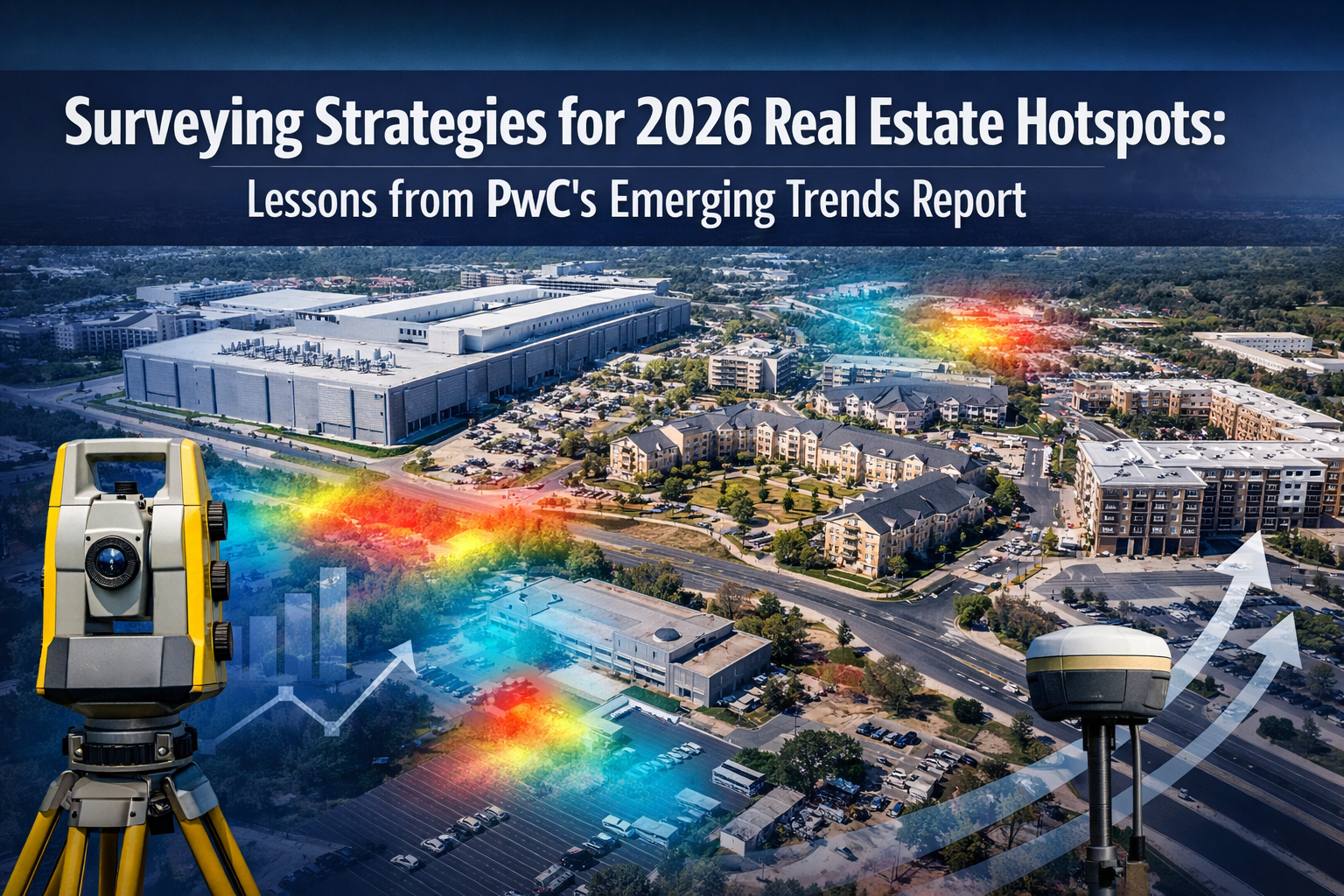
The real estate landscape is undergoing a seismic shift. Gone are the days when investors could rely on broad sector bets and favorable capital markets to drive returns. As we navigate through 2026, PwC's Emerging Trends in Real Estate report reveals a fundamental transformation: success now demands granular, asset-specific analysis and sophisticated surveying strategies tailored to emerging hotspots. For surveyors, investors, and real estate professionals, understanding these Surveying Strategies for 2026 Real Estate Hotspots: Lessons from PwC's Emerging Trends Report isn't just advantageous—it's essential for survival in an increasingly competitive market.
The report's findings paint a picture of cautious optimism mixed with strategic complexity. Industry participants rate 2026 prospects as "fair but improving" with a confidence score of 2.81 on a five-point scale[4]. Yet beneath this modest outlook lies a wealth of opportunity for those equipped with the right surveying methodologies and market intelligence. From data centers grappling with power constraints to senior housing facilities preparing for the first baby boomers turning 80, the opportunities are both diverse and demanding.
Key Takeaways
- 🎯 Asset-specific surveying has replaced broad sector analysis as the critical success factor, requiring deeper building-level and submarket assessments
- 📊 Five interconnected trends are reshaping real estate: capital market uncertainty, niche assets becoming essential, operational focus, demographic shifts, and AI integration[2]
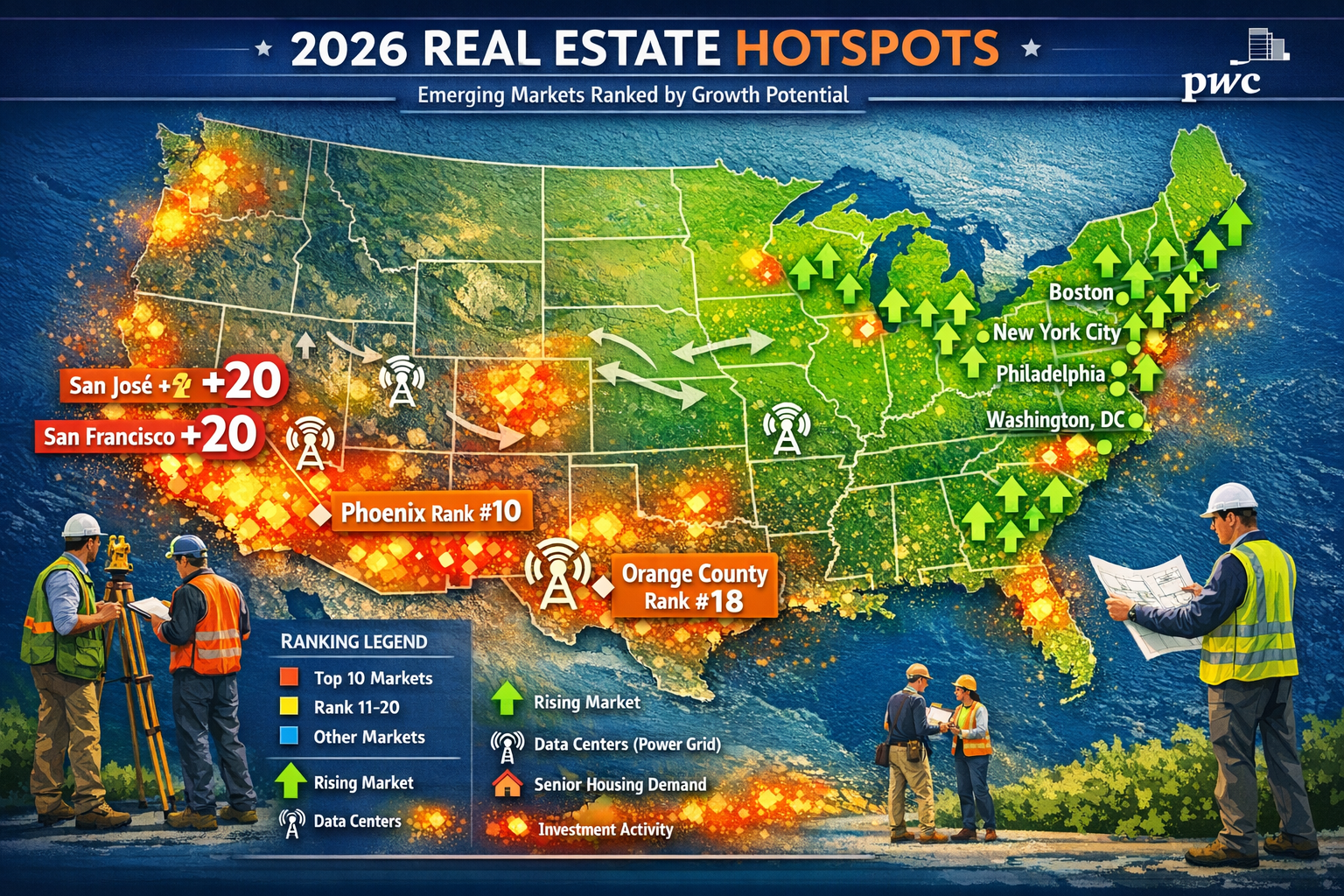
- 🏙️ Northeast markets show strongest momentum with 10 of 15 markets gaining in rankings, while Northern California tech hubs rebounded over 20 positions[4]
- 🏢 Data centers, senior housing, and storage condos represent the highest-demand property types requiring specialized surveying approaches
- 💡 Operational excellence now drives value more than financing advantages, demanding comprehensive building condition and revenue potential assessments
Understanding the Five Pivotal Trends Framework from PwC's 2026 Report
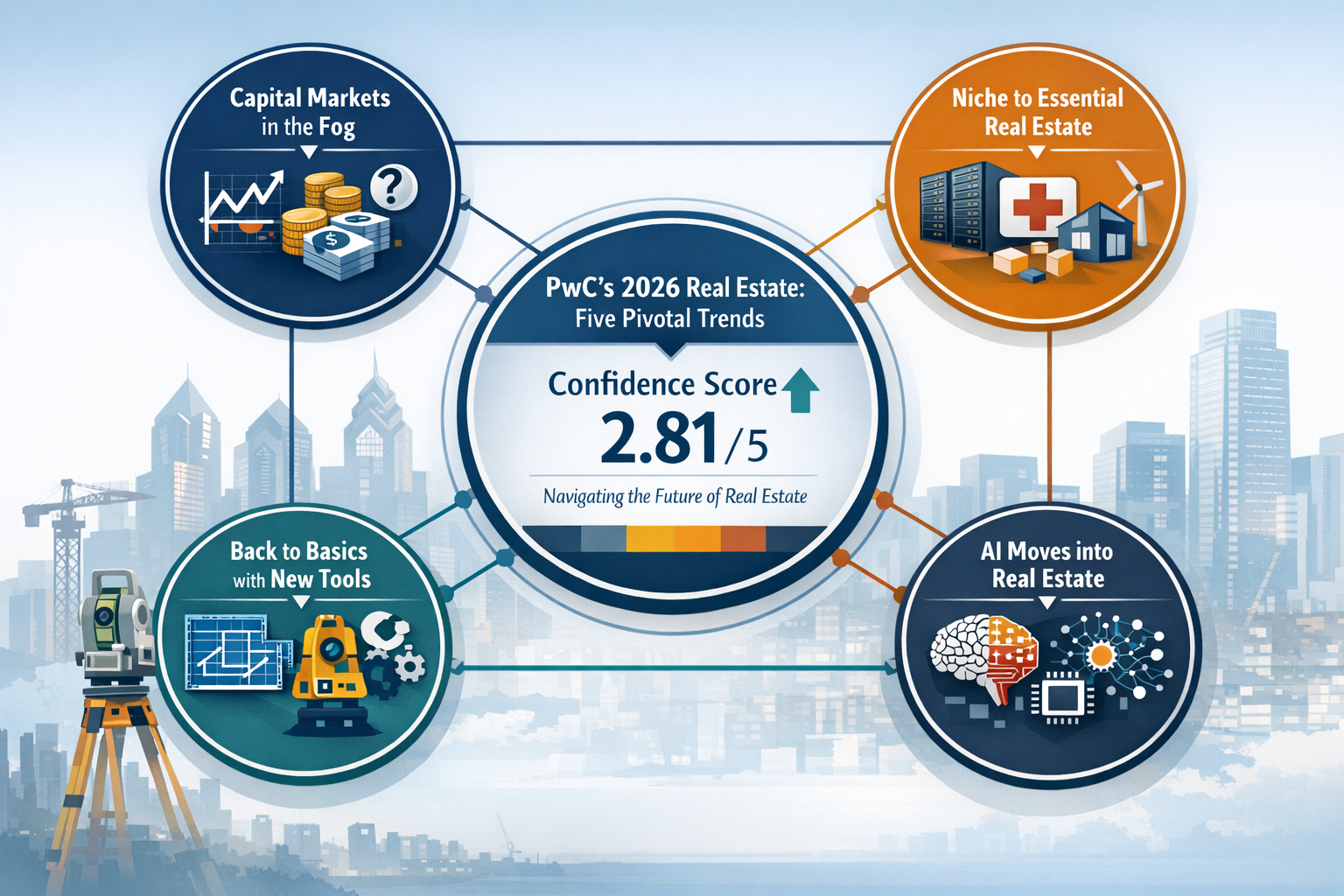
The foundation of effective Surveying Strategies for 2026 Real Estate Hotspots: Lessons from PwC's Emerging Trends Report begins with comprehending the five interconnected themes that define the industry's evolution. These frameworks provide the strategic context that should inform every site assessment, valuation, and investment decision.
Half Full or Half Empty? Capital Markets in the Fog
The first trend addresses the persistent uncertainty in capital markets. Interest rates remain elevated compared to the ultra-low environment of the 2010s, and transaction volumes continue below historical norms. For surveyors, this creates both challenges and opportunities.
What this means for surveying strategies:
- Greater emphasis on accurate valuation reports that account for higher discount rates
- Increased scrutiny of building condition to avoid post-acquisition surprises
- More detailed analysis of income-generating potential versus capital appreciation
- Enhanced focus on RICS valuations that meet lender requirements in tighter credit environments
The capital market fog demands that surveyors provide crystal-clear assessments of property fundamentals. Investors can no longer rely on rising tides lifting all boats; they need granular intelligence about specific assets.
Niche to Essential Real Estate
Properties once considered alternative or niche—data centers, life sciences facilities, senior housing, and self-storage—have moved into the mainstream investment conversation[2]. This shift fundamentally changes surveying priorities.
Survey considerations for emerging essential assets:
| Property Type | Critical Survey Elements | Specialized Expertise Required |
|---|---|---|
| Data Centers | Power infrastructure, cooling systems, fiber connectivity, seismic resilience | Electrical engineering, telecommunications |
| Senior Housing | ADA compliance, medical equipment infrastructure, safety systems | Healthcare facility standards, accessibility codes |
| Life Sciences | HVAC precision, contamination controls, specialized utilities | Laboratory standards, biosafety protocols |
| Storage Condos | Individual unit access systems, climate control, security infrastructure | Mixed-use zoning, condominium regulations |
Surveyors must now develop expertise across property types that didn't exist in traditional residential or commercial categories. The structural engineer reports required for these facilities often involve specialized consultants who understand industry-specific requirements.
Back to Basics with New Tools: Asset Selection and Operations
Perhaps the most significant trend for surveying professionals is the industry's pivot from sector-wide strategies to asset-specific and submarket-specific analysis[3]. This represents a fundamental shift in how real estate value is created and preserved.
The report emphasizes that future returns will increasingly derive from property operations, revenue growth, and expense management rather than financing advantages and declining cap rates[3]. This operational focus demands that surveyors provide actionable intelligence about:
- Building systems efficiency and expected capital expenditure schedules
- Tenant mix quality and lease rollover risk
- Competitive positioning within specific submarkets
- Revenue enhancement opportunities through renovations or repositioning
- Expense reduction potential through energy efficiency or management improvements
For surveyors, this means moving beyond simple condition assessments to provide strategic operational intelligence. A comprehensive Level 3 building survey now serves as the foundation for operational planning, not just transaction due diligence.
Demographics Will Define Demand
The demographic transformation underway in 2026 creates distinct surveying requirements for different property types. With the first baby boomers turning 80 this year, senior housing faces unprecedented demand[1]. Simultaneously, student housing confronts demographic headwinds and visa uncertainties[1].
Demographic-informed surveying checklist:
✅ For Senior Housing:
- Accessibility features and potential ADA upgrade requirements
- Medical equipment infrastructure capacity
- Common area suitability for wellness programs
- Technology integration for health monitoring
- Proximity to healthcare facilities and services
✅ For Student Housing:
- Flexibility for alternative uses if enrollment declines
- Technology infrastructure for hybrid learning
- Amenity quality relative to competitive set
- Proximity to employment centers (alternative tenant base)
✅ For Multifamily:
- Unit size mix alignment with household formation trends
- Remote work amenities (home office potential)
- Multigenerational living adaptability
- Affordability positioning within submarket
Understanding demographic trends allows surveyors to assess not just current condition but future relevance of property configurations.
AI Moves into Real Estate
Artificial intelligence is transforming both real estate operations and surveying methodologies. AI-powered tools now assist with property inspections, defect detection, energy analysis, and market comparisons.
AI-enhanced surveying applications in 2026:
- 🤖 Drone-based inspections with AI image analysis for roof and facade assessments
- 📸 Computer vision for identifying structural defects and maintenance issues
- 📊 Predictive analytics for building system failure forecasting
- 🗺️ Geospatial AI for submarket analysis and comparable property identification
- 💰 Automated valuation models (AVMs) enhanced with hyperlocal data
While AI enhances surveying capabilities, it doesn't replace professional judgment. The most effective approach combines AI-powered data collection with expert interpretation—particularly for complex properties in emerging hotspot markets.
Geographic Hotspots: Where Surveying Demand is Concentrating in 2026
The PwC report identifies clear geographic winners and areas of renewed momentum. Understanding these Surveying Strategies for 2026 Real Estate Hotspots: Lessons from PwC's Emerging Trends Report requires examining specific markets and what makes them attractive.
Northeast Region: The Unexpected Leader
The Northeast region demonstrates the strongest momentum with 10 of 15 markets gaining in rankings, and six of these markets reaching the top 20 overall[4]. This represents a significant shift from previous years when Southern and Western markets dominated investor attention.
Why the Northeast is surging:
- Strong demographic fundamentals with educated workforce concentration
- Life sciences cluster development (Boston, Cambridge)
- Established infrastructure supporting data center growth
- Limited new supply in gateway markets maintaining pricing power
- Climate considerations favoring northern locations
Surveying priorities for Northeast markets:
For investors targeting Northeast properties, building surveys must address region-specific concerns:
- Historic building adaptation: Many Northeast properties involve older structures requiring specialized assessment of renovation feasibility
- Climate resilience: Winter weather impacts on building systems, roof structures, and energy efficiency
- Zoning complexity: Dense urban environments with complicated regulatory frameworks
- Infrastructure age: Older utility systems and potential environmental concerns
The difference between Level 2 and Level 3 surveys becomes particularly important in Northeast markets where building age and complexity typically warrant more comprehensive assessments.
Northern California: The Tech Rebound
San José and San Francisco moved up over 20 places in 2026 rankings, rising from the bottom third to the middle of overall market rankings[4]. This dramatic rebound reflects renewed confidence in tech sector fundamentals and AI-driven space demand.
Tech hub surveying considerations:
- Seismic assessment: Earthquake preparedness for both structural integrity and business continuity
- Technology infrastructure: Fiber connectivity, power redundancy, cooling capacity for AI workloads
- Adaptive reuse potential: Office-to-residential conversion feasibility as hybrid work continues
- Transportation access: Proximity to transit given evolving commute patterns
The tech sector's revival creates opportunities for surveyors who understand both traditional building assessment and technology infrastructure requirements. Properties serving AI companies may need specialized evaluation of power delivery systems and cooling infrastructure typically associated with data centers.
Western Markets: Sustained Strength
Phoenix maintained its 10th place ranking while Orange County moved up 11 places to rank 18th[4]. These Western markets benefit from continued migration trends, business-friendly environments, and diversified economic bases.
Western market survey focus areas:
- Water infrastructure and drought resilience: Critical for long-term viability
- Energy efficiency in extreme heat: HVAC systems and insulation performance
- Rapid construction quality: Many newer buildings requiring verification of construction standards
- Expansion capacity: Land availability and zoning for future development
For Western markets experiencing rapid growth, snagging reports become particularly valuable for newly constructed properties where quality control may have been compromised by construction speed.
Secondary and Tertiary Markets: The Hidden Opportunities
While gateway markets receive most attention, the PwC report suggests that submarket-specific analysis matters more than broad geographic categorization[3]. This creates opportunities in secondary and tertiary markets that offer superior fundamentals at more attractive pricing.
Identifying promising secondary markets:
🔍 Economic diversification: Markets with multiple employment drivers rather than single-industry dependence
🔍 Infrastructure investment: Public transit, fiber networks, and utility upgrades signaling long-term commitment
🔍 Demographic trends: Population growth, educational attainment, and household formation rates
🔍 Development pipeline: Balanced new supply relative to demand absorption
🔍 Regulatory environment: Permitting efficiency and business-friendly policies
For secondary markets, comprehensive homebuyer surveys and commercial property assessments must evaluate not just the building but the broader market context that will drive future demand.
Property Type-Specific Surveying Strategies for High-Demand Sectors
The shift toward operational value creation and niche-to-essential property types requires surveyors to develop specialized expertise. Here are detailed surveying strategies for the highest-demand property types identified in PwC's 2026 report.
Data Centers: Power, Cooling, and Connectivity
National data center vacancy remains below 2% with most facilities pre-leased before completion[1]. However, growth is concentrating in markets with reliable energy access as power availability becomes the defining factor for digital infrastructure investment.
Comprehensive data center survey checklist:
Power Infrastructure Assessment:
- Total power capacity and redundancy (N+1, 2N configurations)
- Utility provider reliability and backup generation
- Power distribution unit (PDU) condition and capacity
- Uninterruptible power supply (UPS) systems and battery backup
- Electrical infrastructure upgrade potential
- Connection to multiple substations for redundancy
Cooling Systems Evaluation:
- Computer room air conditioning (CRAC) unit efficiency
- Hot aisle/cold aisle containment effectiveness
- Water cooling infrastructure and water availability
- Outside air economization potential
- Temperature and humidity monitoring systems
- Cooling capacity relative to power density
Connectivity and Location:
- Fiber optic connectivity and carrier diversity
- Network latency to major internet exchange points
- Physical security and access control systems
- Proximity to power generation sources
- Natural disaster risk (flooding, earthquakes, hurricanes)
- Regulatory environment for data privacy and operations
The specialized nature of data center surveying often requires collaboration with electrical engineers and telecommunications experts. For investors entering this sector, understanding what surveyors do in specialized contexts helps set appropriate expectations.
Senior Housing: The Demographic Wave
With the first baby boomers turning 80 in 2026, senior housing demand is reaching a critical threshold with record-high occupancy levels and limited new supply[1]. Developers are diversifying offerings into independent living lite communities, wellness-focused facilities, and tech-enabled options.
Senior housing survey priorities:
Regulatory Compliance:
- State-specific licensing requirements for assisted living
- Americans with Disabilities Act (ADA) compliance
- Fire safety systems and egress requirements
- Healthcare facility standards where applicable
- Medication management infrastructure
- Emergency response systems
Resident Safety and Accessibility:
- Grab bars, handrails, and fall prevention features
- Elevator capacity and reliability
- Bathroom accessibility and safety features
- Corridor widths and wheelchair accessibility
- Emergency lighting and backup power
- Secure outdoor spaces and wandering prevention (for memory care)
Operational Infrastructure:
- Commercial kitchen facilities and food service areas
- Nurse call systems and health monitoring technology
- Common areas for activities and socialization
- Therapy and rehabilitation spaces
- Medical equipment storage and distribution
- Laundry and housekeeping facilities
Market Positioning:
- Competitive amenity assessment within submarket
- Proximity to hospitals and medical services
- Public transportation access for staff and visitors
- Expansion capacity for future phases
- Mixed-acuity potential (independent to skilled nursing continuum)
Senior housing facilities benefit from comprehensive structural surveys that evaluate both current condition and adaptation potential as resident needs evolve over time.
Storage Condos: The Emerging Hybrid Asset
Self-storage is evolving into a hybrid asset class with a new subsegment—storage condos—blending industrial and personal-use space as a unique investment opportunity[1]. This emerging property type requires surveying approaches that combine elements of industrial, retail, and condominium assessment.
Storage condo survey considerations:
Individual Unit Assessment:
- Climate control systems and energy efficiency
- Individual utility metering infrastructure
- Security systems (unit-level and facility-level)
- Access control technology and monitoring
- Fire suppression and detection systems
- Electrical capacity for workshop/business use
Common Area Evaluation:
- Loading dock and drive-up access
- Parking adequacy for unit owners and customers
- Elevator capacity for multi-story facilities
- Common restroom and office facilities
- Landscaping and exterior maintenance
- Signage and wayfinding systems
Legal and Operational Structure:
- Condominium declaration and bylaws review
- Common area maintenance responsibilities
- Reserve fund adequacy for capital improvements
- Use restrictions and enforcement mechanisms
- Owner association governance structure
- Mixed-use zoning compliance
The hybrid nature of storage condos means surveyors must understand both industrial building standards and condominium legal frameworks—a unique combination requiring specialized expertise.
Student Housing: Navigating Uncertainty
After strong 2024 recovery with near-record absorption and steady rent increases, student housing now faces demographic headwinds, ongoing visa delays, and rising construction costs[1]. This creates both risks and opportunities for investors with appropriate due diligence.
Student housing survey strategy:
Enrollment Risk Mitigation:
- Proximity to campus and academic buildings
- Alternative use potential (conventional multifamily conversion)
- Unit configuration flexibility
- Appeal to non-traditional students (graduate, professional)
- Co-living suitability for young professionals
Competitive Positioning:
- Amenity quality relative to university-owned housing
- Technology infrastructure (high-speed internet, smart units)
- Study spaces and academic support areas
- Fitness and recreation facilities
- Social spaces and community programming areas
Operational Considerations:
- Turnover-resistant finishes and materials
- Furniture package condition (if furnished)
- Individual bedroom locks and privacy features
- Lease-up timeline alignment with academic calendar
- Parking ratios and transportation options
Financial Structure:
- Parent guarantee requirements and collection risk
- Seasonal cash flow patterns
- Operating expense ratios relative to conventional multifamily
- Management intensity and staffing requirements
For student housing properties, Level 2 vs Level 3 survey decisions often depend on building age and the likelihood of conversion to alternative uses if enrollment declines.
Office: The Bifurcated Market
Top-tier office buildings in major markets are capturing record rents, while overall valuations remain far below pre-pandemic peaks[1]. Lower-quality and less central properties continue struggling with elevated vacancies, indicating a selective and uneven recovery.
Quality-stratified office survey approach:
For Trophy/Class A Properties:
- Technology infrastructure supporting hybrid work
- Wellness features (air quality, natural light, outdoor access)
- Collaborative space design and flexibility
- Sustainability certifications and energy performance
- Amenity quality (fitness, food service, conference facilities)
- Public transportation connectivity
For Class B/C Properties:
- Adaptive reuse feasibility (residential, lab, industrial)
- Capital expenditure requirements for competitive repositioning
- Floor plate efficiency and layout flexibility
- Building systems end-of-life assessment
- Structural capacity for alternative uses
- Demolition versus renovation economics
For All Office Properties:
- Tenant credit quality and lease rollover schedule
- Operating expense competitiveness
- Property management effectiveness
- Capital reserve adequacy
- Environmental systems performance
- Parking ratio and alternative transportation options
The bifurcated office market means that RICS building surveys must go beyond physical condition to assess competitive positioning and strategic alternatives.
Operational Value Creation: Surveying for Performance Enhancement
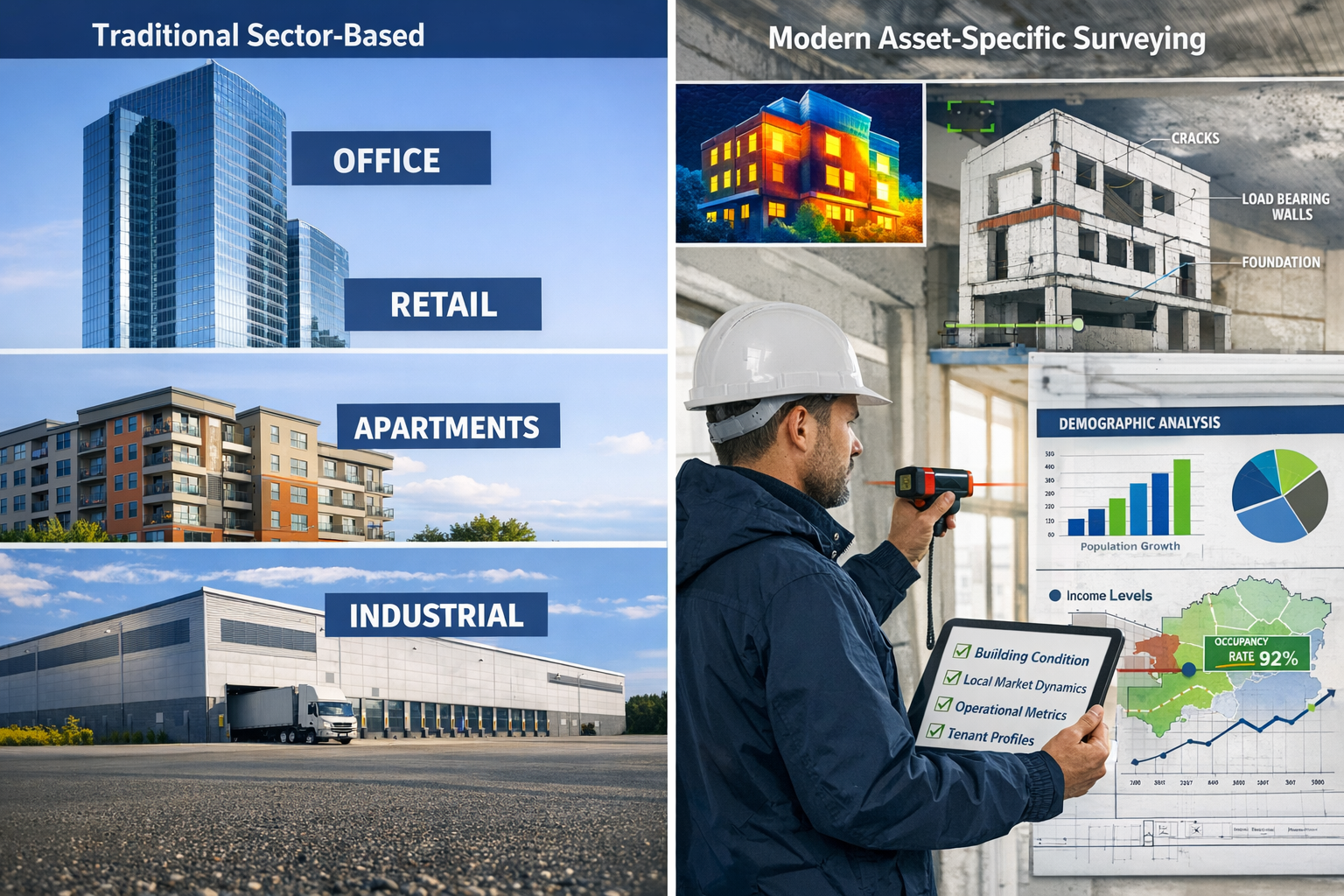
The PwC report emphasizes that value creation now derives from property operations, revenue growth, and expense management rather than financing advantages[3]. This operational focus transforms the surveyor's role from transaction facilitator to strategic advisor.
Revenue Enhancement Opportunities
Surveyors can identify revenue growth potential through:
Physical Improvements:
- Unit renovation potential and expected rent premiums
- Amenity additions with demonstrated tenant demand
- Common area enhancements supporting rent growth
- Technology upgrades enabling premium pricing
- Accessibility improvements expanding tenant base
Space Optimization:
- Underutilized areas suitable for conversion
- Storage income potential
- Parking optimization and alternative uses
- Rooftop development opportunities (solar, amenities, cellular)
- Signage and advertising income potential
Operational Enhancements:
- Utility billing recovery opportunities
- Ancillary service income (package management, cleaning)
- Event space rental potential
- Coworking or flexible space carve-outs
- Pet amenities and fee structures
Expense Reduction Analysis
Comprehensive surveys should evaluate cost reduction opportunities:
Energy Efficiency:
- HVAC system upgrades and expected savings
- Insulation improvements and thermal performance
- Lighting retrofits (LED conversion)
- Smart building technology for automated optimization
- Solar installation feasibility and economics
- Water conservation measures
Preventive Maintenance:
- Building system lifecycle assessment
- Predictive maintenance technology implementation
- Deferred maintenance prioritization and costs
- Warranty and service contract optimization
- Self-performed maintenance versus outsourcing
Insurance and Risk Management:
- Property condition improvements reducing premiums
- Safety enhancements and liability reduction
- Natural disaster mitigation measures
- Security system upgrades
- Environmental remediation needs
For properties where operational improvements drive value, is a Level 3 survey worth it becomes an easier question to answer—the detailed intelligence supports strategic decision-making beyond simple transaction due diligence.
Technology Integration: Modern Tools for 2026 Surveying
The fifth trend in PwC's framework—AI Moves into Real Estate—has direct implications for surveying methodologies[2]. Surveyors who integrate modern technology gain competitive advantages in accuracy, efficiency, and insight generation.
Drone-Based Inspections
Unmanned aerial vehicles (UAVs) transform roof and facade inspections:
Advantages:
- Safety improvements eliminating dangerous access
- Comprehensive photographic documentation
- Thermal imaging for moisture and insulation issues
- Time efficiency for large or complex structures
- Cost reduction versus traditional methods
Applications:
- Roof condition assessment without physical access
- Facade inspection for high-rise buildings
- Site surveys and topographic mapping
- Solar installation feasibility analysis
- Construction progress monitoring
Limitations:
- Regulatory restrictions in certain airspaces
- Weather dependency
- Limited interior application
- Requires specialized operator certification
- Data processing and interpretation needs
Thermal Imaging and Moisture Detection
Infrared technology reveals hidden defects:
- Insulation gaps and thermal bridging
- Moisture intrusion and water damage
- HVAC system performance issues
- Electrical hot spots indicating failure risk
- Air leakage locations
3D Laser Scanning and Building Information Modeling
Advanced measurement technology creates detailed digital twins:
- Precise dimensional documentation
- As-built condition verification
- Renovation planning and visualization
- Space utilization analysis
- Historical preservation documentation
AI-Powered Defect Recognition
Machine learning algorithms assist with:
- Crack pattern analysis and severity assessment
- Material degradation identification
- Comparative analysis with similar buildings
- Predictive maintenance scheduling
- Automated report generation
Geographic Information Systems (GIS)
Spatial analysis enhances market intelligence:
- Demographic overlay analysis
- Competitive property mapping
- Transportation and amenity proximity
- Natural hazard risk assessment
- Submarket boundary definition
The integration of technology doesn't eliminate the need for professional judgment but enhances the surveyor's ability to provide comprehensive, data-driven insights. Understanding how long house surveys take now includes consideration of technology deployment and data processing time.
Implementing Surveying Strategies for 2026 Real Estate Hotspots: Practical Framework
Drawing together the insights from Surveying Strategies for 2026 Real Estate Hotspots: Lessons from PwC's Emerging Trends Report, here's a practical implementation framework for surveyors and investors.
Pre-Survey Market Intelligence Gathering
Before conducting physical inspections, gather comprehensive market context:
Demographic Analysis:
- Population growth trends and projections
- Age distribution and household formation
- Income levels and employment diversity
- Educational attainment
- Migration patterns (in-migration versus out-migration)
Economic Fundamentals:
- Employment growth by sector
- Major employers and industry concentration
- Wage growth trends
- Business formation rates
- Economic development initiatives
Real Estate Supply and Demand:
- Absorption rates by property type
- Construction pipeline and delivery schedule
- Vacancy trends and trajectory
- Rent growth history and expectations
- Sales velocity and pricing trends
Infrastructure and Amenities:
- Transportation improvements planned or underway
- Utility capacity and reliability
- School quality and capacity
- Healthcare facilities
- Retail and entertainment options
This market intelligence informs the physical survey by establishing context for competitive positioning and future demand drivers.
Asset-Specific Survey Protocol
Implement a tiered survey approach based on property complexity and investment strategy:
Tier 1: Screening Survey
- Exterior inspection and curb appeal assessment
- Major building systems overview
- Obvious defects and red flags
- Competitive positioning observation
- Preliminary cost estimation
Tier 2: Standard Due Diligence Survey
- Comprehensive building systems evaluation
- Interior and exterior condition assessment
- Code compliance review
- Capital expenditure projection (5-10 years)
- Operational efficiency analysis
- RICS Home Survey standards for residential properties
Tier 3: Investment-Grade Survey
- Detailed component-level assessment
- Specialized consultant engagement (structural, MEP, environmental)
- Renovation feasibility and cost analysis
- Alternative use evaluation
- Operational improvement recommendations
- Strategic positioning analysis
- Comprehensive RICS specific defect survey for identified concerns
Submarket Analysis Integration
Following PwC's emphasis on submarket-specific strategies[3], surveys must evaluate properties within their competitive context:
Competitive Set Definition:
- Identify directly comparable properties
- Assess relative condition and positioning
- Evaluate amenity competitiveness
- Compare operational metrics
- Analyze pricing and occupancy
Submarket Boundaries:
- Define relevant geographic market
- Identify demand drivers specific to submarket
- Assess barriers to entry (zoning, land availability)
- Evaluate transportation and accessibility
- Consider micromarket trends
Future Submarket Evolution:
- Planned developments and their impact
- Infrastructure improvements
- Demographic shifts
- Zoning changes and development incentives
- Environmental and climate considerations
Reporting Framework for Investment Decision-Making
Survey reports should directly support investment analysis:
Executive Summary:
- Overall property grade (A/B/C/D)
- Critical defects requiring immediate attention
- Capital expenditure summary (immediate, 5-year, 10-year)
- Competitive positioning assessment
- Investment recommendation
Detailed Findings:
- Building systems condition by component
- Photographic documentation
- Code compliance issues
- Deferred maintenance quantification
- Energy efficiency assessment
Strategic Analysis:
- Revenue enhancement opportunities
- Expense reduction potential
- Repositioning alternatives
- Market positioning recommendations
- Risk factors and mitigation strategies
Financial Impact:
- Capital expenditure schedule and costs
- Operating expense benchmarking
- Revenue optimization potential
- Net operating income impact
- Return on investment for improvements
This reporting framework transforms the survey from a compliance document into a strategic decision-making tool aligned with operational value creation principles.
Risk Mitigation and Specialized Considerations
Comprehensive surveying strategies must address property-specific and market-specific risks identified in the PwC report.
Climate and Natural Disaster Risk
2026 brings heightened awareness of climate impacts:
Assessment Requirements:
- Flood zone mapping and historical flooding
- Hurricane/tornado exposure and building resilience
- Wildfire risk and defensible space
- Earthquake vulnerability and seismic retrofitting
- Extreme temperature impacts on building systems
- Water availability and drought risk
Mitigation Strategies:
- Insurance availability and cost assessment
- Physical hardening opportunities
- Emergency preparedness infrastructure
- Business continuity planning
- Sustainability improvements reducing exposure
Environmental Contamination
Older properties and industrial conversions require environmental due diligence:
- Phase I Environmental Site Assessment
- Phase II testing if contamination suspected
- Asbestos, lead paint, and mold assessment
- Underground storage tank identification
- Soil and groundwater testing
- Vapor intrusion evaluation
Regulatory and Zoning Risks
Market-specific regulatory environments create opportunities and constraints:
- Current use conformity with zoning
- Grandfathered use vulnerability
- Pending zoning changes
- Historic preservation restrictions
- Rent control or tenant protection laws
- Short-term rental regulations
Title and Boundary Issues
Comprehensive boundary surveys prevent costly disputes:
- Property line verification
- Encroachment identification
- Easement and right-of-way documentation
- Access rights confirmation
- Shared infrastructure responsibilities
Case Studies: Surveying Strategies in Action
Case Study 1: Data Center Conversion in Northeast Market
Situation: Investor evaluating industrial building conversion to data center in Boston submarket.
Survey Approach:
- Electrical infrastructure assessment with power utility coordination
- Structural capacity evaluation for equipment loads
- Fiber connectivity analysis with telecommunications providers
- Cooling system design and water availability
- Seismic assessment for equipment protection
- Permitting and regulatory review
Key Findings:
- Existing electrical service inadequate; utility upgrade required ($2.3M, 18-month timeline)
- Structural capacity sufficient with minor reinforcement
- Excellent fiber connectivity with three carriers within 500 feet
- Cooling infrastructure required complete redesign
- Zoning permitted data center use by-right
Investment Decision: Proceed with acquisition contingent on utility commitment; total conversion cost $12M with 24-month timeline; projected stabilized NOI supports investment thesis.
Case Study 2: Senior Housing Facility in Phoenix
Situation: Developer evaluating land acquisition for ground-up senior housing development.
Survey Approach:
- Demographic analysis of 75+ population within 5-mile radius
- Competitive facility assessment (occupancy, pricing, amenities)
- Site suitability evaluation (topography, utilities, access)
- Healthcare facility proximity mapping
- Regulatory review of state licensing requirements
- Market absorption analysis
Key Findings:
- 75+ population projected to grow 42% over 10 years
- Three competitive facilities at 96%+ occupancy
- Site well-suited with minimal grading required
- Major hospital system 1.2 miles away
- Arizona licensing relatively streamlined
- Absorption projected at 15 units/month based on competitive experience
Investment Decision: Proceed with land acquisition and development; 120-unit facility with phased delivery to match absorption.
Case Study 3: Office Repositioning in San Francisco
Situation: Opportunistic investor evaluating distressed Class B office building for repositioning or conversion.
Survey Approach:
- Building systems condition and upgrade requirements
- Office-to-residential conversion feasibility
- Life sciences conversion analysis
- Competitive office market positioning
- Capital expenditure estimation for multiple scenarios
- Highest and best use analysis
Key Findings:
- Building systems at end of useful life ($8M replacement required)
- Floor plates suitable for residential conversion with 85% efficiency
- Plumbing infrastructure inadequate for residential without major investment
- Life sciences conversion structurally feasible but market oversupplied
- As-is office positioning uncompetitive with newer buildings
- Residential conversion economics superior to office repositioning
Investment Decision: Acquire at significant discount to replacement cost; pursue residential conversion targeting $450/SF exit pricing.
Conclusion: Positioning for Success in 2026 Real Estate Hotspots
The Surveying Strategies for 2026 Real Estate Hotspots: Lessons from PwC's Emerging Trends Report reveal a market in fundamental transition. Success requires moving beyond traditional sector-based approaches toward granular, asset-specific analysis informed by demographic trends, technological capabilities, and operational excellence.
The five pivotal trends—capital market uncertainty, niche assets becoming essential, operational value creation, demographic shifts, and AI integration—create both challenges and opportunities for surveyors and investors. Those who adapt their methodologies to address these trends will identify opportunities others miss and avoid risks others overlook.
Key Success Factors for 2026 and Beyond
🎯 Develop Specialized Expertise: The days of generalist real estate surveying are waning. Developing deep knowledge in high-demand property types—data centers, senior housing, storage condos, and others—creates competitive differentiation.
📊 Integrate Technology Strategically: AI, drones, thermal imaging, and other technologies enhance surveying capabilities but don't replace professional judgment. The winning combination blends technological efficiency with human expertise.
🏙️ Master Submarket Analysis: Geographic hotspots matter less than specific submarkets with superior fundamentals. Understanding local demographics, infrastructure, and competitive dynamics separates successful investments from failures.
💡 Focus on Operations: With value creation shifting from capital markets to property operations, surveys must identify revenue enhancement and expense reduction opportunities beyond simple condition assessment.
🔄 Maintain Flexibility: Market conditions evolve rapidly. Survey methodologies must assess alternative uses and repositioning potential, not just current configuration optimization.
Actionable Next Steps
For surveyors and real estate professionals looking to implement these strategies:
-
Assess Current Capabilities: Evaluate your expertise against high-demand property types and identify knowledge gaps requiring development.
-
Invest in Technology: Research and implement surveying technologies that enhance accuracy and efficiency for your target property types.
-
Build Specialist Networks: Develop relationships with structural engineers, MEP consultants, environmental specialists, and other experts required for comprehensive assessments.
-
Enhance Market Intelligence: Create systematic processes for gathering demographic, economic, and real estate supply/demand data for target markets.
-
Refine Reporting: Redesign survey reports to directly support investment decision-making with clear financial impact analysis and strategic recommendations.
-
Pursue Continuing Education: Stay current with evolving building codes, sustainability standards, accessibility requirements, and technology applications through professional development.
-
Monitor PwC Trends: Regularly review updated Emerging Trends reports and industry research to anticipate market shifts before they become obvious.
The real estate landscape of 2026 rewards those who combine traditional surveying rigor with modern technology, market intelligence, and strategic thinking. By implementing the Surveying Strategies for 2026 Real Estate Hotspots: Lessons from PwC's Emerging Trends Report outlined in this guide, surveyors and investors position themselves to identify opportunities, mitigate risks, and create value in an increasingly complex and competitive market.
The shift from broad sector bets to asset-specific strategies isn't a temporary trend—it represents the new normal for real estate investment. Those who embrace this reality and develop the capabilities to execute granular analysis will thrive. Those who cling to outdated approaches will find themselves increasingly marginalized in a market that demands precision, expertise, and operational excellence.
The opportunities are significant. The tools are available. The question is whether you're ready to adapt your surveying strategies to capture them. For more guidance on specific survey types and methodologies, explore our comprehensive resources on building surveys and specialized assessment services that align with 2026 market demands.
References
[1] Emerging Trends In Real Estate 2026 – https://www.pwc.com/us/en/about-us/newsroom/press-releases/emerging-trends-in-real-estate-2026.html
[2] Emerging Trends In Real Estate United States And Canada 2026 – https://knowledge.uli.org/en/reports/emerging-trends/2026/emerging-trends-in-real-estate-united-states-and-canada-2026
[3] Watch – https://www.youtube.com/watch?v=3Pu5zAVbhLU
[4] Markets To Watch – https://www.pwc.com/us/en/industries/financial-services/asset-wealth-management/real-estate/emerging-trends-in-real-estate-pwc-uli/markets-to-watch.html
