
.
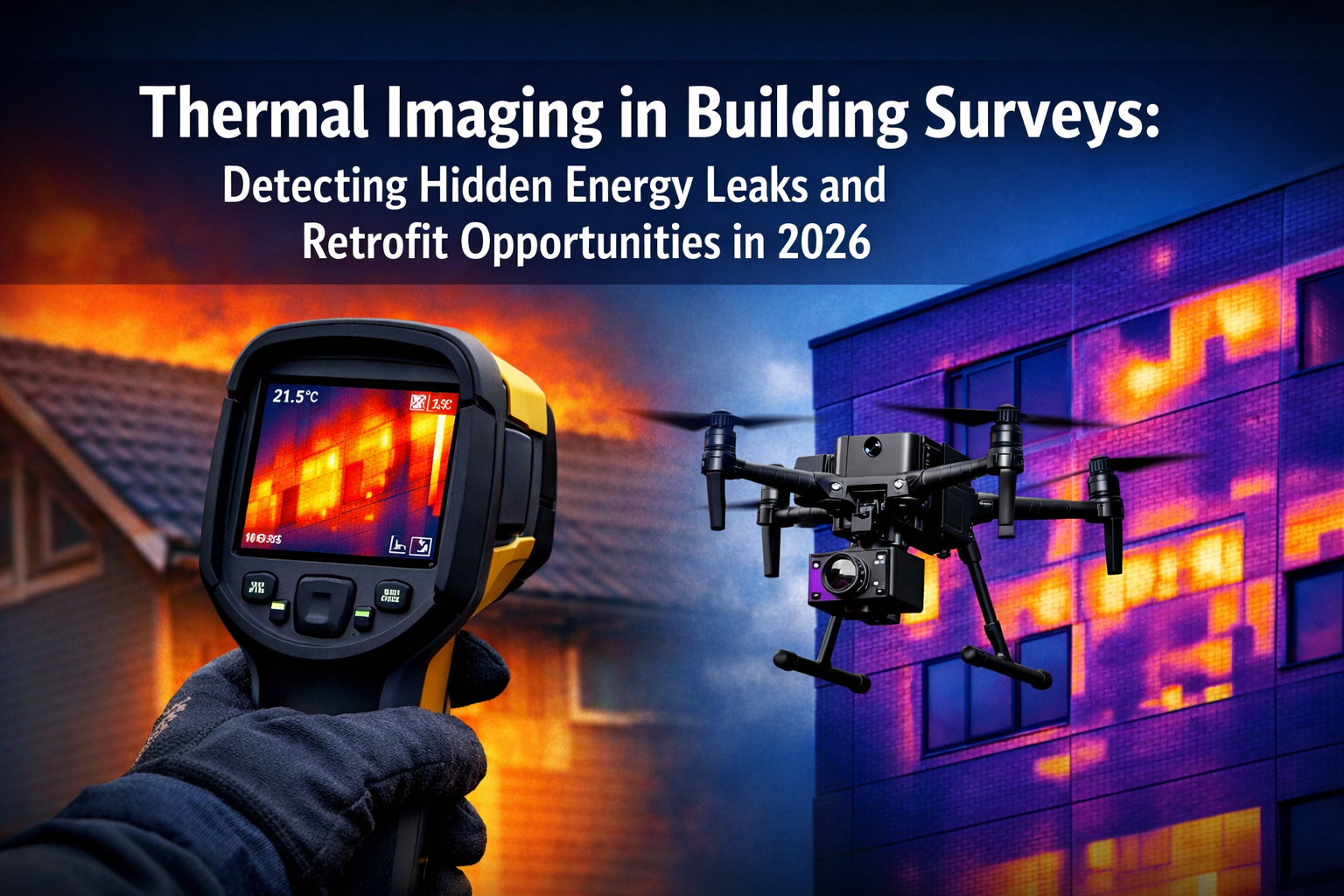
Energy costs continue to climb in 2026, placing unprecedented pressure on property owners, commercial facilities, and homebuyers to identify and eliminate wasteful heat loss. Traditional visual inspections miss the invisible culprits—insulation gaps, air leakage paths, thermal bridges, and moisture intrusion—that silently drain budgets and compromise building performance. Thermal Imaging in Building Surveys: Detecting Hidden Energy Leaks and Retrofit Opportunities in 2026 has emerged as the definitive solution, combining drone-mounted sensors and handheld infrared cameras to map thermal defects with surgical precision. This technology empowers surveyors to deliver actionable intelligence that transforms standard property reports into strategic retrofit roadmaps, proving return on investment within months while future-proofing assets against escalating utility expenses.
The thermal imaging market is projected to reach $16 billion by 2026[7], driven by commercial adoption across building inspections, predictive maintenance, and energy diagnostics. With commercial UAV thermal deployments surging 41% in 2025[2] and regulatory barriers falling across key markets, thermal surveys have shifted from niche specialty to mainstream necessity. Surveyors who integrate Thermal Imaging in Building Surveys: Detecting Hidden Energy Leaks and Retrofit Opportunities in 2026 into their service portfolios unlock competitive differentiation, command premium fees, and deliver measurable client value that translates directly to energy savings and asset appreciation.
Key Takeaways
🔍 Thermal imaging detects invisible energy leaks that visual inspections miss, including insulation defects, air leakage, thermal bridging, moisture intrusion, and HVAC failures, enabling targeted retrofit interventions.
📊 Commercial case studies demonstrate up to 18% energy usage reductions following infrared-guided retrofits, with rapid ROI typically achieved within one year of implementation[1].
🚁 Drone-mounted thermal sensors accelerate inspection timelines by 35% while eliminating manual access safety risks, particularly for rooftop and façade surveys on large commercial properties[2].
🤖 AI-driven analytics and digital twin integration transform periodic thermal scans into continuous predictive maintenance systems, reducing false positives and prioritizing interventions by asset criticality[1].
⚖️ Regulatory changes in 2025 eased UAV thermal inspection rules in key markets like Arizona and Nevada, accelerating commercial adoption and expanding beyond-visual-line-of-sight (BVLOS) capabilities for large-scale facility assessments[2].
Understanding Thermal Imaging Technology in Modern Building Surveys
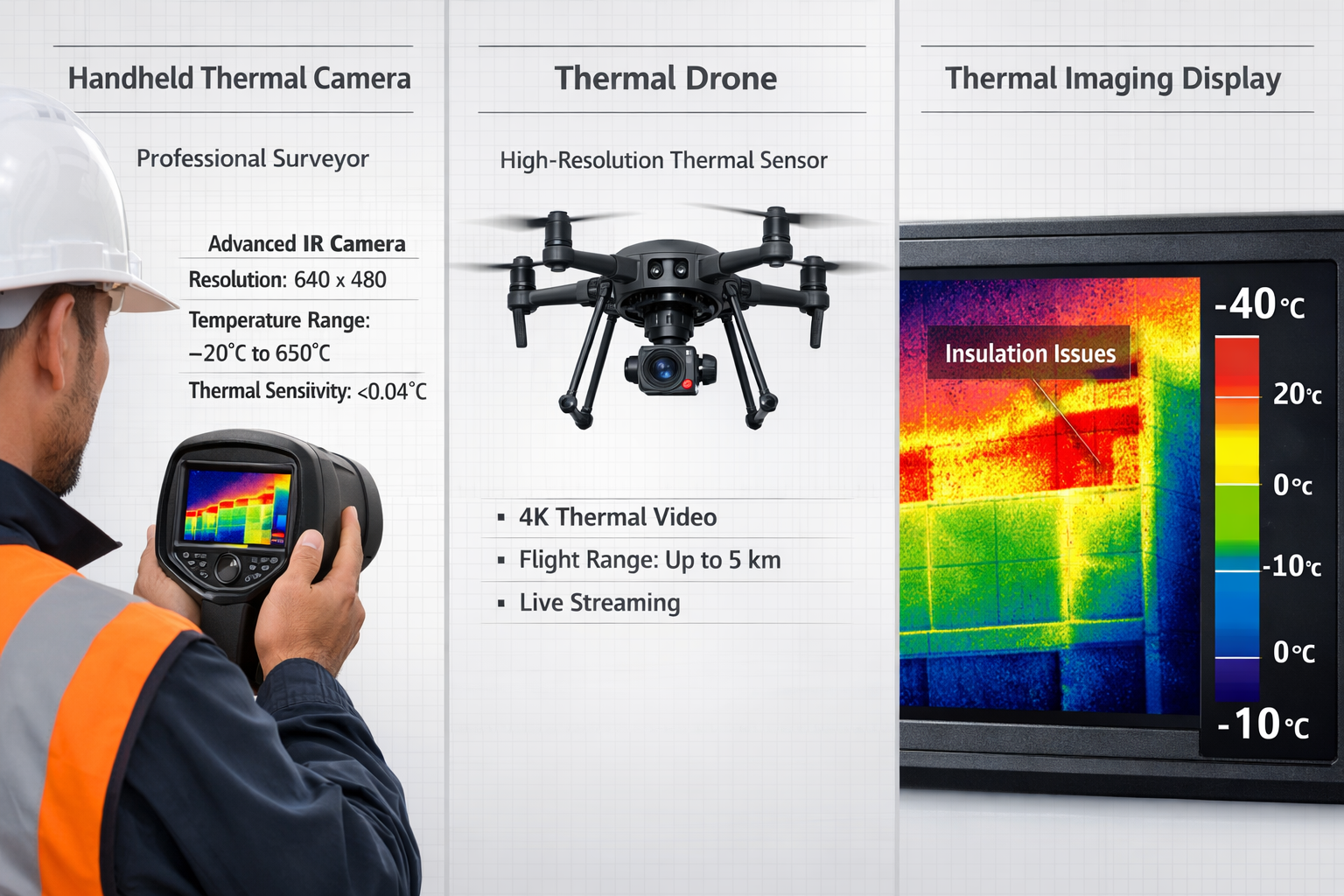
Thermal imaging cameras detect infrared radiation emitted by all objects based on their temperature, translating invisible heat signatures into visible color-coded images called thermograms. Unlike traditional photography that captures reflected light, thermal sensors measure emitted energy in the long-wave infrared spectrum (8-14 micrometers), revealing temperature variations as small as 0.1°C across building surfaces[4]. This capability makes thermal imaging the gold standard for identifying energy inefficiencies that remain hidden to the naked eye.
How Thermal Cameras Work in Building Diagnostics
Modern thermal imaging systems employ microbolometer detector arrays that respond to infrared radiation by changing electrical resistance. Sophisticated onboard processors convert these resistance variations into temperature measurements, assigning distinct colors to different temperature ranges. The resulting thermal image displays warmer areas in red, orange, and yellow tones, while cooler zones appear in blue, purple, and black hues[3]. This intuitive color mapping enables surveyors to instantly identify thermal anomalies during building assessments.
Key thermal imaging parameters that influence survey accuracy include:
- Thermal sensitivity (NETD): Measures the smallest temperature difference the camera can detect, with professional-grade units achieving 0.03°C sensitivity
- Resolution: Determines image detail, ranging from 160×120 pixels in entry-level units to 640×480 or higher in advanced systems
- Field of view: Affects coverage area, with interchangeable lenses enabling both wide-area scans and detailed spot measurements
- Temperature range: Defines measurement limits, typically -20°C to +650°C for building survey applications
- Emissivity compensation: Adjusts readings based on surface material properties to ensure measurement accuracy
The thermal imaging camera for building market is projected to grow by USD 1,560.37 million at a compound annual growth rate of 6.97% by 2032[1], reflecting sustained industry expansion driven by energy efficiency mandates and sustainability compliance requirements.
Handheld vs. Drone-Mounted Thermal Systems
Surveyors conducting Thermal Imaging in Building Surveys: Detecting Hidden Energy Leaks and Retrofit Opportunities in 2026 typically deploy two complementary technology platforms:
Handheld thermal cameras excel at detailed interior inspections, offering:
- Precise spot measurements and temperature profiling
- Immediate visual feedback during walkthroughs
- Flexible positioning for awkward access points
- Integration with moisture meters and environmental sensors
- Real-time annotation and voice recording capabilities
Drone-mounted thermal sensors revolutionize exterior assessments by providing:
- Rapid façade and rooftop coverage without scaffolding or lifts
- Consistent standoff distance for uniform thermal mapping
- Georeferenced imagery for precise defect location documentation
- Safe inspection of dangerous or inaccessible building elements
- Simultaneous RGB and thermal data capture for comprehensive documentation
Commercial UAV thermal deployments rose by 41% in 2025 according to FAA data[2], with regulatory milestones in Arizona and Nevada easing rules for UAV thermal inspections and enabling smarter onboard AI analytics[2]. This regulatory acceleration removed barriers to beyond-visual-line-of-sight (BVLOS) operations, directly expanding commercial adoption for large-scale facility inspections.
For comprehensive property assessments, surveyors often combine both platforms—using drones for efficient exterior mapping and handheld units for detailed interior diagnostics. This integrated approach delivers complete thermal documentation that supports Level 3 building surveys and specialized damp surveys.
Detecting Hidden Energy Leaks: Applications of Thermal Imaging in Building Surveys
Thermal Imaging in Building Surveys: Detecting Hidden Energy Leaks and Retrofit Opportunities in 2026 encompasses a broad spectrum of diagnostic applications that reveal building performance deficiencies invisible to conventional inspection methods. Each application addresses specific failure modes that compromise energy efficiency and occupant comfort.
Insulation Defects and Thermal Bridging
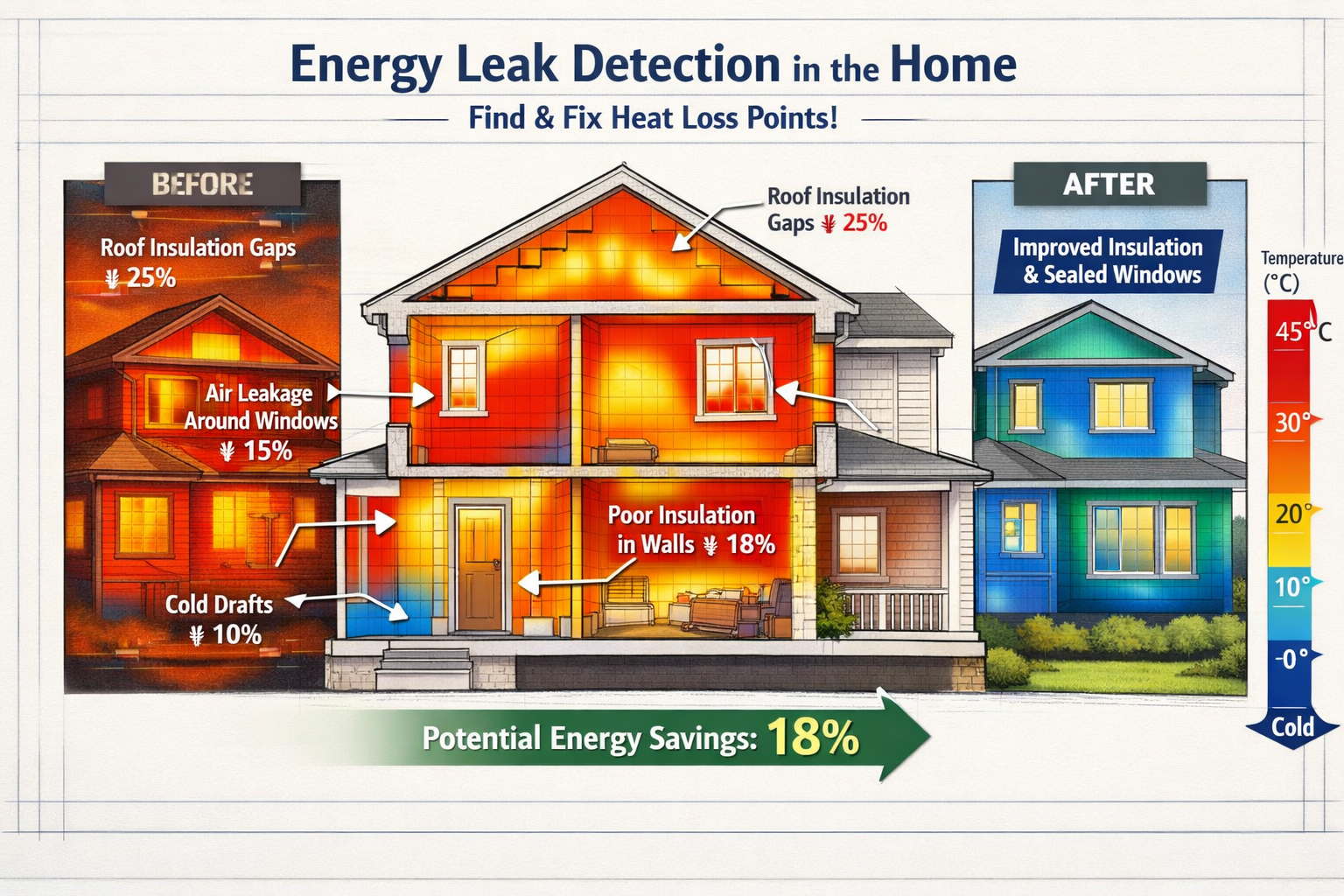
Insulation gaps and voids represent the most common energy waste pathway in both residential and commercial buildings. Thermal imaging instantly identifies areas where insulation has settled, been improperly installed, or is completely missing. During heating season, these defects appear as warm spots on exterior walls or cold spots on interior surfaces, indicating heat escaping through the building envelope[3].
Thermal bridging occurs when conductive building materials create preferential heat transfer paths through the insulation layer. Common thermal bridge locations include:
- Steel or concrete structural members penetrating the envelope
- Window and door frames with inadequate thermal breaks
- Balcony connections and cantilevered floor slabs
- Wall-to-roof junctions and parapet details
- Foundation-to-wall transitions
Thermal surveys quantify thermal bridge severity by measuring temperature differentials across suspected areas, enabling engineers to calculate precise heat loss rates and prioritize remediation measures. A 2025 Phoenix high-rise project using UAV thermal mapping validated energy efficiency improvements while cutting rework costs by 18%[2].
Air Leakage and Infiltration Paths
Air leakage accounts for 25-40% of heating and cooling energy loss in typical buildings, yet remains difficult to detect without specialized equipment. Thermal imaging combined with blower door testing creates artificial pressure differentials that force air through leakage paths, making them visible as temperature anomalies on thermal images[4].
Common air leakage locations revealed by thermal surveys include:
| Building Element | Typical Leakage Points |
|---|---|
| Windows | Perimeter seals, sash joints, glazing gaskets |
| Doors | Threshold gaps, weatherstripping failures, frame penetrations |
| Walls | Electrical outlets, service penetrations, construction joints |
| Roofs | Ventilation penetrations, skylight curbs, parapet caps |
| Foundations | Sill plate connections, rim joist areas, service entries |
Quantifying air leakage through thermal documentation enables surveyors to recommend targeted sealing interventions that deliver immediate energy savings. When integrated into homebuyer surveys, thermal air leakage assessments provide buyers with negotiating leverage and clear remediation roadmaps.
Moisture Intrusion and Damp Detection
Moisture problems manifest as temperature anomalies because wet building materials exhibit different thermal properties than dry materials. Water has high thermal mass and evaporative cooling effects, causing damp areas to appear cooler than surrounding dry surfaces during thermal scans[3]. This temperature differential enables non-invasive moisture detection across large building areas.
Thermal imaging identifies moisture-related issues including:
- Roof leaks: Water infiltration paths through roofing membranes
- Plumbing failures: Hidden pipe leaks within walls and floors
- Condensation zones: Areas prone to interstitial condensation
- Rising damp: Ground moisture wicking through masonry
- Penetrating damp: Water ingress through defective external walls
The optimal thermographic survey season runs October through March in the UK, when colder weather provides necessary temperature contrast for reliable imaging[3]. This seasonal timing consideration is critical for BREEAM project compliance and building energy performance validation.
Thermal moisture surveys complement traditional damp surveys by rapidly screening large areas before deploying invasive moisture meters for confirmation readings. This workflow reduces inspection time while improving diagnostic accuracy.
HVAC System Performance and Duct Leakage
HVAC inefficiencies waste substantial energy through duct leakage, poor insulation, and equipment malfunctions. Thermal imaging reveals:
- Duct leakage: Temperature differentials indicating conditioned air escaping into unconditioned spaces
- Insulation failures: Hot or cold spots on ductwork indicating missing or damaged insulation
- Equipment malfunctions: Abnormal temperature patterns on compressors, heat exchangers, and motors
- Airflow imbalances: Uneven temperature distribution indicating blocked or undersized ducts
Arizona solar farm inspections using UAV thermal imaging achieved 30% faster fault detection in 2025, directly cutting downtime and maintenance costs[2]. Similar efficiency gains apply to commercial HVAC systems, where thermal surveys identify problems before they escalate into costly failures.
Embedded thermal sensors within HVAC ductwork and structural elements now stream continuous temperature and humidity data to centralized dashboards, enabling predictive maintenance algorithms to detect deviations indicative of emerging failures[1]. This AI-driven approach transforms periodic thermal inspections into continuous monitoring systems.
Electrical Hot Spots and Fire Hazards
Electrical defects generate excess heat that thermal imaging detects before failures occur. Critical electrical applications include:
- Substation monitoring: Transformer and switchgear thermal analysis
- Distribution panel assessment: Circuit breaker and connection integrity
- Wiring defects: Loose connections, overloaded circuits, and deteriorating insulation
- Motor condition: Bearing failures and winding defects in mechanical equipment
Thermal electrical inspections prevent fires, reduce downtime, and extend equipment lifespan by identifying problems during early stages when corrective action is simple and inexpensive[1]. For commercial properties, quarterly thermal electrical surveys represent best practice preventive maintenance.
Thermal Imaging in Building Surveys: Identifying Retrofit Opportunities and Calculating ROI in 2026
Beyond detecting existing defects, Thermal Imaging in Building Surveys: Detecting Hidden Energy Leaks and Retrofit Opportunities in 2026 enables strategic retrofit planning by quantifying energy waste and predicting improvement outcomes. This analytical capability transforms thermal surveys from diagnostic tools into investment decision frameworks.
Quantifying Energy Loss and Prioritizing Interventions
Thermal survey data provides the foundation for evidence-based retrofit planning. By measuring temperature differentials across building elements and calculating heat transfer coefficients, surveyors quantify energy loss rates for each defect category. This quantification enables cost-benefit analysis that prioritizes interventions by:
- Energy savings potential: Annual kWh or therms saved per retrofit measure
- Implementation cost: Material and labor expenses for each intervention
- Payback period: Time required to recover investment through energy savings
- Asset criticality: Risk of secondary damage if defects remain unaddressed
Commercial case studies demonstrate that infrared scans deployed prior to retrofits can achieve energy usage reductions of up to 18%, with rapid return on investment within one year[1]. These documented outcomes provide compelling business cases for property owners evaluating retrofit investments.
Retrofit Opportunity Categories
Thermal imaging surveys reveal multiple retrofit opportunity categories with varying complexity and ROI profiles:
🔧 Quick-Win Interventions (Payback < 1 year):
- Air sealing around windows, doors, and penetrations
- Weatherstripping replacement and threshold adjustments
- Electrical outlet and switch plate gaskets
- Duct sealing and insulation in accessible areas
- Programmable thermostat installation
🏗️ Medium-Term Retrofits (Payback 1-3 years):
- Attic and wall cavity insulation upgrades
- Window and door replacement with high-performance units
- HVAC system optimization and controls upgrades
- Roof insulation and reflective coating application
- Thermal bridge mitigation at critical junctions
🏢 Strategic Capital Improvements (Payback 3-7 years):
- Building envelope overcladding and external insulation
- Complete HVAC system replacement with high-efficiency equipment
- Solar thermal or photovoltaic system integration
- Heat recovery ventilation installation
- Building automation and energy management systems
When thermal surveys inform Level 2 surveys or Level 3 building surveys, the resulting reports provide buyers with clear retrofit roadmaps that inform purchase negotiations and renovation budgeting.
Digital Twin Integration and Continuous Monitoring
The convergence of digital twin frameworks with thermal inspection creates living representations of building thermal health through detailed 3D models incorporating periodic infrared scans[1]. This synthesis enables:
- Scenario simulation: Modeling energy savings from proposed retrofit combinations
- Cost-benefit analysis: Comparing lifecycle costs across intervention strategies
- Performance tracking: Documenting thermal improvements following retrofit implementation
- Predictive maintenance: Identifying emerging defects through trend analysis
- Stakeholder collaboration: Enabling seamless information sharing between design, operations, and maintenance teams
Digital twins integrate thermal data with other building systems—HVAC controls, occupancy sensors, weather stations, and utility meters—creating comprehensive energy management platforms. AI-driven pattern recognition correlates multi-source sensor data with historical performance records, reducing false positives and prioritizing interventions by asset criticality[1].
Compliance, Certification, and Incentive Programs
Thermal assessments function as critical tools for achieving ESG (Environmental, Social, Governance) targets, with infrared data integration into comprehensive energy audits enabling organizations to validate performance improvements and secure rebate incentives under evolving efficiency standards[1]. Green building certifications increasingly hinge on demonstrable thermal integrity.
Key compliance and certification frameworks leveraging thermal survey data include:
- BREEAM: UK building environmental assessment requiring thermal performance documentation
- LEED: Leadership in Energy and Environmental Design certification
- Passive House: Ultra-low energy building standard with stringent envelope requirements
- Energy Performance Certificates (EPC): Mandatory UK property efficiency ratings
- Building Regulations Part L: UK conservation of fuel and power requirements
Government and utility incentive programs often require thermal imaging documentation to verify retrofit eligibility and validate claimed energy savings. Surveyors who understand these program requirements add substantial value by ensuring thermal survey deliverables meet compliance specifications.
Calculating Retrofit ROI: A Practical Example
Consider a 2,500 sq ft residential property with thermal imaging revealing:
- 15% heat loss through inadequate attic insulation
- 10% loss through air leakage around windows and doors
- 8% loss through uninsulated rim joists
- 5% loss through thermal bridging at wall-roof junction
Annual heating cost: £2,400
Total thermal losses: 38% of heating energy = £912/year waste
Proposed retrofit package:
- Attic insulation upgrade: £1,800 (eliminates 15% loss = £360/year savings)
- Air sealing and weatherstripping: £600 (eliminates 10% loss = £240/year savings)
- Rim joist spray foam insulation: £900 (eliminates 8% loss = £192/year savings)
- Thermal bridge mitigation: £1,200 (eliminates 5% loss = £120/year savings)
Total investment: £4,500
Annual savings: £912
Simple payback: 4.9 years
25-year net savings: £18,300 (assuming 3% annual energy cost inflation)
This calculation demonstrates how thermal imaging transforms abstract energy efficiency concepts into concrete financial projections that justify retrofit investments. When incorporated into homebuyer surveys, these analyses empower buyers to negotiate purchase price reductions or seller-funded improvements.
Implementing Thermal Imaging Services: Practical Guidance for Surveyors
Surveyors seeking to integrate Thermal Imaging in Building Surveys: Detecting Hidden Energy Leaks and Retrofit Opportunities in 2026 into their service portfolios must address equipment selection, methodology development, regulatory compliance, and client communication to deliver professional-grade thermal assessments.
Equipment Selection and Investment Considerations
Handheld thermal camera selection criteria include:
| Specification | Entry-Level | Professional | Advanced |
|---|---|---|---|
| Resolution | 160×120 pixels | 320×240 pixels | 640×480 pixels |
| Thermal Sensitivity | <0.10°C | <0.05°C | <0.03°C |
| Temperature Range | -20°C to +250°C | -40°C to +650°C | -40°C to +1200°C |
| Price Range | £2,000-£5,000 | £8,000-£15,000 | £20,000-£40,000 |
| Typical Applications | Residential surveys | Commercial inspections | Industrial diagnostics |
For surveyors primarily conducting residential and small commercial surveys, professional-grade cameras in the £8,000-£15,000 range offer optimal balance between capability and investment. These units provide sufficient resolution and sensitivity for accurate building diagnostics while remaining cost-effective for typical project volumes.
Drone thermal systems require additional considerations:
- Platform selection: Multirotor drones offer stability and hovering capability essential for detailed thermal mapping
- Thermal sensor integration: Radiometric sensors that record temperature data for every pixel enable post-flight analysis
- Flight time: Minimum 25-30 minutes required for comprehensive building surveys
- Regulatory compliance: CAA/FAA commercial drone licenses and insurance requirements
- Data processing software: Photogrammetry and thermal analysis platforms for deliverable creation
In 2025, 90% of successful UAV thermal projects began with careful planning and regulatory checks, indicating that structured workflows are now industry standard for legal compliance and project value delivery[2]. Surveyors must budget for training, licensing, and insurance alongside equipment costs.
Survey Methodology and Best Practices
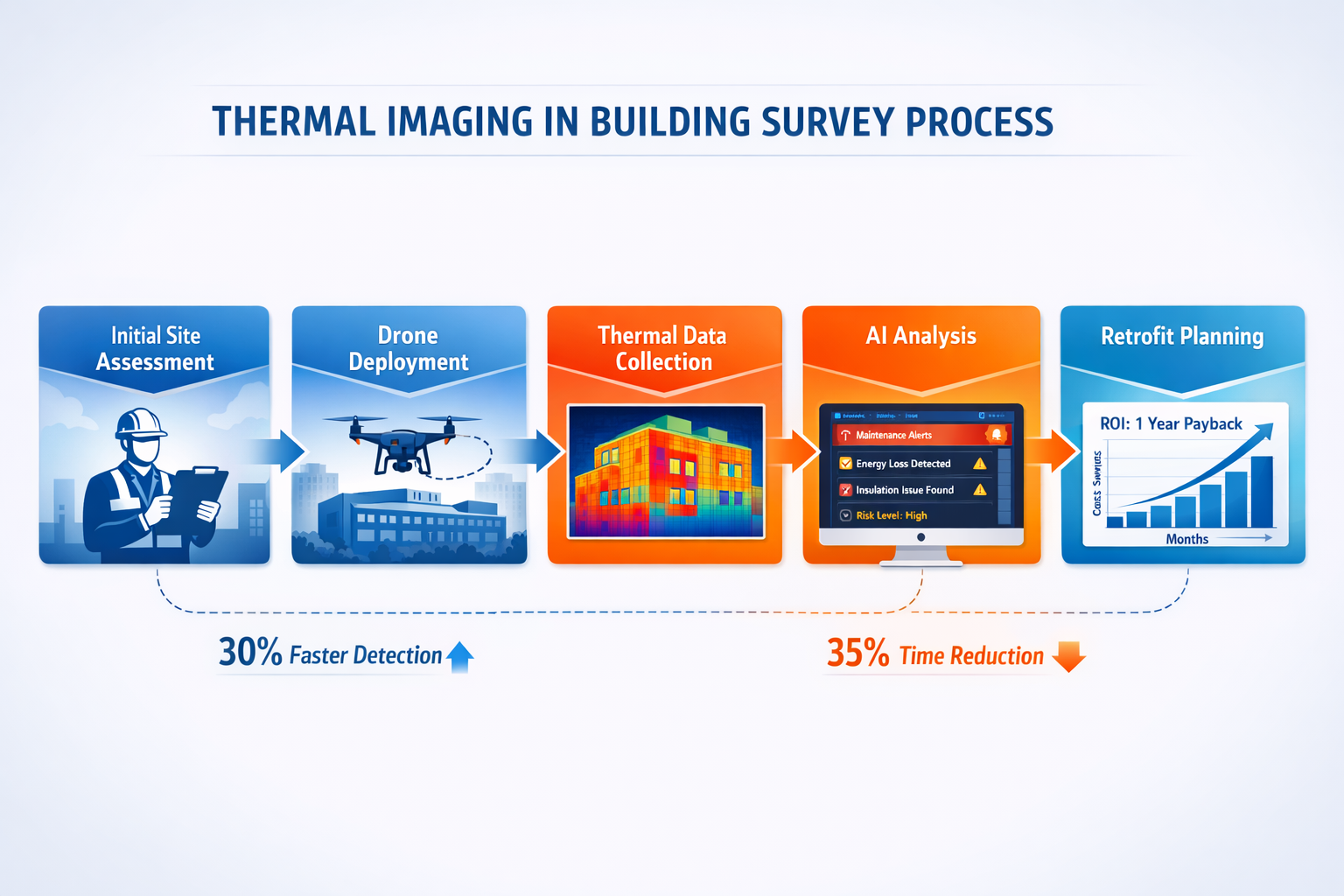
Effective thermal surveys follow systematic protocols that ensure data quality and diagnostic accuracy:
Pre-Survey Planning:
- Review building drawings and construction documentation
- Identify suspect areas based on age, construction type, and known issues
- Schedule surveys during optimal weather conditions (temperature differential >10°C)
- Coordinate with building occupants to ensure heating/cooling systems operate normally
- Conduct site safety assessment and secure necessary access permissions
Data Collection Procedures:
- Establish consistent standoff distances for comparable measurements
- Document ambient conditions (temperature, humidity, wind speed)
- Capture both thermal and visible-light images of each area
- Record emissivity settings for different surface materials
- Annotate images with location identifiers and measurement data
- Use blower door testing to enhance air leakage detection
Analysis and Reporting:
- Process thermal imagery using calibrated analysis software
- Calculate temperature differentials and heat loss rates
- Correlate thermal findings with visual observations
- Prioritize defects by severity and remediation urgency
- Generate annotated reports with side-by-side thermal/visible comparisons
- Provide retrofit recommendations with estimated costs and ROI projections
Thermal inspection time reductions of up to 35% were documented on a Phoenix commercial roof site in 2025[2], demonstrating efficiency gains from optimized workflows and drone deployment.
Integration with Existing Survey Services
Thermal imaging enhances multiple traditional survey types:
- Level 2 surveys: Add thermal screening to identify hidden defects in standard homebuyer reports
- Level 3 building surveys: Include comprehensive thermal analysis in detailed structural assessments
- Damp surveys: Use thermal imaging to locate moisture sources and extent
- Roof surveys: Deploy drones for rapid thermal mapping of large roof areas
- Stock condition surveys: Incorporate thermal assessments in multi-property portfolio evaluations
This integration transforms standard survey deliverables into comprehensive property intelligence that commands premium fees while delivering measurable client value. Surveyors who master thermal imaging differentiate their practices in competitive markets.
Client Communication and Value Demonstration
Effective client communication translates technical thermal data into actionable business intelligence. Best practices include:
✅ Visual storytelling: Use side-by-side thermal/visible image comparisons that clearly illustrate defects
✅ Financial framing: Present findings in terms of annual energy waste and retrofit ROI
✅ Priority ranking: Categorize recommendations by urgency, cost, and savings potential
✅ Photographic evidence: Document pre- and post-retrofit thermal improvements
✅ Benchmark comparisons: Show how property thermal performance compares to similar buildings
For homebuyers, thermal survey results provide negotiating leverage and renovation planning clarity. For commercial property owners, thermal assessments justify capital improvement budgets and demonstrate ESG commitment. Surveyors who articulate these value propositions build loyal client bases and generate referral business.
Regulatory Landscape and Market Trends Shaping Thermal Imaging in 2026
The Thermal Imaging in Building Surveys: Detecting Hidden Energy Leaks and Retrofit Opportunities in 2026 landscape is rapidly evolving, driven by regulatory changes, technological advancement, and market demand for energy efficiency solutions.
Regulatory Developments Accelerating Adoption
Key regulatory milestones in 2025 fundamentally altered thermal imaging deployment economics:
A critical FAA regulatory milestone in 2025 eased rules for UAV thermal inspections in Arizona and Nevada, combined with smarter onboard AI analytics, directly accelerating commercial adoption[2]. This regulatory shift removed previous barriers to beyond-visual-line-of-sight (BVLOS) drone operations, enabling large-scale facility inspections without visual observers stationed along flight paths.
Phoenix and Las Vegas experienced the fastest UAV thermal adoption rates in 2025, signaling regional concentration in Southwest markets where regulatory innovation preceded national policy changes[2]. These regional pilots are expected to inform broader FAA rulemaking in 2026-2027, potentially expanding BVLOS permissions nationwide.
UK regulatory drivers include:
- Energy Performance Certificate (EPC) requirements: Minimum EPC ratings for rental properties driving retrofit demand
- Building Regulations Part L updates: Stricter thermal performance standards for new construction and renovations
- BREEAM certification: Thermal imaging documentation increasingly required for assessment credits
- Net Zero commitments: Government and corporate carbon reduction targets creating retrofit market expansion
These regulatory pressures create sustained demand for thermal survey services as property owners seek compliance pathways and performance validation.
Market Growth and Industry Projections
The thermal imaging market exhibits robust growth across multiple indicators:
- The broader thermal imaging market could reach $16 billion by 2026[7], driven by applications across building inspections, predictive maintenance, and energy diagnostics
- The thermal imaging camera for building market is projected to grow by USD 1,560.37 million at a CAGR of 6.97% by 2032[1]
- Commercial UAV thermal deployments rose by 41% in 2025 according to FAA data[2]
- UAV thermal inspections surged 38% across the U.S. during 2025[2]
This sustained growth trajectory reflects thermal imaging's transition from specialty application to mainstream building assessment tool. Surveyors entering the market in 2026 benefit from established technology, proven methodologies, and growing client awareness of thermal survey value.
Technological Innovation Driving Capability Expansion
Emerging technologies are expanding thermal imaging capabilities and applications:
🤖 AI-Powered Analytics: Machine learning algorithms automatically detect and classify thermal anomalies, reducing analysis time and improving consistency. Pattern recognition systems compare current thermal signatures against historical baselines, flagging deviations that indicate emerging problems[1].
📡 IoT Sensor Integration: Permanent thermal sensors embedded in critical building systems provide continuous monitoring, triggering alerts when temperature thresholds are exceeded. This shift from periodic surveys to continuous surveillance enables predictive maintenance and early intervention[1].
🗺️ Digital Twin Convergence: Integration of thermal data into 3D building information models creates dynamic representations of thermal performance. Scenario modeling capabilities enable virtual testing of retrofit strategies before implementation[1].
📱 Cloud-Based Collaboration: Thermal imagery uploads to cloud platforms enable real-time sharing with clients, engineers, and contractors. Mobile apps provide field technicians with instant access to historical thermal data during inspections.
🔬 Enhanced Sensor Technology: Next-generation microbolometer arrays deliver higher resolution and sensitivity at lower costs, democratizing access to professional-grade thermal imaging capabilities.
These innovations collectively reduce thermal survey costs while expanding diagnostic capabilities, creating favorable market conditions for surveyor adoption.
Competitive Landscape and Service Differentiation
As thermal imaging becomes mainstream, surveyors must differentiate their offerings through:
- Specialized expertise: Deep knowledge of specific building types (period properties, commercial facilities, industrial plants)
- Comprehensive reporting: Integration of thermal data with structural, mechanical, and energy analysis
- Retrofit planning: Providing actionable improvement roadmaps with ROI projections
- Technology leadership: Early adoption of AI analytics, drone platforms, and digital twin integration
- Industry certifications: Thermography certifications (Level I, II, III) and professional accreditations
Surveyors who position thermal imaging as strategic business intelligence rather than commodity inspection services command premium fees and build sustainable competitive advantages. Integration with comprehensive building survey services creates bundled offerings that address complete client needs.
Case Studies: Real-World Applications and Documented Outcomes
Thermal Imaging in Building Surveys: Detecting Hidden Energy Leaks and Retrofit Opportunities in 2026 delivers measurable results across diverse property types and project scales. These documented case studies illustrate practical applications and quantified outcomes.
Commercial High-Rise Energy Optimization
A 2025 Phoenix high-rise project deployed UAV thermal mapping to assess envelope performance across a 25-story office building experiencing excessive HVAC costs. The thermal survey revealed:
- Widespread insulation failures at curtain wall spandrel panels
- Air leakage at floor-to-floor perimeter seals
- Thermal bridging through aluminum mullion systems
- HVAC duct leakage in mechanical spaces
Outcomes: The project validated energy efficiency improvements while cutting rework costs by 18%[2]. Targeted retrofit interventions focused on the most severe thermal defects, avoiding unnecessary whole-building envelope replacement. Annual energy costs decreased by 22% following implementation, with simple payback achieved in 14 months.
Solar Farm Fault Detection Acceleration
Arizona solar farm inspections using UAV thermal imaging achieved 30% faster fault detection in 2025, directly cutting downtime and maintenance costs[2]. Traditional visual inspections required ground crews to walk extensive panel arrays, limiting coverage and missing subtle performance degradation.
Drone-mounted thermal sensors rapidly identified:
- Individual panel failures due to cell defects
- String-level problems from wiring faults
- Inverter thermal anomalies indicating imminent failures
- Soiling patterns affecting generation efficiency
The accelerated fault detection enabled predictive maintenance scheduling that minimized production losses and extended equipment lifespan.
Residential Retrofit Planning and Negotiation
A Victorian terraced property in London underwent comprehensive thermal survey as part of a Level 3 building survey prior to purchase. Thermal imaging revealed:
- Missing cavity wall insulation across 60% of external walls
- Severe air leakage around original sash windows
- Uninsulated suspended timber ground floor
- Thermal bridging at solid wall-cavity wall junctions
Outcomes: The buyer negotiated a £15,000 purchase price reduction based on documented retrofit costs. Post-purchase implementation of prioritized improvements reduced heating costs by 35% annually, with total investment recovered within 3.5 years. The thermal survey transformed an uncertain renovation project into a data-driven investment decision.
Commercial Roof Leak Detection
A Phoenix commercial roof site experienced persistent interior water damage despite multiple visual inspections failing to locate leak sources. Thermal inspection time reductions of up to 35% were documented using drone thermal mapping[2].
The thermal survey identified:
- Trapped moisture within roof insulation layers
- Membrane defects at penetration flashings
- Inadequate drainage causing ponding water
- Insulation compression from rooftop equipment
Targeted repairs addressed documented defects, eliminating leak problems and extending roof service life by an estimated 8-10 years compared to premature replacement.
Future Outlook: Thermal Imaging Evolution Beyond 2026
The trajectory of Thermal Imaging in Building Surveys: Detecting Hidden Energy Leaks and Retrofit Opportunities in 2026 points toward continued technological advancement, regulatory expansion, and market penetration across property sectors.
Autonomous Inspection Systems
Fully autonomous drone systems will conduct routine thermal surveys without human pilots, following pre-programmed flight paths and automatically uploading data for AI analysis. Regulatory frameworks enabling autonomous operations are expected to expand from current Southwest U.S. pilots to nationwide deployment by 2027-2028.
Hyperspectral Imaging Integration
Next-generation sensors combining thermal infrared with hyperspectral visible/near-infrared imaging will enable simultaneous assessment of thermal performance, moisture content, and material composition. This multi-modal approach will reduce inspection time while expanding diagnostic capabilities.
Blockchain-Verified Performance Records
Distributed ledger technology will create immutable thermal performance records that follow properties through ownership transfers, providing verified energy efficiency histories that inform valuations and insurance underwriting.
Mandatory Thermal Disclosure Requirements
Regulatory trends suggest potential mandatory thermal imaging disclosure for property transactions, similar to current EPC requirements. Such mandates would fundamentally transform the market from optional premium service to standard transaction requirement.
Integration with Smart Building Ecosystems
Thermal sensors will become standard components of smart building infrastructure, providing continuous data streams that inform automated HVAC optimization, predictive maintenance scheduling, and real-time energy management.
Surveyors who establish thermal imaging capabilities in 2026 position themselves to capitalize on these emerging trends while building expertise that will remain valuable as technology and regulations evolve.
Conclusion: Actionable Steps for Surveyors and Property Professionals
Thermal Imaging in Building Surveys: Detecting Hidden Energy Leaks and Retrofit Opportunities in 2026 represents a transformative capability that elevates surveying practice from descriptive reporting to strategic advisory services. The technology's ability to quantify energy waste, predict retrofit ROI, and validate improvement outcomes creates measurable client value that justifies premium fees and builds competitive differentiation.
The market fundamentals strongly favor thermal imaging adoption: sustained industry growth projections, regulatory acceleration, documented energy savings outcomes, and technological innovation reducing implementation barriers. Surveyors who integrate thermal capabilities into comprehensive building survey services unlock new revenue streams while delivering solutions that directly address client priorities around energy costs, sustainability compliance, and asset optimization.
Immediate Action Steps for Surveyors
🎯 For Surveyors New to Thermal Imaging:
- Invest in professional-grade equipment: Select handheld thermal cameras in the £8,000-£15,000 range offering 320×240 resolution minimum
- Obtain thermography certification: Complete Level I thermography training through recognized certification bodies
- Develop standard operating procedures: Create systematic survey protocols ensuring data quality and consistency
- Pilot thermal services: Offer thermal screening as value-add to existing Level 2 and Level 3 surveys
- Build case study portfolio: Document thermal findings and retrofit outcomes to demonstrate ROI
🚀 For Experienced Thermal Practitioners:
- Add drone capabilities: Invest in UAV platforms and obtain commercial drone licenses for exterior survey efficiency
- Implement AI analytics: Deploy machine learning tools that automate anomaly detection and trend analysis
- Develop digital twin services: Integrate thermal data into 3D building models for advanced scenario modeling
- Create retrofit planning packages: Bundle thermal assessment with energy modeling and contractor coordination
- Pursue specialty certifications: Obtain advanced thermography credentials and building science certifications
For Property Owners and Buyers
Property owners evaluating retrofit investments should commission comprehensive thermal surveys before finalizing improvement scopes. The resulting data enables evidence-based decision making that prioritizes interventions by ROI and eliminates wasteful spending on unnecessary measures.
Homebuyers should request thermal imaging as part of homebuyer surveys on properties built before 2000 or exhibiting signs of energy inefficiency. The thermal assessment provides negotiating leverage and clear renovation roadmaps that inform purchase decisions and budget planning.
Commercial property managers should implement annual thermal surveys as preventive maintenance tools that identify problems before they escalate into costly failures. Integration with building automation systems creates continuous monitoring capabilities that optimize energy performance and extend asset lifespan.
The convergence of rising energy costs, regulatory pressure, technological advancement, and proven ROI outcomes makes 2026 the optimal time to embrace Thermal Imaging in Building Surveys: Detecting Hidden Energy Leaks and Retrofit Opportunities in 2026. Surveyors and property professionals who act decisively will capture market leadership positions as thermal assessment transitions from specialty service to industry standard.
References
[1] Thermal Imaging Camera For Building – https://www.360iresearch.com/library/intelligence/thermal-imaging-camera-for-building
[2] Uav Thermal – https://www.extremeaerialproductions.com/post/uav-thermal
[3] Thermographic Inspection Season Why Colder Temperatures Are Better For Thermal Imaging – https://www.enconassociates.com/blog-insights/thermographic-inspection-season-why-colder-temperatures-are-better-for-thermal-imaging/
[4] Whats A Thermographic Survey And Does My Building Need One – https://www.leecompany.com/resources/whats-a-thermographic-survey-and-does-my-building-need-one/
[5] Thermographic Inspection – https://mfe-is.com/thermographic-inspection/
[6] Thermal Drones For Construction – https://www.thedroneu.com/blog/thermal-drones-for-construction/
[7] 98338 Thermal Imaging Market Could Be Worth 16 Billion By 2026 – https://www.sdmmag.com/articles/98338-thermal-imaging-market-could-be-worth-16-billion-by-2026
[8] Infrared Thermography Market Report – https://www.cognitivemarketresearch.com/infrared-thermography-market-report
[9] Revolutionizing Property Surveys How Ai And Machine Learning Are Predicting Risks In 2026 – https://nottinghillsurveyors.com/blog/revolutionizing-property-surveys-how-ai-and-machine-learning-are-predicting-risks-in-2026
