
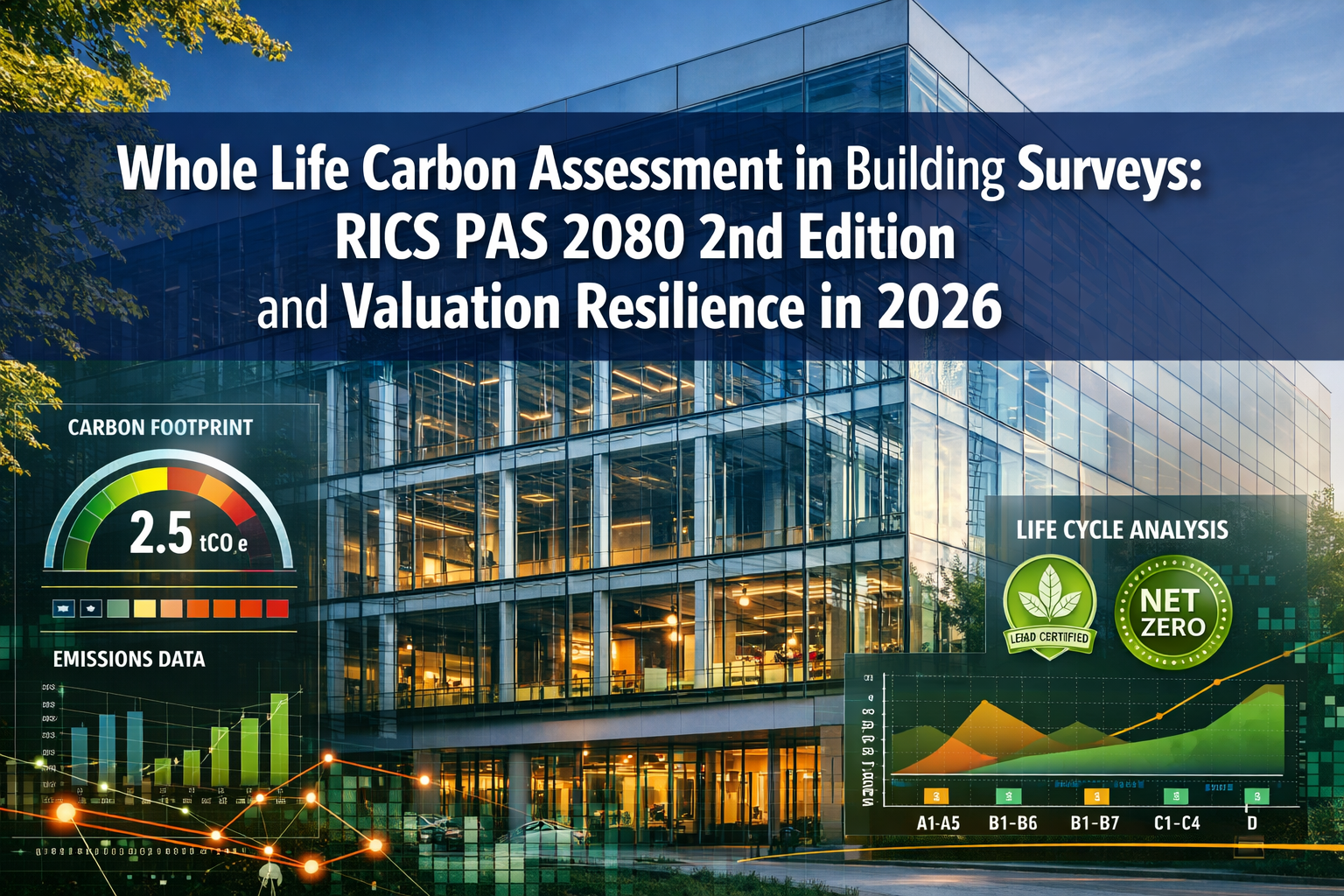
Buildings account for nearly 40% of global carbon emissions, yet most property valuations still overlook the carbon cost embedded in walls, floors, and mechanical systems. Since July 1, 2024, RICS members have been mandated to follow the 2nd edition standard when completing whole life carbon assessments—a shift that fundamentally changes how surveyors evaluate property resilience and long-term value.[9] Whole Life Carbon Assessment in Building Surveys: RICS PAS 2080 2nd Edition and Valuation Resilience in 2026 represents not just a compliance requirement but a strategic evolution in how chartered surveyors integrate carbon performance into valuation advice for lenders, investors, and property owners.
The updated RICS Professional Standard on Whole Life Carbon Assessment shifts building survey focus toward long-term property resilience, energy standards, and maintenance costs. This comprehensive guide explores how to integrate carbon assessment into valuation advice, ensuring that commercial building surveys and residential assessments reflect the true lifecycle impact of construction materials, operational energy, and end-of-life scenarios.
Key Takeaways
- ✅ Mandatory compliance since July 2024: RICS members must follow the 2nd edition standard for all whole life carbon assessments across buildings and infrastructure
- 🔄 Dual-standard framework: RICS WLCA 2nd edition provides calculation methodology while PAS 2080:2023 establishes management and governance requirements
- 📊 Enhanced calculation modules: New B modules (B2, B3, A5, C1) and automated decarbonization factors eliminate manual calculations and improve accuracy
- 💰 Valuation integration: Carbon performance increasingly influences asset values, requiring surveyors to incorporate WLCA data into property valuations
- 🎓 Professional development: RICS Global Certificate training programs ensure practitioners can competently apply the 2nd edition methodology
Understanding Whole Life Carbon Assessment: The 2026 Framework
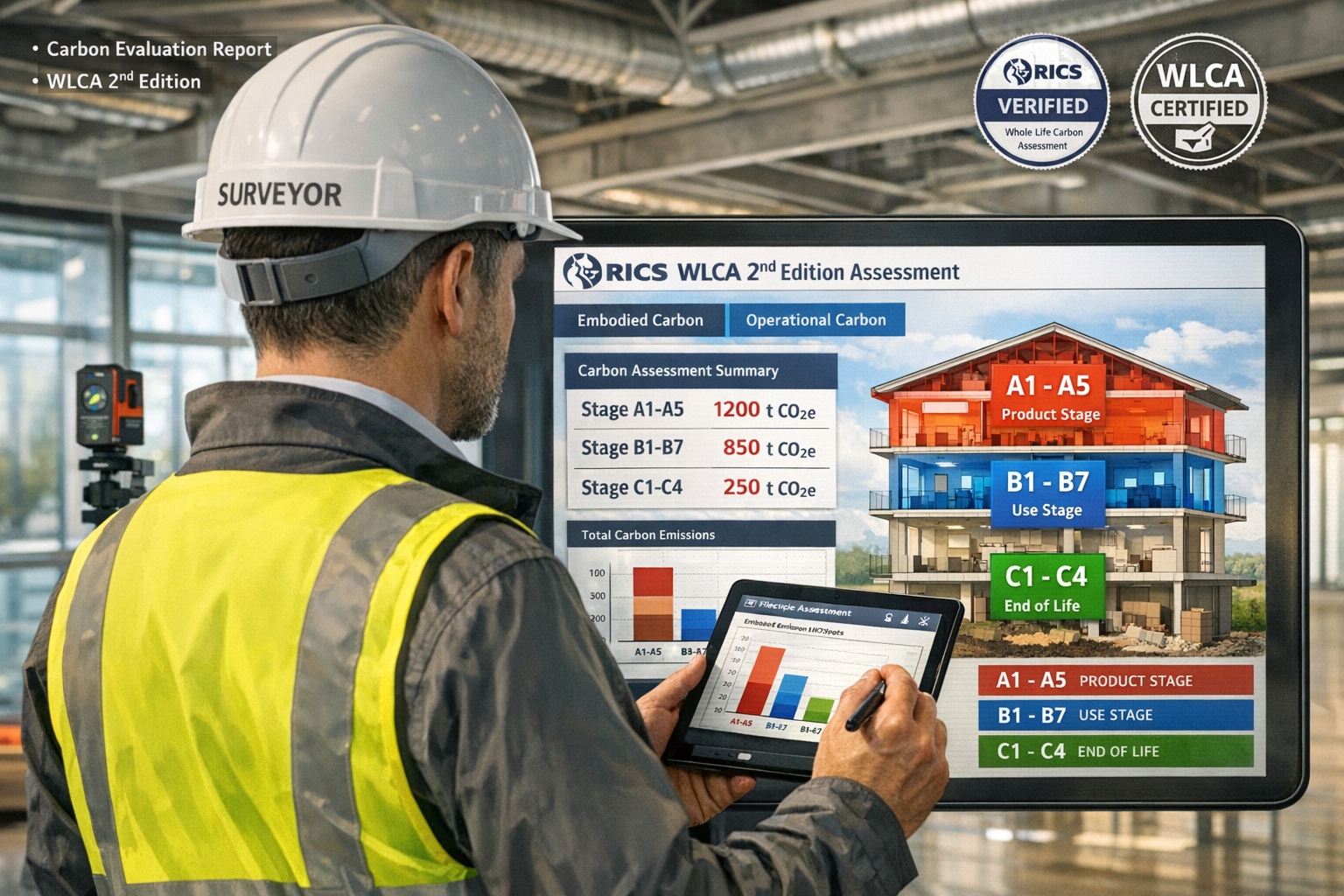
Whole Life Carbon Assessment (WLCA) measures the total carbon emissions associated with a building throughout its entire lifecycle—from raw material extraction and manufacturing (embodied carbon) through construction, operation, maintenance, and eventual demolition or deconstruction. The RICS 2nd edition, which became mandatory in July 2024, represents a significant expansion from the 1st edition by including all buildings and infrastructure across the entire life cycle of the built environment.[1]
The Expanded Scope of RICS WLCA 2nd Edition
The 2nd edition introduces several critical enhancements that directly impact how surveyors conduct building surveys:
Enhanced Calculation Modules 🔧
The updated standard includes new B modules (B2, B3, A5, and C1 for demolition scenarios), expanded transportation profiles, and automated application of end-of-life scenarios and decarbonization factors through tool backends.[1] These additions eliminate the need for manual calculations that previously created inconsistencies and errors in carbon assessments.
Consistency Factors and Benchmarking 📈
New consistency factors have been added to RICS WLCA 2nd edition, along with improved benchmarking capabilities to support like-for-like comparisons across projects.[1] This standardization enables surveyors to provide clients with meaningful context about how a property's carbon performance compares to similar buildings.
Infrastructure Tools Alignment 🏗️
The infrastructure-focused tools PAS 2080 (formerly P 2080) and I 17472 are being updated to align with RICS 2nd edition where relevant, ensuring consistency across infrastructure and building assessments.[1] This harmonization is particularly important for mixed-use developments and properties with significant infrastructure components.
The Lifecycle Stages Explained
WLCA divides a building's lifecycle into distinct stages, each with specific carbon implications:
| Stage | Description | Carbon Impact |
|---|---|---|
| A1-A3 | Product stage (raw materials, transport, manufacturing) | Embodied carbon in materials |
| A4-A5 | Construction process (transport to site, construction activities) | Construction carbon footprint |
| B1-B7 | Use stage (operation, maintenance, repair, replacement, refurbishment) | Operational and maintenance carbon |
| C1-C4 | End-of-life (deconstruction, transport, waste processing, disposal) | Demolition and disposal carbon |
| D | Benefits beyond building lifecycle (reuse, recovery, recycling potential) | Carbon offset opportunities |
Understanding these stages enables surveyors conducting Level 3 building surveys to identify specific areas where carbon reduction strategies can be implemented, directly affecting long-term property value and operational costs.
PAS 2080:2023 and RICS WLCA 2nd Edition: The Dual-Standard Framework for Whole Life Carbon Assessment in Building Surveys
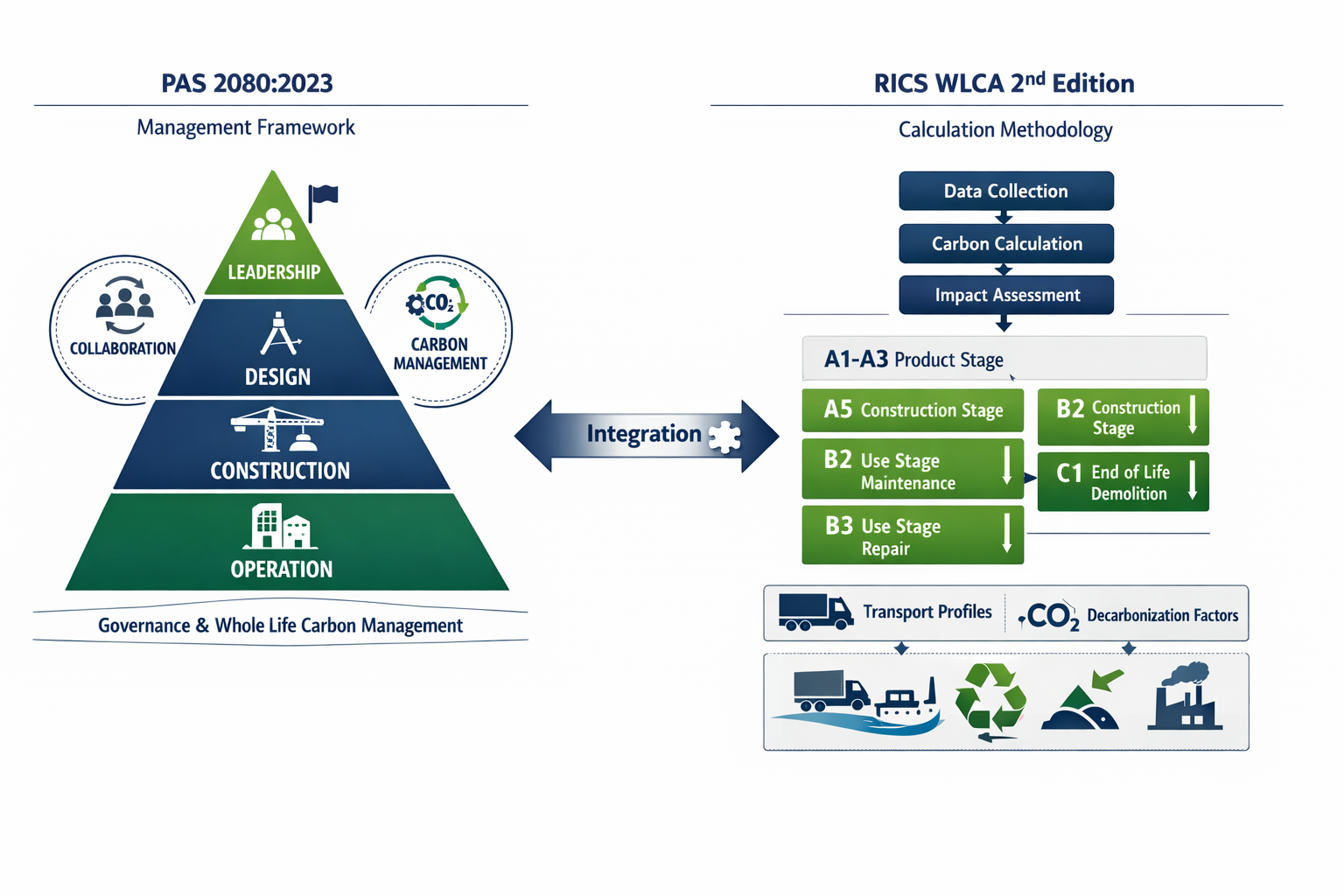
While RICS WLCA 2nd edition provides the calculation and reporting methodology, PAS 2080:2023 specifies the management process and governance requirements.[6] These two standards are designed to work hand-in-hand for consistent carbon measurement and management across the built environment sector.
PAS 2080:2023 Management Framework
Released in April 2023 by the Construction Leadership Council and made available free of charge, PAS 2080:2023 updates the original 2016 version with enhanced guidance on carbon management throughout the project lifecycle.[4] The standard establishes principles for leadership, decision-making, collaboration, and ongoing improvement across the value chain, embedding carbon management into project strategy, design, construction, and operation rather than as end-project reporting.[6]
Key Principles of PAS 2080:2023:
- Leadership and Accountability 👔 – Senior management commitment to carbon reduction targets
- Systems Thinking 🔄 – Holistic approach considering entire value chain impacts
- Collaboration 🤝 – Cross-disciplinary cooperation among stakeholders
- Evidence-Based Decision Making 📊 – Data-driven choices supported by WLCA calculations
- Continuous Improvement 📈 – Iterative refinement of carbon reduction strategies
How Surveyors Apply the Dual-Standard Framework
When conducting commercial building surveys or residential assessments, surveyors must integrate both standards:
Assessment Phase:
- Use RICS WLCA 2nd edition methodology to calculate embodied and operational carbon
- Apply PAS 2080:2023 governance principles to identify management gaps
- Document baseline carbon performance against industry benchmarks
Reporting Phase:
- Present WLCA calculations in standardized format per RICS 2nd edition
- Include PAS 2080:2023 compliance assessment for governance and management processes
- Provide recommendations aligned with both standards' requirements
Valuation Integration:
- Incorporate carbon performance data into valuation reports
- Assess impact on property resilience and long-term value
- Identify carbon-related risks affecting insurance and financing
Supply Chain Certification Requirements
Under SDF2 (Supplier Delivery Framework 2), direct bidders are expected to have PAS 2080 certification plans in place, while non-prime supply chain suppliers are increasingly being asked by large primes for PAS 2080-aligned evidence as part of onboarding and delivery processes.[4] This certification requirement extends to surveyors providing carbon assessment services for major projects, making professional competency in both standards essential for maintaining competitive positioning.
Integrating Whole Life Carbon Assessment in Building Surveys: RICS PAS 2080 2nd Edition and Valuation Resilience in 2026
The integration of WLCA into property valuations represents a fundamental shift in how surveyors assess long-term property value and resilience. As of 2026, carbon performance increasingly influences asset values, requiring surveyors to incorporate WLCA data into comprehensive valuation advice.[2]
Carbon Performance and Property Value
Research indicates that buildings with superior carbon performance command premium valuations due to several factors:
Reduced Operational Costs 💰
Lower operational carbon typically correlates with reduced energy consumption, translating to lower utility costs over the building's lifetime. When conducting reinstatement cost valuations, surveyors must account for these ongoing savings in total cost of ownership calculations.
Regulatory Compliance and Future-Proofing 📋
Properties that meet or exceed current carbon standards are better positioned to comply with future regulations, reducing the risk of costly retrofits. This regulatory resilience directly affects property marketability and financing availability.
Enhanced Marketability 🏆
Tenants and buyers increasingly prioritize sustainability credentials, with carbon-efficient buildings experiencing shorter vacancy periods and higher occupancy rates. This market preference translates to improved rental yields and capital values.
Insurance and Financing Benefits 🏦
Lenders and insurers are beginning to offer preferential terms for properties with demonstrated carbon performance, recognizing the reduced risk profile associated with sustainable buildings.
Practical Application in Building Surveys
When conducting structural surveys or comprehensive property assessments, surveyors should integrate WLCA considerations throughout the inspection process:
Pre-Inspection Phase:
- Request existing Energy Performance Certificates (EPCs) and carbon assessments
- Review building specifications and construction materials documentation
- Identify potential high-carbon elements requiring detailed assessment
During Inspection:
- Document construction materials and systems affecting embodied carbon
- Assess operational systems (HVAC, lighting, water) impacting operational carbon
- Identify retrofit opportunities for carbon reduction
- Evaluate maintenance requirements affecting lifecycle carbon
Post-Inspection Reporting:
- Calculate or estimate WLCA using RICS 2nd edition methodology
- Compare results against relevant benchmarks and consistency factors
- Provide carbon-informed valuation reflecting long-term resilience
- Recommend carbon reduction strategies with cost-benefit analysis
RICS Global Certificate Training Programme
To ensure practitioners can competently apply the 2nd edition methodology, a formal RICS Global Certificate in Whole Life Carbon Assessment (2026 Edition) training programme has been developed, led by experts with 30+ years of experience in construction measurement and valuation.[8] This certification provides surveyors with the technical knowledge and practical skills necessary to conduct compliant WLCA and integrate findings into valuation advice.
Training Programme Components:
- 📚 Theoretical foundations of whole life carbon assessment
- 🔧 Practical application of RICS 2nd edition calculation modules
- 📊 Benchmarking and consistency factor application
- 💼 Integration with PAS 2080:2023 management requirements
- 🎯 Case studies demonstrating valuation integration
Technology and Automation Tools
One Click LCA launched a beta tool in December 2023 (with full release by end of March 2024) designed to automate RICS 2nd edition compliance requirements, reducing manual workload for practitioners implementing the updated standard.[1] These digital tools enable surveyors to:
- ✅ Automatically calculate lifecycle carbon across all modules
- ✅ Apply decarbonization factors and end-of-life scenarios
- ✅ Generate compliant reports in standardized formats
- ✅ Benchmark results against industry databases
- ✅ Track changes and scenario modeling for retrofit options
When conducting stock condition surveys for portfolio owners, these automated tools enable efficient assessment of multiple properties with consistent methodology and reporting.
Addressing Common Challenges
Data Availability 📉
Many existing buildings lack comprehensive documentation of construction materials and systems. Surveyors must develop estimation methodologies based on building age, construction type, and regional practices, clearly documenting assumptions and uncertainty ranges.
Client Understanding 🤔
Property owners and investors may not fully understand the implications of WLCA results. Effective communication requires translating technical carbon data into financial impacts, operational considerations, and strategic recommendations.
Retrofit Prioritization 🎯
When dilapidations surveys identify required repairs or improvements, surveyors should prioritize interventions that address both immediate defects and long-term carbon performance, maximizing value from necessary expenditure.
Future Regulatory Landscape
The UK government's Future Homes and Buildings Standards, announced in 2024, will require new buildings to produce 75-80% less carbon emissions than current standards.[10] These evolving regulations underscore the importance of incorporating WLCA into property valuations, as buildings failing to meet emerging standards will face increasing obsolescence risk and declining values.
Surveyors conducting new build surveys must verify that developments meet not only current requirements but also anticipated future standards, protecting clients from investing in properties that will require costly upgrades within years of completion.
Conclusion
Whole Life Carbon Assessment in Building Surveys: RICS PAS 2080 2nd Edition and Valuation Resilience in 2026 represents a fundamental evolution in how chartered surveyors evaluate property value and long-term resilience. The mandatory implementation of RICS WLCA 2nd edition since July 2024, combined with PAS 2080:2023 management requirements, creates a comprehensive framework for measuring, managing, and reporting carbon performance across the built environment.
For property professionals, the integration of WLCA into building surveys and valuations is no longer optional—it's essential for providing clients with accurate, forward-looking advice that accounts for the financial implications of carbon performance. Buildings with superior carbon credentials increasingly command premium valuations, enjoy better financing terms, and demonstrate greater long-term resilience against regulatory change and market preferences.
Actionable Next Steps
For Chartered Surveyors:
- 🎓 Complete RICS Global Certificate in Whole Life Carbon Assessment training
- 🔧 Integrate WLCA methodology into standard survey protocols
- 💻 Adopt automated calculation tools to ensure compliance and efficiency
- 📊 Develop client communication materials explaining carbon-value relationships
- 🤝 Collaborate with carbon specialists on complex assessments
For Property Owners and Investors:
- 📋 Request WLCA data as part of comprehensive building surveys
- 💰 Factor carbon performance into acquisition and disposal decisions
- 🎯 Prioritize retrofit investments that reduce lifecycle carbon
- 📈 Monitor regulatory developments affecting carbon requirements
- 🏆 Pursue green certifications to enhance property marketability
For Developers:
- 🏗️ Engage surveyors with WLCA competency during project planning
- 📊 Establish carbon reduction targets aligned with RICS and PAS 2080 standards
- 🔄 Implement systems thinking approach across project lifecycle
- 📋 Document materials and systems to facilitate future assessments
- 💡 Design for deconstruction to maximize end-of-life carbon benefits
The convergence of RICS WLCA 2nd edition and PAS 2080:2023 creates unprecedented clarity and consistency in carbon assessment for the built environment. Surveyors who embrace these standards and integrate carbon considerations into valuation advice will provide superior service to clients while contributing to the broader decarbonization goals essential for addressing climate change. As we progress through 2026 and beyond, whole life carbon assessment will transition from specialized niche to fundamental component of professional surveying practice—a transformation that benefits property owners, investors, and society alike.
References
[1] Watch – https://www.youtube.com/watch?v=_48g6KJZgvg
[2] Whole Life Carbon Assessments In 2026 Valuations Rics 2nd Edition Standards For Surveyors – https://nottinghillsurveyors.com/blog/whole-life-carbon-assessments-in-2026-valuations-rics-2nd-edition-standards-for-surveyors
[4] Pas 2080 Suppliers Subcontractors Bids Delivery – https://www.seedling.earth/post/pas-2080-suppliers-subcontractors-bids-delivery
[6] Rics And Ice Harmonise Messaging On Carbon Assessment And Manage – https://www.rics.org/news-insights/rics-and-ice-harmonise-messaging-on-carbon-assessment-and-manage
[8] Wlca Delivering The Future Of Carbon Assessment In The Built Environment – https://www.rics.org/news-insights/wlca-delivering-the-future-of-carbon-assessment-in-the-built-environment
[9] Whole Life Carbon Assessment – https://www.rics.org/profession-standards/rics-standards-and-guidance/sector-standards/construction-standards/whole-life-carbon-assessment
[10] Rics Ceo Comments On The Publication Of The Future Homes And Building Standards – https://www.rics.org/news-insights/rics-ceo-comments-on-the-publication-of-the-future-homes-and-building-standards
