
The built environment accounts for nearly 40% of global carbon emissions, making sustainability no longer optional but essential for property professionals. As we navigate 2026, surveyors face a transformed landscape where Whole Life Carbon Assessments in 2026 Valuations: RICS 2nd Edition Standards for Surveyors have become mandatory practice. Since July 1, 2024, all RICS members globally conducting whole life carbon assessments must comply with the updated 2nd edition standard, fundamentally changing how property valuations incorporate environmental impact[5][7].
This comprehensive framework measures embodied, operational, biogenic, and end-of-life carbon across entire asset lifecycles, providing surveyors with the tools to future-proof high-value properties amid increasingly stringent sustainability mandates. For professionals conducting building surveys and commercial property assessments, understanding these standards is now critical to maintaining professional competence and delivering value to clients.
Key Takeaways
- 🌍 Mandatory Compliance: The RICS WLCA 2nd edition became fully mandatory on July 1, 2024, for all RICS members worldwide conducting carbon assessments
- 📊 Comprehensive Scope: The updated standard covers all buildings and infrastructure across complete lifecycles, measuring embodied, operational, biogenic, user, and end-of-life carbon
- 💼 Valuation Integration: Carbon assessments now directly impact property valuations, with high-carbon buildings facing potential devaluation and marketability challenges
- 🔧 Digital Solutions: RICS-validated software tools like One Click LCA streamline compliance, offsetting the additional effort required by expanded assessment scope
- 📚 Professional Development: RICS offers a comprehensive 140-hour CPD training programme specifically designed for 2026 implementation across global markets
Understanding the RICS 2nd Edition Framework for Whole Life Carbon Assessments
The Whole Life Carbon Assessments in 2026 Valuations: RICS 2nd Edition Standards for Surveyors represents a significant evolution from the previous version, expanding coverage to encompass all buildings and infrastructure throughout their entire lifecycle[1][2]. Released in November 2023 following extensive consultation with over 1,300 stakeholders, the standard provides a globally applicable methodology while offering UK-specific numerical assumptions and emissions factors[1][9].
What Makes the 2nd Edition Different?
The updated standard introduces several critical enhancements that surveyors must understand:
Expanded Carbon Measurement Categories 📈
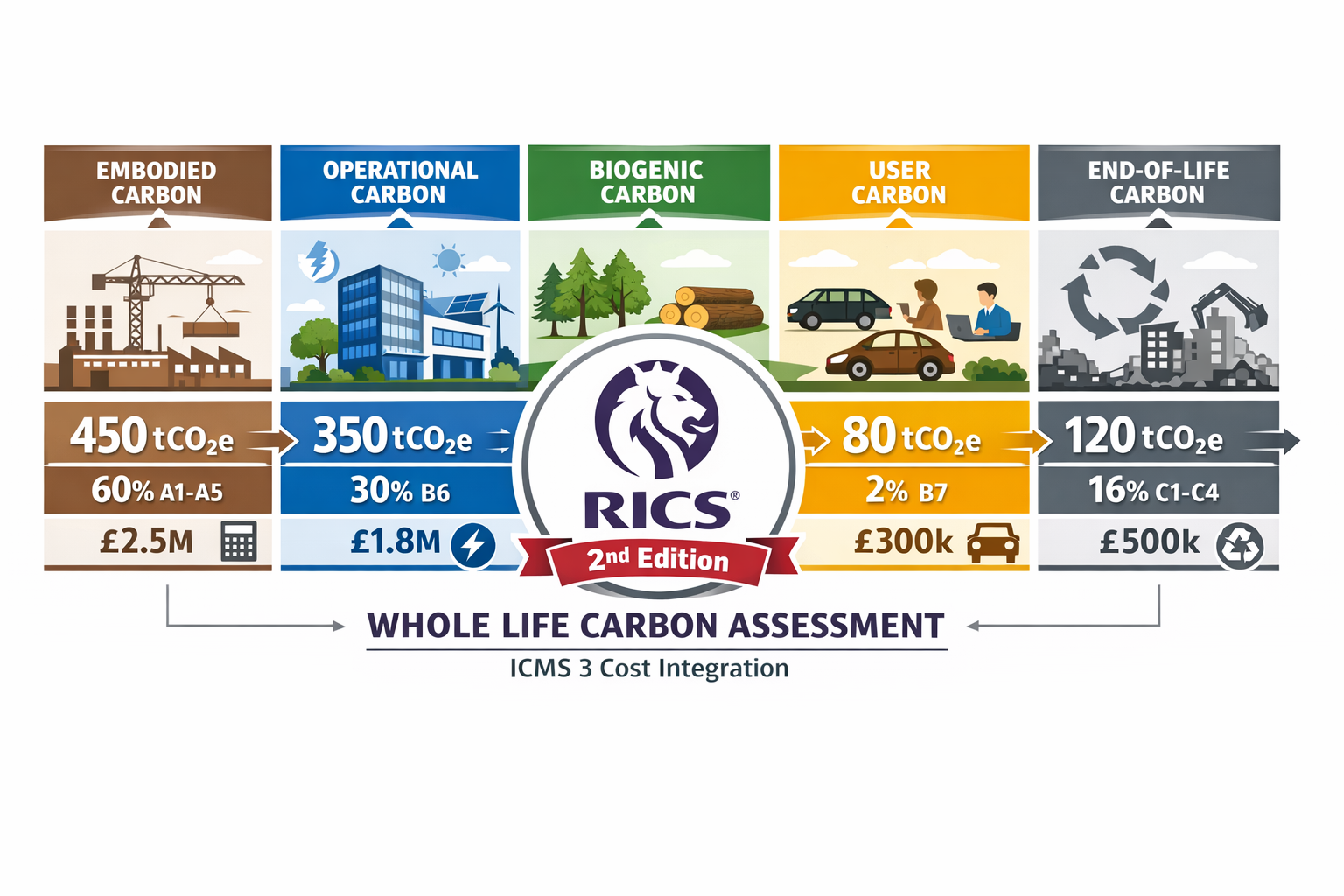
The 2nd edition measures five distinct carbon types:
- Embodied Carbon: Emissions from material extraction, manufacturing, transportation, and construction
- Operational Carbon: Energy consumption and emissions during building use
- Biogenic Carbon: Carbon stored in natural materials like timber
- User Carbon: Emissions from occupant activities and transport
- End-of-Life Carbon: Demolition, waste processing, and material recycling impacts[3]
New Reporting Modules and Element Categorization 🏗️
The standard introduces structured reporting modules that align with both building and infrastructure projects, providing clear categorization systems that integrate seamlessly with the International Cost Management Standard (ICMS 3)[2][3]. This integration enables surveyors to link lifecycle costs directly with emissions data, creating more informed decision-making frameworks for clients.
Mandatory Uncertainty Analysis 🔍
Unlike the first edition, the 2nd version requires assessors to conduct uncertainty analysis, acknowledging the variability inherent in long-term carbon projections and encouraging more transparent reporting[2]. This requirement reflects the professional maturity of the discipline and ensures clients understand the confidence levels associated with different assessment scenarios.
Global Applicability with Regional Precision
While the methodology framework applies globally, the standard provides detailed UK-specific guidance on emissions factors and standard practices[9]. For surveyors operating in other regions, the framework remains applicable, but local emissions factors and regulatory requirements must be substituted appropriately. This flexibility makes the standard valuable for chartered surveyors across London and beyond, whether conducting valuations or comprehensive building assessments.
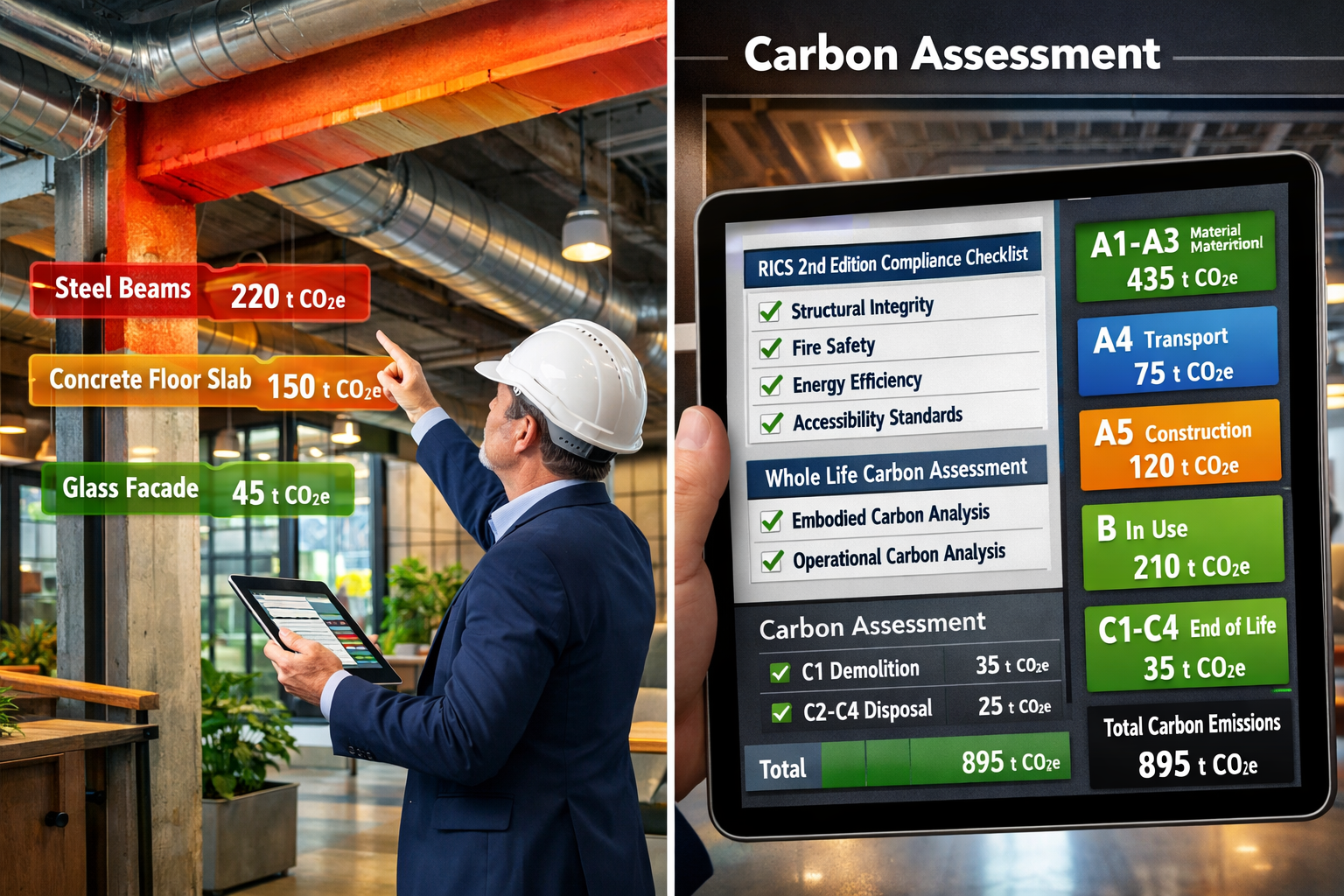
Applying Whole Life Carbon Assessments in 2026 Property Valuations
For surveyors conducting property valuations in 2026, integrating whole life carbon assessments has shifted from optional best practice to professional necessity. The connection between carbon performance and property value has become increasingly direct, with high-carbon buildings facing potential devaluation, reduced marketability, and regulatory compliance challenges.
Carbon Impact on Building Survey Recommendations
When conducting RICS building surveys, surveyors must now consider carbon implications alongside traditional structural and condition assessments. This integration affects several key areas:
Material Selection and Retrofit Recommendations 🔨
Surveyors advising on building improvements must evaluate the embodied carbon of proposed materials. For example, recommending concrete replacement versus timber alternatives now requires carbon footprint comparison, not just cost and structural performance analysis. The RICS 2nd edition provides standardized emissions factors that enable consistent evaluation across different material options[2].
Energy Performance and Operational Carbon ⚡
Operational carbon assessments examine heating, cooling, lighting, and ventilation systems throughout the building's projected lifespan. For commercial building surveys, this analysis often reveals the largest carbon impact area, making energy efficiency upgrades critical value-preservation measures.
End-of-Life Planning and Circular Economy Principles ♻️
The 2nd edition's emphasis on end-of-life carbon encourages surveyors to consider design for disassembly, material reuse potential, and recycling pathways. Buildings designed with circular economy principles demonstrate lower whole life carbon and increasingly command premium valuations.
Valuation Adjustments for Carbon Performance
Professional surveyors must now incorporate carbon performance into valuation methodologies:
| Carbon Performance Level | Potential Valuation Impact | Market Considerations |
|---|---|---|
| High Performance (Low WLC) | +5% to +15% premium | Strong tenant demand, regulatory compliance, future-proofed |
| Average Performance | Baseline valuation | Meets current standards, moderate upgrade requirements |
| Poor Performance (High WLC) | -10% to -25% discount | Limited tenant appeal, significant retrofit costs, regulatory risk |
These adjustments reflect real market dynamics observed in 2026, where institutional investors increasingly screen acquisitions based on carbon performance metrics. For professionals providing cost of valuation services, transparent communication about these factors has become essential.
Integration with PAS 2080:2023 Standards
The RICS 2nd edition works alongside PAS 2080:2023, the carbon management standard for infrastructure. Surveyors working on mixed-use developments or infrastructure-adjacent properties must understand both frameworks. PAS 2080 emphasizes carbon management throughout project delivery, complementing RICS's assessment-focused approach[3].
For surveyors conducting reinstatement cost valuations or capital gains tax valuations, understanding the interaction between these standards ensures comprehensive advice that addresses both financial and environmental performance.
Practical Implementation: Tools, Training, and Professional Requirements
Successfully implementing Whole Life Carbon Assessments in 2026 Valuations: RICS 2nd Edition Standards for Surveyors requires the right combination of knowledge, tools, and ongoing professional development.
RICS-Validated Software Solutions
One Click LCA became the world's first RICS-validated software for whole life carbon assessments, providing compliant reports that meet all 2nd edition requirements[4]. The platform supports assessment processes from early design conceptualization through final as-built performance validation, offering several key advantages:
✅ Automated Compliance: Pre-configured reporting modules aligned with RICS 2nd edition requirements
✅ Integrated Databases: Comprehensive emissions factors for UK and international projects
✅ Scenario Comparison: Side-by-side evaluation of different design and material options
✅ ICMS 3 Integration: Direct linking of carbon data with cost management frameworks
These digital workflows significantly offset the additional effort required by the expanded assessment scope, addressing practitioner concerns about increased time and cost burdens[3].
Professional Training and Certification
RICS offers a comprehensive Global Certificate in Whole Life Carbon Assessment (2026 Edition) training programme providing 140 hours of CPD over 10 months of enrollment[6][8]. This structured programme covers:
- ISO international standards for whole life carbon assessment
- Detailed methodology for each carbon category (embodied, operational, biogenic, user, end-of-life)
- Practical application of RICS 2nd edition reporting modules
- Integration with cost management and valuation practices
- Case studies demonstrating real-world implementation
For surveyors seeking to maintain professional competence, this certification represents the gold standard for 2026 practice. The programme's global applicability makes it valuable for professionals operating across different markets, from chartered surveyors in Hertfordshire to international practitioners.
Mandatory Professional Requirements
According to Anil Sawhney, Head of Sustainability at RICS, assessors must follow mandatory requirements, with all RICS members conducting whole-life carbon assessments anywhere in the world required to meet these standards[3]. Key professional obligations include:
Documentation and Deviation Recording 📋
Surveyors must record any deviations from the standard as part of the assessment process[5]. This transparency requirement ensures clients understand where assessments diverge from standard methodology and why such deviations were necessary.
Continuous Professional Development 📚
The rapidly evolving nature of carbon assessment methodology requires ongoing learning. RICS provides a dedicated hub with helpful guides and resources for stakeholders implementing the 2nd edition standard[1], supporting practitioners in maintaining current knowledge.
Client Communication and Education 💬
Surveyors bear responsibility for educating clients about carbon assessment significance and implications. RICS launched two guidance documents in March 2024, including "Whole Life Carbon Assessments – a guide for clients," specifically to support this communication requirement[1].
Practical Workflow Integration
For surveyors conducting routine property assessments, integrating carbon evaluation requires workflow adjustments:
- Initial Scoping: Determine assessment scope based on property type, project stage, and client requirements
- Data Collection: Gather building specifications, material schedules, energy performance data, and operational information
- Software Input: Enter data into RICS-validated assessment tools
- Analysis and Scenario Testing: Evaluate baseline performance and alternative improvement scenarios
- Reporting: Generate compliant reports with clear recommendations
- Client Presentation: Communicate findings with emphasis on valuation implications and improvement opportunities
This systematic approach ensures consistency across different property types, from residential surveys to complex commercial assessments.
Future-Proofing High-Value Assets Through Carbon Assessment
The strategic value of whole life carbon assessments extends beyond regulatory compliance, offering property owners and investors critical insights for long-term asset performance and value preservation.
Sustainability Mandates and Market Dynamics
As 2026 progresses, sustainability mandates continue tightening across multiple fronts:
- Building Regulations: Enhanced energy performance requirements in new construction and major renovations
- Disclosure Requirements: Mandatory carbon reporting for larger commercial properties
- Financing Conditions: Green lending criteria incorporating carbon performance metrics
- Tenant Expectations: Corporate occupiers increasingly demanding low-carbon buildings to meet their own sustainability commitments
Properties with strong carbon performance are better positioned to navigate these evolving requirements, maintaining marketability and avoiding costly retrofit obligations.
Investment Decision-Making
Institutional investors now routinely incorporate whole life carbon assessments into acquisition due diligence. For surveyors providing probate valuations or lease extension valuations, understanding carbon performance implications helps clients make informed decisions about property retention, improvement, or disposition.
Risk Mitigation Strategies 🛡️
Carbon assessment identifies specific risks and mitigation opportunities:
- Stranded Asset Risk: Properties with poor carbon performance face potential devaluation as regulations tighten
- Retrofit Cost Planning: Early identification of improvement needs enables strategic capital planning
- Regulatory Compliance: Proactive assessment ensures readiness for emerging disclosure and performance requirements
- Market Positioning: Strong carbon credentials differentiate properties in competitive markets
Decarbonization Pathways
The RICS 2nd edition includes requirements for decarbonization pathway analysis, helping property owners understand improvement trajectories toward net-zero targets[2]. These pathways typically include:
Short-Term Improvements (1-3 years) 🎯
- Operational efficiency optimization
- Renewable energy procurement
- Basic building envelope improvements
Medium-Term Upgrades (3-10 years) 🔄
- Major system replacements (HVAC, lighting)
- Significant envelope retrofits
- On-site renewable generation
Long-Term Transformation (10+ years) 🚀
- Deep retrofits or redevelopment
- Advanced low-carbon technologies
- Circular economy implementation
For professionals conducting schedule of dilapidations assessments or advising on collective enfranchisement, understanding these pathways helps contextualize improvement recommendations within broader carbon reduction strategies.
Stakeholder Collaboration
Effective carbon assessment requires collaboration across multiple disciplines:
- Architects and Engineers: Design optimization for carbon reduction
- Cost Consultants: Integration of carbon and financial analysis
- Facilities Managers: Operational carbon data and improvement implementation
- Sustainability Consultants: Specialized carbon accounting expertise
Surveyors increasingly serve as coordinators for these multidisciplinary teams, ensuring carbon considerations integrate seamlessly with traditional valuation and assessment practices. This collaborative approach mirrors the teamwork required in party wall matters, where multiple stakeholders must align around shared objectives.
Regional Implementation and Local Considerations
While the RICS 2nd edition provides a globally applicable framework, regional variations in building practices, climate conditions, and regulatory environments require localized application strategies.
UK-Specific Implementation
For surveyors operating across the UK, the standard's UK-based emissions factors and assumptions provide direct applicability[9]. However, regional variations still matter:
London and Southeast England 🏙️
High property values and dense urban environments create unique challenges and opportunities. Chartered surveyors in Central London frequently encounter heritage buildings requiring sensitive carbon reduction approaches that preserve architectural character while improving performance.
Regional Markets 🌳
Areas like Hertfordshire, Berkshire, and Sussex present different property types and market dynamics. Lower-density developments may offer more straightforward retrofit opportunities, while rural properties might incorporate renewable energy generation more easily than urban counterparts.
Adapting the Framework for International Practice
Surveyors applying the RICS 2nd edition outside the UK must substitute appropriate local emissions factors and consider regional regulatory frameworks. The methodology remains valid, but numerical inputs require adjustment to reflect:
- Local electricity grid carbon intensity
- Regional material production processes
- Climate-specific operational energy requirements
- Local construction practices and standards
Common Challenges and Solutions
Implementing Whole Life Carbon Assessments in 2026 Valuations: RICS 2nd Edition Standards for Surveyors presents several practical challenges that practitioners must navigate.
Data Availability and Quality
Challenge: Obtaining accurate material specifications and operational data for existing buildings can be difficult, particularly for older properties with incomplete records.
Solution: The RICS 2nd edition acknowledges this reality and provides guidance on using proxy data and industry benchmarks when specific information is unavailable. RICS-validated software tools include extensive default databases that enable reasonable estimates when precise data is lacking[4].
Balancing Comprehensiveness with Practicality
Challenge: The expanded scope of the 2nd edition could potentially increase assessment time and cost, raising client concerns about value for money.
Solution: Digital workflows and validated tools significantly offset additional effort[3]. Surveyors should communicate the long-term value of comprehensive assessment, emphasizing how carbon insights protect property values and inform strategic decision-making.
Client Education and Engagement
Challenge: Many property owners and investors still view carbon assessment as regulatory compliance rather than strategic value creation.
Solution: Effective communication focusing on financial implications, risk mitigation, and market positioning helps clients understand assessment value. The RICS client guidance documents provide helpful frameworks for these conversations[1].
Keeping Current with Evolving Standards
Challenge: Carbon assessment methodology continues evolving rapidly, requiring ongoing professional development.
Solution: Structured training programmes like the RICS Global Certificate provide comprehensive foundations, while regular engagement with RICS resources and professional networks ensures practitioners stay current with emerging best practices[6][8].
Conclusion
Whole Life Carbon Assessments in 2026 Valuations: RICS 2nd Edition Standards for Surveyors represent a fundamental shift in professional practice, transforming carbon performance from peripheral consideration to core valuation factor. Since the mandatory implementation date of July 1, 2024, RICS members worldwide must comply with these comprehensive standards, measuring embodied, operational, biogenic, user, and end-of-life carbon across complete asset lifecycles[5][7].
For surveyors conducting building surveys, commercial property assessments, and various valuation types, integrating carbon assessment is no longer optional but essential to professional competence and client service. The standard's integration with ICMS 3 cost management frameworks enables holistic analysis linking financial and environmental performance, while RICS-validated software tools make compliance practical and efficient[3][4].
Actionable Next Steps for Surveyors
-
Invest in Training: Enroll in the RICS Global Certificate in Whole Life Carbon Assessment to build comprehensive competence in the 2nd edition methodology[6][8]
-
Adopt Validated Tools: Implement RICS-validated software like One Click LCA to streamline assessment workflows and ensure compliant reporting[4]
-
Update Service Offerings: Explicitly incorporate carbon assessment into standard survey and valuation packages, communicating the value to clients
-
Build Collaborative Networks: Develop relationships with sustainability consultants, engineers, and other specialists to support multidisciplinary carbon assessment projects
-
Engage with RICS Resources: Regularly review the RICS implementation hub for updated guidance, case studies, and best practice examples[1]
-
Educate Clients: Use RICS client guidance documents to help property owners understand carbon assessment value and implications[1]
The transition to carbon-conscious property practice represents both challenge and opportunity. Surveyors who embrace these standards position themselves as forward-thinking professionals capable of delivering the comprehensive, future-focused advice that 2026 markets demand. As sustainability mandates continue tightening and carbon performance increasingly drives property values, expertise in whole life carbon assessment becomes not just a professional requirement but a competitive advantage.
Whether conducting routine residential surveys or complex commercial valuations, integrating RICS 2nd edition standards ensures surveyors provide clients with the complete picture of property performance, risk, and value in an increasingly carbon-conscious world.
References
[1] Rics Whole Life Carbon Assessment 2nd Edition Now In Effect – https://circularecology.com/news/rics-whole-life-carbon-assessment-2nd-edition-now-in-effect
[2] New Rics Whole Life Carbon 2nd Edition – https://support.etool.app/index.php/knowledgebase/new-rics-whole-life-carbon-2nd-edition/
[3] Rics Whole Life Carbon Assessment V2 Whats Working Whats Next – https://oneclicklca.com/en/resources/articles/rics-whole-life-carbon-assessment-v2-whats-working-whats-next
[4] Rics Whole Life Carbon Assessment Wlca 2nd Edition – https://oneclicklca.com/regulations/rics-whole-life-carbon-assessment-wlca-2nd-edition
[5] Wlca Standard 2nd Edition Now In Full Effect – https://www.rics.org/news-insights/wlca-standard-2nd-edition-now-in-full-effect
[6] Certificate In Whole Life Carbon Assessment Training Programme 200126 – https://www.rics.org/content/dam/ricsglobal/documents/event-programmes/Certificate-in-whole-life-carbon-assessment_training-programme_200126.pdf
[7] Rics Whole Life Carbon Assessment Wlca Standard – https://netzerocompare.com/policies/rics-whole-life-carbon-assessment-wlca-standard
[8] Certificate In Whole Life Carbon Assessment Training Programme – https://www.rics.org/training-events/training-courses/certificate-in-whole-life-carbon-assessment-training-programme
[9] Whole Life Carbon Assessment – https://www.rics.org/profession-standards/rics-standards-and-guidance/sector-standards/construction-standards/whole-life-carbon-assessment
