
The UK housing market has shifted dramatically in 2026, presenting first-time buyers with opportunities not seen in years. With mortgage rates retreating from their 2023 peaks and housing stock increasing across key regions, the landscape has transformed from a seller's market into one where buyers hold genuine negotiating power. Valuing First-Time Buyer Properties in 2026: RICS Tactics Amid Improving Affordability and Supply has become essential knowledge for anyone entering the property ladder, as accurate valuations now serve as powerful negotiation tools rather than mere formalities.
For RICS-qualified surveyors, this evolving market demands refined strategies that account for improved affordability metrics, increased inventory, and buyers' enhanced bargaining positions. The traditional valuation approach—focused primarily on comparable sales—must now incorporate broader market dynamics, condition assessments, and strategic positioning that empowers first-time buyers to secure favorable purchase terms.

Key Takeaways
- 📊 Market conditions favor buyers: Mortgage rates have declined to approximately 4.5-5%, while housing stock has increased by 15-20% in many first-time buyer hotspots, creating genuine negotiation leverage
- 🏠 RICS valuation standards ensure consistency: Standardized inspection procedures across all RICS surveyors provide uniform consumer protection and reliable valuation benchmarks[5]
- 💷 Strategic valuations support negotiations: Accurate property assessments identifying defects, market positioning, and comparable sales data empower first-time buyers to negotiate 5-10% reductions in asking prices
- 📋 Multiple valuation types serve different purposes: From Help to Buy repayment valuations (£200+) to comprehensive Level 3 Building Surveys (£750-£1,500+), choosing the right assessment type maximizes value[1][4]
- ⚖️ Professional independence matters: RICS-qualified surveyors provide impartial assessments free from lender or seller influence, protecting buyer interests in complex transactions
Understanding the 2026 First-Time Buyer Market Landscape
The transformation of the UK property market between 2023 and 2026 represents one of the most significant shifts in recent housing history. After years of escalating prices and fierce competition, first-time buyers now operate in conditions that favor careful evaluation and strategic negotiation rather than rushed decisions driven by fear of missing out.
Current Affordability Metrics and Their Impact
Mortgage affordability has improved substantially as rates stabilized around 4.5-5% in 2026, down from peaks exceeding 6% in late 2023. This reduction translates to approximately £150-200 monthly savings on a typical £250,000 mortgage—meaningful relief for first-time buyers stretching their budgets. Combined with modest wage growth and stabilized property prices in many regions, the deposit-to-income ratio has become more manageable for households saving toward homeownership.
The ripple effects extend beyond monthly payments. Lenders have gradually relaxed lending criteria, with loan-to-value ratios improving and stress testing becoming less prohibitive. First-time buyers can now access mortgages with 5-10% deposits more readily, though larger deposits still secure more favorable rates.
Housing Stock Increases and Regional Variations
Supply constraints that plagued the market for years have eased considerably in 2026. New construction completions, combined with existing homeowners listing properties, have increased available stock by 15-20% in popular first-time buyer areas including:
- Greater London outer boroughs: Particularly zones 3-6 where starter flats and terraced houses dominate
- Regional cities: Manchester, Birmingham, Leeds, and Bristol showing strongest inventory growth
- Commuter belt towns: Hertfordshire, Essex, and Berkshire locations with good transport links
This increased supply fundamentally alters valuation dynamics. Where scarcity once drove prices above asking, surveyors now identify properties sitting on the market longer, creating opportunities for buyers to negotiate based on condition, comparable sales, and realistic market positioning.
When considering properties in these regions, working with chartered surveyors across multiple locations ensures local market knowledge informs valuation accuracy.
The Buyer's Market Advantage
The confluence of improved affordability and increased supply creates what economists term a "buyer's market"—conditions where purchasers hold negotiating leverage. For RICS surveyors, this context transforms valuation from a passive assessment into an active negotiation tool that first-time buyers can deploy strategically.
Properties with identified defects, outdated features, or above-market pricing now face genuine scrutiny. Sellers motivated by carrying costs, chain requirements, or market timing pressures increasingly accept offers 5-10% below asking prices when supported by professional valuations documenting legitimate concerns.
RICS Valuation Standards and Methodologies for First-Time Buyer Properties
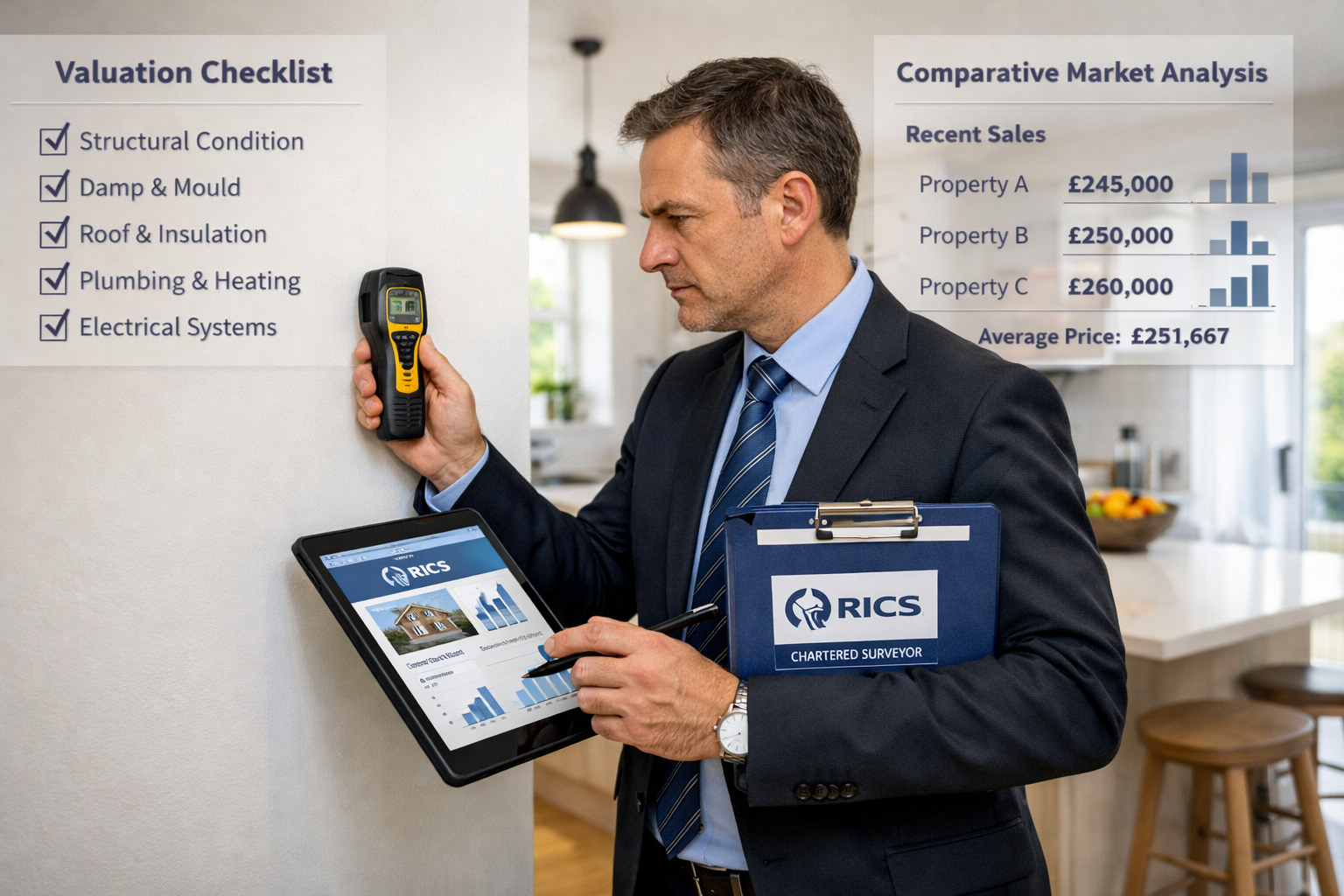
The Royal Institution of Chartered Surveyors (RICS) maintains rigorous standards ensuring consistency, professionalism, and consumer protection across all property valuations. Understanding these frameworks helps first-time buyers select appropriate assessment types and interpret findings effectively.
Core RICS Valuation Principles
RICS valuation standards apply uniformly across various property types and transaction purposes, from standard purchases to specialized schemes like Help to Buy and Shared Ownership[5]. These principles include:
- Independence and objectivity: Surveyors must remain free from conflicts of interest, providing impartial assessments regardless of buyer, seller, or lender preferences
- Competence and due diligence: Only qualified professionals with relevant experience should conduct valuations, ensuring thorough inspections and accurate reporting
- Transparency: Valuation reports must clearly explain methodologies, assumptions, limitations, and conclusions in accessible language
- Market value basis: Assessments reflect realistic market conditions, comparable sales, and property-specific factors rather than aspirational or distressed pricing
The RICS Home Survey Standard, implemented to ensure uniform inspection procedures, provides consistent consumer protection levels across all chartered surveyors[7]. This standardization means first-time buyers receive comparable quality regardless of which RICS professional they engage.
Valuation Types Relevant to First-Time Buyers
Different valuation and survey types serve distinct purposes in the first-time buyer journey. Understanding these options helps purchasers invest appropriately in property assessments:
Level 2 Home Survey (RICS Home Survey)
The most popular choice for first-time buyers purchasing standard properties built after 1900 in reasonable condition. Level 2 surveys cost £450-£800 and provide:
- Visual inspection of accessible areas without invasive testing
- Identification of urgent defects and potential issues requiring attention
- Market valuation and insurance rebuild cost assessment
- Guidance on maintenance and repairs
This survey type balances cost with comprehensive coverage, making it ideal for typical starter homes, flats, and terraced houses. For detailed information about what this assessment includes, review our complete guide to Level 2 house surveys.
Level 3 Building Survey (Full Structural Survey)
Recommended for older properties (pre-1900), those with visible defects, or homes requiring renovation. Level 3 surveys range from £750-£1,500+ and deliver:
- Comprehensive inspection including accessible roof spaces, floors, and foundations
- Detailed analysis of construction, materials, and condition
- Specific defect descriptions with repair cost estimates
- Advice on maintenance, alterations, and ongoing care
First-time buyers considering fixer-uppers or period properties benefit enormously from this thorough assessment, which uncovers hidden issues that could derail budgets. Learn more about whether this investment makes sense in our article on whether Level 3 surveys are worth the cost.
Help to Buy Valuations
For existing Help to Buy equity loan holders selling their properties, independent RICS valuations are mandatory to determine repayment amounts[1]. These assessments cost approximately £200 including VAT and must be conducted by qualified surveyors from the government's approved panel.
While new Help to Buy applications in England have discontinued (with Wales extended to March 2025), thousands of first-time buyers who purchased through this scheme between 2013-2023 still require these valuations when selling or remortgaging[1]. The valuation determines the equity loan percentage owed based on current market value.
Comparative Market Analysis in 2026 Conditions
RICS surveyors employ comparative market analysis (CMA) as a cornerstone valuation methodology, examining recent sales of similar properties in the same area. In 2026's improved supply environment, this approach reveals critical insights:
- Time on market trends: Properties sitting unsold for 60+ days often indicate overpricing, suggesting negotiation opportunities
- Sale price vs. asking price ratios: Tracking how much below asking prices properties actually sell reveals market strength
- Seasonal variations: Understanding whether spring/summer premiums still apply or if year-round supply has flattened seasonal patterns
- Condition premiums: Quantifying how much buyers pay for move-in-ready properties versus those requiring work
By analyzing 10-15 comparable sales from the previous 3-6 months, surveyors establish realistic value ranges that account for current market dynamics rather than historical trends that may no longer apply.
Valuing First-Time Buyer Properties in 2026: RICS Tactics for Negotiation Leverage

The strategic value of professional RICS valuations extends far beyond satisfying lender requirements. In 2026's buyer-favorable market, these assessments become powerful negotiation instruments that first-time buyers can wield to secure better purchase terms, reduced prices, and favorable conditions.
Identifying Defects That Support Price Reductions
Thorough property inspections uncover issues that justify negotiated price adjustments. RICS surveyors document:
Structural concerns: Cracks, subsidence signs, roof damage, or foundation issues that require immediate or future remediation. Even minor structural defects can support £10,000-£30,000 reductions when repair costs are quantified.
Damp and moisture problems: Rising damp, penetrating moisture, or condensation issues affecting walls, ceilings, or floors. Treatment costs ranging from £1,500-£5,000+ provide concrete negotiation figures.
Electrical and plumbing deficiencies: Outdated wiring requiring rewiring (£3,000-£8,000), aging boilers needing replacement (£2,000-£4,000), or plumbing issues affecting multiple fixtures.
Building regulation non-compliance: Extensions, conversions, or alterations completed without proper approvals create legal risks and potential remediation costs. Surveyors identify these concerns, enabling buyers to request indemnity insurance or price reductions.
For properties requiring extensive assessment, consider structural surveys that provide detailed analysis of construction integrity and defect severity.
Leveraging Market Position and Comparable Sales
Beyond physical condition, RICS valuations assess market positioning—how the asking price compares to recent sales of genuinely similar properties. In 2026's increased supply environment, this analysis often reveals:
- Overpricing relative to comparables: When asking prices exceed recent sales by 10-15%, professional valuations document this discrepancy with specific comparable evidence
- Market trend adjustments: If comparable sales occurred 6-12 months ago during stronger market conditions, valuations adjust for current softer demand
- Feature-by-feature comparisons: Accounting for differences in square footage, bedrooms, condition, parking, and gardens to establish fair value
First-time buyers armed with detailed comparable analysis can approach sellers with evidence-based offers rather than arbitrary reductions, increasing acceptance likelihood while securing genuine savings.
Timing Valuations for Maximum Impact
Strategic timing amplifies valuation effectiveness in negotiations:
Pre-offer valuations: Commissioning surveys before making offers allows buyers to submit realistic initial bids based on professional assessment rather than asking prices. This approach saves time and positions buyers as serious, informed purchasers.
Post-offer, pre-exchange valuations: Standard practice involves surveys after offer acceptance but before exchange. Findings that reveal defects or overpricing provide legitimate grounds for renegotiation before legal commitment.
Contingent offer strategies: Making offers explicitly contingent on satisfactory survey results protects buyers while signaling professional due diligence expectations to sellers.
Understanding how long property surveys take helps buyers plan timelines that maintain negotiation leverage without delaying transactions unnecessarily.
Presenting Valuation Findings Effectively
Professional RICS reports provide credibility that informal assessments lack. When renegotiating based on survey findings:
✅ Share the full report: Providing sellers with complete RICS documentation demonstrates legitimate concerns rather than buyer's remorse
✅ Quantify repair costs: Include contractor quotes or surveyor estimates for identified defects, translating concerns into concrete figures
✅ Propose solutions, not just reductions: Offer alternatives like seller-funded repairs, retention amounts held in escrow, or completion guarantees alongside price adjustments
✅ Maintain professional tone: Frame discussions around fair value and mutual benefit rather than adversarial positioning
Sellers facing multiple interested buyers may resist renegotiation, but in 2026's balanced market, motivated vendors increasingly accommodate reasonable requests supported by professional evidence.
Specialized Valuation Scenarios for First-Time Buyers in 2026
Beyond standard purchase valuations, first-time buyers encounter specialized scenarios requiring specific RICS expertise and approaches.
New Build Property Valuations
Despite common assumptions, surveys on new build properties remain valuable for first-time buyers. RICS surveyors assess:
- Snagging issues: Cosmetic defects, finishing problems, and incomplete work that developers should remedy before completion
- NHBC warranty compliance: Ensuring proper certification and warranty coverage for structural defects
- Market value vs. developer pricing: New builds often carry premiums above resale equivalents; valuations identify when asking prices exceed sustainable market values
In 2026's improved supply environment, new build premiums have compressed as resale stock competes more effectively. Valuations help first-time buyers avoid overpaying for new construction when comparable resale properties offer better value.
Leasehold Flat Valuations
First-time buyers frequently purchase leasehold flats, requiring specialized valuation considerations:
- Lease length impact: Remaining lease terms below 80 years significantly affect value and mortgageability; valuations account for extension costs
- Service charge and ground rent analysis: Reviewing historical charges and anticipated increases affects long-term affordability
- Building condition and management quality: Assessing overall building maintenance, major works provisions, and management company effectiveness
For properties requiring lease extensions, understanding lease extension valuation processes helps buyers factor these costs into purchase decisions.
Shared Ownership Valuations
Shared ownership schemes remain popular first-time buyer entry routes. RICS valuations for shared ownership properties assess:
- Full market value: Determining the 100% freehold value from which share percentages calculate
- Staircasing implications: Valuing the property for future share purchases as buyers increase ownership stakes
- Rent and service charge sustainability: Evaluating ongoing costs on the housing association's retained share
These valuations follow the same rigorous RICS standards ensuring consistency and consumer protection[5].
Properties Requiring Immediate Works
First-time buyers with renovation skills or budgets for improvements often target properties needing work. Level 3 Building Surveys become essential for these purchases, providing:
- Detailed defect schedules: Comprehensive lists of required repairs with priority rankings
- Cost estimation guidance: Approximate repair costs helping buyers budget realistically
- Structural integrity assessment: Ensuring fundamental soundness before committing to cosmetic improvements
Buyers can then negotiate purchase prices that account for required works, effectively acquiring properties at discounts that reward their willingness to undertake improvements.
Selecting and Working with RICS Surveyors for Optimal Results

Choosing the right RICS surveyor significantly impacts valuation quality, negotiation outcomes, and overall first-time buyer experience. Several factors deserve consideration when selecting professionals.
Qualifications and Accreditations to Verify
All RICS surveyors must hold appropriate qualifications, but specific credentials indicate specialized expertise:
- MRICS or FRICS designation: Member or Fellow status confirms professional qualification and ongoing competence
- Registered Valuer status: RICS Registered Valuers meet enhanced standards for valuation work
- Local market knowledge: Surveyors regularly working in your target area understand regional pricing, common defects, and neighborhood dynamics
- First-time buyer experience: Professionals accustomed to working with first-time purchasers communicate more effectively and understand unique concerns
Verify credentials through the RICS member directory and request examples of recent comparable work when interviewing potential surveyors.
Questions to Ask Before Commissioning Valuations
Informed first-time buyers ask prospective surveyors:
- What survey level do you recommend for this property type and condition? Ensures appropriate assessment scope
- How long will the inspection take, and when will I receive the report? Manages timeline expectations; typical turnaround is 5-10 working days
- Will you be available to discuss findings and answer questions? Access to surveyor expertise maximizes report value
- What comparable sales will inform the valuation? Understanding CMA scope ensures thorough market analysis
- Do you provide follow-up support if negotiations require clarification? Some surveyors assist with renegotiation discussions
Professional surveyors welcome these questions and provide clear, confident answers demonstrating their expertise and client service commitment.
Understanding Survey Costs and Value Propositions
While survey costs represent significant upfront expenses for first-time buyers, the investment typically delivers substantial returns:
| Survey Type | Typical Cost | Best For | Potential Savings |
|---|---|---|---|
| Level 2 Home Survey | £450-£800 | Standard properties in reasonable condition | £5,000-£15,000 through defect-based negotiation |
| Level 3 Building Survey | £750-£1,500+ | Older properties, those with visible issues, or requiring renovation | £10,000-£30,000+ identifying major defects |
| Help to Buy Valuation | £200+ | Existing equity loan repayment calculations | Ensures accurate repayment amounts |
The return on investment from professional surveys far exceeds costs when valuations uncover defects, support price negotiations, or prevent purchases of fundamentally flawed properties[4].
To understand what surveyors examine during assessments, read our guide on what surveyors check during house surveys.
Maximizing Report Value Through Follow-Up
RICS survey reports contain dense technical information that first-time buyers may find overwhelming. Maximize value by:
📞 Scheduling a follow-up call: Most surveyors offer telephone discussions to explain findings, answer questions, and clarify priorities
📋 Creating action plans: Organize identified issues by urgency, cost, and negotiation potential
💰 Obtaining repair quotes: For significant defects, commission contractor estimates that quantify costs for negotiation purposes
🔄 Requesting clarifications in writing: Document surveyor responses to specific questions for reference during negotiations
Professional surveyors view client education as integral to their service, not an imposition on their time.
Integrating Valuations into the Broader First-Time Buyer Strategy
Professional RICS valuations represent one component of comprehensive first-time buyer strategies that optimize outcomes in 2026's improved market conditions.
Coordinating with Mortgage Lenders
While buyers commission their own surveys, mortgage lenders conduct separate valuations to protect their security interests. Understanding this distinction prevents confusion:
- Lender valuations: Basic assessments confirming property value supports the loan amount; not detailed condition reports
- Buyer surveys: Comprehensive assessments protecting purchaser interests by identifying defects and confirming fair value
- Valuation discrepancies: When buyer surveys reveal issues affecting value, lenders may adjust their valuations downward, potentially reducing available mortgage amounts
First-time buyers should anticipate both valuation types and understand that thorough buyer surveys may trigger lender reassessments that actually protect against overextending financially.
Building Negotiation Strategies Around Valuation Findings
Effective negotiation integrates survey findings with broader market intelligence:
- Assess seller motivation: Time on market, chain position, and listing history indicate flexibility
- Quantify total adjustment requests: Combine defect repair costs with market positioning analysis for comprehensive renegotiation proposals
- Prioritize critical issues: Focus negotiations on structural, safety, or legal concerns rather than cosmetic preferences
- Offer creative solutions: Propose retention amounts, staged payments, or seller-funded repairs as alternatives to pure price reductions
- Maintain relationship: Preserve goodwill for ongoing transaction cooperation while firmly advocating for fair terms
Survey evidence provides objective foundations for these discussions, transforming potentially adversarial negotiations into problem-solving conversations.
Long-Term Value Protection
Beyond immediate purchase negotiations, RICS valuations serve ongoing purposes:
- Maintenance planning: Survey recommendations guide prioritized maintenance schedules, preventing small issues from becoming major problems
- Insurance accuracy: Rebuild cost assessments ensure adequate coverage without overpaying premiums
- Future sale preparation: Understanding property strengths and weaknesses informs improvement investments that maximize resale value
- Remortgage valuations: Baseline assessments provide comparison points for future refinancing valuations
First-time buyers who view surveys as long-term property management tools rather than mere transaction requirements extract maximum value from these professional assessments.
Common Pitfalls and How to Avoid Them
Even with professional RICS support, first-time buyers sometimes make mistakes that undermine valuation benefits or create unnecessary complications.
❌ Skipping Surveys to Save Money
The most costly mistake involves foregoing professional surveys to reduce upfront expenses. While saving £500-£1,000 seems attractive, this decision risks:
- Purchasing properties with hidden defects costing tens of thousands to remediate
- Overpaying by 5-15% due to lack of comparable market analysis
- Losing negotiation leverage when issues emerge after legal commitment
- Facing mortgage complications if lender valuations identify concerns post-offer
The question isn't whether to commission surveys, but which type provides optimal value for specific property circumstances. Our article on whether you need a survey when buying a house explains this decision framework comprehensively.
❌ Choosing Surveyors Based Solely on Price
While cost considerations matter for budget-conscious first-time buyers, selecting the cheapest surveyor often proves penny-wise and pound-foolish. Quality, experience, and local expertise deliver far more value than minimal cost savings.
Red flags indicating potentially inadequate service include:
- Prices significantly below market averages (30%+ cheaper than competitors)
- Rushed inspection timelines (same-day or next-day reports)
- Unwillingness to discuss methodology or comparable analysis
- Generic reports lacking property-specific detail
Invest in qualified, experienced RICS professionals whose thorough assessments provide genuine protection and negotiation value.
❌ Ignoring Survey Findings or Proceeding Without Renegotiation
Some first-time buyers, emotionally attached to properties or fearing deal collapse, proceed despite survey findings revealing significant issues. This approach risks:
- Financial strain from unexpected repair costs exceeding budgets
- Safety hazards from unaddressed structural or electrical defects
- Reduced property values if defects worsen or affect future saleability
- Mortgage difficulties if issues affect lender valuations during remortgaging
Professional surveys exist precisely to inform decisions. When significant concerns emerge, buyers should:
✅ Renegotiate purchase terms reflecting identified issues
✅ Request seller remediation before completion
✅ Walk away from properties with fundamental flaws exceeding risk tolerance
The 2026 market's improved supply means alternative properties exist—no single purchase justifies ignoring professional warnings.
❌ Misunderstanding Survey Limitations
RICS surveys provide comprehensive assessments within defined scopes, but limitations exist:
- Non-invasive inspections: Surveyors don't lift floorboards, move furniture, or conduct destructive testing unless specifically commissioned
- Accessible areas only: Spaces behind built-in furniture, under fixed floor coverings, or within walls remain unexamined
- Point-in-time assessments: Surveys capture property condition on inspection date; seasonal issues or intermittent problems may not be evident
Understanding these limitations prevents unrealistic expectations while highlighting the value of appropriate survey levels for specific property types.
Future Outlook: Valuation Practices in an Evolving Market
While 2026 presents favorable first-time buyer conditions, market dynamics continue evolving. RICS valuation practices adapt to emerging trends and technologies shaping property assessment futures.
Technology Integration in Valuation Processes
Digital tools increasingly enhance traditional surveying methods:
- Drone surveys for roof and chimney inspections without scaffolding access
- Thermal imaging detecting insulation deficiencies and moisture problems invisible to visual inspection
- Digital measurement tools providing precise floor plans and square footage calculations
- Automated valuation models (AVMs) supplementing professional judgment with data-driven market analysis
These technologies complement rather than replace professional expertise, enabling more thorough assessments and detailed reporting. Services like drone surveys exemplify how innovation enhances traditional practices.
Sustainability and Energy Efficiency Considerations
Environmental concerns increasingly influence property valuations as buyers prioritize running costs and carbon footprints:
- EPC ratings affecting both value and mortgageability as lenders introduce green lending criteria
- Retrofit potential for properties requiring insulation, heating, or renewable energy improvements
- Long-term cost analysis incorporating energy efficiency into total ownership cost projections
RICS surveyors increasingly incorporate sustainability assessments into standard valuations, recognizing that energy-inefficient properties face value depreciation risks as regulations tighten.
Regulatory Changes on the Horizon
Potential regulatory developments may affect first-time buyer valuations:
- Mandatory property condition reports: Proposals requiring seller-commissioned surveys before marketing could shift cost burdens and timing
- Enhanced building safety standards: Post-Grenfell regulations affecting cladding, fire safety, and building materials create new valuation considerations
- Leasehold reform: Proposed changes to ground rents, service charges, and enfranchisement rights affect leasehold property valuations
Staying informed about regulatory developments helps first-time buyers anticipate how rules changes might affect property values and purchase processes.
Conclusion
Valuing First-Time Buyer Properties in 2026: RICS Tactics Amid Improving Affordability and Supply represents more than technical property assessment—it embodies strategic advantage in a transformed housing market. The confluence of lower mortgage rates, increased housing stock, and balanced supply-demand dynamics creates unprecedented opportunities for first-time buyers willing to leverage professional RICS valuations as negotiation tools.
The key insights for first-time buyers navigating 2026's market include:
🏠 Professional valuations deliver ROI: Investing £450-£1,500 in comprehensive RICS surveys typically returns £5,000-£30,000 through defect identification and price negotiation
📊 Market conditions favor informed buyers: Increased supply and improved affordability create genuine negotiation leverage when supported by objective professional assessments
⚖️ RICS standards ensure consistency: Standardized inspection procedures and reporting provide reliable, comparable assessments protecting consumer interests[5][7]
💡 Strategic timing maximizes impact: Commissioning surveys at optimal transaction stages—whether pre-offer or post-acceptance—amplifies negotiation effectiveness
🔍 Comprehensive assessments prevent costly mistakes: Thorough property inspections identify issues that could derail budgets, affect safety, or undermine long-term value
Actionable Next Steps for First-Time Buyers
-
Research local market conditions in your target areas, understanding supply levels, price trends, and typical time-on-market metrics that inform negotiation strategies
-
Budget appropriately for professional surveys, recognizing these costs as investments rather than expenses, with returns far exceeding initial outlays
-
Interview multiple RICS surveyors, verifying qualifications, local expertise, and first-time buyer experience before selecting professionals
-
Commission appropriate survey types based on property age, condition, and complexity—Level 2 for standard properties, Level 3 for older or problematic homes
-
Prepare negotiation strategies integrating survey findings with market analysis, seller motivation assessment, and creative solution proposals
-
Maintain perspective throughout the process, remembering that 2026's improved supply means alternatives exist if specific transactions don't meet fair value criteria
The transformation from seller's market to buyer's market fundamentally changes how first-time buyers should approach property purchases. Professional RICS valuations—once viewed primarily as lender requirements—now serve as powerful strategic tools enabling informed decisions, effective negotiations, and long-term value protection.
By understanding and implementing the tactics outlined in this guide, first-time buyers can navigate 2026's housing market with confidence, securing properties at fair prices while avoiding costly mistakes that have plagued less-prepared purchasers in previous market cycles. The combination of improved market conditions and professional valuation support creates a genuine opportunity for a new generation to access homeownership on favorable terms—an opportunity that rewards preparation, patience, and strategic thinking.
References
[1] Help To Buy Valuations – https://hoa.org.uk/advice/guides-for-homeowners/i-am-selling/help-to-buy-valuations/
[2] Valuation Standards – https://www.rics.org/profession-standards/rics-standards-and-guidance/sector-standards/valuation-standards
[3] Residential Valuations – https://www.rics.org/profession-standards/rics-standards-and-guidance/sector-standards/valuation-standards/residential-valuations
[4] What Is A Rics Survey 2025 – https://surveymatch.co.uk/what-is-a-rics-survey-2025/
[5] The New Rics Home Survey Standard Explained – https://www.surveymerchant.com/blog/the-new-rics-home-survey-standard-explained
[7] Understanding The Rics Home Survey Standard Proposal – https://www.rics.org/news-insights/understanding-the-rics-home-survey-standard-proposal
