
Properties with EPC A ratings command a 2.9% price premium per square meter, while B and C-rated properties actually trade at discounts of –2.3% and –1.2% respectively—a counterintuitive market signal that challenges conventional assumptions about energy efficiency investments.[2] As the UK Net Zero Carbon Buildings Standard formally launches verification services in Q2 2026 and the Future Homes and Buildings Standards take effect this March, chartered surveyors face unprecedented complexity in valuing retrofit projects that must balance regulatory compliance, whole life carbon assessments, and increasingly non-linear market pricing dynamics.
Understanding Valuation Techniques for UK Net Zero Retrofit Projects: RICS Standards Amid 2026 EPC Mandates has become essential for property professionals navigating this transformative regulatory landscape. With millions of UK properties requiring substantial improvements to meet tightening requirements, surveyors must integrate new methodologies that account for operational carbon, embodied carbon, and long-term performance verification into traditional valuation frameworks.
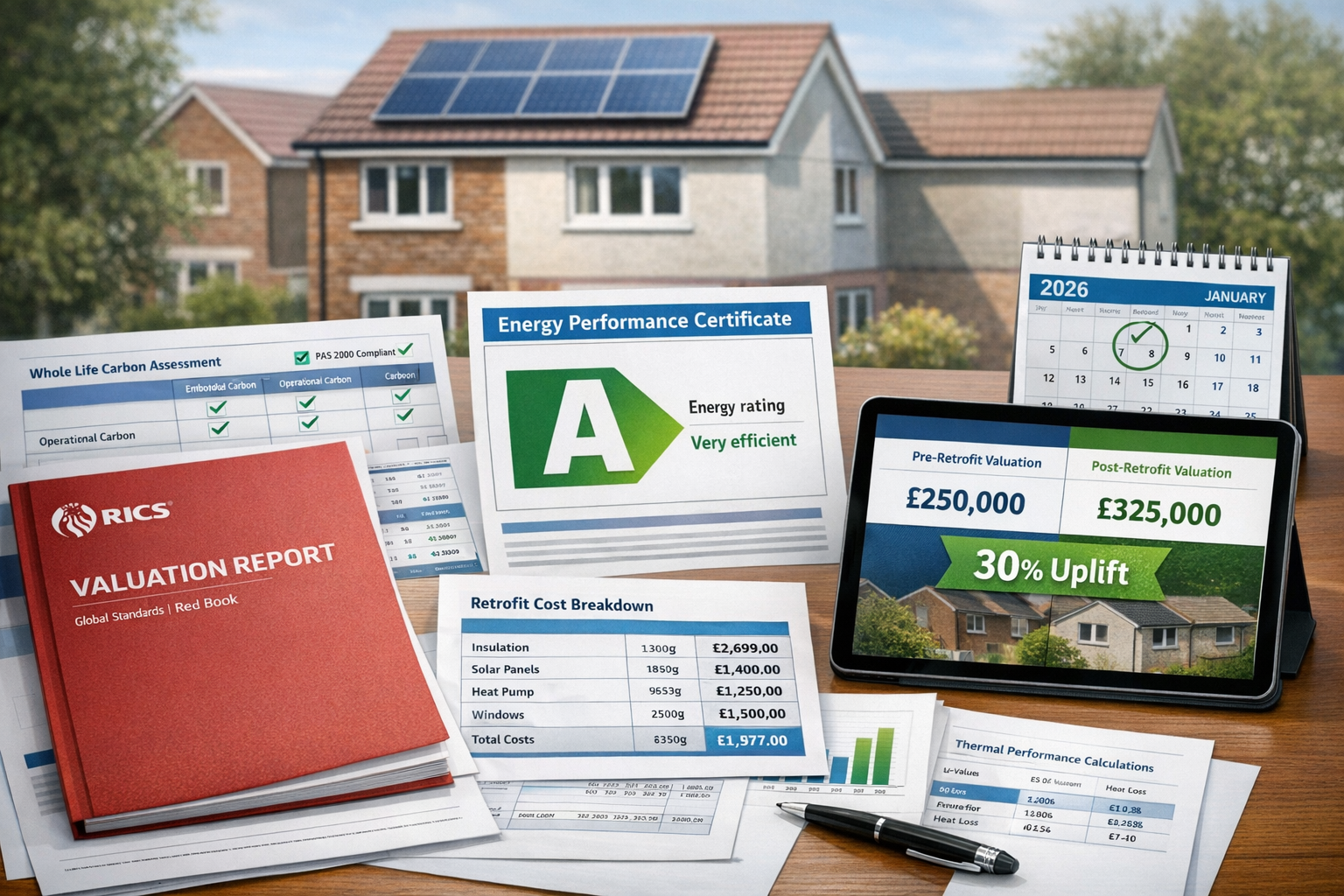
Key Takeaways
- EPC A-rated properties achieve measurable market premiums (2.9% per sqm), while intermediate ratings show minimal or negative pricing effects, requiring targeted deep retrofit strategies rather than incremental improvements
- RICS members play integral roles in national retrofit strategy through Red Book valuation methodologies adapted for whole life carbon and PAS 2080 compliance assessments
- The UK Net Zero Carbon Buildings Standard requires annual operational verification post-certification, fundamentally changing valuation approaches from static to performance-based assessments
- March 2026 Future Homes and Buildings Standards establish mandatory low-carbon requirements that directly impact property valuations across residential and commercial sectors
- Valuation adjustments must account for both capital costs and long-term value capture, including embodied carbon savings from retrofit versus demolition scenarios
Understanding the 2026 EPC Regulatory Landscape
The regulatory environment surrounding Energy Performance Certificates has undergone significant transformation in 2026. The Future Homes and Buildings Standards, published on March 25, 2026, represent the most substantial update to building regulations in decades, with RICS CEO Justin Young confirming these standards will deliver "low-carbon, energy-efficient homes fit for the future" while supporting the UK's net zero transition.[4]
Current EPC Mandate Requirements
Millions of terraced and semi-detached properties across England and Wales now face substantial improvement requirements under the updated EPC mandates.[5] The regulatory framework distinguishes between:
- New construction: Must meet Future Homes Standard specifications with 75-80% lower carbon emissions than current standards
- Existing residential stock: Phased improvement requirements targeting minimum EPC C ratings for rental properties
- Non-domestic buildings: Expected Minimum Energy Efficiency Standards (MEES) updates requiring enhanced performance thresholds[1]
The complexity extends beyond simple rating thresholds. Properties rated F and G demonstrate substantial price reductions in market transactions, indicating significant dis-investment risk in poorly-performing stock.[2] This creates urgent valuation considerations for property owners, lenders, and investors assessing retrofit viability.
The UK Net Zero Carbon Buildings Standard Framework
Launched officially in Q2 2026, the UK Net Zero Carbon Buildings Standard was developed collaboratively by the UK Green Building Council, RICS, CIBSE, and BRE, with input from over 350 industry experts and testing across 200+ building projects during the September 2024 pilot programme.[1]
The Standard establishes distinct pathways for multiple building categories:
| Building Category | Pathway Requirements | Key Considerations |
|---|---|---|
| New Builds | Operational + embodied carbon limits | Whole life carbon from design stage |
| Major Refurbishments | Enhanced performance targets | Retrofit vs. demolition carbon analysis |
| Existing Buildings | Operational carbon verification | Annual performance monitoring |
| Commercial Properties | Sector-specific criteria | Partial certification options available |
A critical innovation enables partial office building certification, allowing landlords and tenants to certify individual sections where whole-building certification proves impractical—addressing a key concern raised during pilot testing.[1]
Annual Verification and Compliance Requirements
Unlike traditional static certifications, the Net Zero Standard requires ongoing annual verification using operational data from completed and occupied buildings.[1] This performance-based approach fundamentally changes valuation considerations, as properties must demonstrate sustained compliance rather than theoretical design specifications.
For RICS registered valuers, this introduces new due diligence requirements including:
- 📊 Historical energy consumption data analysis spanning multiple years
- 🔍 Building management system performance verification confirming operational efficiency
- ⚡ Renewable energy generation tracking validating carbon offset claims
- 📈 Trend analysis identifying performance degradation requiring remediation
Valuation Techniques for UK Net Zero Retrofit Projects: RICS Standards Integration
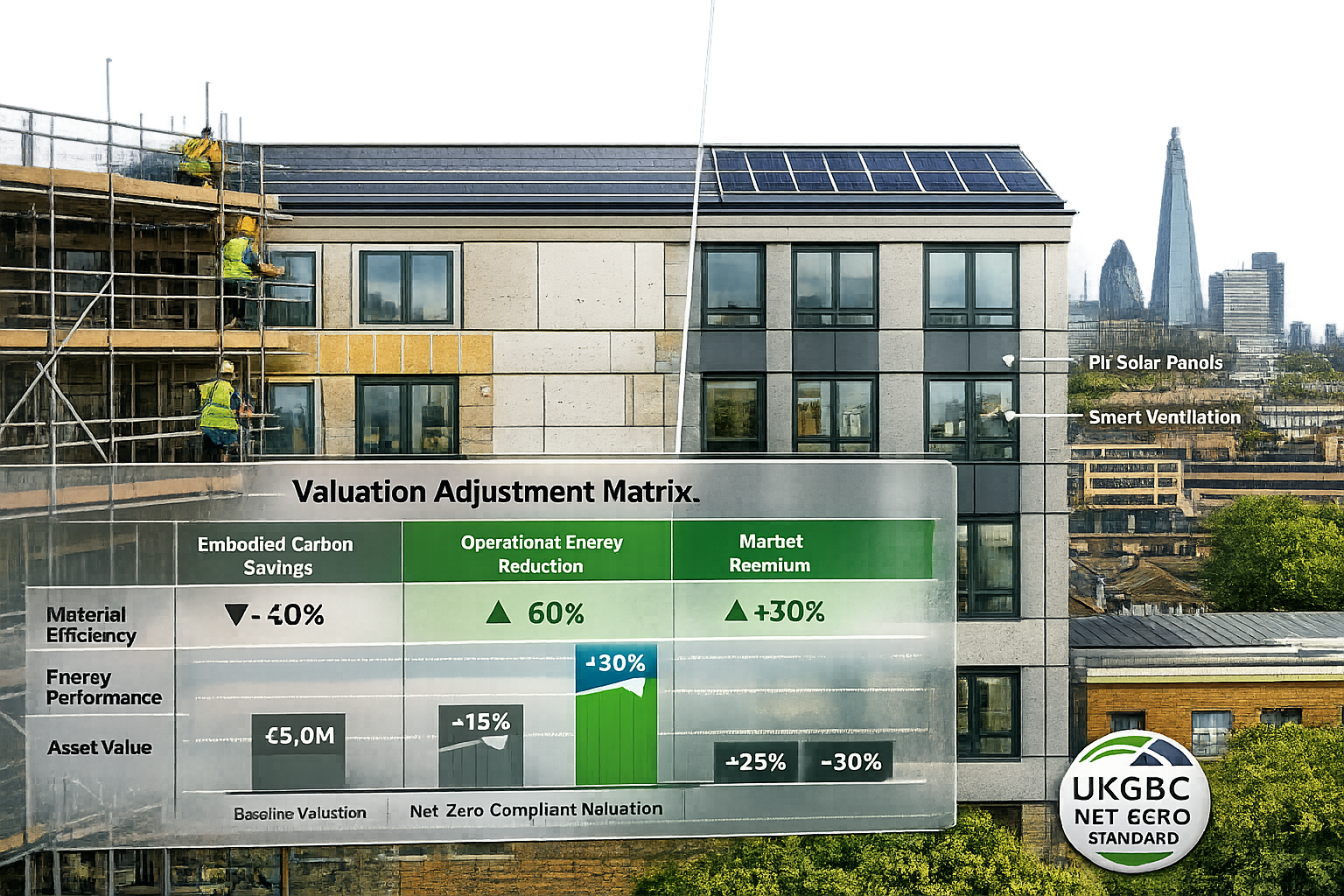
RICS Red Book Valuation Methodology Adaptations
The RICS Valuation – Global Standards (Red Book) provides the foundational framework for property valuation in the UK. However, net zero retrofit projects require methodological extensions that traditional approaches don't fully address. Valuation factors must now incorporate environmental performance metrics alongside conventional comparable analysis.
Key adaptations include:
Cost Approach Modifications 🏗️
Traditional reinstatement cost valuations must now factor in enhanced specifications for net zero compliance. This includes premium materials, advanced building systems, and renewable energy infrastructure that significantly exceed standard rebuild costs. Surveyors must distinguish between:
- Base construction costs at current building standards
- Additional costs for net zero specification compliance
- Future-proofing investments exceeding minimum requirements
Income Approach Adjustments 💰
For investment properties, income capitalization methods require adjustment for:
- Reduced operational costs from energy efficiency improvements
- Premium rental rates achievable with superior EPC ratings
- Tenant demand preferences for sustainable properties
- Regulatory risk mitigation value (avoiding future mandatory upgrades)
Comparable Sales Analysis Complexity 📉
The non-linear EPC pricing dynamics identified in recent research create valuation challenges. With EPC A properties achieving 2.9% premiums but B and C-rated properties showing negative adjustments,[2] comparable selection becomes critical. Surveyors must:
- Identify truly comparable properties with similar energy performance
- Adjust for specific retrofit specifications rather than rating alone
- Account for location-specific sustainability premiums
- Consider timing of comparable sales relative to regulatory changes
Whole Life Carbon Assessment Integration
Valuation Techniques for UK Net Zero Retrofit Projects: RICS Standards Amid 2026 EPC Mandates must incorporate whole life carbon assessments as fundamental valuation components rather than supplementary considerations. This represents a paradigm shift from focusing solely on operational energy to comprehensive lifecycle carbon accounting.
Embodied Carbon Considerations 🌍
Commercial retrofit guidance emphasizes substantial resource use and embodied carbon savings achieved by retrofitting existing assets versus demolition and new construction.[3] Valuation adjustments should quantify:
- Embodied carbon avoided through building retention and retrofit
- Material selection impacts on whole life carbon profiles
- Construction process emissions during retrofit implementation
- End-of-life considerations for replaced building components
For commercial property surveyors, this requires collaboration with carbon consultants and access to Environmental Product Declarations (EPDs) for building materials.
Operational Carbon Projections ⚡
Beyond current energy performance, valuations must project long-term operational carbon trajectories considering:
- Decarbonization of the electricity grid (reducing carbon intensity over time)
- Building performance degradation requiring maintenance interventions
- Occupant behavior variations affecting actual versus designed performance
- Technology obsolescence requiring future system upgrades
PAS 2080 Carbon Management Framework Application
PAS 2080:2023 provides a standardized framework for carbon management in infrastructure projects, increasingly applied to building retrofit valuations. The standard establishes principles for:
Carbon Baselining 📊
Establishing accurate pre-retrofit carbon baselines enables quantifiable improvement measurement. Valuation reports should document:
- Current operational energy consumption (kWh/m²/year)
- Existing embodied carbon in building fabric and systems
- Baseline carbon emissions (kgCO₂e/m²/year)
- Performance gaps between design and actual consumption
Retrofit Option Appraisal 🔄
PAS 2080 principles support systematic evaluation of retrofit alternatives, enabling valuers to assess:
| Retrofit Strategy | Capital Cost | Carbon Reduction | Payback Period | Valuation Impact |
|---|---|---|---|---|
| Fabric-first approach | Moderate | 30-40% | 8-12 years | Moderate premium |
| Systems upgrade | High | 40-55% | 10-15 years | Significant premium |
| Deep retrofit to EPC A | Very high | 60-75% | 15-25 years | Maximum premium |
| Renewable integration | Variable | 20-50% | 5-20 years | Market-dependent |
Verification and Monitoring Protocols ✅
The annual verification requirement under the Net Zero Standard aligns with PAS 2080 performance monitoring principles. Valuations should assess:
- Quality of building energy management systems enabling verification
- Historical performance data availability and reliability
- Maintenance regimes supporting sustained performance
- Contractual arrangements for ongoing monitoring and reporting
Market Value Implications and Investment Analysis
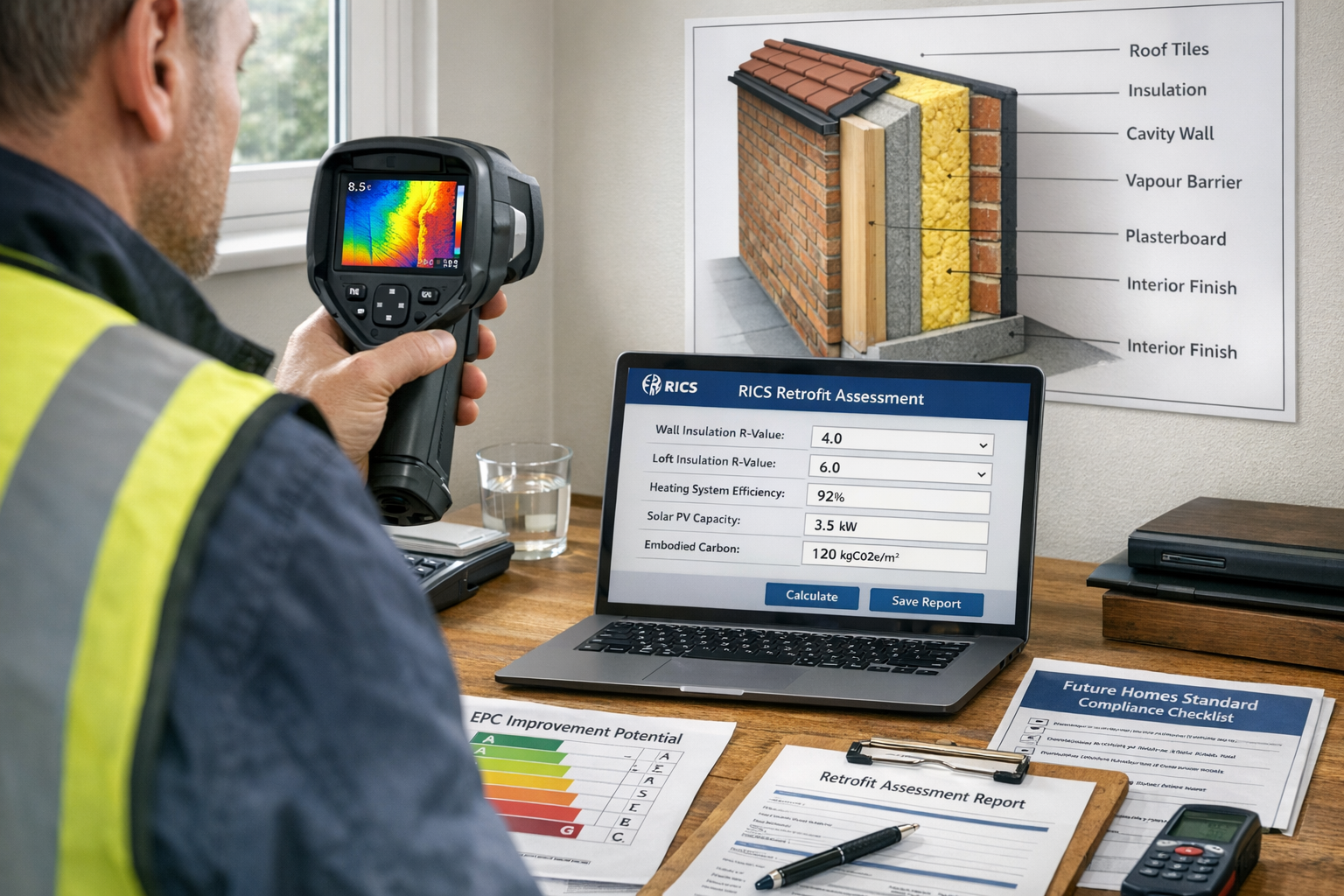
EPC Rating Premium and Discount Quantification
The market pricing research analyzing 6.8 million housing transactions in England and Wales from 2014-2024 reveals complex and non-linear dynamics that challenge simplistic assumptions about energy efficiency value.[2] Understanding these patterns is essential for accurate Valuation Techniques for UK Net Zero Retrofit Projects: RICS Standards Amid 2026 EPC Mandates.
Rating-Specific Market Adjustments:
- EPC A: +2.9% per square meter premium (statistically significant)
- EPC B: –2.3% per square meter discount (counterintuitive)
- EPC C: –1.2% per square meter discount (minimal impact)
- EPC D-E: Baseline reference (no significant adjustment)
- EPC F-G: Substantial discounts (dis-investment territory)
This pricing structure suggests that only deep retrofits achieving EPC A ratings generate measurable market value capture, while intermediate improvements may not justify investment costs purely from resale value perspective.
Investment Return Modeling for Retrofit Projects
For property investors and developers, retrofit investment decisions require sophisticated financial modeling incorporating multiple value drivers beyond simple market premiums.
Capital Cost Components 💷
Typical retrofit costs to achieve various EPC ratings:
- EPC C (from D/E): £8,000-£15,000 for typical semi-detached property
- EPC B (from D/E): £15,000-£30,000 including enhanced insulation and systems
- EPC A (from D/E): £30,000-£60,000+ requiring comprehensive deep retrofit
Value Creation Pathways 📈
Beyond market premium capture, retrofit investments generate value through:
- Operational cost savings: Reduced energy bills creating income benefit for owner-occupiers or rental yield improvement for investors
- Regulatory compliance value: Avoiding future mandatory upgrade costs and rental restrictions
- Tenant demand premium: Superior properties commanding higher rents and lower vacancy rates
- Financing advantages: Preferential mortgage rates and green finance products for high-performance properties
- Future-proofing value: Protection against regulatory tightening and carbon pricing mechanisms
Net Present Value Analysis 📊
Comprehensive investment appraisal should calculate:
NPV = (Annual Energy Savings × Discount Factor)
      + (Market Premium at Resale × Probability of Sale)
      + (Regulatory Risk Mitigation Value)
      - (Capital Cost + Financing Costs)
      - (Ongoing Verification and Maintenance Costs)
For RICS Help to Buy valuations and shared ownership properties, retrofit investment analysis becomes particularly important as these properties must meet evolving lender requirements.
Commercial Property Retrofit Valuation Considerations
Commercial properties present distinct valuation challenges for net zero retrofit projects, with sector-specific performance requirements and investment dynamics.
Lease Structure Impacts 📋
Retrofit valuation varies significantly based on lease arrangements:
- Full Repairing and Insuring (FRI) leases: Tenant responsibility for improvements creates split incentive challenges
- Landlord-controlled buildings: Clear investment case but capital-intensive
- Multi-tenanted properties: Partial certification options enable phased implementation[1]
Sector-Specific Considerations 🏢
The Net Zero Standard establishes differentiated criteria for:
- Office buildings: Emphasis on operational efficiency and partial certification flexibility
- Retail properties: Customer-facing sustainability credentials affecting brand value
- Industrial/logistics: Large-scale renewable energy integration opportunities
- Healthcare and education: Enhanced indoor environmental quality requirements
For properties requiring commercial building surveys, retrofit feasibility assessment should precede detailed valuation analysis.
Risk Assessment and Valuation Uncertainty
Retrofit project valuations carry inherent uncertainties requiring explicit risk assessment and sensitivity analysis.
Performance Risk ⚠️
The gap between designed and actual building performance (the "performance gap") can significantly impact valuation assumptions:
- Theoretical energy savings may not materialize due to occupant behavior
- Building system complexity can lead to operational issues
- Inadequate commissioning may prevent optimal performance
- Maintenance quality affects long-term efficiency retention
Regulatory Risk 📜
Evolving standards create both opportunities and threats:
- Further tightening of EPC requirements may enhance retrofit value
- Changes to carbon pricing or energy costs affect payback calculations
- New technologies may render current retrofit specifications obsolete
- Planning and building control requirements may evolve
Market Risk 📉
Sustainability premium volatility affects investment returns:
- Economic conditions influence buyer willingness to pay green premiums
- Competing properties' retrofit activities affect relative positioning
- Mortgage lender policies on energy efficiency evolve
- Tenant preferences for sustainable buildings may strengthen or weaken
Practical Implementation for Surveyors and Property Professionals
Due Diligence Checklist for Net Zero Retrofit Valuations
Chartered surveyors conducting Valuation Techniques for UK Net Zero Retrofit Projects: RICS Standards Amid 2026 EPC Mandates should implement comprehensive due diligence protocols:
Pre-Retrofit Assessment 🔍
- Obtain current EPC and identify rating limitations
- Review building fabric condition through Level 2 RICS surveys or Level 3 building surveys
- Assess structural capacity for retrofit interventions
- Identify planning constraints affecting external modifications
- Review building services age and replacement requirements
- Evaluate renewable energy integration opportunities
- Obtain utility consumption data for baseline establishment
- Check for asbestos or other hazardous materials requiring remediation
Retrofit Specification Review 📋
- Verify proposed improvements meet Future Homes Standard requirements
- Confirm target EPC rating achievability through modeling
- Assess whole life carbon calculations and methodology
- Review material specifications and Environmental Product Declarations
- Evaluate contractor qualifications and warranty provisions
- Confirm building control and certification pathways
- Assess ongoing monitoring and verification arrangements
Post-Retrofit Verification ✅
- Review commissioning reports and performance testing results
- Obtain as-built EPC and compare to projections
- Verify Net Zero Standard certification (if applicable)
- Assess building management system functionality
- Review initial operational performance data
- Confirm warranty and maintenance arrangements
- Document lessons learned and performance gaps
Collaboration with Specialist Consultants
Complex retrofit valuations require multidisciplinary collaboration beyond traditional surveying expertise:
Energy Consultants ⚡
Provide detailed energy modeling, EPC assessments, and performance projections essential for valuation assumptions.
Carbon Consultants 🌍
Deliver whole life carbon assessments compliant with PAS 2080 and Net Zero Standard requirements, quantifying embodied and operational carbon impacts.
Structural Engineers 🏗️
Assess building capacity for retrofit interventions, particularly for external wall insulation, roof-mounted renewables, and building services upgrades. Structural engineer reports provide essential technical validation.
M&E Engineers 🔧
Specify and evaluate heating, ventilation, and cooling systems, renewable energy technologies, and building management systems critical to net zero performance.
Quantity Surveyors 💷
Provide detailed cost estimates for retrofit specifications, enabling accurate capital cost assessment in valuation calculations.
Technology Tools and Data Sources
Modern retrofit valuation requires access to specialized software and databases:
Energy Modeling Software 💻
- PHPP (Passive House Planning Package) for detailed thermal modeling
- IES-VE for dynamic building performance simulation
- DesignBuilder for whole building energy analysis
- SAP/RdSAP for EPC compliance calculations
Carbon Assessment Tools 📊
- One Click LCA for whole life carbon assessment
- RICS Whole Life Carbon Assessment guidance tools
- Carbon calculators aligned with PAS 2080 methodology
Market Data Sources 📈
- Land Registry price paid data for comparable analysis
- EPC register for energy performance benchmarking
- RICS Residential Property Price Index for market trends
- Local authority planning databases for retrofit precedents
Case Study Applications
Residential Terrace Retrofit: EPC E to A
A Victorian terrace in Camden required comprehensive retrofit from EPC E to A rating:
- Pre-retrofit value: £850,000 (120m²)
- Retrofit cost: £48,000 (external wall insulation, triple glazing, heat pump, solar PV)
- Post-retrofit value: £879,500 (applying 2.9% premium)
- Value uplift: £29,500
- Annual energy savings: £1,800
- Simple payback: 10.1 years (capital cost vs. energy savings)
- Investment return: Positive when including value uplift and regulatory compliance
Commercial Office Retrofit: Partial Building Certification
A multi-tenanted office building in Islington pursued partial Net Zero Standard certification for landlord-controlled areas:
- Building size: 2,400m² across 6 floors
- Retrofit scope: Common areas, building envelope, central systems
- Investment: £420,000
- Rental premium achieved: 8% on re-letting
- Tenant retention improvement: 15% reduction in vacancy
- Valuation impact: £1.2M increase in capital value (yield compression from sustainability credentials)
Future Outlook and Strategic Considerations
Evolving Regulatory Trajectory
The 2026 EPC mandates and Future Homes Standard represent the current regulatory baseline, but further tightening appears inevitable as the UK pursues net zero by 2050 targets.
Anticipated Developments 🔮
- Minimum Energy Efficiency Standards (MEES) progression: Expected advancement from current EPC C requirement toward B or A ratings for rental properties
- Embodied carbon regulations: Likely introduction of whole life carbon limits for major refurbishments
- Operational performance requirements: Shift from design-stage compliance to actual performance verification
- Carbon pricing mechanisms: Potential introduction of property-level carbon taxes or trading schemes
Strategic retrofit investment should anticipate these developments, with deep retrofits to EPC A providing greater future-proofing than incremental improvements.
Market Maturation and Premium Evolution
Current EPC premium data reflects a relatively immature market with limited high-performance stock. As retrofit activity accelerates, market dynamics will likely evolve:
Supply-Side Factors 📊
- Increasing availability of EPC A properties may reduce scarcity premium
- Improved contractor expertise and economies of scale may reduce retrofit costs
- Technology advancement may enable more cost-effective performance improvements
Demand-Side Factors 💡
- Growing climate awareness may strengthen buyer preferences for sustainable properties
- Mortgage lender requirements may increasingly favor high-performance properties
- Energy cost volatility may enhance operational savings value
- Corporate sustainability commitments may drive commercial property demand
Strategic Recommendations for Property Owners
For Residential Property Owners 🏠
- Prioritize deep retrofits: Target EPC A ratings rather than incremental improvements given market premium data
- Bundle improvements: Combine retrofit with other planned maintenance to optimize costs
- Access green finance: Utilize low-interest green mortgages and government grant schemes
- Document performance: Maintain energy consumption records to demonstrate actual savings
- Consider timing: Balance current costs against anticipated regulatory tightening
For Commercial Property Investors 🏢
- Conduct portfolio risk assessment: Identify assets most vulnerable to regulatory obsolescence
- Develop retrofit strategies: Create phased improvement plans aligned with lease events
- Engage tenants early: Collaborate on green lease provisions and improvement sharing
- Leverage partial certification: Utilize flexible certification options for complex assets
- Integrate ESG reporting: Align retrofit initiatives with broader sustainability commitments
For Developers and Housebuilders 🏗️
- Exceed minimum standards: Build to higher specifications than current requirements
- Emphasize whole life carbon: Differentiate through comprehensive sustainability credentials
- Invest in verification systems: Install robust monitoring enabling ongoing certification
- Market sustainability value: Educate buyers on operational cost benefits and future-proofing
- Collaborate with valuers: Ensure sustainability investments are properly reflected in valuations
Conclusion
Valuation Techniques for UK Net Zero Retrofit Projects: RICS Standards Amid 2026 EPC Mandates represent a fundamental evolution in property valuation methodology, requiring integration of whole life carbon assessment, PAS 2080 principles, and sophisticated understanding of non-linear market pricing dynamics. The counterintuitive finding that only EPC A-rated properties achieve measurable market premiums—while B and C-rated properties trade at discounts—demands strategic reconsideration of retrofit investment approaches.
As the UK Net Zero Carbon Buildings Standard launches formal verification services in Q2 2026 and the Future Homes and Buildings Standards take effect this March, chartered surveyors occupy a pivotal position in the national retrofit strategy. The shift from static design-stage certification to ongoing performance verification fundamentally changes valuation from a point-in-time assessment to a dynamic evaluation of sustained compliance and operational delivery.
Key action steps for property professionals:
✅ Update valuation methodologies to incorporate whole life carbon assessments and PAS 2080 frameworks alongside traditional Red Book approaches
✅ Develop multidisciplinary collaboration protocols with energy consultants, carbon specialists, and building performance experts
✅ Invest in technology tools enabling sophisticated energy modeling, carbon assessment, and market data analysis
✅ Prioritize deep retrofit strategies targeting EPC A performance rather than incremental improvements with limited market value capture
✅ Implement robust verification and monitoring systems supporting annual Net Zero Standard compliance and sustained performance
✅ Educate clients on the complex relationship between retrofit investment, regulatory compliance, operational savings, and market value creation
The transformation of UK property valuation to incorporate net zero considerations is not merely a technical adjustment but a fundamental reimagining of how buildings are assessed, valued, and positioned in an increasingly carbon-constrained economy. Surveyors who master these evolving Valuation Techniques for UK Net Zero Retrofit Projects: RICS Standards Amid 2026 EPC Mandates will provide essential guidance enabling the built environment transition required to meet national climate commitments while protecting and enhancing property value for owners and investors.
For property owners considering retrofit investments, engaging qualified RICS surveyors with expertise in sustainability valuation provides essential insight into optimal improvement strategies, realistic value uplift expectations, and comprehensive risk assessment in this rapidly evolving regulatory and market landscape.
References
[1] Uk Net Zero Carbon Buildings Standard Launches To Define Credible Net Zero Claims – https://energyadvicehub.org/uk-net-zero-carbon-buildings-standard-launches-to-define-credible-net-zero-claims/
[2] Future Property Valuation Influence Esg Criteria Residential Buildings – https://www.rics.org/news-insights/future-property-valuation-influence-esg-criteria-residential-buildings
[3] Delivering Net Zero Key Considerations For Commercial Retrofits – https://ukgbc.org/resources/delivering-net-zero-key-considerations-for-commercial-retrofits/
[4] Rics Ceo Comments On The Publication Of The Future Homes And Building Standards – https://www.rics.org/news-insights/rics-ceo-comments-on-the-publication-of-the-future-homes-and-building-standards
[5] Epc Mandates 2026 – https://nottinghillsurveyors.com/blog/tag/epc-mandates-2026
[6] Modus By Rics January 2026 – https://www.rics.org/content/dam/ricsglobal/documents/to-be-sorted/MODUS-by-RICS-January-2026.pdf
SEO Meta Title: Valuation Techniques for UK Net Zero Retrofit Projects 2026
