
The UK housing market stands at a critical juncture in early 2026. After months of declining sentiment and price pressures, the Royal Institution of Chartered Surveyors (RICS) January 2026 survey reveals early signs of stabilisation—but not recovery. With the national house price net balance improving to -10% from October's low of -19%, surveyors face a unique challenge: how to accurately value properties in a market showing gradual improvement yet subdued momentum. The Valuation Techniques for Stabilising National House Prices: RICS January 2026 Survey Insights for Surveyors provide essential guidance for navigating this transitional period where regional divergence, cautious buyer sentiment, and interest rate uncertainty create complex valuation scenarios.

Key Takeaways
- 📊 National house prices are stabilising with the net balance improving to -10% in January 2026, up from -19% in October 2025, signaling a potential turning point in market sentiment
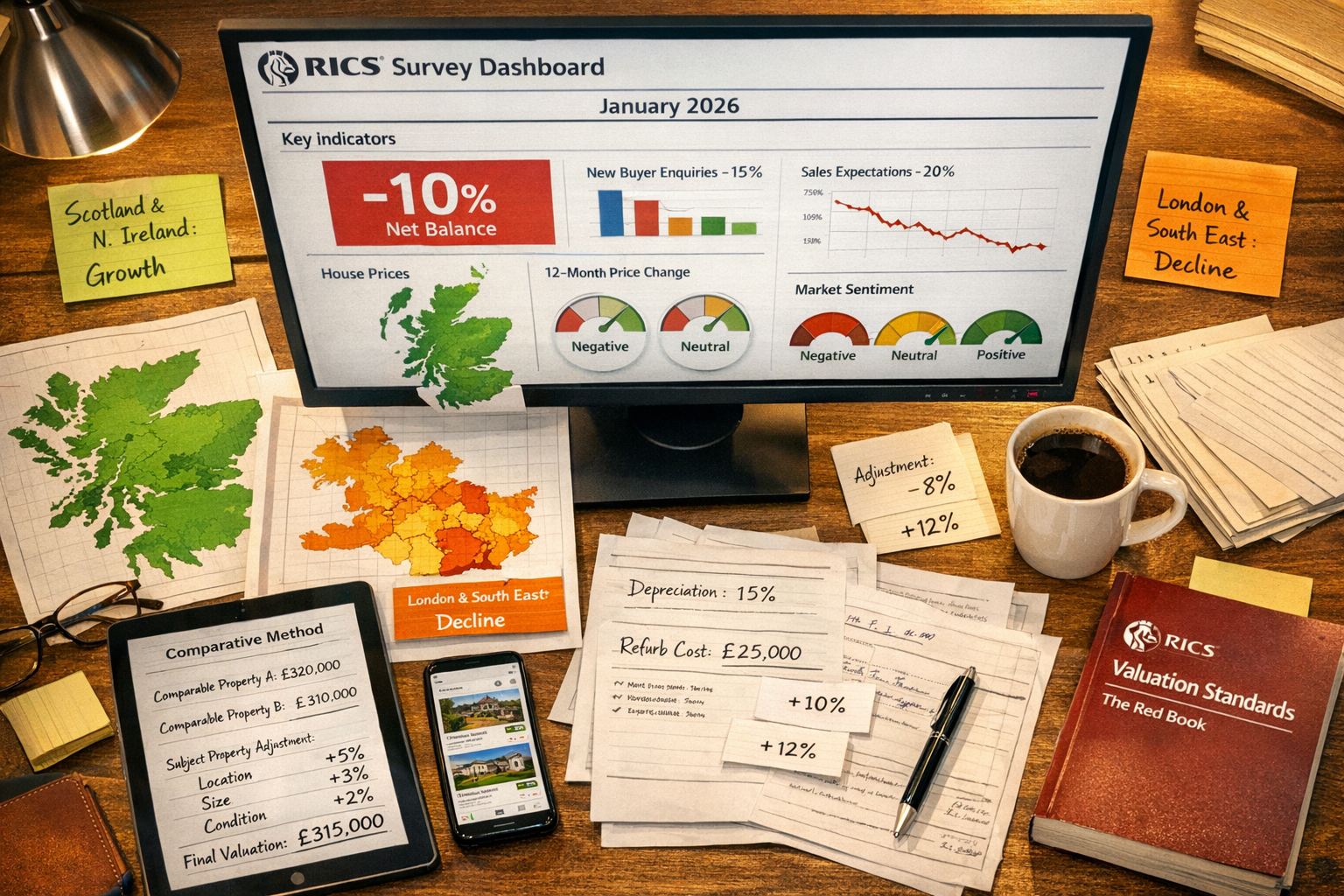
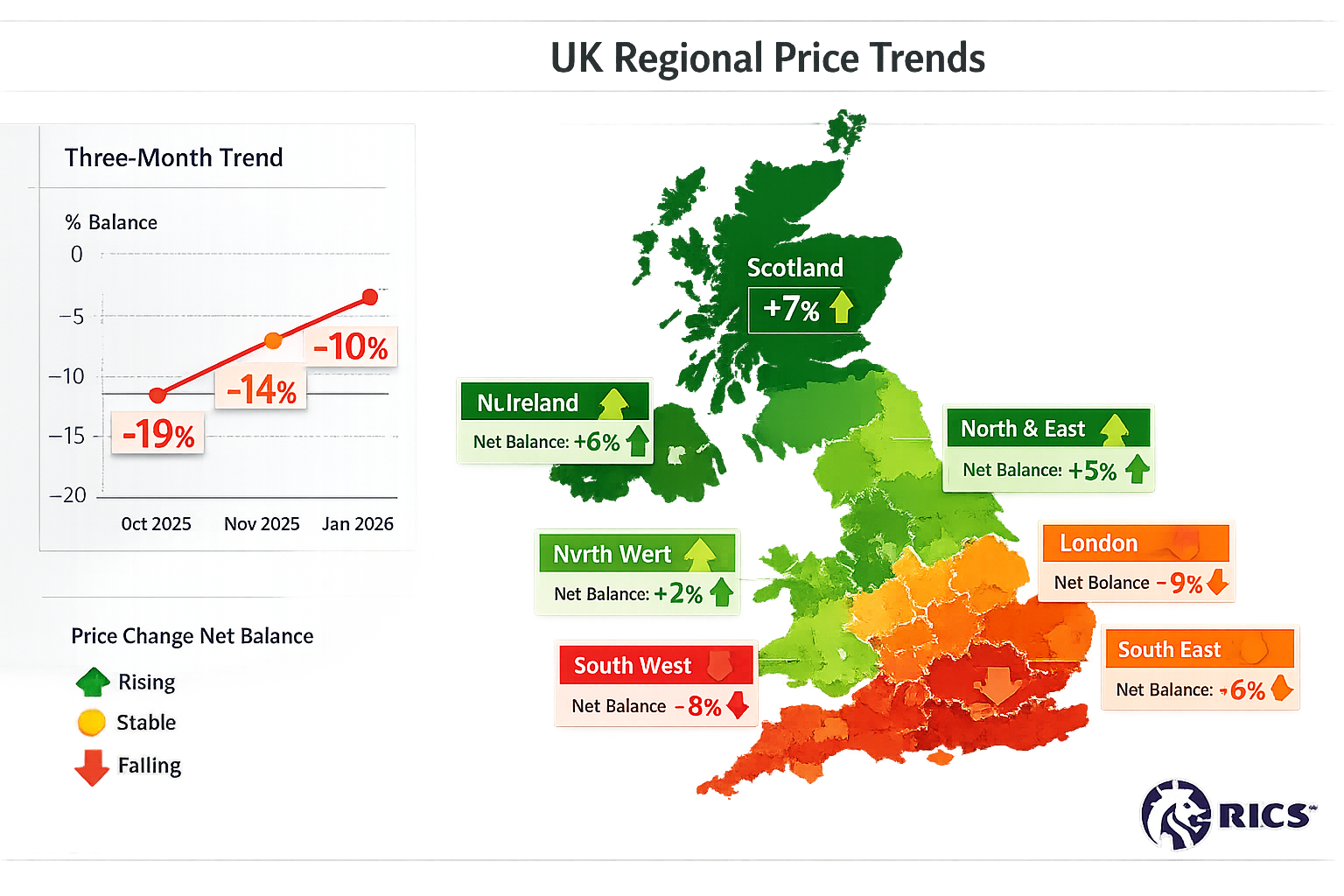
- 🗺️ Regional divergence has widened significantly, with Scotland and Northern Ireland showing price growth while London and the South East continue to experience downward pressure
- 📈 12-month price expectations remain positive at +43%, though near-term caution persists with three-month expectations at only +4%
- 🔍 Valuation adjustments must account for subdued transaction momentum, with agreed sales at -9% net balance—the least negative since June 2025
- 💼 Surveyors require enhanced comparable analysis techniques to navigate the gap between improving sentiment and actual market activity
Understanding the Current Market Context from RICS January 2026 Data
The Valuation Techniques for Stabilising National House Prices: RICS January 2026 Survey Insights for Surveyors begin with understanding the fundamental market dynamics revealed in the latest data. The January 2026 RICS Residential Market Survey demonstrates a market in transition rather than transformation [1].
The Stabilisation Signal
The headline house price net balance of -10% in January represents the fourth consecutive month of improvement from October's -19% reading [1]. This stabilisation indicates that fewer surveyors are reporting falling prices, though the negative balance confirms prices remain under modest downward pressure. For chartered surveyors conducting valuations, this creates a challenging environment where historical comparables may not accurately reflect current market conditions.
Key market indicators from January 2026:
| Metric | January 2026 | December 2025 | October 2025 |
|---|---|---|---|
| House Price Net Balance | -10% | -12% | -19% |
| New Buyer Enquiries | -15% | -21% | -29% |
| Agreed Sales | -9% | -12% | -15% |
| 12-Month Price Expectations | +43% | +41% | +38% |
Buyer Demand and Transaction Activity
New buyer enquiries improved to a net balance of -15% in January, up from -21% in December and -29% in November [1]. While still negative, this represents easing downward pressure on demand. More significantly, agreed sales reached -9%—the least negative reading since June 2025 [1]. This improvement in transaction momentum suggests the market is moving away from the paralysis experienced in late 2025.
For surveyors conducting homebuyer surveys, understanding this context is crucial. Properties are selling, but at a slower pace than historical norms, which affects the reliability of recent comparable evidence and requires careful adjustment in valuation reports.
The Sentiment-Reality Gap
Perhaps most striking is the divergence between near-term and long-term expectations. The 12-month sales outlook surged to +35% in January—the strongest reading since December 2024 [1]. Similarly, +43% of respondents anticipated higher prices over the year ahead [1]. However, three-month price expectations showed only a modest +4% net balance, revealing significant caution about immediate market conditions.
This gap between optimism and near-term caution creates valuation challenges. Surveyors must balance forward-looking market sentiment with current transaction evidence, particularly when advising clients on RICS Red Book valuations for lending purposes.
Regional Valuation Divergences in the RICS January 2026 Survey
One of the most significant findings in the Valuation Techniques for Stabilising National House Prices: RICS January 2026 Survey Insights for Surveyors is the widening regional divergence across the UK property market. This geographic split demands location-specific valuation approaches and challenges the application of national trends to local markets [2].
Northern Strength vs Southern Weakness
The RICS January 2026 data reveals a clear north-south divide that has intensified in recent months:
Regions showing price growth:
- 🏴 Scotland: Strongest regional performance with positive net balance
- 🇮🇪 Northern Ireland: Continued upward price momentum
- 🏭 North West England: Emerging positive trends
- 🏛️ North of England: Prices moving higher [3]
Regions experiencing continued decline:
- 🏙️ London: Persistent affordability challenges suppressing demand
- 🌊 South East: Ongoing downward pressure
- 🌾 South West: Below national average performance
- 📍 East Anglia: Lagging recovery [1]
This divergence reflects fundamental differences in affordability, with average house prices in London and the South East remaining at multiples of local earnings that constrain buyer activity. Meanwhile, more affordable northern markets benefit from improved buyer confidence and stronger relative value propositions [6].
Implications for Comparable Analysis
For surveyors, this regional divergence creates significant challenges in comparable analysis—the cornerstone of residential valuation. When conducting building surveys with valuation components, professionals must:
1. Narrow geographic search parameters: Comparables from even 5-10 miles away may reflect different market dynamics in 2026. Chartered surveyors in North London face different conditions than those in Surrey.
2. Weight recent transactions more heavily: In rapidly diverging markets, transactions from six months ago may be less relevant than usual. Fresh evidence from the past 8-12 weeks provides better guidance.
3. Apply location-specific adjustments: Standard adjustment factors for location may need recalibration to reflect the widening performance gap between regions.
4. Consider micro-market variations: Even within regions showing overall decline, specific neighborhoods may demonstrate resilience. Detailed local knowledge becomes paramount.
The Affordability Factor
The regional divergence fundamentally stems from affordability constraints. London's average house price-to-earnings ratio remains above 10:1, while northern regions typically sit between 5:1 and 7:1 [2]. This affordability gap explains why buyer demand has held up better in the north despite national economic headwinds.
Surveyors must incorporate affordability metrics into their market commentary within valuation reports. When a property in Clapham or Islington is valued, the report should acknowledge local affordability constraints that may limit buyer pools and price growth potential.
Core Valuation Adjustment Strategies for Stabilising Markets
The Valuation Techniques for Stabilising National House Prices: RICS January 2026 Survey Insights for Surveyors demand refined methodologies that account for market stabilisation without assuming recovery. Traditional valuation approaches require calibration when applied in the current environment [3].
Time-Adjusted Comparable Analysis
In a stabilising market, the timing of comparable transactions becomes critically important. The improvement from -19% to -10% in the house price net balance over just three months indicates rapidly changing conditions [1].
Recommended time adjustment framework:
Recent comparables (0-3 months): Apply minimal adjustment, typically 0% to -2% depending on specific local market trajectory. These provide the most reliable evidence of current market conditions.
Medium-term comparables (3-6 months): Apply -2% to -5% adjustment to reflect the improving sentiment since October 2025. The magnitude depends on regional performance—larger adjustments needed for southern markets experiencing continued decline.
Older comparables (6-12 months): Use with caution and apply -5% to -8% adjustment. These transactions occurred during the market's weakest period and may not reflect current stabilisation.
Comparables beyond 12 months: Generally unsuitable for current valuations unless adjusted significantly or used only to establish longer-term trends rather than current market value.
This time-adjustment framework ensures valuations reflect the stabilisation trajectory revealed in RICS data while avoiding over-optimism about near-term price movements [4].
Condition and Quality Adjustments
In a subdued market with agreed sales at -9% net balance [1], property condition becomes a more significant differentiator. Well-presented properties in good condition command premiums over those requiring work, with the gap widening compared to stronger market periods.
Enhanced condition adjustment factors for 2026:
- Excellent condition (recently renovated, modern): +5% to +8% premium over average condition
- Good condition (well-maintained, no immediate work required): +2% to +4% premium
- Average condition (typical wear, minor updates needed): Baseline (0%)
- Below average (deferred maintenance, cosmetic work required): -5% to -8% discount
- Poor condition (structural concerns, significant renovation needed): -10% to -15% discount
These adjustments are more pronounced than in strong markets because buyer pools narrow for properties requiring work. When conducting a Level 2 house survey, surveyors should clearly identify condition issues that will impact valuation in the current market context.
Location Micro-Adjustment Techniques
With regional divergence widening, location adjustments require granular analysis beyond traditional suburb-to-suburb comparisons. Surveyors should consider:
Transport connectivity: Properties with excellent transport links (within 10-minute walk of stations) command 8-12% premiums in commuter markets, up from typical 5-8% premiums in stronger markets. Buyers prioritize convenience when budgets are constrained.
School catchments: Premium primary school catchments maintain 10-15% premiums even in weaker markets, as family buyers remain active. Secondary catchments show 5-8% premiums.
Neighborhood trajectory: Areas showing improvement (new developments, infrastructure investment) deserve +3% to +5% adjustments over comparable neighborhoods in decline.
Local amenity quality: Proximity to quality retail, dining, and green spaces commands 3-5% premiums as lifestyle factors remain important to buyers.
These micro-adjustments help explain price variations within the same broader market area, providing robust support for valuation conclusions.
Transaction Evidence Weighting
Not all comparable transactions carry equal weight in the current market. Surveyors should apply a weighting hierarchy:
Highest weight (40-50% influence):
- Recent sales (0-3 months) of similar properties in immediate vicinity
- Arm's length transactions with confirmed financing
- Properties in similar condition requiring similar buyer profiles
Medium weight (25-35% influence):
- Sales 3-6 months old with appropriate time adjustments
- Properties in adjacent neighborhoods with similar characteristics
- Transactions from established agents with reliable data
Lower weight (15-25% influence):
- Older transactions (6-12 months) with significant adjustments
- Properties with material differences requiring substantial adjustment
- Sales in comparable but not identical micro-markets
Minimal weight (5-10% influence):
- Distressed sales, family transactions, or non-arm's length deals
- Properties with unique characteristics limiting comparability
- Transactions lacking full verification or details
This weighting system ensures valuations prioritize the most reliable evidence while still considering the full range of market data available.
Practical Application: Valuation Scenarios in January 2026
To illustrate how the Valuation Techniques for Stabilising National House Prices: RICS January 2026 Survey Insights for Surveyors apply in practice, consider these realistic scenarios facing professionals in early 2026.
Scenario 1: London Terraced House Valuation
Property: 3-bedroom Victorian terraced house in Islington, requiring valuation for remortgage purposes.
Challenge: London continues to experience downward price pressure with negative net balance, but 12-month expectations remain positive [1].
Valuation approach:
- Identify comparables: Three similar properties sold in past 3 months within 0.5 miles, ranging £875,000-£925,000
- Apply time adjustments: No adjustment needed (all recent transactions)
- Condition adjustment: Subject property in good condition (+3% vs average comparable)
- Location micro-adjustment: Subject property closer to tube station (+4%)
- Market context: Note in report that London market remains under pressure but stabilising, with 12-month outlook positive
Concluded value: £920,000 (upper end of range justified by superior condition and location)
Report commentary: "The London market continues to experience modest downward pressure with the RICS net balance remaining negative. However, recent transaction evidence suggests stabilisation, with the rate of decline moderating significantly since October 2025. The subject property's excellent condition and superior location justify a premium within the comparable range."
Scenario 2: Northern England New Build Valuation
Property: 4-bedroom new build detached house in North England development, requiring valuation for Help to Buy purposes.
Challenge: Northern regions showing price growth, but new builds require careful comparable selection [6].
Valuation approach:
- Identify comparables: Two recent resales in same development (£385,000 and £395,000), plus three new builds in comparable developments (£410,000-£425,000)
- New build premium: Apply 3-5% premium for unused condition and warranties
- Regional context: North England showing positive price momentum per RICS data
- Forward adjustment: Apply modest +2% adjustment to reflect improving market conditions in region
Concluded value: £420,000
Report commentary: "The North of England market demonstrates stronger performance than the national average, with RICS survey data indicating positive price momentum. New build properties command premiums for their unused condition, energy efficiency, and warranty coverage. Transaction evidence from both resales and comparable new developments supports the concluded value."
Scenario 3: Rural Property with Limited Comparables
Property: 4-bedroom detached house in rural Hertfordshire, requiring valuation for shared ownership purposes.
Challenge: Limited comparable evidence in rural areas, South East region experiencing downward pressure [1].
Valuation approach:
- Widen geographic search: Identify five comparables within 5-mile radius over past 6 months
- Apply time adjustments: -3% to -4% for comparables from 4-6 months ago to reflect market stabilisation
- Adjust for property differences: Account for plot size, accommodation, and condition variations
- Regional context: Acknowledge South East downward pressure but note rural resilience
- Cross-check with price per square foot analysis: £285-£310 per sq ft for similar rural properties
Concluded value: £675,000
Report commentary: "Rural markets in the South East demonstrate greater resilience than urban centers, though remain subject to regional affordability constraints. Limited transaction evidence requires wider geographic search parameters and careful adjustment for property differences. The concluded value reflects current market conditions while acknowledging the stabilising trend evident in recent RICS survey data."
Scenario 4: Buy-to-Let Investment Valuation
Property: 2-bedroom apartment in Clapham, requiring valuation for investment purchase.
Challenge: Rental market dynamics differ from sales market, with tenant demand improving but landlord supply constrained [1].
Valuation approach:
- Sales comparable analysis: Identify recent apartment sales in development (£485,000-£515,000)
- Investment yield analysis: Calculate gross yield based on current rental evidence (£1,950 pcm = 4.5% gross yield at £515,000)
- Market rent verification: Confirm rental level with lettings agents and recent lettings
- Investor demand assessment: Consider that buy-to-let buyers face higher mortgage rates and tax constraints
- Dual approach: Weight sales comparables 60%, investment yield analysis 40%
Concluded value: £500,000
Report commentary: "The buy-to-let market faces headwinds from higher mortgage rates and tax changes, though rental demand remains firm with RICS reporting improving tenant enquiries. The concluded value reflects both recent sales evidence and investment yield expectations, with the property offering a 4.7% gross yield at the concluded value—in line with investor requirements for London buy-to-let properties in 2026."
Navigating February 2026's Renewed Caution
While the Valuation Techniques for Stabilising National House Prices: RICS January 2026 Survey Insights for Surveyors showed encouraging signs, the February 2026 survey revealed renewed caution that surveyors must incorporate into current valuations [4].
The February Sentiment Shift
The February 2026 RICS survey demonstrated that the market's stabilisation remains fragile:
- Near-term price expectations dropped to -18% (from -6% in January), returning to negative territory [4]
- Buyer demand declined amid renewed concerns over interest rate outlook [4]
- Headline house price net balance fell to -12% (from -10% in January) [4]
- 12-month expectations remained positive at +33% but declined from +43% [4]
This shift reflects the market's sensitivity to interest rate expectations and economic uncertainty. For surveyors, it reinforces the importance of cautious near-term valuations while acknowledging longer-term optimism.
Adjusting Valuation Approaches for Renewed Caution
In light of February's data, surveyors should:
1. Reduce forward-looking adjustments: The modest positive adjustments applied to older comparables in January should be reconsidered. Apply neutral to slightly negative adjustments instead.
2. Increase report caveats: Strengthen market uncertainty language in valuation reports, noting the fragile nature of stabilisation and sensitivity to interest rate movements.
3. Recommend shorter validity periods: Consider recommending 60-day rather than 90-day validity periods for valuations, given the market's volatility.
4. Monitor weekly market data: Stay current with weekly RICS data releases and local market intelligence to identify any acceleration in the cautionary trend.
5. Communicate uncertainty to clients: Be transparent with clients about the limitations of valuation certainty in the current environment, particularly for commercial property valuations where market shifts can be more pronounced.
The Role of Professional Standards and Red Book Compliance
Throughout this period of market stabilisation, adherence to professional standards remains paramount. The Valuation Techniques for Stabilising National House Prices: RICS January 2026 Survey Insights for Surveyors must be applied within the framework of RICS Valuation – Global Standards (the Red Book).
Red Book Requirements in Uncertain Markets
The RICS Red Book provides clear guidance for valuations in uncertain market conditions:
Market Value definition: "The estimated amount for which an asset should exchange on the valuation date between a willing buyer and a willing seller in an arm's length transaction, after proper marketing and where the parties had each acted knowledgeably, prudently and without compulsion."
This definition remains constant regardless of market conditions. However, the assumptions, special assumptions, and departures sections of valuation reports become more important in stabilising markets.
Essential Report Disclosures for 2026 Valuations
Surveyors should ensure their reports include:
1. Market conditions commentary: Detailed explanation of current market dynamics, referencing RICS survey data where relevant. Example: "The RICS January 2026 survey indicates a stabilising market with the house price net balance improving to -10%, though February data suggests renewed caution."
2. Comparable evidence limitations: Transparent disclosure of any limitations in comparable evidence, particularly in markets with low transaction volumes.
3. Valuation uncertainty: Where appropriate, include an uncertainty clause stating: "Given current market conditions and the pace of change in sentiment, this valuation should be reviewed if not relied upon within [60/90] days of the valuation date."
4. Assumptions about market trajectory: Clearly state whether the valuation assumes continued stabilisation, further decline, or recovery—and the basis for that assumption.
5. Regional context: Acknowledge regional divergence and explain how the subject property's location affects the valuation conclusion.
When to Consider Material Uncertainty Clauses
In extreme cases, surveyors may need to include a "material valuation uncertainty" clause as was common during the COVID-19 pandemic. While the January 2026 market doesn't warrant this for most residential valuations, it may be appropriate for:
- Properties in highly volatile micro-markets
- Unique properties with very limited comparable evidence
- Commercial property valuations in sectors experiencing significant disruption
- Properties subject to significant planning or legal uncertainties
The decision to include such a clause should be made carefully and in consultation with professional indemnity insurers where appropriate.
Technology and Data Tools for Enhanced Valuation Accuracy
Modern surveyors have access to technology and data tools that can enhance valuation accuracy in the challenging market conditions revealed by the Valuation Techniques for Stabilising National House Prices: RICS January 2026 Survey Insights for Surveyors.
Automated Valuation Models (AVMs) as Supporting Evidence
AVMs can provide useful supporting evidence in 2026, particularly for:
- Identifying comparable properties: AVMs quickly surface potential comparables that may not be immediately obvious
- Price trend analysis: Tracking how AVM outputs change over time reveals market trajectory
- Sanity checking: Significant divergence between professional valuation and AVM output warrants investigation
However, AVMs have limitations in stabilising markets:
- They often lag actual market conditions by 2-3 months
- They struggle with regional divergence and micro-market variations
- They cannot assess property condition or unique features
- They may not capture the sentiment-reality gap evident in RICS data
Professional surveyors should use AVMs as one data point among many, never as a replacement for detailed comparable analysis and professional judgment.
Property Data Platforms and Market Intelligence
Subscription data platforms provide valuable intelligence:
Land Registry data: Essential for verifying transaction prices and dates, though typically 2-3 months behind actual completions
Rightmove/Zoopla analytics: Asking price trends, time on market, and price reductions provide insight into seller expectations and buyer demand
Local agent intelligence: Regular dialogue with active estate agents provides qualitative insight into buyer sentiment, offer levels, and transaction fall-through rates
RICS survey data: Monthly RICS residential survey data (as analyzed in this article) provides authoritative national and regional market context
Digital Survey and Reporting Tools
Modern digital tools enhance the survey and valuation process:
- Tablet-based survey software: Enables efficient on-site data capture, photo annotation, and comparable research
- Laser measuring devices: Provides accurate floor area measurements essential for price per square foot analysis
- Drone photography: For larger properties, provides comprehensive external photography and roof inspection
- Digital reporting platforms: Streamlines report production and ensures consistency in format and content
When conducting what surveyors look for in a house survey, these tools enhance efficiency and accuracy, allowing more time for analysis and professional judgment.
Client Communication and Managing Expectations
Beyond technical valuation skills, the Valuation Techniques for Stabilising National House Prices: RICS January 2026 Survey Insights for Surveyors require effective client communication to manage expectations in an uncertain market.
Explaining Market Conditions to Clients
Clients often lack understanding of market dynamics and may have unrealistic expectations based on outdated information or anecdotal evidence. Surveyors should:
1. Provide context: Explain that the market is stabilising but not recovering, using RICS data to support this narrative [1].
2. Clarify regional differences: Help clients understand that national trends may not apply to their specific location, particularly given the north-south divide [2].
3. Distinguish between asking prices and achieved prices: Many clients focus on asking prices on property portals, which may not reflect actual transaction levels.
4. Explain the time lag: Help clients understand that valuations reflect current market conditions, not where the market might be in 6-12 months when optimistic expectations suggest recovery.
5. Manage emotional responses: Property valuation often triggers emotional responses, particularly when the figure is lower than expected. Professional, empathetic communication is essential.
Valuation vs Survey: Clarifying the Distinction
Many clients confuse the survey and valuation functions, particularly when instructing a homebuyer survey with valuation. Clear communication should explain:
Survey function: Assesses the property's physical condition, identifies defects, and advises on necessary repairs. This is covered in our guide on what surveyors do.
Valuation function: Determines the property's market value based on comparable evidence and market conditions, independent of the client's offer price or the asking price.
Independence: The valuation must be objective and independent, reflecting market reality rather than supporting the client's desired outcome.
When to Recommend Revaluation
Given the market volatility evident in January and February 2026 data [4], surveyors should advise clients on when revaluation may be necessary:
- Significant time delay: If more than 90 days passes between valuation and transaction completion
- Market shift: If subsequent RICS data or local market intelligence suggests material market changes
- Property changes: If the property undergoes significant works or damage between valuation and completion
- Transaction structure changes: If the nature of the transaction changes (e.g., from owner-occupation to buy-to-let)
Future Outlook: Preparing for Market Evolution in 2026
The Valuation Techniques for Stabilising National House Prices: RICS January 2026 Survey Insights for Surveyors provide a snapshot of early 2026 market conditions, but surveyors must prepare for continued evolution throughout the year.
Key Factors to Monitor
Several factors will shape market trajectory through 2026:
Interest rate movements: The Bank of England's monetary policy decisions will significantly impact buyer affordability and sentiment. The February shift to renewed caution reflects sensitivity to interest rate expectations [4].
Economic growth: GDP growth, employment levels, and wage inflation will affect buyer confidence and purchasing power.
Government policy: Any changes to stamp duty, Help to Buy schemes, or mortgage market regulation will impact demand and transaction volumes.
Regional rebalancing: Whether the north-south divergence continues or moderates will affect valuation approaches across different markets [2].
Rental market dynamics: With landlord supply constrained and tenant demand improving [1], rental market performance may influence investor demand for buy-to-let properties.
Adapting Valuation Techniques Through 2026
As the year progresses, surveyors should be prepared to adapt their approaches:
If stabilisation strengthens: Reduce time adjustments on older comparables, increase confidence in forward-looking adjustments, and adopt more positive market commentary.
If renewed decline emerges: Increase time adjustments, weight recent transactions more heavily, strengthen uncertainty disclosures, and consider shorter valuation validity periods.
If recovery accelerates: Be cautious about over-optimism, ensure valuations remain grounded in actual transaction evidence rather than sentiment, and watch for regional variations in recovery pace.
If divergence widens further: Develop increasingly granular micro-market analysis, reduce reliance on regional trends for local valuations, and enhance location-specific adjustment factors.
Professional Development and Continuing Education
The challenging market conditions of 2026 underscore the importance of ongoing professional development for surveyors. Key areas for continuing education include:
- Advanced comparable analysis techniques for low-transaction markets
- Regional market dynamics and economic drivers of divergence
- Technology tools for enhanced data analysis and valuation accuracy
- Client communication skills for managing expectations in uncertain markets
- Red Book updates and evolving professional standards
Professional bodies including RICS offer regular training and webinars addressing current market conditions and valuation challenges. Engagement with these resources ensures surveyors maintain the highest professional standards.
Conclusion
The Valuation Techniques for Stabilising National House Prices: RICS January 2026 Survey Insights for Surveyors reveal a UK housing market at a critical transition point. With the national house price net balance improving to -10% but February data showing renewed caution, surveyors face the complex task of accurately valuing properties amid subdued momentum and significant regional divergence.
Success in this environment requires:
✅ Enhanced comparable analysis with careful time adjustments and weighting of evidence
✅ Regional awareness that acknowledges the widening north-south divide and micro-market variations
✅ Refined adjustment techniques for condition, location, and property-specific factors
✅ Robust professional standards with comprehensive market commentary and appropriate uncertainty disclosures
✅ Effective client communication that manages expectations and explains market complexity
✅ Continuous monitoring of RICS data and local market intelligence to identify evolving trends
The gap between 12-month optimism (+43% expecting higher prices) and near-term caution (+4% three-month expectations in January, -18% in February) encapsulates the challenge facing valuers in 2026 [1][4]. Professional judgment, grounded in reliable comparable evidence and supported by authoritative market data, remains the cornerstone of accurate valuation.
Actionable Next Steps for Surveyors
-
Review your comparable databases: Ensure you have robust recent transaction evidence for your key market areas, with particular focus on transactions from the past 3 months
-
Refine your adjustment frameworks: Calibrate your time, condition, and location adjustments to reflect current market dynamics rather than historical norms
-
Enhance report templates: Update your standard valuation report templates to include comprehensive market commentary sections that reference RICS survey data
-
Strengthen client communication processes: Develop clear explanations of market conditions that you can share with clients to manage expectations effectively
-
Monitor monthly RICS data: Subscribe to RICS survey releases and review each month's data to track market evolution and adjust your approaches accordingly
-
Engage in peer discussion: Participate in local surveyor networks and professional forums to share insights and comparable evidence in your market areas
-
Consider professional development: Identify any skills gaps in your valuation toolkit and pursue relevant CPD opportunities through RICS or other professional bodies
For comprehensive property survey and valuation services that apply these techniques in practice, contact our team of chartered surveyors who combine local market expertise with professional standards to deliver accurate, reliable valuations in the evolving 2026 market.
References
[1] Uk Resi Survey Jan 2026 Report Shows Early Signs Market Recovery Despite Caution – https://www.rics.org/news-insights/uk-resi-survey-jan-2026-report-shows-early-signs-market-recovery-despite-caution
[2] Regional Valuation Divergences In 2026 Recovery Rics Tactics For North South Price Shifts In Building Surveys – https://nottinghillsurveyors.com/blog/regional-valuation-divergences-in-2026-recovery-rics-tactics-for-north-south-price-shifts-in-building-surveys
[3] Uk Residential Market Survey January 2026 – https://www.rics.org/content/dam/ricsglobal/documents/market-surveys/uk-residential-market-survey/UK-Residential-Market-Survey_January-2026.pdf
[4] Uk Residential Market Survey February 2026 – https://www.rics.org/content/dam/ricsglobal/documents/market-surveys/uk-residential-market-survey/UK-Residential-Market-Survey_February-2026.pdf
[5] Uk Rics Residential Market Survey Jan 2026 – https://www.capitaleconomics.com/publications/uk-housing-market-update/uk-rics-residential-market-survey-jan-2026
[6] Valuation Techniques For Northern England Property Boom 2026 Rics Methods Amid 6 7 Price Surges – https://nottinghillsurveyors.com/blog/valuation-techniques-for-northern-england-property-boom-2026-rics-methods-amid-6-7-price-surges
