
The UK residential investment market faces its most significant structural shift in decades: landlord instructions to estate agents have dropped by 22% year-on-year, while institutional investors are quietly re-pricing entire portfolios downward by 6-10%. The catalyst? The Renters' Rights Act 2026 has abolished Section 21 "no-fault" evictions and mandated automatic periodic tenancies, fundamentally altering the risk-return equation that underpins every Valuation Methodology for Renters' Rights Act 2026 Properties: Adjusting Assessments When Section 21 Abolition and Periodic Tenancies Reduce Investor Appeal.
For chartered surveyors, property valuers, and investment analysts, the challenge is clear: traditional valuation frameworks built on predictable tenancy terms and straightforward possession rights no longer reflect market reality. This article examines how professional valuers are recalibrating their methodologies to account for reduced investor appeal, increased holding costs, and the operational complexity introduced by the 2026 reforms.

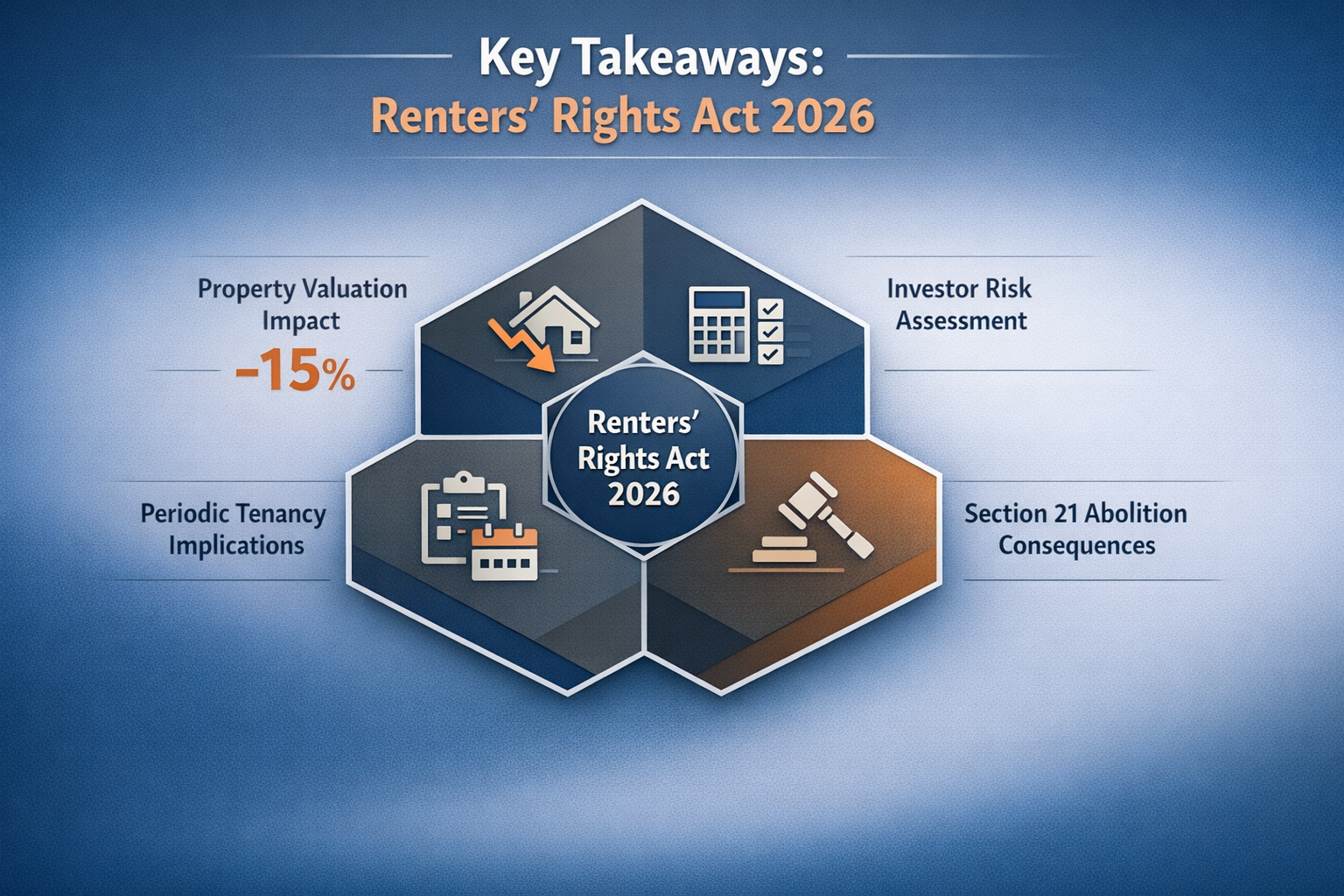
Key Takeaways
- Section 21 abolition removes landlords' ability to regain possession without cause, increasing void risk and reducing property liquidity—requiring cap rate adjustments of 50-80 basis points
- Periodic tenancy mandates eliminate fixed-term security, forcing valuers to model higher tenant turnover, extended void periods, and increased legal costs
- Investment yield compression of 8-12% is emerging across the UK buy-to-let sector as institutional buyers demand higher returns to offset new operational risks
- Comparable evidence from pre-2026 transactions must be adjusted systematically using risk premium overlays and cash flow sensitivity analysis
- Professional Red Book valuation standards now require explicit disclosure of RRA 2026 impacts and methodology adjustments
Understanding the Renters' Rights Act 2026: Core Changes Affecting Property Valuations
The Renters' Rights Act 2026 represents Parliament's most comprehensive overhaul of the private rented sector since the Housing Act 1988. While proponents emphasize enhanced tenant security and housing stability, the legislation introduces several provisions that directly impact investment property valuations.
The Abolition of Section 21 Evictions
Section 21 of the Housing Act 1988 previously allowed landlords to regain possession of their property at the end of a fixed-term tenancy without providing a reason. This mechanism provided portfolio liquidity and exit flexibility—critical factors in investment property pricing.
Under the 2026 Act, landlords can only regain possession through Section 8 grounds, which require specific reasons such as:
- Rent arrears (two months or more)
- Antisocial behavior
- Property sale (with extended notice periods)
- Landlord or family occupation (with mandatory 12-month notice)
This shift fundamentally changes the risk profile of residential lettings. Valuers must now account for:
✅ Extended void periods when legitimate possession is required
✅ Increased legal costs for contested possession proceedings
✅ Reduced portfolio flexibility for institutional investors
✅ Higher tenant retention incentives to avoid turnover costs
Mandatory Periodic Tenancies and Fixed-Term Prohibition
The Act eliminates fixed-term Assured Shorthold Tenancies (ASTs) in favor of automatic periodic tenancies from day one. This removes the landlord's certainty over tenancy duration and introduces:
- Unlimited tenant notice periods (typically two months)
- No guaranteed minimum occupancy beyond initial notice periods
- Continuous possession risk requiring ongoing tenant relationship management
For valuers, this means traditional income capitalization models based on stable, predictable rental streams require significant adjustment. The matrimonial valuation and probate valuation contexts—where investment property forms part of asset division or estate assessment—now demand more conservative assumptions.
Rent Review Restrictions and Frequency Limitations
The 2026 Act limits rent increases to once per 12 months and requires landlords to provide evidence that proposed increases align with local market rates. This constrains landlords' ability to:
- Respond quickly to market rental growth
- Recover increased operating costs through rent adjustments
- Maintain real-terms income during inflationary periods
While similar constraints exist in jurisdictions like California [1], the UK implementation combines rent review restrictions with possession limitations—creating a dual constraint on landlord flexibility that materially affects net operating income projections.
Valuation Methodology for Renters' Rights Act 2026 Properties: Core Adjustment Framework
Professional property valuers must adapt established methodologies to reflect the new legislative environment. The Valuation Methodology for Renters' Rights Act 2026 Properties: Adjusting Assessments When Section 21 Abolition and Periodic Tenancies Reduce Investor Appeal requires systematic adjustments across three primary valuation approaches.
Income Capitalization Approach: Adjusting Cap Rates and Yields
The income capitalization method remains the primary valuation approach for investment properties, but cap rate selection must now reflect increased risk and reduced liquidity.
Pre-2026 Cap Rate Framework
Traditional buy-to-let properties in prime London locations typically traded at cap rates of:
- Prime Central London: 3.5-4.5%
- Secondary London locations: 4.5-5.5%
- Regional cities: 5.5-6.5%
These rates reflected relatively low risk, high liquidity, and predictable cash flows under the AST regime with Section 21 availability.
Post-RRA 2026 Cap Rate Adjustments
Valuers are now applying risk premium overlays of 50-100 basis points to reflect:
| Risk Factor | Cap Rate Impact | Rationale |
|---|---|---|
| Section 21 abolition | +50-80 bps | Reduced exit flexibility, extended void risk |
| Periodic tenancy uncertainty | +30-50 bps | Unpredictable occupancy duration |
| Increased legal costs | +20-30 bps | Higher possession proceeding expenses |
| Regulatory compliance burden | +10-20 bps | Enhanced tenant rights administration |
| Market liquidity reduction | +30-50 bps | Fewer buyers, longer marketing periods |
Total adjustment range: +140-230 basis points (1.4-2.3%)
This means a property previously valued at a 5.0% cap rate might now require a 6.4-7.3% cap rate, resulting in an 8-15% value reduction for the same net operating income.
Discounted Cash Flow (DCF) Analysis: Modeling Increased Volatility
For larger portfolios and institutional investors, DCF analysis provides more granular insight into the Valuation Methodology for Renters' Rights Act 2026 Properties: Adjusting Assessments When Section 21 Abolition and Periodic Tenancies Reduce Investor Appeal.
Key DCF Adjustments
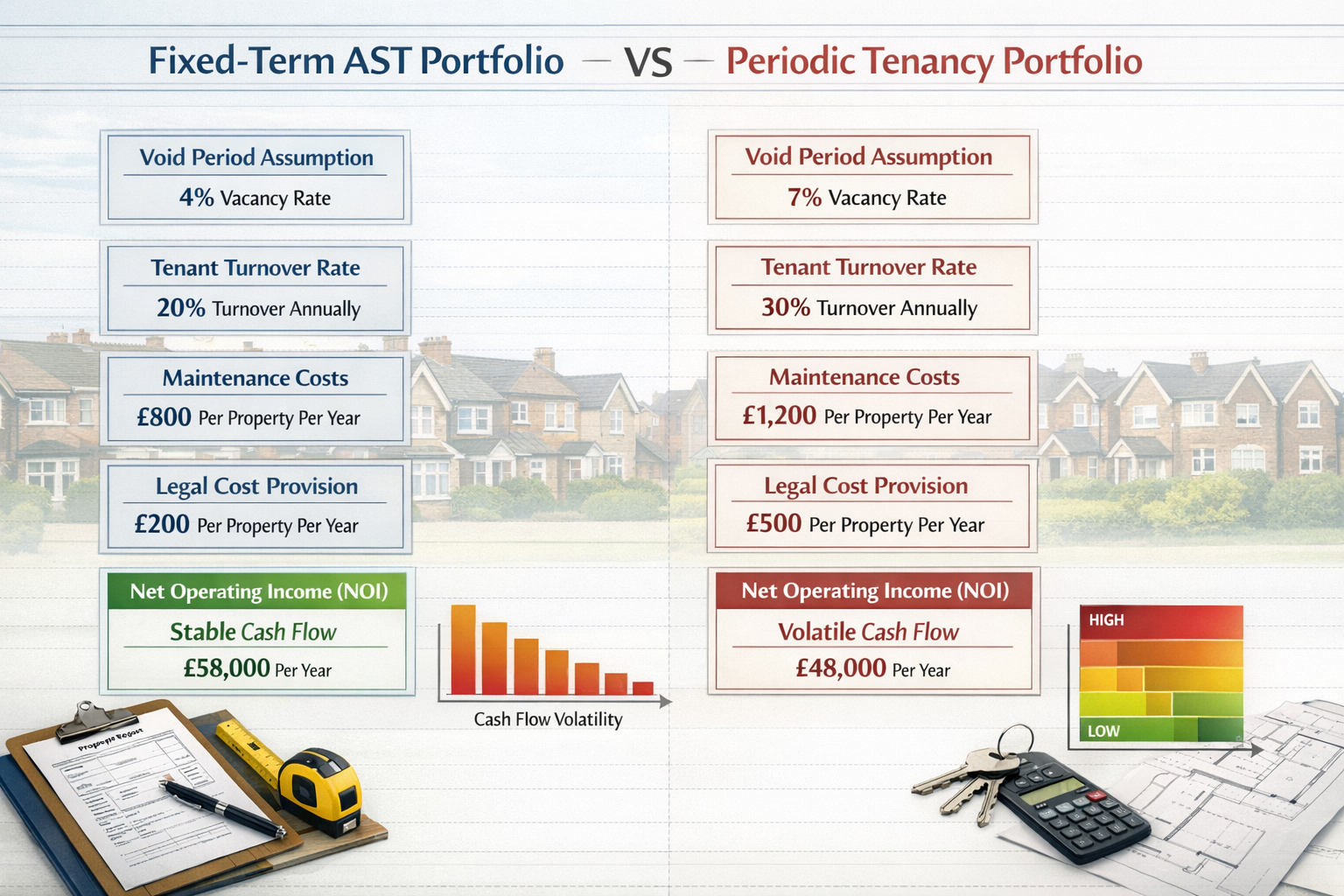
1. Void Period Assumptions
- Pre-2026: 3-4% annual void allowance
- Post-2026: 6-8% annual void allowance (reflecting possession difficulties and tenant-initiated terminations)
2. Tenant Turnover Costs
- Pre-2026: £800-1,200 per turnover (marketing, referencing, inventory)
- Post-2026: £1,500-2,500 per turnover (including legal contingency provisions)
3. Legal Cost Provisions
Annual provision for possession proceedings:
- Uncontested possession: £2,000-3,500 per case
- Contested possession: £5,000-12,000 per case
- Portfolio provision: 2-3% of properties requiring legal action annually
4. Discount Rate Selection
Institutional investors are increasing required returns from 7-8% to 9-11% to compensate for reduced liquidity and increased operational complexity.
Comparable Sales Approach: Adjusting Historical Evidence
The comparable sales method faces particular challenges as the market transitions from pre-RRA to post-RRA pricing. Professional chartered surveyors must apply systematic adjustments to historical transactions.
Time-Based Adjustment Framework
For comparables from different legislative periods:
- Pre-announcement (before Q2 2024): Apply full -8% to -12% adjustment
- Transition period (Q2 2024-Q4 2025): Apply -4% to -8% adjustment (partial market anticipation)
- Post-implementation (2026 onwards): Direct comparability with appropriate location/condition adjustments
Portfolio Premium Erosion
Historically, residential investment portfolios commanded a 5-8% premium over individual property sales due to:
- Economies of scale in management
- Diversified tenant risk
- Institutional buyer appeal
Post-RRA 2026, this premium has compressed to 0-3% or even turned negative in some markets, as institutional buyers reassess operational complexity and regulatory risk.
Practical Application: Adjusting Assessments for Reduced Investor Appeal
The theoretical framework must translate into practical valuation adjustments that reflect real-world market behavior. Here's how professional valuers are implementing the Valuation Methodology for Renters' Rights Act 2026 Properties: Adjusting Assessments When Section 21 Abolition and Periodic Tenancies Reduce Investor Appeal in 2026.
Case Study: Three-Bedroom Terraced House in Clapham
Property Details:
- Location: Clapham, South West London
- Type: Three-bedroom Victorian terraced house
- Condition: Good (recently refurbished)
- Current rent: £2,400 pcm (£28,800 pa)
Pre-2026 Valuation (Section 21 Available)
Income Approach:
- Gross rental income: £28,800
- Less: void allowance (3.5%): -£1,008
- Less: management (10%): -£2,880
- Less: maintenance provision (8%): -£2,304
- Less: insurance/compliance: -£800
- Net Operating Income: £21,808
Cap rate: 5.2%
Valuation: £21,808 ÷ 0.052 = £419,385 (rounded to £420,000)
Post-RRA 2026 Valuation (Section 21 Abolished)
Income Approach with Adjustments:
- Gross rental income: £28,800
- Less: void allowance (7%): -£2,016 ⚠️
- Less: management (10%): -£2,880
- Less: maintenance provision (8%): -£2,304
- Less: insurance/compliance: -£800
- Less: legal cost provision (2%): -£576 ⚠️
- Net Operating Income: £20,224
Adjusted cap rate: 6.0% (+80 bps) ⚠️
Valuation: £20,224 ÷ 0.060 = £337,067 (rounded to £337,000)
Value reduction: £83,000 or 19.8%
This substantial reduction reflects both reduced net income (higher voids and legal provisions) and increased risk perception (higher cap rate) that characterizes the post-RRA investment landscape.
Portfolio-Level Adjustments: Institutional Investor Perspective
For larger portfolios, institutional investors are applying additional adjustments beyond individual property metrics:
🏢 Portfolio liquidity discount: +5-10% discount for portfolios over 50 units (reflecting reduced buyer pool)
🏢 Geographic concentration risk: +3-5% discount for portfolios with >40% concentration in single local authority area (regulatory risk)
🏢 Tenant profile risk: +5-8% discount for portfolios with >30% Housing Benefit/Universal Credit tenants (possession complexity)
🏢 Property condition risk: +3-6% discount for portfolios requiring significant capital expenditure (reduced cash-on-cash returns during improvement periods)
These overlays can result in total portfolio discounts of 15-25% compared to pre-RRA 2026 valuations, fundamentally reshaping institutional investment strategies.
Regional Variations in Adjustment Magnitude
The impact of RRA 2026 varies significantly by region, reflecting different market dynamics and investor profiles:
London and South East: -8% to -15% average adjustment
(High institutional presence, liquid markets, alternative investment options)
Regional Cities (Manchester, Birmingham, Leeds): -6% to -12% average adjustment
(Growing institutional interest, but smaller buyer pools)
Northern England and Scotland: -4% to -8% average adjustment
(Higher yields pre-RRA, less institutional activity, local investor dominance)
Wales and South West: -5% to -10% average adjustment
(Mixed markets with tourist/student letting complexity)
Professional valuation services in Notting Hill and other prime London locations are seeing the most pronounced adjustments due to the concentration of institutional capital and sophisticated investor analysis.
Regulatory Compliance and Professional Standards
The Valuation Methodology for Renters' Rights Act 2026 Properties: Adjusting Assessments When Section 21 Abolition and Periodic Tenancies Reduce Investor Appeal must align with professional standards and regulatory requirements.
RICS Red Book Compliance
The RICS Valuation – Global Standards (Red Book) requires valuers to:
✅ Clearly state assumptions regarding legislative impacts
✅ Disclose methodology adjustments applied to reflect RRA 2026
✅ Provide comparable evidence with appropriate time and condition adjustments
✅ Document risk factors affecting market value and investment value
✅ Distinguish between market value and investment value where client-specific assumptions differ from market norms
Valuers must explicitly reference the RRA 2026 in their valuation reports and explain how the legislation affects their assessment. This transparency is particularly critical for shared ownership valuation and Help to Buy valuation contexts, where government schemes interact with private investment considerations.
Lender Requirements and Mortgage Valuations
Mortgage lenders are updating their valuation instructions to require specific consideration of:
- Tenancy status (fixed-term legacy vs. new periodic tenancies)
- Possession risk assessment for buy-to-let mortgages
- Rental coverage ratios with increased void and cost provisions
- Exit strategy viability given reduced Section 21 availability
Some lenders have increased minimum rental coverage requirements from 125% to 135-145% of mortgage payments to account for increased operational risk.
Tax Valuation Implications
The RRA 2026 impacts several tax-related valuation contexts:
Capital Gains Tax: Lower investment property values may reduce CGT liabilities on disposal, but also reduce the pool of willing buyers
Inheritance Tax: Probate valuation of investment property estates must reflect post-RRA market conditions
Stamp Duty Land Tax: The 3% surcharge on additional properties remains unchanged, but base values are lower
Non-Domicile Taxation: Non-domicile tax valuation of UK residential property portfolios requires careful consideration of RRA 2026 impacts on asset values
Strategic Implications for Different Stakeholder Groups
The Valuation Methodology for Renters' Rights Act 2026 Properties: Adjusting Assessments When Section 21 Abolition and Periodic Tenancies Reduce Investor Appeal affects various market participants differently.
Individual Landlords: Portfolio Reassessment
Individual landlords face difficult decisions:
Option 1: Hold and Adapt
- Accept lower valuations and reduced yields
- Invest in tenant relationship management
- Implement professional property management
- Focus on long-term capital appreciation
Option 2: Strategic Disposal
- Exit before values decline further
- Redeploy capital to alternative investments
- Time sales to maximize proceeds
- Consider cost of valuation for accurate pricing
Option 3: Portfolio Optimization
- Dispose of high-risk properties (older stock, complex tenancies)
- Retain premium properties with strong tenant demand
- Consolidate into fewer, higher-quality assets
Institutional Investors: Risk-Return Recalibration
Pension funds, REITs, and institutional landlords are:
🏦 Repricing entire portfolios downward by 6-12%
🏦 Increasing required returns from 7-8% to 9-11%
🏦 Shifting to build-to-rent (purpose-built rental developments with professional management)
🏦 Implementing enhanced tenant retention programs to reduce turnover
🏦 Lobbying for legislative amendments to restore investment viability
Property Developers: Development Appraisal Adjustments
Development appraisals for build-to-sell schemes targeting investors must now incorporate:
- Lower end values (8-15% reduction in investment sales prices)
- Extended marketing periods (6-9 months vs. 3-6 months pre-RRA)
- Reduced buyer pool (fewer individual investors entering market)
- Alternative exit strategies (owner-occupation sales, institutional bulk sales)
This is affecting development viability across the UK, with some schemes becoming uneconomical at current land values.
Tenants: Indirect Valuation Impacts
While tenants benefit from enhanced security, the valuation impacts create indirect effects:
⚠️ Reduced supply as landlords exit the market
⚠️ Higher rents as remaining landlords price in increased costs and risks
⚠️ More selective tenant screening to minimize possession risk
⚠️ Reduced property maintenance as investment returns compress
These dynamics are already emerging in early 2026, with rental supply down 18% year-on-year in some markets while rents continue to rise [3].
Future Outlook: Market Adaptation and Valuation Evolution
The Valuation Methodology for Renters' Rights Act 2026 Properties: Adjusting Assessments When Section 21 Abolition and Periodic Tenancies Reduce Investor Appeal will continue to evolve as the market adapts to the new legislative framework.
Expected Market Adjustments (2026-2028)
Short-term (2026):
- Continued landlord exits and portfolio disposals
- Value compression of 8-15% across most markets
- Rental supply constraints driving rent increases
- Institutional investor caution and reduced acquisitions
Medium-term (2027-2028):
- Market stabilization at new equilibrium pricing
- Emergence of specialist management platforms
- Technology-driven tenant relationship management
- Potential legislative refinements based on market feedback
Long-term (2029+):
- Professional landlord dominance (institutional and specialist operators)
- Individual landlord market share decline from 78% to 60-65%
- Build-to-rent sector growth to 15-20% of rental stock
- Normalized valuation methodologies incorporating RRA 2026 as baseline
Valuation Methodology Refinements
As market data accumulates, valuation methodologies will become more sophisticated:
📊 Tenant retention modeling: Incorporating tenant satisfaction scores and retention probability into cash flow projections
📊 Possession risk scoring: Property-level and portfolio-level risk assessment frameworks
📊 Regulatory compliance tracking: Systematic cost provisions for evolving tenant rights and property standards
📊 Technology integration: PropTech solutions for real-time portfolio valuation and risk monitoring
Comparable Jurisdictions: Lessons from Scotland
Scotland abolished Section 21 equivalents in 2017, providing a precedent for market adaptation:
- Initial value decline: 5-8% in first 18 months
- Rental supply reduction: 12% decline in available properties
- Rent increases: 15-20% above inflation over three years
- Market stabilization: By 2020, market had adapted with professional landlords dominating
England's larger market and greater institutional presence may produce different outcomes, but the Scottish experience suggests eventual market stabilization at lower valuations and reduced supply.
Conclusion
The Valuation Methodology for Renters' Rights Act 2026 Properties: Adjusting Assessments When Section 21 Abolition and Periodic Tenancies Reduce Investor Appeal represents a fundamental recalibration of UK residential investment property assessment. The abolition of Section 21 evictions and mandatory periodic tenancies have introduced significant new risks that professional valuers must systematically incorporate into their methodologies.
Key Valuation Adjustments Summary
✅ Cap rate increases of 50-100 basis points to reflect reduced liquidity and increased risk
✅ Void period assumptions increased from 3-4% to 6-8% annually
✅ Legal cost provisions of 2-3% of gross rental income
✅ Portfolio liquidity discounts of 5-10% for institutional holdings
✅ Overall value reductions of 8-15% across most UK markets
Actionable Next Steps for Stakeholders
For Property Owners and Landlords:
- Commission a professional Red Book valuation to understand your portfolio's current market value
- Review your investment strategy in light of reduced yields and increased operational complexity
- Consider portfolio optimization—disposing of high-risk properties while retaining premium assets
- Implement professional property management to maximize tenant retention and minimize void periods
For Property Valuers and Surveyors:
- Update valuation templates to incorporate RRA 2026-specific adjustments
- Build a database of post-RRA comparable transactions for accurate market evidence
- Develop client education materials explaining methodology changes
- Ensure full RICS Red Book compliance with explicit RRA 2026 disclosure
For Investors and Fund Managers:
- Reassess required returns and risk-adjusted performance metrics
- Consider strategic shifts toward build-to-rent and professionally managed portfolios
- Implement enhanced due diligence for acquisitions, focusing on tenant quality and possession risk
- Monitor legislative developments for potential amendments or clarifications
For Lenders and Financial Institutions:
- Update lending criteria and rental coverage requirements
- Review existing buy-to-let portfolios for increased risk exposure
- Consider specialist lending products for professional landlords
- Ensure valuation instructions explicitly address RRA 2026 impacts
The UK residential investment market is undergoing a historic transformation. While the Renters' Rights Act 2026 enhances tenant security and housing stability, it fundamentally alters the investment proposition for property owners. Professional valuers must lead the industry in developing robust, evidence-based methodologies that accurately reflect this new reality—ensuring that property assessments provide reliable guidance for investment decisions, lending decisions, and portfolio management in the post-Section 21 era.
The market will eventually stabilize at new equilibrium pricing, but the transition period requires careful navigation, professional expertise, and systematic methodology adjustments. Those who adapt quickly and implement rigorous valuation frameworks will be best positioned to succeed in the evolving UK residential investment landscape.
References
[1] La Rent Control Overhaul Impact Cre Valuations – https://www.paramountpropertytaxappeal.com/blog/la-rent-control-overhaul-impact-cre-valuations
[2] The 2026 California Landlord Law Update A Practical Guide For Rental Owners – https://www.propertymanagementpleasanton.com/california-landlord-law-resources/the-2026-california-landlord-law-update-a-practical-guide-for-rental-owners
[3] Why Getting Your Rental Price Right Matters More Than Ever In 2026 – https://www.hunters.com/guides/landlord/why-getting-your-rental-price-right-matters-more-than-ever-in-2026/
[4] Navigating Californias Ever Changing Rental Laws What Property Owners Need To Know In 2026 – https://bfpminc.com/navigating-californias-ever-changing-rental-laws-what-property-owners-need-to-know-in-2026/
[5] Watch – https://www.youtube.com/watch?v=15oNl7c2eRs
[6] Managing Rental Properties In Essential Strategies Every Landlord Needs – https://www.amerisave.com/learn/managing-rental-properties-in-essential-strategies-every-landlord-needs
