
When property markets turn south, surveyors face their toughest challenge: how do you accurately value a home when prices are falling, buyers are scarce, and comparable sales data becomes unreliable? In February 2026, regions like the South East (-24%) and East Anglia (-26%) are experiencing persistent downward pressure that demands a complete rethinking of traditional valuation approaches. The Valuation Methodology for Flat and Declining Markets: Surveyor Techniques When Regional Price Pressures Mount has become essential knowledge for any professional navigating today's turbulent property landscape.
The appraisal industry is experiencing what experts call "the most impactful structural changes in decades," with new standards fundamentally altering how property data is collected and validated across different market conditions[3]. For chartered surveyors working in regions facing significant price pressures, mastering specialized techniques for declining markets isn't just good practice—it's survival.

Key Takeaways
- Regional disparities require systematic monitoring beyond standard survey approaches, with South East and East Anglia markets down over 24% in early 2026[1]
- Multiple valuation approaches (sales comparison, income capitalization, cost approach) provide essential cross-verification when comparable data becomes scarce
- Technology integration including AVMs, hybrid appraisals, and machine learning analytics helps reduce regional variability and increase accuracy in volatile conditions[3]
- Professional surveyor assessment remains cornerstone of effective valuation strategy, particularly when standardized approaches fail in declining markets[4]
- Expanded adjustment frameworks accounting for market conditions, days on market, and seller concessions become critical in flat or falling price environments
Understanding Regional Price Pressures in 2026 Markets
The UK property market in 2026 presents a complex picture of regional divergence. While some areas maintain stability, others face significant headwinds. The South East region's 24% decline and East Anglia's 26% drop represent more than statistical anomalies—they signal fundamental shifts in buyer demand, affordability constraints, and economic confidence that directly impact valuation methodology[1].
What Defines a Declining Market? 📉
A declining market exhibits several characteristic features:
- Sustained price reductions over consecutive quarters
- Increased days on market for listed properties
- Rising inventory levels with fewer transactions
- Seller concessions becoming standard practice
- Negative buyer sentiment and reduced mortgage approvals
These conditions create what industry professionals call a "data desert"—a 30% decrease in normal sales volume over the last three years makes identifying credible comparable sales increasingly challenging[3]. When transaction activity drops dramatically, surveyors must adapt their methodologies to maintain accuracy and professional standards.
Regional Disparities Require New Frameworks
Successful valuation practice in 2026 demands "systematic regional market monitoring beyond what any single survey provides"[1]. This means understanding:
- Local employment trends and economic indicators
- Migration patterns affecting housing demand
- Infrastructure developments or planned changes
- Lending conditions specific to the region
- Inventory absorption rates and market velocity
Understanding what surveyors do in these challenging conditions extends far beyond simple property inspection—it requires economic analysis, market intelligence, and sophisticated adjustment techniques.
Core Valuation Methodology for Flat and Declining Markets: Surveyor Techniques When Regional Price Pressures Mount
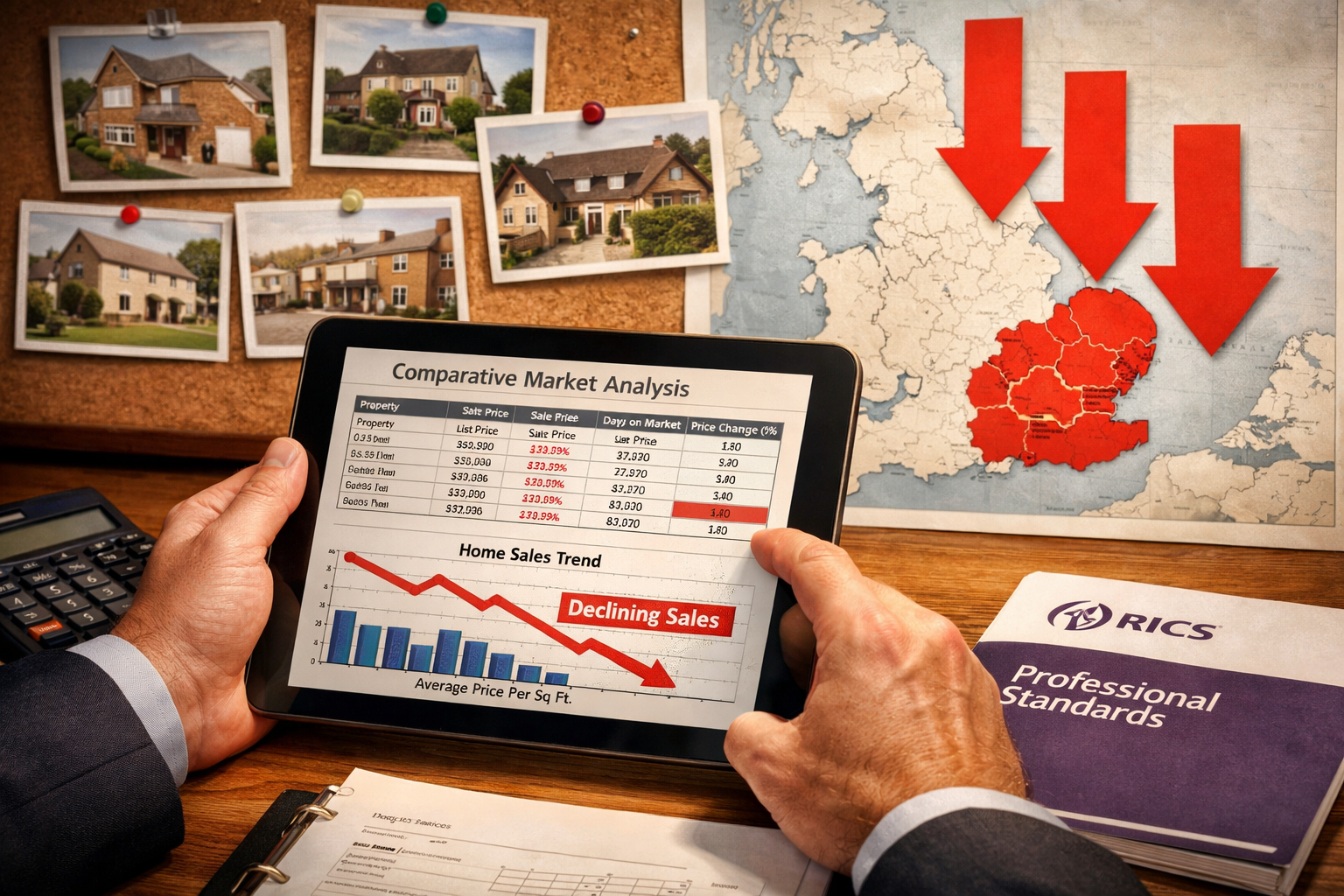
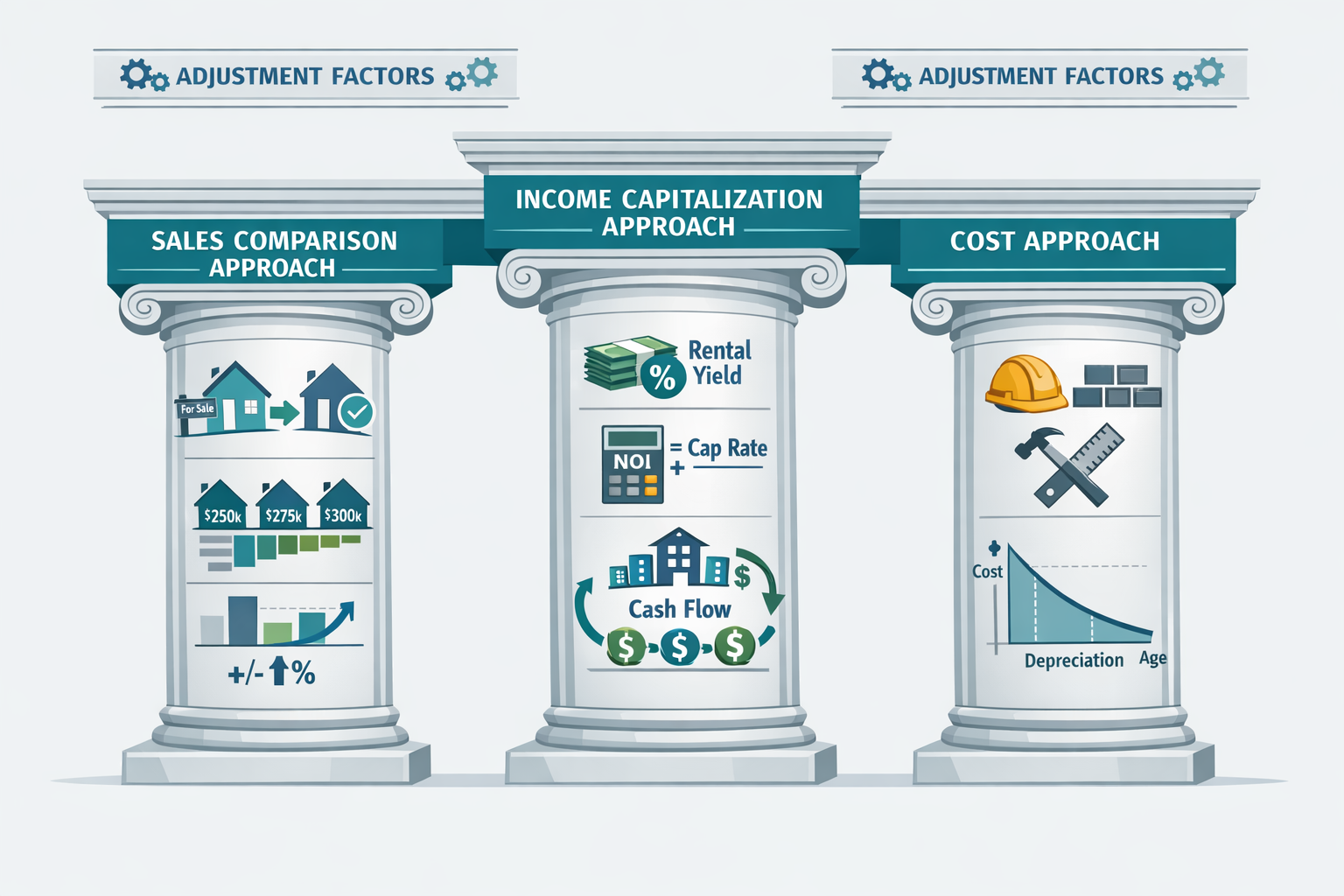
When traditional valuation approaches struggle, chartered surveyors must deploy a comprehensive toolkit that combines multiple methodologies to triangulate accurate values. The Valuation Methodology for Flat and Declining Markets: Surveyor Techniques When Regional Price Pressures Mount centers on three fundamental approaches, each providing unique insights.
The Sales Comparison Approach in Data-Scarce Environments
The sales comparison approach remains the primary valuation method for residential properties, but declining markets present unique challenges:
Expanding the Comparable Search Radius
When recent sales within the immediate area are limited, surveyors must:
- Extend geographic search parameters while maintaining neighborhood similarity
- Look back further in time (6-12 months instead of 3-6 months)
- Apply appropriate time adjustments to account for market decline rates
- Weight more recent sales more heavily despite smaller sample sizes
Enhanced Adjustment Frameworks ⚙️
Standard adjustments for location, size, condition, and features must be supplemented with:
| Adjustment Category | Standard Market | Declining Market |
|---|---|---|
| Time/Market Conditions | ±0.5% per month | ±1-3% per month |
| Days on Market | Minimal impact | -2-5% for extended listings |
| Seller Concessions | Rare consideration | -3-7% when present |
| Distressed Sales | Excluded | Carefully weighted inclusion |
| Pending Sales | Limited use | Greater reliance with verification |
The key principle: every adjustment must be supported by market evidence, not assumptions. When working in areas served by chartered surveyors in Surrey or chartered surveyors in Oxfordshire, understanding hyper-local market conditions becomes paramount.
Income Capitalization Approach for Residential Properties
While traditionally associated with commercial valuations, the income approach provides valuable verification in declining residential markets, particularly for:
- Buy-to-let properties where rental income remains stable
- Multi-unit residential buildings
- Properties in areas with strong rental demand despite weak sales
Key Calculations:
Property Value = Net Operating Income (NOI) / Capitalization Rate

Where:
NOI = Annual Rental Income - Operating Expenses
Cap Rate = Market-derived rate reflecting risk and return expectations
In declining markets, cap rates typically increase (reflecting higher perceived risk), which decreases calculated values. Surveyors must carefully research local rental markets and investor expectations to derive appropriate rates.
The Cost Approach as Reality Check
The cost approach—calculating replacement cost minus depreciation—serves as an important floor value in declining markets:
Replacement Cost New (RCN)
- Current construction costs per square foot
- Site improvements and landscaping
- Professional fees and permits
Less: Depreciation
- Physical deterioration
- Functional obsolescence
- Economic obsolescence (particularly relevant in declining markets)
This approach proves especially valuable for RICS reinstatement cost valuations and unique properties where comparable sales are inherently scarce.
Advanced Surveyor Techniques for Valuation Methodology in Flat and Declining Markets
The professional surveyor's role has evolved dramatically in 2026, incorporating technology while maintaining the critical human judgment that machines cannot replicate. The Valuation Methodology for Flat and Declining Markets: Surveyor Techniques When Regional Price Pressures Mount now includes sophisticated hybrid approaches.
Leveraging Automated Valuation Models (AVMs) Appropriately
Lenders increasingly use machine learning, deep learning, computer vision, property condition analytics, and nationally standardized datasets to "decrease regional variability, increase comparability across markets"[3]. However, AVMs have significant limitations in declining markets:
✅ When AVMs Add Value:
- Initial screening and range establishment
- Identifying outliers requiring investigation
- Analyzing broad market trends
- Supporting desktop valuations for low-risk transactions
❌ When AVMs Fall Short:
- Rapidly changing market conditions
- Limited recent sales data
- Unique property characteristics
- Distressed or unusual market conditions
The emerging paradigm includes "appraisal waivers, automated valuation models, desktop and hybrid appraisals, and traditional reports," allowing practitioners to apply appropriate scrutiny levels based on market conditions[3]. Understanding when you need a survey when buying a house helps clients navigate these options.
Hybrid Appraisal Techniques 🔄
Hybrid appraisals combine remote data collection with professional analysis:
Desktop Component:
- Public records analysis
- MLS data review
- Aerial and street-view imagery
- Prior inspection reports
- Automated measurement tools
Professional Assessment:
- Neighborhood analysis and trends
- Comparable selection and adjustment
- Market condition analysis
- Risk factor identification
- Final value reconciliation
This approach proves particularly effective when the appraiser workforce contraction (from 53,000 in 2016 to 38,000 in mid-2025, projected below 30,000 by 2029) creates capacity constraints[3].
Market Conditions Addendum: Essential Documentation
In declining markets, the market conditions addendum transforms from optional paperwork to essential documentation:
Required Elements:
- Inventory levels and absorption rates
- Price trend analysis (6-12 months)
- Days on market trends
- Foreclosure and distressed sale percentages
- Economic indicators affecting the local market
- Comparable sales timeline and adjustments
This documentation protects both surveyor and client by clearly establishing the market context influencing the valuation.
Reconciliation Techniques for Multiple Value Indicators
When different approaches yield varying results, professional reconciliation becomes critical:
- Weight each approach based on data quality and market appropriateness
- Identify and explain variances between methods
- Consider market participant behavior in current conditions
- Apply professional judgment informed by local expertise
- Document the reasoning supporting final value conclusion
For professionals offering RICS building surveys Level 3 services, this reconciliation process demonstrates the value of comprehensive professional assessment over automated alternatives.
Navigating Regulatory Changes and Professional Standards
The introduction of UAD 3.6 standard and redesigned Uniform Residential Appraisal Report in 2026 fundamentally alters how property data is structured, collected, and validated[3]. These changes specifically address challenges in varying market conditions.
Key Regulatory Updates for 2026
Enhanced Data Requirements:
- More granular property condition reporting
- Standardized market conditions analysis
- Expanded comparable sales justification
- Technology-assisted measurement verification
Professional Competency Standards:
- Continuing education on declining market valuation
- Regional market expertise documentation
- Technology proficiency requirements
- Enhanced quality control protocols
RICS Valuation Standards in Challenging Markets
RICS (Royal Institution of Chartered Surveyors) standards emphasize that professional surveyor assessment remains "the cornerstone of any effective valuation strategy," particularly important when regional pressures complicate standardized approaches[4].
Core RICS Principles:
- Independence and objectivity regardless of market conditions
- Competence specific to property type and market conditions
- Transparency in methodology and assumptions
- Proportionality matching valuation effort to risk and purpose
Understanding the difference between Level 2 and Level 3 surveys helps clients select appropriate assessment levels for their circumstances.
Practical Application: Case Studies from South East and East Anglia
Case Study 1: Semi-Detached Home in Declining South East Market
Property: 3-bedroom semi-detached, built 1985, 1,200 sq ft
Challenge: Only 2 comparable sales in 6 months, both distressed
Surveyor Approach:
- Expanded search to 12 months, found 5 additional comparables
- Applied -2% monthly time adjustment based on regional index data
- Weighted non-distressed sales more heavily (70% vs 30%)
- Cross-verified with income approach using rental comparables
- Applied cost approach to establish floor value
Result: Arrived at defensible value 8% below most recent comparable, supported by multiple methodologies
Case Study 2: Period Property in East Anglia Village
Property: Victorian cottage, unique features, limited comparables
Challenge: No sales in immediate village for 18 months
Surveyor Approach:
- Identified 4 comparables in similar villages within 10-mile radius
- Made careful location adjustments based on amenity differences
- Heavily weighted income approach due to strong rental market
- Consulted local estate agents for market intelligence
- Applied enhanced market conditions analysis
Result: Valuation supported by cross-methodology verification, clearly documented assumptions
These examples demonstrate how chartered surveyors in London and surrounding regions adapt methodology to market realities.
Technology Integration and Future-Proofing Your Practice
Essential Technology Tools for 2026 Surveyors
Data Analytics Platforms:
- Regional price index tracking
- Automated comparable search tools
- Statistical adjustment calculators
- Market trend visualization
Property Assessment Technology:
- Laser measurement devices
- Drone photography for site analysis
- Thermal imaging for condition assessment
- 3D modeling and virtual tours
Reporting and Documentation:
- Cloud-based report generation
- Standardized data input systems
- Client portal access
- Digital signature and delivery
Balancing Technology with Professional Judgment 🎯
While technology enhances efficiency and consistency, the human element remains irreplaceable:
"Technology provides data; surveyors provide insight. In declining markets, understanding the 'why' behind the numbers separates adequate valuations from excellent ones."
The most successful practitioners in 2026 combine technological efficiency with deep local knowledge, professional networks, and judgment refined through experience. Whether conducting Help to Buy valuations or Right to Buy valuations, this balance proves essential.
Risk Management and Professional Liability Considerations
Documenting Assumptions and Limiting Conditions
In declining markets, comprehensive documentation protects professional surveyors:
Essential Documentation:
- Market conditions statement with supporting data
- Comparable sales analysis with detailed adjustments
- Methodology selection rationale
- Assumptions regarding market trends
- Limiting conditions specific to volatile markets
- Scope of work clearly defined
Communicating Uncertainty to Clients
Professional integrity requires honest communication about valuation confidence levels:
Effective Communication Strategies:
- Provide value ranges when appropriate
- Explain market volatility impact
- Discuss data limitations transparently
- Recommend monitoring and potential revaluation timelines
- Set realistic expectations about market recovery
Understanding the cost of valuation services helps clients appreciate the expertise required in challenging markets.
Building Regional Market Expertise
Continuous Market Monitoring Systems
Successful surveyors in 2026 maintain systematic regional market monitoring[1]:
Weekly Activities:
- Review new listings and price changes
- Track pending and closed sales
- Monitor days on market trends
- Note builder incentives and concessions
Monthly Analysis:
- Calculate absorption rates by property type
- Analyze price per square foot trends
- Review economic indicators
- Update comparable sales database
Quarterly Review:
- Comprehensive market conditions report
- Adjustment factor recalibration
- Methodology effectiveness assessment
- Professional development planning
Professional Networks and Information Sharing
Regional expertise develops through:
- Local RICS chapter participation
- Estate agent relationship cultivation
- Lender and mortgage broker connections
- Fellow surveyor collaboration
- Economic development authority engagement
For those seeking specialized services, connecting with chartered surveyors in Godalming or chartered surveyors in Twickenham provides access to deep local knowledge.
Conclusion
The Valuation Methodology for Flat and Declining Markets: Surveyor Techniques When Regional Price Pressures Mount represents more than technical proficiency—it embodies professional resilience and adaptability in challenging conditions. As the South East and East Anglia regions navigate significant price pressures in 2026, chartered surveyors equipped with comprehensive methodologies, technological tools, and deep regional expertise provide essential value to clients navigating uncertain markets.
The convergence of regulatory restructuring, workforce contraction, and technology integration creates both challenges and opportunities for surveying professionals. Those who master multiple valuation approaches, leverage technology appropriately while maintaining professional judgment, and commit to continuous regional market monitoring will thrive regardless of market conditions.
Actionable Next Steps for Surveyors:
- Audit your current methodology against the frameworks outlined in this guide
- Invest in technology tools that enhance data collection and analysis efficiency
- Develop systematic market monitoring protocols for your service regions
- Enhance documentation practices to protect professional liability in volatile markets
- Pursue continuing education focused on declining market valuation techniques
- Build professional networks for information sharing and market intelligence
- Review and update your professional indemnity insurance for expanded risk exposure
For property buyers, sellers, and investors navigating declining markets, engaging qualified professionals who understand these specialized techniques proves invaluable. Whether you need a comprehensive Level 3 building survey or specialized valuation services, choosing surveyors with demonstrated expertise in challenging market conditions protects your interests and investment decisions.
The property market's cyclical nature guarantees that today's declining markets will eventually stabilize and recover. Surveyors who master the specialized techniques required during downturns position themselves as trusted advisors throughout all market cycles, providing consistent value when clients need expertise most.
References
[1] Valuation Adjustments For Widening Regional Disparities Rics January 2026 Survey Insights For Surveyors – https://nottinghillsurveyors.com/blog/valuation-adjustments-for-widening-regional-disparities-rics-january-2026-survey-insights-for-surveyors
[2] Rethinking The Commercial Property Valuation Process – https://www.ey.com/en_us/insights/real-estate/rethinking-the-commercial-property-valuation-process
[3] Premier Member Editorial The Pivot To Precision How Appraisals Will Change In 2026 – https://newslink.mba.org/mba-newslinks/2026/march/premier-member-editorial-the-pivot-to-precision-how-appraisals-will-change-in-2026/
[4] Valuation Strategies For First Time Buyers In 2026 Leveraging Affordability Gains And Regional Price Variations – https://nottinghillsurveyors.com/blog/valuation-strategies-for-first-time-buyers-in-2026-leveraging-affordability-gains-and-regional-price-variations
