
The Party Wall Act: Your Complete Guide to Rights, Responsibilities, and Procedures in 2025
Imagine receiving a letter from your neighbour informing you of their plans to build an extension right up against your shared wall. Your heart sinks as questions flood your mind: What are your rights? Can they proceed without your permission? Who pays for any damage? Welcome to the world of the party wall act—a crucial piece of legislation that governs construction work on or near shared boundaries between properties. Whether you’re planning renovations or responding to a neighbour’s building project, understanding this Act could save you thousands of pounds and prevent costly disputes.
The party wall act exists to protect both property owners when construction work affects shared structures or boundaries. Enacted in 1996 and formally known as the Party Wall etc. Act 1996, this legislation provides a framework for preventing and resolving disputes between neighbours undertaking building work. Despite its importance, many homeowners remain unaware of their obligations under the Act until they’re already in the middle of a construction project—often leading to delays, disputes, and unexpected expenses.
Key Takeaways
- 📋 The party wall act requires building owners to serve formal notices to adjoining owners at least two months before starting most types of construction work affecting shared walls or boundaries
- 🏗️ Three main types of work are covered: work directly to an existing party wall, building a new wall on or astride the boundary line, and excavation within three or six metres of a neighbouring property
- 👥 Party wall surveyors play a crucial role in resolving disputes and creating legally binding awards that protect both parties’ interests throughout the construction process
- 💰 The building owner typically pays all costs associated with the party wall process, including surveyor fees for both parties if a dispute arises
- ⚖️ Adjoining owners cannot prevent reasonable work from proceeding, but they have significant rights to ensure their property is protected and any damage is remedied
Understanding the Party Wall Act: What It Is and Why It Matters
The Party Wall etc. Act 1996 represents one of the most important pieces of property legislation in England and Wales. This Act provides a framework for preventing and resolving disputes in relation to party walls, boundary walls, and excavations near neighbouring buildings.
The Legal Foundation
The party wall act came into force on July 1, 1997, replacing the previous London Building Acts and extending similar protections across England and Wales. Before this legislation, only London had comprehensive party wall procedures. The Act filled a significant gap in property law, creating a standardised approach to managing construction work that affects neighbouring properties.
The legislation recognises that in densely populated areas, particularly cities, properties often share structural elements. When one owner wishes to carry out building work, there’s potential for conflict, damage, and disputes. The Act provides a legal mechanism to balance the rights of property owners to develop their land with the rights of neighbours to protect their property.
Why the Act Exists
At its core, the party wall act serves several essential purposes:
Preventing disputes before they arise by establishing clear procedures and timelines for notification and consent. When property owners follow the Act’s requirements, many potential conflicts are resolved before construction even begins.
Protecting property rights for both the building owner (the person carrying out the work) and the adjoining owner (the neighbour whose property may be affected). The Act ensures that neither party can unreasonably prevent development or suffer uncompensated damage.
Providing a dispute resolution mechanism that’s faster and less expensive than court proceedings. When disagreements occur, the Act establishes a surveyor-led process that creates legally binding decisions without requiring litigation.
Establishing a record of condition through surveys conducted before work begins, protecting both parties by documenting the state of properties and making it clear what damage, if any, results from construction work.
For property owners planning extensions, loft conversions, basement excavations, or other significant building work, understanding the party wall act and its requirements is absolutely essential for project success.
Types of Work Covered Under the Party Wall Act
The party wall act doesn’t apply to all building work—only specific types that could affect shared structures or neighbouring properties. Understanding which activities fall under the Act’s scope is crucial for compliance.
Section 1: New Building on the Line of Junction
This section covers situations where you want to build a new wall on the boundary between your property and your neighbour’s. This includes:
- Building a new wall directly on the boundary line (astride the line)
- Building entirely on your own land but positioned right up to the boundary
- Constructing garden walls, garage walls, or extension walls at the property line
When building astride the boundary line, you’ll need your neighbour’s express consent, as the new wall will technically belong to both of you. If they refuse consent, you must build the wall entirely on your own land, though you’ll still need to serve notice under the Act.
Section 2: Work to Existing Party Structures
This is the most commonly invoked section of the party wall act, covering a wide range of work to existing shared walls, floors, and structures:
| Type of Work | Examples | Notice Required |
|---|---|---|
| Cutting into the wall | Inserting damp-proof courses, cutting in beams for loft conversions | ✅ Yes – 2 months |
| Raising the wall | Adding an extra storey, raising a party wall for a loft extension | ✅ Yes – 2 months |
| Demolishing and rebuilding | Replacing a shared wall, rebuilding after structural failure | ✅ Yes – 2 months |
| Underpinning | Strengthening foundations of a party wall | ✅ Yes – 2 months |
| Protecting walls | Installing weatherproofing, flashings after raising a wall | ✅ Yes – 2 months |
| Minor repairs | Replastering, painting, minor cosmetic work | ❌ No notice needed |
It’s important to note that cosmetic work that doesn’t affect the structure—such as plastering, decorating, or adding shelving—doesn’t require notice under the Act.
Section 6: Excavation Near Neighbouring Buildings
Section 6 addresses excavation and foundation work within specified distances of a neighbouring building. This section becomes relevant when:
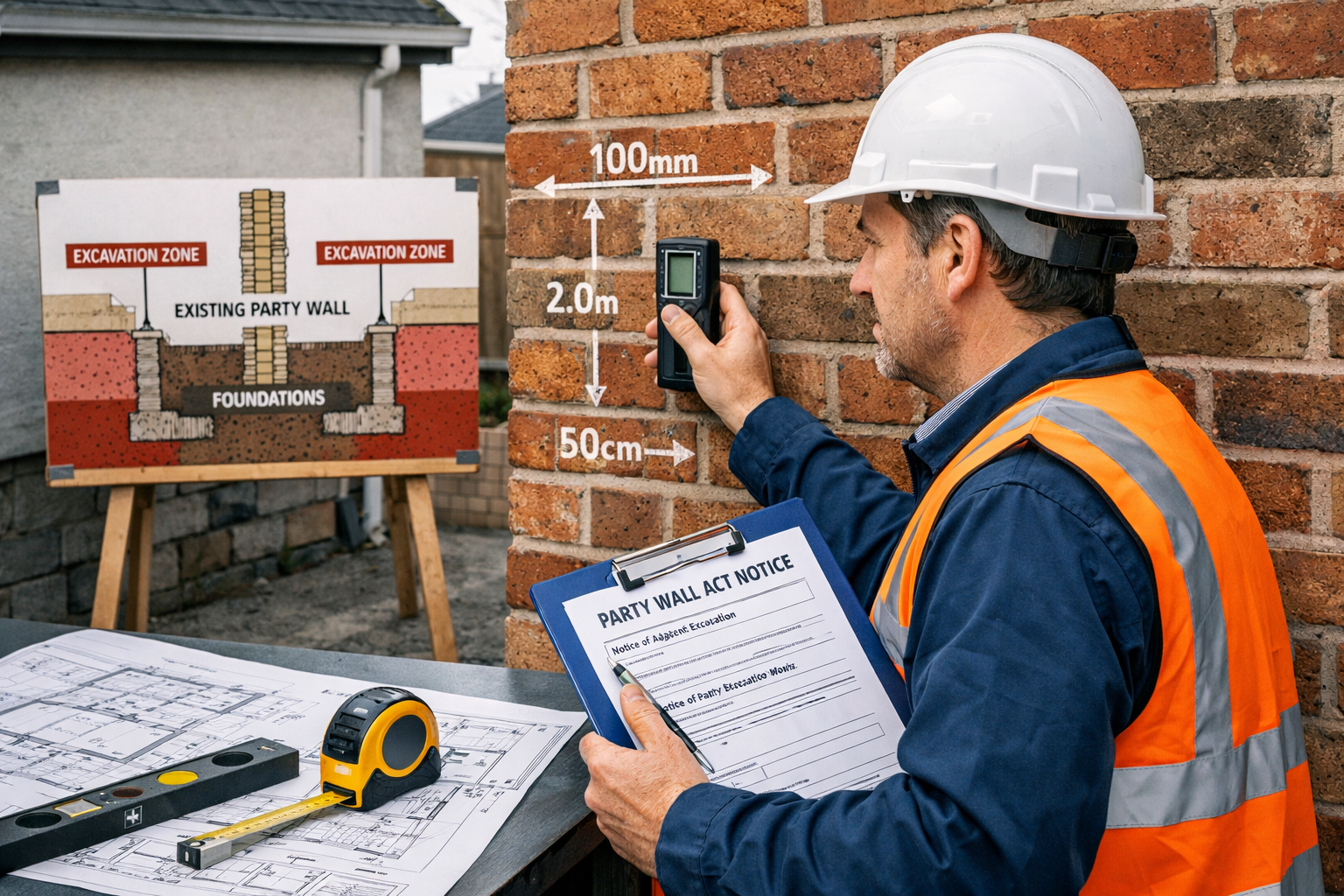
Within three metres of a neighbour’s structure: If you’re excavating within three metres of any part of a neighbouring building or structure, and your excavation will go deeper than the neighbour’s foundations, you must serve notice.
Within six metres of a neighbour’s structure: If excavating within six metres, and your excavation will cut a line drawn downwards at 45 degrees from the bottom of the neighbour’s foundations, notice is required.
This section commonly applies to:
- Basement conversions and excavations
- Deep foundation work for extensions
- Underpinning existing structures
- Installing deep drainage systems
Many homeowners planning basement excavations or extensions discover they need to comply with Section 6, even when their work doesn’t directly touch a shared wall.
What’s NOT Covered
The party wall act doesn’t apply to:
- Work entirely within your own property that doesn’t affect shared structures
- Minor repairs and maintenance
- Internal alterations that don’t involve cutting into party walls
- Purely cosmetic changes
- Work in Scotland or Northern Ireland (which have different legislation)
The Party Wall Notice Process: Step-by-Step Guide
Navigating the party wall act successfully requires following a specific procedural timeline. Missing deadlines or serving incorrect notices can delay your project significantly.
Step 1: Determine If Notice Is Required
Before anything else, establish whether your planned work falls under the Act. Review the types of work covered in the previous section, and if in doubt, consult with a qualified party wall surveyor who can advise on your specific circumstances.
Step 2: Prepare and Serve the Appropriate Notice
The party wall act requires formal written notice served to all adjoining owners. The type of notice depends on the work:
Party Structure Notice (for Section 2 work): Must be served at least two months before the intended start date. This notice should include:
- Your name and address
- The address of the building where work will occur
- Details of the proposed work with drawings
- The intended start date
- A statement of the adjoining owner’s rights
Line of Junction Notice (for Section 1 work): Must be served at least one month before starting. Includes similar information to the Party Structure Notice.
Notice of Adjacent Excavation (for Section 6 work): Must be served at least one month before excavation begins.
The notice must be served correctly—either delivered by hand, sent by recorded delivery, or left at the property. Email alone is generally not sufficient unless the adjoining owner agrees to accept it this way.
Step 3: Await Your Neighbour’s Response
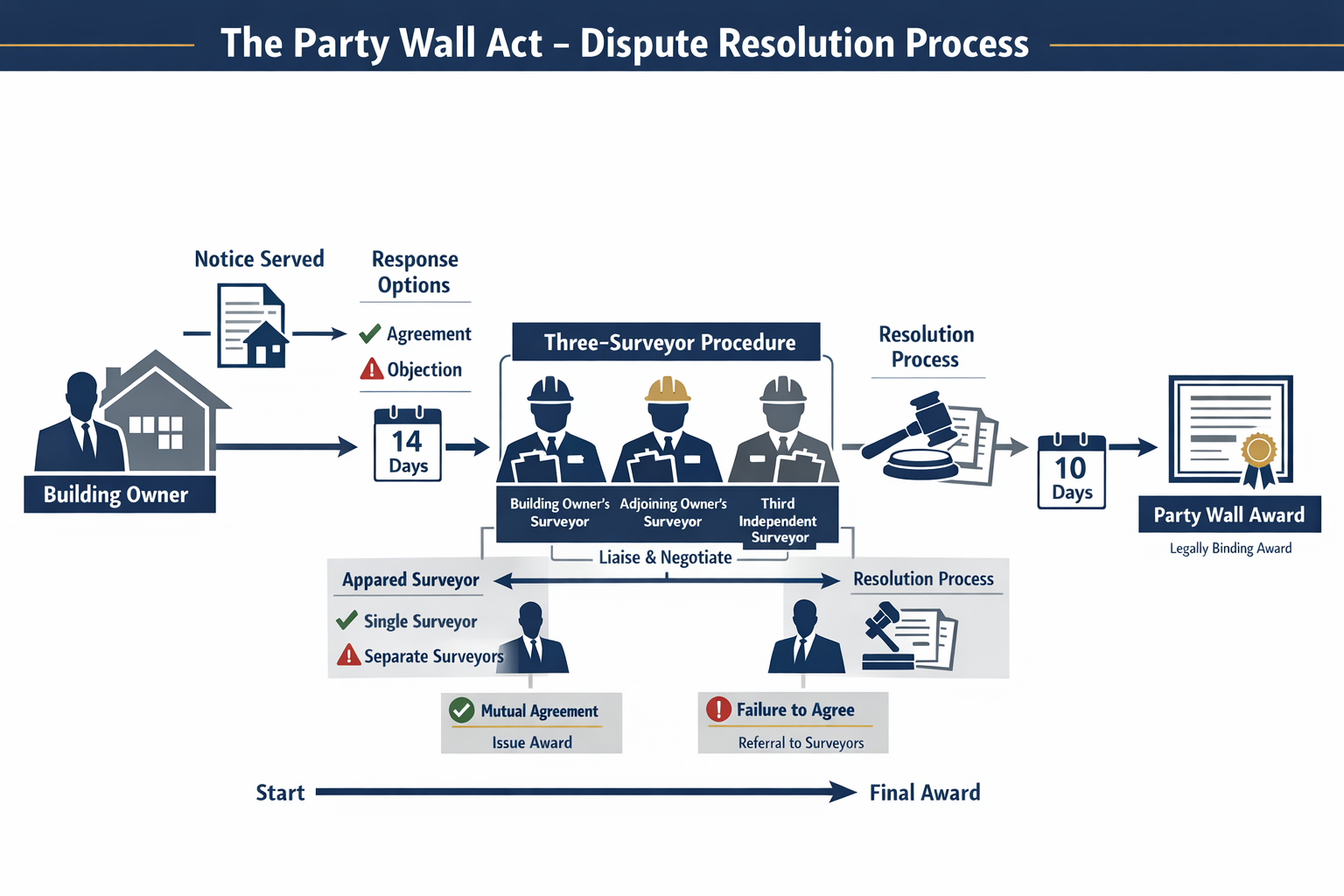
Once you’ve served notice, the adjoining owner has 14 days to respond. They have three options:
✅ Consent: They agree to the work as described. You can proceed once the notice period expires, though it’s still wise to arrange a condition survey to document the property’s state before work begins.
❌ Dissent: They formally disagree with the work or don’t respond within 14 days. This triggers a “dispute” under the Act (even if the disagreement is amicable), requiring the appointment of surveyors.
📝 Request modifications: They may consent with conditions or request additional protective measures. This often leads to negotiations and surveyor involvement.
Step 4: Appointing Surveyors (If There’s a Dispute)
When a dispute arises, the party wall act provides a surveyor-based resolution process. There are three options:
Option 1: Agreed Surveyor 🤝
Both parties jointly appoint a single surveyor to act impartially for both sides. This is typically the most cost-effective approach and works well when relationships are amicable.
Option 2: Two Surveyors 👥
Each party appoints their own surveyor. These two surveyors then work together to produce the party wall award. This is the most common approach and provides each party with dedicated representation.
Option 3: Three Surveyors 🏛️
Each party appoints a surveyor, and those two surveyors appoint a third “agreed surveyor” who acts as referee if they cannot reach agreement. This is rare and typically reserved for complex or contentious cases.
Important: The building owner (the person doing the work) pays for all surveyors’ fees, even the adjoining owner’s surveyor, unless the award specifies otherwise.
Step 5: The Party Wall Award
The appointed surveyor(s) will:
- Inspect both properties and prepare condition surveys
- Review the proposed work and plans
- Assess potential impacts on the adjoining property
- Determine appropriate protective measures
- Create a party wall award—a legally binding document that sets out:
- What work is permitted
- How and when it will be carried out
- What protective measures must be implemented
- Access arrangements
- How disputes will be resolved
- Responsibility for costs
The award must be served within 10 days of either party requesting it. Once served, either party has 14 days to appeal to the county court if they believe the award is unfair.
Step 6: Conducting the Work
With the award in place, work can proceed according to the terms specified. The building owner must:
- Follow all conditions in the award
- Allow reasonable access for inspections
- Carry out work with minimal disruption
- Repair any damage caused by the work
- Provide updated information if work changes significantly
Understanding the complete party wall process helps ensure your project proceeds smoothly and legally.
Rights and Responsibilities: Building Owners vs. Adjoining Owners
The party wall act creates a careful balance of rights and obligations for both parties involved in construction work.
Building Owner Rights ⚒️
As the building owner (the person carrying out the work), you have the right to:
Undertake reasonable development on your property, even if your neighbour objects. The Act doesn’t give adjoining owners veto power over sensible building projects.
Access the adjoining property if necessary to carry out the work, provided you give at least 14 days’ notice and access is at reasonable times.
Execute the work described in your notice or award, subject to any conditions imposed by the surveyor(s).
Appoint your own surveyor to represent your interests in any dispute.
Building Owner Responsibilities 📋
With these rights come significant responsibilities:
Serve proper notice at the correct time with accurate information about your proposed work.
Pay all costs associated with the party wall process, including:
- Your own surveyor’s fees
- The adjoining owner’s surveyor’s fees (in most cases)
- The agreed surveyor’s fees (if applicable)
- Costs of preparing the award
- Costs of condition surveys
Compensate for damage caused by your work, returning the adjoining property to its previous condition.
Follow the award precisely, including any protective measures, working hours, or access arrangements specified.
Maintain insurance adequate to cover potential damage to neighbouring properties.
Adjoining Owner Rights 🏠
As an adjoining owner receiving notice of work, you have the right to:
Receive proper notice with sufficient detail to understand the proposed work and its potential impact.
Appoint a surveyor at the building owner’s expense to protect your interests.
Have your property protected through appropriate measures specified in the party wall award.
Receive compensation for any damage caused by the building work.
Request a condition survey documenting your property’s state before work begins, creating clear evidence of any subsequent damage.
Appeal the award to the county court if you believe it’s unjust.
Adjoining Owner Responsibilities ⚖️
Adjoining owners also have obligations:
Respond to notices within the 14-day timeframe, or risk being deemed to have dissented.
Allow reasonable access to your property for inspections and, if necessary, to carry out the work.
Act reasonably and not obstruct legitimate development unnecessarily.
Appoint a surveyor promptly if you dissent or have concerns about the proposed work.
Common Misconceptions ❌
“My neighbour can refuse my extension”: FALSE. Adjoining owners cannot prevent reasonable work from proceeding. They can ensure it’s done properly with appropriate protections, but they don’t have veto power.
“I don’t need to follow the Act if my neighbour is friendly”: FALSE. The Act’s procedures are legally required regardless of your relationship. Informal agreements aren’t legally binding and can lead to problems if disputes arise later.
“The Act only applies to terraced houses”: FALSE. The party wall act applies to all property types where work affects shared structures or involves excavation near boundaries—including semi-detached houses, flats, and even some detached properties.
“I can refuse to appoint a surveyor”: FALSE. If you dissent or don’t respond to a notice, and then refuse to appoint a surveyor, the building owner can appoint one on your behalf after giving you further notice.
Many property owners benefit from understanding whether they can refuse a party wall agreement and what their actual rights are under the legislation.
Party Wall Surveyors: Their Role and Importance
Party wall surveyors are central to the successful operation of the party wall act. These professionals ensure the Act’s procedures are followed correctly and fairly.
What Party Wall Surveyors Do
A party wall surveyor’s role encompasses several critical functions:
Advising on the Act’s application 📊
Surveyors help property owners understand whether their work requires notices under the Act and guide them through the procedural requirements.
Preparing and serving notices 📝
Many surveyors assist building owners in drafting compliant notices with appropriate technical details and serving them correctly.
Conducting condition surveys 🔍
Before work begins, surveyors document the condition of both properties through detailed surveys, including photographs and descriptions of existing defects, cracks, or damage. This creates an evidential baseline.
Negotiating terms 🤝
Surveyors from both sides work together to agree on appropriate protective measures, working methods, and access arrangements that safeguard the adjoining owner’s property while allowing the work to proceed.
Drafting the party wall award ⚖️
The surveyor(s) prepare a comprehensive, legally binding document that sets out all agreed terms, conditions, and procedures for the work.
Monitoring the work 👁️
During construction, surveyors may conduct inspections to ensure compliance with the award and identify any emerging issues.
Resolving disputes 🔧
If disagreements arise during the work, surveyors can make determinations and issue supplemental awards to address new circumstances.
Assessing damage claims 💰
After work completes, surveyors determine whether damage has occurred and, if so, what remedial work or compensation is appropriate.
Qualifications and Selection
Not just anyone can act as a party wall surveyor. While the Act doesn’t mandate specific qualifications, competent surveyors typically have:
- Membership of the Royal Institution of Chartered Surveyors (RICS)
- Specific training in party wall matters
- Professional indemnity insurance
- Experience with similar projects and property types
- Knowledge of construction methods and structural issues
When selecting a surveyor, consider:
✅ Relevant experience: Have they handled similar types of work and property?
✅ Local knowledge: Are they familiar with local building practices and property types?
✅ Professional qualifications: Are they RICS-registered or similarly qualified?
✅ Independence: Can they act impartially (particularly important for agreed surveyors)?
✅ Communication skills: Will they explain the process clearly and keep you informed?
✅ Reasonable fees: Are their charges proportionate to the work involved?
Finding qualified party wall surveyors near you is essential for ensuring the process runs smoothly and your interests are properly protected.
The Agreed Surveyor Approach
When relationships between neighbours are good and the work is relatively straightforward, appointing an agreed surveyor offers several advantages:
💰 Cost savings: One surveyor’s fee instead of two (or three)
⚡ Faster process: Fewer people to coordinate and no need for surveyors to agree between themselves
🤝 Simpler communication: One point of contact for both parties
📋 Streamlined documentation: Single set of surveys and one award to manage
However, the agreed surveyor must act completely impartially, balancing both parties’ interests. This requires significant skill and integrity, and both parties must trust the surveyor’s independence.
The Two Surveyor Approach
For more complex work or where relationships are strained, the two surveyor approach provides:
🛡️ Dedicated representation: Each party has their own advocate
🔍 Thorough scrutiny: Two professionals reviewing the proposals and conditions
⚖️ Balanced outcomes: Built-in checks and balances through the need for agreement
📞 Direct communication: Each party can discuss concerns privately with their surveyor
The two surveyors must work together professionally to produce a joint award. If they cannot agree on any matter, they must appoint a third surveyor to make a determination.
Costs and Fees
Party wall surveyor fees vary depending on:
- The complexity of the work
- The number of properties affected
- The property location (London and the South East typically cost more)
- Whether disputes arise requiring additional work
- The surveyor’s experience and qualifications
Typical costs in 2025:
| Scenario | Estimated Cost Range |
|---|---|
| Simple extension (agreed surveyor) | £700 – £1,200 |
| Standard extension (two surveyors) | £1,500 – £3,000 |
| Complex work or multiple properties | £3,000 – £6,000+ |
| Basement excavation | £2,000 – £5,000+ |
Remember: the building owner pays all surveyor fees unless the award specifies otherwise. For detailed information about costs, review this guide on party wall surveyor pricing.
Common Party Wall Scenarios and How to Handle Them
Understanding how the party wall act applies to real-world situations helps property owners navigate the process confidently.
Scenario 1: Single-Storey Rear Extension
The Situation: You’re adding a single-storey extension to the rear of your terraced house. The extension will be built up to the boundary with your neighbour, and you need to cut into the existing party wall to insert a steel beam.
Party Wall Act Requirements:
- Serve a Party Structure Notice under Section 2 (cutting into the party wall)
- Serve at least two months before starting work
- May also need Section 6 notice if foundations are deep enough
Best Practice:
- Discuss plans informally with your neighbour first
- Serve formal notice with clear drawings and specifications
- If your neighbour consents, still arrange a condition survey
- If they dissent, appoint surveyors promptly to avoid delays
- Ensure your builder understands and follows the award conditions
Scenario 2: Loft Conversion
The Situation: You’re converting your loft in a semi-detached house. The work involves raising the party wall by one metre to create headroom and cutting into the wall to insert steel beams.
Party Wall Act Requirements:
- Serve Party Structure Notice for raising the wall and cutting in beams
- Two months’ notice required
- Must include details of how you’ll weatherproof the raised wall
- May need to provide temporary weatherproofing during construction
Best Practice:
- Include detailed drawings showing the raised wall and beam positions
- Specify materials and weatherproofing methods in your notice
- Expect your neighbour to appoint a surveyor—loft conversions often raise concerns
- Budget for surveyor fees and potential protective measures
- Plan for possible delays if awards take time to negotiate
Scenario 3: Basement Excavation
The Situation: You’re excavating a basement beneath your Victorian terrace. The excavation will go deeper than your neighbours’ foundations on both sides and extend within three metres of their properties.
Party Wall Act Requirements:
- Serve Notice of Adjacent Excavation under Section 6 to both neighbours
- One month’s notice required
- Likely to also need Party Structure Notice if underpinning party walls
- Must provide detailed structural engineering information
Best Practice:
- Engage a structural engineer early to design appropriate underpinning
- Commission detailed surveys of neighbouring properties
- Expect both neighbours to appoint surveyors—basement work is high-risk
- Budget significantly for surveyor fees (£3,000-£6,000+)
- Allow extra time for the party wall process (3-4 months minimum)
- Ensure your contractor has relevant experience and insurance
Basement excavations are among the most complex party wall scenarios. Understanding party wall disputes and their resolution is particularly important for these projects.
Scenario 4: Garden Wall on Boundary
The Situation: You want to build a new brick garden wall directly on the boundary line between your property and your neighbour’s.
Party Wall Act Requirements:
- Serve Line of Junction Notice under Section 1
- One month’s notice required
- Need neighbour’s express consent to build astride the boundary
- If consent refused, must build entirely on your land (but still serve notice)
Best Practice:
- Discuss the proposal with your neighbour before serving notice
- Explain that a shared wall can benefit both properties
- Offer to build a quality wall with good materials
- If they refuse consent, redesign to build on your land with notice
- Consider whether an agreed surveyor could facilitate agreement
Scenario 5: Multiple Adjoining Owners
The Situation: You’re renovating a mid-terrace property with work affecting party walls on both sides and a shared wall with the flat above.
Party Wall Act Requirements:
- Serve separate notices to each adjoining owner
- Each can respond independently
- May need to coordinate multiple surveyors and awards
- Costs multiply with each additional adjoining owner
Best Practice:
- Identify all adjoining owners early (including leaseholders and freeholders)
- Serve notices simultaneously to all parties
- Consider proposing a single agreed surveyor for all parties to reduce costs
- Maintain clear communication with all neighbours
- Budget appropriately—multiple surveyors significantly increase costs
Scenario 6: Neighbour Refuses to Engage
The Situation: You’ve served proper notice, but your neighbour won’t respond, won’t appoint a surveyor, and won’t engage with the process.
Party Wall Act Requirements:
- After 14 days of no response, a dispute is deemed to exist
- After 10 days’ further notice, you can appoint a surveyor on their behalf
- The appointed surveyor must still act in their interests
- The process continues even without their cooperation
Best Practice:
- Ensure your original notice was properly served (keep proof)
- Send a follow-up letter explaining the deemed dispute
- Give formal notice of your intention to appoint a surveyor for them
- Select a reputable, impartial surveyor for this appointment
- Proceed with the process—their non-engagement doesn’t stop your work
Preventing and Resolving Party Wall Disputes
While the party wall act provides dispute resolution mechanisms, preventing conflicts in the first place saves time, money, and stress.
Prevention Strategies 🛡️
Early communication 💬
Talk to your neighbours before serving formal notices. Explain your plans, show them drawings, and address their concerns. Many disputes arise from surprise or lack of information.
Clear, detailed notices 📄
Provide comprehensive information in your notices, including:
- Detailed drawings and plans
- Specifications of materials and methods
- Expected duration of work
- Working hours
- Contact information for you and your builder
Professional advice 👔
Engage a party wall surveyor early, even before serving notices. They can advise on the process, help draft notices, and identify potential issues before they become problems.
Realistic timelines ⏰
Don’t serve notices at the last minute. Allow plenty of time for the full process, including potential disputes and award negotiations. A rushed process creates stress and conflict.
Quality contractors 🔨
Choose builders experienced with party wall work who understand their obligations under awards. A professional contractor who respects neighbouring properties prevents many problems.
Maintain relationships 🤝
Remember you’ll continue living next to these people after the work completes. Courtesy, consideration, and respect go a long way toward preventing disputes.
Common Causes of Disputes ⚠️
Understanding what triggers party wall disputes helps you avoid them:
Inadequate notice 📋
Serving notices too late, with insufficient detail, or to the wrong people creates immediate problems.
Lack of communication 🔇
Failing to keep neighbours informed about progress, changes, or delays breeds mistrust and conflict.
Excessive noise or disruption 🔊
Work outside agreed hours, excessive dust or vibration, or blocked access can turn amicable neighbours into adversaries.
Visible damage 💥
Cracks, subsidence, or other damage to neighbouring properties—especially if not acknowledged or addressed promptly—lead to serious disputes.
Scope creep 📐
Carrying out work beyond what was described in notices or awards without serving supplemental notices creates legitimate grievances.
Access issues 🚪
Demanding access without proper notice or at unreasonable times violates neighbours’ rights and creates conflict.
Resolving Disputes When They Arise 🔧
If despite your best efforts a dispute develops, the party wall act provides a structured resolution process:
Step 1: Surveyor Involvement
If not already appointed, both parties should appoint surveyors (or agree on a single surveyor). The surveyors’ role is to find workable solutions that protect both parties’ interests.
Step 2: Site Meetings and Negotiations
Surveyors will typically:
- Inspect both properties
- Review the proposed work in detail
- Discuss concerns and potential solutions
- Negotiate protective measures and working methods
Step 3: The Award
The surveyor(s) will prepare an award that addresses the dispute by:
- Clarifying exactly what work is permitted
- Specifying protective measures
- Setting out working hours and access arrangements
- Determining how damage will be assessed and remedied
- Establishing a framework for ongoing communication
Step 4: Implementation
Once the award is served, both parties must comply with its terms. The award is legally binding and enforceable.
Step 5: Ongoing Monitoring
Surveyors may conduct periodic inspections during the work to ensure compliance and identify any emerging issues before they escalate.
When Surveyors Can’t Agree 🤔
In the two-surveyor approach, if the appointed surveyors cannot reach agreement on any matter, they must appoint a third surveyor (sometimes called the “agreed surveyor” or “third surveyor”) to make a determination. This third surveyor’s decision is binding.
This mechanism ensures the process cannot become deadlocked and provides a clear path to resolution even in contentious cases.
Appealing an Award ⚖️
If either party believes an award is unjust, they can appeal to the county court within 14 days of the award being served. However, appeals are relatively rare because:
- Courts generally defer to surveyors’ technical expertise
- Appeals are expensive and time-consuming
- Most awards represent reasonable compromises
- The grounds for appeal are limited to legal errors or manifest unfairness
Alternative Dispute Resolution 🕊️
For disputes that extend beyond the party wall act’s scope, or where relationships have completely broken down, alternative dispute resolution (ADR) methods may help:
Mediation: A neutral third party facilitates discussion and helps parties reach a voluntary agreement.
Arbitration: A neutral arbitrator makes a binding decision after hearing both sides.
Negotiation: Direct discussions between parties (or their representatives) to find mutually acceptable solutions.
These approaches can be faster and cheaper than court proceedings, though they’re typically used for disputes outside the Act’s specific procedures.
For comprehensive guidance on handling conflicts, explore this resource on resolving party wall disputes.
Costs Associated with the Party Wall Act
Understanding the financial implications of the party wall act helps property owners budget appropriately for their building projects.
Who Pays What? 💰
The fundamental principle is simple: the building owner pays. This includes:
✅ All surveyor fees (both their own and the adjoining owner’s)
✅ Award preparation costs
✅ Condition survey costs
✅ Any damage repair or compensation
✅ Legal costs if disputes escalate
This principle reflects the fact that the building owner is initiating the work and should bear the costs of ensuring it’s done properly and safely.
Breakdown of Typical Costs 📊
Surveyor Fees
As mentioned earlier, surveyor fees vary based on complexity:
| Project Type | Agreed Surveyor | Two Surveyors | Three Surveyors |
|---|---|---|---|
| Simple extension | £700-£1,200 | £1,500-£2,500 | £2,500-£4,000 |
| Standard loft conversion | £1,000-£1,500 | £2,000-£3,500 | £3,500-£5,500 |
| Complex extension/multiple properties | £1,500-£2,500 | £3,000-£5,000 | £5,000-£8,000 |
| Basement excavation | £2,000-£3,500 | £4,000-£6,000 | £6,000-£10,000+ |
Condition Survey Costs
Detailed condition surveys typically cost £300-£800 per property, depending on size and complexity. These are usually included in surveyor fees but may be itemized separately.
Award Preparation
Award preparation is normally included in surveyor fees, though complex awards requiring extensive documentation may incur additional charges.
Damage Repairs
This is the most unpredictable cost element. Potential damage repair costs depend on:
- The nature and extent of work
- The condition of neighbouring properties
- The quality of construction work
- Soil conditions (especially for excavations)
- Age and construction of adjoining properties
Damage can range from minor cosmetic cracks (£500-£2,000 to repair) to significant structural issues (£10,000+). This is why adequate insurance is essential.
Cost-Saving Strategies 💡
Use an agreed surveyor when possible
If relationships are good and work is straightforward, a single agreed surveyor can halve surveyor costs.
Serve notices early
Rushed processes cost more. Early notices allow time for negotiation and prevent premium fees for urgent work.
Provide detailed information upfront
Complete, accurate notices and plans reduce surveyor time spent seeking clarification, lowering fees.
Choose experienced contractors
Builders familiar with party wall work are less likely to cause damage, reducing repair costs.
Maintain good communication
Keeping neighbours informed prevents disputes that escalate costs.
Bundle multiple projects
If planning several phases of work, consider combining them into a single party wall process to reduce administrative costs.
Hidden Costs to Consider 🔍
Project delays
If you haven’t allowed sufficient time for the party wall process, delays can incur costs from:
- Extended equipment hire
- Contractor downtime
- Rescheduling other trades
- Additional professional fees
Insurance premiums
Your building insurance and contractor’s liability insurance may increase for projects involving party wall work.
Temporary works
Awards may require temporary protective measures like:
- Shoring and propping
- Temporary weatherproofing
- Monitoring equipment
- Protective barriers
Supplemental awards
If work changes during construction, supplemental awards may be needed, incurring additional surveyor fees.
Relationship costs
While not financial, damaged neighbour relationships can have long-term costs in terms of quality of life and future cooperation.
Budgeting Recommendations 📈
When budgeting for a project requiring party wall procedures:
- Add 2-5% of total project costs for party wall expenses in straightforward cases
- Add 5-10% for complex work like basements or multiple adjoining owners
- Include a contingency of at least £2,000-£5,000 for unexpected damage repairs
- Factor in potential delays of 2-4 months for the full process
- Get quotes from surveyors before committing to project timelines
For more detailed cost information, review this guide on party wall agreement costs.
Frequently Asked Questions About the Party Wall Act
Do I need a party wall agreement for a small extension?
If your extension involves cutting into a party wall, building on the boundary line, or excavating within the specified distances of a neighbouring property, yes, you need to follow the party wall act procedures regardless of the extension’s size. “Small” doesn’t exempt you from the Act’s requirements.
Can my neighbour stop my building work?
No. The party wall act doesn’t give adjoining owners the right to veto reasonable building work. However, they can ensure appropriate protective measures are in place and that any damage is properly remedied. The Act balances development rights with property protection.
What happens if I don’t follow the Party Wall Act?
Failing to comply with the party wall act can result in:
- Injunctions stopping your work
- Legal action from adjoining owners
- Liability for damage without the protections an award provides
- Costs orders requiring you to pay neighbours’ legal fees
- Delays while you retrospectively comply with the Act
Non-compliance is risky and expensive. It’s always better to follow the proper procedures from the start.
How long does the party wall process take?
Minimum timelines:
- Section 2 (party structure) work: 2 months from notice
- Section 1 and 6 work: 1 month from notice
- Add time for surveyor appointment and award preparation: 1-2 months
- Total: typically 3-4 months for the complete process
Complex cases or disputes may take longer. Start the process early to avoid project delays.
Do I need a party wall agreement for internal work?
Internal work that doesn’t involve cutting into party walls, raising party walls, or excavating near boundaries doesn’t require party wall procedures. However, if your internal work involves inserting beams into a party wall or similar structural interventions, the Act applies.
What if my neighbour won’t appoint a surveyor?
If your neighbour doesn’t appoint a surveyor within 10 days of being requested to do so, you can appoint one on their behalf after giving them further notice. The appointed surveyor must still act in their interests, even though you selected and will pay them.
Can I do party wall work without a surveyor?
If your neighbour consents in writing to your notice, technically you can proceed without surveyors. However, this is risky because:
- You have no formal record of the property’s pre-work condition
- Disputes about damage have no framework for resolution
- Your neighbour could later claim damage without baseline evidence
Even with consent, arranging a condition survey provides valuable protection for both parties.
Does the Party Wall Act apply to flats?
Yes. The party wall act applies to flats and apartments where work affects party walls, floors, or ceilings shared with other units. You must serve notices to all affected leaseholders and may also need to notify the freeholder.
What if I discover my neighbour didn’t serve me notice for their work?
If your neighbour carried out party wall work without serving proper notice, you can:
- Request a retrospective party wall award
- Claim for any damage caused
- Potentially seek an injunction if work is ongoing
However, there are time limitations on claims, so act promptly if you discover non-compliance.
Can I claim compensation for inconvenience?
The party wall act provides for compensation for physical damage to property, not for inconvenience, stress, or loss of enjoyment. However, awards can specify working hours and methods to minimize disruption.
Conclusion: Navigating the Party Wall Act Successfully
The party wall act represents a carefully balanced piece of legislation that enables property development while protecting neighbouring owners from unreasonable harm. Understanding its requirements, procedures, and principles is essential for any property owner planning construction work that affects shared structures or boundaries.
Key principles to remember:
🏗️ The Act enables development while protecting property rights—it’s not designed to prevent reasonable building work
📋 Proper procedures are mandatory, not optional, regardless of your relationship with neighbours
👥 Professional surveyors provide expertise and impartiality that protect both parties’ interests
💰 Building owners bear the costs of ensuring their work complies with the Act and doesn’t damage neighbouring properties
⚖️ The process is structured and predictable, with clear timelines, procedures, and resolution mechanisms
Your Action Plan 📝
If you’re planning building work that may fall under the party wall act:
1. Assess your requirements early (3-6 months before planned start)
- Review your plans against the Act’s three main sections
- Identify all adjoining owners who need notice
- Determine which type(s) of notice you need to serve
2. Engage professional help
- Consult a qualified party wall surveyor for advice
- Consider appointing them to handle the entire process
- Ensure your architect and builder understand party wall requirements
3. Communicate with neighbours
- Discuss your plans informally before serving formal notices
- Address concerns and explain the process
- Maintain good relationships throughout the project
4. Serve proper notices
- Use the correct notice type for your work
- Include comprehensive details and drawings
- Serve at least 2 months before starting (or 1 month for Section 1 and 6 work)
- Keep proof of service
5. Budget appropriately
- Include surveyor fees in your project budget
- Allow for potential damage repairs
- Factor in the time required for the full process
6. Follow the award
- Comply with all conditions and protective measures
- Allow access for inspections
- Maintain communication throughout the work
- Address any damage promptly and professionally
Final Thoughts 💭
The party wall act may seem complex and bureaucratic, but it serves a vital purpose in densely populated areas where properties share structures and boundaries. By following its procedures, you protect yourself from liability, provide assurance to your neighbours, and create a framework for successful completion of your building project.
Whether you’re adding a small extension, converting a loft, or excavating a basement, understanding and complying with the party wall act isn’t just a legal obligation—it’s good practice that protects your investment and maintains positive relationships with those who live around you.
Don’t view the Act as an obstacle to your plans. Instead, see it as a structured process that, when followed correctly, enables your development while ensuring fairness and protection for all parties involved. With proper planning, professional advice, and good communication, navigating the party wall act can be straightforward and stress-free.
Ready to start your building project? Ensure you’re fully compliant with the party wall act by consulting with experienced party wall surveyors who can guide you through every step of the process. Early professional advice saves time, money, and stress, allowing your project to proceed smoothly and legally.
