
Semi Detached Party Wall: Your Complete Guide to Rights, Responsibilities, and Legal Requirements in 2025
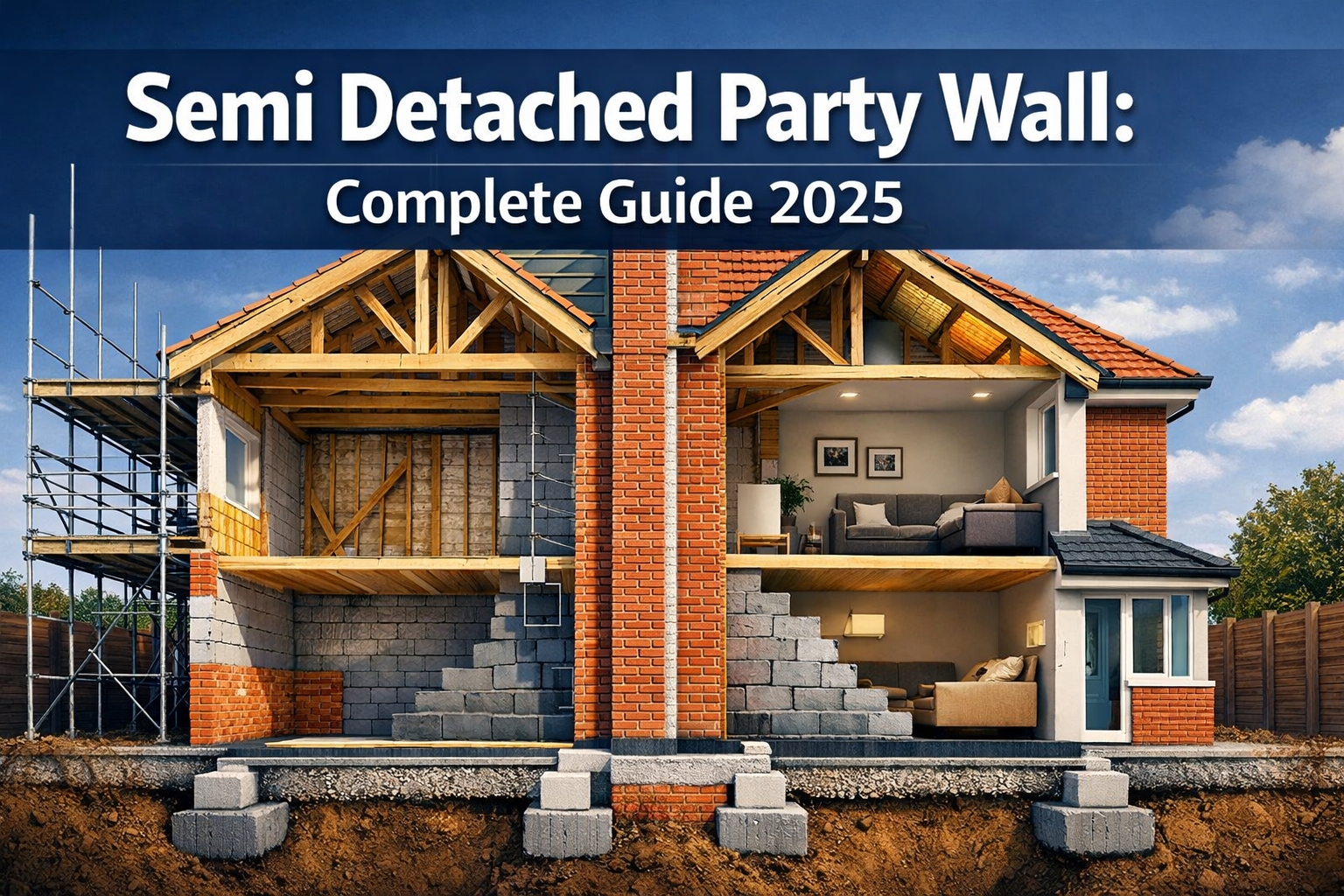
Imagine discovering your neighbour’s renovation plans could legally affect your home’s structural integrity—yet you have no say in stopping the work. This scenario plays out thousands of times each year across the UK, particularly in semi-detached properties where homes share a critical structural element: the semi detached party wall. Understanding your rights and obligations regarding this shared boundary isn’t just helpful—it’s essential for protecting your property investment and maintaining good neighbourly relations.
A semi detached party wall represents one of the most common yet frequently misunderstood aspects of UK property ownership. Whether you’re planning an extension, dealing with a neighbour’s construction project, or simply want to understand what you legally own, this comprehensive guide will equip you with everything you need to know.
Key Takeaways
- 🏠 A semi detached party wall is a shared structural wall between two properties, with specific legal protections under the Party Wall etc. Act 1996
- 📋 Both property owners have equal rights and responsibilities for maintaining the party wall, regardless of who built it originally
- ⚖️ Legal notices are mandatory before undertaking any work that affects the party wall, with specific timeframes and procedures to follow
- 💰 Costs for party wall work are typically borne by the building owner, including surveyor fees and any necessary protective measures
- 🔍 Professional party wall surveyors play a crucial role in protecting both parties’ interests and ensuring compliance with legal requirements
What Is a Semi Detached Party Wall?
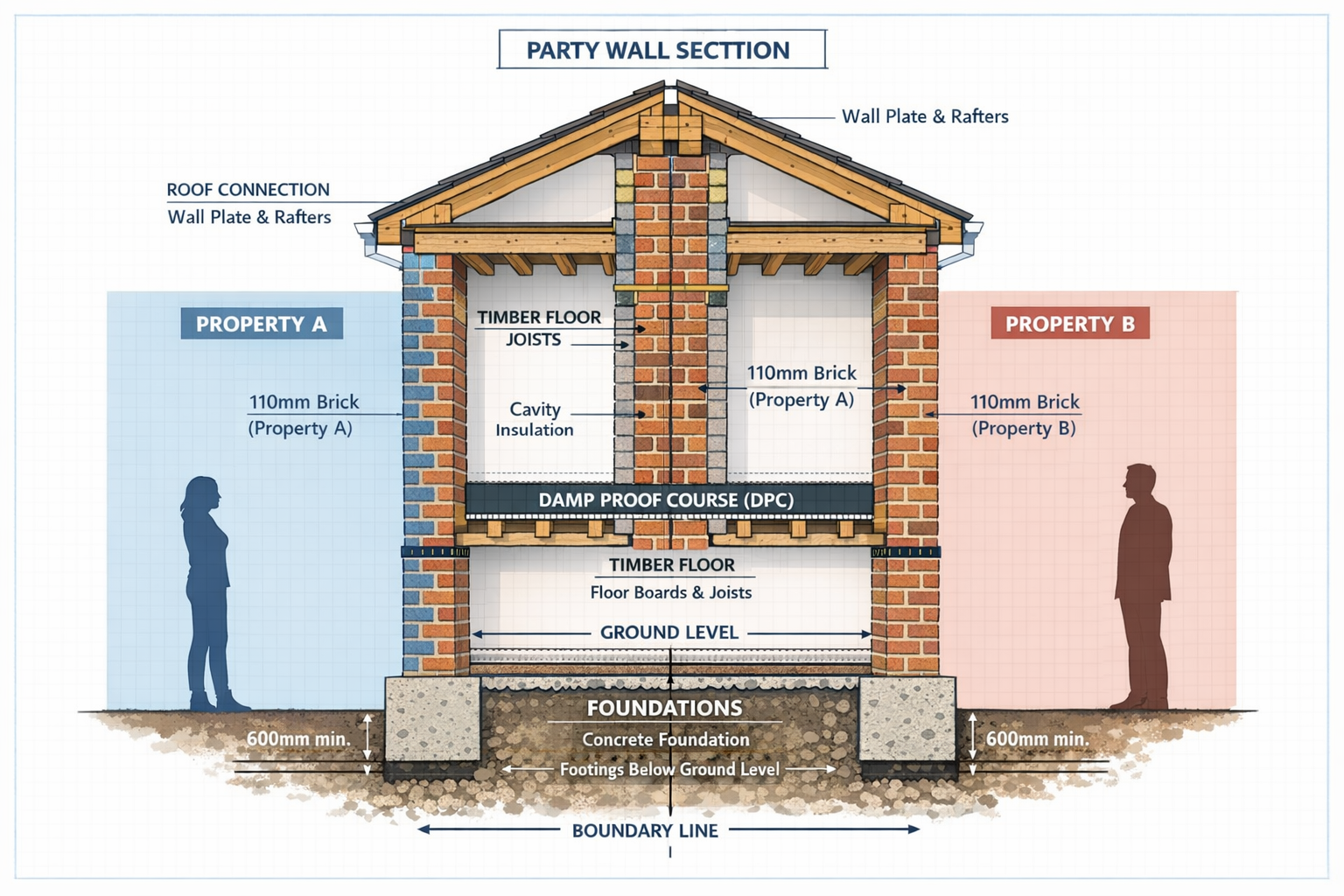
A semi detached party wall is the shared vertical wall structure that separates two semi-detached houses. Unlike detached properties that stand completely alone, or terraced houses that may share walls on both sides, semi-detached homes share exactly one wall with their immediate neighbour.
Legal Definition and Classification
Under the Party Wall etc. Act 1996, a party wall in a semi-detached property is classified as a “party structure.” This legal framework defines it as:
- A wall that stands on the land of two or more owners
- A wall that separates buildings belonging to different owners
- A structure that forms part of a building and is shared with another building
The Act provides specific protections and establishes clear procedures for any work affecting these structures, making it crucial for homeowners to understand their position.
Physical Characteristics
Key features of a semi detached party wall include:
- Structural continuity: The wall runs from the foundation through to the roof structure
- Shared ownership: Both property owners have rights to the entire thickness of the wall
- Load-bearing function: Typically supports floor joists, roof timbers, and other structural elements from both properties
- Boundary marker: Defines the legal property line between the two homes
| Component | Description | Ownership |
|---|---|---|
| Wall foundation | Below-ground support structure | Shared equally |
| Main wall structure | Brick, block, or stone construction | Shared equally |
| Internal finishes | Plaster, decoration on each side | Individual owner |
| Embedded timbers | Floor joists, roof supports | Owner whose property they serve |
Understanding Your Rights as a Semi Detached Property Owner
Ownership of a semi detached party wall comes with specific rights that protect your property interests. These rights exist regardless of which property was built first or who may have paid for the original construction.
Right to Support
Your most fundamental right is the right to support. This means:
✅ Your neighbour cannot remove or weaken the party wall in a way that compromises your property’s structural integrity
✅ You’re entitled to the wall remaining in its current condition to support your building
✅ Any work must maintain or improve the wall’s load-bearing capacity
Right to Light and Weather Protection
The party wall must continue to provide:
- Protection from the elements (rain, wind, cold)
- Adequate separation between the two properties
- Fire resistance as originally designed
- Sound insulation to reasonable standards
Right to Refuse Consent (With Limitations)
While you cannot arbitrarily block your neighbour’s reasonable building work, you have the right to:
- Receive proper notice of proposed works
- Appoint your own surveyor to protect your interests
- Request protective measures and monitoring
- Claim compensation for any damage caused
It’s important to note that neighbours cannot legally refuse a party wall agreement outright—the Act provides mechanisms to proceed even without consent, but with proper safeguards in place.
Your Responsibilities Regarding the Semi Detached Party Wall
Rights come with corresponding responsibilities. Understanding what you’re obligated to do helps prevent disputes and potential legal issues.
Maintenance Obligations
Both owners share responsibility for maintaining the semi detached party wall in good condition:
Shared maintenance duties include:
- 🔧 Repairing structural defects that affect both properties
- 💧 Addressing water penetration or damp issues
- 🏗️ Maintaining the wall’s structural integrity
- 🔥 Preserving fire-resistance properties
“The cost of repairs to a party wall should typically be shared proportionately between both owners, unless the damage was caused by one party’s negligence or alterations.”
Notification Requirements
Before undertaking any work affecting the party wall, you must provide formal notice to your neighbour. This legal requirement applies to:
- Cutting into the wall for beams or joists
- Raising the height of the wall
- Demolishing and rebuilding the wall
- Underpinning the wall’s foundations
- Installing a damp proof course
- Cutting away projecting footings
The notice period varies depending on the type of work:
| Work Type | Notice Period | Additional Requirements |
|---|---|---|
| Basic party wall works | 2 months | Written notice with drawings |
| Excavation within 3 metres | 1 month | Depth and proximity details |
| Excavation within 6 metres | 1 month | Only if deeper than foundations |
Financial Responsibilities
The building owner (the person carrying out the work) typically bears all costs associated with party wall matters, including:
💷 Party wall surveyor fees for both parties (if surveyors are appointed)
💷 Protective measures such as temporary supports or monitoring
💷 Making good any damage caused by the works
💷 Compensation for loss of amenity or inconvenience
Understanding how much a party wall surveyor costs helps you budget appropriately for any planned construction work.
Common Works Affecting Semi Detached Party Walls
Certain building projects inevitably involve the semi detached party wall and trigger the need for formal procedures. Recognizing these scenarios helps you plan ahead and comply with legal requirements.
Extensions and Loft Conversions
Rear or side extensions frequently require party wall involvement when:
- New foundations are dug within 3-6 metres of the party wall
- The extension wall ties into or abuts the party wall
- Roof alterations affect the party wall structure
- Beams need to be inserted into the party wall for support
Loft conversions typically involve party wall matters because:
- Steel beams often need to be inserted into the party wall
- The party wall may need to be raised to increase headroom
- Roof structure modifications affect the shared wall
- Fire-resistance requirements may necessitate wall upgrades
Basement Excavations and Underpinning
Digging below the level of your neighbour’s foundations triggers specific party wall procedures. This commonly occurs with:
- Basement conversions: Excavating beneath existing ground floors
- Underpinning projects: Strengthening existing foundations
- Drainage work: Installing new drains near party wall foundations
These works carry significant risk and require careful planning with professional guidance from qualified building surveyors.
Internal Alterations
Even work entirely within your property may require party wall procedures:
- Removing chimney breasts: If the breast is built into the party wall
- Installing RSJs or steel beams: When they bear on the party wall
- Creating new openings: Doorways or hatches through the party wall (rare in semi-detached properties)
- Damp-proofing: Injecting chemicals or installing membranes
Structural Repairs
Necessary repairs to the semi detached party wall itself require proper procedures:
- Repointing or rebuilding deteriorated sections
- Replacing failed wall ties
- Installing new damp proof courses
- Repairing cracks or structural movement
The Party Wall Notice Process for Semi Detached Properties
Navigating the formal notification process correctly prevents delays and disputes. Here’s exactly what you need to do when planning work affecting your semi detached party wall.
Step 1: Determine If Notice Is Required
First, establish whether your planned work falls under the Party Wall etc. Act 1996. Understanding when you need a party wall agreement is the crucial first step.
Work requiring notice includes:
✓ Building on or astride the boundary line
✓ Work directly to the existing party wall
✓ Excavation within 3 metres (if deeper than neighbour’s foundations)
✓ Excavation within 6 metres (if it will cut a line drawn at 45° from the bottom of neighbour’s foundations)
Step 2: Prepare Your Party Wall Notice
Your notice must include specific information to be legally valid:
Essential elements:
- Your name and address
- Your neighbour’s name and address
- Description of the proposed works
- Date when work will commence (at least 2 months away)
- Detailed drawings showing the work
- Contact information for queries
How to write a party wall letter provides templates and specific guidance on creating legally compliant notices.
Step 3: Serve the Notice
Deliver your notice using a method that provides proof of service:
- Hand delivery with signed receipt
- Recorded delivery post
- Email (if previously agreed)
Important timing considerations:
⏰ Serve notice at least 2 months before starting work (for party structure notices)
⏰ Serve notice at least 1 month before starting work (for excavation notices)
⏰ Allow additional time for the surveyor appointment and award process
Step 4: Await Your Neighbour’s Response
Your neighbour has 14 days to respond to your notice. Three outcomes are possible:
1. Consent ✅
- Your neighbour agrees in writing
- No surveyors needed (though still recommended)
- Work can proceed after the notice period expires
2. Dissent ⚠️
- Your neighbour disagrees or raises concerns
- Party wall surveyors must be appointed
- A Party Wall Award will be prepared
3. No Response 📭
- Treated as dissent after 14 days
- Triggers the surveyor appointment process
- Cannot be interpreted as consent
Step 5: Appoint Party Wall Surveyors
If your neighbour dissents or doesn’t respond, surveyors must be appointed. You have three options:
| Option | Description | Best For |
|---|---|---|
| Agreed Surveyor | One impartial surveyor acts for both parties | Straightforward work, cooperative neighbours |
| Two Surveyors | Each party appoints their own surveyor | Complex projects, contentious situations |
| Three Surveyors | Each party’s surveyor plus a third surveyor | Highly disputed matters (rare) |
Finding qualified party wall surveyors near you ensures proper protection of your interests throughout the process.
Step 6: The Party Wall Award
The appointed surveyor(s) will prepare a Party Wall Award—a legally binding document that sets out:
- Detailed description of the proposed works
- Timing and schedule for the work
- Protective measures required (monitoring, temporary supports, etc.)
- Access arrangements for inspections
- How costs will be allocated
- Dispute resolution procedures
The Award must be served within specific timeframes and can be appealed within 14 days if either party disagrees with its terms.
Costs Associated with Semi Detached Party Wall Procedures
Understanding the financial implications of party wall work helps you budget appropriately and avoid surprises.
Surveyor Fees
Party wall surveyor costs vary based on several factors:
Typical fee ranges (2025):
- Simple party wall notice (agreed surveyor): £700-£1,200
- Standard two-surveyor appointment: £1,500-£3,000 total
- Complex projects with extensive monitoring: £3,000-£6,000+
Factors affecting costs:
- 🏗️ Complexity and scope of the proposed works
- 📍 Location (London and Southeast typically higher)
- 👥 Number of surveyors appointed
- ⏱️ Duration of the project and monitoring required
- 📊 Number of inspections needed
The complete pricing guide for party wall surveyors breaks down these costs in greater detail.
Additional Expenses
Beyond surveyor fees, budget for:
Protective measures:
- Crack monitoring systems: £300-£800
- Temporary propping or supports: £500-£2,000
- Photographic surveys: £200-£500
- Structural monitoring: £400-£1,000
Legal and professional fees:
- Solicitor consultation (if disputes arise): £200-£500 per hour
- Structural engineer reports: £800-£2,000
- Expert witness fees (if disputes escalate): £1,500-£5,000+
Who Pays What?
The general principle is clear: the building owner pays all party wall costs. This includes:
✓ Your own surveyor’s fees
✓ Your neighbour’s surveyor’s fees (if appointed)
✓ All protective measures and monitoring
✓ Making good any damage caused
✓ Reasonable costs for your neighbour’s professional advice
Exceptions:
- Shared maintenance costs are split proportionately
- If your neighbour requests excessive or unreasonable measures, they may bear those costs
- Frivolous objections may result in cost awards against the objecting party
Common Disputes and How to Resolve Them
Even with proper procedures, disagreements can arise regarding semi detached party walls. Understanding common issues and resolution paths helps you navigate conflicts effectively.
Typical Party Wall Disputes
1. Damage Claims 🏚️
The most frequent dispute involves alleged damage to the adjoining property:
- Cracks appearing in walls or ceilings
- Structural movement or subsidence
- Damage to finishes, fixtures, or fittings
- Disruption to services (plumbing, electrical, heating)
Prevention strategy: Commission a comprehensive photographic survey before work begins, documenting the existing condition of both properties.
2. Access Disputes 🚪
Conflicts over site access include:
- Refusing reasonable access for inspections
- Disputes over access timing or frequency
- Damage caused during access
- Security concerns about access arrangements
Resolution approach: The Party Wall Award should specify clear access terms, including notice periods, permitted hours, and supervision requirements.
3. Noise and Disruption 🔨
While not strictly a party wall matter, construction disturbance often accompanies party wall work:
- Extended working hours
- Excessive noise or vibration
- Dust and debris
- Disruption to daily life
Best practice: Agree on a considerate construction schedule and maintain open communication throughout the project.
4. Cost Disputes 💰
Disagreements over who pays for what:
- Surveyor fee allocation
- Extent of necessary protective measures
- Scope of making good required
- Compensation for inconvenience
Solution: The Party Wall Award should clearly specify all cost allocations. Any disputes should be referred back to the surveyor(s) for determination.
Resolution Mechanisms
When disputes arise, follow this escalation path:
Level 1: Direct Communication 💬
- Discuss concerns directly with your neighbour
- Many issues resolve through simple conversation
- Document all agreements in writing
Level 2: Surveyor Intervention 📋
- Refer the matter to the appointed surveyor(s)
- Surveyors have authority to determine most disputes
- Their decision is binding unless appealed
Level 3: Third Surveyor ⚖️
- If the two surveyors cannot agree, they select a third surveyor
- The third surveyor makes the final determination
- This process is relatively quick and cost-effective
Level 4: County Court Appeal 🏛️
- Either party can appeal a Party Wall Award within 14 days
- Court proceedings are formal and potentially expensive
- Should be a last resort after exhausting other options
Resolving party wall disputes requires patience, proper documentation, and often professional guidance to reach satisfactory outcomes.
Special Considerations for Semi Detached Properties
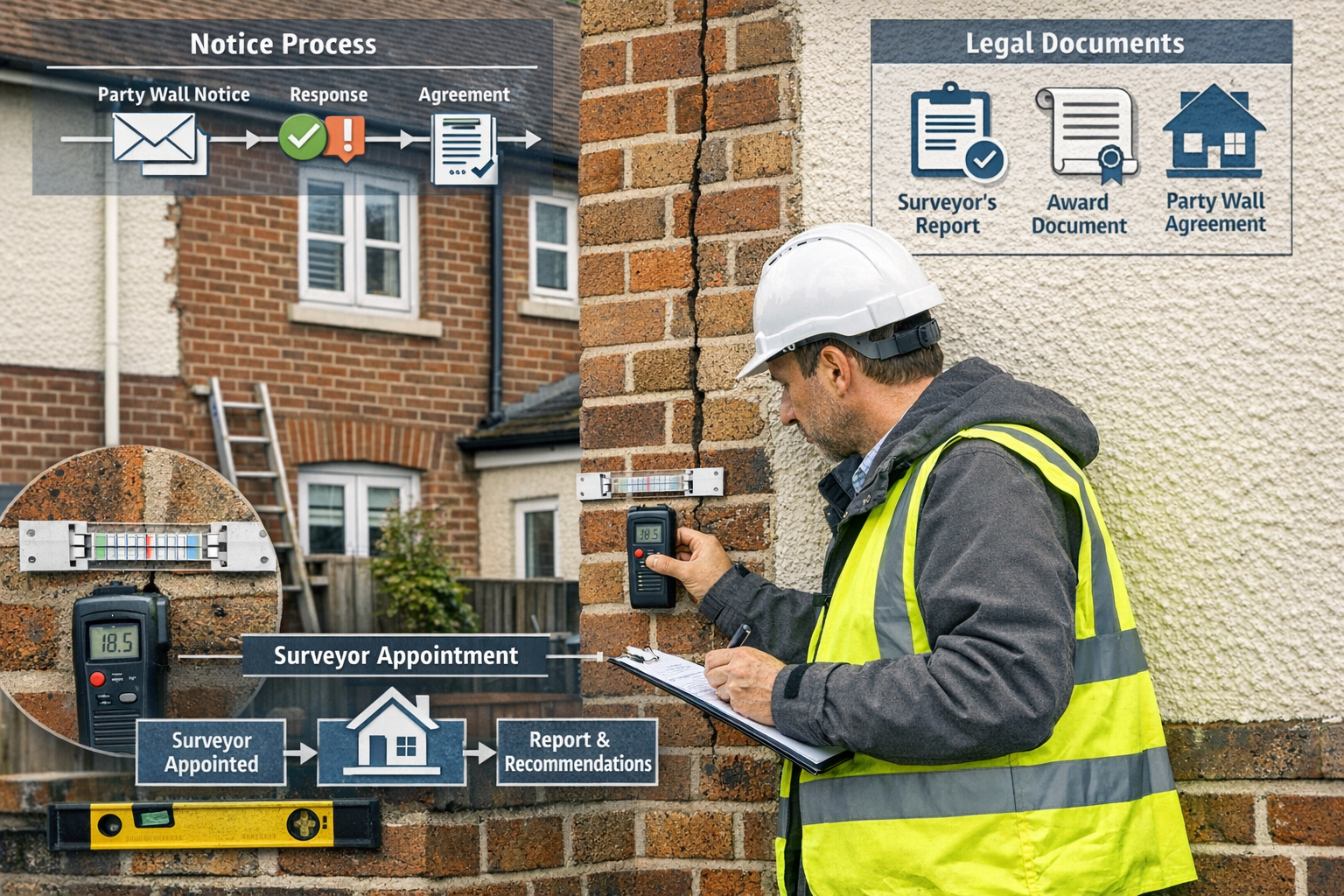
Semi detached party walls present unique challenges that differ from terraced properties or boundary walls. Understanding these distinctions helps you navigate your specific situation more effectively.
Structural Interdependence
Unlike terraced properties with support from multiple adjacent buildings, semi-detached homes rely heavily on the single party wall for:
- Lateral stability: The party wall braces both properties against wind loads
- Load distribution: Roof and floor loads transfer through the party wall
- Foundation continuity: Foundations typically run continuously beneath the party wall
This interdependence means any structural work requires extra care and thorough assessment.
Asymmetric Extensions and Alterations
A common scenario in semi-detached properties involves one owner extending while the other doesn’t:
Challenges this creates:
- Visual asymmetry affecting both properties’ appearance
- Potential planning permission complications
- Different roof levels creating weatherproofing challenges
- Unequal loading on the shared party wall
Solutions:
- Design extensions to minimize visual impact on the unextended property
- Ensure proper weatherproofing where roof levels differ
- Conduct structural analysis to confirm the party wall can handle new loads
- Consider future-proofing for potential matching extension by neighbour
Conversion from Single to Semi-Detached
Some properties were originally built as single detached homes and later subdivided:
⚠️ Important implications:
- Original construction may not meet party wall standards
- Fire resistance might be inadequate
- Sound insulation often requires upgrading
- Legal ownership boundaries may be unclear
If you’re dealing with a converted property, commission a thorough survey to identify any deficiencies that need addressing.
Modern Building Standards vs. Older Construction
Semi detached party walls built in different eras have varying characteristics:
| Era | Typical Construction | Common Issues |
|---|---|---|
| Pre-1919 | Solid brick (9-inch minimum) | Lack of cavity, poor damp-proofing, settlement |
| 1919-1945 | Solid brick or early cavity | Weak mortar, no wall ties, limited insulation |
| 1945-1980 | Cavity wall construction | Corroded wall ties, cavity fill issues |
| Post-1980 | Block and brick cavity | Generally sound, modern standards |
| Post-2000 | Engineered cavity systems | Excellent fire/sound rating, proper insulation |
Understanding your property’s construction era helps anticipate potential challenges when planning work.
Working with Professional Party Wall Surveyors
Engaging the right professional makes the difference between a smooth party wall process and a contentious nightmare. Here’s what you need to know about working with party wall surveyors.
What Does a Party Wall Surveyor Do?
Party wall surveyors perform several crucial functions:
Pre-work responsibilities:
- Review proposed works and assess party wall implications
- Prepare or review party wall notices
- Conduct condition surveys of both properties
- Draft the Party Wall Award with protective conditions
During construction:
- Monitor the works to ensure compliance with the Award
- Conduct periodic inspections
- Address any issues or variations that arise
- Mediate disputes between parties
Post-completion duties:
- Final inspection to confirm work completion
- Verify any making good has been properly executed
- Close out the Award and release any retained funds
Choosing the Right Surveyor
Essential qualifications to look for:
✓ RICS membership (Royal Institution of Chartered Surveyors)
✓ Specialist party wall experience (not just general surveying)
✓ Professional indemnity insurance (minimum £1 million)
✓ Local knowledge of your area and property types
✓ Good communication skills and responsiveness
Red flags to avoid:
❌ Builders or contractors offering to “handle the party wall stuff”
❌ Surveyors who guarantee they’ll approve all your plans
❌ Extremely low fees that seem too good to be true
❌ Lack of proper professional qualifications
❌ Poor reviews or complaints history
The Surveyor’s Duty of Impartiality
An important principle: even if you appoint and pay for a surveyor, they must act impartially. Their duty is to:
- Apply the Party Wall etc. Act 1996 correctly
- Protect both parties’ legitimate interests
- Make fair and reasonable determinations
- Act professionally regardless of who pays their fees
This impartiality protects everyone involved and ensures the process remains fair and legal.
Working with Notting Hill Surveyors
Professional surveying firms like Notting Hill Surveyors bring extensive experience to party wall matters. Their expertise covers:
- Comprehensive understanding of semi detached party wall issues
- Detailed condition surveys before and after works
- Expert drafting of Party Wall Awards
- Effective dispute resolution
- Professional monitoring throughout construction
Their team of specialists ensures your party wall matters are handled with the highest professional standards.
Preventive Measures and Best Practices
Proactive approaches to semi detached party wall management prevent problems before they arise. Implement these strategies to protect your interests and maintain positive neighbour relations.
Regular Maintenance and Inspection
Annual checks should include:
🔍 Visual inspection of the party wall from both sides
🔍 Crack monitoring to identify any new or widening cracks
🔍 Damp assessment for signs of water penetration
🔍 Structural soundness checking for bulging, leaning, or movement
Early detection of issues allows for timely repairs before they become serious problems.
Documentation and Record-Keeping
Maintain comprehensive records of all party wall matters:
Essential documents to keep:
- Original property deeds and plans
- All party wall notices (sent and received)
- Party Wall Awards and schedules of condition
- Correspondence with neighbours and surveyors
- Photographs documenting the wall’s condition over time
- Receipts for any maintenance or repair work
These records prove invaluable if disputes arise or when selling your property.
Communication with Neighbours
Good neighbour relations prevent many party wall disputes:
💬 Inform early: Tell your neighbour about planned works before formal notices
💬 Be transparent: Share your plans, timings, and how you’ll minimize disruption
💬 Listen actively: Address concerns respectfully and find reasonable compromises
💬 Keep updated: Provide regular progress updates during construction
💬 Be considerate: Minimize noise, dust, and inconvenience where possible
“The best party wall processes are those where neighbours work together cooperatively, with surveyors providing professional oversight rather than mediating disputes.”
Pre-Purchase Surveys
If you’re buying a semi-detached property, commission a thorough survey that specifically examines:
- The party wall’s structural condition
- Any signs of previous undisclosed party wall work
- Potential issues that might require future party wall procedures
- Whether any ongoing party wall matters exist
Understanding what surveyors look for helps you appreciate the value of comprehensive pre-purchase inspections.
Planning Ahead for Future Works
If you’re considering future alterations:
Strategic planning steps:
- Consult early with architects and structural engineers
- Identify party wall implications before finalizing designs
- Budget appropriately for all party wall costs
- Factor in timelines for notice periods and Award preparation
- Consider your neighbour’s perspective when designing works
This forward planning prevents costly redesigns and delays when you’re ready to proceed.
Legal Framework and Compliance
Understanding the legal context of semi detached party walls ensures you remain compliant and protected throughout any building project.
The Party Wall etc. Act 1996
This legislation governs all party wall matters in England and Wales (Scotland and Northern Ireland have different systems). The Act provides:
Key provisions:
- Right to undertake necessary works affecting party walls
- Obligation to serve proper notice before starting work
- Procedures for appointing surveyors and resolving disputes
- Protection for adjoining owners from damage or loss
- Enforcement mechanisms for non-compliance
Geographic coverage:
✓ Applies throughout England and Wales
✗ Does not apply in Scotland (different system)
✗ Does not apply in Northern Ireland (different system)
Building Regulations Compliance
Party wall procedures run parallel to, but separately from, Building Regulations:
Important distinctions:
| Party Wall Act | Building Regulations |
|---|---|
| Protects neighbours’ interests | Ensures safety and standards |
| Civil matter between parties | Statutory approval from council |
| Enforced through surveyors/courts | Enforced by Building Control |
| Focuses on impact on adjoining property | Focuses on construction quality |
You need BOTH party wall compliance and Building Regulations approval for most construction projects.
Planning Permission Considerations
Some works affecting semi detached party walls also require planning permission:
Typically requires planning:
- Significant extensions exceeding permitted development rights
- Alterations to listed buildings
- Works in conservation areas
- Changes to the external appearance visible from the street
Usually permitted development:
- Single-storey rear extensions (within size limits)
- Loft conversions (within parameters)
- Internal alterations with no external changes
Always check with your local planning authority before assuming work is permitted development.
Consequences of Non-Compliance
Failing to follow proper party wall procedures can result in:
⚠️ Injunctions stopping your work immediately
⚠️ Retrospective costs for surveys and Awards (often higher)
⚠️ Compensation claims from your neighbour for damage
⚠️ Legal costs if disputes reach court
⚠️ Difficulty selling your property if work wasn’t properly documented
The cost and hassle of non-compliance far exceed the expense of doing things correctly from the start.
Case Studies: Real-World Semi Detached Party Wall Scenarios
Learning from real situations helps you understand how party wall principles apply in practice. Here are common scenarios involving semi detached party walls.
Case Study 1: Loft Conversion with Beam Installation
Scenario:
Sarah wanted to convert her loft, requiring a steel beam to be inserted into the party wall for structural support.
Process:
- Architect designed the conversion, identifying party wall implications
- Sarah served a party wall notice on her neighbour two months before planned start
- Neighbour appointed their own surveyor (Sarah paid both surveyors’ fees)
- Surveyors prepared a Party Wall Award specifying protective measures
- Condition survey documented existing state of both properties
- Work proceeded with periodic surveyor inspections
- Final inspection confirmed no damage occurred
Outcome:
Total party wall costs: £2,400 (two surveyors plus monitoring). Work completed without disputes, and both neighbours maintained good relations.
Key lesson: Early planning and professional guidance prevented problems despite the intrusive nature of the work.
Case Study 2: Rear Extension Near Party Wall
Scenario:
James planned a single-storey rear extension with foundations within 2.5 metres of the party wall and deeper than the existing foundations.
Process:
- Initial designs didn’t account for party wall requirements
- Structural engineer identified the excavation would trigger the Act
- James served notice one month before starting excavation work
- Neighbour consented in writing after seeing the plans
- Despite consent, James engaged an agreed surveyor for protection
- Surveyor prepared a simple Award and conducted three inspections
- Minor crack appeared during work, quickly addressed and made good
Outcome:
Total party wall costs: £900 (agreed surveyor). Small crack was repaired at James’s expense (£350). Work completed successfully with documented evidence of proper procedures.
Key lesson: Even with neighbour consent, professional surveyor involvement provides valuable protection for both parties.
Case Study 3: Basement Excavation Dispute
Scenario:
Michael planned a basement excavation requiring underpinning of the party wall. His neighbour, Patricia, strongly objected due to concerns about structural damage.
Process:
- Michael served proper notice despite knowing Patricia would object
- Patricia immediately dissented and appointed her own surveyor
- Michael appointed his surveyor (both RICS qualified party wall specialists)
- Surveyors conducted detailed structural assessments
- Party Wall Award included extensive monitoring and protective measures
- Work proceeded with weekly inspections by both surveyors
- Minor settlement occurred but was within predicted parameters
- All making good completed to Patricia’s surveyor’s satisfaction
Outcome:
Total party wall costs: £5,200 (two surveyors, extensive monitoring, third-party structural engineer input). No damage compensation required. Despite initial tension, proper procedures protected both parties.
Key lesson: The party wall framework allows necessary work to proceed even when neighbours object, provided proper safeguards are in place.
Frequently Asked Questions About Semi Detached Party Walls
Can I paint or decorate my side of the party wall without notice?
Yes. Purely cosmetic work such as painting, wallpapering, or hanging pictures doesn’t require party wall notice. You’re free to decorate your side of the wall as you wish.
What if my neighbour starts work without serving notice?
Contact them immediately in writing, explaining the legal requirement for notice. If they continue, you can:
- Appoint a surveyor to protect your interests (at their expense)
- Seek an injunction to stop the work
- Claim compensation for any damage
Document everything with photographs and written records.
Do I need party wall procedures for minor repairs?
It depends. Simple repairs like repointing or replacing a few bricks typically don’t require formal procedures. However, more extensive repairs, especially those affecting structural integrity, do require notice. When in doubt, consult a surveyor.
How long does the party wall process take?
Typical timeline:
- Notice period: 2 months (for party structure works) or 1 month (for excavations)
- Surveyor appointment: 1-2 weeks
- Award preparation: 2-4 weeks
- Total: Approximately 3-4 months from first notice to starting work
Plan accordingly when scheduling your project.
Can my neighbour demand I pay for improvements to their property?
No. You’re only obligated to:
- Make good any damage your work causes
- Return the property to its previous condition
- Pay for protective measures and monitoring
You’re not required to improve or upgrade your neighbour’s property beyond addressing damage you caused.
What happens if I sell my property during party wall works?
The Party Wall Award typically binds the property rather than the individual owner. The obligations transfer to the new owner, but:
- Disclose all ongoing party wall matters to potential buyers
- Provide copies of all notices and Awards
- Ensure the buyer understands their obligations
- Consider delaying completion until works finish
Failure to disclose can lead to legal complications and potential claims.
Is party wall insurance necessary?
While not legally required, party wall insurance can provide valuable protection:
Coverage typically includes:
- Legal costs if disputes arise
- Surveyor fees (sometimes)
- Compensation claims from neighbours
- Emergency repairs if damage occurs
Policies cost approximately £100-£300 annually and may be worthwhile for complex projects.
Conclusion: Protecting Your Interests with Semi Detached Party Walls
Understanding your semi detached party wall rights and responsibilities isn’t just about legal compliance—it’s about protecting your most significant investment while maintaining harmonious relationships with those who share your property boundary.
Key Actions to Take Now
If you’re planning building work:
- ✅ Identify party wall implications early in your design process
- ✅ Budget for all party wall costs (typically £1,500-£3,000 for standard projects)
- ✅ Engage qualified party wall surveyors before serving notices
- ✅ Communicate openly with your neighbour from the outset
- ✅ Allow sufficient time for the full party wall process (3-4 months)
If you’ve received a party wall notice:
- ✅ Respond within 14 days (consent or dissent)
- ✅ Appoint your own surveyor to protect your interests (at your neighbour’s expense)
- ✅ Request a comprehensive condition survey before work starts
- ✅ Ensure the Party Wall Award includes adequate protective measures
- ✅ Stay engaged throughout the process with regular updates
For ongoing property ownership:
- ✅ Maintain your party wall in good condition
- ✅ Document its current state with photographs
- ✅ Address any defects promptly before they worsen
- ✅ Keep all party wall records organized and accessible
- ✅ Build positive relationships with your neighbours
The Value of Professional Guidance
While party wall procedures may seem complex, professional surveyors make the process manageable and protect all parties involved. Whether you’re the building owner undertaking work or the adjoining owner affected by your neighbour’s project, expert guidance ensures:
- ⚖️ Fair and legally compliant procedures
- 🛡️ Protection of your property’s structural integrity
- 💰 Appropriate allocation of costs and responsibilities
- 📋 Comprehensive documentation for future reference
- 🤝 Maintained or improved neighbour relations
The team at Notting Hill Surveyors brings decades of combined experience to party wall matters, ensuring your interests are protected throughout any building project affecting your semi detached party wall.
Moving Forward with Confidence
Party wall legislation exists to balance the rights of property owners to improve their homes with the rights of neighbours to protection from damage and disruption. By understanding these principles and following proper procedures, you can undertake necessary building work with confidence, knowing that all parties’ interests are properly safeguarded.
Don’t let party wall requirements become an obstacle to your property plans. With proper planning, professional guidance, and open communication, the party wall process becomes a straightforward aspect of your project rather than a source of stress and conflict.
Take the next step: If you’re planning work affecting your semi detached party wall or have received notice of your neighbour’s plans, contact qualified party wall surveyors today to discuss your specific situation and ensure full compliance with all legal requirements.
