
Property disputes arising from construction work cost UK homeowners an average of £12,000 to resolve in court—yet most could be prevented with a single document prepared before the first shovel breaks ground. As construction activity surges across England and Wales in 2026, the humble Schedule of Condition has become the most powerful shield against spurious damage claims and costly litigation.
Schedules of Condition in Party Wall Works: Best Practices to Prevent Post-Construction Claims in 2026 represents a critical documentation process that protects both building owners and adjoining property owners during construction projects. This comprehensive guide explores the essential strategies, digital tools, and inspection methodologies that create bulletproof evidence of pre-existing conditions—transforming potential disputes into straightforward comparisons.
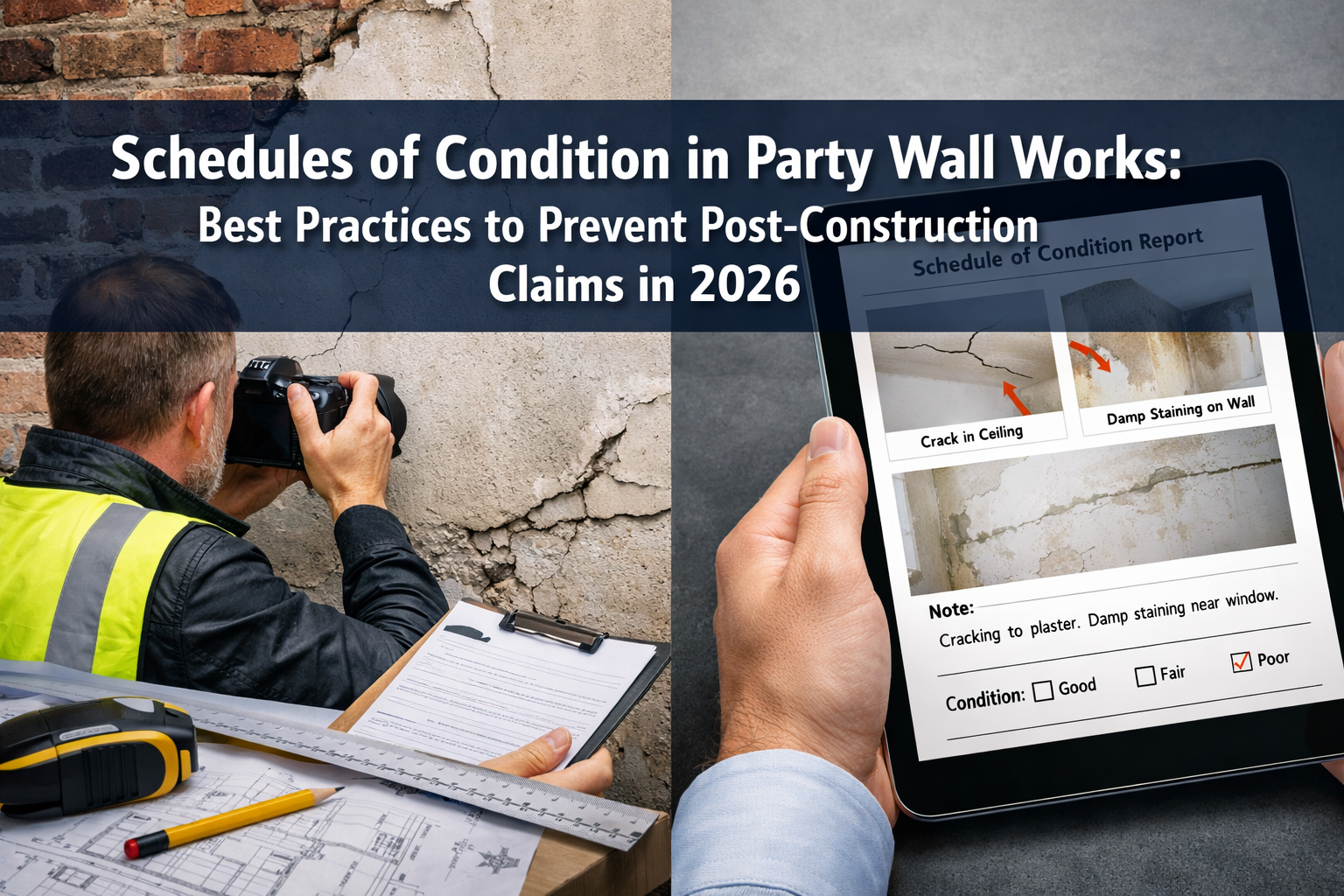
Key Takeaways
- 📸 Pre-works documentation is mandatory: Schedules of Condition must be prepared before any notifiable works begin under the Party Wall etc. Act 1996 to establish baseline property conditions
- ⚖️ Legal protection for all parties: Proper schedules protect building owners from false claims while ensuring adjoining owners receive compensation for genuine damage
- 🔍 Comprehensive coverage required: Both internal and external areas must be thoroughly documented, including walls, ceilings, floors, drainage, and structural elements
- 📱 Digital tools enhance accuracy: Modern photography, timestamping, and cloud-based documentation systems create more reliable and defensible records in 2026
- ⏱️ Timing determines success: Schedules must be completed before works commence and repeated after completion to enable clear before-and-after comparisons
Understanding Schedules of Condition in Party Wall Works
A Schedule of Condition serves as an independent, photographic record of an adjoining owner's property condition before construction work begins. Under the Party Wall etc. Act 1996, which applies exclusively to England and Wales, this documentation becomes the cornerstone of fair dispute resolution.[3]
What Makes a Schedule of Condition Legally Robust?
The legal strength of a Schedule of Condition depends on several critical factors:
Comprehensive Coverage: The inspection must document all areas potentially affected by the proposed works. This includes both obvious locations near the party wall and less apparent areas that might experience vibration damage or settlement.[1]
Professional Impartiality: Schedules prepared by qualified party wall surveyors carry significantly more weight than those created by builders or property owners themselves. The surveyor's professional indemnity insurance and RICS accreditation add credibility to the documentation.
Timestamped Evidence: Every photograph and observation must be clearly dated and linked to the specific property address. In 2026, digital timestamps embedded in image metadata provide additional verification that documentation occurred before works commenced.
Detailed Descriptions: Photographs alone aren't sufficient. Each image requires accompanying written descriptions that specify the exact location, existing defects, and condition ratings using standardized terminology.[2]
Statutory Requirements Under the Party Wall Act
The Party Wall etc. Act 1996 mandates that building owners serve proper notice to adjoining owners before commencing notifiable works. Common triggering activities include:
- Loft conversions that affect the party wall structure
- Excavation works within three or six metres of a neighbouring property (depending on depth)
- Insertion of damp proof courses into existing party walls
- New wall construction at boundary lines
- Structural alterations to existing party walls[3]
When serving party wall notices, building owners must allow two months for works affecting party walls or boundaries, and one month for excavation work.[3] During this period, the Schedule of Condition should be commissioned and completed.
The Risk of Proceeding Without Proper Documentation
Without an independent expert Schedule of Condition produced before building work starts, establishing which damage resulted from construction becomes extraordinarily difficult.[3] This uncertainty creates several serious risks:
⚠️ Injunction Risk: Neighbours may apply for a party wall injunction to halt work entirely until proper notices are served and documentation completed.[3]
💰 Unlimited Liability: Building owners may find themselves liable for pre-existing damage they didn't cause, simply because no baseline evidence exists to prove the damage predated their works.
⏳ Project Delays: Disputes without clear documentation typically require lengthy negotiations, expert assessments, and potentially court proceedings—all of which delay project completion.
🔨 Relationship Breakdown: The absence of objective evidence transforms technical discussions into accusatory arguments between neighbours, permanently damaging relationships.
For comprehensive guidance on the legal framework, review our complete guide to the Party Wall Act.
Best Practices for Creating Comprehensive Schedules of Condition in 2026
The effectiveness of Schedules of Condition in Party Wall Works: Best Practices to Prevent Post-Construction Claims in 2026 hinges on meticulous preparation, systematic inspection, and thorough documentation. Modern technology has revolutionized this process, but fundamental principles remain unchanged.
Pre-Inspection Planning and Risk Assessment
Before conducting the physical inspection, experienced party wall surveyors must thoroughly analyze the building owner's proposed plans to identify which areas of the adjoining owner's property face the greatest risk.[1] This strategic approach ensures no vulnerable area goes undocumented.
Risk Mapping Process:
- Review construction drawings to understand excavation depths, structural alterations, and load transfers
- Identify vibration-sensitive areas such as ornamental plasterwork, period features, or recently repaired sections
- Assess proximity factors to determine which rooms and external elements require detailed documentation
- Consider historical issues such as previous subsidence, drainage problems, or structural repairs
- Plan photographic angles to ensure consistent before-and-after comparisons
Internal Areas Requiring Documentation
The internal inspection must capture comprehensive evidence of condition throughout potentially affected spaces. Key areas include:
| Internal Element | Documentation Requirements | Common Pre-Existing Issues |
|---|---|---|
| Ceilings | Photograph all corners, center, and junctions with walls; note cracks, staining, or sagging | Hairline cracks at corners, historic water damage, plaster deterioration |
| Walls | Document party walls and perpendicular walls; measure crack widths; note decoration condition | Settlement cracks, nail holes, wallpaper lifting, damp patches |
| Windows | Photograph frames, glass, and opening mechanisms; test operation | Paint deterioration, minor cracks in glass, stiff operation |
| Doors | Document frames, panels, and hardware; check alignment | Sticking, minor frame damage, hardware wear |
| Floors | Note levelness, surface condition, and any movement or squeaking | Uneven boards, minor deflection, surface wear |
| Staircases | Check for movement, cracks in plaster beneath, handrail condition | Creaking, minor plaster cracks, loose balusters |
External Areas and Structural Elements
External documentation proves equally critical, as many construction-related issues manifest on building exteriors:
Roof and Chimneys: Photograph roof slopes, ridge lines, flashing details, and chimney stacks from multiple angles. Document existing slipped tiles, cracked pointing, or leaning chimneys.[1]
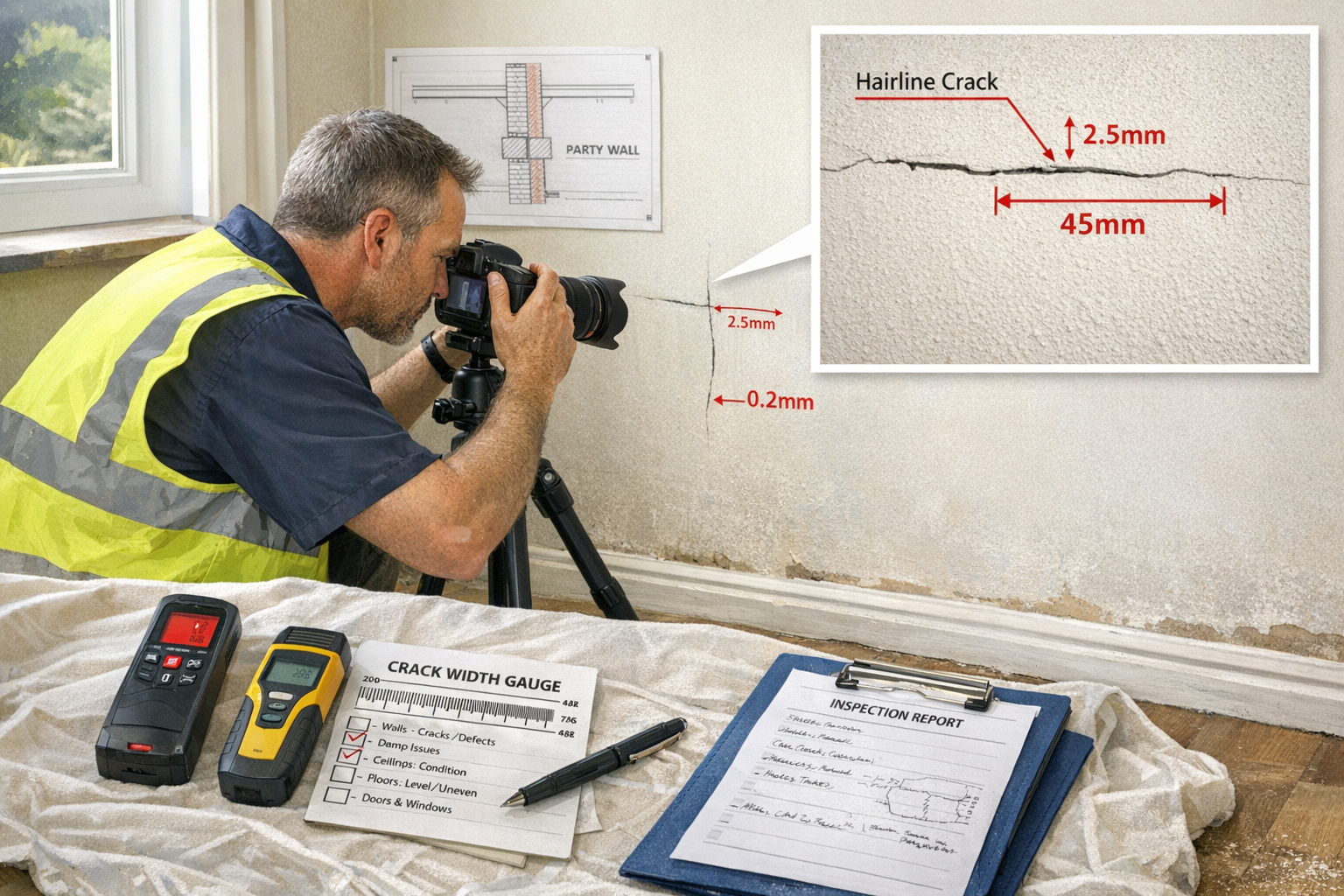
External Walls: Capture full elevations and close-ups of brickwork, render, or cladding. Measure and photograph any existing cracks, noting their width, length, and orientation. Document pointing condition and any previous repairs.
Windows and Doors: Record external frames, sills, and lintels. Note any existing cracks radiating from corners—a common indicator of historic settlement.
Drainage Systems: Photograph gullies, inspection chambers, and visible pipework. Note any existing blockages, cracks, or poor falls that might be incorrectly attributed to construction work.
Ground Levels and Paving: Document existing settlement, cracking in paving or paths, and the relationship between ground levels and damp proof courses.
Photography Standards and Digital Documentation
In 2026, digital photography has become the primary evidence medium for Schedules of Condition. However, not all photographic documentation provides equal protection:
📷 Essential Photography Standards:
- Resolution: Minimum 12 megapixels to allow detailed zooming during dispute analysis
- Lighting: Natural daylight preferred; supplementary flash for dark areas to reveal detail
- Scale references: Include measuring tape or scale card in close-up defect photographs
- Multiple angles: Capture each room or elevation from at least three viewpoints
- Systematic coverage: Work methodically room-by-room or elevation-by-elevation to avoid omissions
- Metadata preservation: Ensure camera date/time settings are accurate and GPS tagging is enabled
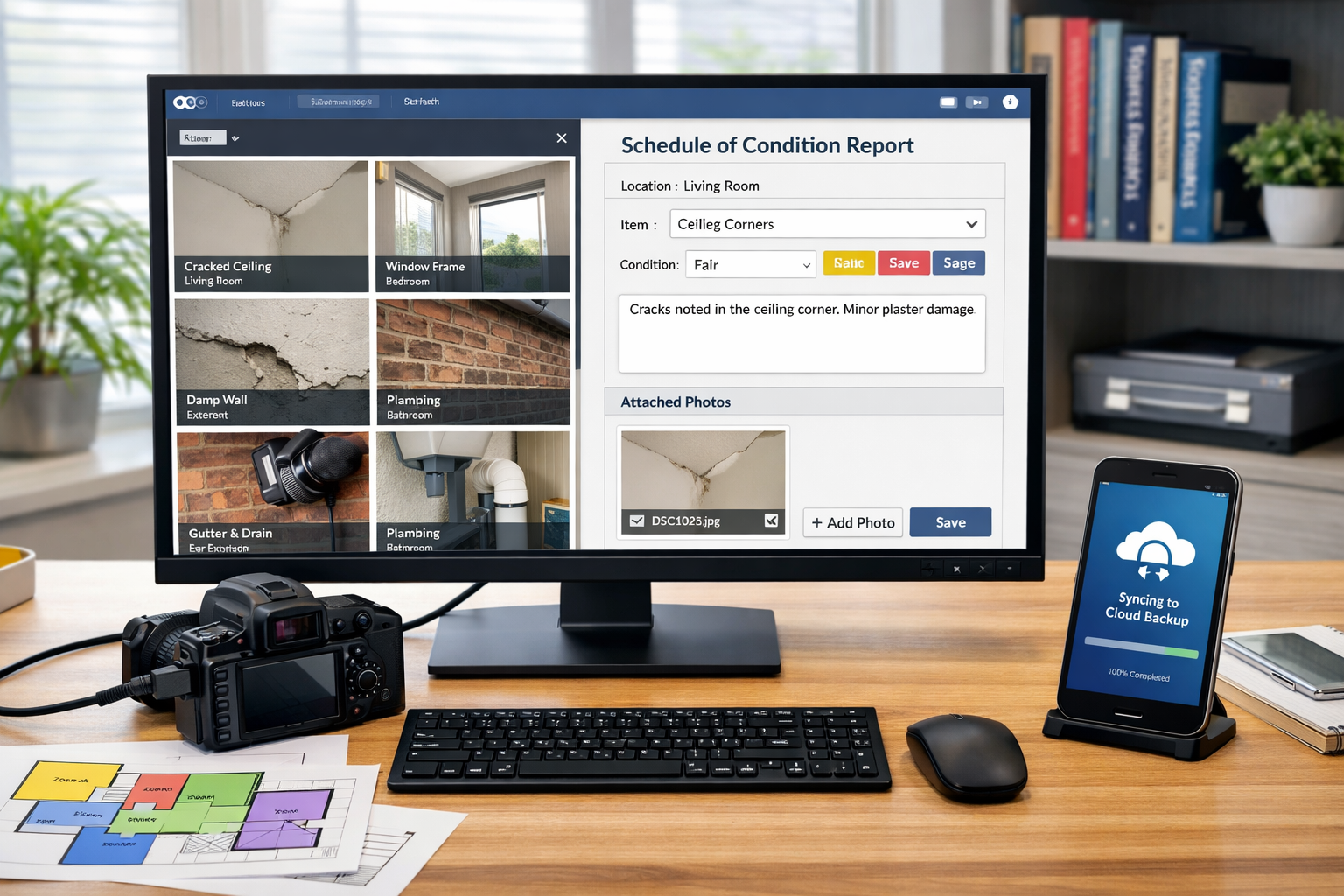
- Backup protocols: Upload images to cloud storage immediately to prevent loss
Modern Digital Tools Enhancing Accuracy:
- 360-degree cameras capture entire room conditions in single images, eliminating coverage gaps
- Laser measurement devices provide precise crack width and room dimension data
- Moisture meters identify hidden damp issues that might worsen during construction
- Drone photography documents roof conditions and upper-level elevations safely and comprehensively
- Dedicated survey apps streamline annotation, organization, and report generation
For professional schedule of condition reports, these technological advances create more defensible documentation while reducing inspection time.
Written Descriptions and Condition Ratings
Photographs require context. Each documented area needs accompanying written descriptions using standardized terminology:
Condition Rating Scale:
- Excellent: As new or recently refurbished with no defects
- Good: Well-maintained with only minor wear consistent with age
- Fair: Functional but showing age-related deterioration or minor defects
- Poor: Significant defects present requiring attention
- Very Poor: Serious defects requiring urgent repair
Written descriptions should specify:
✍️ Exact location (e.g., "First floor rear bedroom, northeast corner, ceiling/wall junction")
✍️ Defect type and dimensions (e.g., "Diagonal hairline crack, 450mm length, <0.5mm width")
✍️ Apparent age and cause (e.g., "Historic settlement crack, stable, previously filled")
✍️ Decoration condition (e.g., "Emulsion paint, good condition, no recent redecoration evident")
This combination of visual and written evidence creates documentation that withstands scrutiny during party wall award negotiations or legal proceedings.
Post-Construction Documentation
A Schedule of Condition's protective value only materializes when post-works documentation occurs. After the building owner's works are completed, a second inspection must be undertaken to identify whether any damage has occurred to the adjoining property as a result of the building works.[1]
Post-Works Inspection Protocol:
- Replicate photography angles using pre-works images as reference to enable direct comparison
- Document any new defects with the same photographic and written standards
- Distinguish new from pre-existing damage by comparing against baseline documentation
- Measure progression of any pre-existing cracks to determine if construction caused worsening
- Prepare comparison report showing before-and-after images side-by-side with analysis
This systematic comparison transforms subjective arguments into objective evidence, enabling fair resolution of legitimate claims while dismissing unfounded allegations.
Preventing Post-Construction Claims Through Strategic Documentation
The ultimate purpose of Schedules of Condition in Party Wall Works: Best Practices to Prevent Post-Construction Claims in 2026 extends beyond mere record-keeping—it's about creating an evidentiary framework that prevents disputes from arising and resolves those that do quickly and fairly.
Common Claim Scenarios and How Proper Documentation Prevents Them
Scenario 1: The "New" Crack That Wasn't
A neighbour claims construction vibration caused a ceiling crack. Without a Schedule of Condition, the building owner faces an uphill battle proving the crack existed beforehand. With comprehensive pre-works documentation showing the identical crack with measurements, the claim is immediately dismissed.
Protection Strategy: Photograph all existing cracks from multiple angles with scale references. Measure and record width, length, and orientation. Include close-ups showing crack characteristics (clean edges indicating age, previous filler, etc.).
Scenario 2: Pre-Existing Drainage Issues Blamed on Excavation
Following foundation work, a neighbour reports drainage problems and attributes them to ground disturbance. Proper pre-works documentation showing existing poor falls, partially blocked gullies, or cracked inspection chambers proves the issues predated construction.
Protection Strategy: Test drainage flow during pre-works inspection. Photograph water levels in chambers. Document any existing blockages, cracks, or poor installation evident before works commence.
Scenario 3: Historic Settlement Attributed to New Basement
Basement excavation often triggers accusations of causing settlement. However, Victorian and Edwardian properties commonly exhibit historic settlement cracks. Detailed pre-works documentation distinguishing these from any new movement protects building owners from unfair liability.
Protection Strategy: Photograph all existing cracks with particular attention to stepped cracking in brickwork, diagonal cracks from window corners, and ceiling/wall junction separation. Measure crack widths precisely. Note evidence of previous repairs indicating long-standing issues.
The Role of Agreed Surveyors in Documentation
Both building owners and adjoining owners can appoint a single agreed surveyor who acts impartially for both parties, typically within ten days of notice being served.[3] This arrangement offers significant advantages for Schedule of Condition preparation:
Benefits of Agreed Surveyor Approach:
- ✅ Cost efficiency: Single professional fee rather than two separate surveyors
- ✅ Reduced conflict: Impartial documentation accepted by both parties from the outset
- ✅ Streamlined process: Faster inspection scheduling and report delivery
- ✅ Enhanced credibility: Independent professional status strengthens evidential weight
When selecting surveyors, ensure they possess:
- RICS accreditation and party wall specialization
- Professional indemnity insurance covering party wall work
- Experience with similar property types and construction projects
- Modern documentation equipment and methodologies
- Clear communication skills for explaining findings to non-technical clients
Our guide to party wall surveyors' roles and costs provides detailed selection criteria.
Integrating Schedules into Party Wall Awards
The Schedule of Condition should be formally incorporated into the party wall award as an appendix or schedule. This integration ensures:
🔒 Legal enforceability: The schedule becomes part of the binding agreement between parties
🔒 Clear reference point: All parties acknowledge the documented baseline condition
🔒 Dispute resolution framework: The award can specify how post-works comparisons will be conducted and claims assessed
🔒 Cost allocation clarity: The award should address who bears responsibility for post-works inspection costs
Digital Archive Management and Long-Term Storage
Construction projects may take months or years to complete. During this period, and potentially for years afterward, Schedule of Condition documentation must remain accessible and intact:
Best Practice Storage Protocols:
- Cloud backup: Upload all images and reports to secure cloud storage immediately after inspection
- Multiple copies: Maintain copies with the surveyor, building owner, and adjoining owner
- Format preservation: Save images in original high-resolution format; also create PDF reports for easy sharing
- Metadata protection: Avoid editing original images, which can corrupt timestamp metadata
- Version control: Clearly label pre-works and post-works documentation with dates
- Access protocols: Establish who can access documentation and under what circumstances
In 2026, blockchain-based timestamping services offer additional verification that documentation hasn't been altered after creation—an emerging best practice for high-value or contentious projects.
When Claims Arise Despite Documentation
Even with comprehensive Schedules of Condition, disputes occasionally arise. Proper documentation transforms these situations:
Resolution Process with Robust Documentation:
Step 1: Adjoining owner raises concern about potential damage
Step 2: Building owner's surveyor retrieves pre-works Schedule of Condition
Step 3: Joint inspection conducted comparing current condition to baseline documentation
Step 4: Side-by-side photographic comparison prepared showing identical angles
Step 5: Analysis determines whether damage is new, pre-existing, or represents progression of existing defects
Step 6: If new damage confirmed, building owner accepts liability and arranges repairs; if damage was pre-existing, evidence dismisses claim
This systematic approach typically resolves disputes within days rather than months, saving both parties significant legal costs and stress.
Cost Considerations and Value Proposition
Building owners sometimes question the cost of commissioning professional Schedules of Condition. Understanding the value proposition clarifies why this documentation represents essential insurance rather than optional expense:
Typical Schedule of Condition Costs (2026):
- Small terraced house: £350-£600
- Semi-detached house: £500-£800
- Large detached house: £800-£1,200
- Multiple adjoining properties: £400-£700 per additional property
Compare Against Dispute Costs:
- Legal representation: £3,000-£10,000+
- Expert witness fees: £2,000-£5,000
- Court costs: £1,000-£3,000
- Repair costs for disputed damage: £2,000-£15,000
- Project delays: Potentially tens of thousands in holding costs
The Schedule of Condition typically costs less than 1% of most construction projects while eliminating the risk of disputes costing 10-20% or more of project value.
For detailed cost breakdowns, see our analysis of who pays for party wall surveyors.
Conclusion
Schedules of Condition in Party Wall Works: Best Practices to Prevent Post-Construction Claims in 2026 represents far more than bureaucratic box-ticking—it's the foundation of fair, evidence-based dispute prevention and resolution. As construction activity intensifies across England and Wales, the properties most protected are those where building owners invested in comprehensive pre-works documentation.
The best practices outlined in this guide—systematic risk assessment, comprehensive internal and external photography, standardized condition ratings, digital documentation tools, and post-works comparison—create an impenetrable shield against spurious claims while ensuring legitimate damage receives appropriate compensation.
Actionable Next Steps
For building owners planning construction work in 2026:
- Serve proper party wall notices at least two months before works commence (one month for excavation only)
- Commission a qualified party wall surveyor with RICS accreditation and modern documentation equipment
- Ensure Schedule of Condition completion before any construction work begins—no exceptions
- Incorporate the schedule into your party wall award as a formal appendix
- Maintain secure digital archives of all documentation with cloud backup
- Schedule post-works inspection immediately upon construction completion
- Address any legitimate damage promptly to maintain good neighbour relations
For adjoining owners receiving party wall notices:
- Respond within 14 days to avoid deemed consent
- Request Schedule of Condition inclusion in the party wall award if not already proposed
- Participate in the inspection to ensure all concerns are documented
- Keep your own photographic record as supplementary evidence
- Review the completed schedule carefully before accepting
The modest investment in professional Schedules of Condition delivers extraordinary returns by preventing disputes that could otherwise cost tens of thousands of pounds and destroy neighbour relationships. In 2026's active construction environment, this documentation isn't optional—it's essential protection for everyone involved.
By implementing these best practices, property owners transform party wall works from potential conflict zones into well-managed projects where all parties' interests receive appropriate protection through objective, comprehensive documentation.
References
[1] Schedule Of Condition – https://stokemont.com/advice/schedule-of-condition/
[2] Party Walls Specimen Schedule Of Condition – https://www.isurv.com/downloads/download/32/party_walls_specimen_schedule_of_condition
[3] Party Wall Agreement – https://hoa.org.uk/advice/guides-for-homeowners/i-am-improving/party-wall-agreement/
