
The Royal Institution of Chartered Surveyors (RICS) has fundamentally transformed professional practice: as of March 9, 2026, every RICS member and regulated firm worldwide must comply with the new Responsible Use of Artificial Intelligence in Surveying Practice standard.[3] This mandatory framework marks the first time a global surveying body has codified AI governance requirements, directly impacting how Level 3 building surveys are conducted, documented, and delivered to clients.
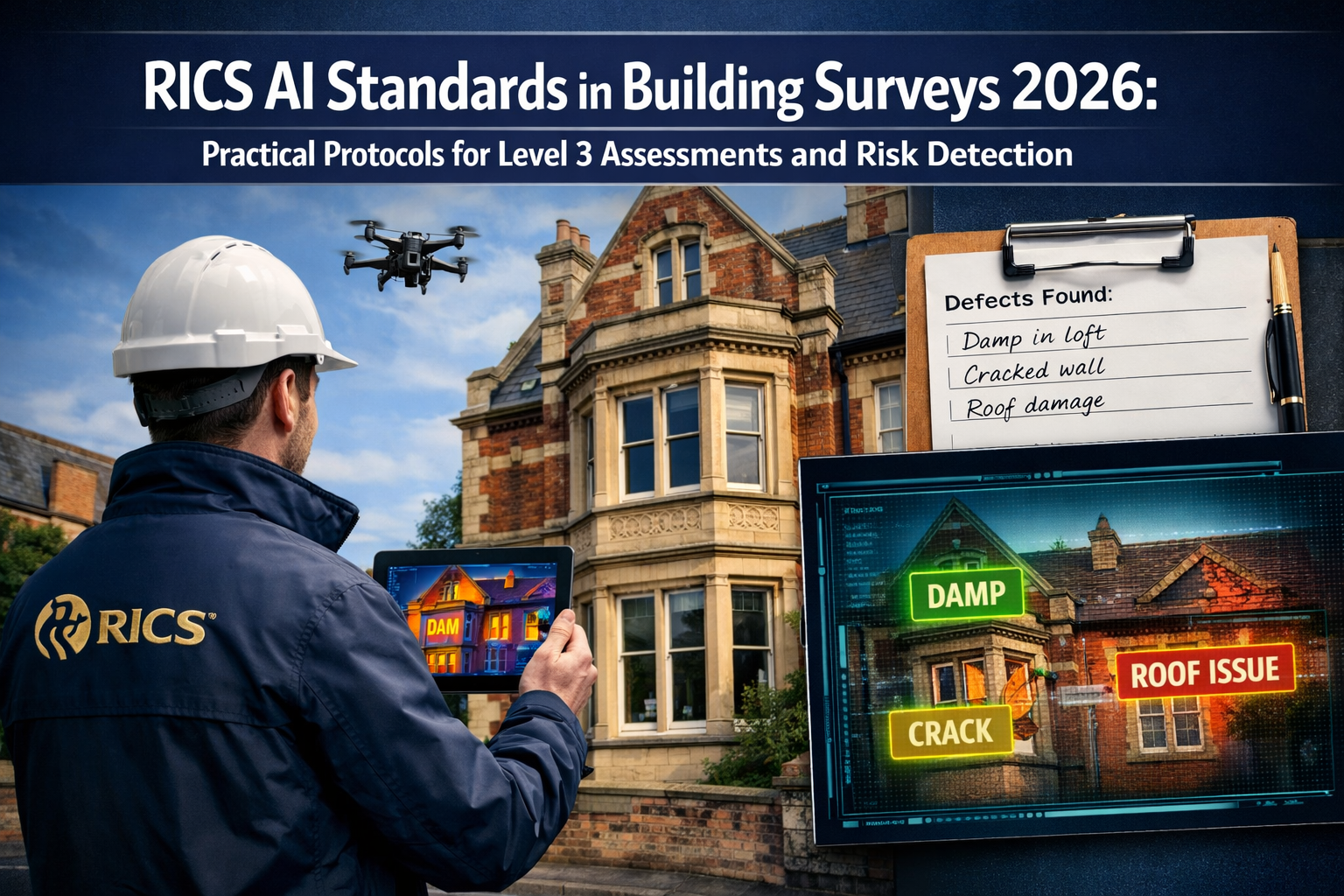
The RICS AI Standards in Building Surveys 2026: Practical Protocols for Level 3 Assessments and Risk Detection establish clear boundaries between AI assistance and professional judgment. For surveyors conducting comprehensive property inspections, these protocols require systematic documentation of AI tool usage, mandatory human verification of automated defect detection, and transparent client communication about technology deployment.[1] Whether analyzing structural movement, identifying damp patterns, or assessing construction defects, practitioners must now balance technological efficiency with regulatory compliance.
Key Takeaways
- Mandatory compliance deadline: All RICS members must implement AI governance frameworks, risk registers, and client disclosure protocols as of March 9, 2026[3]
- Human-in-the-loop requirement: AI can assist with defect detection and data analysis, but qualified surveyors must review, validate, and document all outputs before client delivery[1]
- Universal application scope: Standards apply across valuation, construction, land, and infrastructure services—including Level 3 surveys, party wall assessments, and specific defect investigations[1]
- Risk register mandate: Firms using AI must maintain written risk registers reviewed quarterly, logging every AI tool with documented due diligence[2]
- Client transparency obligation: Terms of engagement must explicitly state when and how AI supports service delivery, with written disclosure requirements[2]
Understanding the RICS AI Standards Framework for Building Surveys
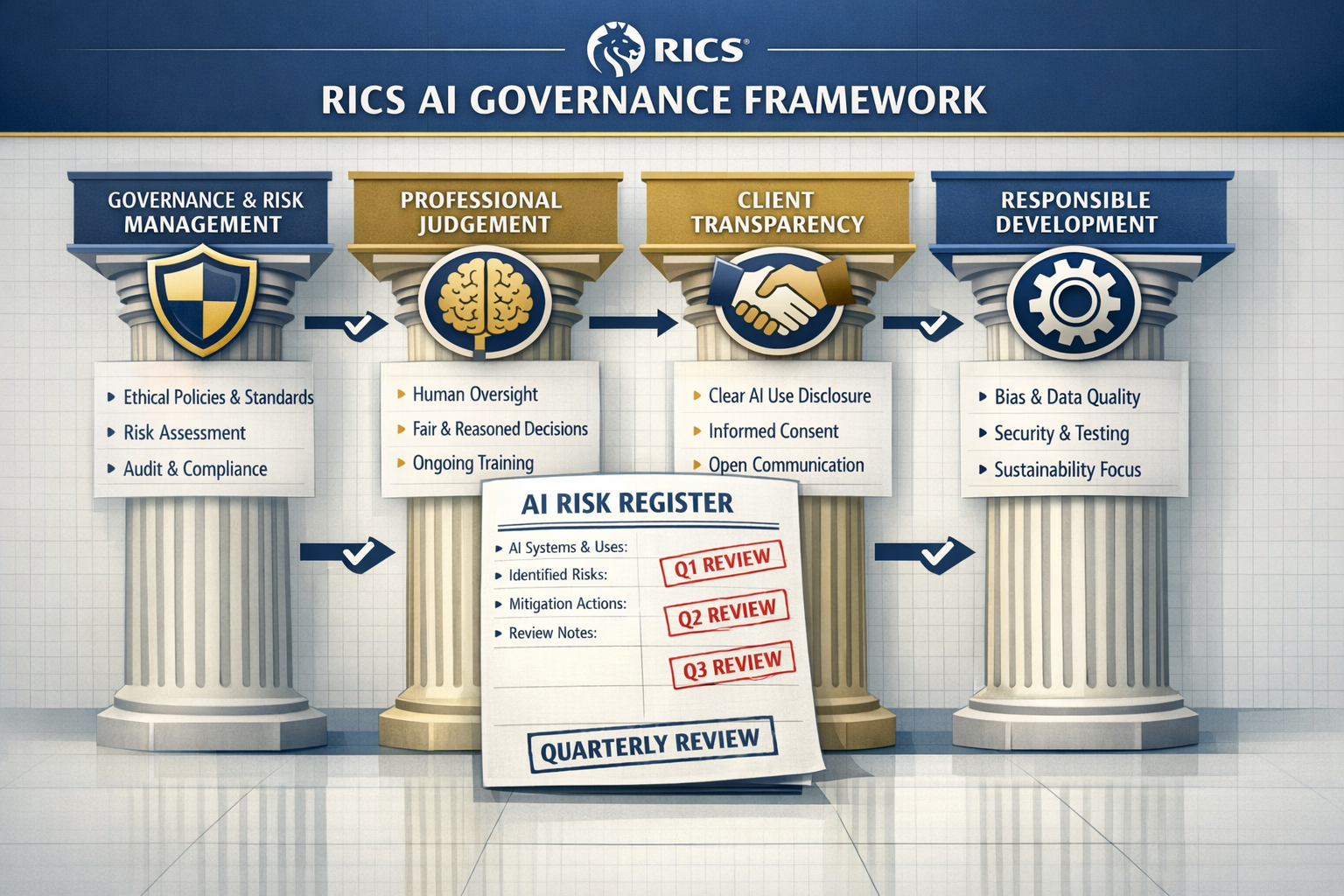
The RICS AI Standards in Building Surveys 2026: Practical Protocols for Level 3 Assessments and Risk Detection rest on four foundational pillars that govern how chartered surveyors integrate artificial intelligence into property assessments.[3]
Governance and Risk Management Requirements
Every surveying practice using AI—regardless of firm size—must establish formal governance policies that document AI tool selection, implementation, and monitoring processes.[1] This requirement extends beyond firms actively deploying AI systems; even practices not currently using artificial intelligence must demonstrate awareness and readiness, as many future software tools will incorporate AI capabilities without explicit labeling.[1]
The cornerstone of compliance is the AI risk register, a written document that must:
✅ Log every AI tool used in service delivery
✅ Document third-party AI system due diligence
✅ Undergo formal review at least quarterly
✅ Assess material impact on client outcomes
✅ Record risk mitigation strategies[2]
For Level 3 building survey practitioners, this means cataloging AI-powered thermal imaging software, automated crack detection algorithms, moisture pattern analysis tools, and any machine learning systems that support defect identification.
Professional Judgment and Human Oversight
The standard explicitly rejects autonomous AI decision-making in surveying practice. Professional judgment must remain central to all assessments, with qualified surveyors responsible for reviewing AI outputs for consistency, questioning anomalies, and documenting where professional skepticism has been applied.[1]
This "human-in-the-loop" model requires surveyors to:
🔍 Verify AI-generated defect classifications against physical inspection findings
🔍 Cross-reference automated measurements with manual validation
🔍 Challenge algorithmic risk assessments using professional experience
🔍 Document decision-making rationale when AI outputs are accepted or rejected
For example, when AI thermal imaging identifies potential moisture ingress in a Victorian property, the surveyor must physically inspect the area, consider historical construction methods, assess alternative explanations, and provide professional commentary beyond the algorithmic output. The comprehensive nature of Level 3 surveys demands this layered verification approach.
Transparency and Client Communication
Mandatory client disclosure represents a significant shift in professional practice. Terms of engagement must clearly set out when and how AI will be used to support service delivery, with written communication required before work commences.[2]
Clients must understand:
📋 Which specific AI tools will be deployed
📋 What aspects of the survey involve AI assistance
📋 How AI outputs are validated by human professionals
📋 Limitations of AI technology in property assessment
📋 Data handling and privacy protections
This transparency obligation extends to survey reports themselves. When AI contributes to defect detection, risk assessment, or data analysis, the final documentation should acknowledge this assistance while emphasizing the surveyor's professional validation and interpretation.
Data Governance and Quality Assurance
Robust data governance policies must safeguard private and confidential information when AI systems process client data, property details, or sensitive commercial information.[2] This requirement aligns with GDPR obligations but extends specifically to AI training data, algorithmic processing, and third-party AI service providers.
Quality assurance protocols must include:
⚙️ Staff training programs on AI tool capabilities and limitations
⚙️ Randomized dip-sampling of AI-assisted outputs
⚙️ Documented reliability assessments for material AI contributions
⚙️ Regular calibration checks against traditional survey methods
⚙️ Version control tracking for AI software updates[2]
For practices conducting various types of surveys, this means establishing differentiated quality assurance protocols based on survey complexity and AI involvement intensity.
Practical AI Applications in Level 3 Assessments and Risk Detection
The RICS AI Standards in Building Surveys 2026: Practical Protocols for Level 3 Assessments and Risk Detection provide specific guidance for integrating artificial intelligence into comprehensive property inspections while maintaining professional accountability.
AI-Enhanced Defect Detection in Building Fabric
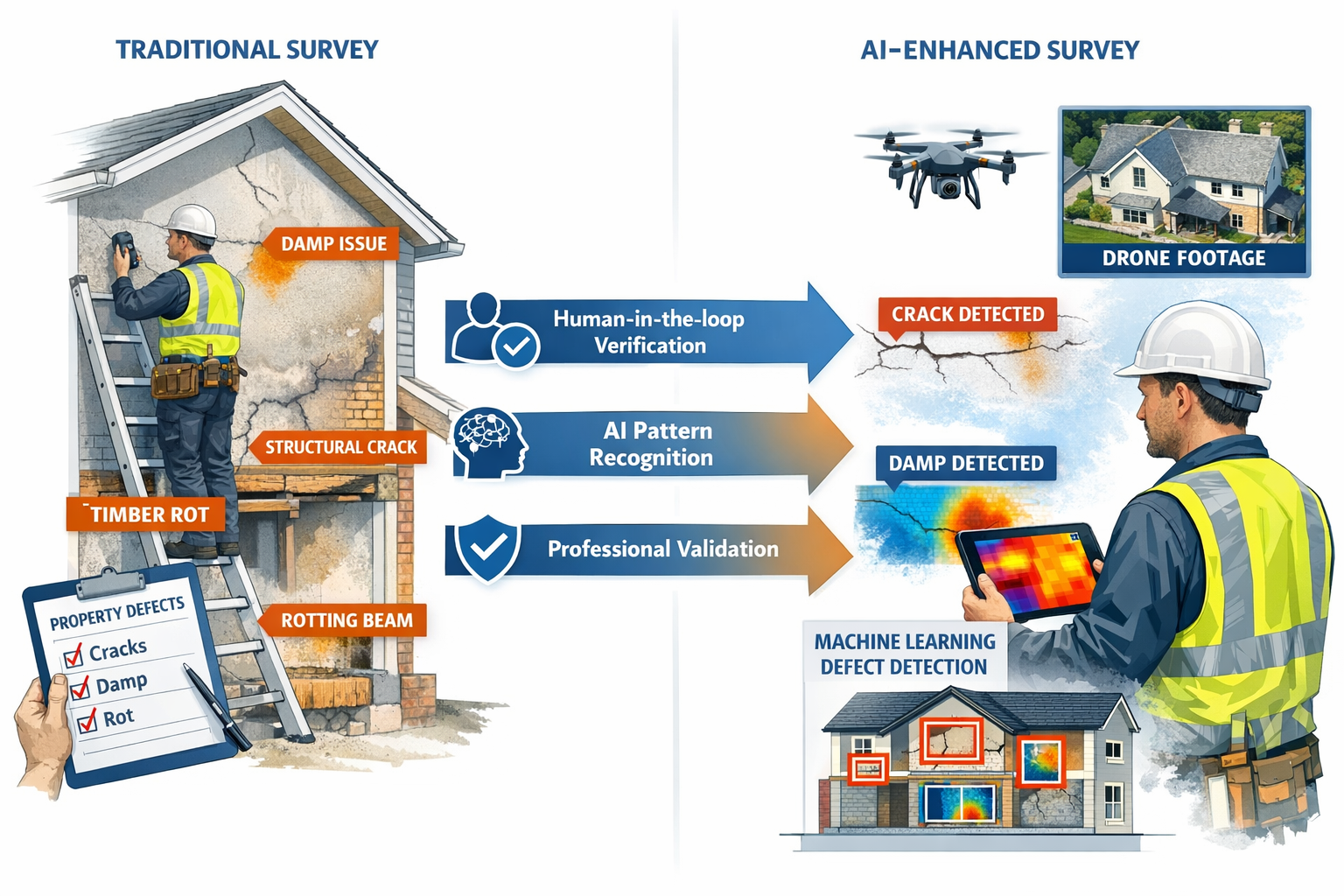
Modern AI systems excel at pattern recognition across large datasets, making them valuable tools for identifying structural defects, material deterioration, and construction anomalies. When properly deployed under the RICS framework, these technologies augment—but never replace—professional surveying expertise.
Thermal imaging analysis: AI algorithms can process infrared imagery to highlight temperature differentials indicating insulation gaps, moisture ingress, or thermal bridging. However, surveyors must validate these findings through physical inspection, considering factors like recent weather conditions, heating patterns, and building orientation that algorithms may misinterpret.
Crack pattern assessment: Machine learning models trained on thousands of structural defect images can classify crack severity, suggest potential causes (settlement, subsidence, thermal movement), and flag priority concerns. The surveyor's role involves verifying these classifications against building age, construction type, and site-specific factors—particularly important for subsidence investigations.
Moisture mapping: AI-powered moisture meters with spatial mapping capabilities can create comprehensive damp distribution patterns across building elements. Professional validation ensures these readings account for construction materials, environmental conditions, and potential false positives from dense materials or metallic components.
Drone-based facade inspection: Automated flight paths with AI image analysis can identify render defects, masonry deterioration, or roofing issues on tall or inaccessible structures. Surveyors must interpret these findings within the context of building history, maintenance records, and structural loading considerations.
Risk Prioritization and Report Generation
AI systems can assist with risk stratification, helping surveyors prioritize defects by severity, urgency, and potential cost implications. The RICS standard requires documentation of how these algorithmic risk assessments inform—but do not determine—professional recommendations.[1]
Automated defect categorization: AI can sort identified issues into condition ratings (1-3 scales), but surveyors must apply professional judgment to ensure categorization reflects property-specific context, client use intentions, and local market conditions relevant to what surveyors look for.
Cost estimation support: Machine learning models trained on repair cost databases can provide preliminary budget ranges for remedial works. These estimates require professional adjustment for regional pricing variations, access constraints, and specification requirements that algorithms cannot fully assess.
Report drafting assistance: Natural language processing tools can generate preliminary report sections from structured inspection data. However, surveyors must extensively edit, contextualize, and personalize these outputs to ensure accuracy, clarity, and professional tone appropriate for client needs.
AI Integration in Specialist Survey Types
The RICS AI standards apply across all surveying disciplines, requiring tailored implementation approaches for different assessment types.
Party wall surveys: AI-powered condition recording systems can document pre-works property conditions with photographic analysis and automated defect logging. Surveyors must ensure these records meet legal evidential standards and provide sufficient detail for potential dispute resolution, as outlined in party wall procedures.
Commercial building assessments: AI analysis of building management system data, energy consumption patterns, and maintenance records can inform commercial survey recommendations. Professional interpretation ensures these insights align with business operational requirements and regulatory compliance obligations.
Specific defect investigations: When conducting targeted defect surveys, AI diagnostic tools can accelerate root cause analysis by correlating symptoms across multiple data sources. Surveyors must validate these correlations through physical investigation and material testing.
Limitations and Professional Skepticism
The RICS framework explicitly requires surveyors to maintain professional skepticism toward AI outputs, recognizing inherent technological limitations:[1]
⚠️ Training data bias: AI models reflect the datasets used for training, potentially missing regional construction variations or historical building techniques
⚠️ Contextual blindness: Algorithms lack understanding of property history, previous alterations, or client-specific circumstances
⚠️ False confidence: AI systems may present incorrect conclusions with high confidence scores, requiring human verification
⚠️ Novel defect patterns: Unusual or rare building pathologies may fall outside AI training parameters
⚠️ Environmental variables: Weather conditions, seasonal factors, and temporary circumstances can confound automated analysis
Surveyors must document instances where professional judgment overrides AI recommendations, creating an audit trail that demonstrates compliance with the human oversight requirement.
Compliance Checklist: Implementing RICS AI Standards in Your Practice
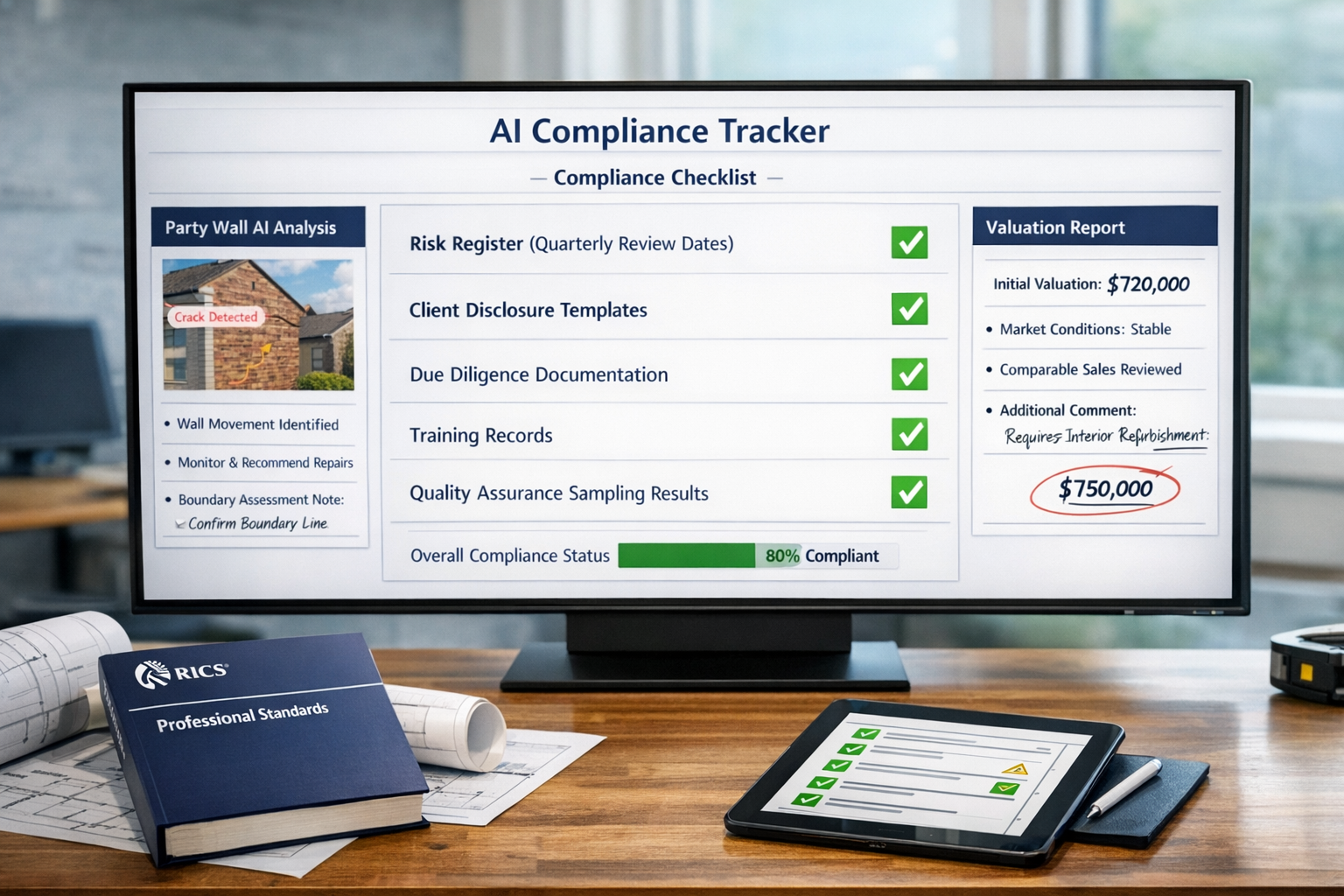
The RICS AI Standards in Building Surveys 2026: Practical Protocols for Level 3 Assessments and Risk Detection demand systematic implementation across surveying practices. This practical compliance framework ensures adherence while maintaining operational efficiency.
Initial Compliance Setup (Pre-Deployment)
1. Conduct AI Technology Audit
Begin by identifying all software, tools, and systems currently used in your practice that incorporate artificial intelligence—including embedded AI in seemingly conventional applications:[1]
- Survey reporting software with automated text generation
- Photo analysis tools with defect recognition
- Measurement applications using computer vision
- Valuation platforms with algorithmic comparables selection
- Scheduling systems with predictive optimization
- Client communication tools with AI-powered responses
2. Establish Governance Framework
Document formal policies covering:[2]
✏️ AI selection criteria: How the practice evaluates and approves new AI tools
✏️ Implementation protocols: Step-by-step procedures for deploying AI systems
✏️ Responsibility assignment: Who oversees AI governance and compliance monitoring
✏️ Budget allocation: Resources dedicated to AI training, licensing, and quality assurance
✏️ Review schedules: Quarterly governance policy updates and effectiveness assessments
3. Create AI Risk Register
Develop a comprehensive register template capturing:[2]
| AI Tool Name | Function | Material Impact | Due Diligence Date | Risk Level | Mitigation Measures | Review Date |
|---|---|---|---|---|---|---|
| [Tool name] | [Purpose] | [Yes/No] | [DD/MM/YYYY] | [High/Med/Low] | [Actions taken] | [DD/MM/YYYY] |
Populate this register with all identified AI systems, ensuring quarterly review dates are scheduled in advance.
4. Develop Client Communication Templates
Prepare standardized disclosure language for terms of engagement:[2]
"This survey will be supported by AI-powered thermal imaging analysis and automated defect detection software. All AI-generated outputs will be reviewed, validated, and interpreted by our qualified chartered surveyor before inclusion in your report. The final assessment and recommendations represent our professional judgment, informed but not determined by AI assistance."
Customize templates for different survey types, including Level 2 surveys, Level 3 assessments, and specialist investigations.
Operational Compliance Procedures
5. Implement Human-in-the-Loop Verification
Establish mandatory verification protocols for all AI-assisted work:[1]
🔄 Output review checklist: Standardized questions surveyors must answer before accepting AI conclusions
🔄 Anomaly investigation procedure: Required steps when AI outputs conflict with professional expectations
🔄 Documentation requirements: How verification decisions are recorded in working papers
🔄 Escalation pathway: When to seek second opinions on AI-flagged concerns
6. Conduct Staff Training Programs
Ensure all surveyors understand:[2]
- AI capabilities and limitations specific to each deployed tool
- Professional responsibility for validating AI outputs
- Documentation requirements under RICS standards
- Client communication protocols regarding AI use
- Data privacy and confidentiality obligations
- Quality assurance sampling procedures
Schedule refresher training quarterly, particularly when AI tools are updated or new systems introduced.
7. Deploy Quality Assurance Sampling
Implement randomized dip-sampling of AI-assisted surveys:[2]
- Select 10-15% of completed surveys quarterly for detailed review
- Compare AI outputs against surveyor's final report conclusions
- Document instances where AI recommendations were modified or rejected
- Identify patterns suggesting AI tool recalibration needs
- Track accuracy metrics over time to demonstrate reliability
For practices conducting stock condition surveys or large portfolio assessments, adjust sampling rates based on AI involvement intensity.
Third-Party AI System Due Diligence
8. Evaluate AI Vendor Compliance
Before implementing external AI services, document:[1][2]
✓ Vendor AI governance policies: How the provider manages AI development and deployment
✓ Training data sources: What datasets inform the AI model and potential bias implications
✓ Accuracy metrics: Vendor-provided performance statistics and validation studies
✓ Update protocols: How frequently AI models are retrained and improved
✓ Data handling practices: Where client data is processed and stored
✓ Professional indemnity coverage: Whether vendor insurance addresses AI-related errors
Maintain this due diligence documentation in the AI risk register, updating when vendor systems change.
Ongoing Compliance Maintenance
9. Quarterly Risk Register Review
Schedule mandatory quarterly reviews addressing:[2]
- New AI tools introduced since last review
- Performance issues with existing AI systems
- Client feedback regarding AI-assisted surveys
- Staff training needs and competency gaps
- Regulatory updates or RICS guidance changes
- Quality assurance sampling results and trends
Document review outcomes and action items with assigned responsibilities and deadlines.
10. Annual Compliance Audit
Conduct comprehensive annual audits examining:
📊 Policy effectiveness: Whether governance frameworks remain fit for purpose
📊 Training completion: All staff current on AI protocols and responsibilities
📊 Client disclosure compliance: Terms of engagement consistently include AI transparency language
📊 Documentation quality: Working papers adequately evidence human oversight
📊 Risk register accuracy: All AI tools logged with current information
📊 Quality metrics: AI-assisted survey outcomes compared to traditional methods
Non-Compliance Consequences
The RICS standard carries the same enforcement weight as other professional standards. Non-compliance can result in:[1]
- Professional complaints and disciplinary proceedings
- Regulatory action affecting RICS membership status
- Professional indemnity insurance complications
- Reputational damage and client confidence erosion
- Competitive disadvantage as clients prioritize compliant firms
For practices serving clients requiring comprehensive condition reports, demonstrating RICS AI compliance becomes a market differentiator and professional necessity.
Special Considerations for Small Practices
Smaller surveying firms may feel overwhelmed by governance requirements, but the RICS framework scales appropriately:[1]
- Simplified risk registers: Single-page documents suffice for practices using limited AI tools
- Combined roles: Solo practitioners can fulfill all governance responsibilities personally
- Proportionate documentation: Working paper annotations can serve as verification evidence
- Shared resources: Professional networks can collaborate on template development and training materials
- Gradual implementation: Firms not currently using AI can prepare governance frameworks proactively
The key principle remains consistent regardless of firm size: professional judgment must govern AI use, not the reverse.
Conclusion
The RICS AI Standards in Building Surveys 2026: Practical Protocols for Level 3 Assessments and Risk Detection represent a watershed moment for the surveying profession. As of March 9, 2026, every RICS member operates under mandatory requirements that fundamentally reshape how artificial intelligence integrates into property assessments, defect detection, and risk analysis.[3]
These standards establish clear professional boundaries: AI serves as a powerful assistant for pattern recognition, data processing, and preliminary analysis, but qualified surveyors retain ultimate responsibility for validation, interpretation, and client recommendations.[1] The human-in-the-loop model ensures that professional judgment, contextual understanding, and ethical accountability remain central to building survey practice.
For practitioners conducting comprehensive Level 3 assessments, the compliance framework demands systematic governance: maintaining AI risk registers, documenting due diligence for third-party systems, training staff on verification protocols, implementing quality assurance sampling, and transparently communicating AI involvement to clients.[2] These requirements apply equally to thermal imaging analysis, automated defect detection, moisture mapping, drone inspections, and any other AI-assisted surveying activities.
The standards also carry enforcement weight. Non-compliance can trigger professional complaints, disciplinary proceedings, and regulatory action—making implementation not merely advisable but professionally essential.[1] Firms that embrace these protocols position themselves as forward-thinking practitioners who harness technological innovation while maintaining the professional standards that underpin client trust.
Actionable Next Steps
Immediate actions (this week):
- Audit current AI usage: Identify all tools and software incorporating artificial intelligence in your practice
- Download RICS guidance: Review the complete Responsible Use of Artificial Intelligence in Surveying Practice standard
- Assess compliance gaps: Compare current practices against the four requirement pillars
Short-term implementation (this month):
- Create AI risk register: Document all AI tools with initial due diligence and risk assessments
- Draft client disclosure templates: Prepare terms of engagement language explaining AI involvement
- Schedule staff training: Organize team sessions on AI verification protocols and documentation requirements
Ongoing compliance (quarterly):
- Review risk register: Update AI tool inventory, assess performance metrics, and document any issues
- Conduct quality sampling: Randomly select AI-assisted surveys for detailed verification review
- Update governance policies: Refine procedures based on practical experience and RICS guidance updates
The integration of AI into building surveys offers tremendous potential for enhanced defect detection, improved efficiency, and more comprehensive property assessments. The RICS standards ensure this technological evolution occurs within a framework that protects client interests, maintains professional integrity, and upholds the chartered surveying profession's reputation for rigorous, independent advice.
For surveyors committed to excellence in Level 3 building surveys and comprehensive property assessments, these standards provide both challenge and opportunity—demanding thoughtful implementation while enabling cutting-edge practice that serves clients better than ever before.
Ready to ensure your building survey practice meets RICS AI compliance requirements? Contact our team for guidance on implementing these standards across your surveying operations.
References
[1] Rics Ai Standards For Surveyors – https://goreport.com/rics-ai-standards-for-surveyors/
[2] Navigating The New Rics Ai Standard What It Means For Surveyors – https://www.artefact.com/blog/navigating-the-new-rics-ai-standard-what-it-means-for-surveyors/
[3] Rics First Ever Standard On Responsible Ai Use Now In Effect – https://www.rics.org/news-insights/rics-first-ever-standard-on-responsible-ai-use-now-in-effect
