
The Royal Institution of Chartered Surveyors (RICS) has drawn a line in the sand: as of March 9, 2026, all members and regulated firms must comply with the profession's first-ever mandatory standard on responsible artificial intelligence use [3]. This watershed moment arrives as AI-powered defect detection systems proliferate across construction sites and residential assessments, promising faster inspections, enhanced accuracy, and cost savings. Yet the standard makes one thing abundantly clear—technology augments professional judgment but never replaces it. For building surveyors embracing automated hazard identification tools, this creates both unprecedented opportunity and non-negotiable obligation.
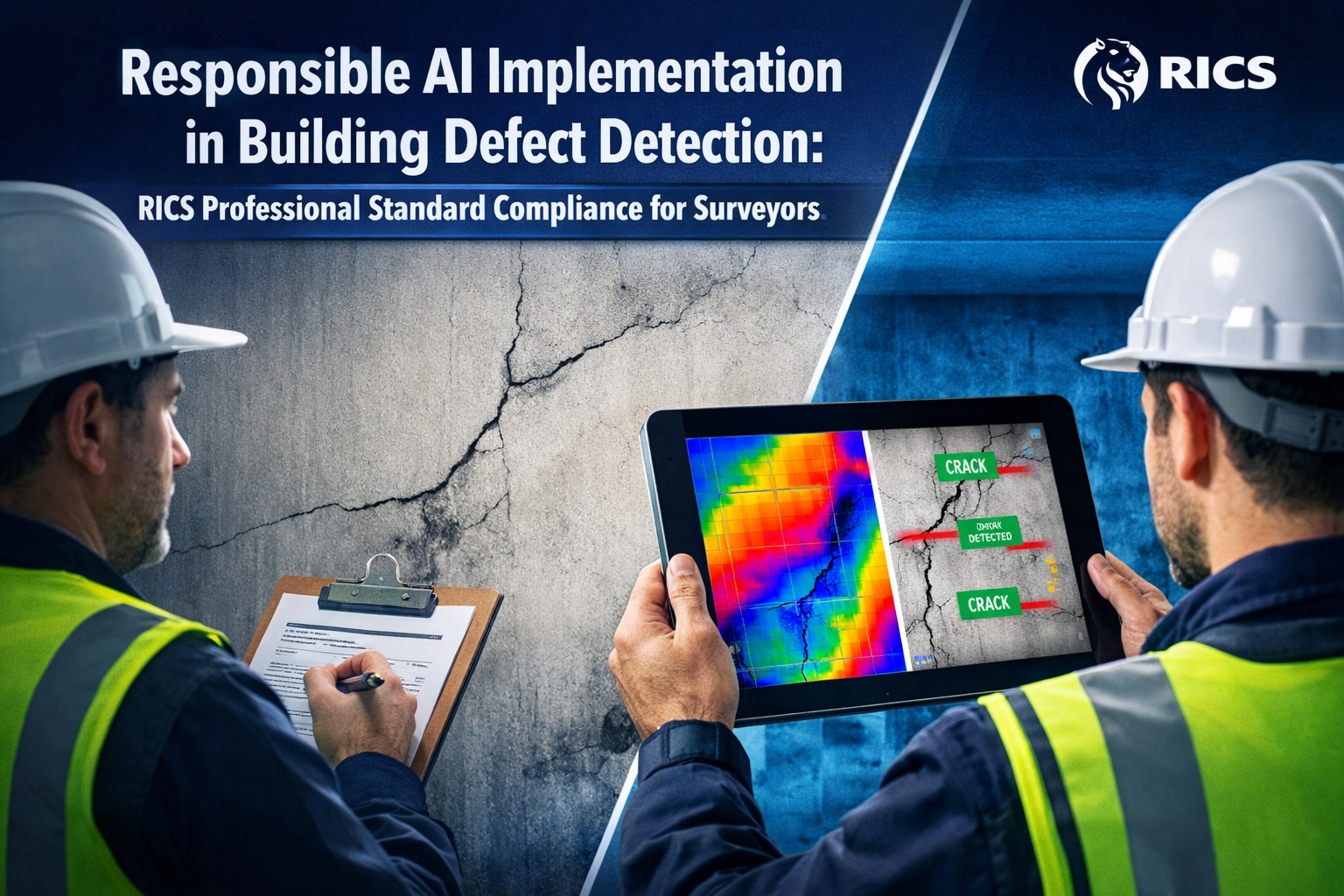
Responsible AI Implementation in Building Defect Detection: RICS Professional Standard Compliance for Surveyors Adopting Automated Hazard Identification represents the convergence of cutting-edge technology and traditional professional accountability. Surveyors can now deploy systems that analyze high-resolution imagery to detect structural cracks, damp penetration, corrosion, and design deviations during construction phases [1]. Some advanced platforms even compare visual site data against Building Information Modelling (BIM) specifications in real time [1]. However, these capabilities come with stringent governance requirements, documentation obligations, and the unwavering principle that human expertise remains the ultimate authority in every professional opinion delivered to clients.
Key Takeaways
- Mandatory compliance date: All RICS members and regulated firms must adhere to the Responsible AI Use standard effective March 9, 2026, with binding requirements across all jurisdictions [3]
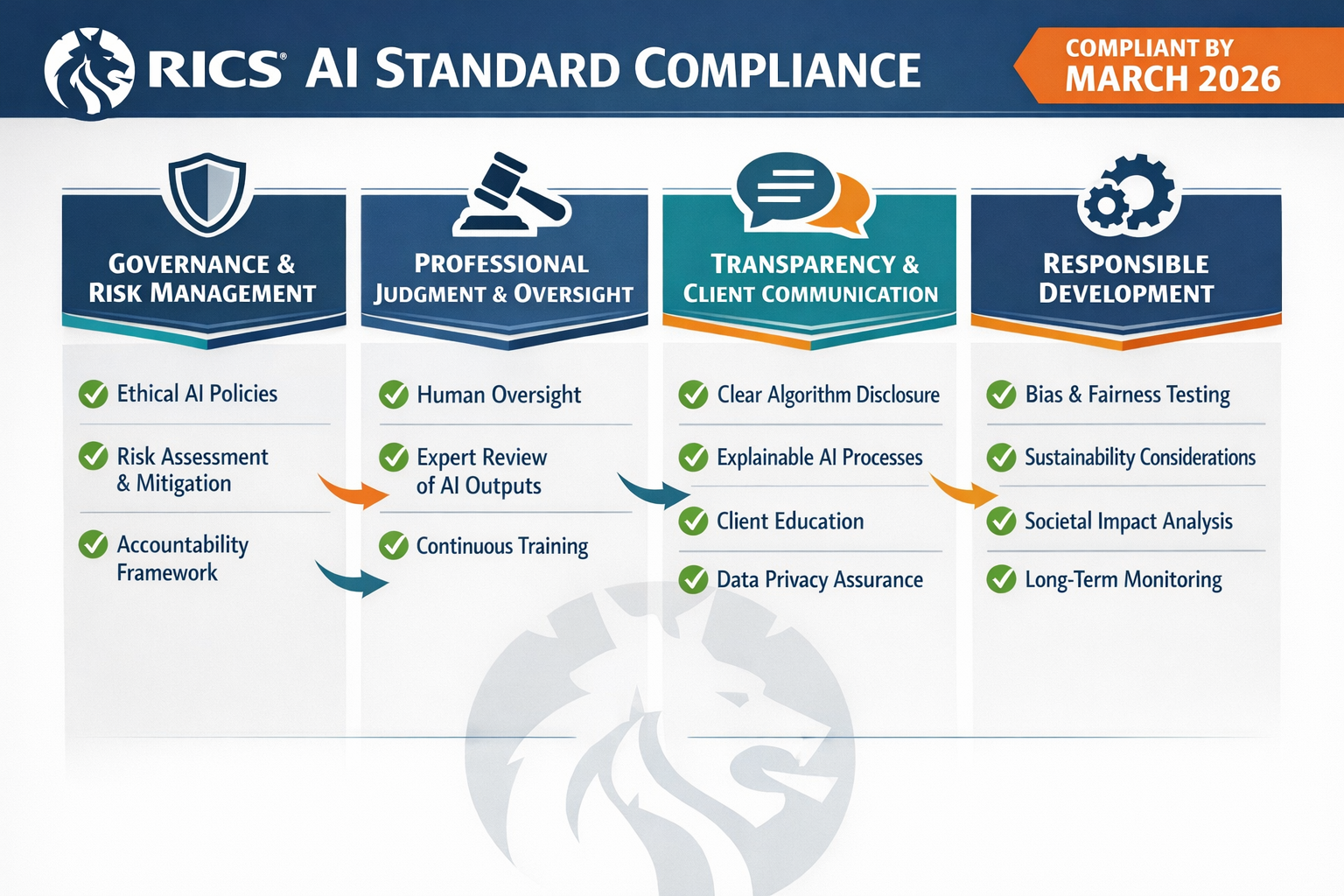
- Four compliance pillars: The standard establishes requirements for governance and risk management, professional judgment retention, transparency with clients, and responsible AI development [3]
- Non-delegable accountability: AI serves as a "valuable second perspective" for sense-checking, but surveyors retain full professional responsibility for all advice regardless of tools used [3]
- Documentation requirements: Firms must create written records when AI has material impact on service delivery, including risk assessments, procurement due diligence, and formal AI use policies [2]
- Quality dependency: AI defect detection accuracy relies entirely on input data quality—poor imagery or hidden views can distort results, requiring professional judgment for interpretation [1]
Understanding the RICS Responsible AI Standard Framework for Building Surveyors
The new RICS standard establishes a comprehensive framework that recognizes AI's transformative potential while safeguarding professional integrity. At its core, the standard operates on a fundamental premise: artificial intelligence enhances surveying practice but does not substitute for it [3]. This distinction becomes critical when deploying automated defect detection systems that can identify structural anomalies, moisture ingress, and material degradation with remarkable speed.
The Four Core Compliance Requirements
The standard mandates adherence across four interconnected areas, each with specific obligations that building surveyors must integrate into their practice [3]:
-
Governance and Risk Management 🛡️
- Conduct and document comprehensive risk assessments before deploying any AI system
- Establish formal procurement due diligence processes
- Develop written responsible AI use policies informed by detailed risk registers
- Identify potential failure modes and implement mitigation strategies
-
Professional Judgment and Oversight ⚖️
- Maintain ultimate accountability for all professional advice delivered
- Review and validate AI-generated outputs against site observations
- Apply contextual knowledge that automated systems may miss
- Ensure AI functions as decision support, not decision replacement
-
Transparency and Client Communication 💬
- Disclose AI use when it has material impact on service delivery
- Explain how automated systems contribute to assessment processes
- Document the reasoning behind material impact determinations
- Maintain client trust through clear communication protocols
-
Responsible Development of AI 🔧
- Participate in ethical AI system design when feasible
- Provide feedback to vendors on system limitations and failures
- Contribute to industry-wide improvement of detection algorithms
- Support development of surveying-specific AI standards
For surveyors conducting RICS-specific defect surveys, these requirements translate into practical workflow changes. Before deploying an AI-powered crack detection system, firms must complete written documentation assessing potential risks such as false negatives (missed defects), false positives (over-reporting), bias in training data, and limitations in specific building types or materials [2].
Material Impact Determination and Documentation Obligations
A critical aspect of compliance involves determining whether AI use has material impact on service delivery. The standard places this responsibility squarely on individual RICS members and regulated firms [2]. Material impact typically occurs when:
- AI analysis directly influences defect severity classifications
- Automated systems generate substantial portions of survey reports
- Detection algorithms identify hazards that might be missed by visual inspection alone
- Cost estimates or remediation recommendations rely on AI-generated data
When material impact is established, firms must create written records documenting the determination and reasoning [2]. This documentation serves multiple purposes: demonstrating compliance during RICS audits, providing transparency to clients, and establishing clear audit trails for professional indemnity purposes.
RICS provides supporting guidance to assist members in making these determinations, recognizing that materiality exists on a spectrum. For instance, using AI to organize site photographs may not constitute material impact, while deploying machine learning models to classify structural defects as minor, moderate, or severe almost certainly does [2].
AI-Powered Defect Detection Applications in Building Surveying Practice
The practical applications of AI in building defect detection have expanded rapidly, particularly during construction phases where early identification prevents costly rework. Understanding these applications—and their limitations—is essential for responsible implementation aligned with RICS standards.
Construction Phase Defect Detection Systems
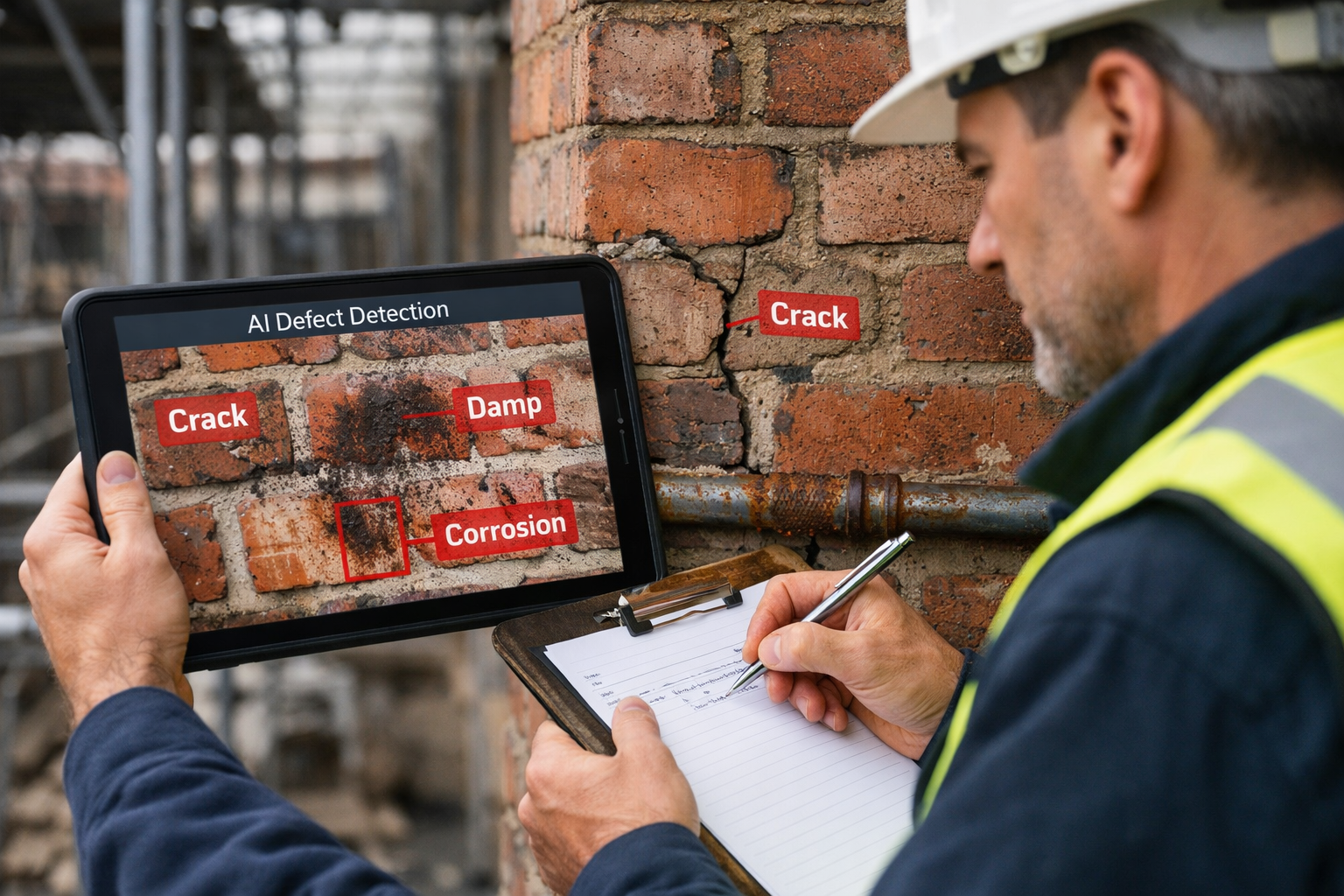
AI systems deployed during active construction analyze high-resolution images and videos to detect multiple defect categories [1]:
- Structural defects: Cracks in concrete, masonry settlement, beam deflection
- Moisture-related issues: Damp patches, water staining, condensation patterns
- Material degradation: Corrosion in reinforcement, timber decay, surface deterioration
- Design deviations: Misaligned elements, incorrect specifications, dimensional errors
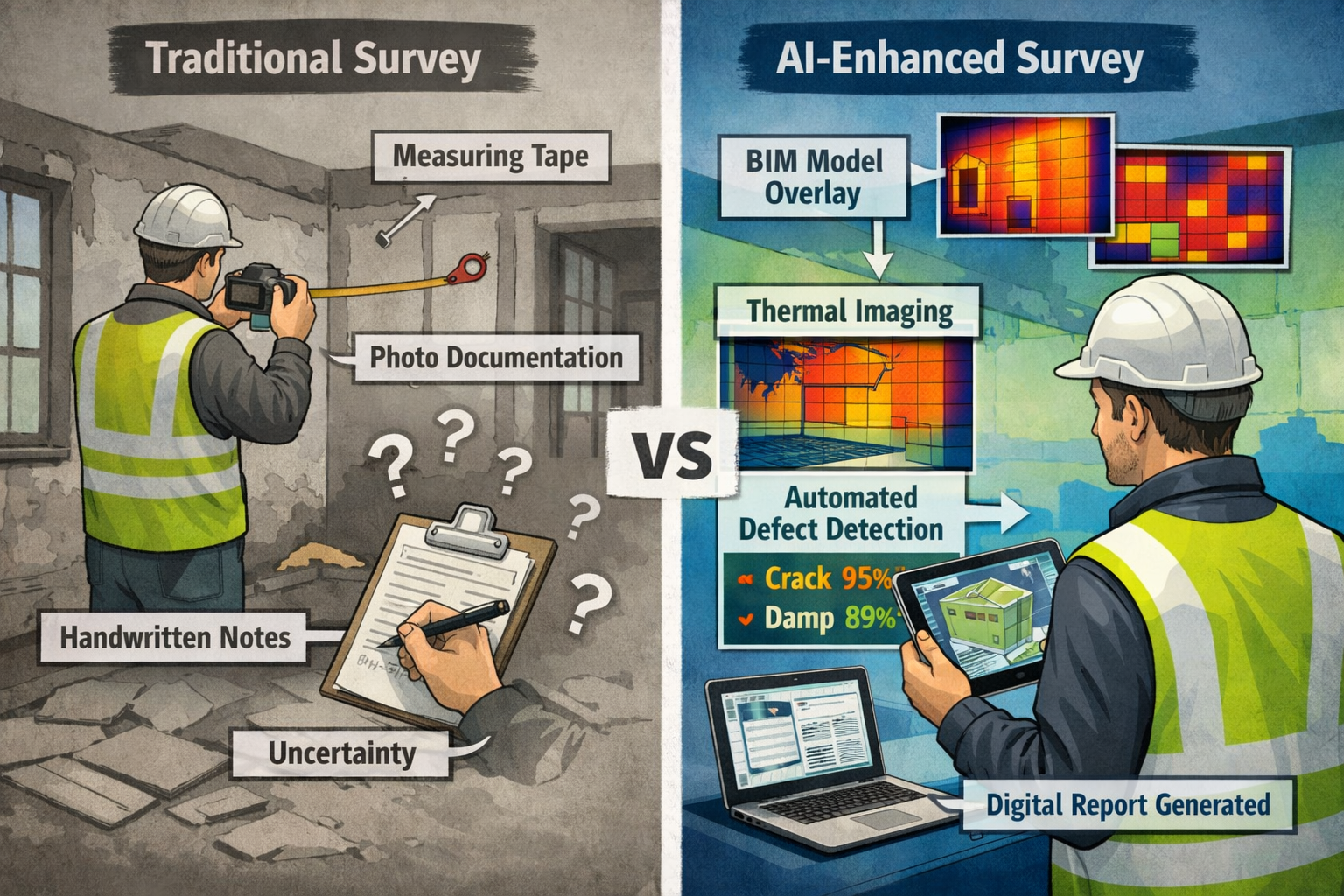
These systems typically employ computer vision algorithms trained on thousands of labeled defect images. When a site photograph is uploaded, the AI compares visual patterns against its training database, flagging potential issues for surveyor review. Advanced platforms integrate with Building Information Modelling (BIM) systems, enabling real-time comparison of site conditions against design specifications [1].
For example, during a Level 3 building survey, AI tools can process hundreds of photographs captured throughout a property, automatically highlighting areas requiring detailed investigation. The surveyor then conducts hands-on assessment of flagged locations, applying professional judgment to determine defect severity, causation, and remediation requirements.
Residential Property Assessment Capabilities and Critical Limitations
Within residential contexts, AI applications focus on basic property condition evaluations through automated scoring systems [1]. These tools analyze listing photographs or initial inspection images to generate preliminary condition assessments for:
- Rental property listings and condition documentation
- Mortgage pre-approval screening and risk assessment
- Initial condition checks before detailed surveys
- Portfolio-level property monitoring for large landlords
However, the RICS case study emphasizes a crucial caveat: these systems are not substitutes for professional inspections [1]. Their accuracy depends entirely on input quality—resolution, lighting conditions, viewing angles, and coverage completeness. A photograph taken in poor lighting may fail to reveal damp staining. An image captured from the wrong angle might obscure structural cracks. Areas not photographed remain completely unassessed.
This limitation underscores the standard's emphasis on professional oversight. When conducting RICS building surveys, surveyors must recognize AI outputs as preliminary indicators requiring validation through physical inspection, moisture meter readings, invasive investigation where appropriate, and contextual interpretation based on building age, construction type, and local environmental factors.
Data Quality Dependency and Input Validation Requirements
The accuracy and reliability of AI-generated defect assessments is entirely dependent on foundational data quality [1]. Poor data inputs can distort results in several ways:
| Input Quality Issue | Potential Impact | Mitigation Strategy |
|---|---|---|
| Low resolution imagery | Missed fine cracks, surface defects | Establish minimum resolution standards (e.g., 12MP minimum) |
| Poor lighting conditions | Misidentified shadows as defects, missed moisture staining | Use consistent lighting protocols, supplementary illumination |
| Limited viewing angles | Obscured structural elements, incomplete coverage | Implement systematic photography checklists |
| Hidden or inaccessible areas | Complete assessment gaps | Document limitations explicitly in reports |
| Inconsistent image capture | Algorithm confusion, reduced accuracy | Standardize photography procedures across survey teams |
Surveyors implementing AI defect detection must establish input validation protocols as part of their governance framework. This includes training survey staff on proper image capture techniques, implementing quality control checks before AI processing, and documenting input limitations that may affect output reliability [1].
For commercial building surveys, where defect detection can have significant financial implications, these validation requirements become even more critical. A missed structural defect in a commercial property could lead to substantial liability exposure, making the combination of AI efficiency and human validation essential.
Implementing Responsible AI in Building Defect Detection: Practical Compliance Steps for Surveyors
Translating the RICS standard into operational practice requires systematic implementation across multiple organizational levels. For building surveyors adopting automated hazard identification, the following framework provides a compliance roadmap.
Pre-Deployment Governance Assessment
Before deploying any AI defect detection system, firms must complete and document several governance assessment steps in writing [2]:
Step 1: Comprehensive Risk Assessment
Identify potential risks specific to AI-powered defect detection:
- Technical risks: Algorithm failures, false negatives/positives, system downtime
- Professional risks: Over-reliance on automation, skill degradation, missed contextual factors
- Client risks: Misunderstood capabilities, inappropriate expectations, communication gaps
- Liability risks: Disputed findings, professional negligence claims, insurance coverage questions
Document each identified risk with likelihood ratings, potential impact severity, and proposed mitigation measures. This risk register becomes a living document updated as experience with the system grows [2].
Step 2: Procurement Due Diligence
When selecting an AI defect detection platform, conduct thorough vendor evaluation:
- Request transparency about training data sources and potential biases
- Understand algorithm limitations for specific building types and defect categories
- Verify vendor compliance with data protection regulations (GDPR, etc.)
- Assess technical support availability and system update frequency
- Review contractual terms regarding liability and data ownership
For surveyors working across diverse property types—from chartered surveyor services in Central London to Berkshire locations—ensure the selected system performs adequately across the full range of construction types encountered.
Step 3: Formal Policy Development
RICS-regulated firms must develop and implement formal responsible AI use policies [2]. These policies should address:
- Scope of AI use: Which survey types and defect categories are appropriate for AI assistance
- Human oversight requirements: Mandatory validation steps for AI-generated findings
- Client communication protocols: When and how to disclose AI use
- Staff training requirements: Competency standards for surveyors using AI tools
- Quality assurance processes: Regular audits of AI accuracy against manual assessments
- Documentation standards: Required records for compliance demonstration
AI-Generated Report Validation Protocols
When using AI-powered report generation tools, surveyors must implement rigorous validation protocols [1]. The standard makes clear that human professional oversight remains essential for maintaining quality, accountability, and client trust.
Validation Checklist for AI-Assisted Defect Reports:
✅ Accuracy verification: Do AI-identified defects match on-site observations?
✅ Completeness assessment: Has the AI missed any defects identified through manual inspection?
✅ Severity calibration: Are AI-assigned severity ratings appropriate given building context?
✅ Contextual factors: Has the system considered building age, construction type, and local conditions?
✅ Professional standards compliance: Does the report meet RICS reporting requirements?
✅ Client-specific needs: Does the output address the client's specific concerns and instructions?
✅ Remediation appropriateness: Are suggested repair approaches suitable and cost-effective?
This validation process should be documented for each survey where AI has material impact. For subsidence surveys or drainage surveys where specialist defect detection is critical, validation documentation becomes particularly important for demonstrating professional diligence.
Transparency and Client Communication Best Practices
The standard's transparency requirements extend beyond simple disclosure to meaningful client communication about AI's role in service delivery [3]. Effective communication strategies include:
Pre-Engagement Communication:
- Include AI use disclosure in terms of engagement and service descriptions
- Explain how AI enhances efficiency and accuracy while maintaining professional oversight
- Clarify that AI serves as a tool supporting—not replacing—surveyor expertise
- Address common client concerns about automation and quality
During Survey Execution:
- Document AI-flagged areas requiring detailed investigation
- Photograph both AI-identified defects and areas cleared after manual verification
- Maintain clear distinction between automated detection and professional assessment
In Survey Reports:
- Include methodology section explaining AI tool usage and validation procedures
- Distinguish between AI-detected defects and those identified through manual inspection
- Note any system limitations affecting specific areas or defect types
- Emphasize professional judgment applied throughout the assessment
For surveyors conducting schedule of condition reports or monitoring surveys, this transparency builds client confidence and establishes clear expectations about the technology's role.
Ongoing Competence and Continuous Improvement
Responsible AI implementation requires continuous professional development in both traditional surveying skills and emerging technologies. RICS members should:
- Participate in AI-specific training programs addressing capabilities, limitations, and ethical considerations
- Maintain core surveying competencies to provide effective oversight of automated systems
- Contribute feedback to AI vendors about system performance and improvement opportunities
- Share lessons learned with the professional community to advance industry-wide standards
- Stay informed about evolving RICS guidance and regulatory developments
Regular internal audits comparing AI outputs against manual assessments help identify system weaknesses and training needs. When discrepancies occur, investigate root causes—was the issue related to input data quality, algorithm limitations, or insufficient human validation? [1]
Balancing Innovation with Professional Liability and Insurance Considerations
The adoption of AI-powered defect detection introduces new dimensions to professional liability management. While the technology offers efficiency gains and potential accuracy improvements, it also creates novel risk exposures that surveyors and their insurers must address.
Professional Indemnity Insurance Implications
Professional indemnity insurers are increasingly scrutinizing AI use in surveying practice [4]. Key considerations include:
Policy Coverage Clarity:
- Verify that existing professional indemnity policies explicitly cover AI-assisted services
- Understand any exclusions related to automated systems or algorithm failures
- Confirm coverage extends to both AI-generated errors and failures of human oversight
- Review policy requirements for AI system documentation and validation procedures
Premium Implications:
- Some insurers may adjust premiums based on AI adoption and governance maturity
- Demonstrated compliance with RICS standards may support favorable underwriting decisions
- Documented validation protocols and quality assurance processes strengthen risk profiles
- Incident history with AI systems will increasingly influence renewal terms
Claims Scenarios:
- Missed defect claims: AI fails to identify significant structural issue, surveyor doesn't catch the oversight
- False positive disputes: AI over-reports defects, leading to unnecessary remediation costs
- Reliance disputes: Client claims they relied on AI-enhanced accuracy representations
- Data breach claims: Sensitive property information compromised through AI platform vulnerabilities
Surveyors should proactively engage with their professional indemnity insurers when implementing AI systems, providing documentation of governance frameworks, validation protocols, and staff training programs [4].
Liability Allocation Between Surveyor and Technology Vendor
A critical question emerges: when an AI system makes an error, who bears responsibility? The RICS standard provides unambiguous guidance—surveyors retain full accountability for every piece of professional advice regardless of tools used [3].
This principle means that vendor contracts and terms of service cannot absolve surveyors of professional responsibility. Even if an AI platform's algorithm fails to detect a significant defect, the surveyor remains liable for the missed finding. This allocation reflects the professional's duty of care to clients and the non-delegable nature of professional judgment.
However, surveyors may have recourse against vendors in certain circumstances:
- Product liability claims: If the AI system fails due to defective design or implementation
- Contractual remedies: Breach of warranty claims for systems not performing as represented
- Contribution claims: In multi-party litigation, seeking contribution from technology providers
Procurement contracts should address these scenarios explicitly, including warranties about system performance, limitations of liability, indemnification provisions, and dispute resolution mechanisms. For surveyors providing expert witness services, understanding these liability boundaries becomes particularly important when disputes arise.
Risk Mitigation Through Documentation and Process Discipline
The most effective liability protection comes from rigorous documentation and process discipline. Comprehensive records demonstrate professional diligence and RICS compliance:
Essential Documentation Elements:
- Pre-deployment risk assessments and procurement due diligence records
- AI use policies and staff training completion records
- Survey-specific validation checklists showing human review of AI outputs
- Material impact determinations and reasoning for each engagement
- Client communications disclosing AI use and explaining validation procedures
- Incident logs tracking AI errors, near-misses, and corrective actions
- Regular system performance audits comparing AI accuracy to manual assessments
This documentation serves multiple purposes: demonstrating RICS compliance during regulatory reviews, supporting professional indemnity claims defense, and providing evidence of reasonable care in negligence disputes.
Future Developments and Evolving Standards in AI-Assisted Surveying
The March 2026 standard represents the beginning of an evolving regulatory framework rather than a final destination. As AI capabilities advance and industry experience grows, surveyors should anticipate further developments.
Emerging AI Capabilities in Defect Detection
Next-generation systems under development promise enhanced capabilities:
- Multi-modal analysis: Combining visual imagery with thermal imaging, moisture readings, and acoustic data
- Predictive defect modeling: Forecasting defect progression based on building characteristics and environmental factors
- Automated BIM integration: Seamless comparison of as-built conditions against design specifications
- Natural language report generation: AI-drafted narrative reports requiring surveyor validation and refinement
These advances will require ongoing updates to governance frameworks and validation protocols. Surveyors must remain adaptable, continuously assessing new technologies against RICS principles of responsible use [3].
Anticipated Regulatory Evolution
RICS has indicated that the current standard will evolve based on member feedback and technological developments [2]. Potential future enhancements include:
- More specific guidance for different surveying specialisms (building surveying, quantity surveying, valuation)
- Standardized AI system certification or approval processes
- Enhanced requirements for algorithm transparency and explainability
- Integration with broader regulatory frameworks as governments develop AI legislation
Surveyors should actively participate in this evolution by providing feedback to RICS about practical implementation challenges, sharing case studies of successful and unsuccessful AI deployments, and contributing to working groups developing sector-specific guidance.
Building Client Trust in an AI-Enhanced Profession
Ultimately, successful AI integration depends on maintaining client trust. Transparency, competence, and unwavering professional accountability form the foundation of this trust [3]. When clients understand that AI enhances rather than replaces professional judgment—and when surveyors consistently demonstrate this principle through rigorous validation and clear communication—technology adoption strengthens rather than undermines professional standing.
For building surveyors navigating this transformation, the RICS standard provides both guardrails and guidance. By embracing responsible implementation principles, maintaining robust governance frameworks, and prioritizing professional judgment, surveyors can harness AI's efficiency gains while upholding the profession's core values of competence, integrity, and client service.
Conclusion
Responsible AI Implementation in Building Defect Detection: RICS Professional Standard Compliance for Surveyors Adopting Automated Hazard Identification represents a defining moment for the surveying profession. The mandatory standard effective March 9, 2026, establishes clear expectations: AI serves as a powerful tool for enhancing defect detection capabilities, but professional judgment remains paramount and non-delegable [3].
Building surveyors implementing automated hazard identification systems must balance innovation with obligation across four critical domains—governance and risk management, professional oversight, client transparency, and responsible development [3]. Success requires comprehensive pre-deployment assessment, rigorous validation protocols, transparent client communication, and continuous professional development.
The technology offers genuine benefits: faster defect identification during construction phases, enhanced coverage through systematic image analysis, real-time BIM comparison capabilities, and potential accuracy improvements when properly validated [1]. However, these advantages come with corresponding responsibilities to understand system limitations, validate outputs against professional expertise, maintain input data quality, and document compliance systematically [2].
Actionable Next Steps for Surveyors
Immediate Actions (Next 30 Days):
- Review your current AI tool usage and determine material impact on service delivery
- Begin documenting risk assessments for any AI systems currently deployed
- Verify professional indemnity insurance coverage for AI-assisted services
- Communicate with clients about AI use in ongoing and upcoming engagements
Short-Term Implementation (Next 90 Days):
5. Develop formal responsible AI use policies aligned with RICS requirements
6. Establish validation protocols and documentation standards for AI-assisted surveys
7. Conduct staff training on AI capabilities, limitations, and validation procedures
8. Implement quality assurance audits comparing AI outputs to manual assessments
Long-Term Strategic Development:
9. Participate in professional development programs addressing AI in surveying practice
10. Engage with professional indemnity insurers about governance frameworks and risk management
11. Contribute feedback to RICS and technology vendors about system performance and standards evolution
12. Build internal expertise combining traditional surveying competence with technology proficiency
The convergence of artificial intelligence and building surveying creates unprecedented opportunities for those who approach implementation responsibly. By adhering to RICS standards, maintaining professional judgment, and prioritizing client transparency, surveyors can harness AI's potential while upholding the profession's fundamental commitment to competence, integrity, and public trust.
Whether conducting Level 3 building surveys, commercial property assessments, or specialized defect investigations, the principle remains constant: technology augments professional practice but never replaces it. This balance—between innovation and accountability, efficiency and thoroughness, automation and expertise—defines responsible AI implementation in building defect detection for 2026 and beyond.
References
[1] Responsible use of AI case study – Building surveying – https://www.rics.org/profession-standards/rics-standards-and-guidance/conduct-competence/responsible-use-of-ai/ruai-case-studies-06
[2] New standard provides guidance on emerging technologies – https://ww3.rics.org/uk/en/journals/construction-journal/ai-responsible-use-standard.html
[3] RICS' first-ever standard on responsible AI use is now in effect – https://www.rics.org/news-insights/rics-first-ever-standard-on-responsible-ai-use-now-in-effect
[4] RICS introduces mandatory AI standard for surveyors what insurers and their clients need to know – https://cms.law/en/gbr/legal-updates/rics-introduces-mandatory-ai-standard-for-surveyors-what-insurers-and-their-clients-need-to-know
