
Landlords face unprecedented scrutiny under the Renters' Rights Act 2026, with Section 21 no-fault evictions abolished as of May 1, 2026[1]. This seismic shift means every possession claim must now rely on valid Section 8 grounds—and building surveyors have become essential allies in documenting property conditions, preparing evidence for disputes, and ensuring compliance with new regulatory standards. Understanding the Renters' Rights Act 2026: Building Survey Checklists for Section 8 Evictions and Ombudsman Disputes is no longer optional for property professionals navigating this transformed landscape.
The stakes have never been higher. Maximum Rent Repayment Orders have doubled to 24 months of rent[3], while local authorities wield enhanced enforcement powers with fines reaching £40,000[2]. For landlords seeking possession under Section 8, comprehensive building surveys provide the documented evidence needed to substantiate claims—particularly for grounds involving property condition, safety concerns, or required renovation works.
Key Takeaways
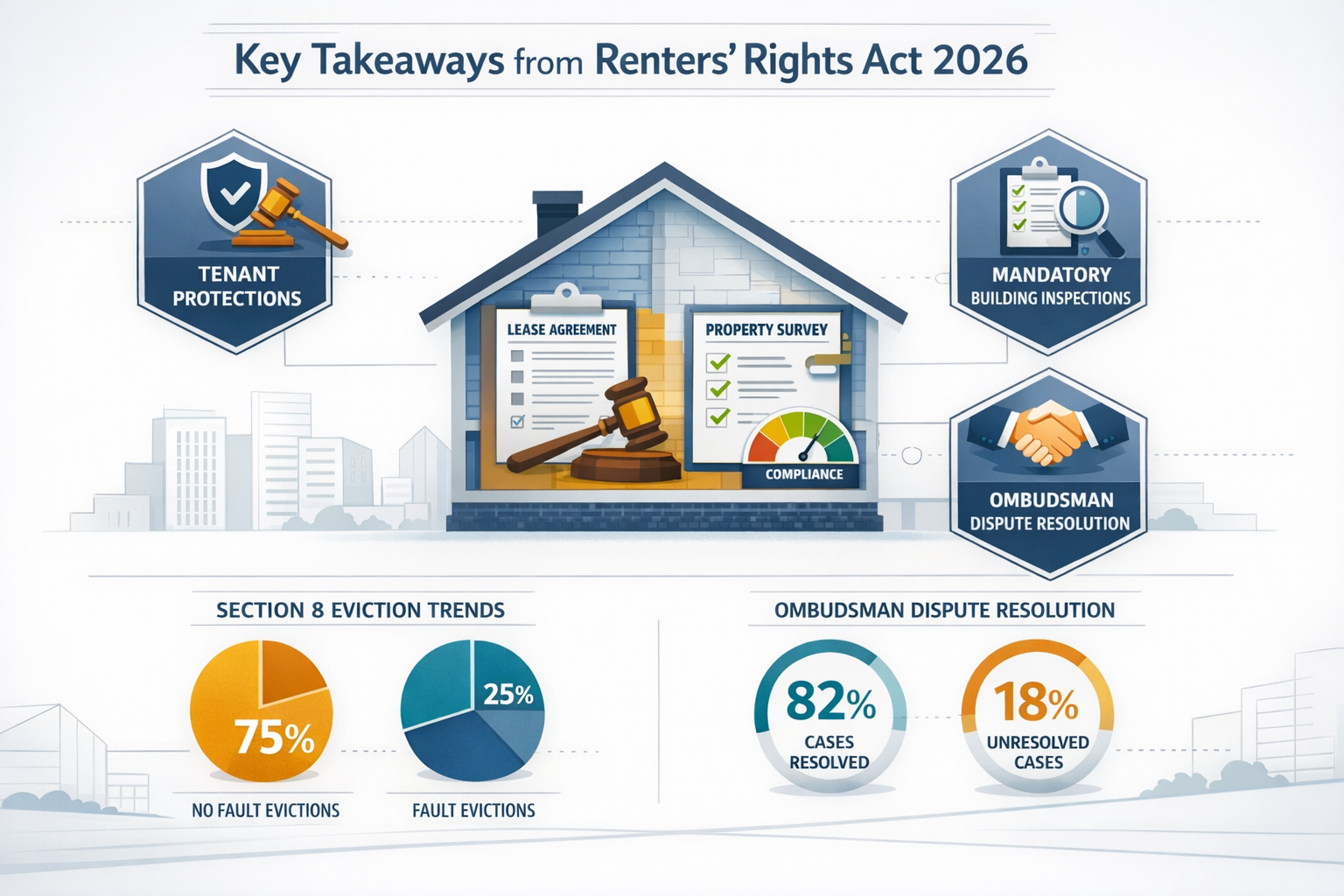
- Section 8 evictions now require robust evidence: With no-fault evictions banned, landlords must document valid grounds using professional building surveys and condition reports
- Level 3 surveys provide comprehensive protection: Detailed structural assessments help landlords demonstrate compliance with Decent Homes Standards and justify possession claims
- Ombudsman disputes demand systematic documentation: Mandatory PRS Ombudsman membership by 2028 requires landlords to maintain thorough survey records and evidence trails
- Four-month notice periods and 12-month re-letting bans: Ground 1 and 1A evictions carry significant restrictions, making proper documentation critical before initiating proceedings
- Building survey checklists ensure compliance: Standardized templates help property professionals systematically assess rental properties and prepare evidence for legal proceedings
Understanding Section 8 Evictions Under the Renters' Rights Act 2026
The abolition of Section 21 no-fault evictions represents the most significant change to UK tenancy law in decades. Landlords can no longer simply serve notice without providing justification—every possession claim must now cite specific Section 8 grounds[1].
Key Section 8 Grounds Requiring Survey Evidence
The most commonly used grounds that benefit from professional building survey documentation include:
Ground 1 (Occupation) 🏠
Landlords intending to occupy the property themselves must now provide four months' notice and cannot use this ground within the first 12 months of tenancy[3]. A comprehensive building survey helps document the property's suitability for owner occupation and demonstrates genuine intent.
Ground 1A (Sale) 💷
When selling a property with vacant possession, landlords face the same four-month notice requirement plus a 12-month re-letting ban[3]. Survey evidence showing the property's market condition supports legitimate sale intentions.
Ground 6 (Redevelopment) 🔨
This ground requires landlords to demonstrate that substantial renovation or reconstruction work necessitates vacant possession. A Level 3 building survey provides the detailed structural assessment needed to substantiate these claims.
Ground 7 (Deceased Tenant) ⚖️
Following a tenant's death, landlords must document property condition before seeking possession from remaining occupiers.
The Critical Role of Building Surveys in Section 8 Proceedings
Professional building surveys serve multiple functions in the new regulatory environment:
✅ Evidence Documentation: Systematic recording of property conditions before, during, and after tenancies
✅ Compliance Verification: Demonstrating adherence to Decent Homes Standards and safety regulations
✅ Dispute Prevention: Creating objective records that reduce tenant challenges
✅ Legal Protection: Providing court-admissible evidence for possession proceedings
Landlords who attempt Section 8 evictions without proper survey documentation face significant risks. Courts increasingly scrutinize possession claims, and inadequate evidence can result in dismissed applications, extended proceedings, and mounting legal costs.
Building Survey Checklists for Section 8 Evictions and PRS Compliance
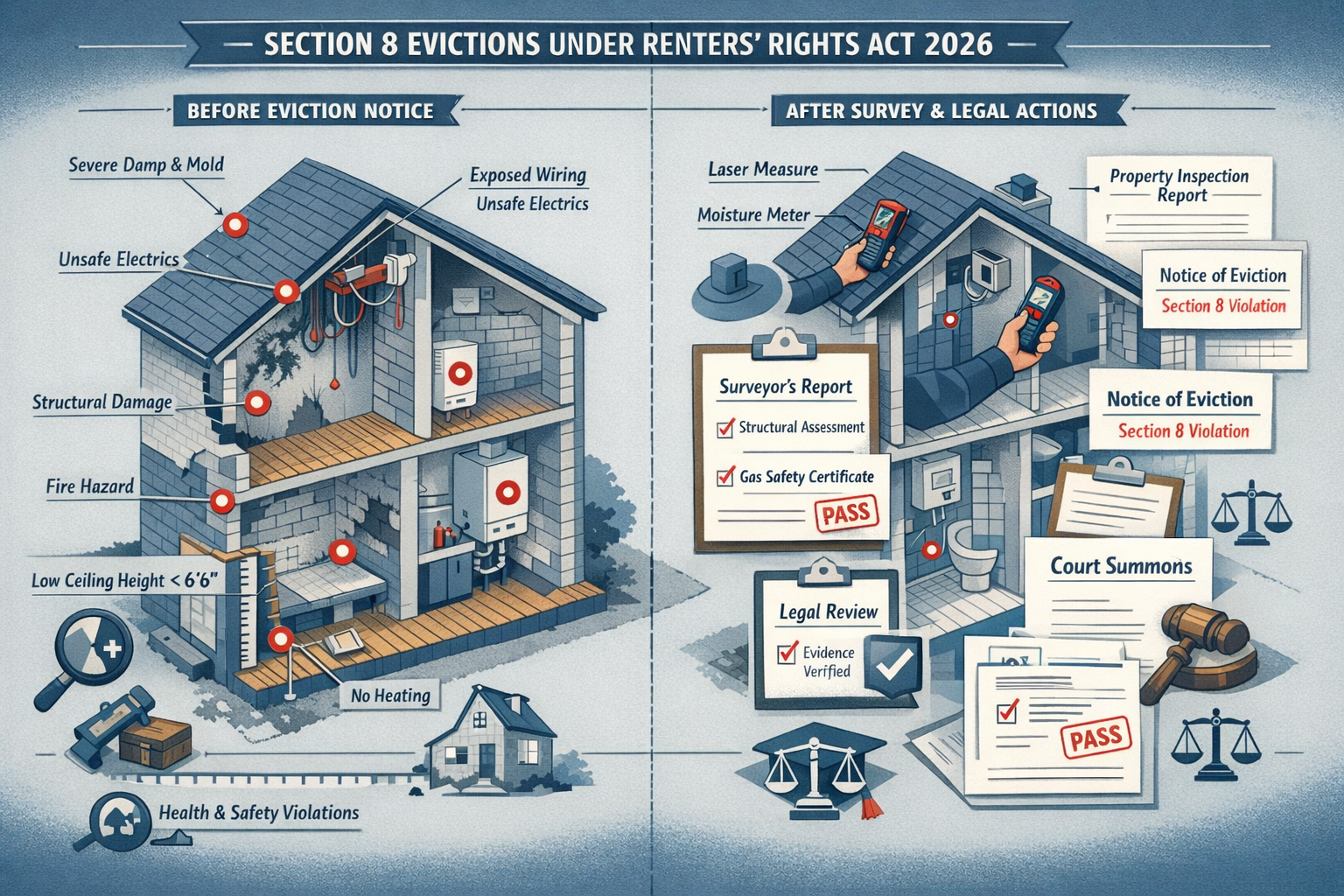
Creating comprehensive building survey checklists tailored to Renters' Rights Act 2026: Building Survey Checklists for Section 8 Evictions and Ombudsman Disputes requires understanding both structural assessment principles and regulatory requirements.
Essential Components of a Section 8 Survey Checklist
A robust survey checklist for rental properties must cover these critical areas:
1. Structural Integrity Assessment 🏗️
| Element | Inspection Points | Documentation Required |
|---|---|---|
| Foundations | Settlement cracks, subsidence indicators, movement | Photographic evidence, severity ratings (1-3) |
| Walls | Load-bearing capacity, damp penetration, structural defects | Moisture meter readings, crack width measurements |
| Roof Structure | Timber condition, load capacity, water ingress | Roof void access photos, structural calculations |
| Floors | Level assessment, joist condition, load capacity | Spirit level readings, deflection measurements |
2. Decent Homes Standard Compliance ⭐
The Decent Homes Standard requires rental properties to meet four criteria:
- Free from Category 1 hazards under the Housing Health and Safety Rating System (HHSRS)
- In reasonable state of repair with modern facilities
- Adequate thermal comfort through effective heating and insulation
- Reasonable modern facilities including kitchens and bathrooms
Your building survey checklist must systematically assess each criterion with detailed findings. For properties failing to meet these standards, surveys provide the evidence landlords need to justify renovation-based Section 8 possession claims.
3. Safety Systems and Compliance 🔥
Mandatory safety checks include:
- Electrical Installation Condition Reports (EICR): Required every five years
- Gas Safety Certificates: Annual inspections
- Fire Safety Assessments: Smoke alarms, escape routes, fire doors
- Carbon Monoxide Detectors: In rooms with solid fuel appliances
- Energy Performance Certificates (EPC): Minimum rating requirements
A comprehensive building survey verifies compliance with all safety regulations and identifies deficiencies requiring remediation.
4. Damp, Timber, and Environmental Issues 💧
Moisture-related problems represent the most common property defects in rental housing:
Rising Damp
- Visual inspection of walls up to 1.5m height
- Moisture meter readings at multiple points
- Assessment of damp-proof course integrity
- Photographic evidence of tide marks, salt deposits
Penetrating Damp
- External wall condition assessment
- Window and door seal inspection
- Roof covering and flashing examination
- Internal staining and mould growth documentation
Condensation and Mould
- Ventilation adequacy assessment
- Heating system effectiveness
- Tenant lifestyle factor consideration
- Mould growth severity rating
Timber Defects
- Rot identification (wet rot vs. dry rot)
- Woodworm infestation evidence
- Structural timber integrity assessment
- Treatment requirements and costs
Template: Section 8 Eviction Survey Checklist
This standardized template ensures systematic property assessment:
SECTION 8 EVICTION BUILDING SURVEY CHECKLIST

Property Address: _________________________________
Survey Date: _____________________________________
Surveyor Name & RICS Number: _____________________
Eviction Ground Cited: ____________________________

PART A: STRUCTURAL CONDITION
□ Foundations (Rate 1-3): ___
□ External Walls (Rate 1-3): ___
□ Roof Structure (Rate 1-3): ___
□ Internal Walls (Rate 1-3): ___
□ Floors (Rate 1-3): ___
□ Chimneys (Rate 1-3): ___

PART B: DECENT HOMES COMPLIANCE
□ Category 1 Hazards Present: YES / NO
□ Reasonable Repair Standard Met: YES / NO
□ Thermal Comfort Adequate: YES / NO
□ Modern Facilities Present: YES / NO

PART C: SAFETY SYSTEMS
□ EICR Valid (Date: ______): YES / NO
□ Gas Safety Certificate Current: YES / NO
□ Smoke Alarms Functional: YES / NO
□ CO Detectors Present: YES / NO
□ EPC Rating: ___

PART D: DAMP & TIMBER
□ Rising Damp Evidence: YES / NO
□ Penetrating Damp: YES / NO
□ Condensation Issues: YES / NO
□ Timber Rot Present: YES / NO
□ Woodworm Active: YES / NO

PART E: RENOVATION REQUIREMENTS
□ Works Necessitate Vacant Possession: YES / NO
□ Estimated Duration: ___ weeks/months
□ Estimated Cost: £________
□ Planning Permission Required: YES / NO

PART F: PHOTOGRAPHIC EVIDENCE
Number of Photos Attached: ___
Key Defects Photographed: ___________________

SURVEYOR DECLARATION
I confirm this survey was conducted in accordance with RICS standards and provides accurate documentation for Section 8 possession proceedings.

Signature: _________________ Date: __________
Level 3 Survey Requirements for PRS Properties
For landlords seeking possession under grounds requiring substantial renovation, a Level 3 building survey provides the most comprehensive assessment. This detailed inspection includes:
- Non-invasive investigation of accessible areas
- Detailed structural analysis with severity ratings
- Cost estimates for identified defects
- Prioritized repair schedules distinguishing urgent from routine work
- Expert opinions on property condition and renovation requirements
Unlike basic condition reports, Level 3 surveys provide the depth of analysis courts expect when evaluating Section 8 possession claims based on redevelopment grounds.
Preparing Evidence for Ombudsman Disputes Under the Renters' Rights Act 2026
The mandatory PRS Ombudsman scheme represents another transformative element of the Renters' Rights Act 2026. By 2028, all private landlords must join an approved Ombudsman service[3], creating a formal dispute resolution pathway that requires systematic evidence preparation.
Understanding the PRS Ombudsman Framework
Phase 2 Implementation (Late 2026): Ombudsman scheme becomes operational
Phase 3 Implementation (2028): Mandatory participation for all private landlords[1]
The Ombudsman provides an alternative dispute resolution mechanism for tenant complaints, including:
- Property condition disputes
- Repair request handling
- Deposit return disagreements
- Maintenance standard complaints
- Safety concern responses
Landlords who fail to join face fines up to £7,000[6] and potential Rent Repayment Orders.
Building Survey Evidence for Ombudsman Cases
When tenants escalate disputes to the Ombudsman, landlords must present comprehensive evidence demonstrating:
✅ Property condition at tenancy commencement
✅ Responsive maintenance practices
✅ Compliance with repair obligations
✅ Reasonable property standards
✅ Safety regulation adherence
Professional building surveys create the objective evidence base needed to defend against tenant complaints.
The Ombudsman Evidence Checklist
Prepare for potential disputes by maintaining these survey-related documents:
Pre-Tenancy Documentation 📋
- Initial condition survey with photographic evidence
- Inventory report detailing fixtures and fittings
- Safety certificates (EICR, Gas Safety, EPC)
- Decent Homes compliance assessment
- Check-in report signed by tenant
During-Tenancy Records 📝
- Routine inspection reports (recommended quarterly)
- Maintenance request logs with response times
- Repair work documentation including invoices and completion photos
- Updated safety certificates as they expire
- Tenant communication records regarding property issues
End-of-Tenancy Evidence 📸
- Check-out survey comparing condition to check-in
- Dilapidation assessment distinguishing wear-and-tear from damage
- Deposit deduction justification with photographic evidence
- Final safety certificate updates
- Property handover documentation
Survey Standards for Ombudsman Proceedings
The Ombudsman expects evidence to meet professional standards. Surveys should:
🔍 Be conducted by qualified professionals: RICS-chartered surveyors provide the credibility Ombudsman adjudicators respect
🔍 Include objective measurements: Moisture readings, crack widths, temperature measurements
🔍 Provide clear photographic evidence: Time-stamped, high-resolution images with reference points
🔍 Distinguish opinion from fact: Clear separation between observed conditions and expert interpretation
🔍 Reference relevant standards: Citation of Decent Homes criteria, HHSRS categories, building regulations
For complex disputes, engaging chartered surveyors to prepare expert witness reports strengthens your position significantly.
Template: Ombudsman Dispute Evidence Bundle
OMBUDSMAN DISPUTE EVIDENCE BUNDLE

Case Reference: _________________________________
Property Address: _______________________________
Landlord: _______________________________________
Tenant: _________________________________________
Dispute Nature: _________________________________

SECTION 1: PRE-TENANCY CONDITION
□ Initial Building Survey (Date: ______)
□ Photographic Evidence (__ images)
□ Safety Certificates Attached
□ Inventory Report Included
□ Tenant Acknowledgement Signed

SECTION 2: TENANCY MAINTENANCE RECORD
Date | Issue Reported | Response Time | Action Taken | Cost
_____|_______________|_______________|______________|_____
_____|_______________|_______________|______________|_____
_____|_______________|_______________|______________|_____

SECTION 3: ROUTINE INSPECTION REPORTS
□ Inspection 1 (Date: ______): Attached
□ Inspection 2 (Date: ______): Attached
□ Inspection 3 (Date: ______): Attached
□ Inspection 4 (Date: ______): Attached

SECTION 4: SPECIFIC DISPUTE EVIDENCE
Issue in Dispute: _______________________________
Landlord Position: _____________________________
Supporting Survey Evidence: ____________________
Photographic Evidence: ___ images attached
Expert Opinion: ________________________________

SECTION 5: END-OF-TENANCY ASSESSMENT
□ Check-Out Survey Completed
□ Comparison to Check-In Condition
□ Dilapidation Assessment
□ Deposit Deduction Justification
□ Final Photographic Record

SURVEYOR DECLARATION
This evidence bundle was prepared in accordance with RICS professional standards and accurately represents property conditions throughout the tenancy period.

Surveyor Name: _________________________________
RICS Number: ___________________________________
Signature: _________________ Date: ____________
Landlord Registration and Decent Homes Compliance
The Renters' Rights Act 2026 introduces a mandatory landlord registration system designed to improve property standards and enforcement capabilities[5]. This database will track landlord compliance with regulations, including Decent Homes Standards.
Registration Requirements and Survey Implications
While full registration details are still being finalized, landlords should expect to provide:
- Property condition declarations: Self-certification of Decent Homes compliance
- Safety certificate uploads: Current EICR, Gas Safety, and EPC documentation
- Enforcement history disclosure: Previous violations and improvement notices
- Professional survey evidence: For properties with known defects or ongoing remediation
Proactive landlords are commissioning building surveys now to identify and address compliance gaps before registration becomes mandatory.
Decent Homes Standard Assessment Methodology
Surveyors assessing Decent Homes compliance use a systematic approach:
Category 1 Hazard Assessment 🚨
The HHSRS identifies 29 potential hazards grouped into four categories:
Physiological Requirements
- Damp and mould growth
- Excess cold
- Excess heat
- Asbestos exposure
- Biocides
- Carbon monoxide and fuel combustion products
- Lead
- Radiation
- Uncombusted fuel gas
- Volatile organic compounds
Psychological Requirements
- Crowding and space
- Entry by intruders
- Lighting
- Noise
Protection Against Infection
- Domestic hygiene, pests, and refuse
- Food safety
- Personal hygiene, sanitation, and drainage
- Water supply
Protection Against Accidents
- Falls on level surfaces
- Falls on stairs
- Falls between levels
- Electrical hazards
- Fire
- Hot surfaces and materials
- Collision and entrapment
- Explosions
- Position and operability of amenities
- Structural collapse and falling elements
Surveyors rate each hazard's likelihood and severity. Category 1 hazards (highest risk) require immediate remediation.
Repair Standard Assessment 🔧
Properties must be in reasonable repair considering:
- Age and character: Victorian terraces aren't held to new-build standards
- Prospective life: Elements near end-of-life may require replacement
- External elements: Roof, walls, windows, doors, chimneys, drainage
- Internal elements: Walls, floors, ceilings, stairs, fixtures
- Services: Heating, plumbing, electrical, ventilation
Surveyors document defects requiring attention within the next 12 months.
Thermal Comfort Evaluation 🌡️
Adequate heating means:
- Efficient heating system: Gas central heating or equivalent
- Controllable temperatures: Thermostatic controls in living areas
- Insulation standards: Loft insulation minimum 270mm, cavity wall insulation where feasible
- Double glazing: In most properties (exceptions for conservation areas)
Thermal imaging surveys help identify heat loss and insulation deficiencies.
Modern Facilities Standards 🚿
Reasonably modern facilities include:
- Kitchen: Less than 30 years old with adequate layout and appliances
- Bathroom: Less than 30 years old with bath/shower, toilet, basin
- Common areas: Adequate for property size and occupancy
Surveyors assess facility age, condition, and suitability.
Survey-Based Compliance Action Plans
When surveys identify Decent Homes failures, landlords need prioritized action plans:
Immediate Actions (0-3 months)
- Category 1 hazard remediation
- Safety system repairs
- Emergency structural work
Short-Term Actions (3-12 months)
- Category 2 hazard addressing
- Planned maintenance completion
- Thermal comfort improvements
Medium-Term Actions (12-24 months)
- Facility modernization
- Energy efficiency upgrades
- Preventative maintenance programs
Professional surveyors provide detailed cost estimates and contractor recommendations for each action item.
Advanced Survey Techniques for Complex Section 8 Cases
Some Section 8 eviction grounds require specialized survey approaches beyond standard building assessments.
Structural Engineer Reports for Ground 6 Claims
When claiming Ground 6 (redevelopment requiring vacant possession), landlords may need structural engineer reports demonstrating:
- Structural inadequacy: Load-bearing elements requiring replacement
- Safety concerns: Structural movement threatening building integrity
- Renovation impossibility: Work cannot be completed with tenants in situ
- Planning requirements: Development proposals requiring vacant possession
These reports include:
📐 Structural calculations proving inadequacy
📐 CAD drawings showing proposed alterations
📐 Method statements explaining why tenants must vacate
📐 Timeline estimates for completion
📐 Cost schedules for renovation works
Courts scrutinize Ground 6 claims carefully, requiring compelling technical evidence that vacant possession is genuinely necessary.
Subsidence and Structural Movement Surveys
Properties with subsidence or structural movement present unique challenges. Subsidence surveys document:
- Crack patterns and severity: Using crack monitoring equipment
- Foundation investigation: Trial pits and structural opening-up
- Soil analysis: Ground conditions and tree root impact
- Monitoring programs: 12-month crack monitoring schedules
- Remediation proposals: Underpinning, drainage, or other solutions
For Section 8 possession based on necessary structural repairs, comprehensive subsidence documentation proves the work cannot proceed with tenants present.
Specific Defect Reports
When disputes center on particular property elements, specific defect reports provide focused analysis:
- Damp investigation reports: Moisture mapping, cause identification, remediation specifications
- Roof condition surveys: Covering assessment, structural timber inspection, repair schedules
- Electrical safety reports: EICR with remedial work prioritization
- Drainage surveys: CCTV investigation, structural assessment, repair recommendations
These targeted reports address specific tenant complaints or justify particular repair-based possession claims.
Cost Considerations and ROI of Professional Surveys
Landlords often question whether professional building surveys represent worthwhile investments. The answer becomes clear when considering the costs of inadequate documentation.
Survey Cost Benchmarks (2026)
| Survey Type | Typical Cost Range | Best Used For |
|---|---|---|
| Basic Condition Report | £200-£400 | Simple tenancy check-ins/check-outs |
| Level 2 Survey | £400-£800 | Standard rental properties, routine assessments |
| Level 3 Survey | £800-£1,500 | Complex properties, Section 8 evidence, dispute preparation |
| Structural Engineer Report | £1,000-£3,000 | Ground 6 claims, major structural concerns |
| Specialist Investigation | £500-£2,000 | Damp, subsidence, specific defect analysis |
The Cost of Inadequate Documentation
Consider these potential expenses without proper survey evidence:
❌ Failed Section 8 possession claim: £5,000-£15,000 in legal costs
❌ Extended void periods: £1,000-£2,000 per month in lost rent
❌ Rent Repayment Order: Up to 24 months rent (£24,000-£48,000 typical)
❌ Ombudsman compensation awards: £500-£5,000 per upheld complaint
❌ Local authority fines: £7,000-£40,000 for serious violations
❌ Reputational damage: Difficulty securing future tenants
A £1,200 Level 3 survey that successfully supports a Section 8 possession claim saves tens of thousands in potential losses.
ROI Calculation Example
Scenario: Landlord needs vacant possession for major renovation (Ground 6)
Without Professional Survey:
- Possession claim fails due to inadequate evidence: £8,000 legal costs
- Extended tenancy during appeal: 6 months lost renovation time
- Delayed property improvement: £3,000 additional holding costs
- Total Cost: £11,000+
With Professional Survey:
- Level 3 survey + structural engineer report: £2,500
- Successful possession claim: First time
- Renovation proceeds on schedule: No delays
- Net Saving: £8,500+
The ROI of professional survey evidence becomes undeniable when facing the Renters' Rights Act 2026's stringent requirements.
Selecting the Right Surveyor for Section 8 and Ombudsman Cases
Not all surveyors possess the expertise needed for Renters' Rights Act 2026: Building Survey Checklists for Section 8 Evictions and Ombudsman Disputes. Landlords should prioritize:
Essential Qualifications 🎓
✅ RICS Chartered Status: Ensures professional standards and insurance
✅ Residential Property Specialism: Experience with rental sector requirements
✅ Legal Proceedings Experience: Familiarity with court and Ombudsman evidence standards
✅ Decent Homes Knowledge: Understanding of compliance assessment methodology
✅ Expert Witness Capability: Ability to provide court testimony if required
Verify credentials through the RICS Find a Surveyor directory.
Key Questions to Ask Potential Surveyors
Before commissioning a survey for Section 8 or Ombudsman purposes, ask:
- How many Section 8 possession cases have you provided evidence for?
- What is your experience with Ombudsman dispute documentation?
- Can you provide court-admissible reports with expert witness support?
- What is your turnaround time for urgent possession proceedings?
- Do you offer Decent Homes compliance assessments?
- What photographic and measurement standards do you employ?
- Can you provide cost estimates for identified remedial works?
- What professional indemnity insurance coverage do you maintain?
Experienced surveyors will answer these questions confidently and provide case examples.
Red Flags to Avoid 🚩
Beware of surveyors who:
- Lack RICS chartered status
- Cannot provide professional indemnity insurance proof
- Offer "quick and cheap" surveys without site visits
- Promise specific outcomes before conducting inspections
- Have no experience with legal proceedings
- Cannot explain Decent Homes assessment methodology
- Refuse to provide court testimony if required
For critical Section 8 cases, choosing the cheapest option often proves the most expensive mistake.
Implementing a Systematic Survey Program for PRS Portfolios
Landlords managing multiple properties benefit from systematic survey programs that ensure consistent compliance and evidence gathering across their portfolios.
The Quarterly Inspection Protocol
Month 1: Property A inspections
Month 2: Property B inspections
Month 3: Property C inspections
Month 4: Return to Property A
This rotating schedule ensures every property receives quarterly assessment while distributing costs throughout the year.
Digital Survey Management Systems
Modern property management requires digital documentation:
- Cloud-based storage: Secure, accessible survey archives
- Mobile inspection apps: Real-time data capture during site visits
- Automated compliance tracking: Reminders for certificate renewals
- Tenant portal integration: Transparent maintenance communication
- Evidence bundle generation: One-click Ombudsman submission packages
Several property management platforms now integrate building survey data with tenancy records, creating comprehensive evidence trails.
Building a Survey Evidence Library
Successful landlords maintain organized evidence libraries:
Property_Address/
├── Pre-Tenancy/
│   ├── Initial_Survey_2025.pdf
│   ├── Photos_Check-In/
│   ├── Safety_Certificates/
│   └── Inventory_Report.pdf
├── During_Tenancy/
│   ├── Inspection_Q1_2026.pdf
│   ├── Inspection_Q2_2026.pdf
│   ├── Maintenance_Records/
│   └── Tenant_Communications/
├── End_Tenancy/
│   ├── Check-Out_Survey.pdf
│   ├── Dilapidation_Assessment.pdf
│   └── Photos_Check-Out/
└── Compliance/
    ├── EICR_Current.pdf
    ├── Gas_Safety_Current.pdf
    ├── EPC_Current.pdf
    └── Decent_Homes_Assessment.pdf
This structure ensures rapid evidence retrieval for Section 8 proceedings or Ombudsman disputes.
Conclusion
The Renters' Rights Act 2026: Building Survey Checklists for Section 8 Evictions and Ombudsman Disputes represents a fundamental shift in how landlords must document and maintain rental properties. With Section 21 no-fault evictions abolished and mandatory Ombudsman membership approaching, professional building surveys have transitioned from optional extras to essential risk management tools.
Landlords who embrace systematic survey programs, maintain comprehensive evidence libraries, and engage qualified chartered surveyors will navigate this new regulatory landscape successfully. Those who attempt to manage properties without proper documentation face escalating risks: failed possession claims, substantial fines, Rent Repayment Orders, and reputational damage.
Actionable Next Steps
Immediate Actions (This Month) ⚡
- Commission Level 3 surveys for all rental properties to establish baseline conditions
- Verify all safety certificates are current and compliant
- Create digital evidence libraries for each property
- Review existing tenancies for potential Section 8 grounds requiring documentation
Short-Term Actions (Next 3 Months) 📅
- Implement quarterly inspection protocols across your portfolio
- Identify properties failing Decent Homes Standards and create remediation plans
- Establish relationships with RICS-chartered surveyors experienced in legal proceedings
- Prepare for mandatory landlord registration by gathering required documentation
Medium-Term Actions (Next 12 Months) 🎯
- Complete all Decent Homes compliance work before registration deadlines
- Join an approved PRS Ombudsman scheme ahead of mandatory requirements
- Develop standardized survey checklists aligned with your property types
- Train property managers on evidence gathering and documentation standards
Long-Term Strategy (Ongoing) 🔄
- Maintain systematic survey programs with professional documentation
- Stay informed about evolving regulations and compliance requirements
- Build comprehensive evidence trails for every property and tenancy
- Engage professional surveyors for all significant property decisions
The Renters' Rights Act 2026 has elevated property standards and tenant protections to unprecedented levels. Landlords who view professional building surveys as investments rather than expenses—and who maintain meticulous documentation throughout every tenancy—will thrive in this transformed regulatory environment.
For properties requiring comprehensive assessment, consider engaging experienced professionals who understand both building pathology and legal evidence requirements. The cost of proper documentation pales in comparison to the financial and reputational consequences of inadequate preparation.
Start building your survey evidence library today. The next Section 8 possession claim or Ombudsman dispute may depend on documentation you create right now.
References
[1] The Renters Rights Act What S Changing What It Means For Landlords And How To Mitigate Risks – https://www.kennedyslaw.com/en/thought-leadership/article/2026/the-renters-rights-act-what-s-changing-what-it-means-for-landlords-and-how-to-mitigate-risks/
[2] Renters Rights Bill A Letting Agents Guide – https://blog.goodlord.co/renters-rights-bill-a-letting-agents-guide
[3] Renters Rights Act Everything Guide – https://www.crownluxuryhomes.com/renters-rights-act-everything-guide/
[4] Landlords 2026 – https://theindependentlandlord.com/landlords-2026/
[5] Explainer Everything You Need To Know About The New Renters Rights Act – https://mhclgmedia.blog.gov.uk/2025/11/19/explainer-everything-you-need-to-know-about-the-new-renters-rights-act/
[6] The Renters Rights Act Information Sheet 2026 – https://www.gov.uk/government/publications/the-renters-rights-act-information-sheet-2026
