
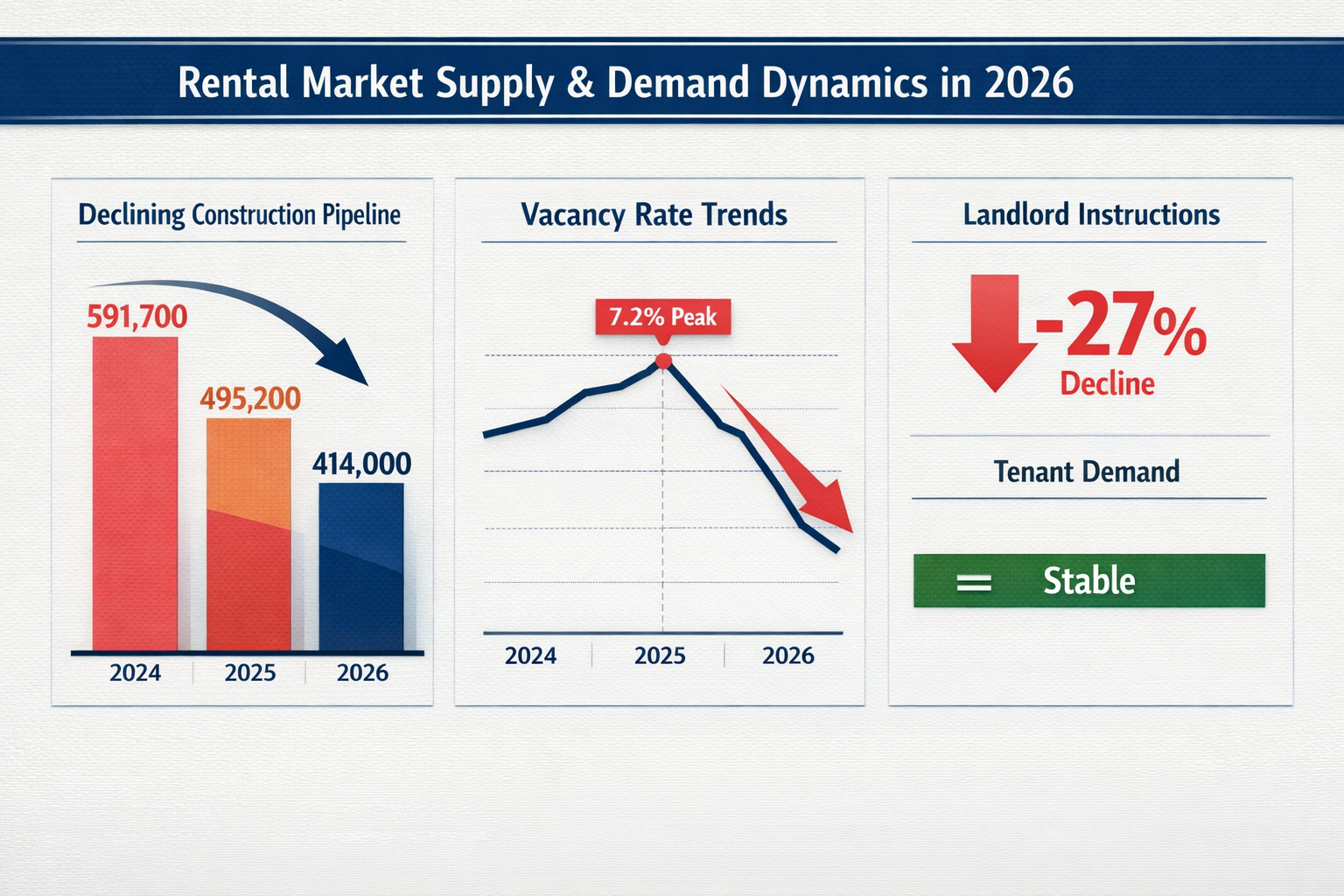
Record vacancy rates of 7.2% emerged in 2024 as over 600,000 new multifamily units flooded rental markets, yet by 2026, the landscape has shifted dramatically—landlord instructions have plummeted 27% while tenant demand remains remarkably stable, creating unprecedented challenges for property valuation surveyors[1]. This supply-constrained environment demands entirely new approaches to Rental Market Valuation Adjustments: Strategies for Surveying Properties Amid Landlord Shortage and Tenant Demand Surge in 2026.
The rental market has entered a stabilization phase that fundamentally alters how chartered surveyors must assess property values. With multifamily construction declining from 591,700 units delivered in 2024 to a projected 414,000 units in 2026, the oversupply crisis is resolving, but the shortage of landlord instructions creates a valuation paradox[1]. Properties entering the market face intense competition from stable tenant demand, while reduced supply tightens pricing dynamics.
Understanding Rental Market Valuation Adjustments: Strategies for Surveying Properties Amid Landlord Shortage and Tenant Demand Surge in 2026 requires surveyors to master new methodologies that account for shifting market fundamentals, property condition differentials, and the growing importance of tenant retention in revenue projections.
Key Takeaways
✅ Dynamic pricing strategies are now essential for accurate valuations, with property condition and amenities serving as primary value differentiators rather than location alone
✅ Renewal lease valuations significantly outpace new lease growth at 3-4% versus 1%, making tenant retention metrics critical components of property assessment
✅ Supply-demand rebalancing projects 2-3% national rent growth for 2026 as construction activity moderates, requiring surveyors to adjust comparable analysis methodologies
✅ Single-family rental properties are projected to outperform multifamily apartments in high-growth metros, affecting comparative valuation strategies across property types
✅ Proactive maintenance and property upgrades have become essential survey components that directly impact vacancy periods and long-term value retention
Understanding the 2026 Rental Market Landscape
The rental market of 2026 bears little resemblance to the oversupplied environment of 2024. National median rents have stabilized at $1,693 across the 50 largest metros, following 28 consecutive months of declines through November 2025[1]. This stabilization signals a fundamental shift in market dynamics that directly impacts how surveyors must approach property valuations.
Supply Constraints Reshape Valuation Parameters
The dramatic decline in multifamily construction—from 591,700 units in 2024 to just 414,000 projected for 2026—has created more balanced supply-demand dynamics[1]. For valuation surveyors, this means:
🏗️ Reduced competitive pressure from new construction in most markets
📊 Stabilizing rental rates that allow for more predictable income projections
🎯 Increased value differentiation based on property condition and amenities
💰 Higher premiums for well-maintained properties with modern features
Markets that experienced severe oversupply in 2024—including Austin, Phoenix, Tampa, Orlando, and Jacksonville—are now showing stabilization potential with projected rent growth returning to 1-2% as excess inventory is absorbed[1]. This recovery pattern requires surveyors to carefully analyze local market absorption rates when conducting RICS valuations.
The Landlord Shortage Phenomenon
The 27% decline in landlord instructions creates a unique valuation challenge. Fewer properties entering the market means:
- Limited comparable sales data requiring broader geographic search parameters
- Increased reliance on rental income analysis rather than pure market comparison
- Greater weight on property-specific factors like condition and amenities
- Enhanced importance of tenant retention metrics in income projections
This shortage doesn't indicate reduced property values—rather, it reflects landlord confidence in stable rental income streams and reluctance to sell in a market where replacement properties are difficult to acquire.
Tenant Demand Dynamics in 2026
Despite the supply constraints, tenant demand remains robust and stable. This persistent demand, combined with reduced new supply, creates favorable conditions for property owners but requires surveyors to adopt more nuanced valuation approaches. Understanding valuation factors becomes critical in this environment.
The era of aggressive concessions has ended—landlords are no longer offering 1-2 months free rent, waived application fees, or other incentives that were common during the oversupply period[1]. This shift improves property valuation parameters for properties offering competitive amenities and quality maintenance.
Rental Market Valuation Adjustments: Core Strategies for Property Surveying in 2026
Effective valuation in the current market requires surveyors to implement comprehensive strategies that account for the unique dynamics of landlord shortage and sustained tenant demand. Traditional comparable analysis alone no longer provides sufficient accuracy.

Dynamic Pricing Analysis Methodology
Pricing accuracy has become critical for property valuation in 2026[2]. Overpricing leads to extended vacancies while underpricing leaves significant revenue on the table. Surveyors must now incorporate dynamic pricing strategies that account for:
Seasonality factors 📅
Rental demand fluctuates throughout the year, with peak leasing seasons commanding premium rates. Surveyors should adjust valuations based on when properties are likely to be marketed, incorporating seasonal variance into income projections.
Unit condition differentials 🔧
Well-maintained properties with modern amenities and energy-efficient features command fair market rents without concessions, while those lagging in maintenance see longer vacancy periods[1]. This creates significant valuation spreads even within the same building or development.
Localized demand patterns 📍
National trends provide context, but accurate valuations require current, localized data rather than relying on past trends[2]. Markets showing negative to near-zero rent growth in 2024 (like Austin and Phoenix) may experience recovery in 2026, requiring careful analysis of local absorption rates.
Competitive amenity benchmarking ⭐
Property condition and amenities are now primary value differentiators. Surveyors should conduct detailed comparisons of:
- In-unit features (appliances, finishes, smart home technology)
- Building amenities (fitness centers, coworking spaces, package services)
- Energy efficiency ratings and utility costs
- Parking availability and convenience
- Pet policies and associated facilities
When conducting a Level 2 survey or Level 3 building survey, these amenity factors must be systematically documented and weighted in the final valuation.
Income Approach Refinements
The income approach to valuation has gained increased importance in 2026 due to limited comparable sales data. Key refinements include:
Renewal vs. New Lease Growth Differential
Perhaps the most significant valuation adjustment for 2026 involves recognizing that renewal lease rent increases (projected at 3-4%) significantly outpace new lease growth (only 1%)[1]. This creates a fundamental shift in how surveyors should project income:
| Lease Type | Growth Rate | Valuation Impact |
|---|---|---|
| Renewal Leases | 3-4% | Primary revenue driver |
| New Leases | 1% | Limited growth contribution |
| Market Premium | Variable | Condition-dependent |
Properties with high tenant retention rates command premium valuations because they can capture the higher renewal growth rates without incurring turnover costs. Surveyors should request detailed tenant retention data spanning at least 3-5 years when available.
Vacancy Rate Adjustments
With record vacancy rates of 7.2% in 2024 now declining as supply moderates[1], surveyors must carefully project stabilized vacancy rates based on:
- Historical property-specific vacancy patterns
- Local market absorption trends
- Property condition and competitive positioning
- Management quality and responsiveness
Operating Expense Analysis
Proactive maintenance and property upgrades have become essential to reduce vacancy length and protect long-term property value[2]. Surveyors should analyze:
- Deferred maintenance liabilities
- Capital expenditure requirements
- Energy efficiency and utility costs
- Property management effectiveness
Understanding what surveyors look for in a house survey provides valuable context for identifying maintenance issues that impact valuation.
Property Type Differentiation Strategies
Single-family rental properties are projected to outperform multifamily apartments in 2026, especially in high-growth metros with limited new construction including Florida, Texas, and Arizona markets[1]. This performance differential requires surveyors to adjust their valuation approaches based on property type.
Single-Family Rental Considerations:
- Lower density and higher perceived value among tenants
- Limited new supply in established neighborhoods
- Higher maintenance costs but also higher rent premiums
- Stronger tenant retention and longer lease terms
- Different financing and cap rate expectations
Multifamily Apartment Considerations:
- Economies of scale in management and maintenance
- More comparable sales data typically available
- Amenity packages as key differentiators
- Higher turnover but more predictable cash flows
- Market-specific supply dynamics critical to valuation
When determining what survey you need for rental property valuation, property type significantly influences the appropriate survey level and focus areas.
Advanced Surveying Techniques for Rental Market Valuation Adjustments in 2026
The supply-constrained environment of 2026 demands advanced surveying techniques that go beyond traditional methodologies. Surveyors must integrate multiple data sources and analytical approaches to produce accurate valuations.

Comprehensive Property Condition Assessment
Property condition has emerged as the primary value differentiator in 2026. A systematic condition assessment should include:
Structural and Systems Evaluation 🏗️
Conduct thorough inspections of:
- Foundation and structural integrity
- Roof condition and remaining useful life
- HVAC systems age and efficiency
- Plumbing and electrical systems
- Building envelope and weatherization
For older properties or those showing signs of deterioration, a structural survey may be necessary to identify hidden defects that significantly impact valuation.
Interior Finishes and Amenities 🎨
Document and rate:
- Kitchen and bathroom quality and modernity
- Flooring condition and type
- Paint, fixtures, and overall aesthetic appeal
- Smart home features and technology integration
- Storage solutions and space efficiency
Energy Efficiency and Sustainability ⚡
Properties with superior energy performance command premiums:
- Energy Performance Certificate (EPC) ratings
- Insulation quality and thermal performance
- Window quality and solar gain management
- Renewable energy installations (solar panels, heat pumps)
- Water conservation features
Maintenance History and Management Quality 📋
Request and review:
- Maintenance logs and repair histories
- Capital improvement schedules and budgets
- Tenant complaint response times
- Property management company credentials
- Preventive maintenance programs
The importance of maintenance responsiveness cannot be overstated—it has become a key differentiator in stabilized markets[2]. Properties with documented proactive maintenance programs justify higher valuations through reduced vacancy periods and extended tenant retention.
Market Positioning and Competitive Analysis
Accurate valuation requires understanding a property's competitive position within its micro-market. Surveyors should develop a comprehensive competitive analysis that includes:
Comparable Property Matrix
Create detailed comparisons across multiple dimensions:
| Factor | Subject Property | Comparable 1 | Comparable 2 | Comparable 3 |
|---|---|---|---|---|
| Rent per sq ft | £X.XX | £X.XX | £X.XX | £X.XX |
| Vacancy rate | X% | X% | X% | X% |
| Amenity score | X/10 | X/10 | X/10 | X/10 |
| Condition rating | X/10 | X/10 | X/10 | X/10 |
| Tenant retention | X% | X% | X% | X% |
Micro-Market Supply Analysis
Evaluate local supply dynamics:
- Pipeline construction within 1-mile radius
- Recent completions and absorption rates
- Planned developments and zoning changes
- Demolitions and conversions affecting supply
Demand Driver Assessment
Identify factors supporting tenant demand:
- Employment centers and job growth
- Transportation access and commute times
- School quality and family demographics
- Retail, dining, and entertainment options
- Crime rates and neighborhood safety
Understanding valuation types helps surveyors select the most appropriate methodology based on property characteristics and market conditions.
Data-Driven Valuation Adjustments
The 2026 rental market requires surveyors to leverage multiple data sources for accurate valuations:
Real-Time Market Data Integration 📊
- Current listing rents and absorption rates
- Actual transaction data (not just asking rents)
- Concession tracking and market incentives
- Days on market and lease-up velocity
Tenant Retention Metrics 🤝
Given that renewal lease rent growth (3-4%) significantly outpaces new lease growth (1%)[1], tenant retention data becomes critical:
- Historical renewal rates by unit type
- Average tenant tenure
- Renewal rent increase acceptance rates
- Turnover costs and vacancy periods
Forward-Looking Projections 🔮
With national rent growth projected at 2-3% for 2026, potentially accelerating toward 3-4% by year-end if job growth remains steady[1], surveyors must incorporate:
- Local employment forecasts
- Population growth trends
- Housing affordability metrics
- Construction pipeline moderation effects
Property-Specific Performance Indicators 📈
Request and analyze:
- Three to five years of operating statements
- Rent roll details including lease terms and expiration schedules
- Capital expenditure history and future requirements
- Utility consumption and efficiency trends
For comprehensive property assessments, consider utilizing stock condition surveys to systematically document property condition and identify capital expenditure requirements.
Adjusting for Market Stabilization
The transition from oversupply to balanced markets requires specific valuation adjustments:
Concession Phase-Out Adjustments 💰
As the era of aggressive concessions ends[1], surveyors must:
- Identify properties still offering concessions as market laggards
- Adjust comparable rents to reflect true economic rent
- Project income increases as concessions are eliminated
- Account for competitive positioning that necessitated concessions
Supply-Demand Rebalancing Factors ⚖️
Markets experiencing stabilization require careful analysis:
- Austin, Phoenix, Tampa, Orlando, and Jacksonville showing recovery from negative/near-zero growth[1]
- Absorption rates for excess inventory
- Construction pipeline slowdown impacts
- Migration patterns and population growth
Regional Performance Variations 🗺️
National trends mask significant regional differences:
- High-growth metros with limited new construction outperforming
- Oversupplied markets showing stabilization
- Established urban cores versus suburban expansion areas
- Single-family versus multifamily performance gaps
When conducting valuations across different regions, understanding local market expertise becomes essential. For London-specific valuations, explore services from chartered surveyors in Chelsea, Fulham, or West London.
Risk Assessment and Mitigation in Rental Property Valuations
The unique market conditions of 2026—characterized by landlord shortage and sustained tenant demand—introduce specific risks that surveyors must identify and quantify in their valuations.
Market Risk Factors
Supply Pipeline Uncertainty 🏗️
While multifamily construction is declining significantly, unexpected changes in development activity could impact valuations:
- Monitor local planning approvals and construction starts
- Assess financial viability of planned projects
- Evaluate potential for project delays or cancellations
- Consider impact of construction cost trends on new supply
Economic Sensitivity 💼
Projected rent growth of 2-3% (potentially accelerating to 3-4%)[1] depends on continued job growth:
- Local employment diversification and stability
- Major employer expansion or contraction plans
- Recession risk and economic cycle positioning
- Interest rate impacts on housing affordability
Regulatory and Policy Changes 📜
Government policies significantly affect rental property values:
- Rent control proposals or implementations
- Landlord-tenant law modifications
- Tax policy changes affecting investment returns
- Building code and energy efficiency requirements
Property-Specific Risk Factors
Deferred Maintenance Liabilities 🔧
Properties with inadequate maintenance face significant value impairment:
- Quantify deferred maintenance costs
- Assess impact on tenant retention and rental rates
- Evaluate remaining useful life of major systems
- Consider regulatory compliance requirements
A thorough damp survey or asbestos survey may be necessary to identify hidden issues that could substantially impact valuation.
Tenant Concentration Risk 👥
Properties with limited tenant diversity face higher income volatility:
- Analyze tenant mix and lease expiration schedules
- Assess credit quality of major tenants
- Evaluate renewal probability for key leases
- Consider impact of tenant turnover on cash flow
Obsolescence and Competitive Positioning 📉
Properties that fail to keep pace with market expectations lose value:
- Functional obsolescence (outdated layouts or features)
- Economic obsolescence (changing neighborhood dynamics)
- Physical deterioration requiring capital investment
- Competitive disadvantage versus newer properties
Valuation Confidence and Reporting
Given the challenges of limited comparable data due to the 27% decline in landlord instructions, surveyors should:
Expand Comparable Search Parameters 🔍
- Broaden geographic search radius when necessary
- Consider older transactions with appropriate adjustments
- Include pending sales and listings as market indicators
- Utilize multiple valuation approaches for cross-validation
Clearly Document Assumptions 📝
Transparency in assumptions builds confidence:
- Market rent growth projections and supporting rationale
- Vacancy rate assumptions and historical basis
- Tenant retention rate expectations
- Capital expenditure requirements and timing
Provide Valuation Ranges 📊
Given market uncertainty, consider providing:
- Base case valuation with most likely assumptions
- Optimistic scenario with favorable market conditions
- Conservative scenario accounting for downside risks
- Sensitivity analysis showing impact of key variables
Recommend Follow-Up Assessments 🔄
In rapidly changing markets, suggest:
- Periodic revaluations to capture market shifts
- Condition reassessments after major maintenance
- Market rent studies to validate income assumptions
- Portfolio-level analysis for multiple properties
For comprehensive property assessments, commercial building surveys provide detailed analysis appropriate for larger rental properties.
Technology and Tools for Enhanced Valuation Accuracy
Modern rental property valuation increasingly relies on technology to improve accuracy and efficiency, particularly important given the data challenges of the 2026 market.
Digital Valuation Platforms
Automated Valuation Models (AVMs) 💻
While not replacing professional judgment, AVMs provide:
- Rapid preliminary valuations for screening
- Market trend identification and tracking
- Comparable property identification
- Data consistency and standardization
Property Management Software Integration 📱
Access to property management systems enables:
- Real-time rent roll analysis
- Tenant retention and turnover tracking
- Maintenance request and response monitoring
- Actual operating expense verification
Market Data Aggregators 📊
Specialized platforms compile:
- Listing and transaction data across markets
- Rental rate trends and absorption statistics
- Construction pipeline and completion tracking
- Demographic and economic indicators
Inspection and Documentation Technology
Digital Inspection Tools 📸
Modern surveyors utilize:
- Tablet-based inspection software with standardized checklists
- High-resolution photography with automatic organization
- Laser measuring devices for accurate dimensions
- Thermal imaging for energy efficiency assessment
Drone Technology 🚁
For larger properties, drones provide:
- Roof condition assessment without physical access
- Site layout and parking analysis
- Neighborhood context documentation
- Marketing-quality aerial photography
Building Information Modeling (BIM) 🏢
Advanced properties may have:
- Digital building models with component tracking
- Maintenance history linked to specific systems
- Energy performance simulation capabilities
- Capital planning and lifecycle analysis tools
Data Analysis and Reporting
Comparative Market Analysis Software 📉
Specialized tools enable:
- Multi-factor comparable property analysis
- Automated adjustment calculations
- Geographic information system (GIS) mapping
- Market trend visualization and reporting
Financial Modeling Platforms 💰
Sophisticated income approach analysis requires:
- Discounted cash flow modeling
- Sensitivity and scenario analysis
- Cap rate and yield calculations
- Investment return projections
Report Generation Systems 📄
Professional reporting tools provide:
- Standardized report templates and formatting
- Automated data population from inspection records
- Photograph integration and annotation
- Compliance with RICS and industry standards
Understanding the cost of valuation helps clients appreciate the investment in comprehensive assessment utilizing modern technology.
Best Practices for Rental Market Valuation Adjustments in 2026
Implementing effective Rental Market Valuation Adjustments: Strategies for Surveying Properties Amid Landlord Shortage and Tenant Demand Surge in 2026 requires adherence to professional best practices.
Professional Standards and Compliance
RICS Valuation Standards 📋
All valuations should comply with:
- RICS Valuation – Global Standards (Red Book)
- UK National Supplement requirements
- Professional indemnity insurance coverage
- Continuing professional development obligations
Ethical Considerations ⚖️
Maintain independence and objectivity:
- Avoid conflicts of interest
- Disclose any relationships with parties
- Refuse inappropriate pressure on valuation conclusions
- Document decision-making process thoroughly
Quality Assurance ✅
Implement systematic quality controls:
- Peer review of complex valuations
- Standardized inspection checklists
- Data verification protocols
- Regular calibration with market outcomes
Client Communication and Expectations
Scope Definition 📝
Clearly establish:
- Purpose of valuation (investment, financing, portfolio management)
- Valuation date and inspection date
- Property interest being valued (freehold, leasehold)
- Assumptions and special assumptions required
- Limitations on inspection or information
Market Context Education 🎓
Help clients understand:
- Current market dynamics and trends
- Factors affecting their specific property
- Limitations of available data
- Uncertainty ranges in projections
Actionable Recommendations 🎯
Provide practical guidance:
- Property improvements to enhance value
- Optimal timing for market entry or exit
- Tenant retention strategies to maximize income
- Risk mitigation approaches
Continuous Market Monitoring
Stay Current with Market Trends 📰
Effective surveyors continuously:
- Monitor national and local rental market reports
- Track construction pipeline and absorption data
- Follow economic indicators affecting housing demand
- Participate in professional networks and forums
Update Valuation Methodologies 🔄
As markets evolve:
- Refine comparable adjustment factors
- Update cap rate and discount rate assumptions
- Incorporate new data sources and technologies
- Adapt to regulatory and policy changes
Build Local Market Expertise 🏘️
Develop deep knowledge of:
- Neighborhood characteristics and trends
- Local development plans and zoning
- Major employers and economic drivers
- School quality and demographic patterns
For surveyors working in specific areas, developing expertise with chartered surveyors in Hammersmith, Battersea, or other London locations provides competitive advantage.
Conclusion
The rental market of 2026 presents unprecedented challenges and opportunities for property valuation surveyors. The combination of a 27% decline in landlord instructions and sustained tenant demand has created a supply-constrained environment that requires fundamental shifts in valuation methodology.
Key strategies for success include:
✅ Implementing dynamic pricing analysis that accounts for property condition, amenities, seasonality, and localized demand patterns rather than relying solely on historical trends
✅ Prioritizing tenant retention metrics in income projections, recognizing that renewal lease growth of 3-4% significantly outpaces new lease growth of 1%[1]
✅ Conducting comprehensive property condition assessments that identify maintenance issues, energy efficiency opportunities, and amenity gaps that directly impact competitive positioning
✅ Adapting to market stabilization as multifamily construction declines from 591,700 units in 2024 to 414,000 in 2026[1], creating more balanced supply-demand dynamics
✅ Leveraging technology and data to overcome limited comparable sales information and improve valuation accuracy
✅ Differentiating between property types, recognizing that single-family rentals are projected to outperform multifamily apartments in high-growth metros[1]
The end of the aggressive concessions era and the return to more balanced market conditions favor properties with superior maintenance, modern amenities, and effective management[1]. Surveyors who master Rental Market Valuation Adjustments: Strategies for Surveying Properties Amid Landlord Shortage and Tenant Demand Surge in 2026 will provide clients with accurate, actionable valuations that reflect true market dynamics.
Actionable Next Steps
For property owners and investors:
- Schedule comprehensive property surveys that evaluate condition, amenities, and competitive positioning
- Implement proactive maintenance programs to maximize value and tenant retention
- Request detailed market analysis from qualified chartered surveyors with local expertise
- Review tenant retention strategies to capture higher renewal lease growth rates
For surveyors and valuation professionals:
- Invest in continuing education focused on current market dynamics and valuation methodologies
- Develop robust data sources for rental market trends, construction pipelines, and economic indicators
- Enhance technology capabilities for inspection, analysis, and reporting
- Build specialized expertise in local markets and property types
The rental market stabilization of 2026 rewards thorough analysis, professional expertise, and adaptive methodologies. By implementing the strategies outlined in this guide, surveyors can deliver valuations that accurately reflect property values in this transformed market environment.
For professional property valuation services that incorporate these advanced strategies, contact experienced chartered surveyors who understand the complexities of the 2026 rental market.
References
[1] Upcoming Rental Trends For 2026 – https://smartscreen.clearscreening.com/upcoming-rental-trends-for-2026/
[2] How Rental Market Stabilization In 2026 Changes Property Management Strategies For Utah Landlords – https://www.wolfnest.com/blog/how-rental-market-stabilization-in-2026-changes-property-management-strategies-for-utah-landlords
