
Building defects cost UK property buyers an estimated £3 billion annually in unexpected repairs—yet over 60% of these issues could be identified before purchase with the right technology. As the property market recovers in 2026, Real-Time Sensors and Tech in 2026 Building Surveys: Enhancing Defect Detection for Accurate Valuations are transforming how surveyors detect hidden problems, from moisture infiltration to structural weaknesses, reducing valuation delays and protecting investment decisions.
The convergence of IoT sensors, AI-powered analytics, and drone technology has fundamentally changed the building survey landscape. Where traditional inspections relied on visual assessment and manual testing at a single point in time, modern surveys now incorporate continuous monitoring systems that capture temperature fluctuations, humidity levels, and air quality data across multiple locations simultaneously. This shift enables surveyors to identify defects earlier and with greater precision, particularly in complex properties where hidden issues can significantly impact valuations [3].
For property buyers, investors, and mortgage lenders navigating today's competitive market, understanding how these technologies enhance defect detection has become essential for making informed decisions and avoiding costly surprises.
Key Takeaways
- Real-time sensor networks monitor temperature, humidity, and air quality continuously, detecting building defects that traditional single-visit surveys might miss
- AI-powered analytics process sensor data to predict maintenance issues and flag potential structural problems before they become critical, improving valuation accuracy
- Drone-based surveying combined with thermal imaging provides comprehensive property assessments without time-consuming manual inspections, reducing survey completion times by up to 40%
- Digital twin technology integrates multiple data sources to create living property models that support more accurate valuations in complex properties
- Edge-AI processing enables instant defect detection at the sensor level, eliminating delays from cloud-based analysis and accelerating survey workflows
The Evolution of Building Survey Technology: From Visual Inspection to Sensor Networks
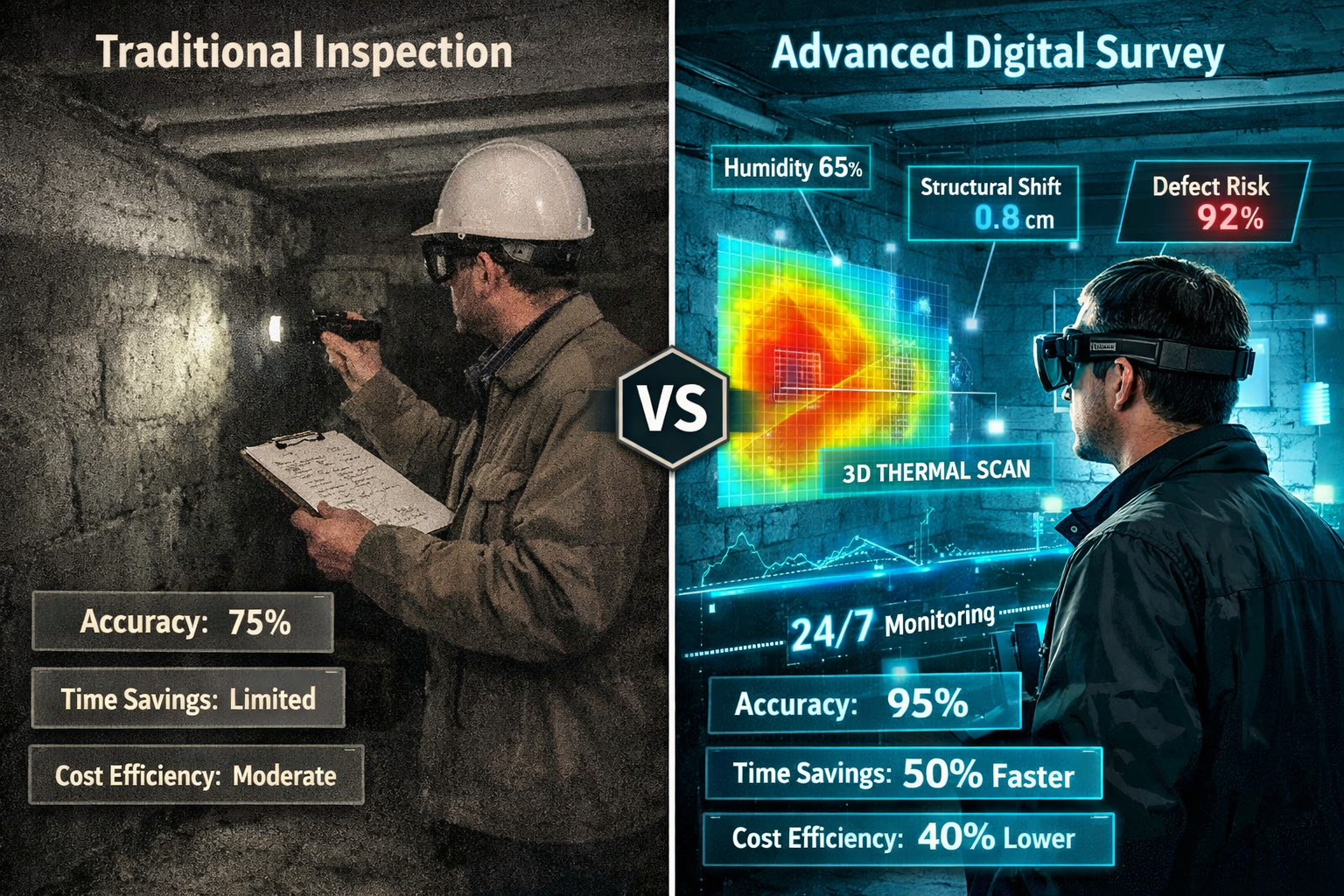
Traditional building surveys have historically depended on the surveyor's expertise, visual inspection, and manual testing equipment like moisture meters and spirit levels. While experienced professionals can identify many defects through these methods, they face inherent limitations: inspections capture conditions at a single moment in time, access restrictions prevent examination of concealed areas, and human observation cannot detect gradual changes or intermittent issues.
The Sensor Revolution in Property Assessment
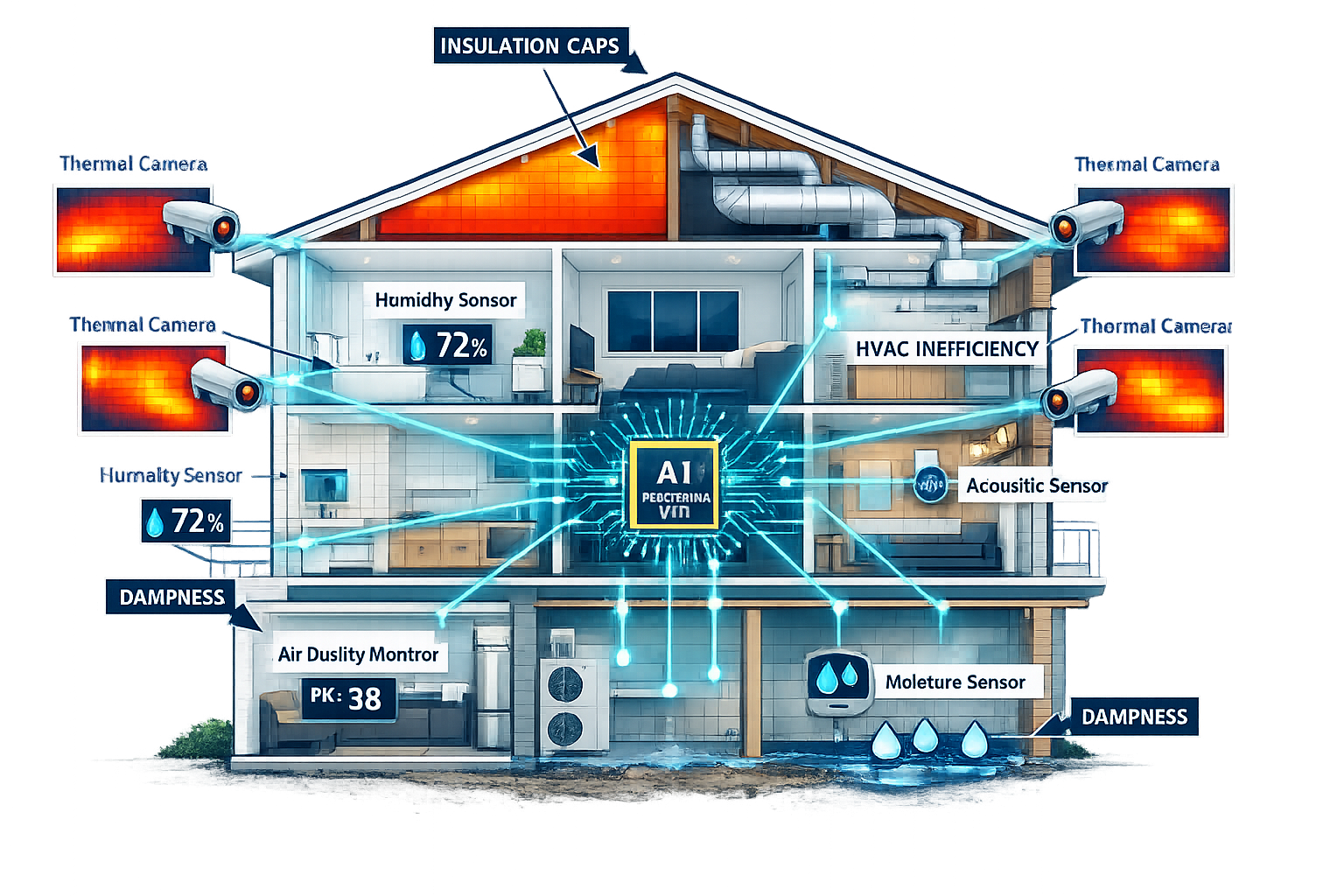
The integration of IoT sensor networks into building surveys addresses these fundamental limitations. Smart occupancy sensors, environmental monitors, and acoustic detection systems are becoming standard equipment in comprehensive property assessments, particularly for commercial building surveys and complex residential properties [1].
These advanced sensors now monitor multiple environmental parameters simultaneously:
- Thermal sensors detect temperature variations that indicate insulation defects, air leakage, or hidden water damage
- Humidity monitors track moisture levels in walls, ceilings, and foundations to identify dampness before visible signs appear
- Air quality sensors measure pollutants, VOCs, and particulate matter that may indicate ventilation problems or material degradation
- Acoustic sensors detect unusual sounds from structural movement, water flow, or mechanical systems
- Vibration monitors identify foundation settlement or structural stress patterns
Multi-Dimensional Data Collection
Unlike traditional surveys that provide a snapshot assessment, sensor-based monitoring creates a temporal data profile of building performance. A surveyor conducting a Level 3 building survey can now install temporary sensor networks that collect data over several days or weeks, revealing patterns invisible during a single visit.
For example, temperature and humidity sensors might detect that moisture levels spike during specific weather conditions or times of day, pinpointing intermittent leaks or condensation issues. This longitudinal approach transforms building surveys from static reports into dynamic assessments that capture how properties actually perform under varying conditions.
Integration with Traditional Survey Methods
Real-Time Sensors and Tech in 2026 Building Surveys: Enhancing Defect Detection for Accurate Valuations doesn't replace traditional surveyor expertise—it amplifies it. Experienced professionals combine sensor data with physical inspection, structural knowledge, and contextual understanding to deliver comprehensive assessments. When a thermal sensor detects an anomaly, the surveyor investigates the physical cause, determines severity, and recommends appropriate remediation.
This hybrid approach proves particularly valuable for properties with known complications. When buyers ask "do I need a survey on a new build," sensor technology can verify that recently constructed properties meet performance specifications and identify construction defects before warranty periods expire.
How Real-Time Sensors Enhance Defect Detection in Complex Properties
Complex properties—whether historic buildings, large commercial structures, or properties with previous renovations—present unique challenges for accurate defect detection. Multiple building phases, concealed structural elements, and aging systems create numerous opportunities for hidden problems that impact valuations. Real-time sensor technology addresses these challenges through continuous monitoring and multi-parameter analysis.
Temperature Monitoring for Structural and Insulation Issues
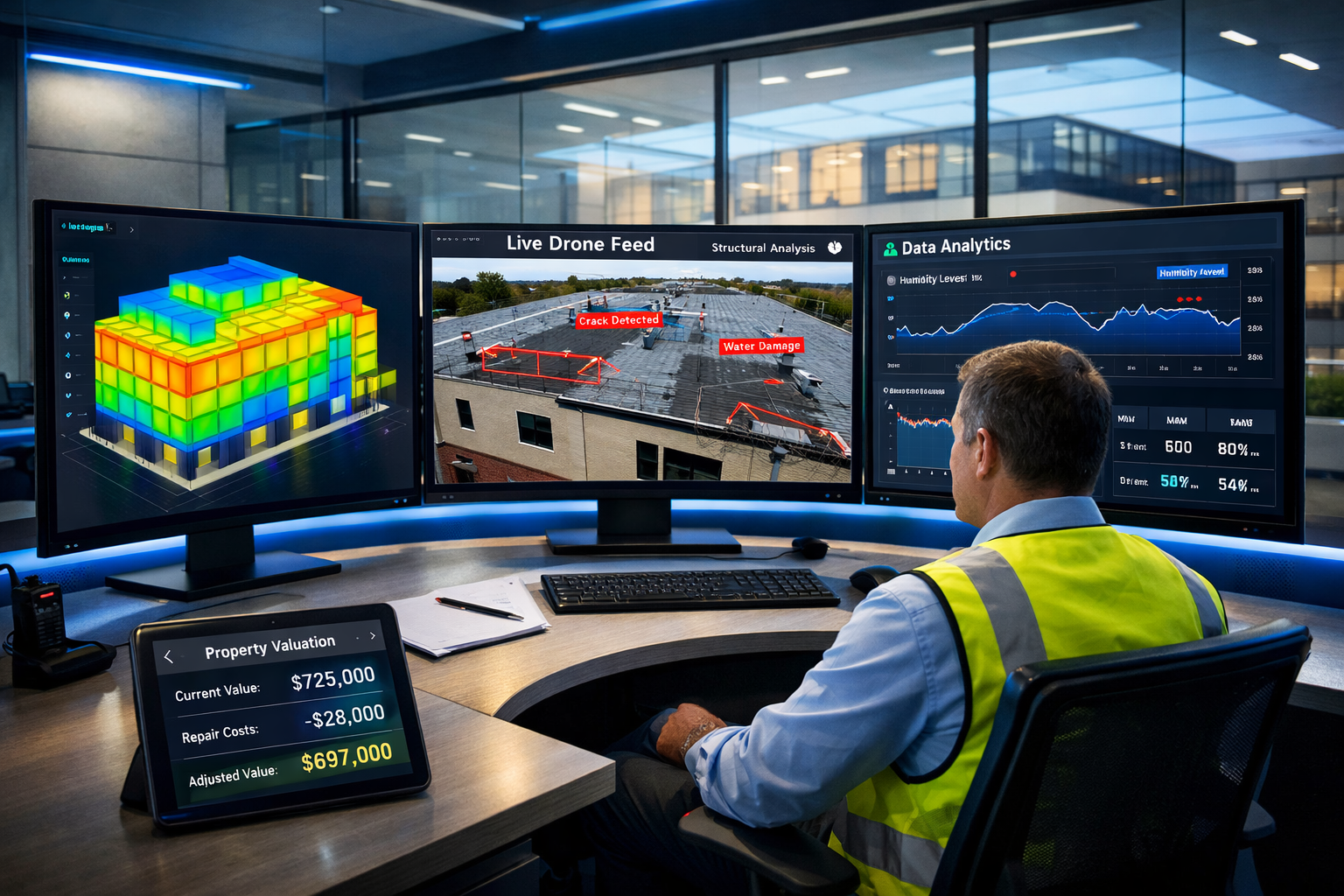
Thermal sensors deployed strategically throughout a property create detailed heat maps that reveal:
- Insulation gaps where heat loss occurs, indicating energy efficiency problems that affect operating costs and property values
- Thermal bridging at structural connections where cold spots suggest construction defects
- Hidden water damage as moisture-affected areas display different thermal signatures than dry materials
- HVAC system inefficiencies when temperature distribution doesn't match design specifications
Advanced thermal imaging integrated with drone technology enables roof surveys that identify membrane defects, ponding water, and insulation problems without physical access to dangerous areas. Drones equipped with thermal cameras can survey large commercial roofs in hours rather than days, capturing comprehensive data that would require extensive scaffolding or lift equipment using traditional methods [2].
Humidity and Moisture Detection Systems
Moisture-related defects represent the most common and costly building problems, from rising damp in foundations to roof leaks and condensation issues. Real-time humidity sensors provide early warning systems that detect problems before they cause visible damage:
Continuous monitoring tracks humidity levels in vulnerable areas like basements, bathrooms, and exterior walls, establishing baseline conditions and flagging deviations that indicate developing problems. When humidity readings exceed threshold levels, surveyors receive immediate alerts to investigate potential water infiltration or ventilation failures.
Spatial mapping using multiple sensors reveals moisture patterns across entire properties. A network of sensors might show that humidity increases progressively from one end of a building to another, suggesting a specific leak source or drainage problem. This spatial intelligence guides targeted investigation rather than expensive exploratory work.
Seasonal variation analysis identifies problems that only occur during specific weather conditions. Sensors operating over several weeks can detect that moisture levels spike during heavy rain (indicating external water penetration) or cold weather (suggesting condensation from inadequate ventilation or insulation).
Air Quality Monitoring for Hidden Defects
Environmental sensors that monitor air quality parameters provide insights into building defects that traditional surveys might miss entirely:
- Elevated CO₂ levels indicate inadequate ventilation, suggesting HVAC system failures or building envelope problems
- VOC detection may reveal hidden mold growth, material degradation, or contamination from previous uses
- Particulate matter spikes can indicate deteriorating insulation materials, pest activity, or structural dust from movement
- Radon monitoring in basements and ground floors identifies health hazards that affect property values and require remediation
These air quality metrics prove particularly valuable for commercial building surveys where indoor environmental quality directly impacts occupant health, productivity, and regulatory compliance [1].
Acoustic and Vibration Sensing
Acoustic sensors add another dimension to defect detection by identifying problems through sound:
- Water flow detection behind walls or under floors reveals hidden leaks before moisture sensors detect elevated humidity
- Structural movement sounds like creaking or cracking indicate settlement, timber decay, or load-bearing issues
- Mechanical system noise patterns reveal equipment problems or installation defects
- Pest activity in concealed spaces can be detected through characteristic sounds
Combined with vibration monitoring, these sensors create a comprehensive picture of building behavior that extends far beyond what visual inspection alone can achieve.
AI-Powered Analytics: Transforming Sensor Data into Actionable Valuation Intelligence
The true power of Real-Time Sensors and Tech in 2026 Building Surveys: Enhancing Defect Detection for Accurate Valuations emerges when artificial intelligence processes the massive data streams these sensors generate. Raw sensor readings alone provide limited value—AI analytics transform this data into actionable intelligence that directly informs property valuations and investment decisions.
Predictive Analytics for Maintenance and Defect Forecasting
AI platforms analyze historical sensor data alongside building characteristics to predict when defects will likely occur and estimate their severity. This predictive capability fundamentally changes how surveyors assess properties and how valuers account for future maintenance costs [4].
Machine learning algorithms identify patterns that precede common building failures:
- Gradual humidity increases that historically lead to structural timber decay within 6-12 months
- Temperature fluctuation patterns that correlate with HVAC system failures requiring replacement
- Air quality degradation trends that indicate developing mold problems before visible growth appears
- Vibration signatures that suggest foundation movement or structural stress accumulation
These predictions enable surveyors to flag potential issues with specific timeframes and probability estimates, allowing valuers to adjust property values based on anticipated maintenance costs rather than simply reporting current conditions.
Automated Defect Classification and Severity Assessment
AI-powered image recognition combined with sensor data automatically classifies defects and assesses severity levels. When thermal imaging reveals a cold spot, AI algorithms compare the thermal signature against databases of known defect patterns to suggest probable causes—insulation gap, air leakage, or moisture infiltration—and estimate repair costs.
This automation significantly reduces the time surveyors spend on administrative tasks. Rather than manually reviewing thousands of sensor readings and images, AI systems flag anomalies and generate preliminary assessments that surveyors then verify and contextualize. Industry data suggests AI automation reduces manual reporting time by up to 35%, allowing surveyors to complete more thorough inspections in less time [2].
Data Consolidation from Multiple Sources
One of the biggest challenges in modern building surveys is data fragmentation. Sensor readings, drone imagery, thermal scans, moisture readings, and physical inspection notes often exist in separate systems, preventing comprehensive analysis. More than 60% of IT leaders in the construction and surveying sectors launched major projects in 2026 to consolidate data from multiple sources into unified platforms [5].
Integrated analytics platforms now combine:
- Real-time sensor data streams from IoT devices
- High-resolution imagery from drone surveys
- Building Information Models (BIM) with as-built documentation
- Historical maintenance records and previous survey reports
- Environmental data like weather patterns and ground conditions
AI algorithms analyze these consolidated datasets to identify correlations invisible when examining individual data sources. For example, the system might discover that moisture problems correlate with specific wind directions, suggesting a particular exterior wall section has weather-sealing defects.
Digital Twin Technology for Comprehensive Property Modeling
Digital twins—virtual replicas of physical buildings that update in real-time based on sensor data—represent the cutting edge of building survey technology in 2026. These dynamic models integrate 3D geometry, material properties, system specifications, and live performance data to create comprehensive property intelligence platforms.
For complex valuations, digital twins enable:
- Scenario modeling that predicts how defects will progress under different conditions
- Cost-benefit analysis of various repair strategies based on predicted building behavior
- Performance benchmarking against similar properties to identify underperforming systems
- Stakeholder visualization that helps buyers, lenders, and investors understand building conditions through interactive 3D models
When conducting valuation assessments, surveyors can demonstrate how specific defects impact property value by showing their effects within the digital twin environment, making complex technical issues accessible to non-specialist audiences.
Edge-AI Processing for Instant Detection
Rather than transmitting all sensor data to cloud platforms for analysis, edge-AI processing enables real-time defect detection directly at the sensor level. This approach reduces latency, lowers data transmission costs, and enables immediate alerts when critical issues are detected [1].
Edge-AI sensors can:
- Instantly flag temperature or humidity readings that exceed safe thresholds
- Detect acoustic signatures indicating active water leaks or structural movement
- Identify air quality hazards requiring immediate attention
- Trigger alerts when vibration patterns suggest structural distress
This real-time capability proves particularly valuable for monitoring surveys of properties with known structural issues, where early warning of deterioration enables timely intervention before minor problems become major defects.
Practical Applications: Real-Time Sensors in Different Property Types
The implementation of Real-Time Sensors and Tech in 2026 Building Surveys: Enhancing Defect Detection for Accurate Valuations varies significantly depending on property type, complexity, and survey objectives. Understanding these practical applications helps property professionals determine when sensor technology provides the greatest value.
Residential Properties: Enhanced Pre-Purchase Surveys
For residential buyers commissioning Level 3 surveys, sensor technology proves particularly valuable when:
Purchasing older properties where hidden defects are more likely. Temporary sensor networks installed for 1-2 weeks before the physical survey capture data on moisture patterns, temperature variations, and air quality that reveal concealed problems. This extended monitoring period identifies intermittent issues that might not be apparent during a single-day inspection.
Assessing properties with known issues. When buyers are considering properties with disclosed defects—previous flooding, structural repairs, or damp problems—sensor data verifies whether remediation work was effective. Humidity sensors confirm that previously damp areas now maintain normal moisture levels, while thermal imaging verifies that structural repairs don't create thermal bridging or insulation gaps.
Evaluating energy efficiency. As energy costs remain a significant concern in 2026, thermal sensor data quantifies heat loss through walls, roofs, windows, and doors. This information helps buyers estimate future heating costs and prioritize improvement projects, directly affecting property valuations.
Commercial Properties: Comprehensive Asset Assessment
Commercial building surveys benefit even more substantially from sensor technology due to larger building sizes, complex systems, and higher financial stakes:
Multi-tenant buildings require comprehensive environmental monitoring to verify that HVAC systems maintain appropriate conditions throughout the property. Sensor networks deployed across multiple floors and zones identify areas with inadequate heating, cooling, or ventilation—issues that affect tenant satisfaction, lease renewals, and property values.
Industrial properties with specialized environmental requirements use continuous monitoring to verify conditions meet operational specifications. Temperature and humidity control in warehouses, manufacturing facilities, or storage buildings directly impacts their suitability for specific uses and therefore their market value.
Retail properties employ occupancy sensors and environmental monitoring to assess building performance under actual operating conditions. This data reveals whether systems can maintain comfortable conditions during peak occupancy periods and identifies efficiency improvements that reduce operating costs.
Historic and Listed Buildings: Non-Invasive Assessment
Sensor technology provides particular value for historic properties where invasive investigation methods are restricted or prohibited:
Non-destructive monitoring using wireless sensors avoids damaging historic fabric while still gathering comprehensive condition data. Humidity sensors track moisture movement through historic walls without drilling holes, while thermal imaging identifies structural problems without removing finishes.
Environmental monitoring verifies that heating, ventilation, and humidity control systems maintain conditions that preserve historic materials. This documentation proves essential for insurance purposes and helps owners demonstrate proper stewardship to heritage authorities.
Structural movement tracking using precision sensors detects settlement, deflection, or other changes that might indicate deterioration requiring intervention. Early detection enables timely repairs that prevent minor issues from becoming major conservation projects.
New Build Properties: Quality Verification
Even new construction benefits from sensor-based surveys. Buyers asking "do I need a survey on a new build" should consider that sensor technology can:
Verify construction quality by confirming that insulation, air-sealing, and HVAC systems perform as designed. Thermal imaging identifies construction defects like missing insulation or air leakage paths before they cause long-term problems.
Detect early defects during warranty periods when builders remain responsible for repairs. Moisture sensors identify roof leaks, plumbing issues, or condensation problems while coverage remains in effect.
Document baseline conditions for future reference. Sensor data from a new property establishes performance benchmarks that help identify deterioration over time, supporting maintenance planning and future valuations.
Cost-Benefit Analysis: When Sensor Technology Justifies the Investment
While Real-Time Sensors and Tech in 2026 Building Surveys: Enhancing Defect Detection for Accurate Valuations offers significant advantages, property professionals must consider when the additional cost justifies the enhanced detection capabilities.
Investment Thresholds and Property Values
Sensor-enhanced surveys typically add 15-30% to standard survey costs, depending on property size, complexity, and monitoring duration. This investment makes most sense when:
- Property values exceed £500,000, where hidden defects could represent substantial financial exposure
- Properties show visible signs of problems requiring detailed investigation
- Buyers are considering properties with disclosed defects and want verification of remediation effectiveness
- Commercial properties where tenant satisfaction and operating costs significantly impact investment returns
- Properties in locations with known environmental challenges (flood zones, areas with ground movement, high radon regions)
Risk Mitigation Value
The cost of sensor-enhanced surveys should be compared against the potential costs of undetected defects:
| Defect Type | Average Repair Cost | Detection Probability Traditional Survey | Detection Probability Sensor-Enhanced Survey |
|---|---|---|---|
| Hidden roof leak | £3,000-£8,000 | 40% | 85% |
| Concealed damp/moisture | £2,500-£12,000 | 50% | 90% |
| Insulation defects | £4,000-£15,000 | 30% | 80% |
| HVAC inefficiency | £5,000-£20,000 | 45% | 85% |
| Structural movement | £10,000-£50,000+ | 60% | 90% |
When the cost of a single undetected defect could exceed £5,000-£10,000, spending an additional £500-£1,500 on sensor technology provides substantial risk mitigation value.
Time Savings and Faster Transactions
Reduced survey completion times represent another significant benefit. Traditional comprehensive surveys of complex properties might require multiple visits over several weeks as surveyors wait for specific weather conditions or arrange access to difficult areas. Sensor networks and drone surveys can reduce this timeline by 30-40%, accelerating property transactions [2].
In competitive markets where delays can result in lost opportunities, faster survey completion provides tangible value beyond the direct cost comparison.
Enhanced Valuation Accuracy
For property valuations, sensor data reduces uncertainty by providing objective, quantifiable evidence of building conditions. This enhanced accuracy benefits:
Mortgage lenders who can more confidently assess security values and lending risks
Investors making portfolio decisions based on accurate property condition assessments
Sellers who can demonstrate property quality through comprehensive data rather than subjective claims
Buyers negotiating purchase prices based on documented defects and repair cost estimates
The improved accuracy reduces the risk of valuation disputes, failed transactions, and post-purchase surprises that damage trust in property professionals.
Implementation Challenges and Practical Considerations
Despite the clear benefits of Real-Time Sensors and Tech in 2026 Building Surveys: Enhancing Defect Detection for Accurate Valuations, property professionals face several practical challenges when implementing these technologies.
Data Privacy and Security Concerns
IoT sensor networks that continuously monitor buildings generate sensitive data about property conditions, occupancy patterns, and system performance. Property owners and occupants may have legitimate concerns about:
- Data ownership: Who controls the sensor data, and how long is it retained?
- Privacy implications: Do occupancy sensors or acoustic monitoring intrude on privacy?
- Data security: How is sensor data protected from unauthorized access or cyber attacks?
- Future disclosure: Must sensor data be disclosed to future buyers or tenants?
Professional surveyors must establish clear protocols for data handling, obtain appropriate permissions before deploying sensors, and ensure compliance with data protection regulations.
Technical Expertise Requirements
Effective use of sensor technology requires new skill sets beyond traditional surveying expertise:
- Understanding IoT sensor specifications, capabilities, and limitations
- Interpreting complex data sets and AI-generated analytics
- Operating drone equipment safely and effectively
- Managing digital twin platforms and BIM integration
- Troubleshooting sensor network connectivity and calibration issues
Many surveying firms invest in ongoing training programs or partner with technology specialists to bridge these expertise gaps. Professional bodies increasingly offer certification programs in construction technology and digital surveying methods.
Sensor Calibration and Data Quality
Measurement accuracy depends on proper sensor calibration and installation. Poorly positioned sensors, interference from other equipment, or calibration drift can generate misleading data that undermines survey accuracy rather than enhancing it.
Best practices include:
- Regular calibration checks against reference instruments
- Redundant sensors in critical locations to verify readings
- Environmental controls to prevent interference (electromagnetic, thermal, mechanical)
- Documentation of sensor specifications, installation locations, and calibration history
Integration with Traditional Survey Workflows
Workflow integration presents practical challenges as firms transition from traditional methods to sensor-enhanced approaches:
- Scheduling sensor deployment before physical inspections
- Coordinating access for sensor installation and retrieval
- Training administrative staff on data management systems
- Updating report templates to incorporate sensor data and analytics
- Managing client expectations about extended timelines for sensor monitoring
Successful implementation typically involves phased adoption, starting with pilot projects on complex properties where sensor benefits clearly justify the additional effort.
Cost Management and Service Pricing
Pricing sensor-enhanced surveys requires careful consideration of:
- Equipment purchase or rental costs
- Additional time for sensor deployment and data analysis
- Technology platform subscriptions and data storage costs
- Training and certification expenses
- Insurance implications for drone operations and technology liability
Transparent pricing models that clearly communicate the value proposition help clients understand why sensor-enhanced surveys cost more than traditional approaches.
Future Trends: The Next Evolution in Building Survey Technology
As Real-Time Sensors and Tech in 2026 Building Surveys: Enhancing Defect Detection for Accurate Valuations becomes standard practice, several emerging trends will further transform the industry over the next 3-5 years.
Physical AI and Autonomous Inspection Systems
Physical AI—robots and devices that autonomously detect and respond to building conditions—represents the next frontier in survey technology [1]. Autonomous inspection robots equipped with multiple sensor types can navigate buildings independently, capturing comprehensive data without human supervision:
- Crawling robots that inspect confined spaces like roof voids, underfloor areas, and service ducts
- Climbing robots that examine exterior walls and facades on tall buildings
- Swimming robots that inspect water tanks, drainage systems, and underground structures
These systems will enable inspection of areas currently inaccessible or dangerous for human surveyors, revealing defects that traditional methods cannot detect.
Blockchain for Survey Data Integrity
Blockchain technology will increasingly be used to create immutable records of building condition data, ensuring that survey findings cannot be altered or disputed:
- Time-stamped sensor readings with cryptographic verification
- Permanent records of building conditions at specific dates
- Transparent audit trails showing how valuations were determined
- Smart contracts that automatically trigger actions based on detected conditions
This technology will enhance trust in survey data and reduce disputes over property conditions.
Augmented Reality for On-Site Assessment
AR smart glasses will overlay sensor data, historical information, and AI-generated insights directly onto surveyors' field of view during physical inspections:
- Thermal imaging overlays showing temperature variations on visible surfaces
- Historical photos and previous survey findings displayed in context
- Structural analysis and load calculations visible on building elements
- Real-time translation of sensor readings into defect probability scores
This technology will make complex technical data immediately accessible during inspections, improving decision-making and reducing the need for post-inspection analysis.
Standardization and Regulatory Recognition
As sensor technology matures, industry standardization will emerge:
- Standardized sensor specifications and calibration protocols
- Recognized certifications for technology-enhanced surveys
- Regulatory requirements for sensor monitoring in specific property types
- Insurance industry recognition of sensor-enhanced surveys for premium calculations
This standardization will reduce implementation barriers and increase client confidence in technology-enhanced survey methods.
Conclusion
Real-Time Sensors and Tech in 2026 Building Surveys: Enhancing Defect Detection for Accurate Valuations represents a fundamental shift in how property professionals assess building conditions and determine property values. The convergence of IoT sensors, AI analytics, drone technology, and digital twin platforms enables detection of defects that traditional visual inspections might miss, providing earlier warnings of developing problems and more accurate assessments of property conditions.
For property buyers, investors, and lenders navigating today's recovering market, sensor-enhanced surveys offer substantial risk mitigation by identifying hidden defects before they become costly surprises. The technology proves particularly valuable for complex properties, older buildings, and high-value assets where comprehensive condition assessment justifies the additional investment.
Key Implementation Insights
✅ Temperature, humidity, and air quality sensors provide continuous monitoring that reveals intermittent and developing defects invisible during single-visit inspections
✅ AI-powered analytics transform raw sensor data into actionable intelligence, predicting future maintenance needs and quantifying repair costs
✅ Drone-based surveying combined with thermal imaging enables comprehensive property assessment in less time with greater safety
✅ Digital twin technology integrates multiple data sources to create dynamic property models that support accurate valuations
✅ Edge-AI processing delivers real-time defect detection, enabling immediate alerts for critical issues
Actionable Next Steps
For property buyers: When commissioning a building survey, ask surveyors about sensor-enhanced options, particularly for properties over £500,000 or those with known issues. The modest additional cost provides substantial peace of mind and negotiating power.
For property professionals: Invest in training and partnerships that build sensor technology capabilities. Start with pilot projects on complex properties where the value proposition is clearest, then expand as expertise develops.
For investors and lenders: Require sensor-enhanced surveys for high-value or complex properties where accurate condition assessment significantly impacts investment decisions. The improved accuracy reduces risk and supports better lending decisions.
For property owners: Consider periodic sensor monitoring as part of maintenance programs, particularly for commercial properties where early defect detection prevents expensive emergency repairs and maintains tenant satisfaction.
The technology that seemed futuristic just a few years ago has become practical, affordable, and increasingly essential for comprehensive property assessment. As sensor networks become more sophisticated and AI analytics more powerful, early adopters will gain competitive advantages through faster, more accurate, and more comprehensive building surveys that protect clients and enhance professional reputations.
The future of building surveys isn't about replacing human expertise—it's about augmenting professional judgment with objective data, continuous monitoring, and predictive intelligence that together deliver unprecedented insight into property conditions and values.
References
[1] Security Technology Trends – https://www.pelco.com/blog/security-technology-trends
[2] Construction Technology Trends News – https://companycam.com/resources/blog/construction-technology-trends-news
[3] Technology For Early Property Insight In 2026 Building Surveys Reducing Delays In Complex Valuations – https://nottinghillsurveyors.com/blog/technology-for-early-property-insight-in-2026-building-surveys-reducing-delays-in-complex-valuations
[4] Construction Technology – https://www.permitflow.com/blog/construction-technology
[5] The Age Of Innovation 5 Game Changing Trends Reshaping Construction Engineering In 2026 – https://blog.ifs.com/the-age-of-innovation-5-game-changing-trends-reshaping-construction-engineering-in-2026/
