
The property surveying industry faces a persistent challenge: complex valuations often experience significant delays due to manual data collection, fragmented information systems, and time-intensive analysis processes. In 2026, however, a technological revolution is transforming how surveyors approach building assessments, particularly for non-standard constructions like high-rise developments and adapted homes. Technology for Early Property Insight in 2026 Building Surveys: Reducing Delays in Complex Valuations represents not just an incremental improvement, but a fundamental shift in how property professionals deliver accurate, timely assessments that keep transactions moving forward.
The stakes are substantial. Morgan Stanley projects that AI adoption could unlock $34 billion in efficiency gains for real estate by 2030 [5], with property professionals racing to implement tools that provide earlier insight into structural conditions, valuation parameters, and risk factors. For surveyors conducting Level 3 building surveys or complex commercial building surveys, these technologies offer practical solutions to longstanding workflow bottlenecks.
Key Takeaways
- 🚀 AI adoption has tripled among property professionals in 18 months, with 60% of companies now using AI tools compared to just 20% in late 2024
- ⏱️ Predictive analytics can flag schedule delays months in advance, allowing proactive intervention rather than reactive problem-solving
- 📊 Data consolidation platforms provide real-time visibility across project performance, costs, and market conditions—creating competitive advantages for early adopters
- 🏗️ Advanced site screening tools now complete analyses in 48 hours that previously required two weeks of manual engineering work
- 🤖 Agentic AI systems autonomously monitor portfolios, identify valuation anomalies, and assess investment risk based on market trends
Understanding Technology for Early Property Insight in 2026 Building Surveys
The Evolution of Building Survey Technology
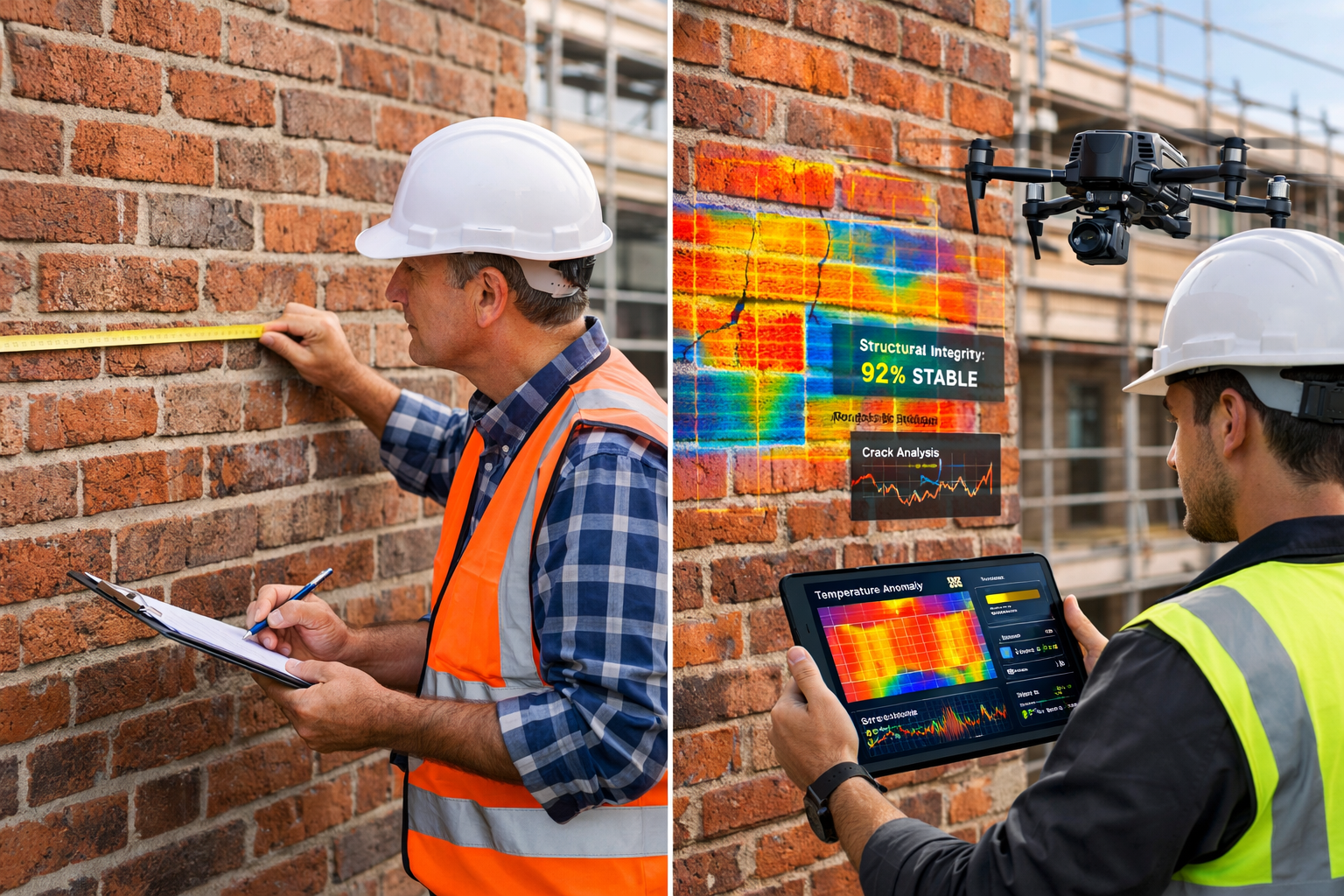
Building surveying has traditionally been a document-heavy, time-intensive profession requiring extensive site visits, manual measurements, and weeks of report compilation. While the human expertise of qualified property surveyors remains irreplaceable, technology now handles the administrative burden that once consumed 40-60% of project timelines.
In 2026, the surveying landscape has shifted dramatically:
Traditional Approach:
- Manual site measurements with tape measures and laser tools
- Handwritten notes compiled into reports over several days
- Sequential workflow: inspect → photograph → analyze → write → review
- Limited data sharing between stakeholders
- Reactive identification of issues during physical inspection
2026 Technology-Enhanced Approach:
- Drone-based aerial surveys capturing comprehensive site data in hours
- AI-powered document analysis extracting key information from historical records
- Parallel workflows with real-time data synchronization
- Cloud-based platforms enabling instant stakeholder collaboration
- Predictive analytics identifying potential issues before site visits
This transformation directly addresses the delays that plague complex valuations, particularly for properties with non-standard construction, heritage features, or adaptive reuse elements.
Why Complex Valuations Experience Delays
Complex property valuations face unique challenges that extend typical survey timeframes:
🏢 Non-Standard Construction Materials
Properties built with unconventional materials or methods require specialized assessment protocols and often additional testing.
🔍 Limited Comparable Data
Unique properties lack sufficient market comparables, requiring more extensive analysis and justification.
📋 Multi-Stakeholder Coordination
High-value or commercial properties involve lenders, investors, planning authorities, and multiple consultants—each adding coordination overhead.
⚠️ Hidden Defects Discovery
Complex buildings often reveal unexpected issues during inspection, triggering additional investigation and specialist consultations.
📄 Regulatory Compliance Verification
Adapted buildings and change-of-use properties require extensive compliance documentation review.
Technology for Early Property Insight in 2026 Building Surveys: Reducing Delays in Complex Valuations specifically targets these pain points through upfront data gathering, automated analysis, and predictive risk assessment.
AI and Predictive Analytics: Accelerating Early Property Assessment
Agentic AI for Portfolio Monitoring and Valuation
The emergence of agentic AI—autonomous artificial intelligence with enhanced decision-making capabilities—represents a significant advancement for property professionals. Unlike traditional AI that requires constant human direction, agentic systems independently monitor conditions, identify patterns, and flag anomalies.
For building surveys and valuations, agentic AI delivers:
Automated Portfolio Tracking 📊
Systems continuously monitor occupancy rates, rental income patterns, and maintenance records across property portfolios, identifying outliers that may indicate valuation issues [3].
Comparative Market Analysis 💰
AI algorithms analyze thousands of comparable properties, adjusting for location, condition, and market timing to provide valuation benchmarks that would take human analysts days to compile.
Risk Assessment Automation ⚠️
Machine learning models evaluate financial data, market trends, and property-specific factors to calculate investment risk scores and highlight concerns requiring human expert review.
Anomaly Detection 🔍
Pattern recognition identifies unusual rent levels, unexpected maintenance costs, or occupancy fluctuations that may signal underlying structural or market issues.
These capabilities prove particularly valuable when conducting RICS valuations for complex properties where traditional comparable analysis proves challenging.
Predictive Analytics Reducing Project Delays
Perhaps the most transformative application of Technology for Early Property Insight in 2026 Building Surveys involves predictive analytics that flag schedule delays months in advance [4]. This proactive capability fundamentally changes project management dynamics.
Modern predictive systems analyze:
| Data Input | Predictive Output | Benefit |
|---|---|---|
| Historical project timelines | Delay probability scores | Early resource allocation |
| Weather patterns and seasonal trends | Optimal inspection scheduling | Reduced weather-related delays |
| Contractor availability and performance | Realistic completion estimates | Accurate client expectations |
| Material supply chain data | Procurement risk assessment | Proactive sourcing strategies |
| Regulatory approval timelines | Permit delay forecasting | Earlier application submission |
For surveyors conducting structural surveys, these insights enable proactive communication with clients about realistic timelines and potential obstacles—building trust through transparency rather than delivering unwelcome surprises.
AI-Powered Document Analysis and Data Extraction
One of the most immediate time-savers in 2026 involves AI systems that automatically process historical building records, planning documents, and previous survey reports. What once required hours of manual review now happens in minutes.
Optical Character Recognition (OCR) advances enable systems to extract key information from decades-old paper documents, building permits, and handwritten notes. AI algorithms then categorize findings, identify discrepancies, and highlight areas requiring surveyor attention.
For example, when assessing a converted Victorian property, AI systems can:
- Extract all historical planning permissions and identify unauthorized alterations
- Compare original architectural drawings against current floor plans
- Flag potential Party Wall Act implications from neighboring property records
- Identify asbestos survey requirements based on construction dates and materials
This upfront intelligence gathering means surveyors arrive at site visits already informed about likely issues, enabling more focused, efficient inspections. The technology complements rather than replaces professional judgment—as industry experts note, "the interpretation of findings, assessment of risk, and provision of tailored advice require human judgment and professional expertise" [2].
Advanced Site Assessment Technologies for Non-Standard Construction
Drone-Based Surveys and Thermal Imaging
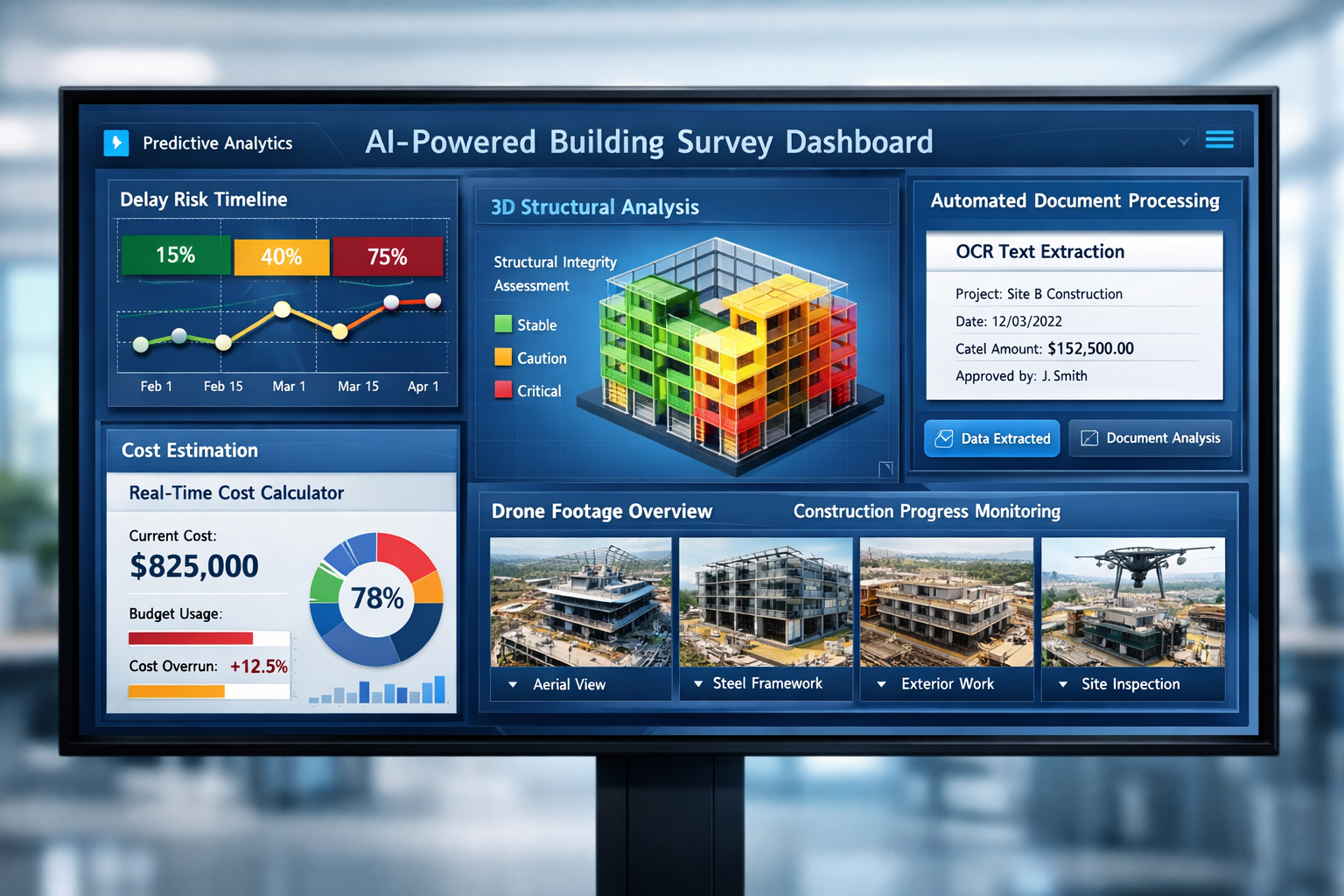
Unmanned aerial vehicles (UAVs) have revolutionized how surveyors assess building exteriors, particularly for high-rise developments and properties with difficult-to-access areas. In 2026, construction monitoring AI—including drone-based progress capture and computer vision-powered schedule comparison—is seeing widespread adoption [1].
Modern drone surveys deliver:
Comprehensive Exterior Documentation 🚁
High-resolution photography captures every elevation, roof section, and architectural detail without scaffolding or cherry pickers—reducing both cost and time.
Thermal Imaging Analysis 🌡️
Infrared cameras identify heat loss, moisture ingress, and insulation deficiencies invisible to conventional inspection methods. This proves invaluable for damp surveys and energy efficiency assessments.
3D Modeling and Photogrammetry 📐
Hundreds of overlapping images generate precise 3D models, enabling accurate measurements and virtual site revisits without additional physical access.
Progress Monitoring ⏱️
For new builds and renovations, regular drone flights document construction progress, comparing actual work against planned schedules to identify delays early.
Safety Enhancement ✅
Eliminating the need for surveyors to access dangerous roof areas or unstable structures significantly reduces injury risk.
For properties requiring subsidence surveys or monitoring surveys, drone technology provides baseline documentation and enables efficient periodic reassessment without repeated physical access arrangements.
Virtual and Augmented Reality for Complex Properties
Visualization technologies have moved beyond novelty status to become practical tools for reducing design errors and accelerating decision-making. Developers and surveyors now use virtual and augmented reality to visualize spaces before construction, strengthening communication among owners, architects, and contractors [4].
Virtual Reality (VR) Applications:
- Immersive property tours enabling remote stakeholder review
- Pre-construction visualization of proposed alterations
- Training simulations for surveyor skill development
- Client presentations that improve understanding of technical findings
Augmented Reality (AR) Applications:
- On-site overlay of building plans against actual construction
- Real-time measurement and annotation during inspections
- Visualization of hidden building elements (pipes, wiring, structural members)
- Collaborative remote inspections with off-site experts
These technologies prove particularly valuable for adapted homes and conversion projects where understanding spatial relationships and proposed changes challenges even experienced professionals. When conducting commercial building surveys, AR overlays help identify discrepancies between approved plans and actual construction—issues that might otherwise remain undetected until later project stages.
Advanced Site Screening for Development Feasibility
Technology for Early Property Insight in 2026 Building Surveys extends beyond existing buildings to development site assessment. Current AI systems can assess irregularly shaped parcels for buildable pad configurations, model truck ingress and egress geometry, and flag sites where specific infrastructure requirements are achievable—analysis that previously required civil engineering expertise [1].
This capability dramatically accelerates development feasibility studies:
Traditional Site Analysis Timeline:
- Week 1-2: Site visit and preliminary measurements
- Week 2-3: Civil engineer review and initial layout concepts
- Week 3-4: Refinement and feasibility report preparation
- Total: 3-4 weeks
AI-Enhanced Site Analysis Timeline:
- Day 1: Upload site survey and parameters
- Day 1-2: AI generates multiple layout scenarios with access analysis
- Day 2-3: Human expert review and refinement
- Total: 2-3 days
Development teams using AI workflow layers that connect site analysis directly to financial modeling can respond with site-specific cost matrices in 48 hours, compared to two weeks using manual analysis [1]. This speed advantage proves critical in competitive acquisition scenarios where rapid decision-making determines success.
Data Consolidation Platforms: Creating Real-Time Visibility
Integrated Project Management Systems
In 2026, firms outperforming the market consolidate project performance, labor costs, leasing activity, market conditions, and financial metrics into single, real-time views using modern platforms [4]. This data consolidation represents a competitive advantage that directly impacts survey delivery timelines.
Key Platform Capabilities:
Centralized Document Management 📁
All survey reports, photographs, specialist assessments, and correspondence stored in searchable, version-controlled repositories accessible to authorized stakeholders.
Automated Workflow Tracking 📊
Real-time visibility into survey progress, outstanding actions, and bottlenecks—enabling proactive management rather than reactive problem-solving.
Stakeholder Collaboration Tools 👥
Secure portals where clients, lenders, and consultants access relevant information without email chains or document version confusion.
Financial Integration 💷
Direct connection between survey findings, cost implications, and valuation adjustments—providing transparent audit trails for complex assessments.
Compliance Monitoring ✅
Automated tracking of regulatory requirements, certification expiry dates, and mandatory review intervals.
For surveyors managing multiple building survey projects simultaneously, these platforms eliminate the administrative overhead that once consumed significant professional time. The efficiency gains translate directly into faster turnaround times and improved client satisfaction.
Smart Building Systems and IoT Integration
The proliferation of Internet of Things (IoT) sensors in modern buildings creates unprecedented opportunities for ongoing property monitoring. Automated lighting, HVAC optimization, air-quality monitoring, and sensor-based maintenance alerts are becoming the new baseline for modern properties [4].
For surveyors, this sensor data provides:
Continuous Condition Monitoring 📡
Real-time data on temperature, humidity, air quality, and energy consumption reveals performance trends and emerging issues between formal inspections.
Predictive Maintenance Intelligence 🔧
Machine learning algorithms analyze sensor patterns to predict equipment failures before they occur, enabling proactive rather than reactive maintenance.
Energy Performance Verification ⚡
Actual consumption data validates design assumptions and identifies underperforming building systems requiring remediation.
Occupancy and Usage Patterns 👤
Understanding how spaces are actually used informs valuation assumptions and identifies optimization opportunities.
When conducting RICS home surveys on newer properties with smart building systems, accessing historical sensor data provides insights impossible to obtain through periodic physical inspections alone. This continuous intelligence stream enables more accurate condition assessments and valuation confidence.
Practical Implementation: Tools and Workflows for 2026 Surveyors

Essential Technology Stack for Modern Survey Practices
Building a technology-enhanced survey practice doesn't require massive capital investment. Strategic tool selection focusing on high-impact applications delivers immediate benefits:
Tier 1: Foundation Technologies (Essential)
- 📱 Mobile survey apps with offline capability and photo annotation
- ☁️ Cloud storage with client portal access
- 📧 Automated client communication and appointment scheduling
- 📊 Basic project management and workflow tracking
Tier 2: Efficiency Enhancers (High ROI)
- 🚁 Drone equipment or partnership with licensed operators
- 🌡️ Thermal imaging cameras for moisture and insulation assessment
- 📐 3D scanning equipment or photogrammetry software
- 🤖 AI-powered document analysis and report generation tools
Tier 3: Advanced Capabilities (Competitive Advantage)
- 🥽 AR/VR visualization platforms
- 📊 Predictive analytics and portfolio monitoring systems
- 🔗 IoT sensor integration and data analysis platforms
- 🏗️ BIM (Building Information Modeling) software integration
Most practices achieve significant efficiency gains by implementing Tier 1 and selectively adding Tier 2 technologies based on their specific client mix and property types. The key lies in choosing tools that integrate smoothly rather than creating additional data silos.
Workflow Optimization for Complex Valuations
Technology for Early Property Insight in 2026 Building Surveys: Reducing Delays in Complex Valuations requires rethinking traditional sequential workflows in favor of parallel processes:
Traditional Sequential Workflow:
- Initial client consultation
- Desktop research and document review
- Site inspection scheduling
- Physical site visit
- Specialist consultations (if issues discovered)
- Report writing
- Client review and questions
- Final report delivery
Optimized Parallel Workflow:
- Initial client consultation + automated document gathering
- AI-powered preliminary analysis running simultaneously with:
- Drone exterior survey (weather permitting)
- Historical records review
- Comparable property analysis
- Pre-inspection briefing identifying likely issues and required specialists
- Focused site visit with pre-booked specialists (if needed)
- Real-time data upload and preliminary findings shared
- Automated report generation with human expert review
- Interactive client review via collaboration platform
- Final report delivery
This parallel approach can reduce total timeline by 30-40% for complex properties while improving thoroughness through better preparation and specialist coordination.
Balancing Technology and Professional Expertise
While AI adoption accelerates—with 60% of property companies now using AI tools compared to 20% in late 2024 [5]—the profession remains fundamentally human-centered. Technology handles data processing, pattern recognition, and administrative tasks, but critical judgment calls require experienced professionals.
Tasks Well-Suited to Automation:
- ✅ Document scanning and information extraction
- ✅ Comparable property identification and preliminary analysis
- ✅ Measurement calculations and area computations
- ✅ Report formatting and standard clause insertion
- ✅ Appointment scheduling and client communication
- ✅ Regulatory compliance checking against databases
Tasks Requiring Human Expertise:
- 👤 Risk assessment and materiality judgment
- 👤 Client advice tailored to specific circumstances
- 👤 Negotiation and dispute resolution
- 👤 Unusual defect interpretation
- 👤 Professional liability decisions
- 👤 Ethical considerations and professional standards application
Successful practices in 2026 use technology to eliminate routine tasks, freeing surveyors to focus on the high-value professional judgment that clients actually pay for. As one industry analysis notes, "the interpretation of findings, assessment of risk, and provision of tailored advice require human judgment and professional expertise" [2]—technology augments rather than replaces this core value proposition.
Industry Trends Driving Technology Adoption
Market Pressures Accelerating Digital Transformation
Several converging factors make 2026 a pivotal year for technology adoption in property surveying:
E-commerce and Logistics Demand 📦
Industrial and logistics development is adopting AI faster than most asset classes due to e-commerce demand and nearshoring trends, with vacancy rates remaining below 5 percent in most major logistics corridors [1]. This sustained demand creates pressure for faster feasibility assessments and survey turnaround.
Competitive Transaction Timelines ⏰
In hot property markets, buyers who can complete due diligence faster gain competitive advantages. Surveyors offering technology-enhanced rapid turnaround attract more business.
Client Expectations Evolution 📱
Clients accustomed to instant digital experiences in other sectors now expect similar responsiveness from professional service providers, including real-time updates and online access to findings.
Talent Shortage Mitigation 👥
Technology enables smaller teams to handle larger workloads, addressing the industry's ongoing challenge of attracting and retaining qualified surveyors.
Regulatory Complexity 📋
Increasing building regulations and compliance requirements make manual tracking increasingly difficult—automated systems ensure nothing falls through the cracks.
Investment and ROI Considerations
The business case for technology investment has strengthened considerably. With AI adoption projected to unlock $34 billion in efficiency gains for real estate by 2030 [5], early adopters capture disproportionate advantages.
Typical ROI Timeline:
Year 1: Initial investment and learning curve
- Technology acquisition costs
- Staff training and workflow adjustment
- Temporary productivity dip during transition
- ROI: Neutral to slightly negative
Year 2: Efficiency gains materialize
- 20-30% reduction in administrative time
- 15-25% faster survey turnaround
- Improved client satisfaction and referrals
- ROI: 100-150% of technology investment
Year 3+: Competitive advantage compounds
- Market reputation for innovation and speed
- Premium pricing capability for rapid service
- Reduced staffing requirements for administrative tasks
- ROI: 200-300%+ of technology investment
Practices that delay adoption risk falling behind competitors who offer faster, more comprehensive service at similar or lower price points. The window for competitive advantage through early adoption is closing as technology becomes industry standard.
Overcoming Implementation Challenges
Common Obstacles and Solutions
Despite clear benefits, many surveying practices face hurdles implementing Technology for Early Property Insight in 2026 Building Surveys:
Challenge 1: Initial Cost Concerns 💰
Solution: Start with high-impact, low-cost tools (mobile apps, cloud storage) before investing in expensive equipment. Consider equipment sharing or specialist partnerships for occasional needs.
Challenge 2: Staff Resistance to Change 😟
Solution: Involve team members in technology selection, provide comprehensive training, and demonstrate how tools reduce frustrating administrative work rather than replacing professional judgment.
Challenge 3: Data Security and Client Confidentiality 🔒
Solution: Choose platforms with robust encryption, compliance certifications (ISO 27001, SOC 2), and clear data handling policies. Implement strong access controls and regular security audits.
Challenge 4: Technology Integration Complexity 🔧
Solution: Prioritize tools with open APIs and established integrations. Work with vendors offering implementation support and training.
Challenge 5: Keeping Pace with Rapid Change 🚀
Solution: Establish quarterly technology reviews, participate in industry forums, and maintain relationships with innovative vendors who provide early access to emerging capabilities.
Training and Skill Development
Maximizing technology value requires ongoing professional development. Modern surveyors need both traditional technical expertise and digital literacy:
Essential Digital Skills for 2026:
- Data analysis and interpretation
- 3D modeling and spatial visualization software
- Drone operation (or effective collaboration with operators)
- Cloud platform administration
- AI system training and output validation
- Digital communication and remote collaboration
Professional bodies increasingly offer technology-focused continuing professional development (CPD) programs. Practices should budget both time and resources for ongoing skill development to fully leverage their technology investments.
Future Outlook: What's Next for Survey Technology
Emerging Technologies on the Horizon
While 2026 represents a major inflection point, the pace of innovation continues accelerating:
Autonomous Site Inspection Robots 🤖
Ground-based robots equipped with sensors and cameras will conduct initial site surveys independently, with human surveyors reviewing findings and conducting detailed assessments of flagged areas.
Blockchain for Property Records 🔗
Distributed ledger technology will create tamper-proof property history records, dramatically reducing due diligence time and fraud risk.
Advanced Material Analysis 🔬
Portable spectrometry and other analytical tools will enable instant material identification and condition assessment without laboratory testing delays.
Generative AI for Report Writing ✍️
Next-generation AI will produce complete draft reports from surveyor notes and photographs, requiring only professional review and refinement rather than writing from scratch.
Digital Twin Integration 👯
Comprehensive digital replicas of buildings will enable continuous monitoring, predictive maintenance, and instant valuation updates based on real-time condition data.
Preparing for Continued Evolution
Practices that thrive through ongoing technological change share common characteristics:
Continuous Learning Culture 📚
Regular technology reviews, experimentation with new tools, and willingness to abandon approaches that no longer serve
Client-Centric Innovation 🎯
Technology choices driven by client needs and pain points rather than novelty for its own sake
Strategic Partnerships 🤝
Relationships with technology vendors, specialist consultants, and complementary service providers who extend capabilities without requiring full in-house investment
Data-Driven Decision Making 📊
Systematic tracking of efficiency metrics, client satisfaction, and financial performance to guide technology investment priorities
Balanced Approach ⚖️
Recognition that technology augments rather than replaces professional expertise—maintaining focus on the human judgment that defines professional value
Conclusion
Technology for Early Property Insight in 2026 Building Surveys: Reducing Delays in Complex Valuations represents a fundamental transformation in how property professionals deliver value. The convergence of AI-powered analytics, drone surveys, IoT sensors, and integrated data platforms enables surveyors to identify issues earlier, assess risks more accurately, and deliver comprehensive reports faster than ever before.
The evidence is compelling: 60% of property companies now use AI tools [5], predictive analytics flag delays months in advance [4], and advanced site screening completes analyses in 48 hours that previously required two weeks [1]. These aren't future possibilities—they're current realities reshaping competitive dynamics across the industry.
For surveyors conducting Level 3 building surveys, commercial assessments, or complex valuations, the message is clear: technology adoption is no longer optional for practices seeking to remain competitive. The tools exist, the ROI is proven, and client expectations increasingly demand the speed and comprehensiveness that only technology-enhanced workflows can deliver.
Actionable Next Steps
For Survey Practices:
- Audit current workflows to identify time-consuming manual processes suitable for automation
- Start small with high-impact, low-cost tools before major equipment investments
- Invest in training to ensure team members can fully leverage new technologies
- Track metrics to demonstrate ROI and guide future technology decisions
- Join industry networks focused on technology adoption and best practices
For Property Buyers and Investors:
- Ask surveyors what technologies they use and how these improve service delivery
- Request timeline estimates and understand factors that might cause delays
- Consider paying premiums for technology-enhanced rapid turnaround when transaction timing is critical
- Leverage digital collaboration tools to stay informed throughout the survey process
- Review sample reports to assess quality and comprehensiveness before engaging surveyors
The future of building surveys isn't about replacing experienced professionals with algorithms—it's about empowering those professionals with tools that eliminate tedious tasks, surface insights faster, and enable them to focus on the high-value judgment and advice that clients truly need. Practices that embrace this reality will thrive; those that resist will find themselves increasingly unable to compete on speed, quality, or cost.
The technology exists. The benefits are proven. The question isn't whether to adopt Technology for Early Property Insight in 2026 Building Surveys—it's how quickly practices can implement these tools to serve clients better while building more efficient, profitable operations.
References
[1] Industrial Real Estate Ai Tools 2026 – https://build.inc/insights/industrial-real-estate-ai-tools-2026
[2] How Ai Is Changing Building Surveying Opportunities And Limitations – https://www.eddisons.com/insights/how-ai-is-changing-building-surveying-opportunities-and-limitations
[3] 2026 Proptech Trends Real Estate Pros Cant Afford To Ignore – https://tech.realtor/2026/01/14/2026-proptech-trends-real-estate-pros-cant-afford-to-ignore/
[4] Real Estate Technology In 2026 Tools To Drive Growth And Efficiency – https://www.bradymartz.com/real-estate-technology-in-2026-tools-to-drive-growth-and-efficiency/
[5] Tech Shifts Property Managers Cant Ignore – https://www.buildium.com/blog/tech-shifts-property-managers-cant-ignore/
