
The United Kingdom's life sciences sector is experiencing a remarkable transformation in 2026, with office buildings across tech hubs being repurposed into state-of-the-art laboratory facilities. This infrastructure push creates unprecedented challenges for Party Wall Surveys for Office-to-Lab Conversions: Compliance in 2026's Life Sciences Infrastructure Push, as surveyors navigate complex regulatory requirements while managing neighbour relations during high-stakes conversions. Unlike standard residential modifications, laboratory conversions involve specialized equipment, vibration-sensitive instruments, and stringent containment protocols that demand meticulous party wall compliance.
As the construction sector shows forward recovery signals following subdued activity, party wall surveyors face new demands that extend far beyond traditional residential work. The conversion of commercial office spaces into laboratories requires careful attention to structural modifications, noise transmission, vibration control, and service installations—all while maintaining compliance with the Party Wall etc. Act 1996 and modern biosafety standards [1][3].
Key Takeaways
- Laboratory conversions trigger Party Wall Act provisions through structural modifications, service installations, and load-bearing changes that affect adjoining properties
- Vibration and noise protocols require specialized assessment methods beyond standard residential party wall surveys to protect sensitive scientific equipment
- Early engagement with party wall surveyors (6-8 months before construction) prevents costly delays and disputes in time-sensitive lab conversion projects
- Compliance documentation must address both traditional party wall concerns and specialized laboratory requirements including biosafety containment and environmental controls
- Dispute resolution mechanisms specific to commercial conversions help maintain professional relationships between building owners in multi-tenant developments
Understanding Party Wall Surveys for Office-to-Lab Conversions: Compliance in 2026's Life Sciences Infrastructure Push
The Growing Demand for Laboratory Space
The life sciences sector's expansion in 2026 has created urgent demand for laboratory facilities across the UK, particularly in established tech hubs like London, Cambridge, Oxford, and Manchester. Rather than constructing new buildings from the ground up, developers increasingly convert existing office buildings into functional laboratory spaces—a strategy that offers faster timelines and cost advantages [2].
This trend accelerates as pharmaceutical companies, biotechnology firms, and research institutions compete for suitable facilities. Office-to-lab conversions typically involve substantial structural modifications, making party wall compliance essential for project success.
What Makes Lab Conversions Different
Laboratory conversions differ fundamentally from standard office refurbishments or residential modifications. These projects require:
🔬 Specialized Infrastructure
- Heavy equipment installations requiring reinforced floor slabs
- Complex HVAC systems with dedicated exhaust and supply ventilation
- Specialized electrical systems with uninterruptible power supplies
- Extensive plumbing for laboratory sinks, emergency showers, and eyewash stations
⚡ Structural Modifications
- Floor loading increases from 50 pounds per square foot (typical office) to 150+ pounds per square foot for laboratories [3]
- Vibration isolation systems for sensitive analytical equipment
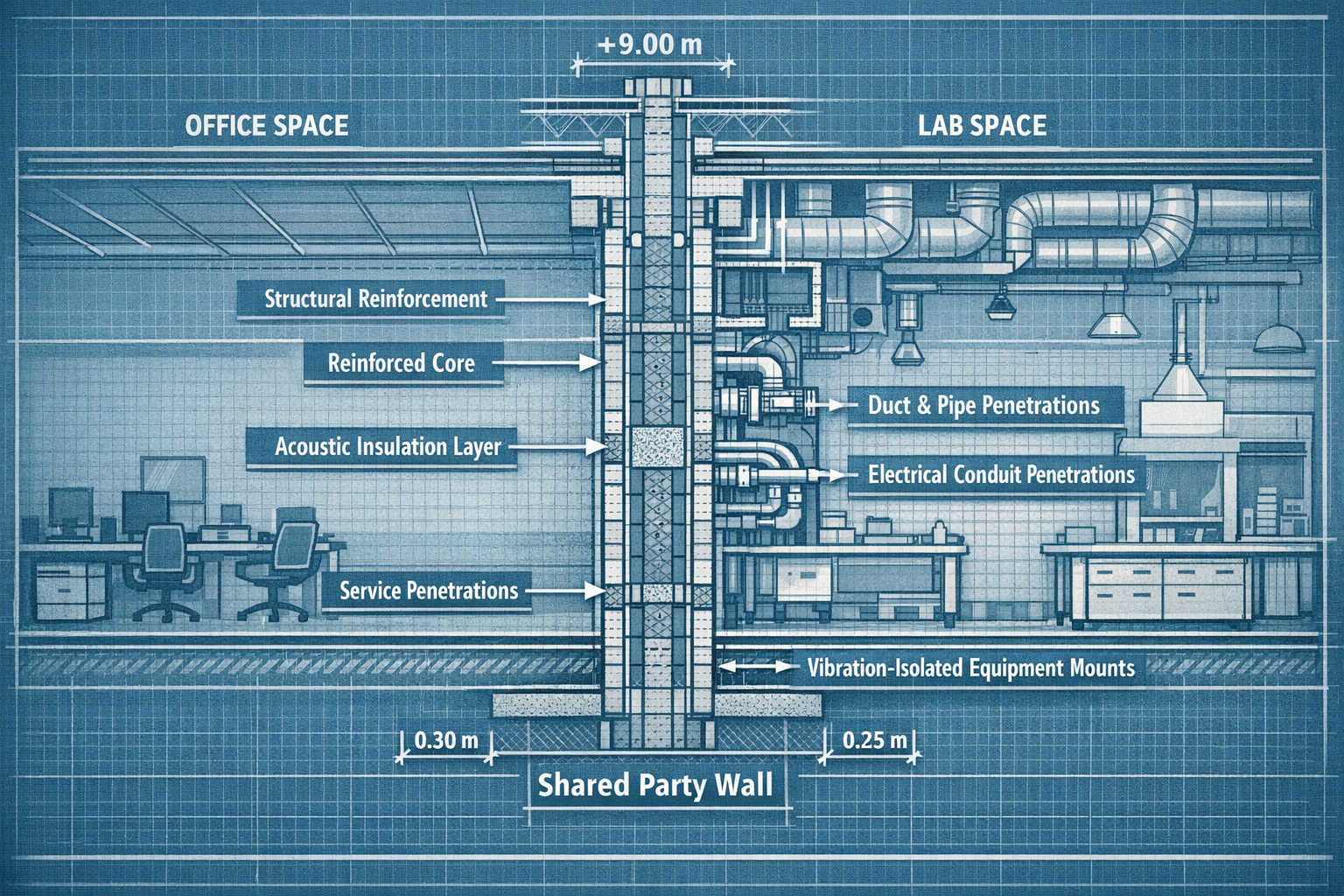
- Penetrations through party walls for services and utilities
- Acoustic separation to prevent noise transmission
🏗️ Regulatory Compliance
- Building control approvals for change of use
- Health and Safety Executive (HSE) requirements for containment laboratories
- Environmental permits for waste handling and emissions
- Party wall compliance under the Party Wall etc. Act 1996
Understanding the Party Wall etc. Act 1996 becomes crucial as these conversions almost always involve notifiable works affecting shared structures.
Key Compliance Requirements for Party Wall Surveys in Laboratory Conversions
Identifying Notifiable Works Under the Party Wall Act
Office-to-lab conversions typically trigger multiple sections of the Party Wall etc. Act 1996. Building owners must serve proper notices for:
Section 2(2)(a) Works – Cutting into party walls for new service penetrations, including:
- Laboratory gas lines (nitrogen, compressed air, vacuum systems)
- Specialized ventilation ductwork
- High-capacity electrical conduits
- Emergency power systems
Section 2(2)(e) Works – Cutting away projections or corbels to accommodate new laboratory equipment or structural modifications
Section 2(2)(f) Works – Cutting into party walls to insert damp-proof courses or install specialized containment barriers required for biosafety laboratories
Section 2(2)(m) Works – Increasing the loading on party walls through heavy equipment installation or structural reinforcement [4]
The complexity of laboratory conversions means that party wall surveyors must possess both traditional surveying expertise and understanding of specialized laboratory requirements.
Timeline Considerations for 2026 Compliance
Proper party wall compliance requires careful timeline planning:
| Phase | Duration | Key Activities |
|---|---|---|
| Pre-Notice Planning | 2-3 months | Engage party wall surveyor, prepare technical specifications, identify affected neighbours |
| Notice Service | 1-2 months | Serve formal notices under Party Wall Act, allow statutory response period |
| Survey & Award | 2-4 months | Conduct pre-construction surveys, negotiate terms, prepare party wall award |
| Construction | 6-12 months | Execute works with ongoing monitoring, address emerging issues |
| Post-Construction | 1-2 months | Final inspections, resolve any damage claims, close out awards |
Critical timing note: Laboratory conversion projects in 2026 face intense competition for qualified contractors and specialized equipment. Delays in party wall compliance can derail entire project schedules and financing arrangements [1].
Vibration and Noise Assessment Protocols
Laboratory conversions introduce unique challenges that standard residential party wall surveys don't address. Vibration-sensitive equipment such as electron microscopes, mass spectrometers, and high-precision balances require extraordinarily stable environments.
Party wall surveyors must now assess:
✅ Baseline Vibration Levels
- Pre-construction vibration monitoring at proposed equipment locations
- Evaluation of vibration transmission through party walls
- Assessment of impact from adjacent building operations
✅ Construction Phase Protocols
- Vibration limits during demolition and installation work
- Timing restrictions for high-impact activities
- Real-time monitoring systems with automatic alerts
✅ Acoustic Performance
- Sound transmission class (STC) ratings for party walls
- Impact insulation class (IIC) for floor/ceiling assemblies
- Specialized acoustic treatments for laboratory spaces
These technical requirements extend beyond traditional party wall surveys, requiring collaboration with acoustic engineers and vibration specialists [3].
Navigating Party Wall Disputes in Office-to-Lab Conversion Projects
Common Dispute Triggers in Commercial Conversions
Laboratory conversion projects face distinct dispute risks compared to residential work:
🔴 Structural Concerns
Building owners in adjacent properties often worry about:
- Increased loading on shared foundations from heavy laboratory equipment
- Structural integrity during demolition of existing office fit-outs
- Long-term effects of vibration from laboratory operations
- Adequacy of structural reinforcement proposals
🔴 Service Interruptions
Commercial tenants face business continuity concerns:
- Disruption to existing HVAC systems during modifications
- Temporary power outages for electrical upgrades
- Water service interruptions for plumbing installations
- Network connectivity issues during construction
🔴 Environmental Impacts
Neighbouring properties may raise concerns about:
- Noise from 24/7 laboratory operations
- Odours from chemical storage and use
- Biosafety risks from containment laboratories
- Increased traffic from deliveries and waste removal
Understanding party wall disputes and their resolution mechanisms helps prevent costly project delays.
Dispute Prevention Strategies for 2026
Proactive measures significantly reduce dispute likelihood:
Early Stakeholder Engagement
- Identify all affected parties before serving formal notices
- Conduct pre-notice meetings to explain project scope and benefits
- Share preliminary designs and address concerns informally
- Establish communication protocols for construction phase
Comprehensive Technical Documentation
- Detailed structural calculations showing load distribution
- Vibration impact assessments with mitigation measures
- Acoustic performance specifications and testing protocols
- Environmental management plans for laboratory operations
Professional Surveyor Selection
Choose qualified party wall surveyors with:
- RICS accreditation and commercial project experience
- Understanding of laboratory design requirements
- Track record in complex multi-party scenarios
- Strong negotiation and mediation skills
Fair Cost Allocation
Laboratory conversions involve substantial costs. Clear agreements on party wall agreement costs prevent disputes:
- Building owner covers own surveyor and adjoining owner's surveyor fees
- Reasonable fee structures based on project complexity
- Transparent billing and documentation
- Contingency provisions for unforeseen issues
The Role of the Third Surveyor
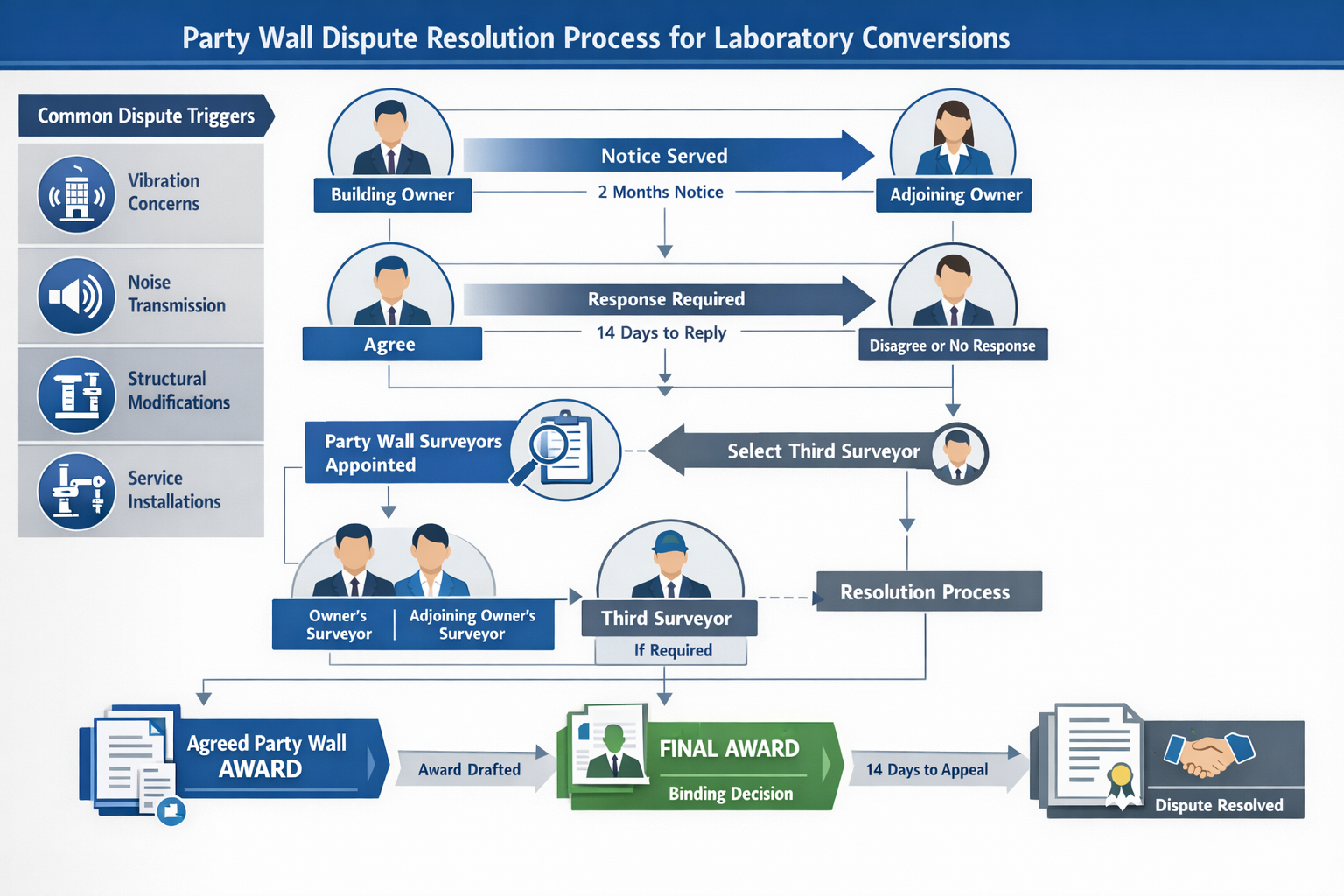
When building and adjoining owners cannot agree on appointed surveyors or award terms, the Party Wall Act provides for appointment of a third surveyor to resolve disputes [10].
In laboratory conversion projects, third surveyors must:
- Possess expertise in both party wall law and commercial construction
- Understand specialized laboratory requirements and constraints
- Balance competing interests fairly while maintaining project viability
- Issue binding determinations on disputed matters
The third surveyor mechanism provides essential dispute resolution without resorting to costly litigation, though parties should aim to avoid this scenario through proactive engagement.
Specialized Considerations for 2026's Life Sciences Infrastructure Push
Biosafety Containment and Party Wall Implications
Many laboratory conversions in 2026 involve biosafety level 2 (BSL-2) or higher facilities, which require specialized containment features:
Physical Containment Barriers
- Sealed penetrations through party walls
- Negative pressure differentials to prevent contamination spread
- Specialized door systems with interlocks
- Dedicated HVAC systems with HEPA filtration
These containment requirements affect party wall compliance by:
- Requiring additional structural modifications for sealed barriers
- Increasing service penetrations through shared walls
- Creating ongoing operational considerations for adjoining owners
- Necessitating emergency response protocols
Party wall awards for laboratory conversions must address these specialized concerns with appropriate conditions and safeguards.
Integration with Building Control and Planning
Party wall compliance represents just one regulatory requirement for office-to-lab conversions. Successful projects coordinate:
Building Control Approval
- Structural calculations for increased floor loading
- Fire safety systems for laboratory occupancy
- Means of escape and emergency procedures
- Accessibility compliance
Planning Permission
- Change of use from office (Class E) to laboratory/research facility
- Environmental impact assessments
- Transportation and parking considerations
- Hours of operation restrictions
Health & Safety Compliance
- COSHH assessments for chemical handling
- Biological safety protocols
- Emergency response procedures
- Staff training requirements
Party wall surveyors should coordinate with these parallel approval processes to ensure comprehensive compliance [5].
Technology and Innovation in 2026 Party Wall Surveys
The party wall surveying profession has embraced technological advances that benefit complex commercial projects:
📱 Digital Documentation
- Cloud-based project management platforms
- Digital service of notices with tracking
- Electronic signatures for awards and consents
- Real-time document sharing with all parties
🎯 Advanced Monitoring Systems
- Continuous vibration monitoring with automated alerts
- Crack monitoring using digital imaging and AI analysis
- Environmental sensors for noise, dust, and air quality
- Integrated dashboards accessible to all stakeholders
🏗️ Building Information Modeling (BIM)
- 3D visualization of party wall interfaces
- Clash detection for service installations
- Coordination between trades and disciplines
- As-built documentation for future reference
These technological tools enhance accuracy, transparency, and efficiency in managing complex laboratory conversion projects [4].
Financial and Commercial Aspects of Party Wall Compliance
Cost Implications for Laboratory Conversions
Party wall compliance represents a significant but manageable cost component in office-to-lab conversions:
Typical Cost Breakdown:
| Cost Component | Estimated Range | Notes |
|---|---|---|
| Building Owner's Surveyor | £3,000-£8,000 | Depends on project complexity and duration |
| Adjoining Owner's Surveyor | £2,500-£6,000 per neighbour | Building owner typically pays |
| Third Surveyor (if required) | £5,000-£15,000 | Split between parties or as determined |
| Pre-Construction Surveys | £1,500-£4,000 per property | Detailed condition documentation |
| Monitoring Systems | £5,000-£20,000 | Vibration and structural monitoring |
| Remedial Works | Variable | For any damage caused during construction |
These costs pale in comparison to overall conversion expenses, which typically range from £1,500-£3,000 per square meter for laboratory fit-outs [2].
Insurance Considerations
Laboratory conversion projects require robust insurance coverage:
Essential Policies:
- Professional indemnity insurance for party wall surveyors
- Contractor's all-risk insurance covering party wall damage
- Public liability insurance for construction activities
- Latent defects insurance for long-term protection
Adjoining owners should verify adequate insurance provisions before consenting to works, with specific attention to coverage limits and exclusions relevant to laboratory operations.
Value Protection for Adjoining Owners
Properly executed party wall compliance protects property values for all parties:
For Building Owners:
- Clear legal authorization for necessary works
- Reduced litigation risk and project delays
- Professional documentation of compliance
- Enhanced marketability of completed laboratory facility
For Adjoining Owners:
- Protection against structural damage
- Documented pre-construction condition
- Fair compensation for any impacts
- Ongoing operational safeguards
Understanding party wall awards helps all parties recognize the mutual benefits of proper compliance.
Best Practices for Successful Party Wall Compliance in 2026
For Building Owners and Developers
Strategic Planning:
- Engage party wall surveyors early – Ideally 6-8 months before planned construction start
- Conduct feasibility assessments – Identify party wall constraints before finalizing designs
- Budget appropriately – Include realistic allowances for party wall costs and potential delays
- Select experienced professionals – Choose surveyors with commercial and laboratory project experience
Communication Excellence:
- Maintain transparent communication with adjoining owners
- Provide regular project updates during construction
- Address concerns promptly and professionally
- Document all interactions for future reference
Technical Rigor:
- Prepare comprehensive technical specifications
- Engage structural engineers early in design process
- Plan for specialized monitoring and testing
- Build contingency into schedules for party wall compliance
For Adjoining Owners
Protecting Your Interests:
- Respond promptly to notices – Don't let statutory deadlines pass
- Appoint qualified surveyors – Select professionals with relevant experience
- Document existing conditions – Take photographs and notes before works commence
- Understand your rights – Familiarize yourself with Party Wall Act provisions
Constructive Engagement:
- Approach discussions collaboratively rather than adversarially
- Focus on legitimate concerns rather than blocking reasonable projects
- Request appropriate safeguards without unreasonable demands
- Maintain professional relationships with neighbours
For Party Wall Surveyors
Professional Excellence in 2026:
✅ Continuous Education
- Stay current with laboratory design standards and biosafety requirements
- Understand evolving building regulations and compliance frameworks
- Maintain awareness of construction technology advances
- Participate in professional development programs
✅ Comprehensive Assessments
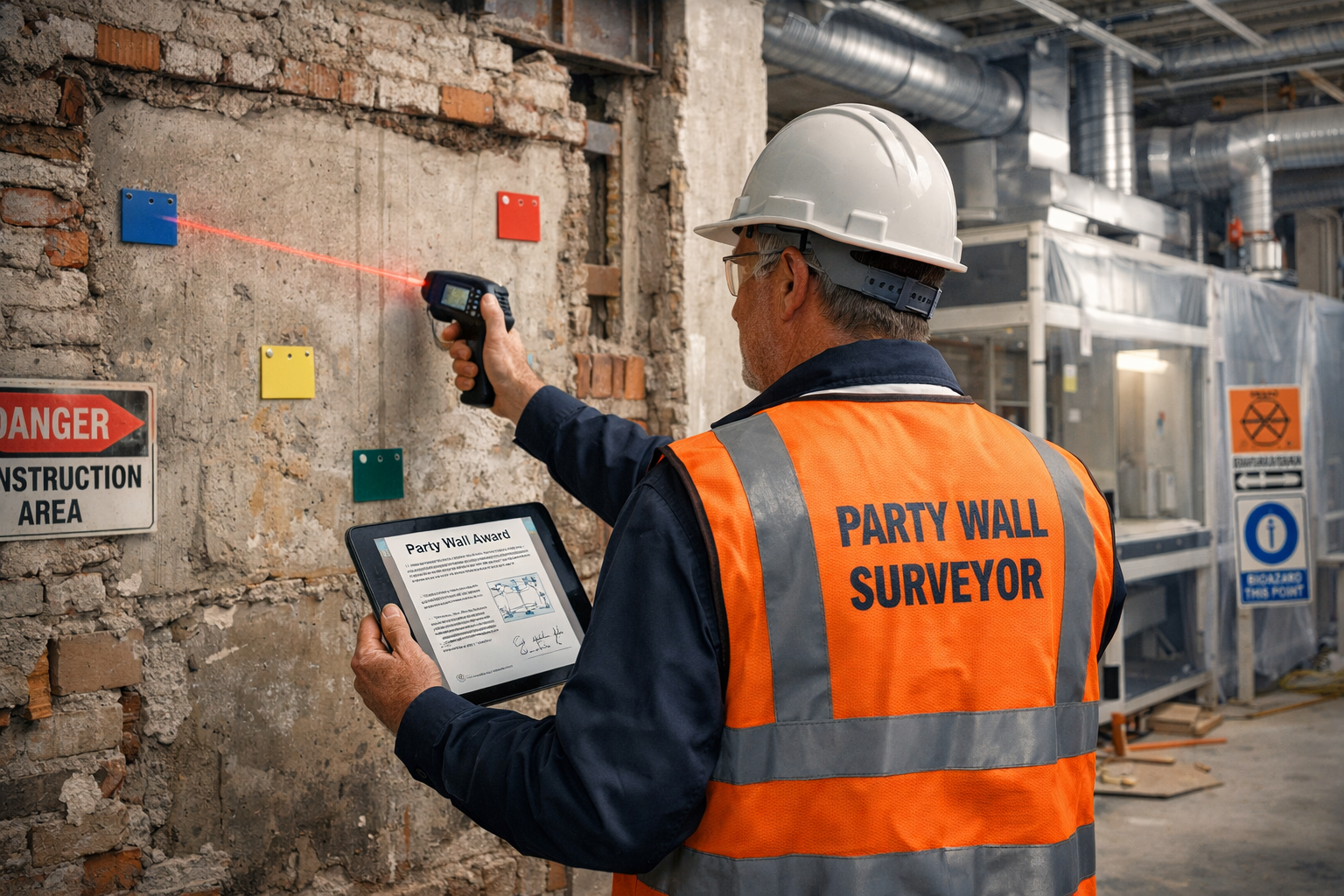
- Conduct thorough pre-construction condition surveys
- Evaluate both immediate construction impacts and long-term operational effects
- Consider cumulative impacts from multiple conversion projects
- Address specialized concerns unique to laboratory facilities
✅ Clear Documentation
- Prepare detailed, unambiguous party wall awards
- Include specific conditions for laboratory-related concerns
- Establish clear monitoring and reporting protocols
- Create accessible records for future reference
Working with RICS party wall surveyors ensures professional standards and ethical practice throughout the process.
Regulatory Outlook and Future Trends
Anticipated Changes in 2026 and Beyond
The life sciences infrastructure push continues to evolve, with several trends shaping party wall compliance:
🔮 Regulatory Developments:
- Potential updates to Building Regulations addressing laboratory conversions
- Enhanced biosafety requirements following pandemic lessons
- Stricter environmental controls for laboratory emissions
- Integration of party wall compliance with broader planning frameworks
🔮 Market Dynamics:
- Continued strong demand for laboratory space in UK tech hubs
- Increasing sophistication of conversion projects
- Growing recognition of party wall compliance importance
- Professional specialization in laboratory-related surveying
🔮 Technology Integration:
- Wider adoption of digital monitoring systems
- AI-assisted condition assessment and damage detection
- Virtual reality for stakeholder engagement
- Blockchain-based documentation and compliance tracking
Lessons from Early 2026 Projects
Projects completed in early 2026 provide valuable insights:
Success Factors:
- Early engagement with all stakeholders prevented disputes
- Comprehensive technical documentation built confidence
- Professional surveyor selection ensured smooth processes
- Realistic timelines accommodated compliance requirements
Common Pitfalls:
- Underestimating party wall compliance timelines
- Inadequate vibration assessment and mitigation
- Poor communication with adjoining owners
- Insufficient budget allocation for surveyor fees and monitoring
Building owners and developers who learn from these early experiences position their projects for success in an increasingly competitive market [1].
Conclusion
Party Wall Surveys for Office-to-Lab Conversions: Compliance in 2026's Life Sciences Infrastructure Push represents a critical intersection of traditional property law, modern construction practices, and cutting-edge scientific infrastructure development. As the UK's life sciences sector continues its remarkable growth trajectory, proper party wall compliance becomes not just a legal requirement but a strategic necessity for project success.
The specialized nature of laboratory conversions—with their heavy equipment loads, vibration-sensitive instruments, complex service requirements, and biosafety considerations—demands expertise beyond standard residential party wall work. Surveyors must understand both the technical requirements of laboratory design and the legal framework of the Party Wall etc. Act 1996, while maintaining professional relationships among commercial stakeholders with significant financial interests.
Key Success Principles
✨ Early engagement – Begin party wall planning 6-8 months before construction
✨ Professional expertise – Select qualified surveyors with commercial and laboratory experience
✨ Comprehensive assessment – Address both construction impacts and operational concerns
✨ Transparent communication – Maintain open dialogue with all affected parties
✨ Technical rigor – Prepare detailed specifications and monitoring protocols
✨ Fair allocation – Ensure reasonable cost distribution and dispute resolution mechanisms
Actionable Next Steps
For building owners planning office-to-lab conversions:
- Engage a qualified party wall surveyor with commercial project experience
- Conduct preliminary party wall assessments during feasibility stage
- Budget appropriately for compliance costs and potential delays
- Initiate early communication with adjoining owners
- Coordinate party wall compliance with other regulatory approvals
For adjoining owners receiving party wall notices:
- Respond within statutory timeframes to protect your rights
- Appoint your own surveyor to represent your interests
- Document existing property conditions thoroughly
- Engage constructively while protecting legitimate concerns
- Understand the mutual benefits of proper compliance
The life sciences infrastructure push of 2026 creates unprecedented opportunities for property owners, developers, and the broader UK economy. By approaching party wall compliance with professionalism, technical expertise, and collaborative spirit, all stakeholders can contribute to this vital sector's growth while protecting individual property rights and maintaining positive neighbour relations.
The projects completed successfully in 2026 will set standards for years to come, demonstrating that complex commercial conversions can proceed efficiently when proper party wall protocols are followed. As the sector continues evolving, the principles of early engagement, professional expertise, and fair dealing remain timeless foundations for success.
References
[1] S190962 – https://www.brydenwood.com/office-to-lab-conversion/s190962/
[2] Office To Lab Conversions Transforming Desks Into Discoveries – https://www.commercialsearch.com/news/office-to-lab-conversions-transforming-desks-into-discoveries/
[3] Design Considerations For Office To Lab Conversions – https://www.labdesignnews.com/content/design-considerations-for-office-to-lab-conversions
[4] Office To Lab Conversion Challenges – https://www.boyesturner.com/news-and-insights/office-to-lab-conversion-challenges
[5] Engineering Requirements For Converting Commercial Spaces In 2026 What Most Teams Dont See Coming – https://mnaquality.com/engineering-requirements-for-converting-commercial-spaces-in-2026-what-most-teams-dont-see-coming/
[10] Office To Lab Conversion Challenges – https://www.boyesturner.com/news-and-insights/office-to-lab-conversion-challenges
