
Last updated: September 17, 2026
Quick Answer
The Bank of England held Bank Rate at 4% on 17 September 2026, giving prime West London buyers a stable backdrop but not a cheaper one [10]. Notting Hill and Holland Park prices continue trading between roughly £2 million for a one-bedroom mews or flat and £10 million-plus for a full stucco townhouse, with super-prime activity concentrated in these two postcodes during Q2 2026 [1]. Sentiment among Notting Hill and Prime West London Property September 2026 buyers has stabilised rather than surged, with cash buyers dominant and many purchasers now watching the Autumn Budget mansion tax and capital gains tax speculation more closely than the mortgage market.
Key Takeaways
- The Bank of England held Bank Rate at 4% on 17 September 2026, matching market expectations after a summer of limited movement [10].
- Notting Hill and Holland Park saw the strongest concentration of super-prime deals in prime central London during Q2 2026 [1].
- Prices across parts of prime central London remain up to 25% below their 2014 peak, creating relative value for well-capitalised buyers [2].
- Cash buyers continue to dominate transactions above £5 million, reducing sensitivity to the rate hold itself.
- Autumn Budget 2026 speculation over a mansion tax and CGT changes is a bigger sentiment driver than Bank Rate for £2m-plus buyers.
- A Level 3 Building Survey is essential on stucco Victorian stock because of subsidence, damp and heritage-consent risk.
- Rental yields in Notting Hill remain modest, positioning the area as a capital-preservation play rather than an income play.
- Buyer sentiment has stabilised and become more confident through summer 2026, though this has not yet translated into higher asking prices [5].
What Happened With Bank of England Interest Rates in September 2026
The Bank of England's Monetary Policy Committee held Bank Rate at 4% on 17 September 2026, extending a pause that has now run for several consecutive meetings. Mortgage pricing had already adjusted to this "steady state" through July and August, so the hold itself changed little for lenders active in the prime bracket [10].
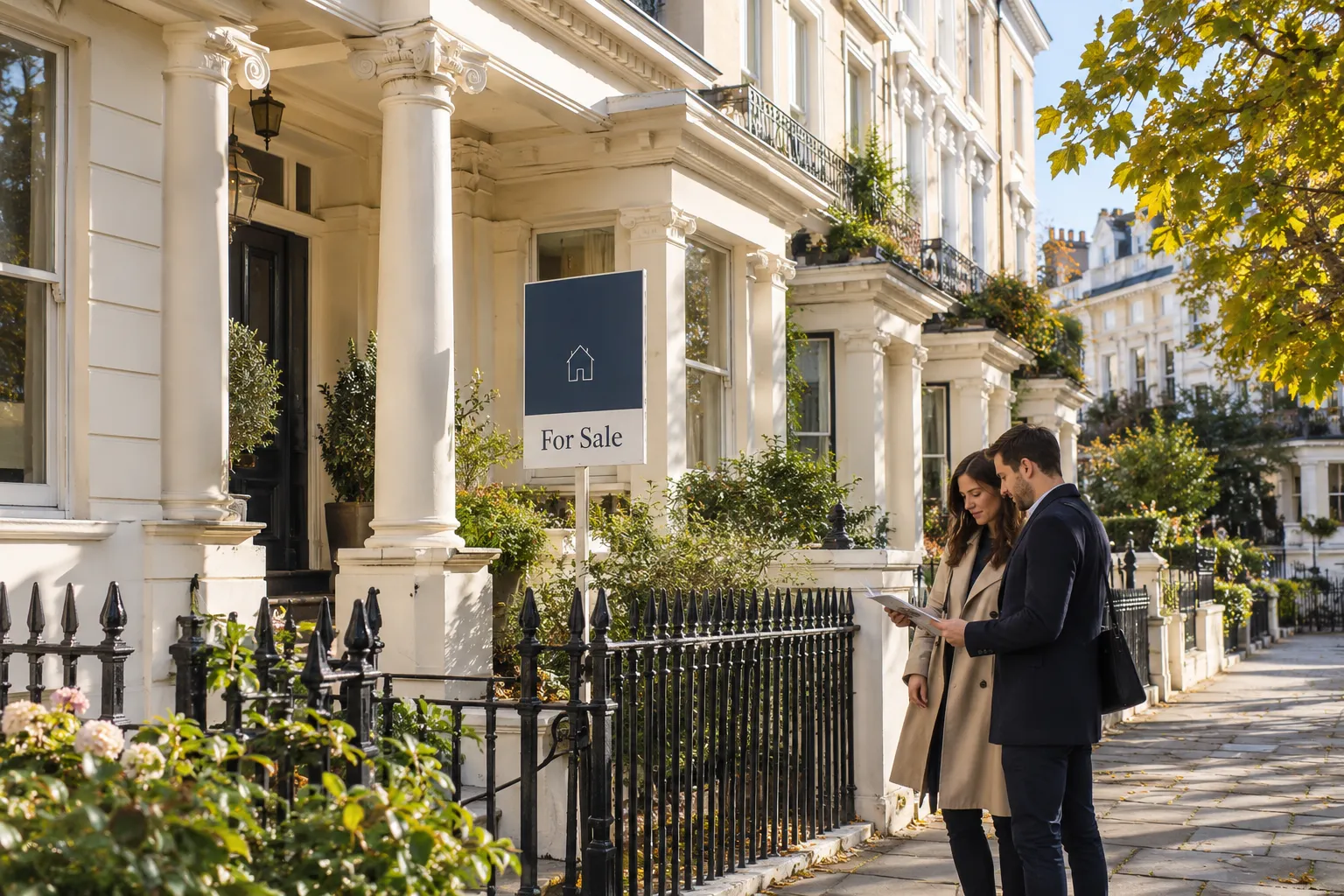
Key points from the September decision:
- Bank Rate remains at 4%, unchanged since the last cut earlier in 2026.
- Lenders serving the £2m-plus mortgage market had largely priced in a hold, so fixed-rate offers for prime borrowers moved only marginally either way [10].
- The MPC's tone signalled watchfulness rather than urgency, leaving room for either a cut or a further hold at the next meeting.
- Prime buyers reacted less to the rate decision itself and more to what it implies about the Autumn Budget's room for manoeuvre on property taxation.
Decision rule: if you are a mortgaged buyer above £3 million, the September hold changes your monthly cost by very little. If you are a cash buyer, the hold is largely irrelevant to your purchase decision and the Budget speculation matters far more.
How Do Rate Holds Affect London Property Prices, and How Does a Hold Compare to a Rate Cut
A rate hold tends to freeze buyer and seller expectations in place rather than move prices sharply in either direction, while a rate cut usually loosens mortgage affordability and can pull hesitant buyers back into the market within a few months. In prime central London, where a large share of buyers pay in cash, the price effect of any single rate decision is smaller than in the mainstream mortgage-dependent market [3][5].
- Rate hold effect: stabilises pricing expectations, slows the pace of negotiation on both sides, and keeps transaction volumes broadly flat.
- Rate cut effect: improves mortgage affordability, tends to bring back mortgaged buyers at the £2m-£4m end faster than it moves the £8m-plus super-prime bracket.
- How long holds typically last: the Bank of England has generally reviewed policy at each scheduled MPC meeting roughly every six to seven weeks, so a single hold is rarely the final word; markets have treated recent holds as pauses within a slow easing cycle rather than a ceiling.
- What happens next: most prime agents expect any further move to be a cut rather than a hike, given the broader UK-wide asking price trends recorded through August 2026 remaining subdued.
Common mistake: treating a single rate hold as a signal to wait indefinitely for cheaper borrowing. Prime West London pricing has already absorbed several years of higher rates, and further cuts are more likely to support price recovery than trigger a discount window.
Notting Hill and Prime West London Property September 2026: Prime Buyer Sentiment After the Bank of England Rate Hold, Is Notting Hill a Good Investment Right Now
Notting Hill remains one of the more resilient corners of prime central London, with Q2 2026 data showing super-prime activity concentrated specifically in Notting Hill and Holland Park rather than spread evenly across all PCL postcodes [1]. For buyers weighing Notting Hill and Prime West London Property September 2026 conditions, the case for investment rests on relative value against the 2014 peak rather than on rapid near-term growth.
- Prices in parts of prime central London sit as much as 25% below their previous peak, which some agents frame as a buying opportunity for patient capital [2].
- Coutts' Q2 2026 index recorded a rebound in demand across prime London, with Notting Hill and Holland Park among the more active submarkets [1].
- Choose Notting Hill if you want a long-term wealth-preservation asset in a globally recognised location with strong architectural character and school catchments.
- Avoid treating it as a short-term flip, transaction costs, stamp duty at the top end, and Budget uncertainty make quick turnarounds risky in 2026.
What's the Average Price of Homes in Notting Hill and Holland Park in 2026
Notting Hill property in September 2026 typically ranges from around £2 million for a one or two-bedroom mews house or garden flat to £10 million or more for a full stucco-fronted townhouse on a prime garden square [4]. Holland Park pricing runs at a similar or slightly higher band for comparable square footage, reflecting its larger family houses and quieter streets.
| Area | Typical entry price | Upper range | Common stock |
|---|---|---|---|
| Notting Hill | £2m | £10m+ | Stucco terraces, mews conversions |
| Holland Park | £2.5m | £15m+ | Detached villas, large family houses |
| Bayswater | £1.2m | £6m | Mansion flats, garden squares |
| Kensington | £1.8m | £12m+ | Stucco terraces, communal gardens |
Example: a two-bedroom mews conversion off Westbourne Grove currently sits near the lower end of this range, while a six-bedroom double-fronted stucco house on a Notting Hill garden square sits firmly in the £8m-£10m-plus bracket [4].
Are Prime London Buyers Still Active After the Rate Hold, and Who Is Actually Buying
Yes. Prime London buyer activity has continued through the rate hold, with Knight Frank reporting that the market backdrop stabilised and activity improved through August 2026 [5]. The buyer profile skews heavily towards cash purchasers and wealth-preservation motives rather than leveraged speculation.
- Cash buyers make up the majority of transactions above £5 million, insulating this segment from mortgage rate movement [1][3].
- Mortgaged buyers are still active between £2m and £4m, where borrowing plays a bigger role in affordability.
- Domestic UK buyers relocating from larger family homes elsewhere in London form a steady baseline of demand [6][7].
- International buyers, including US, EU and Asia-based purchasers, remain present but more price-sensitive than in previous cycles [9].
Edge case: buyers who already exchanged before the September MPC meeting saw no practical change to their financing; the hold mainly affects those still negotiating mortgage offers this autumn.
Notting Hill and Prime West London Property September 2026: Prime Buyer Sentiment After the Bank of England Rate Hold Among Chinese, US and EU Buyers
Sentiment among Chinese, US and EU buyers in prime West London has become more confident through summer 2026, though most remain focused on value and long-term security rather than rapid capital growth [5][6]. Currency movements and Budget tax speculation now weigh on decisions as much as, or more than, UK interest rates.
- US buyers are often drawn by relative sterling weakness against the dollar, making Notting Hill's stucco stock comparatively affordable in dollar terms.
- EU buyers continue to value proximity to Eurostar links and international schools around Holland Park and Kensington.
- Chinese and wider Asia-based buyers remain active but increasingly cautious about mansion tax speculation, favouring lower-profile transactions and longer completion timelines.
- Black Brick's July and September 2026 updates both note steady, rather than booming, international interest, consistent with a "wait and see" posture ahead of the Autumn Budget [6][7].
Practical note: international buyers using overseas mortgage facilities should factor in that UK lender appetite for non-resident borrowers at the prime end remains selective, so early conversations with a specialist broker matter more than the base rate itself.
Should You Buy in Notting Hill Before Rates Change, and What Mistakes Do Prime Buyers Make During Rate Holds
Buying before rates change makes sense if you have found the right stucco house or mews conversion and can transact on your own timetable, rather than trying to time the Bank of England's next move. Waiting for a further cut is a reasonable strategy only if your purchase is not otherwise time-critical.
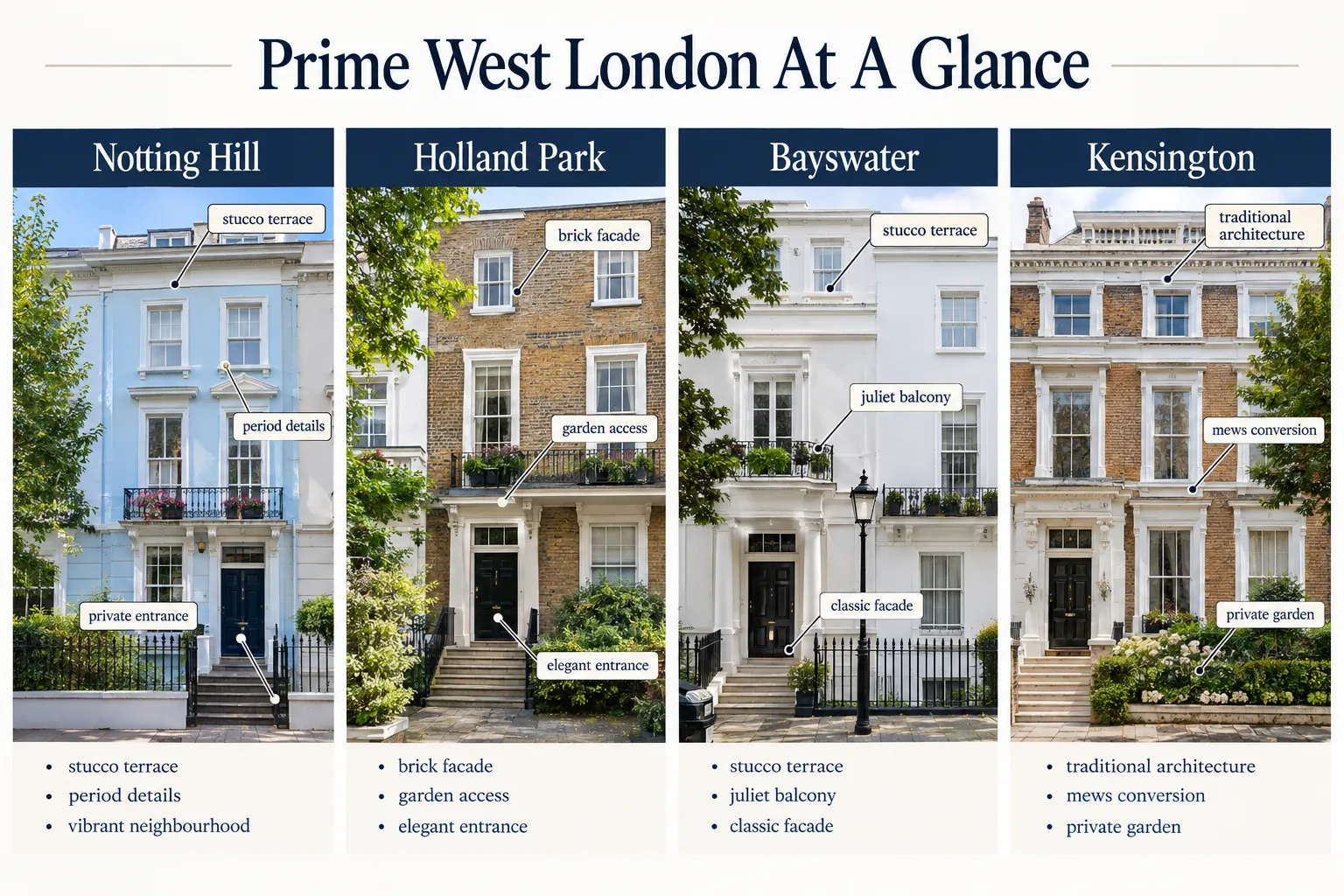
Common mistakes prime buyers make during a rate hold include:
- Overweighting the base rate and underweighting Autumn Budget tax speculation, which has a bigger effect on top-of-market pricing.
- Skipping a proper structural survey on period stucco stock because a purchase feels "safe" at cash-buyer level.
- Assuming a hold means prices are frozen, when local factors, garden square access, off-street parking, lateral space, still move individual property values.
- Delaying an offer while waiting for clarity that may not arrive until the Budget is actually delivered.
Decision rule: proceed now if the property is genuinely scarce (garden square frontage, listed stucco facade, freehold mews); wait only if you are choosing between several comparable, readily available flats.
Which West London Neighbourhoods Offer Better Value Than Notting Hill, and Is Notting Hill Overpriced
Bayswater currently offers better entry-level value than Notting Hill for buyers wanting proximity to Hyde Park without full Notting Hill pricing, while Kensington offers comparable heritage stock at a broadly similar price band. Notting Hill is not obviously overpriced relative to its own history, given it still sits below its 2014 peak in real terms alongside the rest of prime central London [2].
- Bayswater: lower entry price, strong mansion-flat stock, benefiting from ongoing regeneration around Whiteleys.
- Kensington: similar stucco terrace stock to Notting Hill, slightly more formal streetscapes, comparable top-end pricing.
- Holland Park: higher average price than Notting Hill but larger plots and more private gardens.
Choose Notting Hill if you want the strongest concentration of super-prime buyer competition and long-term brand recognition [1]. Choose Bayswater if budget is the primary constraint and you are willing to trade postcode prestige for square footage.
What's the Rental Yield on Notting Hill Properties Right Now
Rental yields on Notting Hill property remain modest, typically in the low single digits, which confirms the area functions primarily as a capital-preservation and lifestyle purchase rather than an income-generating investment. This is consistent with wider prime central London patterns where wealth preservation, not yield, drives purchase decisions at the top end [3].
- Landlords letting a stucco townhouse or large mews house should expect yield compression relative to smaller flats.
- One and two-bedroom flats near Westbourne Grove and Ledbury Road tend to achieve marginally stronger yields than full houses.
- Mistake to avoid: buying purely for rental income at this price point; total return in Notting Hill has historically depended far more on long-term capital appreciation than on rent.
Why a Level 3 Building Survey Matters on Notting Hill and Prime West London Property September 2026: Prime Buyer Sentiment After the Bank of England Rate Hold Stock
A Level 3 Building Survey is essential for anyone buying a stucco Victorian townhouse or mews conversion in Notting Hill, Holland Park, Bayswater or Kensington, because period facades routinely hide subsidence, damp and heritage-consent issues that a basic valuation will never catch. RICS-qualified surveyor demand at the prime end has stayed strong through 2026 as buyers become more diligent before committing seven or eight-figure sums.
- Subsidence risk: common in stucco terraces built on London clay, especially where basements have been extended.
- Damp and rendering defects: painted stucco facades can trap moisture, leading to costly render and timber repairs.
- Heritage and listed-building constraints: many Notting Hill and Kensington streets sit within conservation areas, restricting alterations to windows, porticos and rear extensions.
- Mews conversions: often carry non-standard construction or historic commercial use, which affects both survey scope and mortgage lender appetite.
Checklist before exchange:
- Commission a RICS Level 3 Building Survey, not a mortgage valuation.
- Ask the surveyor specifically about subsidence history and underpinning.
- Check conservation area and listed status with the local planning authority.
- Get a specialist damp and timber report if the survey flags concerns.
- Confirm buildings insurance is obtainable before exchange, not after.
How Long Do Rate Holds Usually Last, and What Happens Next for Prime West London
Rate holds in this cycle have typically persisted for two to four consecutive MPC meetings before the Bank of England moves again, and most prime agents expect the next move, if any, to be a cut rather than a rise. For prime West London specifically, the more decisive event is the Autumn Budget, not the next scheduled rate decision.
- Expect continued price stability through the remainder of 2026 unless the Budget introduces a mansion tax or CGT change that alters seller behaviour.
- A confirmed mansion tax could accelerate listings from owners of £2m-plus homes seeking to sell ahead of implementation.
- CGT changes affecting second homes or investment property could reduce international buy-to-let appetite in Bayswater and parts of Notting Hill.
- JLL's Q2 2026 PCL activity data points to a market that is recovering steadily rather than sharply, suggesting no sudden price shift is likely before year-end [8].
FAQ
Is now a good time to buy in Notting Hill?
For buyers with a specific, scarce property in mind, such as a stucco house on a garden square, yes, since prices remain below the 2014 peak and rate policy is stable [2]. For buyers purely trying to time the market, waiting for Budget clarity may be more sensible.
Will the Autumn Budget definitely include a mansion tax?
No confirmation exists as of 17 September 2026; it remains speculation. Prime buyers and sellers are pricing in the possibility, which is already shaping sentiment ahead of any formal announcement.
Are cash buyers still dominant in Notting Hill?
Yes, cash buyers continue to account for the majority of transactions above roughly £5 million in prime central London, reducing sensitivity to Bank Rate decisions [1][3].
What is the biggest survey risk on a Notting Hill stucco house?
Subsidence linked to London clay and basement extensions, followed by damp affecting painted render, are the most common serious issues found in Level 3 Building Surveys on this stock.
Is Notting Hill better value than Kensington?
The two areas are broadly comparable in price for similar stucco stock; Notting Hill tends to see more super-prime buyer competition, while Kensington offers slightly more formal streetscapes [1].
What rental yield should I expect in Notting Hill?
Expect low single-digit yields typical of prime central London, since the area is bought primarily for capital preservation rather than income.
Comparing Prime West London Neighbourhoods
| Area | Best for | Watch out for |
|---|---|---|
| Notting Hill | Prestige, super-prime demand | Subsidence, listed facades |
| Holland Park | Larger family houses, privacy | Higher entry price |
| Bayswater | Value, park proximity | Mixed street quality |
| Kensington | Heritage stock, schools | Conservation restrictions |
Conclusion
The Bank of England's decision to hold Bank Rate at 4% on 17 September 2026 has not shaken prime West London's steadying market; if anything, it has reinforced a pattern already visible in Notting Hill and Holland Park through Q2 2026, where cash-rich buyers kept transacting regardless of mortgage pricing [1][5]. The real pressure point for Notting Hill and Prime West London Property September 2026 sentiment is the Autumn Budget, not today's rate decision, and buyers and sellers alike are watching mansion tax and CGT speculation closely.
Next steps for anyone active in this market:
- Buyers should get mortgage-in-principle terms locked in now rather than waiting on rate speculation, and commission a Level 3 Building Survey before exchanging on any stucco property.
- Sellers considering a move ahead of a possible mansion tax should speak to a prime agent about realistic timing, since listings could rise sharply if the tax is confirmed.
- Investors should treat Notting Hill as a wealth-preservation holding first and a yield play second, and compare Bayswater or Kensington where budget or heritage constraints matter more.
References
[1] Coutts London Prime Property Index Q2 2026 Market Rebounds As Demand Rises – https://www.coutts.com/insights/property/coutts-london-prime-property-index-q2-2026-market-rebounds-as-demand-rises.html
[2] Prime Property Prices Tumble Some Now 25 Below Peak – https://www.estateagenttoday.co.uk/breaking-news/2026/07/prime-property-prices-tumble-some-now-25-below-peak/
[3] Coutts London Prime Property Index Q1 2026 – https://www.coutts.com/insights/property/coutts-london-prime-property-index-q1-2026.html
[4] Notting Hill – https://www.useperch.co.uk/areas/notting-hill
[5] Prime London Market Activity Improves As Backdrop Stabilises – https://www.knightfrank.co.uk/research/article/2026/8/prime-london-market-activity-improves-as-backdrop-stabilises
[6] July 2026 – https://black-brick.com/insights/market-update/july-2026/
[7] September 2026 – https://black-brick.com/insights/market-update/september-2026/
[8] Meganeglington Jll Pcl Report Q2 2026 Activity 7486027535055724544 Qkpo – https://www.linkedin.com/posts/meganeglington_jll-pcl-report-q2-2026-activity-7486027535055724544-QKPO
[9] Residential Quarterly Spring 2026 – https://www.struttandparker.com/publications/residential-quarterly-spring-2026
[10] Mortgage Rates In August 2026 Whats Actually Changed – https://www.london-fs.com/mortgage-rates-in-august-2026-whats-actually-changed/
.cg-nh-wrap{max-width:720px;margin:0 auto;font-family:Arial,Helvetica,sans-serif;border:1px solid #d8dee6;border-radius:10px;padding:18px;background:#fbfcfe;}
.cg-nh-wrap h3{margin:0 0 10px;color:#0b2545;font-size:19px;}
.cg-nh-btns{display:flex;gap:8px;flex-wrap:wrap;margin-bottom:14px;}
.cg-nh-btn{flex:1;min-width:110px;padding:9px 6px;border:1px solid #0b2545;border-radius:6px;background:#fff;color:#0b2545;font-size:13px;cursor:pointer;font-weight:bold;}
.cg-nh-btn.active,.cg-nh-btn:hover{background:#0b2545;color:#fff;}
.cg-nh-panel{background:#fff;border:1px solid #d8dee6;border-radius:8px;padding:14px;}
.cg-nh-row{display:flex;justify-content:space-between;padding:6px 0;border-bottom:1px dashed #e2e6ea;font-size:14px;}
.cg-nh-row:last-child{border-bottom:none;}
.cg-nh-label{color:#555;}
.cg-nh-val{font-weight:bold;color:#0b2545;text-align:right;}
.cg-nh-note{margin-top:10px;font-size:12px;color:#777;}
@media(max-width:480px){.cg-nh-btn{min-width:80px;font-size:12px;}}
Prime West London Snapshot Tool
var data=[
{entry:”£2m”,upper:”£10m+”,stock:”Stucco terraces, mews”,buyer:”Mostly cash, super-prime”,survey:”Subsidence, damp, heritage”},
{entry:”£2.5m”,upper:”£15m+”,stock:”Detached villas, houses”,buyer:”Cash, wealth preservation”,survey:”Foundations, large gardens”},
{entry:”£1.2m”,upper:”£6m”,stock:”Mansion flats”,buyer:”Mixed cash and mortgage”,survey:”Lease terms, damp”},
{entry:”£1.8m”,upper:”£12m+”,stock:”Stucco terraces”,buyer:”Cash, international”,survey:”Conservation limits, damp”}
];
var btns=document.querySelectorAll(“.cg-nh-btn”);
btns.forEach(function(b){
b.addEventListener(“click”,function(){
btns.forEach(function(x){x.classList.remove(“active”);});
b.classList.add(“active”);
var d=data[parseInt(b.getAttribute(“data-a”))];
document.getElementById(“cg-nh-entry”).textContent=d.entry;
document.getElementById(“cg-nh-upper”).textContent=d.upper;
document.getElementById(“cg-nh-stock”).textContent=d.stock;
document.getElementById(“cg-nh-buyer”).textContent=d.buyer;
document.getElementById(“cg-nh-survey”).textContent=d.survey;
});
});