
Buyers who treat a building survey as a passive formality leave money on the table, sometimes tens of thousands of pounds. Research and professional guidance published through 2026 consistently shows that owner active involvement in UK surveys is one of the most underused tools available to property buyers, yet it directly shapes the quality of the survey report, the depth of defect identification, and the strength of any subsequent price negotiation [2][3].
This article explains exactly how engaged clients collaborate with surveyors before, during, and after an inspection, and why that collaboration produces measurably better outcomes.
Key Takeaways
- Clients who provide documents, attend inspections, and ask targeted questions receive more relevant, actionable survey reports.
- RICS standards formally require surveyors to ensure clients understand survey levels and limitations before commissioning, making early engagement a professional expectation [2].
- Survey findings become a negotiation tool only when clients quantify defects with contractor quotes and present a structured, evidence-backed case.
- Buyers can reasonably seek a 5-10% price reduction where material defects are uncovered, provided they act decisively and marshal clear evidence [7].
- Treating the survey as the start of a due-diligence process, not the end, consistently delivers better financial outcomes [3][8].
Why Client Engagement Matters More Than Most Buyers Realise
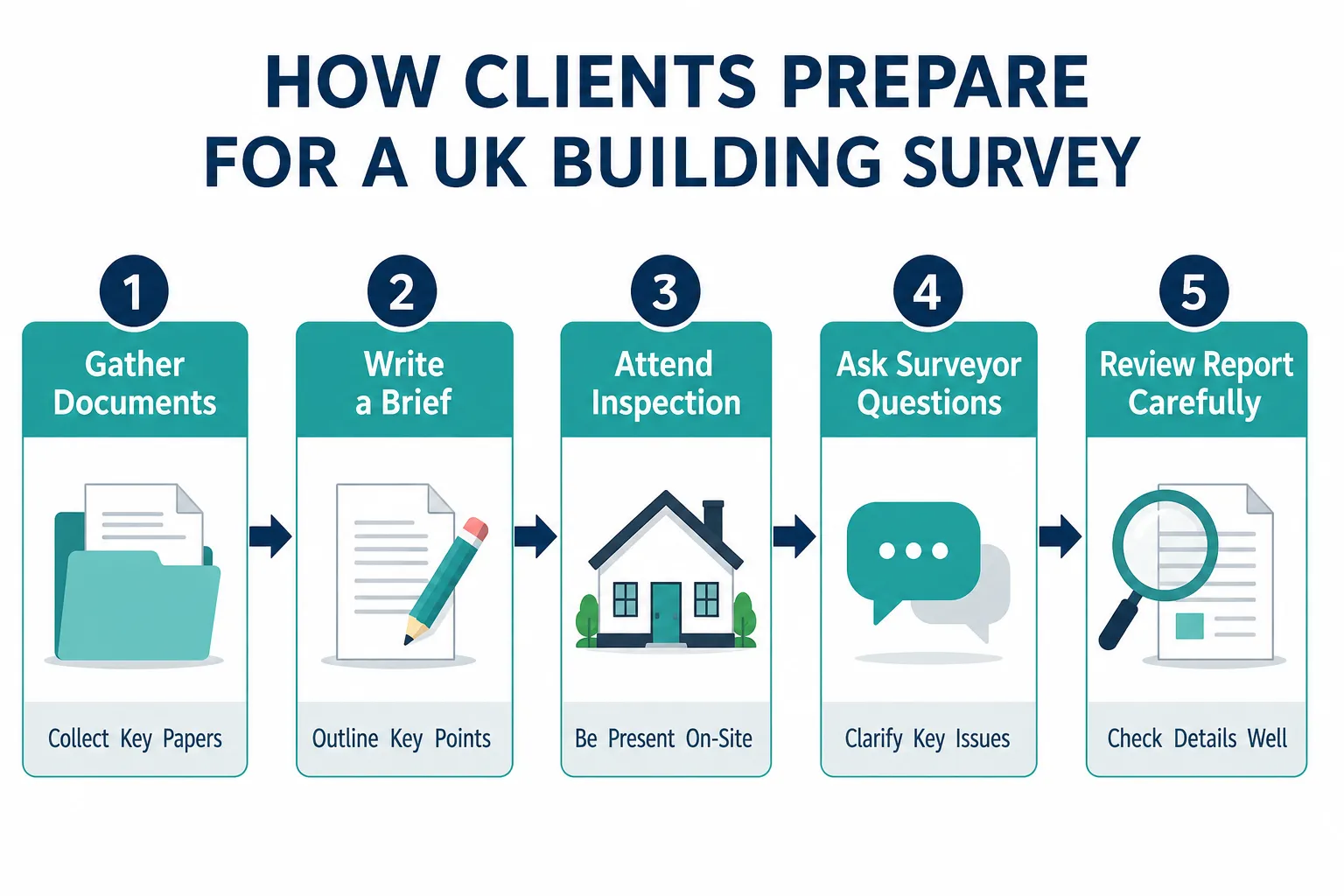
Most buyers commission a survey, receive a PDF report, and then wonder what to do next. That passive approach misses the full value of the exercise. Owner active involvement in UK surveys begins long before the surveyor arrives on site and continues well after the report lands in an inbox.
The RICS Home Survey Standard (1st edition, April 2024) formally embeds client education into professional practice. It requires RICS members to ensure clients understand the different survey service levels, their limitations, fees, and terms of engagement before commissioning [2]. In other words, the professional framework already anticipates an informed, engaged client, buyers who fulfil that expectation get more from the process.
Why does engagement improve the report itself?
A surveyor's findings are shaped partly by the brief they receive. RICS guidance on building surveying stresses that surveyors must fulfil the client's brief and account for the asset's specific use [2]. A buyer planning a full renovation has different priorities from one who intends to occupy the property without alteration. A client who communicates those priorities upfront receives a report calibrated to their actual situation, not a generic template.
What Documents to Provide Before the Survey
Providing the right paperwork before the inspection gives the surveyor critical context and reduces the chance of important issues being missed or mischaracterised.
| Document | Why It Helps |
|---|---|
| Planning permissions and building regulations certificates | Confirms whether extensions or conversions were properly approved |
| Gas and electrical safety certificates | Flags the age and condition of services before the visit |
| Previous survey reports | Highlights known defects and tracks whether remediation was carried out |
| Guarantees (damp, timber, roof) | Identifies existing treatment history and transferable warranties |
| Lease and title documents | Relevant for flats; clarifies maintenance obligations and shared areas |
| Correspondence about disputes or defects | Provides context on any ongoing issues the seller is aware of |
Gathering and sharing these documents is a straightforward act that meaningfully improves the surveyor's preparation. For older properties, or those with a complex history, this step is especially valuable. Buyers purchasing a property with a flat roof, for example, should also consider requesting a specialist roof survey alongside the main building survey.
Attending the Inspection: The Single Most Effective Step
Attending the survey inspection is the highest-impact action an engaged client can take. Most surveyors welcome clients at the end of the inspection, some encourage attendance throughout. Being present allows the buyer to:
- Ask about specific concerns noticed during viewings (a damp smell in the basement, a crack above a window, uneven floors).
- Receive verbal context that may not appear in full detail in the written report.
- Understand the severity of flagged issues directly from the professional, rather than interpreting report language alone.
- Identify access limitations, areas the surveyor could not inspect, and arrange follow-up access if needed.
This direct dialogue is difficult to replicate through email after the fact. A surveyor who has walked the property with an engaged client is better positioned to tailor their commentary to what genuinely matters to that buyer.
For buyers unsure which level of survey is appropriate, reviewing a complete guide to Level 3 building surveys before commissioning helps frame the right questions to ask.
How Engaged Clients Use Survey Findings in Valuation Negotiations

Owner active involvement in UK surveys does not end when the report is delivered. The findings become financially meaningful only when the client acts on them strategically. This is where many buyers lose leverage, they acknowledge a problem but fail to quantify it or present it effectively.
The Standard Negotiation Workflow
Authoritative guidance from 2026, including advice from HomeOwners Alliance and Ashall Surveyors, frames the survey as a negotiation tool from the outset [3][8]. The workflow that consistently produces results follows a clear sequence:
- Read the report in full and identify all Condition Rating 3 items (requiring urgent attention) and Condition Rating 2 items (requiring monitoring or near-term repair).
- Contact the surveyor with specific clarification questions. Ask for an estimated cost range where the report does not provide one, or ask which issues warrant specialist follow-up.
- Commission specialist reports where recommended, a structural engineer for movement cracks, a damp specialist for moisture readings, a drainage survey for older properties. These reports provide independent, costed evidence.
- Obtain at least two written contractor quotes for all significant remediation works. Specialist negotiation guides published in 2026 stress that two quotes are the minimum for a credible, quantified case [10].
- Add a 15-20% contingency to the total remediation cost to account for unforeseen complications, a standard professional allowance that sellers and agents recognise as reasonable [10].
- Present a structured case through the estate agent, specifying the total cost, the evidence behind it, and the precise reduction or remedy being requested.
"Survey-driven renegotiation is most effective when clients turn findings into a quantified argument rather than a vague concern.", consistent theme across 2026 specialist guidance [10][11]
What Reduction Is Realistic?
Where surveys reveal unexpected, material defects, buyers can reasonably seek around a 5-10% price reduction, depending on severity and the cost to remedy [7]. The key word is "unexpected", issues that were visible during viewings or reflected in the asking price carry less negotiating weight than defects uncovered only through professional inspection.
The four main options after a problematic survey are:
- Proceed and fund repairs yourself, appropriate where the price already reflects the property's condition.
- Renegotiate the price, the most common outcome where significant defects are found [3][8].
- Request seller-funded repairs before exchange, useful for straightforward, clearly scoped works.
- Withdraw from the purchase, the right outcome where defects are severe, costs are uncertain, or the seller refuses to engage.
Which option delivers the best result depends almost entirely on how decisively and strategically the client acts [3][8]. Passive buyers who raise concerns vaguely, without documentation, rarely achieve meaningful reductions. Engaged clients who present a costed, evidenced case through the agent routinely do.
When the Vendor Refuses
Sellers sometimes refuse to reduce the price or fund repairs. This is not the end of the negotiation. Conveyancing specialists advise that clients should: restate the evidence calmly, confirm the total remediation cost in writing, and make clear, through the agent, that the offer is contingent on resolution [9]. In many cases, a seller who initially refuses will reconsider once they understand the buyer is prepared to withdraw.
For buyers of leasehold properties or shared ownership units, the negotiation dynamic can differ. Specialist shared ownership valuation advice is worth seeking before entering negotiations in those circumstances.
Building the Right Survey Brief: Practical Steps for Owners
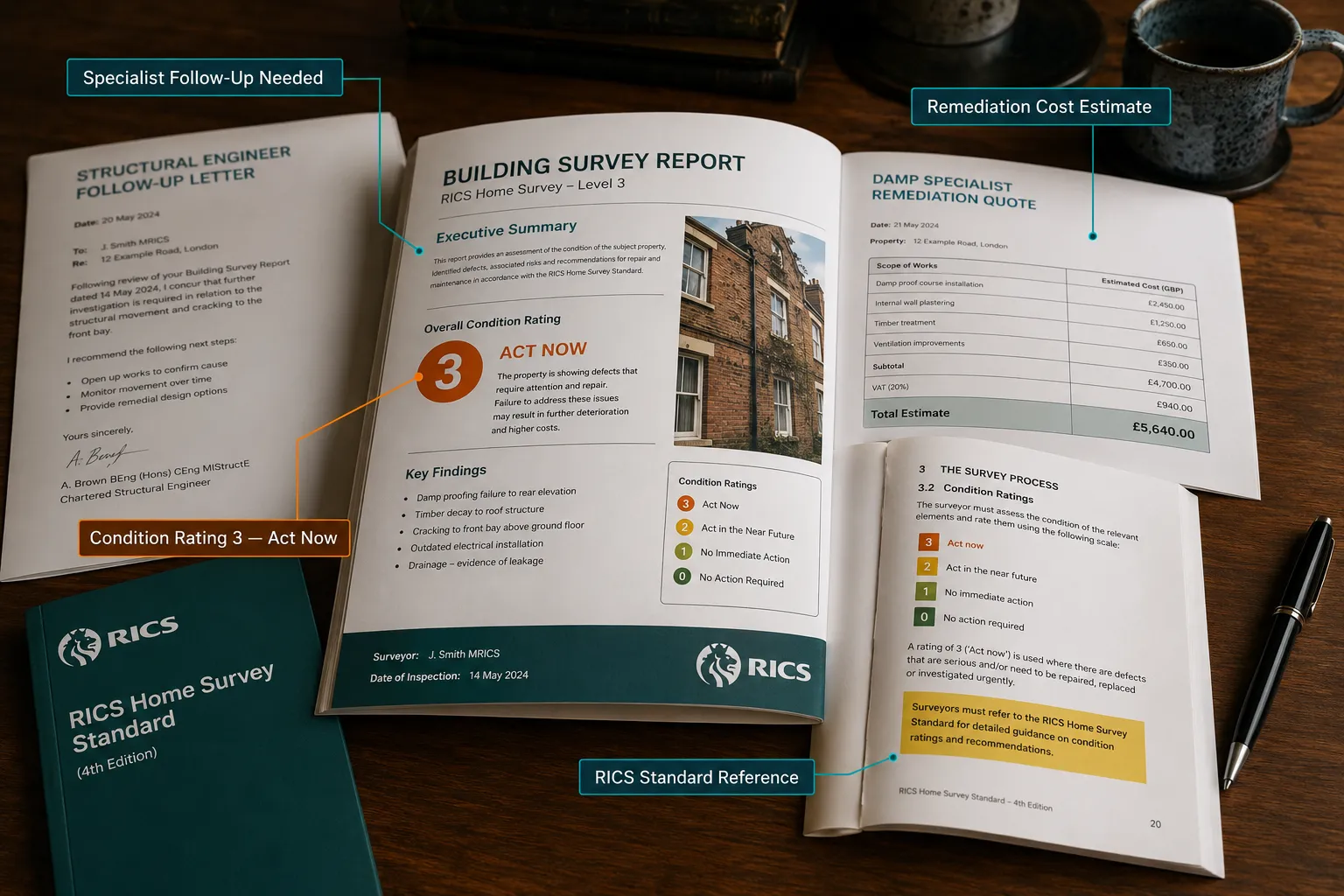
The quality of a building survey is partly a function of the brief the client provides. A well-constructed brief does not require technical expertise, it requires clarity about purpose, priorities, and concerns.
Key Elements of an Effective Client Brief
1. State the intended use
An owner-occupier planning to live in the property for twenty years has different risk tolerances from an investor seeking a rental yield. The surveyor needs to know which applies.
2. Identify specific concerns
List anything noticed during viewings: unusual smells, visible cracks, signs of damp, uneven floors, areas of the roof that looked worn. These observations direct the surveyor's attention to areas that might otherwise receive only passing scrutiny.
3. Clarify planned works
If a loft conversion, kitchen extension, or rewire is planned, say so. The surveyor can then comment on the feasibility and flag any structural or regulatory issues that would affect those plans. This is especially relevant for buyers considering a Level 3 building survey, which provides the most detailed structural assessment.
4. Ask about report format and follow-up
The RICS Home Survey Standard requires surveyors to explain the scope, limitations, and reporting format of the service before commissioning [2][5]. Clients should confirm how findings will be presented, whether verbal clarification is available after delivery, and which issues will require specialist follow-up.
Choosing the Right Survey Level
Engagement also means selecting the right product. The RICS framework offers distinct survey levels, and choosing the wrong one limits what the report can deliver.
- Level 2 (Homebuyer Report): Suitable for conventional, well-maintained properties in reasonable condition.
- Level 3 (Building Survey): Recommended for older, larger, or structurally complex properties, or where significant works are planned.
A detailed comparison of these options is available in this guide to the differences between Level 2 and Level 3 surveys. Selecting the appropriate level is itself an act of informed engagement, and it ensures the report has the depth needed to support any subsequent negotiation.
For buyers who want broader guidance before committing to a specific product, understanding what survey you need is a useful starting point.
After the Report: Keeping the Momentum
The period between receiving the report and exchanging contracts is where engaged clients consolidate their advantage. The following checklist summarises the post-report actions that matter most:
- Contact the surveyor within 48 hours with clarification questions.
- Arrange any recommended specialist inspections promptly, delays weaken negotiating leverage.
- Obtain written quotes, not verbal estimates.
- Calculate total remediation cost plus contingency.
- Instruct your solicitor to pause exchange until the negotiation is resolved.
- Present the case to the agent in writing, with a clear, specific request.
Clients who follow this sequence consistently achieve better outcomes, whether that means a price reduction, seller-funded repairs, or a well-informed decision to withdraw [3][7][9].
For those dealing with more complex structural concerns such as ground movement, a subsidence survey may be necessary as a specialist follow-up, and its findings can significantly strengthen a renegotiation case.
Conclusion
Owner active involvement in UK surveys is not a passive act of commissioning a report and waiting. It is a structured process of preparation, engagement, and follow-through that begins before the surveyor arrives and continues until the transaction is resolved on the best available terms.
Actionable next steps for buyers in 2026:
- Before commissioning: Gather all available property documents and choose the survey level appropriate to the property's age, condition, and your plans for it.
- Before the inspection: Write a clear brief that states intended use, specific concerns, and planned works. Share it with the surveyor in advance.
- On inspection day: Attend if possible, or arrange to speak with the surveyor immediately after. Ask direct questions about severity and urgency.
- On receiving the report: Read it fully, contact the surveyor with clarification questions, and identify which issues require specialist follow-up.
- During negotiation: Obtain at least two written contractor quotes, add a 15-20% contingency, and present a specific, evidenced request through the agent.
- If the seller refuses: Restate the case in writing and be prepared to withdraw if the numbers do not work.
The professional framework, including the updated RICS Home Survey Standard, already anticipates and supports this level of client engagement [2][5]. Buyers who meet that expectation do not just get a better report. They get a stronger negotiating position, a clearer picture of risk, and a transaction outcome that reflects what the property is actually worth.
References
[1] Home Survey Standards – https://www.rics.org/profession-standards/rics-standards-and-guidance/sector-standards/building-surveying-standards/home-surveys/home-survey-standards
[2] Home Survey Standard – https://www.isurv.com/downloads/download/2284/home_survey_standard
[3] Renegotiating After Homebuyer Survey – https://www.ashallsurveyors.co.uk/advice/renegotiating-after-homebuyer-survey
[4] Profession Standards – https://www.rics.org/profession-standards
[5] Home Surveys – https://www.rics.org/profession-standards/rics-standards-and-guidance/sector-standards/building-surveying-standards/home-surveys
[6] Home Survey Standard Nov 2020 – https://www.rics.org/content/dam/ricsglobal/documents/standards/home_survey_standard_nov_2020.pdf
[7] How To Negotiate A House Price Reduction After A Survey – https://www.homebuilding.co.uk/advice/how-to-negotiate-a-house-price-reduction-after-a-survey
[8] Bad House Survey Report – https://hoa.org.uk/advice/guides-for-homeowners/i-am-buying/bad-house-survey-report/
[9] Vendor Refuses To Lower Price – https://www.samconveyancing.co.uk/news/conveyancing/vendor-refuses-to-lower-price
[10] Buyer Wants Money Off After Survey Uk 2026 – https://valuq.co.uk/insights/buyer-wants-money-off-after-survey-uk-2026