
Over 1.6 million people in England and Wales now receive some form of care at home, yet the property implications of that care arrangement remain poorly understood by most homeowners, buyers, and even some surveyors. When a property is adapted for a live-in carer, fitted with accessibility features, or extended to create a dedicated carer annexe, the building survey priorities and valuation methodology change in ways that can directly affect mortgage lending, local authority care-funding assessments, and resale value.
This article addresses home carer accommodation: building survey and valuation considerations when care support is provided at home, bridging the gap between health-focused care planning and the technical requirements of UK property surveying. Whether a household is adapting an existing home, purchasing a property already modified for care use, or seeking a professional valuation for care-funding purposes, understanding these intersecting disciplines is essential.
Key Takeaways
- Adaptations made for home care, from widened doorways to purpose-built annexes, alter both the scope of a building survey and the property's market value.
- RICS Red Book Global Standards 2025 govern all professional valuations, including those required for local authority care-funding assessments [9].
- A Level 3 building survey is almost always the appropriate survey type for care-adapted or extended properties.
- Extensions built to house a live-in carer may trigger Party Wall Act obligations and require evidence of building regulations compliance.
- Market value remains the default valuation basis for owner-occupied homes used for care support, but surveyors must account for adaptation costs, planning status, and functional obsolescence [5].
Why Care Arrangements Change the Property Picture
A home that provides care support is not simply a domestic dwelling. It may contain structural modifications, specialist equipment, or a self-contained annexe. Each of these elements introduces survey and valuation considerations that a standard homebuyer report is unlikely to address in sufficient depth.
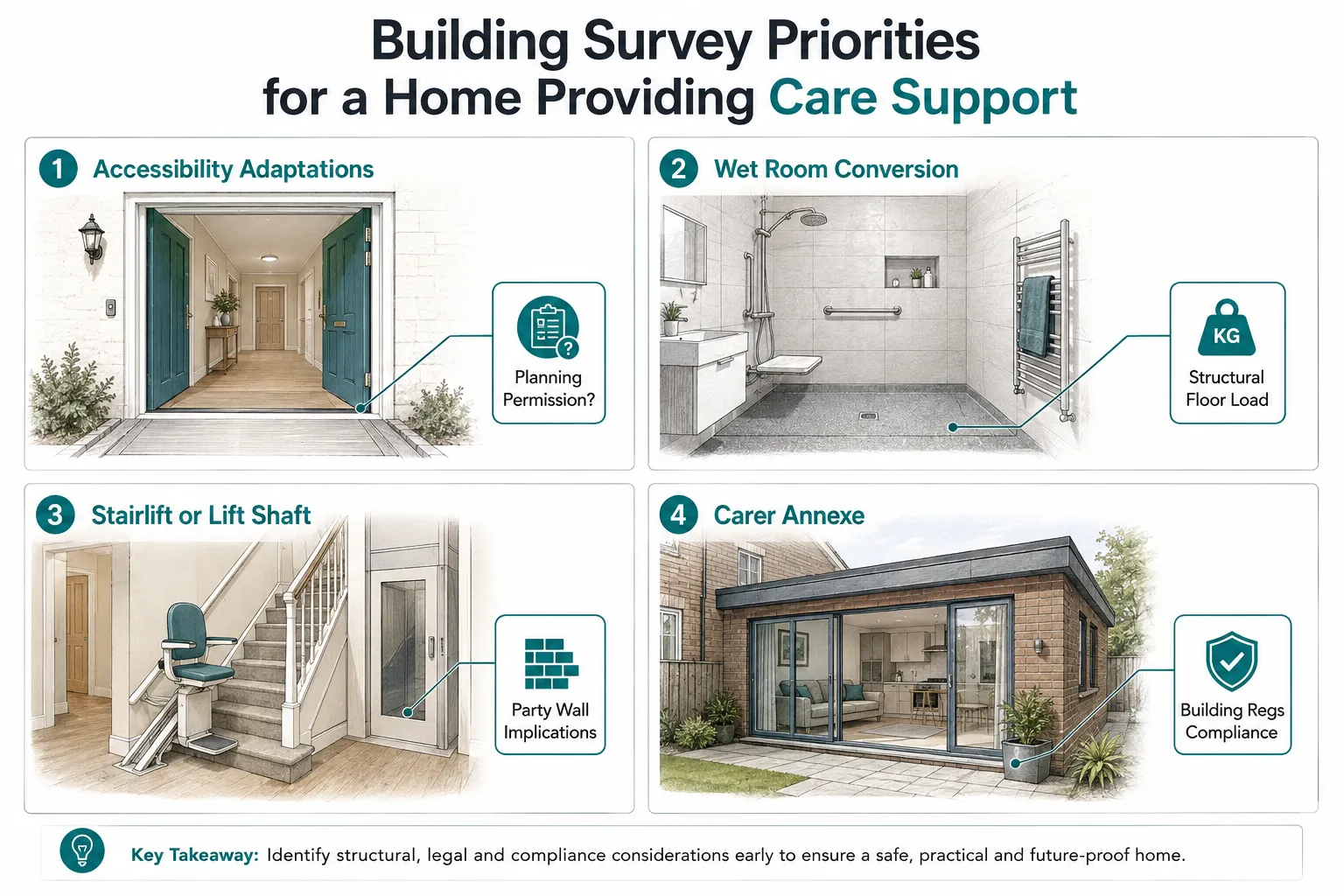
The UK residential care market reached approximately £27.3 billion in value in 2025/26, reflecting strong and growing demand for care-related property [2][3]. A significant portion of that demand is met not by registered care homes but by private residences adapted for home-based care. This trend is accelerating as NHS discharge pressures, an ageing population, and personal preference drive more families toward home care solutions.
From a property perspective, this creates a distinct category of residential asset: the care-adapted home. Its characteristics include:
- Structural alterations (ramps, widened doorways, through-floor lifts)
- Wet room or accessible bathroom conversions
- Ground-floor bedroom or sleeping accommodation
- Purpose-built annexes or outbuildings for live-in carers
- Specialist electrical or mechanical installations (hoists, emergency call systems)
Each of these features must be assessed carefully during a building survey, and each can influence market value in ways that require professional judgment rather than automated estimates.
Building Survey Priorities for Home Carer Accommodation
Choosing the Right Survey Level
For any property that has been adapted for care use, a Level 3 building survey is the appropriate starting point. A Level 2 homebuyer report will not provide the structural analysis needed to assess the integrity of extensions, the adequacy of floor loadings for hoists, or the compliance status of wet room conversions.
A Level 3 home survey complete guide explains that this survey type covers all accessible areas of the building, provides detailed condition ratings, and includes commentary on defects that may not be visible without further investigation. For care-adapted homes, that depth of inspection is not optional, it is essential.
Structural Alterations and Building Regulations Compliance
Many accessibility adaptations are carried out under permitted development rights or with local authority grants (such as Disabled Facilities Grants). However, compliance with building regulations is not automatic, and the absence of a completion certificate is a material concern for any buyer or lender.
Key structural checks for care-adapted properties include:
| Adaptation | Primary Survey Concern | Documentation Required |
|---|---|---|
| Widened doorways | Lintel adequacy, structural integrity | Building regs approval or permitted development notice |
| Wet room conversion | Waterproofing, floor drainage, structural load | Building regs completion certificate |
| Through-floor lift | Structural opening, floor joist modification | Structural engineer's sign-off |
| Ground-floor extension | Foundation adequacy, roof structure, damp | Full planning permission and building regs |
| Carer annexe (outbuilding) | Habitable standard, insulation, services | Planning permission, building regs, council tax status |
A surveyor conducting a building survey on a care-adapted home should request all relevant documentation before the inspection and flag any missing certificates in the report.
Extensions for Live-In Carer Accommodation and Party Wall Considerations
Purpose-built extensions to house a live-in carer are among the most complex scenarios in home carer accommodation: building survey and valuation considerations when care support is provided at home. If the extension is attached to or adjacent to a neighbouring property, the Party Wall Act 1996 will almost certainly apply.
Failure to serve the correct party wall notices before construction is a common problem. A surveyor inspecting a recently extended care-adapted home should check:
- Whether party wall notices were served and agreed
- Whether a party wall award was issued
- The condition of the shared wall or boundary structure
- Any signs of differential settlement between the new extension and the original building
Where no party wall agreement exists for work that required one, this represents a legal and structural risk that must be disclosed in the survey report.
Damp, Drainage, and Specialist Installations
Wet rooms and accessible bathrooms, if poorly installed, are a leading source of moisture ingress in care-adapted homes. Surveyors should pay particular attention to:
- Floor-level drainage: inadequate falls can cause standing water and structural saturation
- Tanking and waterproofing membranes: these are invisible once tiled but critical to long-term performance
- Hoist track fixings: ceiling-mounted hoists require reinforced joists; improper fixings cause cracking and structural movement
Specialist electrical installations (emergency call systems, medical-grade power circuits) should be noted in the survey and referred to a qualified electrician for a separate assessment.
Valuation Considerations When Care Support is Provided at Home
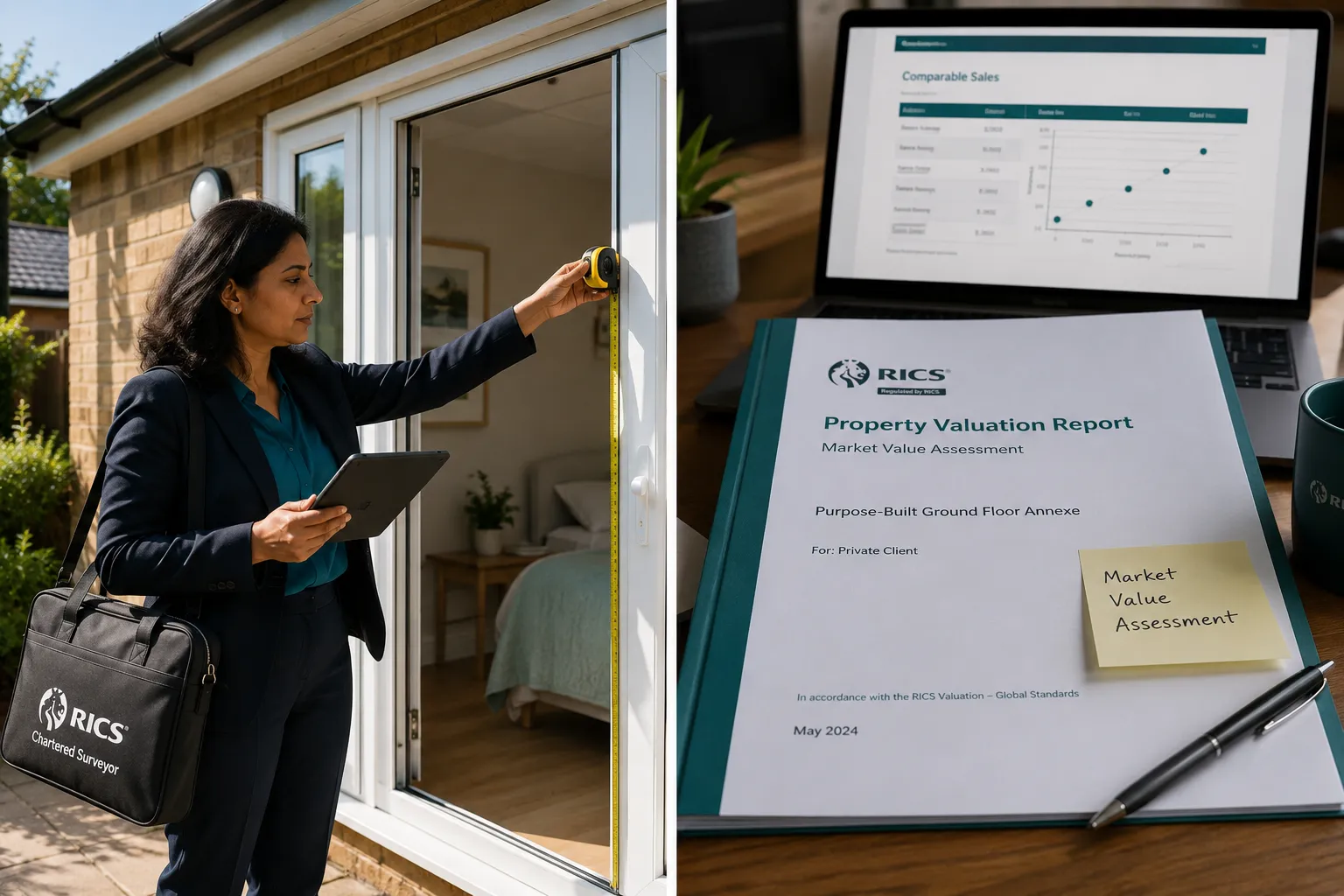
The Default Basis: Market Value for Owner-Occupied Homes
For most homeowners receiving care at home, the relevant valuation basis is market value, the price at which the property would sell between a willing buyer and a willing seller in an arm's-length transaction. This is the default basis under RICS residential valuation guidance and the RICS Red Book Global Standards 2025 [9][5].
RICS is currently developing a new UK-specific standard for owner-occupied residential property, which is expected to address complex occupancy arrangements, including informal care, more explicitly than current guidance [8]. Until that standard is published, valuers must apply professional judgment within the existing Red Book framework.
"Market value remains the cornerstone of residential property valuation, regardless of the occupancy arrangement or adaptations present."
How Adaptations Affect Market Value
The impact of care adaptations on market value is nuanced and depends on several factors:
Positive value effects:
- High-quality accessible bathrooms that appeal to a broad market
- Ground-floor bedroom that adds functional flexibility
- Well-designed annexe with permitted use as independent accommodation
- Energy-efficient adaptations (insulation, heating upgrades)
Negative value effects:
- Highly specialist equipment that limits buyer appeal (clinical hoists, medical gas installations)
- Poorly executed adaptations with no building regulations compliance
- Loss of original rooms (e.g., dining room converted to bedroom)
- Annexe with uncertain planning status or council tax liability
A professional valuer will assess these factors against comparable sales in the local market. In some cases, the cost of reversing adaptations may be deducted from the valuation. In others, the adaptations may be considered neutral or marginally positive.
Local Authority Care-Funding Assessments
One of the most important practical applications of residential property valuation in the care context is the local authority financial assessment for care funding. Under current rules, a person's home is included in the financial assessment if they move into a care home, but it is disregarded for as long as a qualifying relative (including a carer who has been providing care) continues to live there [6].
Where the property must be included in the assessment, the local authority requires a current market value from a qualified valuer, with defined deductions for selling costs. Age UK guidance confirms that this valuation must reflect the open market value of the property as it stands, including any adaptations [6].
Key points for care-funding valuations:
- The valuation must be carried out by a qualified professional, not an online estimate
- Adaptations are valued as part of the property, not separately
- The local authority may commission its own valuation if they dispute the figure provided
- A desktop house valuation is not appropriate for care-funding purposes; a full inspection valuation is required
Purpose-Built Carer Annexes: PropCo and OpCo Considerations
For larger properties where a purpose-built annexe has been constructed specifically for a live-in carer, the valuation may need to address the separation of property value from operational use, a concept familiar from commercial care home valuations.
In the commercial care sector, valuers routinely separate the property value ("PropCo") from the operating business value ("OpCo"), using EBITDARM and EBITDA multiples to assess going-concern value [10][7]. While this methodology is not directly applicable to a domestic annexe, the underlying principle, that a property's value depends partly on its permitted use and operational flexibility, is relevant.
A carer annexe that has been granted planning permission for ancillary residential use (tied to the main dwelling) will have a different value profile than one that has been granted independent residential consent. The former is restricted in use and may be harder to sell separately; the latter adds measurable value as an independent unit.
For properties where the annexe represents a significant proportion of the total floor area, a loft space valuation methodology, assessing the additional space against local comparable values, may provide a useful reference point.
Practical Steps for Buyers, Owners, and Advisers
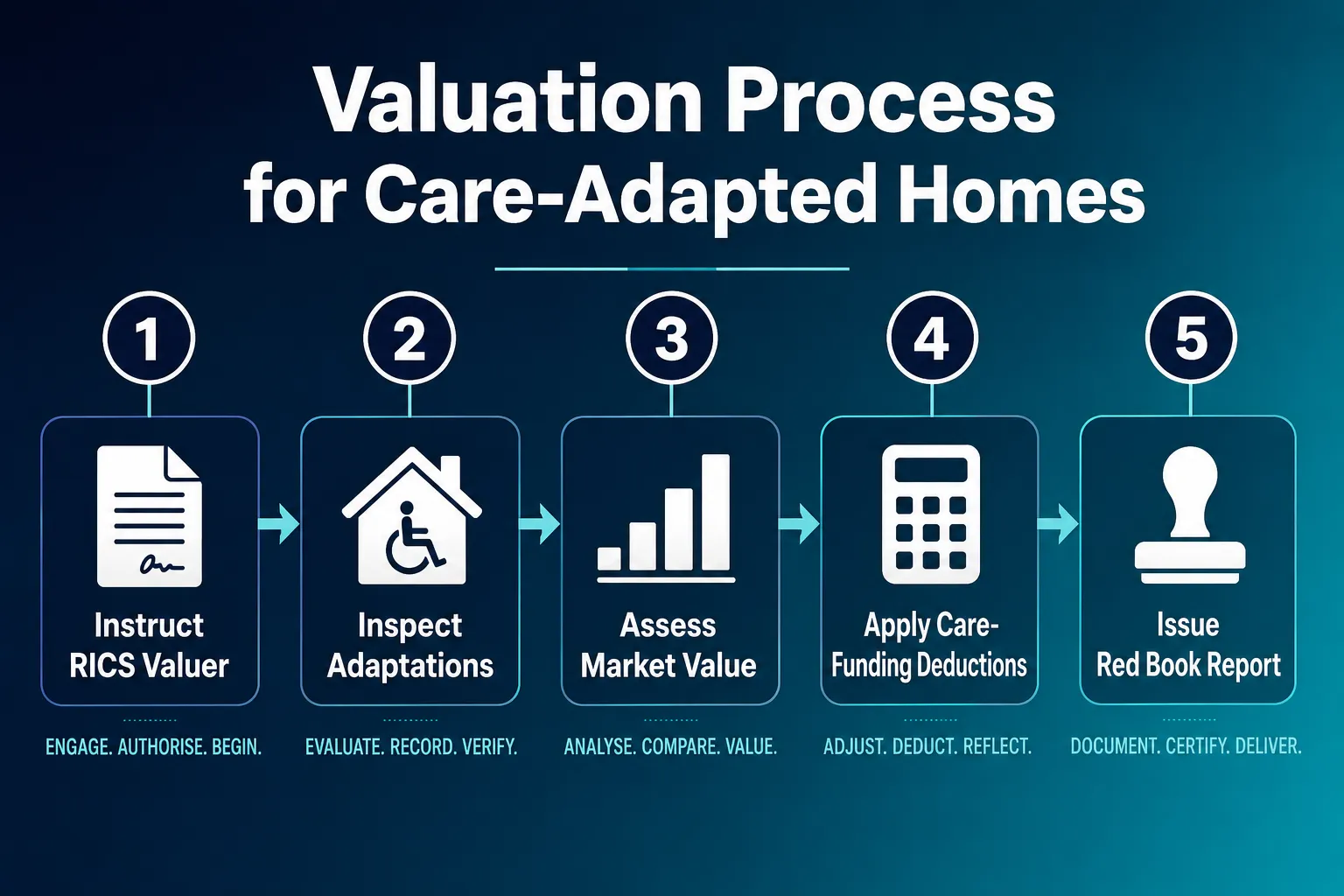
Understanding home carer accommodation: building survey and valuation considerations when care support is provided at home requires a coordinated approach across legal, survey, and valuation disciplines. The following steps provide a practical framework.
For Buyers Purchasing a Care-Adapted Property
- Instruct a Level 3 building survey, do not rely on a mortgage valuation or Level 2 report for any property with structural adaptations or extensions.
- Request all adaptation documentation, building regulations completion certificates, planning permissions, party wall awards, and any structural engineer's reports.
- Obtain a separate electrical inspection, specialist care installations require a current Electrical Installation Condition Report (EICR).
- Clarify the council tax status of any annexe, a self-contained annexe may attract a separate council tax liability.
- Instruct a RICS-registered valuer if the property is being purchased with a mortgage, to ensure the lender's requirements are met.
For Homeowners Seeking a Care-Funding Valuation
- Instruct a RICS-registered valuer with residential valuation experience.
- Provide the valuer with details of all adaptations, including any that have been removed or reversed.
- Confirm with the local authority whether they require a specific valuation format or Red Book compliance [9].
- Be aware that the valuation reflects market value, not the cost of the adaptations.
For Homeowners Planning Adaptations or Extensions
- Obtain planning permission and building regulations approval before commencing work.
- Serve party wall notices if the proposed extension is adjacent to a neighbouring property.
- Keep all documentation, it will be required by any future buyer's solicitor and surveyor.
- Consider instructing a building survey on the existing property before commencing adaptations to identify any pre-existing defects that could be exacerbated by the works.
The Regulatory Outlook: What to Expect from Future RICS Standards
The RICS is actively developing a new UK residential valuation standard that is expected to address owner-occupied properties with complex occupancy arrangements more explicitly [8][5]. As home care becomes more prevalent, it is reasonable to anticipate that future guidance will:
- Provide clearer direction on how care adaptations should be treated in market value assessments
- Address the valuation of carer annexes with greater specificity
- Clarify the interaction between care-funding assessments and standard residential valuation practice
- Reference the growing body of case law and local authority practice in this area
For now, valuers and surveyors must work within the existing Red Book framework, applying professional judgment and drawing on RICS guidance notes where available. The importance of instructing qualified, experienced professionals, rather than relying on automated valuations or generic survey reports, cannot be overstated in this context.
Conclusion
Home carer accommodation sits at the intersection of health planning, property law, and professional surveying practice. The physical adaptations that make a home suitable for care support, from accessible bathrooms to purpose-built annexes, have direct and measurable consequences for building survey scope, structural integrity, planning compliance, and market value.
Actionable next steps:
- If buying a care-adapted property, always instruct a Level 3 building survey and request full documentation for all adaptations.
- If seeking a care-funding valuation, instruct a RICS-registered valuer and confirm Red Book compliance with the local authority.
- If planning an extension for a live-in carer, secure planning permission, building regulations approval, and party wall agreements before work begins.
- If uncertain about which survey or valuation type is needed, consult a chartered surveyor who can advise on the appropriate level of inspection for the specific property and circumstances.
The cost of professional advice at the outset is modest compared to the financial and legal risks of proceeding without it. In the context of care-adapted homes, where the stakes include both property value and the welfare of vulnerable occupants, that investment is always worthwhile.
References
[1] Selling A Care Home UK – https://www.successionadvisory.uk/guides/selling-a-care-home-uk
[2] Care Home Report 36 – https://go.laingbuisson.com/care-home-report-36
[3] Care Market Review 2025 Press Release – https://www.christie.com/news-resources/press-releases/care-market-review-2025-press-release/
[4] Home Care Sector – https://www.dnsassociates.co.uk/blog/home-care-sector
[5] Residential Valuations – https://www.rics.org/profession-standards/rics-standards-and-guidance/sector-standards/valuation-standards/residential-valuations
[6] FS38 Property and Paying for Residential Care – https://www.ageuk.org.uk/bp-assets/globalassets/gloucestershire/our-services/factsheets/fs38_property_and_paying_for_residential_care_fcs.pdf
[7] Sell Care Home Business UK Guide 2026 – https://www.dealflowagent.com/blog/sell-care-home-business-uk-guide-2026
[8] Residential Property Valuation – https://community.rics.org/viewdocument/residential-property-valuation
[9] Red Book Global – https://www.rics.org/profession-standards/rics-standards-and-guidance/sector-standards/valuation-standards/red-book/red-book-global
[10] Care Home Multiples – https://www.dealflowagent.com/valuation/care-home-multiples