
Ninety-two. That is how many fewer homes sold for exactly £2 million between December 2025 and July 2026, according to Tax Policy Associates. Meanwhile, sales priced at £1.99 million roughly doubled. Vendors, agents and solicitors are not reacting to a tax that exists yet. They are reacting to speculation about where the mansion tax threshold Budget October 2026 might land, and that nervousness is already reshaping how prime London property is priced, marketed and sold.
For owners of grand stucco houses in Notting Hill, Holland Park and the wider prime central London belt, the question is no longer whether a high-value property surcharge is coming. It is confirmed for April 2028. The real uncertainty, now sitting squarely in front of the 28 October 2026 Budget, is whether the government will lower the starting point from £2 million and sweep hundreds of thousands more homes into scope.
Key Takeaways
- The High Value Council Tax Surcharge, commonly called the "mansion tax," is confirmed to start in April 2028 on homes valued at £2 million or more, with annual charges between £2,500 and £7,500.
- The Times has reported speculation that the mansion tax threshold Budget October 2026 could be lowered to £1.5 million, though the Treasury has confirmed nothing.
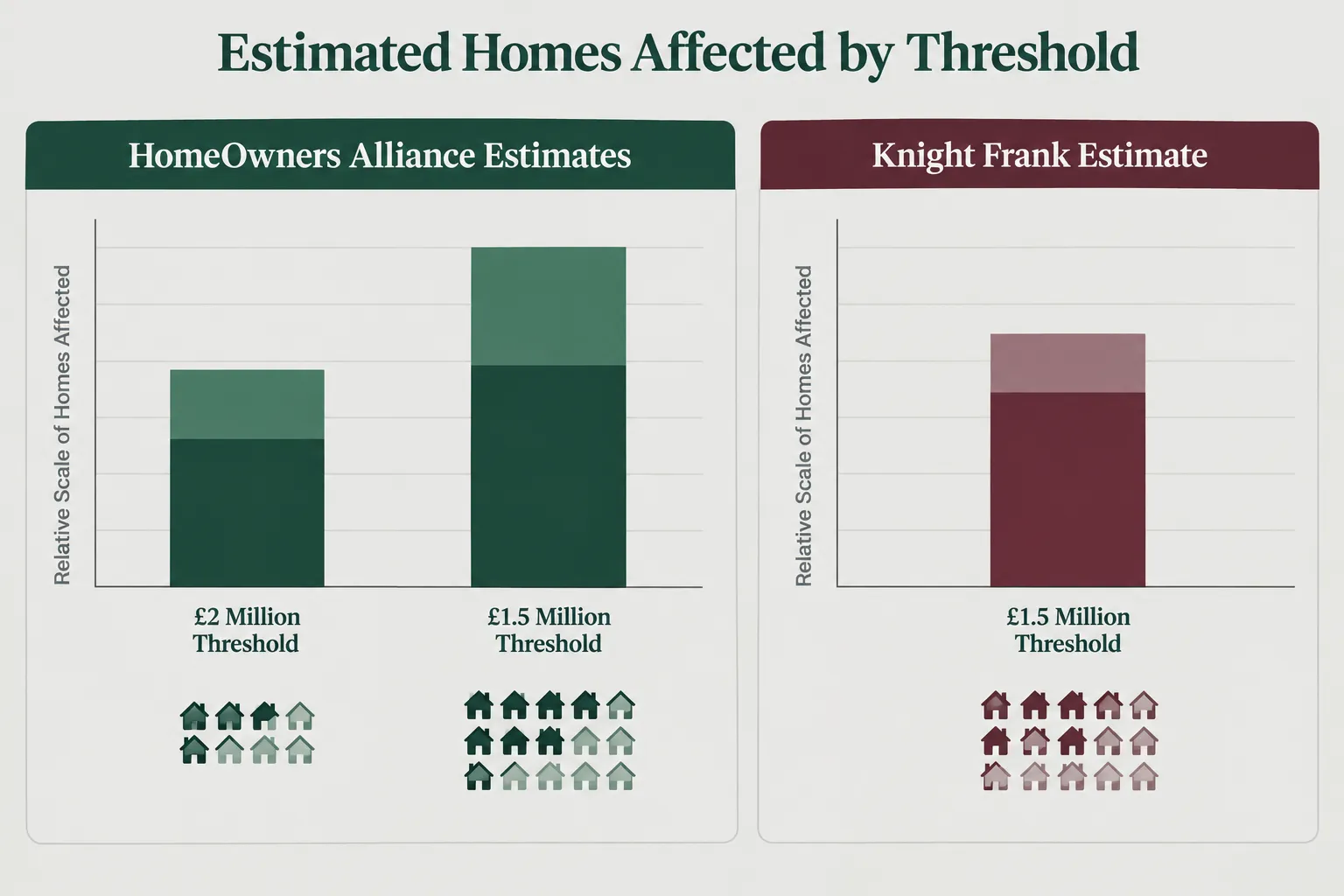
- Estimates of the impact vary: HomeOwners Alliance suggests around 277,000 homes could be affected at a £1.5 million threshold, versus roughly 165,000 at £2 million. Knight Frank separately estimates the number could nearly triple to about 222,800 homes.
- Data already shows vendors pricing just under £2 million to dodge the current threshold, a pattern likely to repeat if £1.5 million becomes the new line.
- Prime Minister Andy Burnham has ruled out stamp duty changes at this Budget, while the Treasury is reportedly modelling capital gains tax rises instead.
What Is the Mansion Tax Threshold Budget October 2026 Debate About
The High Value Council Tax Surcharge was announced as an additional annual charge layered on top of existing council tax, aimed squarely at England's most expensive homes. As things stand, it applies from April 2028 to properties valued at £2 million or above, with yearly charges ranging from £2,500 to £7,500 depending on value band.
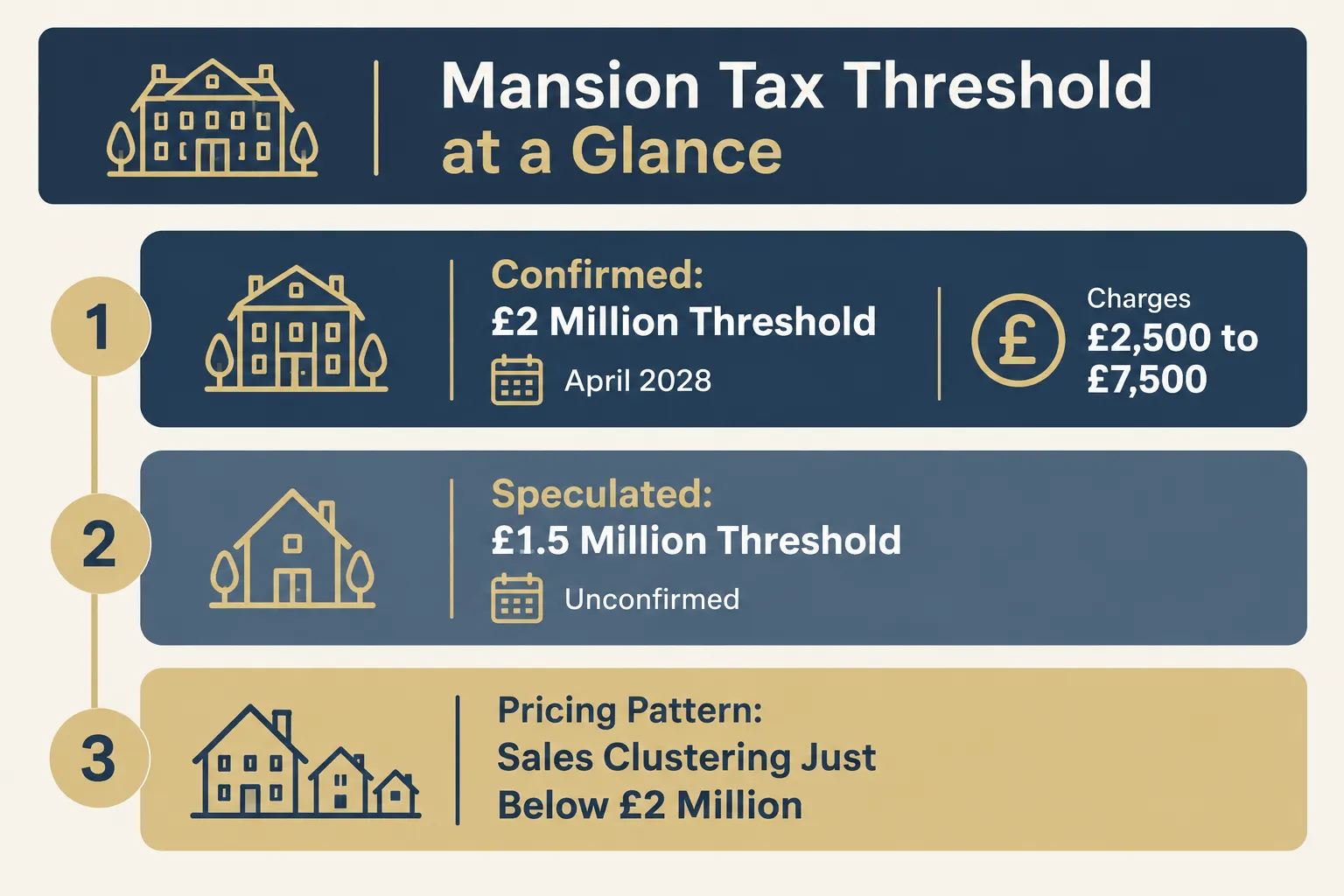
What has unsettled the prime property market is not the policy itself but the rumour mill surrounding the mansion tax threshold Budget October 2026 announcement. The Times has reported speculation inside Westminster that the Chancellor could lower the entry point to £1.5 million, pulling a much larger slice of London's housing stock into the surcharge before the policy has even started.
Nothing has been confirmed by the Treasury. But in a market where sentiment moves faster than legislation, the mere possibility of a lower threshold has already changed behaviour among sellers, buyers and their advisers.
Why Sales Are Clustering Just Below £2 Million
Numbers tell the story better than rhetoric. Tax Policy Associates found that completed sales at precisely £2 million fell from 117 to just 25 between December 2025 and July 2026. In the same window, sales at £1.99 million roughly doubled. That is not coincidence. It is vendors and agents deliberately pricing homes a few thousand pounds under the line to keep buyers out of surcharge territory.
This threshold-dodging pattern matters for two reasons:
- It shows the market reacts strongly even before a policy takes effect, purely on anticipation.
- It hints at what could happen again, on a much larger scale, if the mansion tax threshold Budget October 2026 decision moves the line down to £1.5 million.
A lower threshold would not just add more homes to the surcharge. It would likely trigger a fresh wave of pricing just under whatever the new figure becomes, distorting valuations across a much wider swathe of west London.
How a Lower Threshold Could Reshape Prime London
The scale of the potential change depends entirely on where the line is drawn, and estimates from different organisations diverge meaningfully.
| Threshold | Estimated Homes Affected | Source |
|---|---|---|
| £2 million (confirmed) | Approximately 165,000 | HomeOwners Alliance |
| £1.5 million (speculated) | Approximately 277,000 | HomeOwners Alliance |
| £1.5 million (speculated) | Approximately 222,800 | Knight Frank |
Both figures are estimates, not official forecasts, and the gap between them underlines how much uncertainty still surrounds the mansion tax threshold Budget October 2026 question. What is consistent across both estimates is the direction of travel: a £1.5 million threshold would roughly double or triple the number of homes caught by the surcharge compared with the current £2 million line.
For Notting Hill specifically, where many period conversions, garden flats and family houses sit around or above the thresholds being discussed, a lower threshold would pull far more "ordinary" prime properties into the net, not just the trophy mansions the policy was originally framed around.
Stamp Duty, Capital Gains Tax and Other Budget Pressures
Mansion tax speculation is not happening in isolation. Prime Minister Andy Burnham has stated that stamp duty changes will not be happening at this Budget, and he has rejected proposals to replace stamp duty and council tax entirely with a single annual property tax. That rules out one radical option that had circulated among property commentators.
Instead, reports suggest the Treasury is modelling increases to capital gains tax, currently set at 18% for basic-rate taxpayers and 24% for higher-rate taxpayers on residential property gains. For owners considering a sale ahead of the Budget, this is arguably as significant as the mansion tax threshold Budget October 2026 story, since it could affect profit on disposal regardless of a property's value band.
Adding further noise, shadow housing secretary Katie Lam proposed scrapping stamp duty altogether at the Conservative conference on 5 October 2026. This is opposition policy, not government policy, and should not be mistaken for an imminent change. Still, it illustrates how contested property taxation has become ahead of 28 October.
Is Prime Central London Market Cooling or Stabilising
Despite the tax noise, the underlying market tells a more resilient story. The UBS Global Real Estate Bubble Index 2026 no longer flags London as at risk of a property bubble, ending a five-year run of warnings. Knight Frank reported that summer 2026 prime central London sales were 6% higher than the same period a year earlier.
Camilla Dell of Black Brick has described the prime London market as "off the critical list", deflating gradually rather than collapsing.
Beauchamp Estates reports ultra-prime rents above £4,000 a week, suggesting demand for the very top of the market remains robust even as tax uncertainty persists. The picture emerging is one of gradual adjustment rather than panic selling, though pricing behaviour around threshold points shows real caution among sellers.
What Notting Hill Homeowners Should Do Now
Owners near either the £2 million or speculated £1.5 million line face a practical challenge: how to price, value and time a sale without knowing where the Budget will land. A few sensible steps apply regardless of the outcome on 28 October.
- Commission a RICS Red Book valuation. An independent, defensible valuation establishes exactly where a property sits relative to either threshold, which matters for negotiation and for any future tax liability.
- Factor the surcharge into offers. Buyers near £1.5 million or £2 million should treat the annual charge as part of total ownership cost, not an afterthought.
- Avoid reactive pricing decisions. Shaving a few thousand pounds off an asking price to dodge a threshold that has not been confirmed carries its own risks if the Budget leaves £2 million untouched.
- Track the capital gains tax conversation alongside the mansion tax one. Both could affect net proceeds from a sale far more than either in isolation.
Frequently Asked Questions
Is the mansion tax confirmed for April 2028?
Yes. The High Value Council Tax Surcharge is confirmed to begin in April 2028 on homes valued at £2 million or more, with charges between £2,500 and £7,500 a year.
Will the threshold definitely be lowered to £1.5 million?
No. This is speculation reported by The Times. The Treasury has not confirmed any change to the mansion tax threshold Budget October 2026 decision.
How many homes could be affected at a lower threshold?
Estimates vary. HomeOwners Alliance suggests around 277,000 homes at £1.5 million, up from about 165,000 at £2 million. Knight Frank separately estimates roughly 222,800 homes.
Will stamp duty change at the October 2026 Budget?
Prime Minister Andy Burnham has said stamp duty changes are not happening at this Budget, and has rejected replacing stamp duty and council tax with an annual property tax.
What other taxes might change instead?
Reports suggest the Treasury is modelling capital gains tax increases, with current residential rates at 18% basic and 24% higher rate.
Should homeowners price below £1.5 million now?
Pricing decisions should be based on an independent valuation rather than speculation, since the threshold has not been confirmed and could remain at £2 million.
Conclusion
The mansion tax threshold Budget October 2026 question will not be settled until the Chancellor stands up on 28 October. Until then, Notting Hill and prime London homeowners are navigating real uncertainty: a confirmed surcharge starting in 2028, unconfirmed speculation about a lower £1.5 million entry point, and a parallel conversation about capital gains tax that could matter just as much.
The sensible response is not to guess the Budget outcome but to prepare for either scenario. Obtain a RICS Red Book valuation to understand exactly where a property sits relative to both the £2 million and £1.5 million lines. Build the surcharge into offer calculations if buying near either threshold. And resist the urge to make drastic pricing decisions based on rumour rather than confirmed policy. Clarity will arrive on 28 October. Preparation should start now.
LANGUAGE: en