
UK flats lost 1.3% of their value over the past year while semi-detached houses gained 1.7%, according to Zoopla's index published on 1 October 2026. That is the blunt arithmetic behind the latest house price data, and it explains why London flat prices falling October 2026 leasehold reform Notting Hill is the question many west London owners are asking this autumn. Two major indices published on 1 October 2026 confirm what estate agents across Kensington and west London have been quietly admitting for months: flats are underperforming houses, London's wider market is soft, and leasehold reform is now close enough to start shaping decisions today.
This article, published by Notting Hill Surveyors on 3 October 2026, sets out what the numbers mean for flat owners, buyers and leaseholders across Notting Hill, Kensington and the surrounding boroughs, and what practical steps protect value while the law is still changing.
Key Takeaways
- Zoopla's 1 October 2026 index puts UK flats and maisonettes at an average £191,800, down 1.3% annually, while terraced and semi-detached houses both rose in value.
- Nationwide's 1 October 2026 index shows London up just 0.4% annually, with flats "virtually flat" while terraced houses led growth at 1.8%.
- Average mortgage rates of 5.93% to 5.94% are squeezing first-time buyers and investors hardest, both of whom are concentrated in the flats market.
- The draft Commonhold and Leasehold Reform Bill, reported on by the Commons Housing Committee on 27 May 2026, could change ground rents, lease extensions and commonhold rights before Royal Assent targeted for mid-2027.
- Until the law changes, the 80-year marriage-value cliff edge still applies, making lease length checks essential before any sale or purchase decision.
Why Flats Are Lagging Houses in the Current Market
The gap between flats and houses is no longer a rounding error. Zoopla's House Price Index, published 1 October 2026 using data to August, shows UK flats and maisonettes averaging £191,800, down 1.3% annually. Compare that with semi-detached houses, up 1.7%, and terraced houses, up 1.4%. The UK average across all property types rose 0.8% to £273,000. Nationwide's index, also released 1 October 2026, tells a similar story: terraced houses led growth with a 1.8% annual increase, while flats were described as "virtually flat" year on year.
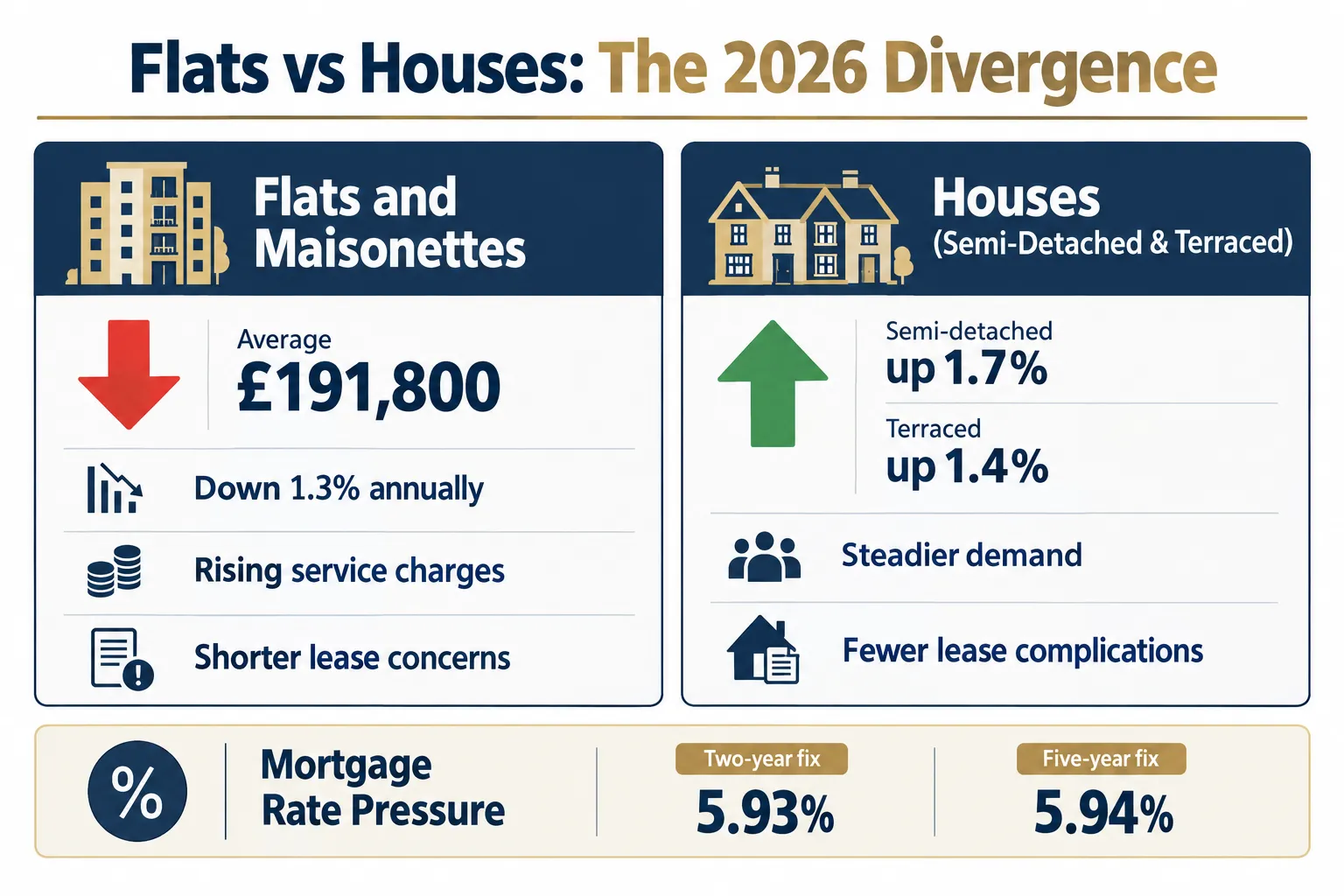
Several forces are driving this split:
- Service charges. Rising buildings insurance, staffing and maintenance costs have pushed annual service charges sharply higher across converted and purpose-built blocks, eroding the affordability advantage flats once had.
- Building-safety and cladding legacy. Even where remediation is complete or funded, some buyers remain cautious about blocks with a recent history of safety works, external wall surveys or waking watch costs.
- Shorter lease lengths. Many flats, particularly in older conversions, now sit closer to critical thresholds that trigger the marriage-value premium on lease extension, discouraging buyers who factor in future extension costs.
- Higher mortgage rates hitting first-time buyers and investors hardest. With the average two-year fix at 5.93% and five-year at 5.94%, the highest two-year rate since July 2024, the buyer groups who dominate flat purchases are the most rate-sensitive. The Bank of England holds Bank Rate at 3.75%, with its next decision on 5 November 2026 and markets pricing in a possible rise to 4%, which would tighten affordability further.
Zoopla also reports homes for sale up 5% while sales agreed are down 9%, meaning more stock is chasing fewer committed buyers, a dynamic that tends to hit flats, where supply is already dense, harder than houses.
London Flat Prices Falling October 2026 Leasehold Reform Notting Hill: The National Backdrop
Regionally, the picture is mixed but leans soft. Zoopla records London prices down 1.0% annually and the South East down 0.7%. Nationwide, using a different methodology, shows London up 0.4% annually while southern England overall is down 0.1%. Both indices agree on the underlying pattern even where the headline London figure diverges: property types dominated by flats are underperforming those dominated by houses, and the South of England is lagging the national average more broadly.
For context, Nationwide's UK average now stands at £274,251, up 0.8% annually but down 0.2% in the month to September. That monthly dip, combined with a stubbornly high mortgage rate environment, suggests the market is still adjusting rather than recovering. For anyone with equity concentrated in a flat, this is the backdrop against which lease terms, service charges and reform timelines now matter more than ever.
What This Means for Notting Hill's Flat-Heavy Housing Stock
Notting Hill, like much of Kensington and the wider Royal Borough, has a housing stock weighted heavily toward period conversions and mansion blocks rather than standalone houses. That structural fact means the national flats-versus-houses divergence is not an abstract statistic for local owners, it is directly relevant to how their asset class is being priced relative to houses in the same postcode.
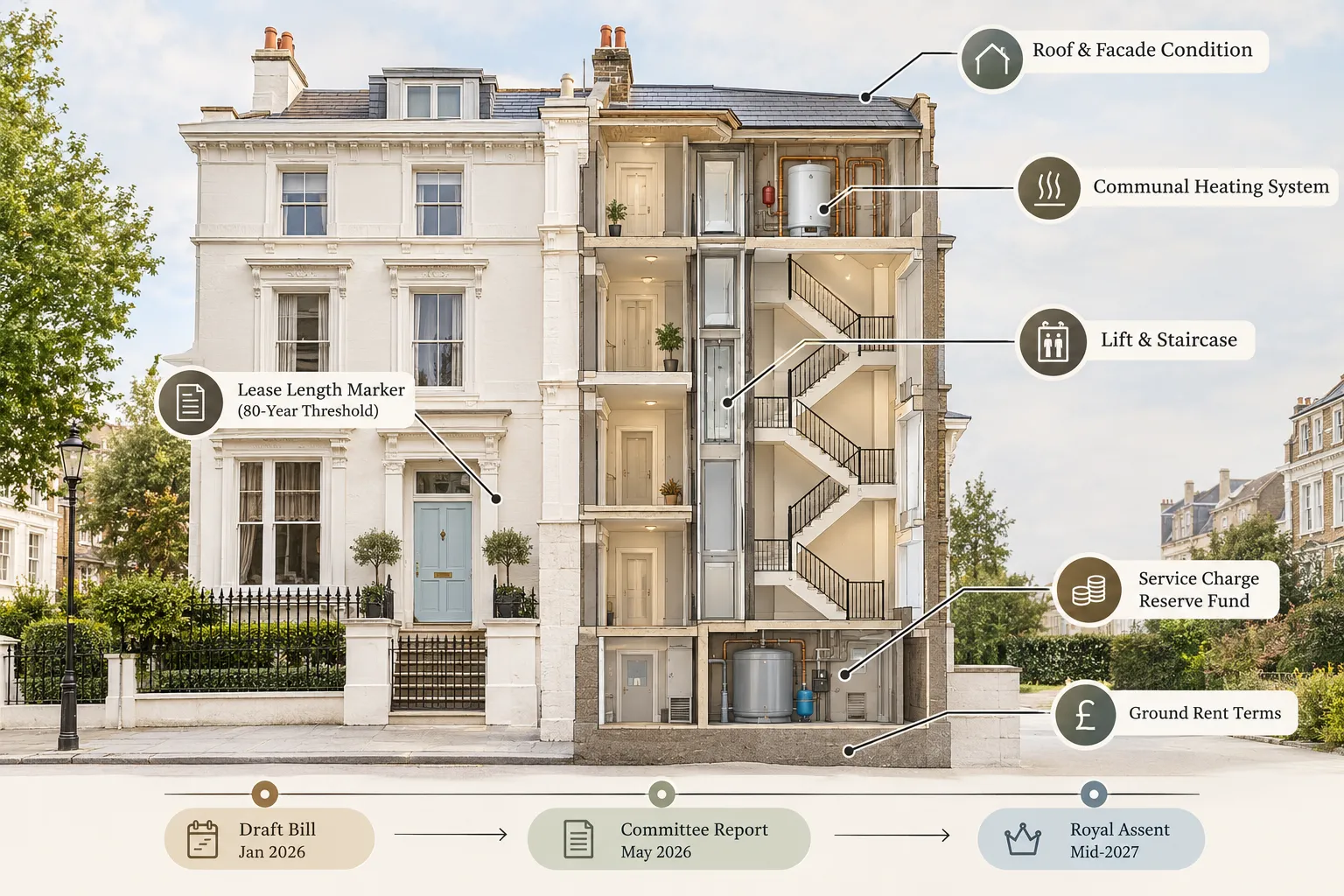
Generally speaking, flats in converted period buildings and larger mansion blocks carry particular sensitivities in the current climate:
- Lease length and service charge transparency weigh more heavily on buyer decisions than they did two or three years ago, because higher borrowing costs leave less room to absorb surprises.
- Communal structure and maintenance history in mansion blocks, lifts, roofs, communal heating, facade condition, are now scrutinised earlier in a transaction, not left to late-stage conveyancing queries.
- Investor appetite, historically a meaningful part of demand for smaller flats in the area, is more exposed to mortgage rate rises than owner-occupier demand for houses.
None of this means values are collapsing locally; it means the national flats discount is a real headwind that owners and buyers should factor into pricing expectations and negotiation. Anyone weighing a purchase or sale of a period conversion flat should read the condition and the paperwork together, a condition survey report covering communal areas as well as the flat itself gives a clearer picture than a valuation alone.
How Leasehold Reform Could Change Flat Values
The other half of this story is legislative, and it is moving. The government published the draft Commonhold and Leasehold Reform Bill in January 2026 for pre-legislative scrutiny. The Commons Housing Committee reported on 27 May 2026, and an amended Bill is expected this autumn, with Royal Assent targeted for mid-2027.
Key proposals that would directly affect flat values include:
| Reform proposal | Draft Bill position | Housing Committee recommendation |
|---|---|---|
| Default tenure for new flats | Commonhold as default | Supported |
| Ground rent cap | £250 a year, tapering to peppercorn | Tapering recommended over 20 years, not 40 |
| Reserve funds | Mandatory | Supported |
| Managing agent oversight | Not specified in draft | Independent regulator recommended |
| Right to manage | Flats only | Extend to leasehold houses |
If enacted broadly as recommended, these changes would reduce ground rent liabilities, add predictability to reserve funds, and potentially make lease extension cheaper and simpler by moving toward commonhold. That is a meaningful long-term positive for flat values generally. But timing matters: Royal Assent is targeted for mid-2027, and implementation of specific provisions is likely to follow in stages after that. Anyone pricing a flat today is pricing in uncertainty, not a finished reform.
This is why independent valuation advice is increasingly important for transactions involving ground rent, service charge disputes or lease extension negotiations, see our guide to valuing freehold versus leasehold interests under the 2026 reforms for a fuller breakdown of how surveyors are adjusting methodology ahead of Royal Assent.
Practical Steps for Owners, Buyers and Leaseholders
Until the amended Bill passes and takes effect, the existing legal framework still governs lease extension and enfranchisement, including the harsh marriage-value calculation that applies once a lease drops below 80 years remaining. Practical, defensive steps now matter more than waiting for reform.
1. Check the remaining lease term immediately. The 80-year marriage-value cliff edge still applies under current law. A lease at 81 years today is a very different financial proposition from one at 79 years, regardless of what reform eventually delivers.
2. Commission a proper survey of the flat and common parts. A RICS Level 2 or Level 3 survey, depending on the building's age and condition, should always cover communal structure, roof, and services, not just the demise. Understanding the difference between Level 2 and Level 3 survey scope helps owners choose the right level of inspection for a period conversion or mansion block flat.
3. Instruct an independent valuation for any lease extension or sale. Ground rent terms, unexpired lease length and service charge history all feed into valuation in ways that generic online estimates cannot capture. A dedicated Notting Hill valuation report or wider valuation service in Notting Hill gives a defensible figure for negotiation, mortgage purposes or a Section 42 lease extension notice.
4. Scrutinise service-charge accounts line by line. Ask for at least three years of accounts, check reserve fund balances against planned major works, and compare charges to similar blocks. This is especially important given the Housing Committee's recommendation for mandatory reserve funds and an independent managing agent regulator, both signal that scrutiny of current practice is only going to increase.
For anyone unsure where to start, Notting Hill Surveyors provides RICS chartered advice across west London, and the firm's blog carries further detail on survey types and reform timelines as they develop.
Frequently Asked Questions
Are London flat prices actually falling in October 2026?
Zoopla's 1 October 2026 index shows London prices down 1.0% annually and UK flats/maisonettes specifically down 1.3% to an average £191,800. Nationwide's same-day index shows London up 0.4% overall but flats "virtually flat," confirming flats are underperforming houses either way.
Will leasehold reform increase my flat's value?
Potentially, over time, if ground rent caps, commonhold conversion and cheaper lease extensions are enacted as proposed. However, Royal Assent is only targeted for mid-2027, with implementation likely staged after that, so current valuations should not assume reform benefits have already arrived.
Why does the 80-year lease threshold still matter if reform is coming?
Because the current marriage-value rules remain law until Parliament changes them. A lease falling below 80 years today still triggers the existing, more expensive extension calculation, regardless of future reform plans.
How do rising mortgage rates affect flat buyers more than house buyers?
First-time buyers and investors, both heavily represented in the flats market, are typically more leveraged and rate-sensitive. With average two-year fixes at 5.93% and the Bank of England's next decision due 5 November 2026, affordability pressure falls disproportionately on this buyer group.
What should I check before buying a flat in a Notting Hill mansion block or conversion?
Remaining lease term, ground rent terms, service charge history and reserve fund levels, plus the physical condition of communal structure, roof and services alongside the flat itself.
Does the draft Bill cover leasehold houses as well as flats?
The draft Bill focuses on flats and commonhold, but the Housing Committee has recommended extending right-to-manage to leasehold houses, which would be a notable expansion if adopted in the amended Bill.
Conclusion
The data published on 1 October 2026 confirms a clear divergence: houses are holding or gaining value while flats, nationally and in London specifically, are losing ground. For Notting Hill, Kensington and the wider west London market, where flats in period conversions and mansion blocks make up a substantial share of housing stock, this is not a passing headline, it is a trend that affects pricing conversations happening right now. Leasehold reform offers a credible path toward better long-term value for flat owners, but with Royal Assent not expected until mid-2027, the sensible approach today is defensive: check lease length against the 80-year threshold, get proper survey cover for the flat and its communal parts, obtain an independent valuation before any lease extension or sale, and read service-charge accounts closely. Owners and buyers who act on these fundamentals now will be better positioned whichever way the reformed law eventually lands.
LANGUAGE: en