
A decade of falling values in one of the world's most scrutinised property markets has just recorded its first quarterly gain since 2022. That is not a typo, and it is not a turning point either, at least not yet. According to Knight Frank data reported on 5 October 2026 by Property Industry Eye and Estate Agent Today, prime central London house prices rise Q3 2026 Knight Frank Notting Hill data shows a 0.3% quarterly increase, the first such rise in roughly four years. For owners in Notting Hill, Holland Park and Kensington, the question is not whether the headline is good news, it is whether it changes anything about how a property should be priced, valued or sold right now.
This article sets out exactly what the figures say, what they do not say, and why an independent RICS valuation matters more than ever heading into the 28 October 2026 Budget.
Key Takeaways
- Knight Frank reports prime central London house prices rise Q3 2026 by 0.3%, the first quarterly uplift in about four years, though annual values remain down 2% and about 22% below the August 2015 peak.
- Prime outer London prices are down 0.6% year-on-year but have stayed within a 1% band since May 2025, suggesting a market finding its floor rather than recovering sharply.
- Exchanges across PCL and POL fell 2.5% in the year to September 2026, a marked improvement on the 14% decline recorded to March 2026.
- Super-prime activity above £10m held steady at 121 deals, with total spend up 14% to £2.4bn, showing strength concentrated at the very top.
- Sellers are becoming more realistic on price, per Knight Frank's Liza-Jane Kelly, and the looming mansion tax threshold debate makes independent valuation essential for anyone near the £2m or rumoured £1.5m line.
Prime Central London House Prices Rise Q3 2026: The Knight Frank Figures in Full
The data, attributed to Knight Frank and reported by Property Industry Eye and Estate Agent Today on 5 October 2026, gives the clearest signal yet that the long PCL correction may be stabilising.
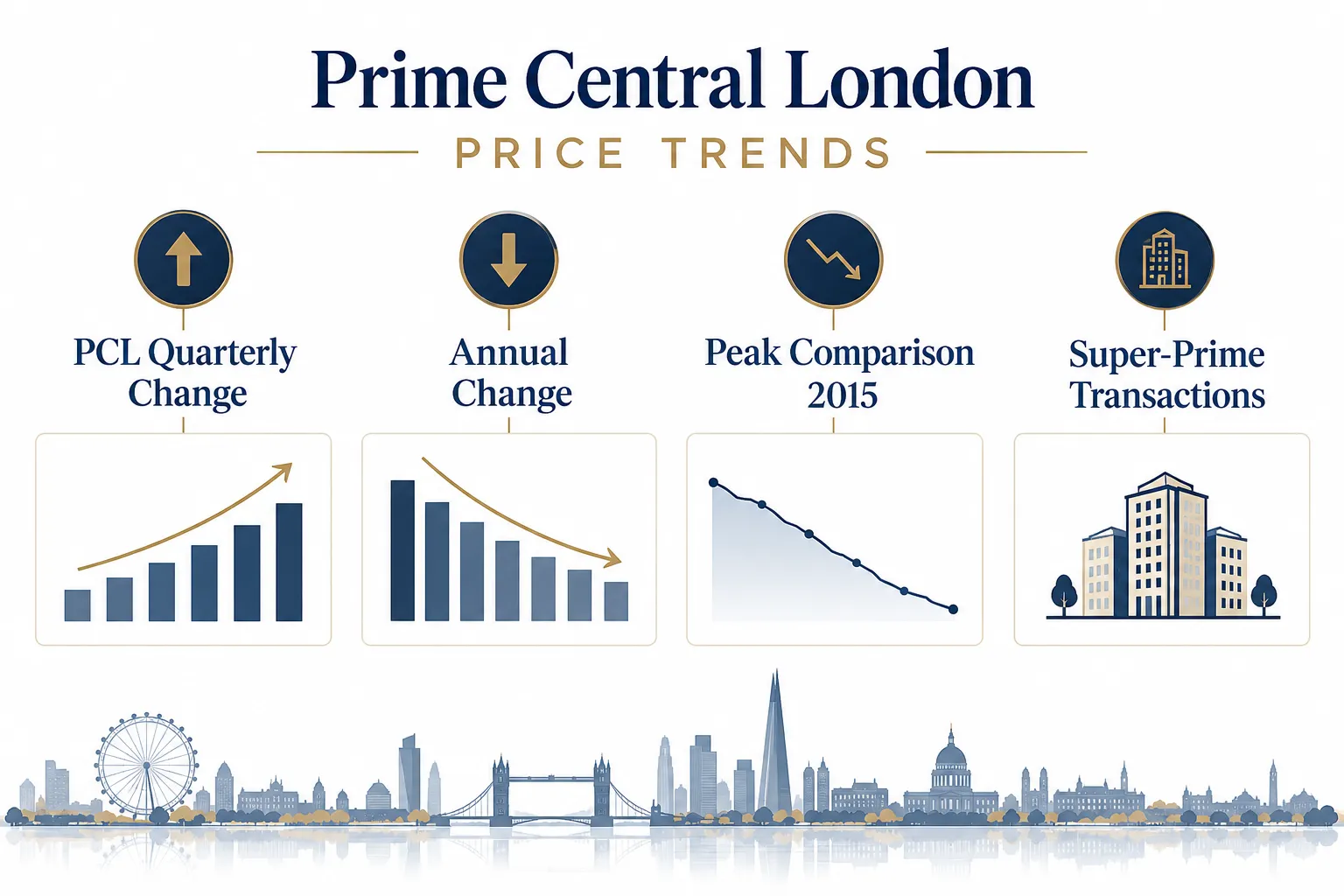
| Metric | Figure |
|---|---|
| PCL quarterly change (Q3 2026) | +0.3% (first rise in about four years) |
| PCL annual change | -2% (smallest annual fall in 18 months) |
| PCL vs August 2015 peak | approximately -22% |
| POL annual change | -0.6% (within 1% range since May 2025) |
| Exchanges, year to September 2026 | -2.5% (vs -14% to March 2026) |
| Transactions above £10m, year to September | 121 (unchanged year-on-year) |
| Total super-prime spend | £2.4bn (+14%) |
| PCL rental growth | +1.3% year-on-year |
| POL rental growth | +3% year-on-year |
| PCL tenant-to-property ratio | 5.6 (highest in four years) |
Two things stand out. First, the quarterly rise is real but small, 0.3% on a market that has fallen roughly 22% since its 2015 peak is a rounding adjustment, not a recovery. Second, the improvement in exchange volumes (down 2.5% rather than down 14%) matters more than the price tick, because it signals buyers are transacting again rather than sitting on the sidelines indefinitely.
Knight Frank's Liza-Jane Kelly, head of London sales, offered a pragmatic read: "We are starting to see sellers become more realistic with their price." She added that sellers "have accepted the more difficult mortgage landscape facing buyers" and that buyers, some of whom have been renting, "are sensing value after the price declines of the last decade." That is the heart of the story, not a bottom being called, but a market where both sides are meeting closer to reality.
Is This the Bottom for Notting Hill and W11?
It is tempting to read one quarter of growth as the start of a new cycle. Owners in W11 should resist that temptation for three reasons.
One quarter does not make a trend. PCL prices have moved sideways to down for roughly four years. A 0.3% rise after that long a decline could reflect genuine stabilisation, or it could be noise from a small number of transactions in a thin market. The annual figure, still down 2%, is the more reliable signal, and even that is described by Knight Frank only as the smallest fall in 18 months, not a reversal.
Prime outer London tells a steadier story. POL values have moved within a narrow 1% band since May 2025. That tighter range, sustained over more than a year, is arguably a stronger indicator of a market finding its level than PCL's single quarterly bounce.
Activity is recovering unevenly. The improvement in exchanges, down 2.5% rather than 14%, is encouraging, but super-prime transactions above £10m were flat in volume. The 14% rise in total super-prime spend came from fewer, bigger deals, not broader market depth. That is a market where wealthy buyers at the very top are active, while the wider £2m-£5m bracket that dominates Notting Hill's period stucco houses is still finding its feet.
The UBS Global Real Estate Bubble Index 2026 no longer classing London as high-risk adds a note of reassurance for long-term holders, but it is a macro signal, not a street-level valuation.
For Notting Hill specifically, the practical implication is this: pricing realism, not optimism about a recovery, is what will get a sale agreed in the current market.
Why Pricing Realism Matters More Than the Headline Number
Kelly's comment about sellers "becoming more realistic" is arguably the most important line in the entire release. It describes a market correction in buyer and seller expectations, not in bricks and mortar.
For sellers, this means an asking price pitched to 2021 comparables, or to an agent's optimistic appraisal designed to win the instruction, risks a property sitting unsold for months while the market moves on. Buyers in today's climate have more choice, higher mortgage costs to factor in, and access to the same Knight Frank data everyone else is reading. They will negotiate hard against any price that ignores the annual 2% fall and the 22% gap to peak.
For buyers, the flip side is also true. A seller who has "accepted the more difficult mortgage landscape" is one who may be open to a fair, evidence-based offer, but only if the buyer's own evidence is robust. Turning up to a negotiation with an online estimate or a casual guess is a weak position when the seller's agent has access to comparable sales data.
This is precisely where an independent, RICS Red Book valuation, distinct from an estate agent's marketing appraisal, earns its fee. An agent's appraisal is designed to win your instruction and is rarely an impartial assessment of value. A chartered surveyor's Valuation In Notting Hill is produced to RICS professional standards, free of any incentive to inflate the figure, and carries the credibility needed in a negotiation, a probate matter, a matrimonial settlement, or a mortgage application.
How the £2m Threshold Is Distorting Pricing Ahead of the Budget
A second distortion is now layered on top of ordinary market dynamics: the mansion tax. The High Value Council Tax Surcharge on homes over £2m is due to take effect from April 2028, and ahead of the 28 October 2026 Budget there have been rumours that the threshold could be cut to £1.5m.
In a borough where a huge proportion of family houses and larger flats sit either side of the £2m mark, this is not a minor technicality. It creates real incentives, for sellers to argue their home sits just under a threshold, and for buyers to argue it sits just over one, each using the figure to their own advantage in negotiation. Whichever threshold is confirmed on 28 October, owners of property anywhere near £1.5m to £2.5m will want documented, defensible evidence of value that predates and survives any political announcement.
This is a second strong argument for commissioning an independent valuation now, rather than waiting for the Budget outcome. A dated, RICS-compliant report gives owners:
- A clear, evidenced figure to plan tax exposure around, whichever threshold is confirmed.
- Protection against both under- and over-valuation disputes with HMRC or local authorities.
- A professional record that is separate from any agent's commercial interest in a sale.
Those managing property portfolios or absentee-owned assets in the area may also find it useful to review Absentee Freeholder Valuation services, and owners weighing leasehold extensions or enfranchisement alongside the surcharge question should look at how recent reform affects freehold vs leasehold valuation under the 2026 changes.
What to Check in a Period Stucco House or Converted Flat
Valuation accuracy depends on condition, and condition in Notting Hill's housing stock is rarely straightforward. The borough's stucco-fronted terraces and converted mansion flats are desirable precisely because of their period character, but that character comes with structural and maintenance risks that a desktop valuation or a quick agent walk-through will not catch.
A Level 3 building survey, the most detailed RICS inspection available, is the appropriate standard for this type of property. It should cover:
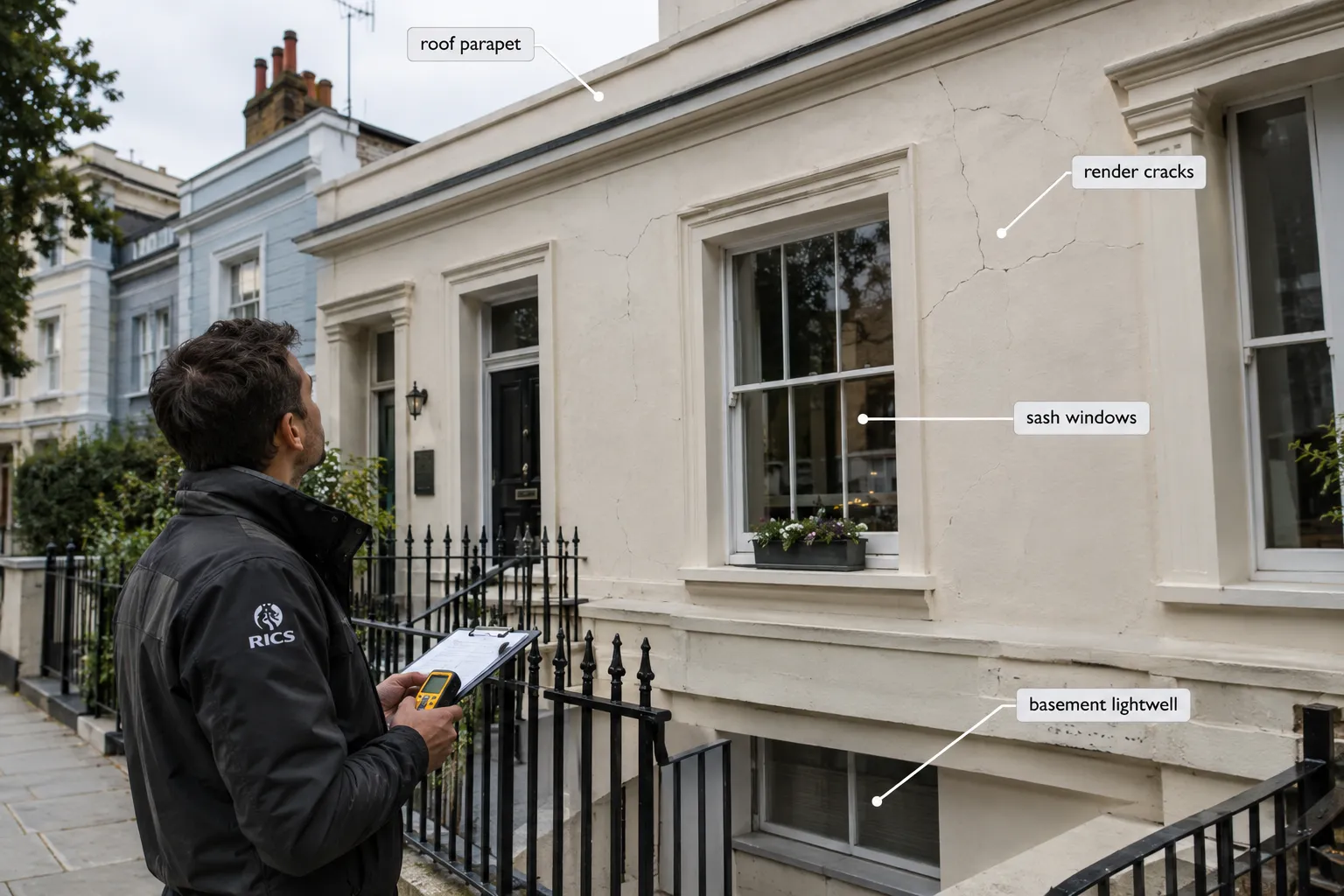
- Render and stucco condition, cracking, water ingress behind painted render, and historic repair quality, which can mask damp or movement.
- Roof coverings and parapets, London stucco terraces often have flat or hidden roof areas behind decorative parapets, a common source of undetected leaks.
- Basement and lightwell conversions, many Notting Hill houses have been dug down or extended; tanking, drainage and damp-proofing here need close inspection.
- Subsidence risk, clay soils across much of W11 make ground movement checks essential; see the specific guidance on subsidence surveys in London.
- Lateral and vertical splits in converted flats, leasehold flats carved from single houses often have altered structural loading, party wall history and fire separation issues worth verifying.
- Historic extensions and loft conversions, check consents and structural adequacy, particularly relevant where extension and loft structural design has been carried out without full building control sign-off.
Understanding the difference between a basic visual appraisal and a full structural inspection matters here. Readers unfamiliar with survey levels should review the key differences between a Level 2 and Level 3 survey before instructing either a buyer's or seller's survey, since the wrong level of inspection on a period property can miss exactly the defects that affect negotiated price.
What This Means for Buyers, Sellers and Owners Right Now
Buyers have more room to negotiate than at almost any point in the last decade, supported by the rental market data showing PCL rents up only 1.3% against POL's 3%, suggesting some tenants are indeed being drawn toward ownership, as Kelly noted. But negotiating from strength requires an independent valuation and a proper condition survey, not just a lower initial offer.
Sellers should treat the 0.3% quarterly rise as a reason for cautious optimism about market sentiment, not as licence to reprice upward. The improving exchange volumes suggest realistically priced homes are moving; overpriced ones will simply continue to sit.
Owners not currently selling should use this period of relative stability to get ahead of the mansion tax question. A documented valuation today, paired with a condition survey that supports or challenges that figure, is a sound administrative step regardless of what the October Budget confirms.
Those considering any of these steps can review Notting Hill Valuation Reports or get an overview of chartered surveyors operating in Notting Hill for the full range of RICS services available locally.
FAQ
Does the Q3 2026 rise mean prime central London prices have bottomed out?
No single quarter confirms a bottom. The 0.3% rise is the first in about four years, but annual values are still down 2% and about 22% below the 2015 peak. It is a sign of stabilising sentiment, not a confirmed reversal.
Should I reprice my Notting Hill property upward because of this news?
Not on this data alone. Knight Frank's own commentary emphasises sellers becoming more realistic, not more ambitious. An independent valuation is the safer basis for any pricing decision.
How does the possible mansion tax threshold change affect my property?
If the threshold is cut from £2m to £1.5m, many more Notting Hill and Holland Park properties would fall within scope from April 2028. Getting a documented, RICS-standard valuation now provides evidence regardless of the final threshold confirmed at the 28 October 2026 Budget.
What is the difference between an agent's appraisal and a RICS Red Book valuation?
An agent's appraisal is a marketing estimate intended to win a sale instruction. A RICS Red Book valuation is an independent, professionally regulated assessment used for negotiation, tax, probate, lending and legal purposes, carrying far greater evidential weight.
Why does a period stucco house need a Level 3 survey rather than a Level 2?
Older stucco-fronted properties commonly have hidden roof areas, historic render repairs, basement conversions and structural alterations that a Level 2 survey is not designed to investigate fully. A Level 3 survey examines these higher-risk elements in detail.
Is now a good time to buy in W11 given the rental market data?
The PCL tenant-to-property ratio of 5.6, the highest in four years, suggests strong rental demand, which some buyers are using as a signal to move from renting to owning while prices remain well below peak. Any purchase decision should still be supported by an independent valuation and survey.
Conclusion
The headline from Knight Frank is genuinely newsworthy: prime central London house prices rise Q3 2026 Knight Frank Notting Hill data marks the first quarterly gain in around four years, alongside improving transaction volumes and resilient super-prime spending. But for owners and buyers in Notting Hill, Holland Park and Kensington, the detail matters far more than the headline. Annual values remain down, the market sits well below its 2015 peak, and the real story is pricing discipline on both sides of the negotiating table, sharpened further by the uncertainty around the mansion tax threshold ahead of the 28 October 2026 Budget.
Whether buying, selling, or simply planning ahead of possible tax changes, the soundest next step is independent, evidence-based advice: a RICS Red Book valuation to establish defensible value, and where the property is a period stucco house or converted flat, a Level 3 building survey to understand its true condition. Contact Notting Hill Surveyors for a valuation or building survey quote tailored to W11 and the surrounding prime London market.
prime central London, Notting Hill property market, Knight Frank house prices, RICS valuation, mansion tax threshold, Holland Park property, Kensington house prices, Level 3 building survey, PCL market trends, property surveyor London, October 2026 property news, super-prime London