
Micro-location adjustments routinely swing a UK residential valuation by between 3% and 10%, according to practitioner analysis in 2026, yet most buyers receive only an estate agent's assurance that a property sits in a "highly sought-after" or "up-and-coming" area. The gap between that marketing language and the structured, evidence-based methodology that RICS-registered surveyors apply is the subject of this guide. Understanding Location, Location, Valuation: How UK Surveyors Assess 'Location' Beyond Estate Agent Marketing Claims is not merely academic: it can mean the difference between paying a fair price and overpaying by tens of thousands of pounds.
Key Takeaways
- RICS surveyors assess location using verifiable, ordered criteria, flood risk, transport connectivity, school catchment quality, planning pipelines, noise, and crime, not marketing descriptors.
- The RICS Red Book requires surveyors to support every location-related adjustment with comparable market evidence, not subjective opinion.
- Micro-location factors (the specific street, aspect, or proximity to a noise source) can move a valuation by 3-10% relative to a postcode average.
- Regional market divergences in 2026 mean that location must be treated as a dynamic variable, not a fixed label.
- Buyers and lenders benefit most from a professional valuation that separates genuine locational value from estate agent narrative.
What "Location" Actually Means to a RICS Surveyor
Estate agents use "location" as a persuasion tool. Surveyors use it as a measurable input. The distinction matters enormously in practice.
When a RICS-registered valuer inspects a property, the process of recording locational attributes is systematic and follows the professional standards set out in the RICS Valuation, Global Standards (the Red Book) [1][2]. Rather than describing a neighbourhood in aspirational terms, the surveyor records objective data points that can be cross-referenced against comparable sales evidence.
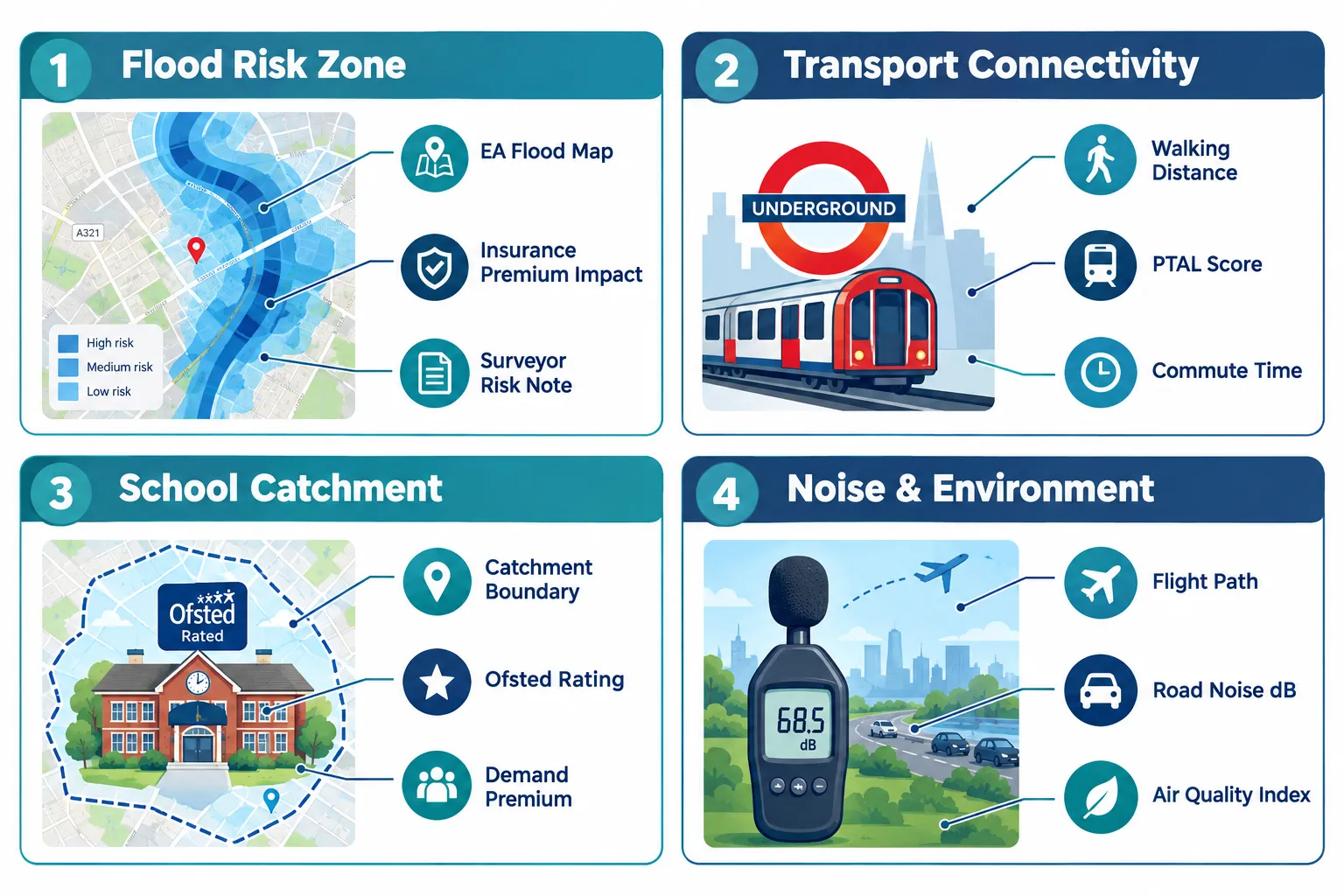
The core locational factors a surveyor considers include:
- Flood risk: Environment Agency flood zone classification, surface water risk, and the likely effect on insurance premiums and mortgage availability.
- Transport connectivity: Measured walking distance to rail or Underground stations, the Public Transport Accessibility Level (PTAL) score in London, and bus frequency.
- School catchment: Proximity to Ofsted-rated schools, current catchment boundaries, and the demonstrable price premium that strong school zones command in comparable sales.
- Noise and environmental quality: Proximity to flight paths, major roads, railway lines, and industrial uses. Decibel levels and air quality data are increasingly referenced.
- Planning pipeline: Permitted or consented development nearby that could alter the character of the area, block views, or increase traffic.
- Crime statistics: Local police data, which can affect both desirability and insurance costs.
Each factor is not merely noted, it is weighed against comparable evidence from similar properties in similar locations. If a property sits within a flood zone and comparable sales in flood-free streets nearby command a premium, the surveyor quantifies that adjustment rather than describing it as a "minor concern."
"The surveyor's job is to translate the concept of location into a number that a lender or buyer can rely on, not to confirm what the marketing brochure says."
Location, Location, Valuation: The Evidence Framework Surveyors Use
The phrase "location, location, location" has been used in property marketing for decades. But Location, Location, Valuation: How UK Surveyors Assess 'Location' Beyond Estate Agent Marketing Claims requires a deeper look at the professional framework that underpins every RICS valuation.

The Red Book and Comparable Evidence
The RICS Red Book Global Standards require that valuations be grounded in market evidence [2]. For residential properties, this means the surveyor must identify recent sales of genuinely comparable properties, similar size, condition, tenure, and, critically, location, and then make explicit, reasoned adjustments for any differences.
The RICS Residential Valuations guidance reinforces this approach, requiring surveyors to document locational attributes and justify any adjustment applied [3]. A property described by an agent as being in a "vibrant regeneration area" must be assessed against actual sold prices in that area, not against the agent's projection of future desirability.
This matters because regeneration narratives are frequently used to justify asking prices that exceed current market evidence. A surveyor working to Red Book standards cannot accept a narrative as a substitute for data.
Ordered Location Adjustments in Rating Valuations
Government rating guidance for 2026 formalises an explicit, ordered approach to location adjustments in non-domestic rating valuations [8]. Valuers must apply location factors in a defined sequence, starting with the primary location tier (town centre versus edge of town, for example) and then applying secondary adjustments for specific site characteristics. This structured approach, now embedded in official guidance, reflects the broader professional direction of travel: location analysis must be transparent, ordered, and reproducible.
Public Sector and Non-Investment Asset Valuations
For public sector assets, HM Treasury guidance limits speculative "alternative site" assumptions and requires that location be assessed based on the asset's existing use and realistic market context [4][6]. The Depreciated Replacement Cost (DRC) method, used for specialist assets with no direct market comparables, similarly requires that the site value component reflect actual location evidence rather than optimistic assumptions about what the site could theoretically be worth [5][7].
ESG and Climate Risk
Sustainability and ESG considerations are now embedded in commercial valuations, and they are increasingly influencing residential assessments too. Flood risk, energy performance, and proximity to green infrastructure are all location-related factors that affect long-term value resilience. A property in a high flood-risk zone may carry a current market value that does not yet fully reflect the trajectory of insurance costs and mortgage availability, a forward-looking risk that a thorough surveyor will flag even if it is not yet fully priced into comparable sales.
Micro-Location: The 3-10% Swing That Marketing Ignores
One of the most important insights from practitioner analysis in 2026 is the scale of micro-location effects. Within a single postcode, the difference between the sunny side of a street and the shadowed side, between a garden that backs onto a railway embankment and one that does not, or between a flat above a commercial unit and one above a residential property, can move a valuation by 3-10%.
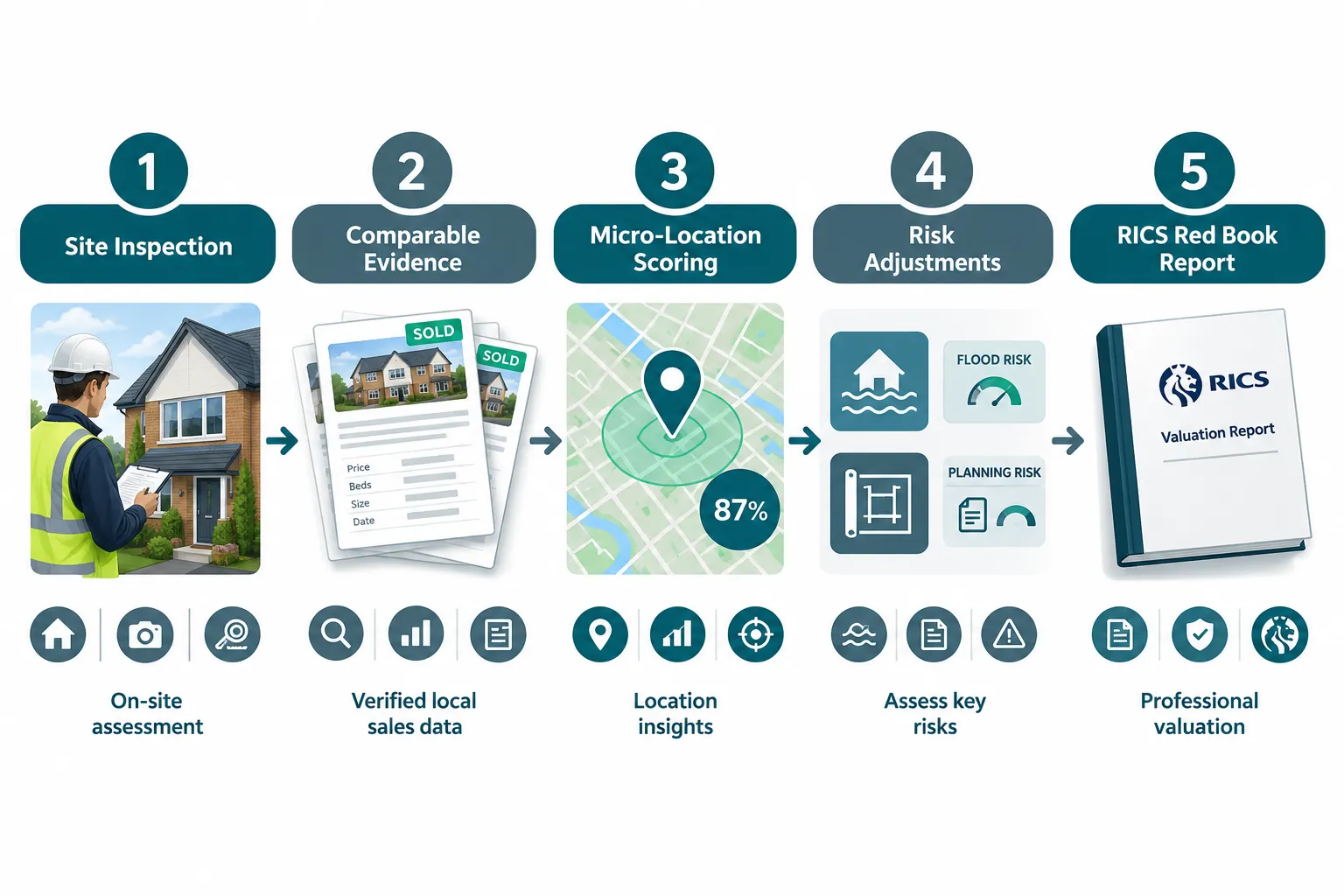
Estate agent marketing almost never addresses these distinctions. A property is described as being "in" a desirable area, with the implication that all properties in that area share equally in its desirability. Surveyors know this is not the case.
Postcode-Level and Street-Level Analysis
Best-practice guidance in 2026 emphasises postcode-level and connectivity-based location analysis as a minimum standard [10]. This means a surveyor assessing a property in, say, Clapham will not simply note "Clapham" as the location. They will consider:
- Which part of Clapham (North, South, Common, Old Town)?
- Walking distance to Clapham Common, Clapham North, or Clapham South Underground stations?
- Proximity to the noise corridor along the A3 or the relative quiet of residential back streets?
- Catchment for which primary schools, and what are their current Ofsted ratings?
For buyers in South London, working with Chartered Surveyors in Clapham who understand these granular distinctions is essential to getting an accurate picture of what a property is actually worth.
Regional Divergences in 2026
Regional market divergences in 2026 have sharpened the need to treat location as a dynamic variable. The gap between prime London postcodes and northern English cities, between commuter belt towns and rural areas, and between regenerating urban cores and stagnating secondary towns has widened in ways that require surveyors to update their comparable evidence continuously rather than relying on historical price patterns [10].
A property that was correctly described as being in a "strong location" three years ago may now be in a location whose fundamentals have shifted, for better or worse. Infrastructure announcements, school performance changes, new flood risk assessments, and shifts in employer bases all alter the locational calculus.
This dynamic quality of location is one reason why a RICS valuation carries a date of valuation, the assessment reflects market conditions at a specific point in time, not a permanent verdict on a location's worth.
Connectivity as a Value Driver
Transport connectivity is one of the most quantifiable locational factors. Research consistently shows that proximity to rail stations, particularly in London and the South East, commands a measurable premium. Surveyors in areas such as Guildford, Epsom, and Twickenham routinely factor in the walking distance to the station as an explicit adjustment in their comparable analysis, because the sold price data supports it.
The table below illustrates how surveyors typically weight locational sub-factors in a residential valuation context:
| Locational Factor | Data Source Used by Surveyor | Typical Valuation Impact |
|---|---|---|
| Flood risk zone | Environment Agency flood maps | -5% to -15% in high-risk zones |
| Station walking distance | Measured distance, PTAL score | +3% to +8% within 5 min walk |
| Ofsted Outstanding school catchment | Ofsted ratings, catchment maps | +3% to +10% premium |
| Road/rail noise exposure | Noise maps, site inspection | -2% to -8% discount |
| Consented development nearby | Local planning authority portal | Variable; surveyor-assessed |
| Crime rate (local police data) | Police.uk statistics | -1% to -5% in high-crime areas |
How Location, Location, Valuation Protects Buyers and Lenders
The practical purpose of the rigorous approach described in Location, Location, Valuation: How UK Surveyors Assess 'Location' Beyond Estate Agent Marketing Claims is protection, for buyers, lenders, and the integrity of the market.
Protecting Buyers from Overpaying
When a buyer relies solely on an estate agent's description of a location, they are relying on a party whose commercial interest lies in completing the sale at the highest possible price. A RICS-registered surveyor, by contrast, has a professional duty to provide an independent, evidence-based opinion of value.
This is particularly important for:
- First-time buyers who may not have the local knowledge to interrogate marketing claims.
- Buyers relocating from other regions, who are unfamiliar with the micro-location distinctions that experienced local buyers take for granted.
- Buyers purchasing in regeneration areas, where the gap between current evidence and future potential is widest and most susceptible to over-optimistic pricing.
Choosing the right type of survey is the first step. A homebuyer survey or a full Level 3 building survey will both include a professional assessment of location as part of the overall valuation context.
Protecting Lenders from Overexposure
Mortgage lenders commission valuations to ensure that the property provides adequate security for the loan. A location that is over-described by an agent, presented as more desirable, more connected, or more resilient than the evidence supports, creates a risk that the lender's security is worth less than the loan amount in the event of default.
Surveyors working to Red Book standards [2] are required to apply cautious, evidence-based location adjustments precisely to guard against this risk. The cost of a professional valuation is, in this context, a form of due diligence that protects the entire transaction.
The Role of Data in Future-Proofing Location Assessments
Data-driven and climate-risk-aware location assessment is expected to grow further in the years ahead. Granular data on postcodes, amenities, flood trajectories, air quality trends, and infrastructure investment pipelines is increasingly available to surveyors, and best practice in 2026 requires that this data be integrated into location analysis rather than treated as supplementary [10].
For buyers considering properties in areas with complex locational profiles, such as Sussex, where coastal flood risk intersects with strong lifestyle demand, or Hertfordshire, where Green Belt constraints shape supply and demand, a surveyor's location analysis provides context that no estate agent brochure can replicate.
Conclusion
The mantra "location, location, location" has long been the property industry's most repeated piece of advice. But Location, Location, Valuation: How UK Surveyors Assess 'Location' Beyond Estate Agent Marketing Claims reveals that the phrase means something fundamentally different depending on who is using it.
For estate agents, location is a narrative device, a way to frame a property's appeal in the most persuasive terms possible. For RICS-registered surveyors, location is a structured, evidence-based input into a valuation that must be justified by comparable sales data, verified against objective datasets, and adjusted for specific micro-location factors that marketing language routinely ignores.
Actionable next steps for buyers and property owners in 2026:
- Commission an independent RICS valuation before exchanging contracts, particularly in areas where the estate agent's description of location is central to the asking price justification.
- Ask the surveyor to explain their location adjustments, specifically which comparables they used and how they weighted transport, flood risk, school catchment, and noise factors.
- Check the planning portal for the local authority covering the property to identify any consented development that could alter the locational character of the area.
- Use the Environment Agency flood map to independently verify the flood zone classification before relying on an agent's reassurance.
- Engage a local specialist, surveyors with deep knowledge of a specific area, such as those covering Hammersmith or Kingston upon Thames, will have the granular comparable evidence needed to assess micro-location factors accurately.
Location is not a fixed quality that an estate agent can simply assert. It is a dynamic, measurable, and professionally assessable set of factors, and understanding how surveyors quantify it is one of the most valuable pieces of knowledge any property buyer can have in 2026.
References
[1] Valuation Standards – https://www.rics.org/profession-standards/rics-standards-and-guidance/sector-standards/valuation-standards
[2] Red Book Global – https://www.rics.org/profession-standards/rics-standards-and-guidance/sector-standards/valuation-standards/red-book/red-book-global
[3] Residential Valuations – https://www.rics.org/profession-standards/rics-standards-and-guidance/sector-standards/valuation-standards/residential-valuations
[4] Valuation Of Non Investment Assets Application Guidance Html Version – https://www.gov.uk/government/publications/government-financial-reporting-manual-application-guidance/valuation-of-non-investment-assets-application-guidance-html-version
[5] Drc Method Of Valuation For Financial Reporting 1st Edition Rics – https://www.rics.org/content/dam/ricsglobal/documents/standards/drc_method_of_valuation_for_financial_reporting_1st_edition_rics.pdf
[6] Public Sector Valuations – https://www.rics.org/profession-standards/rics-standards-and-guidance/sector-standards/valuation-standards/public-sector-valuations
[7] Depreciated Replacement Cost Method Of Valuation For Financial Reporting – https://www.rics.org/profession-standards/rics-standards-and-guidance/sector-standards/valuation-standards/depreciated-replacement-cost-method-of-valuation-for-financial-reporting
[8] Rating Cost Guide 2026 – https://www.gov.uk/government/publications/rating-cost-guide-2026
[10] Valuation Adjustments In Regional Divergences Rics February 2026 Data For Surveyors In London Vs North – https://canterburysurveyors.com/valuation-adjustments-in-regional-divergences-rics-february-2026-data-for-surveyors-in-london-vs-north/