
Level 2 v Level 3 Survey: The Complete Guide to Choosing the Right Property Survey in 2026
Choosing between a Level 2 v Level 3 survey can mean the difference between discovering critical structural issues before purchase or facing unexpected repair bills worth thousands of pounds. When buying a property in 2026, understanding which survey level provides the appropriate depth of inspection for your specific circumstances is crucial for making an informed investment decision. This comprehensive guide breaks down everything you need to know about these two RICS home survey options, helping you select the right property assessment for your needs.
Key Takeaways
- Level 2 surveys are ideal for conventional properties in reasonable condition, typically costing £400-800, while Level 3 surveys provide comprehensive structural analysis for older or altered properties at £600-1,500
- Property age and condition are the primary factors determining which survey level you need—properties built before 1900 or with significant alterations generally require Level 3 assessments
- Survey selection impacts negotiation power—more detailed findings from Level 3 surveys can provide stronger leverage for price reductions or repair agreements
- Long-term financial implications of choosing the wrong survey level can exceed £20,000 in unexpected repairs
- RICS-certified surveyors provide standardized reporting formats that ensure comprehensive property condition assessment regardless of survey level
Understanding RICS Property Survey Levels
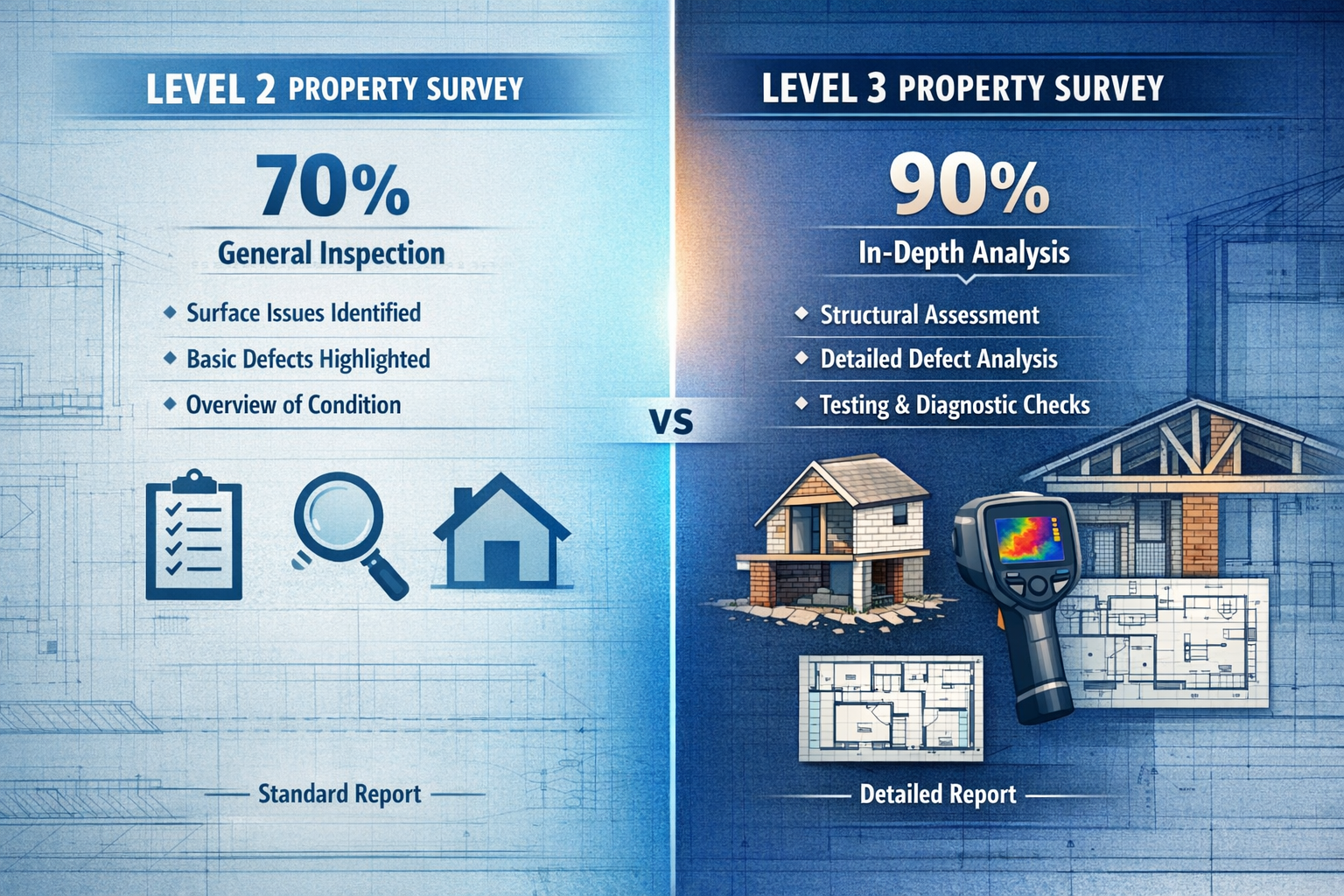
The Royal Institution of Chartered Surveyors (RICS) established standardized survey levels to help homebuyers choose appropriate property inspections based on their specific needs. These building survey types replaced older terminology in 2016, creating clearer distinctions between inspection depths[1].
The current framework includes three main levels:
- Level 1: Basic condition report (rarely used for purchases)
- Level 2: Homebuyer Report for standard properties
- Level 3: Building Survey for comprehensive analysis
Understanding the Level 2 v Level 3 survey distinction is essential because these represent the two most common choices for property buyers in 2026. Each serves different purposes and provides varying depths of property condition assessment.
The Evolution of Survey Standards
RICS updated survey terminology to eliminate confusion between “Homebuyer Reports” and “Full Structural Surveys.” The new system provides clearer guidance on which survey matches specific property types and buyer requirements. Professional surveyors now use these standardized formats to ensure consistent quality across the industry.
What is a Level 2 Survey? 📋
A Level 2 survey, officially known as the RICS Home Survey Level 2 (Homebuyer Report), provides a detailed assessment of a property’s condition without extensive invasive investigation. This intermediate option suits most conventional properties built from standard materials and in reasonable condition.
Level 2 Survey Scope and Coverage
The inspection includes:
✅ Visual Inspection Areas:
- Roof structure and coverings (from ground level)
- Chimneys and external walls
- Windows, doors, and joinery
- Internal walls, floors, and ceilings
- Damp and moisture assessment
- Insulation and ventilation
- Drainage (visible sections only)
- Heating and electrical systems (basic assessment)
❌ What Level 2 Excludes:
- Areas not readily accessible without specialist equipment
- Testing of electrical or gas systems
- Detailed structural calculations
- Concealed areas behind fixtures
- Invasive investigation of suspected defects
Property Condition Rating System
Level 2 surveys use a traffic light system for reporting:
| Rating | Meaning | Action Required |
|---|---|---|
| 1 (Green) | No repair needed | Normal maintenance only |
| 2 (Amber) | Repairs or replacement needed | Budget for future work |
| 3 (Red) | Urgent repairs or serious defects | Immediate action essential |
This standardized approach helps buyers quickly identify priority issues and budget accordingly[2].
Ideal Properties for Level 2 Surveys
Level 2 surveys work best for:
- Conventional construction properties (brick, block, timber)
- Properties built after 1900 in reasonable condition
- Standard layouts without significant alterations
- Properties under 100 years old with visible structural elements
- Homes in good repair requiring standard maintenance
For buyers considering whether they need a survey when purchasing, Level 2 provides adequate protection for most modern properties.
Level 2 Survey Process and Timeline
The typical Level 2 survey follows this sequence:
- Booking and Preparation (1-2 days): Surveyor confirms access arrangements
- Site Inspection (2-4 hours): Visual assessment of all accessible areas
- Report Compilation (3-5 days): Analysis and documentation
- Report Delivery (5-7 days total from booking)
Understanding how long surveys take helps buyers plan their purchase timeline effectively.
What is a Level 3 Survey? 🏗️
A Level 3 survey, officially the RICS Home Survey Level 3 (Building Survey), represents the most comprehensive property inspection available. This detailed examination suits older properties, those with unusual construction, or buildings requiring significant renovation work.
Level 3 Survey Comprehensive Scope
The inspection includes everything in Level 2, plus:
🔍 Extended Investigation:
- Detailed structural analysis and calculations
- Assessment of roof spaces and sub-floor areas
- Investigation of suspected defects
- Evaluation of building services in detail
- Analysis of materials and construction methods
- Identification of potential future problems
- Detailed timber inspection for rot and infestation
- Comprehensive damp investigation with moisture meters
📊 Additional Reporting Elements:
- Detailed repair cost estimates
- Prioritized maintenance schedule
- Technical descriptions of defects
- Advice on specialist investigations needed
- Long-term maintenance planning
- Energy efficiency recommendations
When Level 3 Surveys Are Essential
Choose a Level 3 survey for:
- Period properties built before 1900
- Listed buildings with historical significance
- Properties with extensive alterations or extensions
- Unusual construction methods (timber frame, thatched roofs)
- Properties in poor condition requiring renovation
- Buildings with known defects requiring detailed assessment
- Commercial conversions to residential use
- Properties you plan to renovate significantly
For those wondering if a Level 3 survey is worth it, the answer depends heavily on property age and condition.
Level 3 Survey Depth and Detail
Unlike Level 2 inspections, Level 3 surveys involve:
- Invasive investigation where necessary and agreed
- Specialist equipment including moisture meters, thermal imaging
- Roof space access for detailed timber inspection
- Sub-floor examination where accessible
- Detailed photography documenting all defects
- Technical drawings showing structural concerns
Professional building surveyors in London typically spend 4-8 hours on-site for Level 3 inspections, compared to 2-4 hours for Level 2.
Level 3 Survey Timeline
The comprehensive nature extends the timeline:
- Booking and Access Arrangements (2-3 days)
- Detailed Site Inspection (4-8 hours)
- Analysis and Report Writing (7-10 days)
- Report Delivery (10-14 days total from booking)
Level 2 v Level 3 Survey: Key Differences Explained
Understanding the critical distinctions between Level 2 v Level 3 survey options helps buyers make informed decisions aligned with their property type and risk tolerance.
Comparison Table: Level 2 v Level 3 Survey
| Feature | Level 2 Survey | Level 3 Survey |
|---|---|---|
| Inspection Depth | Visual, non-invasive | Detailed, may include invasive tests |
| Report Length | 15-25 pages | 30-60+ pages |
| Time On-Site | 2-4 hours | 4-8 hours |
| Cost Range (2026) | £400-800 | £600-1,500 |
| Suitable Properties | Modern, conventional | Older, unusual, poor condition |
| Defect Detail | Traffic light ratings | Comprehensive technical descriptions |
| Repair Estimates | General guidance | Detailed cost projections |
| Accessibility | Readily visible areas only | Includes roof spaces, sub-floors |
Inspection Methodology Differences
Level 2 Approach:
- Surveyor conducts visual inspection from ground level
- Uses binoculars for roof assessment
- Checks accessible areas without moving furniture
- Identifies obvious defects requiring attention
- Provides general advice on maintenance
Level 3 Approach:
- Surveyor accesses roof spaces and sub-floor areas
- Uses specialist equipment (moisture meters, thermal cameras)
- Investigates suspected problems in detail
- Provides technical analysis of construction methods
- Offers detailed repair specifications and cost estimates
Reporting Format Variations
The Level 2 v Level 3 survey reports differ significantly in presentation and detail:
Level 2 Reports Include:
- Standardized RICS template
- Traffic light condition ratings
- Summary of key issues
- Market valuation (if requested)
- General maintenance advice
- Insurance rebuild costs
Level 3 Reports Include:
- Bespoke detailed analysis
- Technical descriptions of all elements
- Prioritized repair schedule
- Detailed cost estimates for repairs
- Long-term maintenance planning
- Specialist investigation recommendations
- Comprehensive photographic evidence
For examples of what to expect, review sample structural survey reports to understand the documentation depth.
Survey Cost Comparison: Investment Analysis 💰
Understanding the financial implications of the Level 2 v Level 3 survey decision extends beyond initial survey fees to include potential savings from defect discovery and negotiation leverage.
2026 Survey Pricing Breakdown
Level 2 Survey Costs:
- Small property (1-2 bedrooms): £400-550
- Medium property (3-4 bedrooms): £550-700
- Large property (5+ bedrooms): £700-800
- London premium: Add 15-25%
Level 3 Survey Costs:
- Small property (1-2 bedrooms): £600-850
- Medium property (3-4 bedrooms): £850-1,200
- Large property (5+ bedrooms): £1,200-1,500+
- Complex/listed properties: £1,500-3,000+
Cost-Benefit Analysis
The price difference between Level 2 v Level 3 survey options typically ranges from £200-700, but the potential savings from discovering hidden defects can be substantial:
Real-World Cost Impact Examples:
| Defect Type | Typical Repair Cost | Often Missed by Level 2 | Detected by Level 3 |
|---|---|---|---|
| Roof timber decay | £8,000-15,000 | ✗ | ✓ |
| Structural movement | £5,000-25,000 | Sometimes | ✓ |
| Damp penetration | £3,000-8,000 | Sometimes | ✓ |
| Electrical rewiring | £4,000-7,000 | ✗ | ✓ |
| Subsidence issues | £10,000-50,000+ | ✗ | ✓ |
Return on Investment Calculation
Consider this scenario:
Property Purchase Price: £450,000
Level 3 Survey Cost: £1,200
Major Defects Discovered: Roof timber decay, damp issues
Estimated Repair Costs: £12,000
Negotiated Price Reduction: £10,000
Net Benefit: £8,800 (£10,000 – £1,200)
The £600 premium for Level 3 over Level 2 delivered £9,400 in additional value compared to a Level 2 that might have missed these issues.
Hidden Costs of Inadequate Surveys
Choosing an insufficient survey level can result in:
- Unexpected repair bills within first year of ownership
- Reduced negotiation leverage during purchase
- Insurance complications for pre-existing defects
- Resale difficulties when undisclosed issues emerge
- Safety hazards from undetected structural problems
Understanding full structural survey costs helps buyers appreciate the value proposition of comprehensive inspections.
Decision Framework: Choosing Between Level 2 v Level 3 Survey
Selecting the appropriate survey level requires systematic evaluation of multiple factors. This decision matrix helps buyers match survey depth to property characteristics and personal circumstances.
Property Age Decision Guide
Properties Built After 1980:
- ✅ Level 2 suitable if standard construction
- ⚠️ Level 3 if significant alterations made
- ✅ Level 2 adequate for most modern estates
Properties Built 1900-1980:
- ⚠️ Level 2 acceptable if good condition
- ✅ Level 3 recommended if any concerns
- ✅ Level 3 essential if pre-1950 and original features
Properties Built Before 1900:
- ❌ Level 2 rarely adequate
- ✅ Level 3 strongly recommended
- ✅ Level 3 essential for listed buildings
Property Condition Assessment Checklist
Before deciding on Level 2 v Level 3 survey, evaluate these factors:
Choose Level 3 if ANY apply:
- Property shows visible structural cracks
- Evidence of damp or water damage
- Roof appears in poor condition
- Significant extensions or alterations
- Unusual construction methods
- Planning renovation or conversion
- Property vacant for extended period
- Previous underpinning or structural work
- Located in area with known subsidence
- Timber frame or thatched construction
Level 2 Likely Sufficient if ALL apply:
- Property built after 1980
- Standard brick/block construction
- Good overall condition
- No visible structural concerns
- Regular maintenance evident
- No planned major alterations
- Conventional layout and design
Buyer Circumstance Considerations
Your personal situation influences the Level 2 v Level 3 survey decision:
First-Time Buyers:
- Limited experience identifying defects favors Level 3
- Budget constraints may necessitate Level 2 for newer properties
- Consider long-term ownership plans
Investment Buyers:
- Rental properties benefit from detailed maintenance schedules
- Level 3 provides better renovation cost estimates
- Detailed reports support business planning
Renovation Projects:
- Level 3 essential for accurate project scoping
- Detailed structural analysis prevents costly surprises
- Specialist recommendations guide contractor selection
For buyers experiencing house survey anxiety, understanding which survey level provides appropriate reassurance helps manage stress.
Common Property Issues Detected by Each Survey Level
Understanding what each survey level typically reveals helps set appropriate expectations for the Level 2 v Level 3 survey decision.
Typical Level 2 Survey Findings
Commonly Identified Issues:
- Roof covering defects visible from ground level
- External wall cracks and pointing deterioration
- Window and door condition problems
- Visible damp staining or mold growth
- Drainage issues (surface water, guttering)
- Basic electrical installation age assessment
- Heating system condition overview
- Insulation adequacy concerns
Real-World Level 2 Example:
A 1985-built semi-detached property survey revealed:
- Amber rating: Roof tiles requiring replacement (estimated £4,500)
- Amber rating: External repointing needed (estimated £2,800)
- Green rating: Generally sound structure
- Recommendations: Budget £7,500 for repairs within 2-3 years
Comprehensive Level 3 Survey Discoveries
Additional Issues Level 3 Identifies:
- Hidden timber decay in roof spaces
- Structural movement patterns and causes
- Sub-floor ventilation problems
- Concealed damp penetration routes
- Electrical system safety deficiencies
- Detailed heating system inefficiencies
- Building regulation compliance issues
- Historical alterations and their implications
Real-World Level 3 Case Study:
A 1920s detached property Level 3 survey uncovered:
- Significant roof timber decay (£12,000 repair)
- Structural movement from tree root damage (£8,500 monitoring/repair)
- Outdated electrical system (£6,000 rewiring)
- Damp proof course failure (£4,500 remediation)
- Total defects: £31,000 in previously undetected issues
- Negotiated reduction: £25,000 off purchase price
This example demonstrates why understanding what surveyors look for at different survey levels matters significantly.
Survey Limitations and Additional Investigations
Both survey levels have boundaries requiring additional specialist assessments:
When Additional Surveys Are Needed:
- Asbestos presence: Properties built before 2000 may require asbestos surveys
- Structural calculations: Major alterations need beam calculations
- Drainage systems: CCTV drainage surveys for older properties
- Electrical testing: Full electrical condition reports
- Timber specialists: Detailed rot and infestation analysis
- Geotechnical surveys: Subsidence or ground stability concerns
Professional surveyors recommend these additional investigations when initial findings warrant deeper investigation[3].
Modern Survey Techniques and Technology in 2026
The surveying profession has embraced technological advancement, enhancing both Level 2 and Level 3 survey accuracy and detail.
Technology-Enhanced Inspections
Current Survey Technologies:
Thermal Imaging Cameras:
- Detect hidden moisture penetration
- Identify insulation deficiencies
- Reveal concealed structural elements
- Commonly used in Level 3, occasionally in Level 2
Moisture Meters:
- Precise damp level measurement
- Distinguish condensation from penetrating damp
- Standard in both survey levels
Drone Roof Inspections:
- Detailed roof condition photography
- Access to dangerous or inaccessible areas
- Increasingly common for complex properties
- Primarily Level 3 surveys
Digital Reporting Platforms:
- Interactive reports with embedded photos
- Clickable floor plans linking to defects
- Cloud-based access for all parties
- Standard across both survey levels in 2026
The Impact of Technology on Survey Quality
Modern equipment has significantly improved defect detection rates:
- Thermal imaging increases hidden damp detection by 40%
- Drone photography provides roof detail previously requiring scaffolding
- Digital moisture meters offer precise readings versus subjective assessment
- 3D scanning creates accurate building models for renovation planning
These technological enhancements benefit both Level 2 and Level 3 surveys, though Level 3 inspections typically employ more advanced equipment[4].
Regional Variations and Local Considerations
The Level 2 v Level 3 survey decision can be influenced by regional property characteristics and local market conditions.
London and Southeast England
Regional Factors:
- Higher property values justify Level 3 investment
- Victorian and Edwardian properties predominate
- Subsidence risks from clay soil conditions
- Previous alterations common in period properties
- Premium pricing: surveys cost 15-25% more
Recommendation: Level 3 surveys strongly advised for properties pre-1950 in London boroughs with known ground movement issues.
Northern England and Scotland
Regional Factors:
- More stone-built properties requiring specialist knowledge
- Different construction methods (cavity walls less common)
- Lower property values affect cost-benefit analysis
- Harsh weather impacts on building fabric
- Scottish system includes mandatory Home Reports
Recommendation: Level 3 essential for stone-built properties regardless of age; Level 2 acceptable for modern estates built post-1980.
Coastal and Rural Areas
Regional Factors:
- Salt exposure accelerates material deterioration
- Flood risk considerations
- Septic tank and private drainage systems
- Agricultural building conversions
- Limited comparable property data
Recommendation: Level 3 surveys recommended for coastal properties over 50 years old and all barn conversions or non-standard construction.
Survey Results and Property Negotiation Strategy
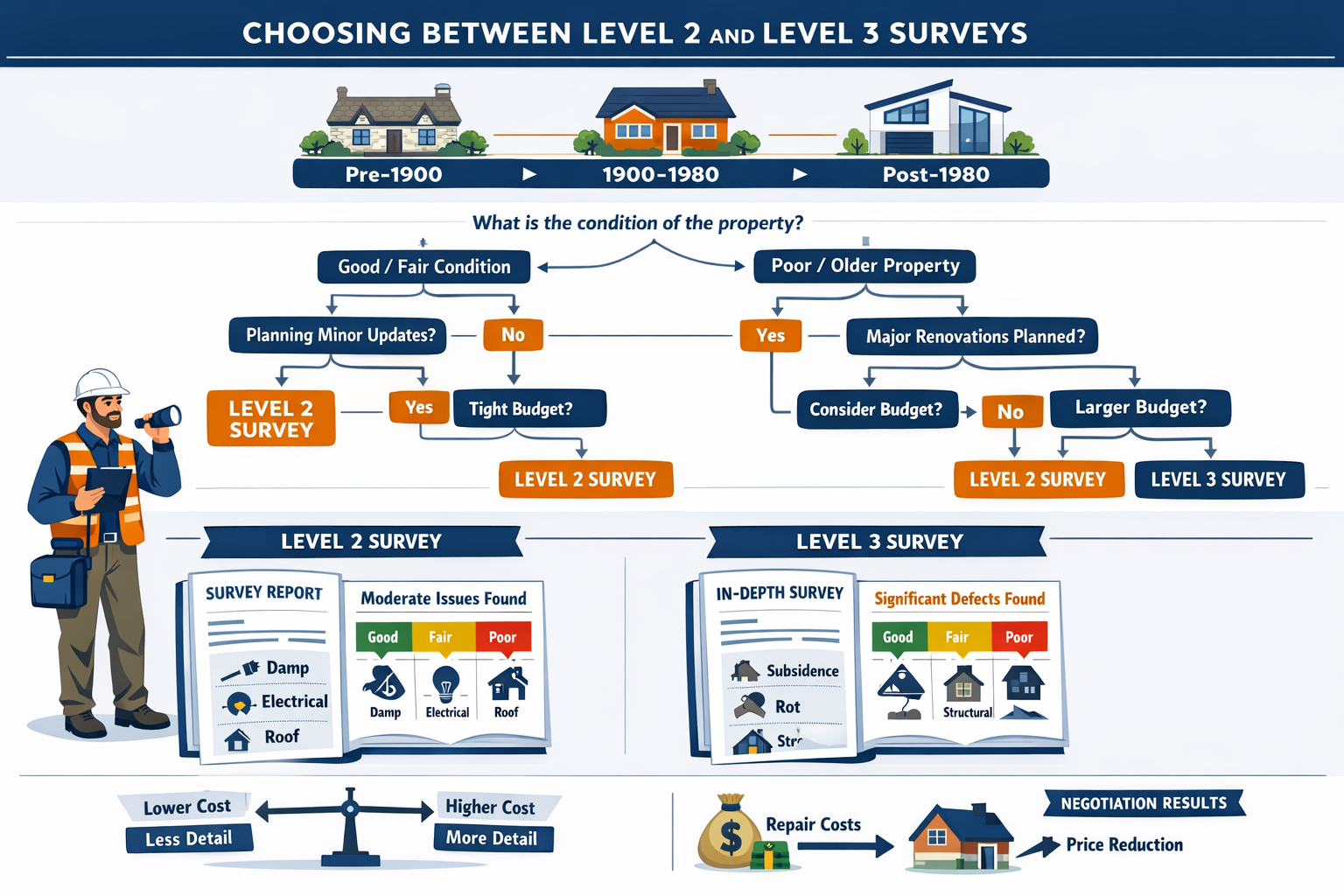
The depth of information from your chosen survey level directly impacts negotiation leverage during property purchase.
Using Survey Findings Effectively
Negotiation Approaches Based on Survey Results:
Minor Issues (Amber Ratings):
- Request seller addresses before completion
- Negotiate modest price reduction (£2,000-5,000)
- Obtain quotes for repairs to support negotiations
- Consider retention agreements
Major Issues (Red Ratings):
- Request significant price reduction (£10,000+)
- Require specialist reports before proceeding
- Consider walking away if structural concerns severe
- Renegotiate based on detailed repair estimates
Level 3 Advantage:
The detailed cost estimates in Level 3 reports provide stronger negotiation evidence than Level 2 general guidance. Sellers find it harder to dispute specific repair costs backed by technical analysis.
Real Negotiation Outcomes
Level 2 Survey Negotiation Example:
- Property price: £325,000
- Survey identified: Roof repairs needed (amber rating)
- Surveyor estimate: “£3,000-6,000”
- Negotiated reduction: £3,500
- Outcome: Moderate success with general estimate
Level 3 Survey Negotiation Example:
- Property price: £425,000
- Survey identified: Multiple structural issues with detailed costs
- Surveyor estimates: £18,500 itemized repairs
- Negotiated reduction: £15,000
- Outcome: Strong success with detailed evidence
The Level 2 v Level 3 survey choice significantly affects negotiation power and potential savings.
Long-Term Value: Maintenance Planning and Property Management
Beyond the immediate purchase decision, survey reports provide valuable long-term property management guidance.
Maintenance Scheduling from Survey Reports
Level 2 Maintenance Insights:
- General condition ratings guide priority
- 5-year maintenance outlook
- Major component replacement timelines
- Basic budgeting guidance
Level 3 Maintenance Advantages:
- Detailed 10-year maintenance schedule
- Specific repair specifications
- Prioritized work programs
- Accurate cost projections for planning
- Energy efficiency improvement recommendations
Financial Planning Benefits
Comprehensive survey information supports:
Budget Forecasting:
- Accurate reserve fund planning
- Renovation project scoping
- Insurance cost estimation
- Resale value protection
Property Investment Analysis:
- True total cost of ownership
- Rental yield calculations accounting for maintenance
- Capital improvement prioritization
- Exit strategy planning
For property investors, the additional detail in Level 3 surveys justifies the cost through better long-term financial planning.
Insurance Implications of Survey Choice
The relationship between property surveys and insurance coverage often surprises buyers making the Level 2 v Level 3 survey decision.
Survey Reports and Insurance Claims
Key Insurance Considerations:
Pre-Existing Defects:
- Insurers may deny claims for defects present at purchase
- Survey reports establish condition baseline
- Level 3 provides more comprehensive defect documentation
- Undisclosed survey findings can void coverage
Professional Indemnity Insurance:
- RICS surveyors carry professional indemnity insurance
- Coverage typically £1-10 million depending on surveyor
- Claims possible if surveyor negligence causes financial loss
- Level 3’s detailed inspection reduces surveyor liability gaps
Building Insurance Accuracy:
- Survey reports inform accurate rebuild cost assessment
- Under-insurance risks significant financial exposure
- Both Level 2 and Level 3 provide rebuild cost estimates
- Level 3 offers more accurate figures for non-standard properties
Survey Negligence and Recourse
If a surveyor misses significant defects:
- Document the defect with photos and specialist reports
- Review survey report for relevant sections
- Obtain repair quotes evidencing financial loss
- Contact surveyor explaining the issue
- Pursue professional indemnity claim if necessary
Level 3 surveys face higher negligence thresholds due to comprehensive inspection scope, but also provide better defect documentation if issues arise[5].
Expert Surveyor Selection: Qualifications and Credentials
Choosing between Level 2 v Level 3 survey matters less than selecting a qualified, experienced surveyor to conduct the inspection.
Essential Surveyor Qualifications
Minimum Requirements:
- RICS membership (MRICS or FRICS designation)
- Professional indemnity insurance (minimum £1 million)
- Local market knowledge of regional construction methods
- Relevant experience with your property type
Verification Steps:
- Check RICS register at rics.org/find-a-surveyor
- Request proof of professional indemnity insurance
- Verify specific experience with property age/type
- Review sample reports if available
- Check online reviews and testimonials
For guidance on verifying surveyor qualifications, consult professional regulatory bodies.
Questions to Ask Potential Surveyors
Before Booking Your Survey:
- How many similar properties have you surveyed?
- What specific equipment do you use?
- How long will the inspection take?
- When will I receive the report?
- What format is the report provided in?
- Do you offer phone consultations to discuss findings?
- What additional surveys might be needed?
- Can you provide references from recent clients?
Red Flags When Selecting Surveyors
Avoid surveyors who:
- Offer significantly below-market pricing
- Lack RICS accreditation
- Cannot provide insurance documentation
- Rush the booking without property discussion
- Promise specific findings before inspection
- Discourage Level 3 surveys for older properties
- Have no local market experience
Working with experienced property surveyors ensures quality inspection regardless of survey level chosen.
The Survey Process: What to Expect
Understanding the practical aspects of the Level 2 v Level 3 survey process helps buyers prepare effectively and maximize value from their chosen inspection level.
Pre-Survey Preparation
Buyer Responsibilities:
- Provide property access (coordinate with seller/agent)
- Share any known issues or concerns with surveyor
- Request specific areas of focus if needed
- Ensure utilities are connected for testing
- Clear access to loft hatches and inspection areas
- Inform surveyor of any access restrictions
Seller Cooperation:
Most sellers accommodate survey access, but issues can arise:
- Occupied properties may limit access times
- Tenanted properties require notice periods
- Some sellers restrict invasive investigation
- Locked outbuildings may remain uninspected
During the Inspection
Level 2 Survey Day:
- Surveyor arrives at scheduled time
- 2-4 hour inspection of accessible areas
- External and internal visual assessment
- Photography of key features and defects
- Brief discussion of obvious concerns (optional)
- No requirement for buyer presence
Level 3 Survey Day:
- Extended 4-8 hour inspection
- Detailed investigation including roof spaces
- Specialist equipment usage
- Extensive photography and notes
- Possible identification of areas requiring specialist input
- Buyer attendance optional but can be valuable
Post-Survey Report Delivery
Report Review Process:
- Initial read-through focusing on summary and condition ratings
- Detailed review of specific defects and recommendations
- Cost estimation for identified repairs
- Question compilation for surveyor clarification
- Consultation call to discuss findings (often included)
- Decision making on purchase progression
Timeline Expectations:
- Level 2 reports: 5-7 days from inspection
- Level 3 reports: 10-14 days from inspection
- Rush services available for premium fees
- Delays possible if specialist input required
Frequently Asked Questions: Level 2 v Level 3 Survey
Can I upgrade from Level 2 to Level 3 after initial results?
Yes, but it’s inefficient and costly. If Level 2 findings raise concerns, surveyors can return for additional investigation, but you’ll pay for two separate visits. Better to choose Level 3 initially if any doubt exists about property condition.
Do new build properties need surveys?
Absolutely. Despite NHBC warranties, new build surveys frequently identify snagging issues and construction defects. Level 2 surveys typically suffice for new builds, though Level 3 provides more detailed finish quality assessment.
Can I use an old survey from a previous buyer?
Not recommended. Surveys are commissioned for specific buyers and reflect conditions at inspection time. Property condition changes, and you cannot pursue negligence claims on surveys commissioned by others. Always obtain your own current survey.
How long are survey reports valid?
Typically 3-6 months, as property conditions can deteriorate. If purchase delays extend beyond this period, consider requesting a re-inspection or updated report, particularly for properties with identified defects.
What if the survey reveals major problems?
You have several options:
- Renegotiate the purchase price based on repair costs
- Request repairs before completion
- Walk away if issues are too severe
- Accept the issues and budget for repairs
Your survey doesn’t obligate you to proceed with the purchase.
Are surveys tax-deductible for buy-to-let properties?
No, survey costs are capital expenses, not deductible operating costs. However, they form part of your property acquisition costs for capital gains tax calculations when you eventually sell.
Making Your Decision: Level 2 v Level 3 Survey Selection
After reviewing all factors, use this final decision framework to select the appropriate survey level for your circumstances.
Decision Matrix Summary
Choose Level 2 Survey When:
- ✅ Property built after 1980 in standard construction
- ✅ Property appears in good overall condition
- ✅ No visible structural concerns or alterations
- ✅ Budget constraints significant
- ✅ Modern estate property with similar neighbors
- ✅ Planning to renovate regardless of findings
- ✅ Short-term ownership anticipated
Choose Level 3 Survey When:
- ✅ Property built before 1900
- ✅ Listed building or conservation area
- ✅ Visible structural concerns or defects
- ✅ Significant extensions or alterations present
- ✅ Unusual construction methods
- ✅ Planning major renovation work
- ✅ Long-term family home investment
- ✅ Property vacant for extended period
- ✅ Located in subsidence-prone area
- ✅ Thatched, timber-framed, or non-standard construction
The Cost of Getting It Wrong
Insufficient Survey Example:
Buyer chose Level 2 for 1890s property to save £600. Survey missed roof timber decay requiring £14,000 repair discovered six months after purchase. No recourse as Level 2 scope doesn’t include detailed roof space inspection. Net loss: £13,400
Appropriate Survey Example:
Buyer invested £1,200 in Level 3 survey for similar property. Detailed inspection revealed £18,000 in required repairs. Negotiated £15,000 price reduction. Net benefit: £13,800
The Level 2 v Level 3 survey decision represents a critical investment protection choice, not merely an expense to minimize.
Conclusion: Protecting Your Property Investment
The Level 2 v Level 3 survey decision fundamentally impacts your property purchase success, financial security, and long-term ownership satisfaction. In 2026, with average UK property prices exceeding £290,000, the £400-1,500 survey investment represents just 0.14-0.52% of purchase price—a minimal cost for comprehensive defect protection[6].
Key Decision Principles
Match Survey to Property Risk:
Older properties, unusual construction, and visible defects warrant Level 3 investment. Modern, conventional properties in good condition suit Level 2 assessment. When doubt exists, Level 3 provides peace of mind and negotiation leverage justifying the additional cost.
Consider Long-Term Implications:
Survey reports guide maintenance planning, renovation decisions, and resale preparation for years after purchase. The comprehensive detail in Level 3 surveys provides ongoing value beyond the immediate purchase decision.
Prioritize Surveyor Quality:
Survey level matters less than surveyor competence. A thorough Level 2 from an experienced RICS surveyor provides more value than a rushed Level 3 from an unqualified inspector. Verify credentials, check references, and select surveyors with specific experience in your property type.
Your Next Steps
- Assess your property using the decision frameworks in this guide
- Research qualified surveyors through RICS directories and local recommendations
- Request quotes from multiple surveyors for comparison
- Book your survey allowing adequate time before exchange deadlines
- Review findings carefully and consult your surveyor with questions
- Use survey results to inform negotiation strategy and purchase decisions
The Level 2 v Level 3 survey choice represents one of the most important decisions in your property purchase journey. Armed with the comprehensive information in this guide, you can select the appropriate survey level with confidence, protecting your investment and ensuring informed decision-making.
For professional survey services tailored to your specific property needs, contact experienced RICS surveyors who can provide expert guidance on the most appropriate inspection level for your circumstances.
References
[1] Royal Institution of Chartered Surveyors (RICS). (2024). “Home Survey Standards and Guidance.” RICS Professional Standards.
[2] HomeOwners Alliance. (2025). “Understanding Property Survey Condition Ratings.” UK Home Buying Guide.
[3] Chartered Institute of Building (CIOB). (2025). “Specialist Property Investigations and When They’re Required.” Technical Guidance Notes.
[4] Building Research Establishment (BRE). (2026). “Technology in Property Surveying: Impact on Defect Detection Rates.” Research Report BR-526.
[5] Financial Ombudsman Service. (2025). “Insurance Claims and Pre-Existing Property Defects: Guidance for Homeowners.”
[6] UK House Price Index. (2026). “Average Property Prices by Region: January 2026.” HM Land Registry Statistical Release.
