
A south-facing garden adds an average of £22,695 to a property's asking price in England, according to analysis of approximately 400,000 listings. That single statistic reveals just how much weight compass direction carries in the UK property market, and why understanding how UK surveyors use compass directions in building surveys: orientation, exposure and valuation effects explained is essential knowledge for any property buyer, seller or owner.
Surveyors do not simply note which way a house faces out of habit. Compass orientation shapes energy performance, overheating risk, exposure to wind-driven rain, daylighting, garden usability and long-term saleability. When a surveyor writes "south-west facing rear elevation" or "north-facing principal facade" in a report, each phrase carries specific technical and commercial meaning. This guide unpacks every dimension of that practice.
Key Takeaways
- Compass orientation is a formal part of RICS building survey and valuation methodology, not an optional observation.
- South-facing gardens command measurable price premiums, with national averages around 7%, and surveyors reference these when explaining value differences between comparable properties.
- West and south-west facing rooms carry the highest overheating risk under UK Building Regulations and RICS guidance, requiring explicit commentary in survey reports.
- North and west elevations face the greatest exposure to wind-driven rain, directly influencing maintenance recommendations and condition ratings.
- The RICS Home Survey Standard (2nd edition, in consultation 2025) and Approved Document O embed orientation into regulatory and professional frameworks, making compass-based descriptions increasingly systematic.
Why Compass Direction Is a Formal Part of UK Building Surveys
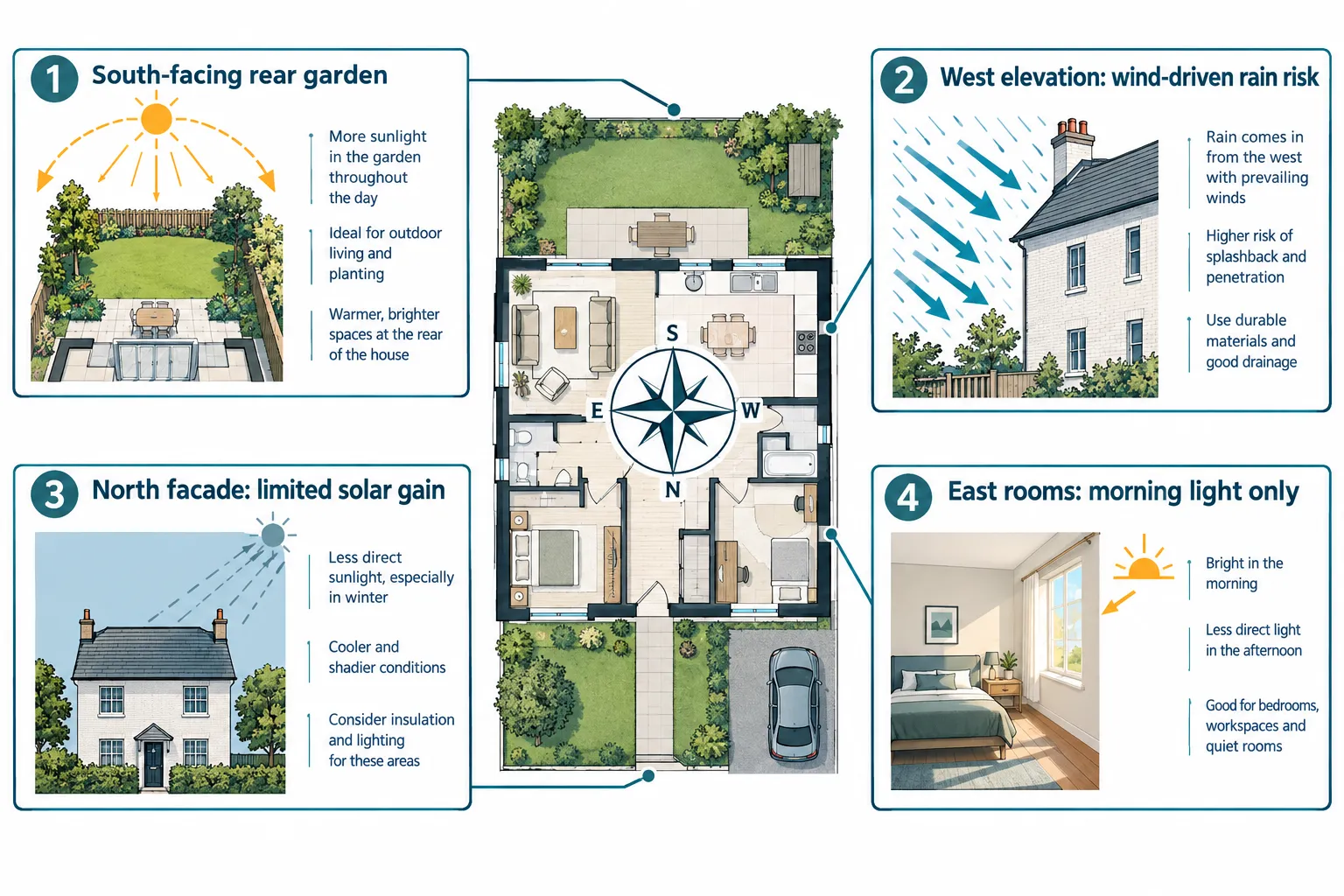
Orientation has always mattered in construction and property assessment, but it has become increasingly formalised in recent years. The RICS Home Survey Standard, currently in its second edition consultation (2025), reinforces that residential surveyors must provide consistent descriptions of a property's orientation, exposure and associated risks, including energy performance and overheating, with full implementation expected around 2027 [2]. These requirements are not advisory suggestions; they form part of the benchmarking framework against which Level 2 and Level 3 home survey reports are assessed [2].
The RICS Valuation Global Standards ("Red Book") and the associated pilot Valuation Compliance Framework require valuers to set out assumptions and site factors clearly [3]. RICS guidance on site notes and valuation reasoning for residential properties (2025) explicitly emphasises transparent reasoning around market value [9]. In practice, this means a valuer must explain how a south-facing garden, a west-facing living room or a heavily shaded north elevation influences comparable selection and the final figure [3] [9].
For those commissioning a Level 3 building survey, compass direction data appears in multiple sections of the report: the site description, the elevation-by-elevation condition analysis, the energy commentary and the risk summary. This is not duplication, each section uses orientation to answer a different question.
What Surveyors Actually Record
A competent surveyor will record the following compass-related data during an inspection:
- Principal facade direction, the compass bearing of the front elevation, typically the street-facing side
- Rear elevation and garden orientation, the direction the rear garden faces, which determines solar access
- Individual room aspects, particularly living rooms, bedrooms and kitchens, noting morning versus afternoon sun
- Roof pitch orientation, relevant to solar PV suitability and snow/ice accumulation
- Exposed elevations, those facing prevailing south-westerly and westerly winds, which drive rain into masonry
- Overshading sources, neighbouring buildings, trees or structures that block solar access on specific facades
This data is gathered using a combination of physical compass readings, digital compass applications, Ordnance Survey mapping and, increasingly, drone survey imagery for complex rooflines [2].
Solar Gain, Overheating Risk and the Compass Directions Surveyors Flag Most
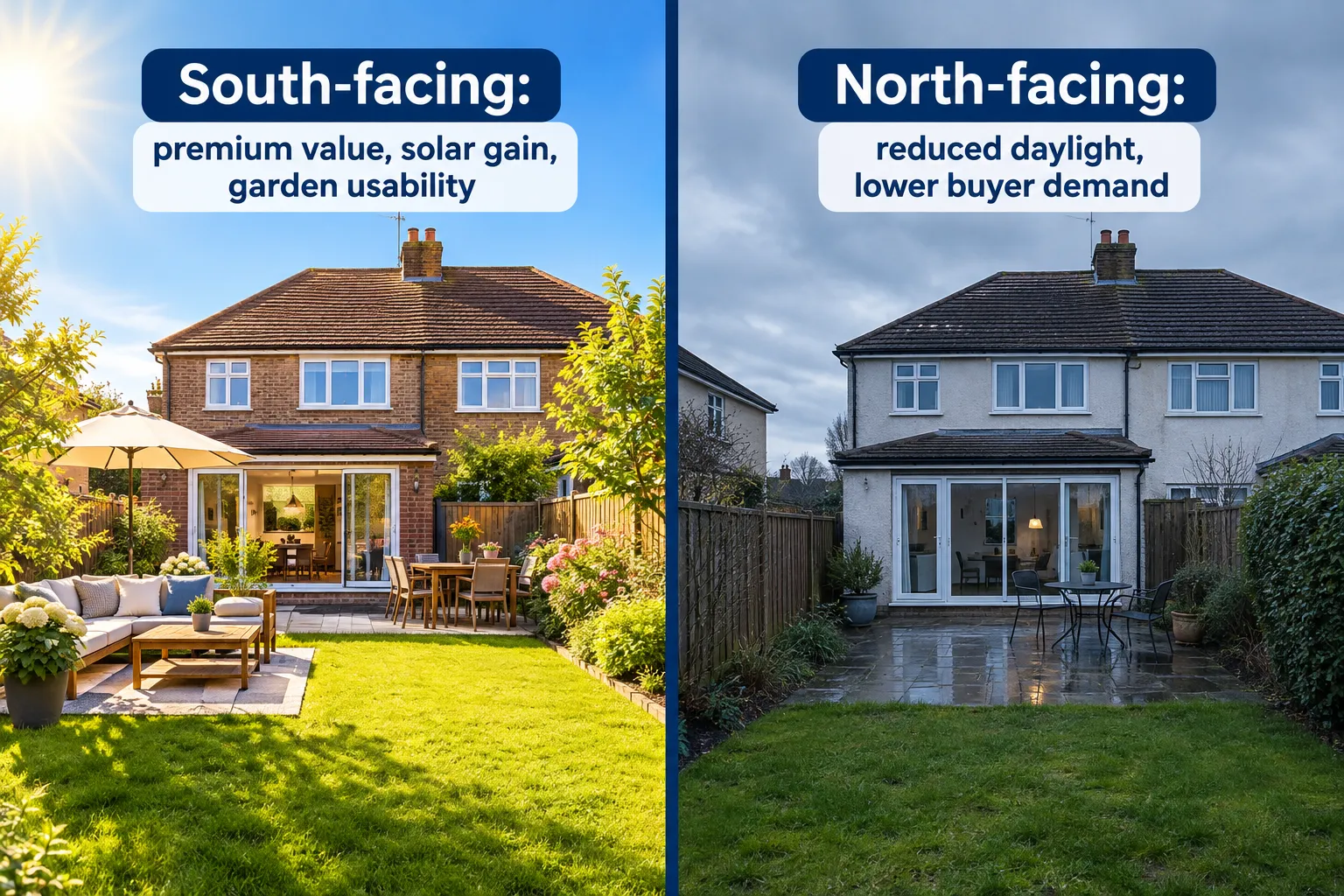
The relationship between compass direction and solar gain sits at the heart of how UK surveyors use compass directions in building surveys: orientation, exposure and valuation effects explained. Solar gain is beneficial in winter, reducing heating demand, but becomes a liability in summer when it drives internal temperatures above comfort thresholds.
South-Facing Rooms and Gardens
South-facing orientations receive the maximum annual solar radiation in the UK. The English Housing Survey 2024-2025 Weather-Resilient Homes fact sheet (published July 2026) treats most solar gains as entering through south-facing windows, making the "southern-most facing view" the primary reference point for overshading assessments [32]. Surveyors follow this logic: a south-facing rear garden with minimal overshadowing is a positive feature for both energy performance and amenity value.
West and South-West: The Overheating Problem
Government-commissioned modelling finds that west-facing living rooms experience substantially more hours above threshold temperatures than south- or east-facing rooms. West-facing flats have approximately 22% more overheating hours than south-facing equivalents [33]. South-southwest rooms are also prone to overheating without adequate shading [43].
The reason is timing. West and south-west facing rooms receive direct sunlight in the late afternoon, when external air temperatures are already at their daily peak. This compounds the solar heat gain effect significantly [35]. CPD material aimed at practising surveyors (2024) states explicitly that south-west and west-facing rooms are at the greatest overheating risk for this reason [35].
Approved Document O: Overheating in the Building Regulations embeds orientation directly into compliance assessments by capping glazing areas based on the facade with the largest glazed area and its compass direction [41]. Critically, the FAQ to Approved Document O makes clear that if a facade faces exactly between two compass points, for example, due south-east, the stricter standard applies [41]. This means surveyors involved in compliance advisory roles must identify precise compass bearings, not approximate directions, and must recognise when borderline orientations trigger more stringent limits.
Practical implication for survey reports: When a surveyor notes "west-facing living room with large glazed sliding doors" in a Level 3 report, this is not merely descriptive. It is a flag for potential overheating risk, and a well-written report will recommend consideration of external shading such as brise-soleil, awnings or external blinds [42] [40].
East-Facing Rooms
East-facing rooms receive morning sun only. This is generally considered benign from an overheating perspective and is often preferred for bedrooms, where morning light is welcome and afternoon overheating is avoided. Surveyors note east-facing aspects as neutral to mildly positive.
North-Facing Rooms and Facades
North-facing rooms receive no direct sunlight in the UK. Surveyors flag north-facing principal rooms, particularly living rooms and kitchens, as a potential amenity concern, noting reduced natural light and higher heating demand. North-facing facades also tend to retain moisture longer, increasing the risk of algae growth, surface deterioration and frost damage to pointing.
Wind-Driven Rain, Exposure and Maintenance: How Orientation Affects Condition Ratings
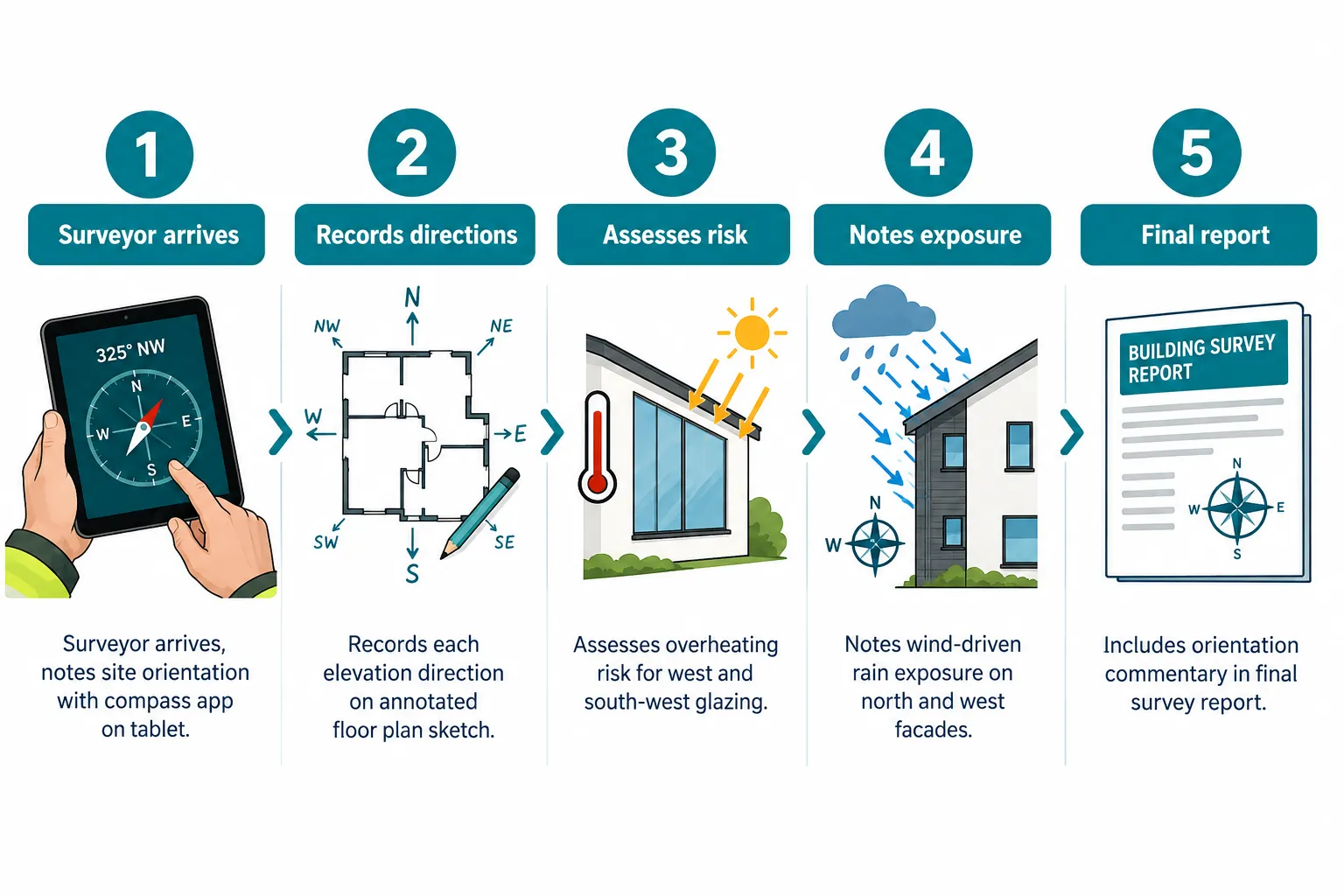
Solar gain is only one dimension of how UK surveyors use compass directions in building surveys: orientation, exposure and valuation effects explained. Wind-driven rain is equally significant for condition assessment and maintenance planning.
Prevailing Wind and the Exposed Elevations
The UK's prevailing winds arrive predominantly from the south-west, with secondary exposure from the west. This means that south-west and west-facing elevations receive the greatest quantity of wind-driven rain over time. Surveyors assess these facades with particular attention to:
| Facade Direction | Typical Exposure Risk | Common Defects to Inspect |
|---|---|---|
| South-west | High | Pointing erosion, render cracking, window seal failure |
| West | High | Brickwork saturation, lintel rust staining, sill weathering |
| North | Moderate-high | Persistent damp, algae, frost damage to mortar |
| South | Moderate | Thermal cycling, UV degradation to paintwork |
| East | Low-moderate | Generally least exposed; inspect for condensation |
A surveyor inspecting a Victorian terraced house with its principal facade facing west will typically spend more time examining the brickwork, window surrounds and roof verges on that elevation. Condition ratings in the report, typically using the RICS 1, 2, 3 traffic-light system, will reflect the additional weathering burden that westerly exposure creates.
For properties in coastal or upland locations, exposure ratings become even more critical. The BRE's BREDEM and related tools use orientation data to calculate exposure indices that feed directly into energy performance and maintenance cost projections.
Damp and Moisture Penetration
Surveyors examining north and north-west facing walls look specifically for signs of moisture penetration. These elevations dry slowly after rain, particularly in winter months when solar radiation is insufficient to evaporate surface water. Persistent dampness can lead to:
- Spalling brickwork, freeze-thaw cycles damage saturated masonry
- Mortar erosion, soft lime mortars in older properties are especially vulnerable
- Internal damp patches, particularly at ground floor level and around window reveals
- Timber decay, window frames and sill ends on exposed elevations deteriorate faster
A Level 3 building survey will document these issues elevation by elevation, with compass direction providing the explanatory context for why one side of a building shows significantly more deterioration than another.
Roof Orientation and Condition
Roof pitch orientation affects both weathering and solar suitability. A south-facing roof slope in good condition is a genuine asset, it is the optimal surface for photovoltaic panels. Surveyors note this in the energy commentary section of modern reports, linking compass direction to retrofit potential and long-term running cost savings [5] [23].
North-facing roof slopes, by contrast, accumulate moss and lichen more rapidly due to persistent moisture and reduced solar drying. Surveyors inspect these slopes carefully for tile or slate displacement, blocked gutters and deteriorating flashings.
Valuation Effects: How Orientation Influences Market Value
Compass direction is not merely a technical observation, it has quantifiable effects on market value that surveyors must account for in valuation reports and mortgage valuations.
The South-Facing Garden Premium
The evidence base here is substantial. Analysis of approximately 400,000 UK property listings finds homes advertised with south-facing gardens priced an average of £22,695 higher, a national premium of around 7% [11] [21]. A July 2024 update reported an average premium of approximately £16,226 (4%), with regional variation: 5% in the South West and South East, around 3% in Wales and the North West, and 2% in London [11] [15]. By mid-2026, coverage placed premiums at approximately 7.1% and around £20,689 at England's average house price [12].
A survey of 1,108 UK homebuyers found 71% more likely to buy a home with a south-facing garden, and 42% willing to pay more for one, with roughly two-fifths prepared to pay at least £16,000 extra [7]. These are not trivial preferences, they represent a systematic market signal that RICS-registered valuers must address when selecting comparables and explaining value differences between seemingly identical houses on the same street [9].
"A south-facing rear garden is consistently among the most cited positive features by buyers and estate agents. Ignoring it in a valuation commentary is not neutral, it is an omission."
For those wanting to understand how these factors feed into formal RICS valuations, the RICS Red Book valuation framework provides the methodological context.
Machine Learning and Quantitative Evidence
A 2022 machine-learning study of UK house prices identifies favourable orientation, notably south-west, as a positive price determinant, with poorer orientation reducing value due to insufficient sunlight hours [26]. Earlier case-study research on views and visual impact shows that directional outlook to negative features such as pylons can reduce sale prices by 7-14% [18]. This supports surveyors' use of compass directions not only for solar exposure but also for outlook quality, which is increasingly referenced in detailed valuation reasoning and lender reports [9].
Balancing Premium Against Overheating Risk
Recent commentary explores whether overheating might erode the traditional premium for south-facing gardens, particularly as UK summers become hotter. As of mid-2026, the consensus is that south-facing remains the preferred orientation, with premiums still exceeding £20,000 on average [12]. However, analysts expect surveyors to increasingly balance this positive with nuanced discussion of shading, ventilation, glazing ratios and overheating risk, particularly in highly glazed, west-facing new-build flats and in hotter regions of England [33] [38] [35].
Surveyors advising on building survey costs should note that properties with complex orientation issues, such as a west-facing glass extension or a top-floor flat with south-west glazing, may require additional analysis time and a more detailed report narrative.
Orientation in Stock Condition and Social Housing Surveys
RICS guidance on residential stock condition surveys (2025) encourages systematic recording of factors affecting maintenance, energy performance and risk [10]. This indirectly elevates the importance of noting facade orientation and overshading when describing building envelopes. Local authorities and housing associations now routinely capture compass orientation data for windows and elevations, feeding into asset strategies and retrofit planning [10] [32].
For those working in the social housing sector or commissioning stock condition surveys, orientation data is increasingly a standard data field rather than a narrative addition.
How Surveyors Record Orientation in Practice: Tools and Report Language
Understanding the mechanics of how surveyors capture and communicate compass direction helps property owners interpret their reports accurately.
Tools Used on Site
Modern surveyors use a combination of:
- Digital compass applications integrated with mapping software
- Ordnance Survey mapping to verify site layout before arrival
- Drone survey imagery for complex multi-elevation properties or where access is restricted [2]
- Sun path analysis tools to model solar access at different times of year
- BRE overshading calculators for formal energy assessments
The RICS Home Survey Standard (2nd edition) explicitly references technology-enabled inspections and stronger benchmarking of reports, making these digital tools part of the expected professional toolkit [2] [14] [20].
Standard Report Language
A well-structured Level 3 survey report will use compass direction in several places:
- Site description: "The property is a mid-terrace Victorian house. The principal (front) elevation faces north-west, with the rear elevation and garden facing south-east."
- Elevation-by-elevation condition notes: "South-west facing side elevation, exposed to prevailing wind-driven rain. Pointing to upper courses shows moderate erosion. Recommend repointing within 2-3 years."
- Overheating commentary: "The first-floor rear bedroom faces south-west and contains a large Velux rooflight. In warm weather, solar gain may cause overheating. Consider external blinds or solar control glazing."
- Energy and sustainability section: "The south-facing rear roof slope is unobstructed and well-suited to photovoltaic panel installation."
- Valuation commentary (where included): "The south-east facing rear garden benefits from afternoon sun. This aspect is generally regarded as positive by buyers and may support a modest premium relative to north-facing equivalents on the same street."
For a detailed example of how these sections appear in a real report, the Level 3 building survey example guide provides annotated illustrations.
Compass Direction in Level 2 vs Level 3 Reports
The depth of orientation commentary differs between survey levels. A Level 2 survey will typically note the principal orientation and flag any obvious exposure concerns, but will not provide the elevation-by-elevation analysis or detailed overheating risk commentary that a Level 3 report delivers. For properties with complex geometry, significant glazing or known exposure issues, the additional depth of a Level 3 report is warranted.
Orientation, Energy Performance and Climate Resilience
The growing emphasis on energy performance certificates (EPCs), net zero targets and climate resilience has elevated compass direction from a descriptive detail to a strategic variable in property assessment.
EPC Ratings and Solar Orientation
SAP (Standard Assessment Procedure) calculations, the methodology behind EPCs, incorporate orientation data for windows and roof slopes. A south-facing roof with unobstructed solar access scores better for solar thermal and PV potential. South-facing glazing contributes passive solar gain that reduces winter heating demand. Surveyors who understand these relationships can provide more accurate commentary on EPC improvement pathways and retrofit potential [5] [23].
The RICS Skills Agenda
The RICS Surveying Skills Report 2025 identifies energy and climate-risk assessment, digital tools and data interpretation as rising competencies for building surveyors [23] [25] [28]. This means surveyors are expected to relate compass direction to overheating risk, daylight quality, renewable energy suitability and long-term value resilience, and to explain these relationships clearly in reports and valuation notes [5] [23].
Valuation Factors Beyond the Garden
Compass direction affects valuation factors beyond garden orientation. The valuation factors that a RICS-registered valuer considers include:
- Room aspect and natural light, south and south-west facing principal rooms attract buyer preference
- Roof orientation for renewables, south-facing roofs add retrofit value
- Exposure-related maintenance liabilities, west-facing properties may carry higher ongoing repair costs
- Overheating risk disclosure, increasingly relevant for highly glazed new-build flats
Conclusion
Compass direction is one of the most information-dense observations a surveyor makes during an inspection. A single bearing, "south-west facing rear elevation", simultaneously communicates solar gain potential, overheating risk, wind-driven rain exposure, maintenance implications and market value signals. Understanding how UK surveyors use compass directions in building surveys: orientation, exposure and valuation effects explained is therefore essential for anyone seeking to interpret a survey report accurately or commission one intelligently.
Actionable next steps for property buyers and owners:
- Before commissioning a survey, check the approximate orientation of the property using an online mapping tool. This helps you ask informed questions about overheating risk, garden usability and exposure.
- When reading a survey report, locate the site description section and note the compass directions recorded for each elevation. Cross-reference these with the condition ratings for each facade.
- For valuation purposes, ask your surveyor to explain how orientation has influenced their comparable selection, particularly if the property has a south-facing garden or a heavily glazed west-facing extension.
- For energy retrofit planning, use the orientation data in your survey report to assess the suitability of solar PV, external shading and improved glazing.
- If purchasing a top-floor flat or a highly glazed new-build, request specific commentary on overheating risk under Approved Document O, with reference to the compass direction of the largest glazed facade.
For professional advice tailored to a specific property, contact a chartered surveyor with RICS accreditation and experience in the relevant property type and location.
References
[1] Published 658 – https://peteranthony.co.uk/landlords/2024/07/16/published-658/
[2] Building Surveying Standards – https://www.rics.org/profession-standards/rics-standards-and-guidance/sector-standards/building-surveying-standards
[3] Red Book Global Standards Incorporating Ivs – https://www.rics.org/content/dam/ricsglobal/documents/standards/Red-Book-Global-Standards-incorporating-IVS.pdf
[5] Profession Standards – https://www.rics.org/profession-standards
[7] South Facing Gardens Hot Property One Really Worth – https://www.thisismoney.co.uk/money/mortgageshome/article-9444441/South-facing-gardens-hot-property-one-really-worth.html
[8] Residential Valuations – https://www.rics.org/profession-standards/rics-standards-and-guidance/sector-standards/valuation-standards/residential-valuations
[9] Site Notes And Valuation Reasoning Residential 2025 – https://www.rics.org/content/dam/ricsglobal/documents/standards/Site_Notes_and_Valuation_Reasoning_Residential_2025.pdf
[10] Residential Stock Condition Survey Code – https://ww3.rics.org/uk/en/journals/property-journal/residential-stock-condition-survey-code.html